


AMERICAS
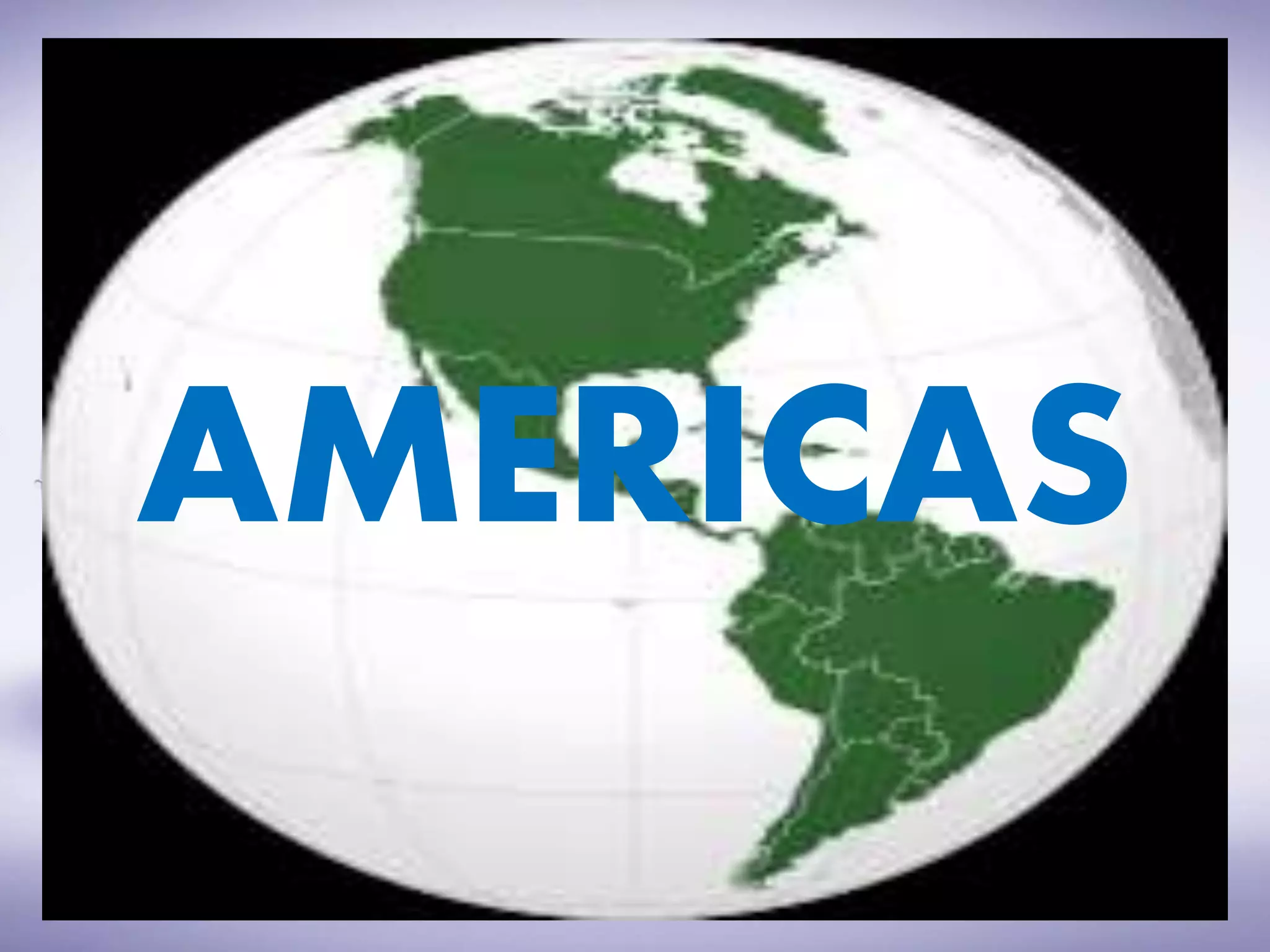
The Americas or America, also known as
the Western Hemisphere and the New
World, comprise the totality of
territories in North.
The earliest known use of the
name America dates to 1507, where it
was applied to what is now known as
South America. The scholarly consensus
is that the name was derived from Italian
explorer Amerigo Vespucci
Countries: 35
largest: Canada / smallest: Kitts and
Nevis
Richest: USA
Poorest; Haiti
Population: 1 billion, with over 65%
of them living in one of the three
most populous countries (the United
States, Brazil, and Mexico)
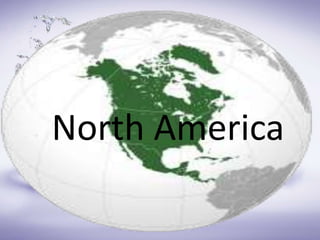
North America
North America
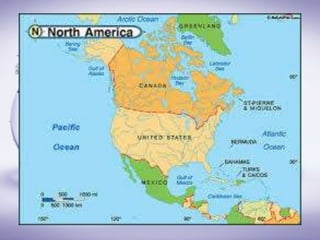
North America, the third-largest continent,
extends from the tiny Aleutian Islands in
the northwest to the Isthmus of Panama in
the south. The continent includes the
enormous island of Greenland in the
northeast and the small island countries
and territories that dot the Caribbean Sea
and western North Atlantic Ocean
Border:
north: Arctic Ocean
east: Atlantic Ocean
west and south by the Pacific Ocean,
southeast: South America and the Caribbean
Sea
Border of North America
North America
Countries:23
Size: 24,709,000 km2
about 16.5% of the earth's land area and about
4.8% of its total surface.
3rd largest continent by area and 4th by population
Largest: Canada
smallest country- Kitts and Nevis.
Mexico City- largest city
Population /Location
Population: 565 million or about 7.5% of the
world's population.
Most Populous: USA, Brazil, and Mexico)
All north America lies above the Equator.
• Exactly in North-western Hemisphere
Outstanding Features of North America
1. The People and their Racial Ancestries
- People of N. America are a mixture of many nationalities.
- In Canada and USA –dominantly Europeans starting from 16th
century the next 200 years
Britain- gaining much control of Northern America.
(they lost its control from 1775-1783 then founded the new
country called the USA)
Spanish- in Central America
French- in East coast of Canada
Most North Americans speak English, Spanish, or French.
Racial Ancestries
1. English
2. German
3. French
4. Italian
5. Mexican
6. Polish
7. Irish
8. Indians
Outstanding Features of North America
2. The Land
Mount McKinley, in Alaska, is the tallest point on the continent
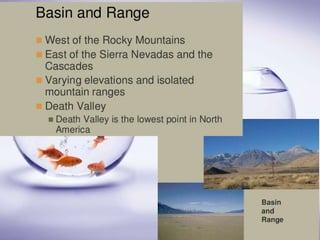
Death Valley, in California, is the lowest point on the continent.
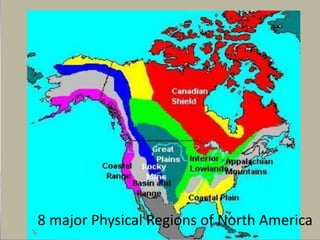
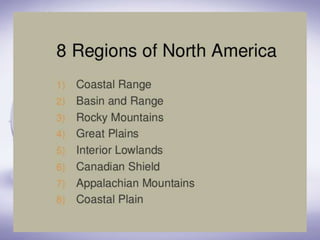
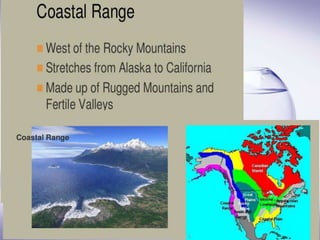
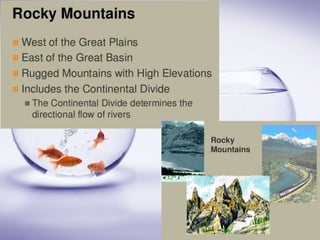
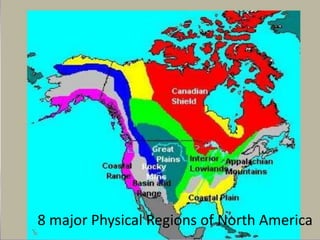
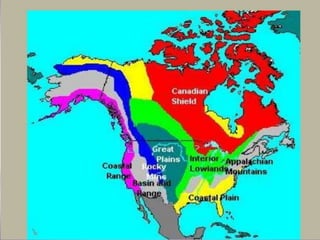
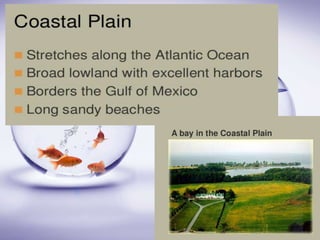
8 major Physical Regions of North America
Rockies, North America’s largest chain. The Rockies
stretch from the province of British Columbia,
Canada, to the U.S. state of New Mexico.
The Rocky Mountains are part of a system of
parallel mountain ranges known as the Cordilleras.
A cordillera is a long series of mountain ranges.
Although cordilleras exist all over the world, in
North America, “the Cordilleras” indicate the
massive mountain ranges in the western part of the
continent. The Cordilleras extend from Canada all
the way to the Isthmus of Panama.
Outstanding Features of North America
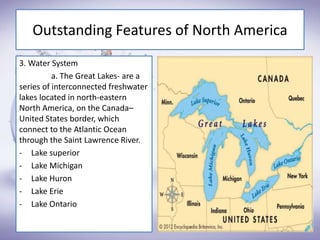
3. Water System
a. The Great Lakes- are a
series of interconnected freshwater
lakes located in north-eastern
North America, on the Canada–
United States border, which
connect to the Atlantic Ocean
through the Saint Lawrence River.
- Lake superior
- Lake Michigan
- Lake Huron
- Lake Erie
- Lake Ontario
Outstanding Features of North America
3. Water System
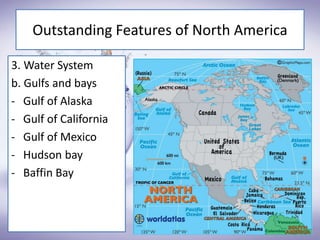
b. Gulfs and bays
- Gulf of Alaska
- Gulf of California
- Gulf of Mexico
- Hudson bay
- Baffin Bay
Outstanding Features of North America
3. Water System
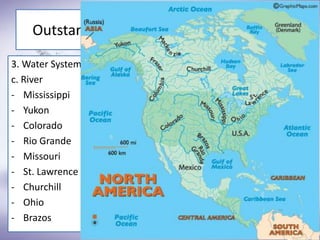
c. River
- Mississippi
- Yukon
- Colorado
- Rio Grande
- Missouri
- St. Lawrence
- Churchill
- Ohio
- Brazos
Outstanding Features of North America
4. Climate
Subpolar Climate - Northern region
Continental Climate - in the central region
Tropical Climate - in the Sothern and Caribbean
region
Outstanding Features of North America
5. Language and Religion
Language: English
Religion: Roman Catholic and Catholic
Protestant
Outstanding Features of North America
6. The Economy
- North America is still world’s largest and
most productive manufacturing complex.
Agriculture: less than 5%
Commerce/industry – 95%
USA- 8th richest country in the world
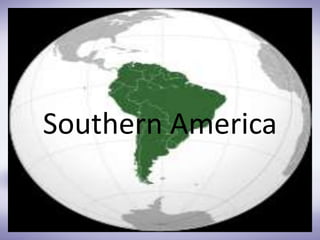
Southern America
Location: South America is a continent in
South-western Hemisphere, It is also
considered as a subcontinent of
the Americas
Border: on the north: North America
West: Pacific Ocean
east: Atlantic Ocean
northwest: Caribbean Sea
Location/ border: South America
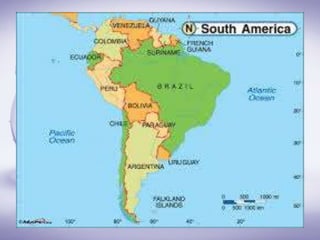
Countries: 12
It includes twelve sovereign states –
Argentina, Bolivia, Brazil, Chile, Colombia,
Ecuador, Guyana, Paraguay, Peru, Suriname
, Uruguay, and Venezuela – and two non-
sovereign areas – French Guiana,
an overseas department of France, and
the Falkland Islands, a British Overseas
Territory (though disputed by Argentina)
Size
Size: 17,840,000 km2
Population: 385,742,554 (2011, 5th)
Brazil- largest and most populous country
Suriname- smallest country
South America is home to the world's highest
uninterrupted waterfall, Angel Falls in Venezuela;
the highest single drop waterfall Kaieteur Falls in
Guyana; the largest river (by volume), the Amazon
River; the longest mountain range,
the Andes (whose highest mountain
is Aconcagua at 6,962 m [22,841 ft]); the driest
non-polar place on earth, theAtacama
Desert;[9][10][11] the largest rainforest, the Amazon
Rainforest; the highest capital city, La Paz, Bolivia;
the highest commercially navigable lake in the
world, Lake Titicaca; and, excluding research
stations in Antarctica, the world's southernmost
permanently inhabited community, Puerto Toro,
Chile
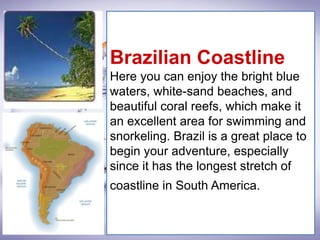
Physical Regions of South America
South America has a huge variety of landscapes,
from active volcanoes, to lush rainforests and grassy
plains, to the pristine white-sand beaches of Brazil,
and the majestic snow-capped peaks of the Andes.
1. Patagonia Region
2. Andes Mountains
3. Brazilian Coastline
4. The Amazon
5. The Pantanal
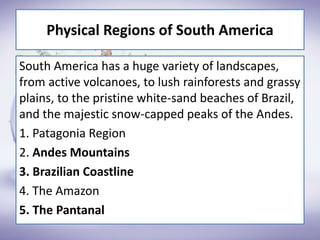
Patagonia Region
The Patagonia Region is home to the most
picturesque landscapes in South America.
Situated in Southern Argentina and Chile,
this region features the Perito Moreno
Glacier, one of the few advancing glaciers
in the world, as well as pristine Andean
national parks, lakes and alpine forests.
The lake region also features a wide
variety of outdoor activities, particularly in
Bariloche, a popular ski resort set in the
scenic mountain of the Andes. Further
south in Glacier National Park you'll find a
mountainous landscape dotted with
glaciers and a variety of rare and unusual
wildlife.
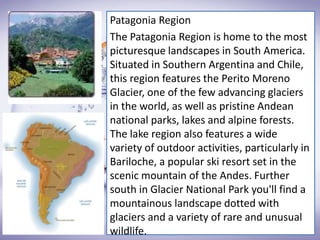
Andes Mountains
The Andes features some of the most
spectacular scenery in South America with
its dynamic variation of terrain. There are
pristine lakes and rivers, glacier parks, Inca
ruins, snow-capped peaks, and lush rain
forests, making it a great place for outdoor
adventures, including some of the best
skiing in the world on the eastern slopes. It
is also the longest mountain range in the
world, running 4,500 miles along the west
coast of South America. It passes through
seven countries, Bolivia, Ecuador, Chile,
Peru, Venezuela, Colombia, and Argentina,
making it accessible for most travelers
bound for South America.
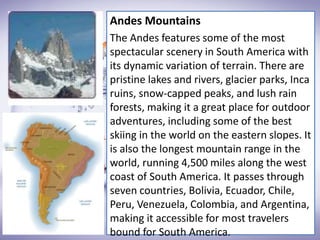
Brazilian Coastline
Here you can enjoy the bright blue
waters, white-sand beaches, and
beautiful coral reefs, which make it
an excellent area for swimming and
snorkeling. Brazil is a great place to
begin your adventure, especially
since it has the longest stretch of
coastline in South America.
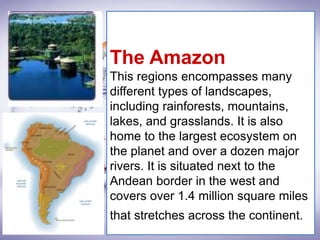
The Amazon
This regions encompasses many
different types of landscapes,
including rainforests, mountains,
lakes, and grasslands. It is also
home to the largest ecosystem on
the planet and over a dozen major
rivers. It is situated next to the
Andean border in the west and
covers over 1.4 million square miles
that stretches across the continent.
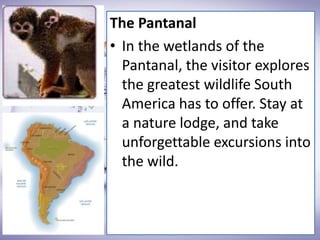
The Pantanal
• In the wetlands of the
Pantanal, the visitor explores
the greatest wildlife South
America has to offer. Stay at
a nature lodge, and take
unforgettable excursions into
the wild.
.

World Geography: Americas

  • 1.
  • 2.
    The Americas orAmerica, also known as the Western Hemisphere and the New World, comprise the totality of territories in North. The earliest known use of the name America dates to 1507, where it was applied to what is now known as South America. The scholarly consensus is that the name was derived from Italian explorer Amerigo Vespucci
  • 3.
    Countries: 35 largest: Canada/ smallest: Kitts and Nevis Richest: USA Poorest; Haiti Population: 1 billion, with over 65% of them living in one of the three most populous countries (the United States, Brazil, and Mexico)
  • 4.
  • 5.
    North America North America,the third-largest continent, extends from the tiny Aleutian Islands in the northwest to the Isthmus of Panama in the south. The continent includes the enormous island of Greenland in the northeast and the small island countries and territories that dot the Caribbean Sea and western North Atlantic Ocean
  • 6.
    Border: north: Arctic Ocean east:Atlantic Ocean west and south by the Pacific Ocean, southeast: South America and the Caribbean Sea Border of North America
  • 7.
    North America Countries:23 Size: 24,709,000km2 about 16.5% of the earth's land area and about 4.8% of its total surface. 3rd largest continent by area and 4th by population Largest: Canada smallest country- Kitts and Nevis. Mexico City- largest city
  • 9.
    Population /Location Population: 565million or about 7.5% of the world's population. Most Populous: USA, Brazil, and Mexico) All north America lies above the Equator. • Exactly in North-western Hemisphere
  • 10.
    Outstanding Features ofNorth America 1. The People and their Racial Ancestries - People of N. America are a mixture of many nationalities. - In Canada and USA –dominantly Europeans starting from 16th century the next 200 years Britain- gaining much control of Northern America. (they lost its control from 1775-1783 then founded the new country called the USA) Spanish- in Central America French- in East coast of Canada Most North Americans speak English, Spanish, or French.
  • 11.
    Racial Ancestries 1. English 2.German 3. French 4. Italian 5. Mexican 6. Polish 7. Irish 8. Indians
  • 12.
    Outstanding Features ofNorth America 2. The Land Mount McKinley, in Alaska, is the tallest point on the continent Death Valley, in California, is the lowest point on the continent.
  • 13.
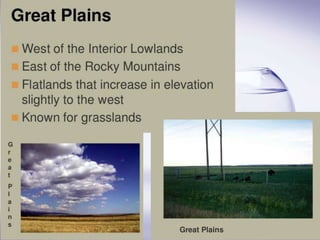
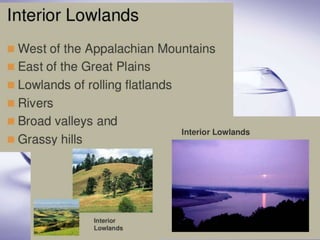
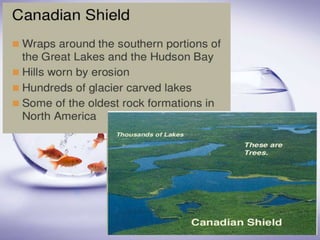
    8 major PhysicalRegions of North America
  • 18.
    8 major PhysicalRegions of North America
  • 19.
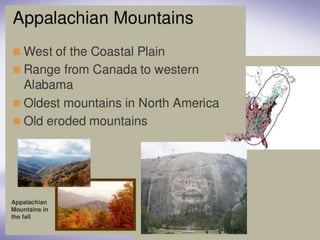
    Rockies, North America’slargest chain. The Rockies stretch from the province of British Columbia, Canada, to the U.S. state of New Mexico. The Rocky Mountains are part of a system of parallel mountain ranges known as the Cordilleras. A cordillera is a long series of mountain ranges. Although cordilleras exist all over the world, in North America, “the Cordilleras” indicate the massive mountain ranges in the western part of the continent. The Cordilleras extend from Canada all the way to the Isthmus of Panama.
  • 26.
    Outstanding Features ofNorth America 3. Water System a. The Great Lakes- are a series of interconnected freshwater lakes located in north-eastern North America, on the Canada– United States border, which connect to the Atlantic Ocean through the Saint Lawrence River. - Lake superior - Lake Michigan - Lake Huron - Lake Erie - Lake Ontario
  • 27.
    Outstanding Features ofNorth America 3. Water System b. Gulfs and bays - Gulf of Alaska - Gulf of California - Gulf of Mexico - Hudson bay - Baffin Bay
  • 28.
    Outstanding Features ofNorth America 3. Water System c. River - Mississippi - Yukon - Colorado - Rio Grande - Missouri - St. Lawrence - Churchill - Ohio - Brazos
  • 29.
    Outstanding Features ofNorth America 4. Climate Subpolar Climate - Northern region Continental Climate - in the central region Tropical Climate - in the Sothern and Caribbean region
  • 30.
    Outstanding Features ofNorth America 5. Language and Religion Language: English Religion: Roman Catholic and Catholic Protestant
  • 31.
    Outstanding Features ofNorth America 6. The Economy - North America is still world’s largest and most productive manufacturing complex. Agriculture: less than 5% Commerce/industry – 95% USA- 8th richest country in the world
  • 33.
  • 34.
    Location: South Americais a continent in South-western Hemisphere, It is also considered as a subcontinent of the Americas Border: on the north: North America West: Pacific Ocean east: Atlantic Ocean northwest: Caribbean Sea Location/ border: South America
  • 35.
    Countries: 12 It includestwelve sovereign states – Argentina, Bolivia, Brazil, Chile, Colombia, Ecuador, Guyana, Paraguay, Peru, Suriname , Uruguay, and Venezuela – and two non- sovereign areas – French Guiana, an overseas department of France, and the Falkland Islands, a British Overseas Territory (though disputed by Argentina)
  • 37.
    Size Size: 17,840,000 km2 Population:385,742,554 (2011, 5th) Brazil- largest and most populous country Suriname- smallest country
  • 38.
    South America ishome to the world's highest uninterrupted waterfall, Angel Falls in Venezuela; the highest single drop waterfall Kaieteur Falls in Guyana; the largest river (by volume), the Amazon River; the longest mountain range, the Andes (whose highest mountain is Aconcagua at 6,962 m [22,841 ft]); the driest non-polar place on earth, theAtacama Desert;[9][10][11] the largest rainforest, the Amazon Rainforest; the highest capital city, La Paz, Bolivia; the highest commercially navigable lake in the world, Lake Titicaca; and, excluding research stations in Antarctica, the world's southernmost permanently inhabited community, Puerto Toro, Chile
  • 39.
    Physical Regions ofSouth America South America has a huge variety of landscapes, from active volcanoes, to lush rainforests and grassy plains, to the pristine white-sand beaches of Brazil, and the majestic snow-capped peaks of the Andes. 1. Patagonia Region 2. Andes Mountains 3. Brazilian Coastline 4. The Amazon 5. The Pantanal
  • 40.
    Patagonia Region The PatagoniaRegion is home to the most picturesque landscapes in South America. Situated in Southern Argentina and Chile, this region features the Perito Moreno Glacier, one of the few advancing glaciers in the world, as well as pristine Andean national parks, lakes and alpine forests. The lake region also features a wide variety of outdoor activities, particularly in Bariloche, a popular ski resort set in the scenic mountain of the Andes. Further south in Glacier National Park you'll find a mountainous landscape dotted with glaciers and a variety of rare and unusual wildlife.
  • 41.
    Andes Mountains The Andesfeatures some of the most spectacular scenery in South America with its dynamic variation of terrain. There are pristine lakes and rivers, glacier parks, Inca ruins, snow-capped peaks, and lush rain forests, making it a great place for outdoor adventures, including some of the best skiing in the world on the eastern slopes. It is also the longest mountain range in the world, running 4,500 miles along the west coast of South America. It passes through seven countries, Bolivia, Ecuador, Chile, Peru, Venezuela, Colombia, and Argentina, making it accessible for most travelers bound for South America.
  • 42.
    Brazilian Coastline Here youcan enjoy the bright blue waters, white-sand beaches, and beautiful coral reefs, which make it an excellent area for swimming and snorkeling. Brazil is a great place to begin your adventure, especially since it has the longest stretch of coastline in South America.
  • 43.
    The Amazon This regionsencompasses many different types of landscapes, including rainforests, mountains, lakes, and grasslands. It is also home to the largest ecosystem on the planet and over a dozen major rivers. It is situated next to the Andean border in the west and covers over 1.4 million square miles that stretches across the continent.
  • 44.
    The Pantanal • Inthe wetlands of the Pantanal, the visitor explores the greatest wildlife South America has to offer. Stay at a nature lodge, and take unforgettable excursions into the wild.
  • 45.