WHAT DO YOU KNOW ABOUT CANADA?
 Location
 Landforms and Bodies of Water
 Climate
 Natural Resources
 Languages Spoken
 Ethnic Groups
 Clothes they wear
CANADA
Geography
SS6G5: The student will locate select features of Canada: Atlantic
Ocean, Pacific Ocean, Hudson Bay, St. Lawrence River, the Great
Lakes, the Canadian Shield, and the Rocky Mountains
Canada is
located in the
Northern and
Western
Hemispheres
of the globe
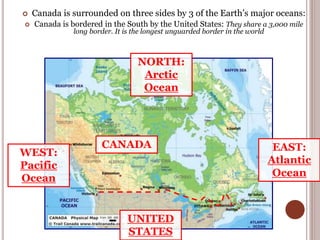
 Canada is surrounded on three sides by 3 of the Earth’s major oceans:
 Canada is bordered in the South by the United States: They share a 3,000 mile
long border. It is the longest unguarded border in the world
EAST:
Atlantic
Ocean
WEST:
Pacific
Ocean
NORTH:
Arctic
Ocean
UNITED
STATES
CANADA
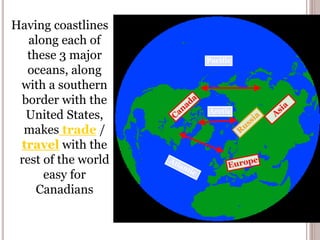
Having coastlines
along each of
these 3 major
oceans, along
with a southern
border with the
United States,
makes trade /
travel with the
rest of the world
easy for
Canadians
Pacific
Arctic
The Great Lakes:
Superior
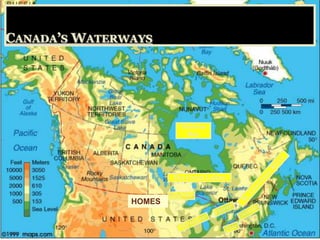
CANADA’S WATERWAYS
Hudson
Bay
HOMES
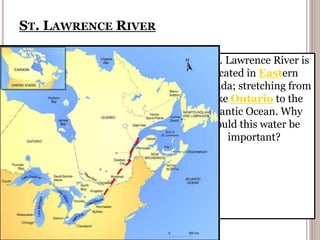
ST. LAWRENCE RIVER
The St. Lawrence River is
located in Eastern
Canada; stretching from
Lake Ontario to the
Atlantic Ocean. Why
would this water be
important?
The St. Lawrence River played an important role
in Canada’s history: Allowed European
explorers to easily travel farther into North
America
The French explorer Jacques Cartier explored
much of the St. Lawrence river system. In 1541
he led an expedition back to Canada, along with
a few hundred colonists, to create New France.
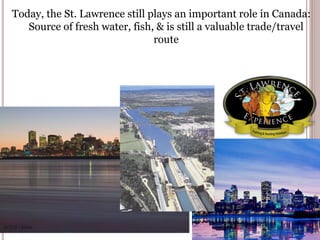
Today, the St. Lawrence still plays an important role in Canada:
Source of fresh water, fish, & is still a valuable trade/travel
route
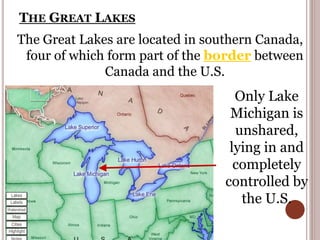
THE GREAT LAKES
The Great Lakes are located in southern Canada,
four of which form part of the border between
Canada and the U.S.
Only Lake
Michigan is
unshared,
lying in and
completely
controlled by
the U.S.
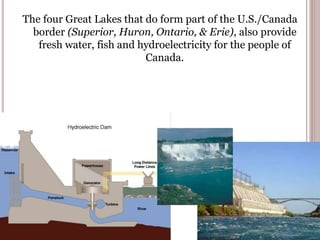
The four Great Lakes that do form part of the U.S./Canada
border (Superior, Huron, Ontario, & Erie), also provide
fresh water, fish and hydroelectricity for the people of
Canada.
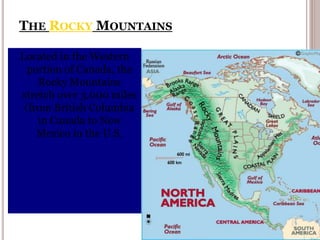
THE ROCKY MOUNTAINS
Located in the Western
portion of Canada, the
Rocky Mountains
stretch over 3,000 miles
(from British Columbia
in Canada to New
Mexico in the U.S.
SS6G6 The student will explain the
impact of location, climate,
distribution of natural resources, and
population distribution on Canada.
 (A) Impact on where people live
 (B) Impact on trade
 Canada is the largest country (in area), in the Western
Hemisphere
 But, only about 33 million people live in Canada.
 Canada’s population is much smaller than both Mexico’s
and the United States’
 Mexico’s population is 3 times Canada’s
population
 The United States population is 9 times
Canada’s population
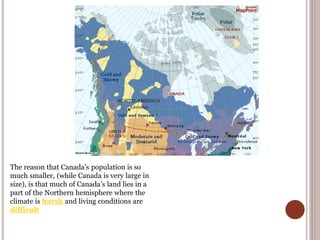
The reason that Canada’s population is so
much smaller, (while Canada is very large in
size), is that much of Canada’s land lies in a
part of the Northern hemisphere where the
climate is harsh and living conditions are
difficult
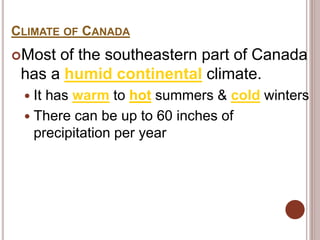
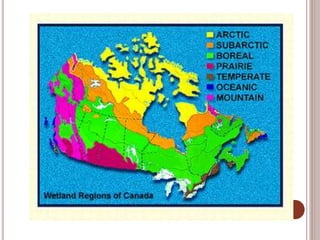
CLIMATE OF CANADA
Most of the southeastern part of Canada
has a humid continental climate.
 It has warm to hot summers & cold winters
 There can be up to 60 inches of
precipitation per year
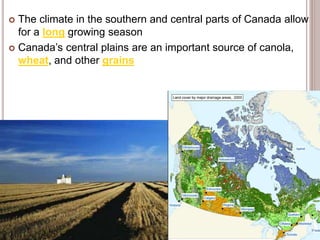
 The climate in the southern and central parts of Canada allow
for a long growing season
 Canada’s central plains are an important source of canola,
wheat, and other grains
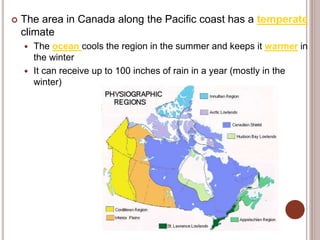
 The area in Canada along the Pacific coast has a temperate
climate
 The ocean cools the region in the summer and keeps it warmer in
the winter
 It can receive up to 100 inches of rain in a year (mostly in the
winter)
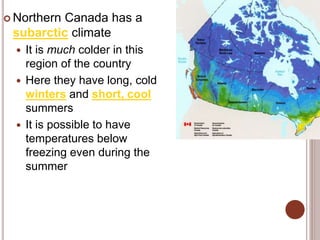
 Northern Canada has a
subarctic climate
 It is much colder in this
region of the country
 Here they have long, cold
winters and short, cool
summers
 It is possible to have
temperatures below
freezing even during the
summer
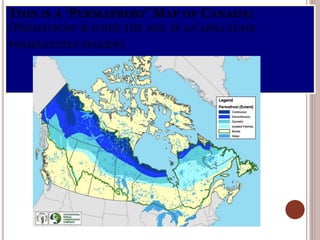
THIS IS A ‘PERMAFROST’ MAP OF CANADA:
(PERMAFROST IS WHEN THE SOIL IN AN AREA STAYS
PERMANENTLY FROZEN).
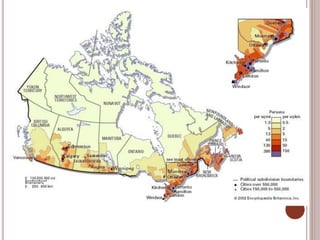
90% of Canadians live in the Southern region
of Canada (within 100 miles of the Canada /
U.S. border)
Most of these people live toward the east and
central parts of the country
Most Canadians live in towns or cities, only
about 20% live in rural areas
CANADA’S POLITICAL BOUNDARIES/DIVISIONS
 Because so many people in Canada live such a small
portion of the country I (within 100 miles of the
Canada / United States border)
 And Because so few people in Canada live in such a
large portion of the country: (in the northern
regions)
 Canada has chosen to divide its land into two different types of
political divisions (we divide our country’s land into states here in
the U.S.)
Provinces
Territories
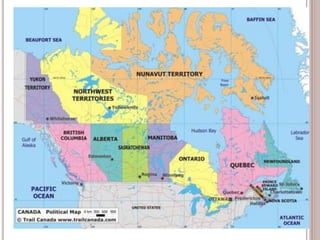
 Canada has 10 provinces (These are similar in their
structure and purpose to our own States. British
Columbia, Alberta, Saskatchewan, Manitoba,
Ontario, Quebec, Newfoundland and Labrador,
Prince Edward Island, Nova Scotia, & New
Brunswick)
 Canada has 3 territories (These are all located in the
northern regions of Canada where there are far
fewer people and thus less reason to formalize these
areas into provinces)
NATURAL RESOURCES OF CANADA
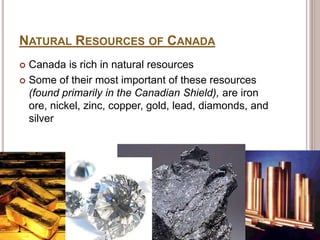
 Canada is rich in natural resources
 Some of their most important of these resources
(found primarily in the Canadian Shield), are iron
ore, nickel, zinc, copper, gold, lead, diamonds, and
silver
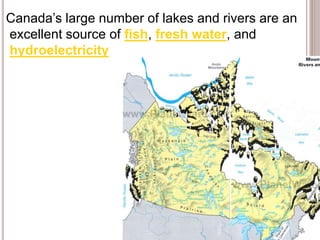
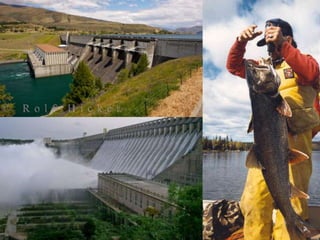
Canada’s large number of lakes and rivers are an
excellent source of fish, fresh water, and
hydroelectricity
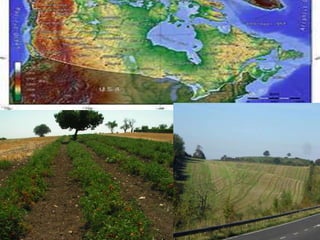
 Good soil in Canada allows farmers to grow crops for the
people of Canada with enough left over to trade with
other countries
 About 5% of Canada’s land is arable (farmable)
 While this may seem like only a small amount of land, 5% of
Canada is actually quite large (remember that Canada is the
largest country in the Western Hemisphere)
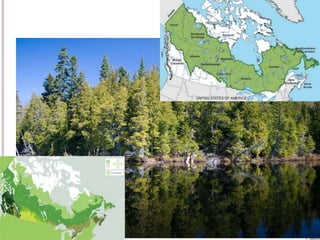
 Forests in Canada are a major natural resource with an
abundance of timber, which is harvested in Canada to
be used by its own people as well as traded with other
countries around the world.
 The forests are also home to abundant wildlife
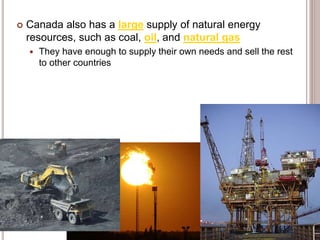
 Canada also has a large supply of natural energy
resources, such as coal, oil, and natural gas
 They have enough to supply their own needs and sell the rest
to other countries
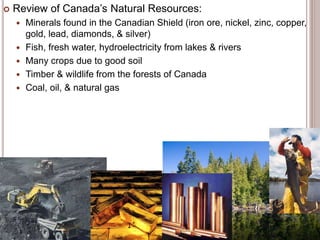
 Review of Canada’s Natural Resources:
 Minerals found in the Canadian Shield (iron ore, nickel, zinc, copper,
gold, lead, diamonds, & silver)
 Fish, fresh water, hydroelectricity from lakes & rivers
 Many crops due to good soil
 Timber & wildlife from the forests of Canada
 Coal, oil, & natural gas
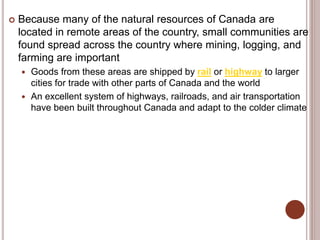
 Because many of the natural resources of Canada are
located in remote areas of the country, small communities are
found spread across the country where mining, logging, and
farming are important
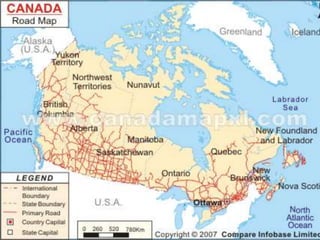
 Goods from these areas are shipped by rail or highway to larger
cities for trade with other parts of Canada and the world
 An excellent system of highways, railroads, and air transportation
have been built throughout Canada and adapt to the colder climate
SUMMARY & REVIEW
 These are the questions located at the end of
your notes… You must write the questions and
your answers on YOUR OWN sheet of paper.
 1. What 3 oceans and 1 country make up Canada’s 4 borders?
North – Arctic Ocean
East – Atlantic Ocean
South – The United States
West – The Pacific Ocean
SUMMARY & REVIEW
2. How does Canada’s location impact its ability to trade /
travel with the rest of the world?
Canada’s location, surrounded by three
oceans with its Southern border formed
by the United States, makes travel / trade
with the rest of the world easy for
Canadians
SUMMARY & REVIEW
3. Why is Canada’s population so small, even though it is
a very large country?
Because a large part if Canada’s land lies
so far north in the northern hemisphere
that the climate is harsh and living
conditions difficult. Most of Canada is
uninhabitable due to its harsh, cold
climate
SUMMARY & REVIEW
4. Where do most Canadians live?
90% of all Canadians live in southern
Canada (within 100 miles of Canada’s
border with the United States)
SUMMARY & REVIEW
5. Why do most Canadians live in this region?
Because the farther north you travel in
Canada, the colder the temperatures
become, the harsher the climate is, and
the more difficult it is to survive
SUMMARY & REVIEW
6. How does the Pacific Ocean impact Canada’s Pacific
coast region?
The ocean creates a temperate climate in
the region, it cools the area in the summer
and helps keep it warmer in the winter
SUMMARY & REVIEW
7. Describe the climate of Northern Canada?
Northern Canada is much colder than the
rest of the country. They have cold winters
and cool summers. The climate is harsh,
making living conditions difficult
SUMMARY & REVIEW
8. List Canada’s major natural resources:
Lakes & Rivers: fresh water, fish,
hydroelectricity and routes for trade and travel
Good Soil: crops like canola, wheat & other
grains
Forests: timber
Canadian Shield: minerals, like uranium, gold,
and silver
Natural Energy: coal, oil, & natural gas

geography of Canada.

  • 2.
    WHAT DO YOUKNOW ABOUT CANADA?  Location  Landforms and Bodies of Water  Climate  Natural Resources  Languages Spoken  Ethnic Groups  Clothes they wear
  • 3.
    CANADA Geography SS6G5: The studentwill locate select features of Canada: Atlantic Ocean, Pacific Ocean, Hudson Bay, St. Lawrence River, the Great Lakes, the Canadian Shield, and the Rocky Mountains
  • 4.
    Canada is located inthe Northern and Western Hemispheres of the globe
  • 5.
     Canada issurrounded on three sides by 3 of the Earth’s major oceans:  Canada is bordered in the South by the United States: They share a 3,000 mile long border. It is the longest unguarded border in the world EAST: Atlantic Ocean WEST: Pacific Ocean NORTH: Arctic Ocean UNITED STATES CANADA
  • 6.
    Having coastlines along eachof these 3 major oceans, along with a southern border with the United States, makes trade / travel with the rest of the world easy for Canadians Pacific Arctic
  • 7.
    The Great Lakes: Superior CANADA’SWATERWAYS Hudson Bay HOMES
  • 8.
    ST. LAWRENCE RIVER TheSt. Lawrence River is located in Eastern Canada; stretching from Lake Ontario to the Atlantic Ocean. Why would this water be important?
  • 9.
    The St. LawrenceRiver played an important role in Canada’s history: Allowed European explorers to easily travel farther into North America The French explorer Jacques Cartier explored much of the St. Lawrence river system. In 1541 he led an expedition back to Canada, along with a few hundred colonists, to create New France.
  • 10.
    Today, the St.Lawrence still plays an important role in Canada: Source of fresh water, fish, & is still a valuable trade/travel route
  • 11.
    THE GREAT LAKES TheGreat Lakes are located in southern Canada, four of which form part of the border between Canada and the U.S. Only Lake Michigan is unshared, lying in and completely controlled by the U.S.
  • 12.
    The four GreatLakes that do form part of the U.S./Canada border (Superior, Huron, Ontario, & Erie), also provide fresh water, fish and hydroelectricity for the people of Canada.
  • 13.
    THE ROCKY MOUNTAINS Locatedin the Western portion of Canada, the Rocky Mountains stretch over 3,000 miles (from British Columbia in Canada to New Mexico in the U.S.
  • 14.
    SS6G6 The studentwill explain the impact of location, climate, distribution of natural resources, and population distribution on Canada.  (A) Impact on where people live  (B) Impact on trade
  • 15.
     Canada isthe largest country (in area), in the Western Hemisphere  But, only about 33 million people live in Canada.  Canada’s population is much smaller than both Mexico’s and the United States’  Mexico’s population is 3 times Canada’s population  The United States population is 9 times Canada’s population
  • 16.
    The reason thatCanada’s population is so much smaller, (while Canada is very large in size), is that much of Canada’s land lies in a part of the Northern hemisphere where the climate is harsh and living conditions are difficult
  • 17.
    CLIMATE OF CANADA Mostof the southeastern part of Canada has a humid continental climate.  It has warm to hot summers & cold winters  There can be up to 60 inches of precipitation per year
  • 18.
     The climatein the southern and central parts of Canada allow for a long growing season  Canada’s central plains are an important source of canola, wheat, and other grains
  • 19.
     The areain Canada along the Pacific coast has a temperate climate  The ocean cools the region in the summer and keeps it warmer in the winter  It can receive up to 100 inches of rain in a year (mostly in the winter)
  • 20.
     Northern Canadahas a subarctic climate  It is much colder in this region of the country  Here they have long, cold winters and short, cool summers  It is possible to have temperatures below freezing even during the summer
  • 22.
    THIS IS A‘PERMAFROST’ MAP OF CANADA: (PERMAFROST IS WHEN THE SOIL IN AN AREA STAYS PERMANENTLY FROZEN).
  • 23.
    90% of Canadianslive in the Southern region of Canada (within 100 miles of the Canada / U.S. border) Most of these people live toward the east and central parts of the country Most Canadians live in towns or cities, only about 20% live in rural areas
  • 25.
    CANADA’S POLITICAL BOUNDARIES/DIVISIONS Because so many people in Canada live such a small portion of the country I (within 100 miles of the Canada / United States border)  And Because so few people in Canada live in such a large portion of the country: (in the northern regions)  Canada has chosen to divide its land into two different types of political divisions (we divide our country’s land into states here in the U.S.) Provinces Territories
  • 26.
     Canada has10 provinces (These are similar in their structure and purpose to our own States. British Columbia, Alberta, Saskatchewan, Manitoba, Ontario, Quebec, Newfoundland and Labrador, Prince Edward Island, Nova Scotia, & New Brunswick)  Canada has 3 territories (These are all located in the northern regions of Canada where there are far fewer people and thus less reason to formalize these areas into provinces)
  • 28.
    NATURAL RESOURCES OFCANADA  Canada is rich in natural resources  Some of their most important of these resources (found primarily in the Canadian Shield), are iron ore, nickel, zinc, copper, gold, lead, diamonds, and silver
  • 29.
    Canada’s large numberof lakes and rivers are an excellent source of fish, fresh water, and hydroelectricity
  • 31.
     Good soilin Canada allows farmers to grow crops for the people of Canada with enough left over to trade with other countries  About 5% of Canada’s land is arable (farmable)  While this may seem like only a small amount of land, 5% of Canada is actually quite large (remember that Canada is the largest country in the Western Hemisphere)
  • 33.
     Forests inCanada are a major natural resource with an abundance of timber, which is harvested in Canada to be used by its own people as well as traded with other countries around the world.  The forests are also home to abundant wildlife
  • 35.
     Canada alsohas a large supply of natural energy resources, such as coal, oil, and natural gas  They have enough to supply their own needs and sell the rest to other countries
  • 36.
     Review ofCanada’s Natural Resources:  Minerals found in the Canadian Shield (iron ore, nickel, zinc, copper, gold, lead, diamonds, & silver)  Fish, fresh water, hydroelectricity from lakes & rivers  Many crops due to good soil  Timber & wildlife from the forests of Canada  Coal, oil, & natural gas
  • 37.
     Because manyof the natural resources of Canada are located in remote areas of the country, small communities are found spread across the country where mining, logging, and farming are important  Goods from these areas are shipped by rail or highway to larger cities for trade with other parts of Canada and the world  An excellent system of highways, railroads, and air transportation have been built throughout Canada and adapt to the colder climate
  • 39.
    SUMMARY & REVIEW These are the questions located at the end of your notes… You must write the questions and your answers on YOUR OWN sheet of paper.  1. What 3 oceans and 1 country make up Canada’s 4 borders? North – Arctic Ocean East – Atlantic Ocean South – The United States West – The Pacific Ocean
  • 40.
    SUMMARY & REVIEW 2.How does Canada’s location impact its ability to trade / travel with the rest of the world? Canada’s location, surrounded by three oceans with its Southern border formed by the United States, makes travel / trade with the rest of the world easy for Canadians
  • 41.
    SUMMARY & REVIEW 3.Why is Canada’s population so small, even though it is a very large country? Because a large part if Canada’s land lies so far north in the northern hemisphere that the climate is harsh and living conditions difficult. Most of Canada is uninhabitable due to its harsh, cold climate
  • 42.
    SUMMARY & REVIEW 4.Where do most Canadians live? 90% of all Canadians live in southern Canada (within 100 miles of Canada’s border with the United States)
  • 43.
    SUMMARY & REVIEW 5.Why do most Canadians live in this region? Because the farther north you travel in Canada, the colder the temperatures become, the harsher the climate is, and the more difficult it is to survive
  • 44.
    SUMMARY & REVIEW 6.How does the Pacific Ocean impact Canada’s Pacific coast region? The ocean creates a temperate climate in the region, it cools the area in the summer and helps keep it warmer in the winter
  • 45.
    SUMMARY & REVIEW 7.Describe the climate of Northern Canada? Northern Canada is much colder than the rest of the country. They have cold winters and cool summers. The climate is harsh, making living conditions difficult
  • 46.
    SUMMARY & REVIEW 8.List Canada’s major natural resources: Lakes & Rivers: fresh water, fish, hydroelectricity and routes for trade and travel Good Soil: crops like canola, wheat & other grains Forests: timber Canadian Shield: minerals, like uranium, gold, and silver Natural Energy: coal, oil, & natural gas