Africa: Physical Features
Essential QuestionHow does Africa’s geography, climate, and natural resources affect the way people live and work?
Standard SS7G1 The student will locate selected features of Africa. a. Locate on a world and regional political-physical map: the Sahara, Sahel, savanna,  tropical rain forest, Congo River, Niger River, Nile River, Lake Tanganyika, Lake Victoria, Atlas Mountains, and Kalahari Desert.
8/12/09 Warm UpStudents will need to write the definition of Sahel, Sahara, Savannah and Tropical Rainforest
Warm up Thursday WARM UP: Answer the following questions:1. What is Africa’s Largest Lake?2. What is unique about the Nile River?3. What is the largest desert in Africa?4. What is unique about the tropical rain forest?
What do you notice about this map?
The Sahara Desert
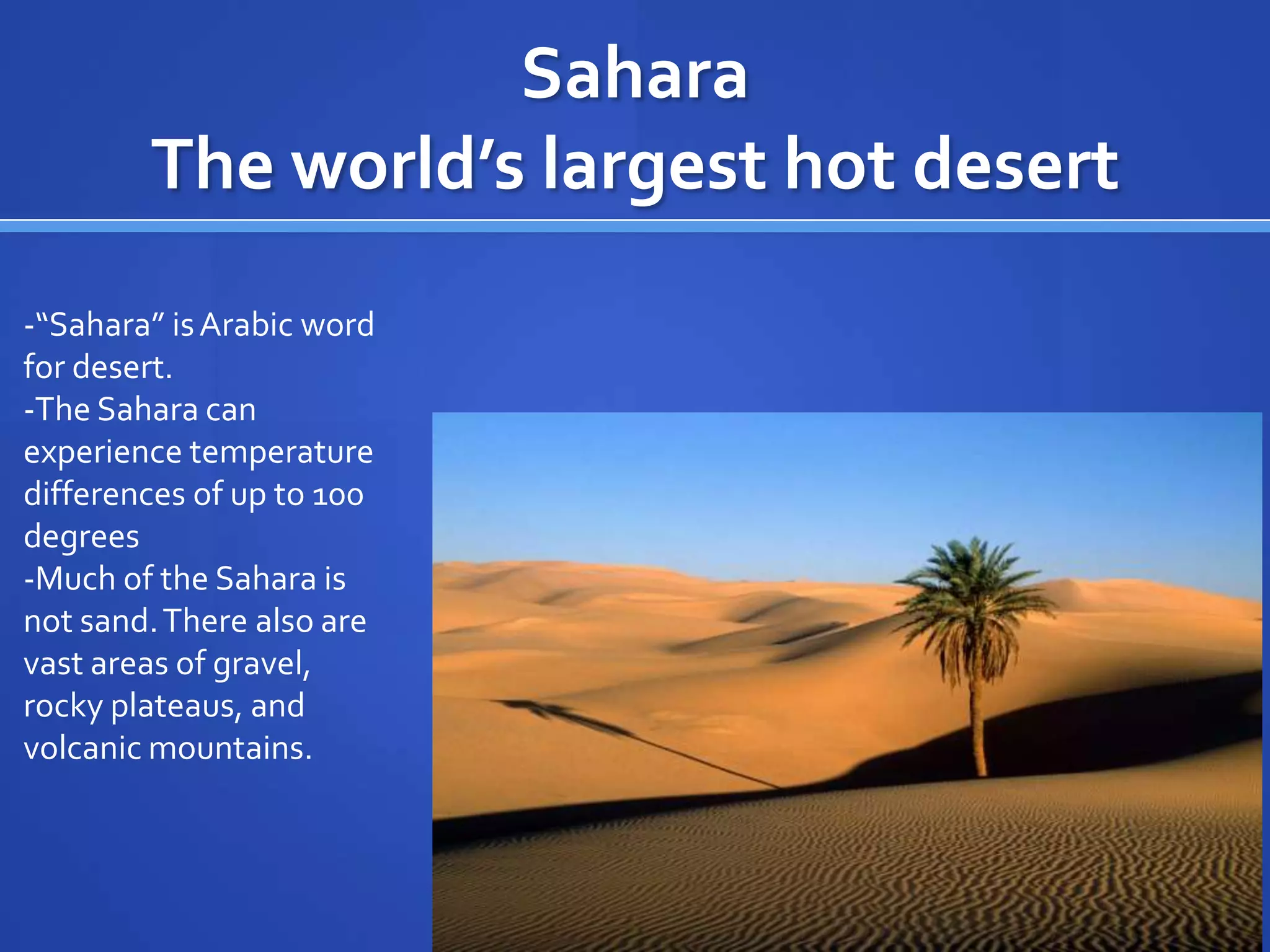
SaharaThe world’s largest hot desert “Sahara” is Arabic word for desert.
The Sahara can experience temperature differences of up to 100 degrees
Much of the Sahara is not sand. There also are vast areas of gravel, rocky plateaus, and volcanic mountains. Kalahari Desert
Kalahari Desert
What differences do you notice in all of these deserts?
The Sahel Desert
The Sahel is in these countries.SenegalMauritaniaMaliNigerBurkina FasoNigeriaChadEritreaSudanThe Sahel is semiarid area just south of the Sahara.  The Sahel suffers from desertification, and great famines have resulted.Desertification means the rapid depletion of plant life and the loss of topsoil at desert boundaries and in semiarid regions, usually caused by a combination of drought and the overexploitation of grasses and other vegetation by peopleTaken from the Classroom Atlas
African SavannasIt covers 40 % of Africa!It covers Guinea, Sierra Leone, Liberia, Cote D‘ Ivore, Ghana, Togo, Benin, Nigeria, Cameroon, Central African Republic, Chad, Sudan, Ethiopia, Somalia, and the Democratic Republic of the Congo, Angola, Uganda, Rwanda, Burundi, Kenya, Tanzania, Malawi, Zambia, Zimbabwe, Mozambique, Botswana, and South Africa.
The Savanna EcosystemA savanna is a rolling grassland scattered with shrubs and isolated trees, which can be found between a tropical rainforest and desert biome.Not enough rain falls on a savanna to support forests. Savannas are also known as tropical grasslands. They are found in a wide band on either side of the equator on the edges of tropical rainforests.What kind of wildlife lives in the savanna?
From 40 to 75% of all species on Earth are indigenous to the rainforests. It has been estimated that many millions of species of plants, insects, and microorganisms are still undiscovered. Tropical rainforests have been called the "jewels of the Earth", and the "world's largest pharmacy", because of the large number of natural medicines discovered there.Tropical Rain Forest
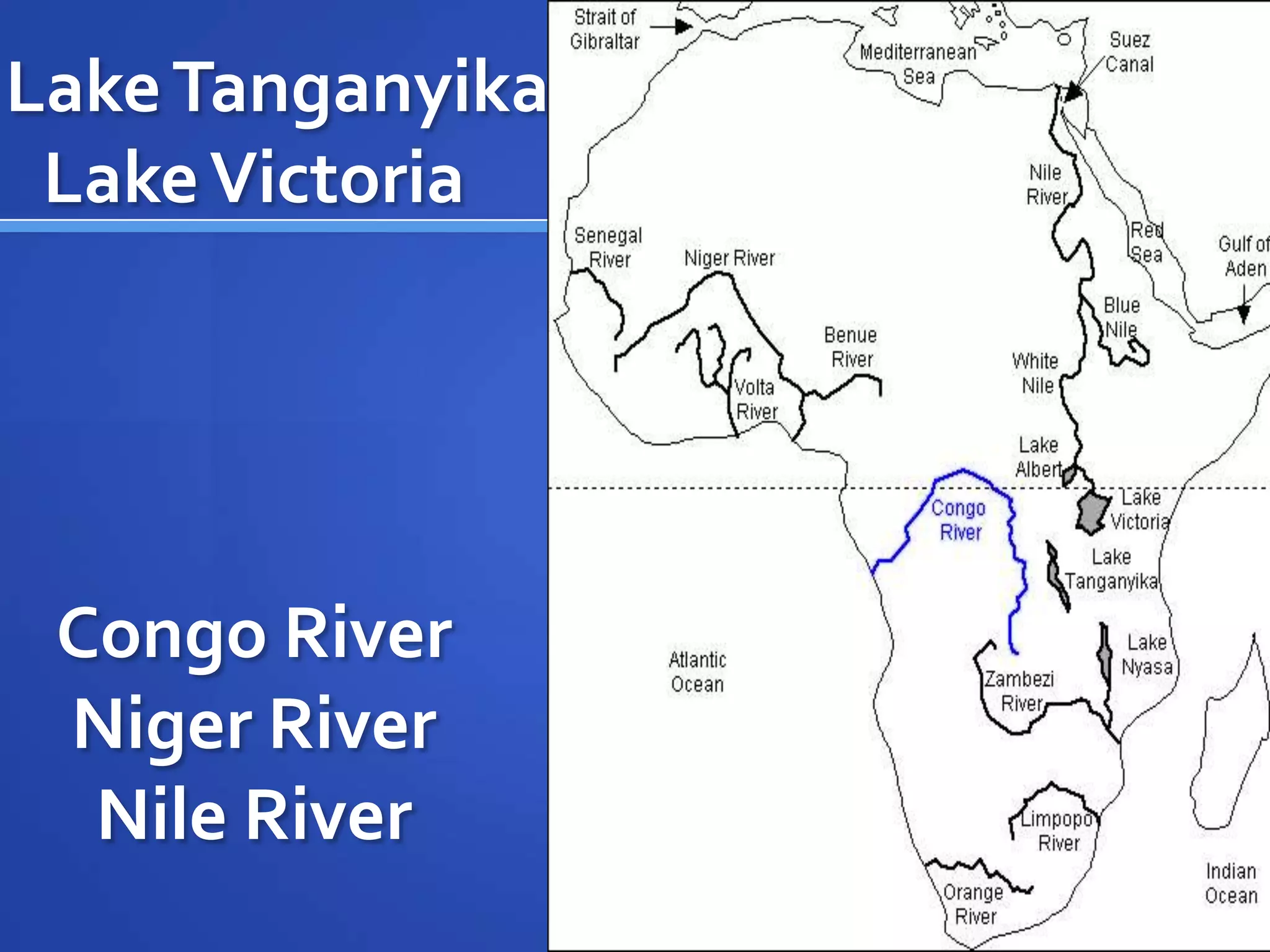
   Lake TanganyikaLake Victoria  Congo River Niger River Nile River
Lake Victoria Largest lake in Africa Second widest fresh water lake in the world
Lake TanganyikaWorld Longest Lake.Second Largest Freshwater Lake in the worldSecond Deepest Lake in the world.
Nile River Runs North instead of South.Longest river in the world.
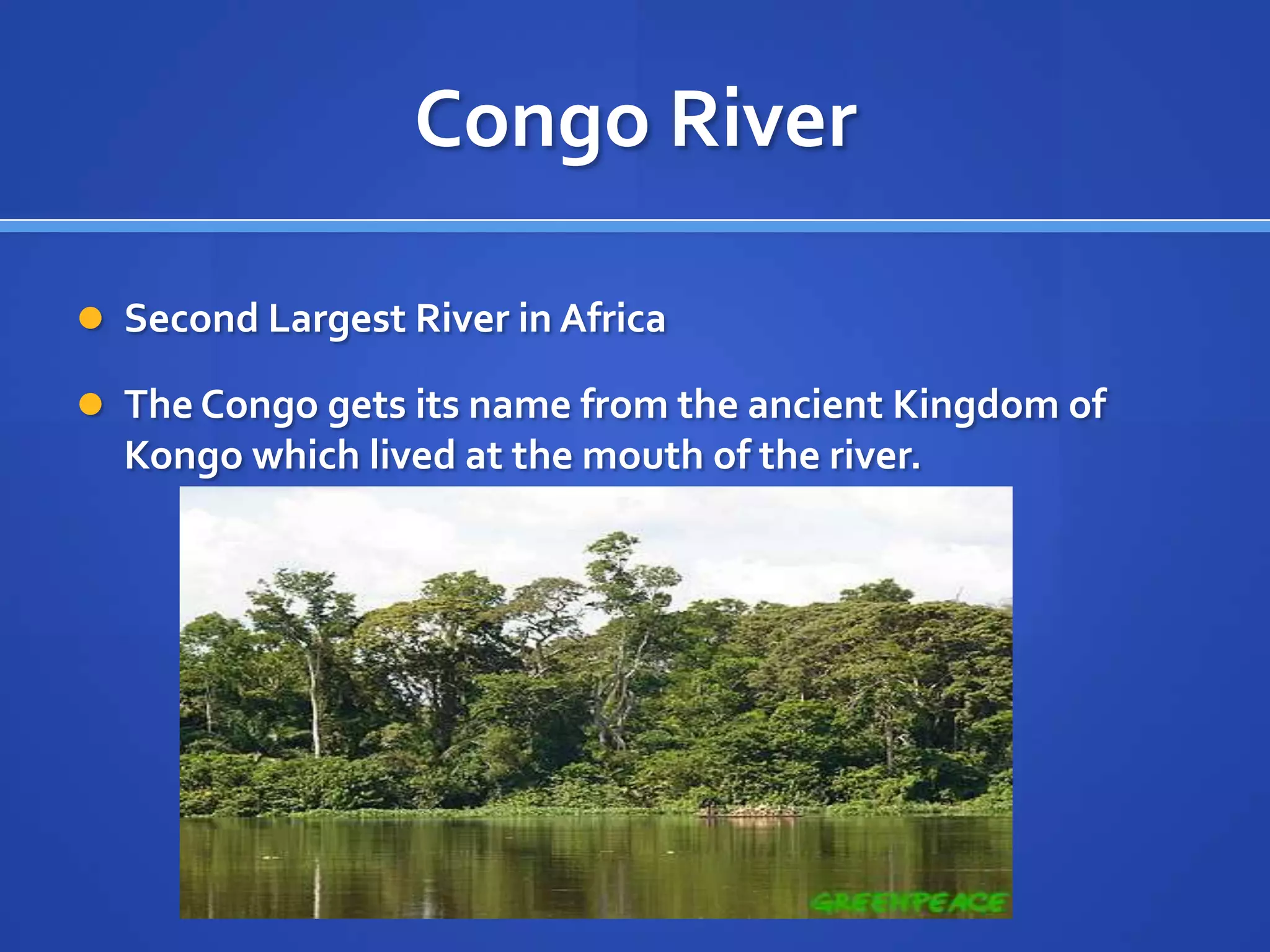
Congo River Second Largest River in AfricaThe Congo gets its name from the ancient Kingdom of Kongo which lived at the mouth of the river.
Congo River
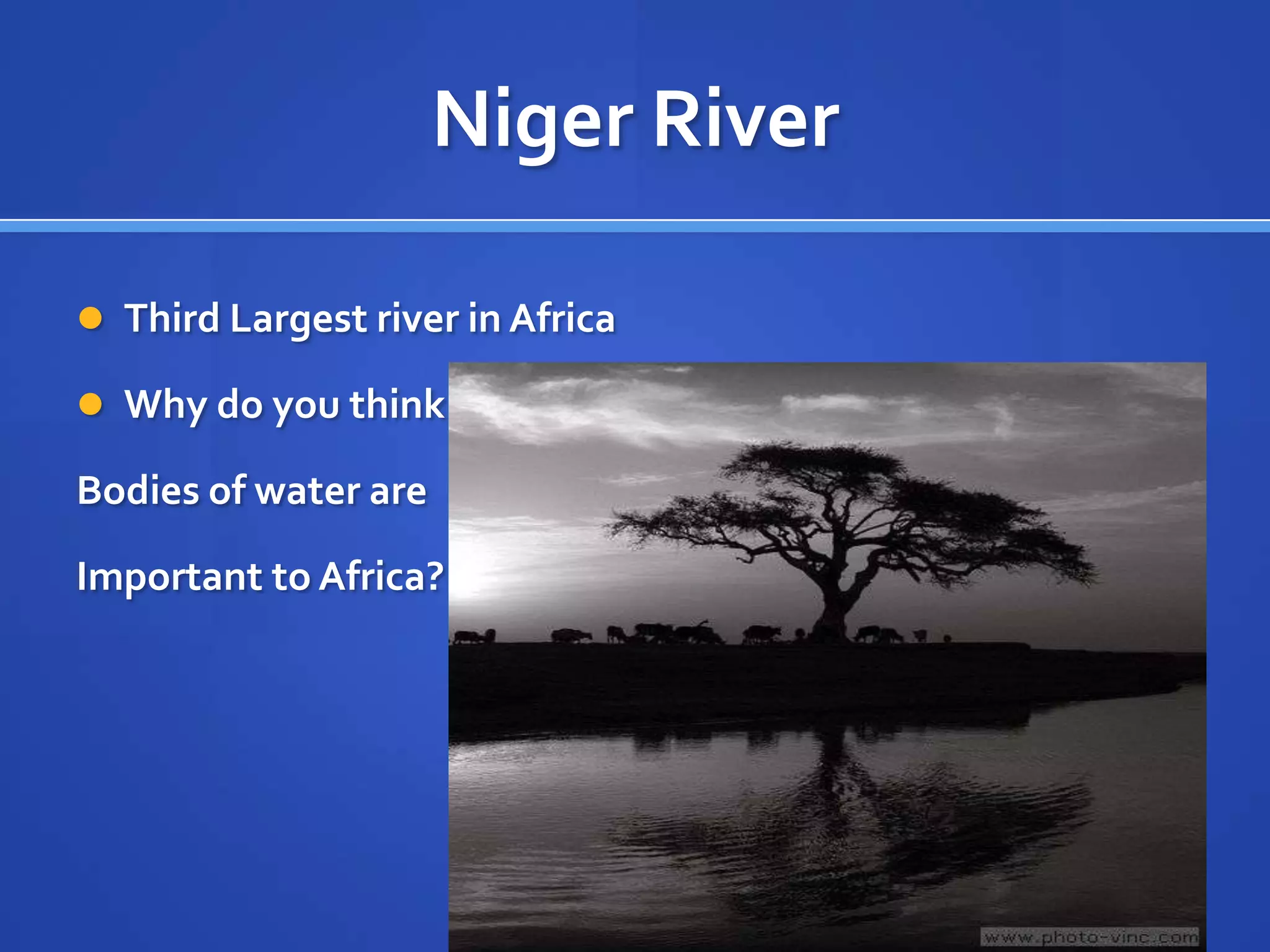
Niger River Third Largest river in Africa Why do you thinkBodies of water are Important to Africa?
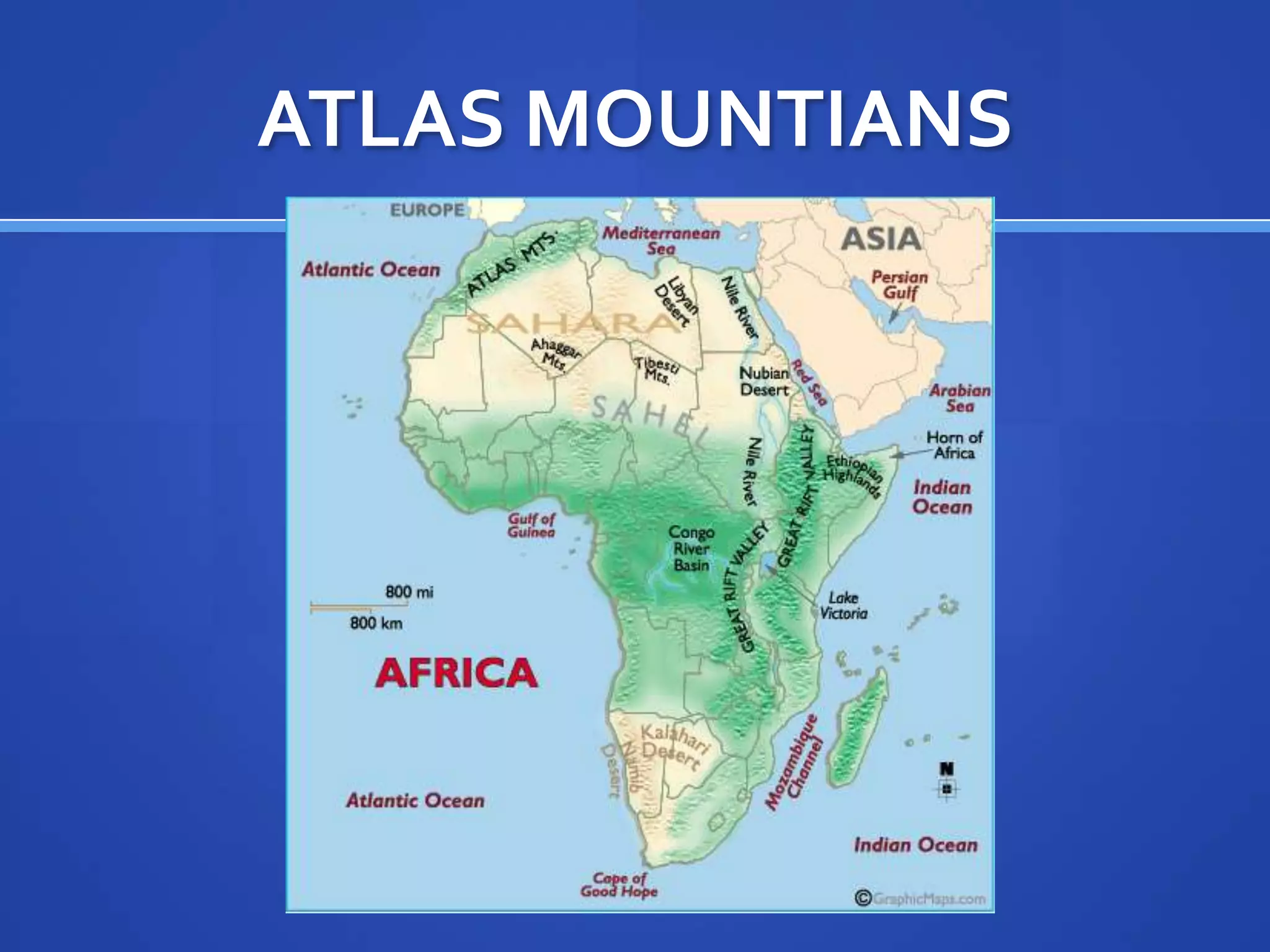
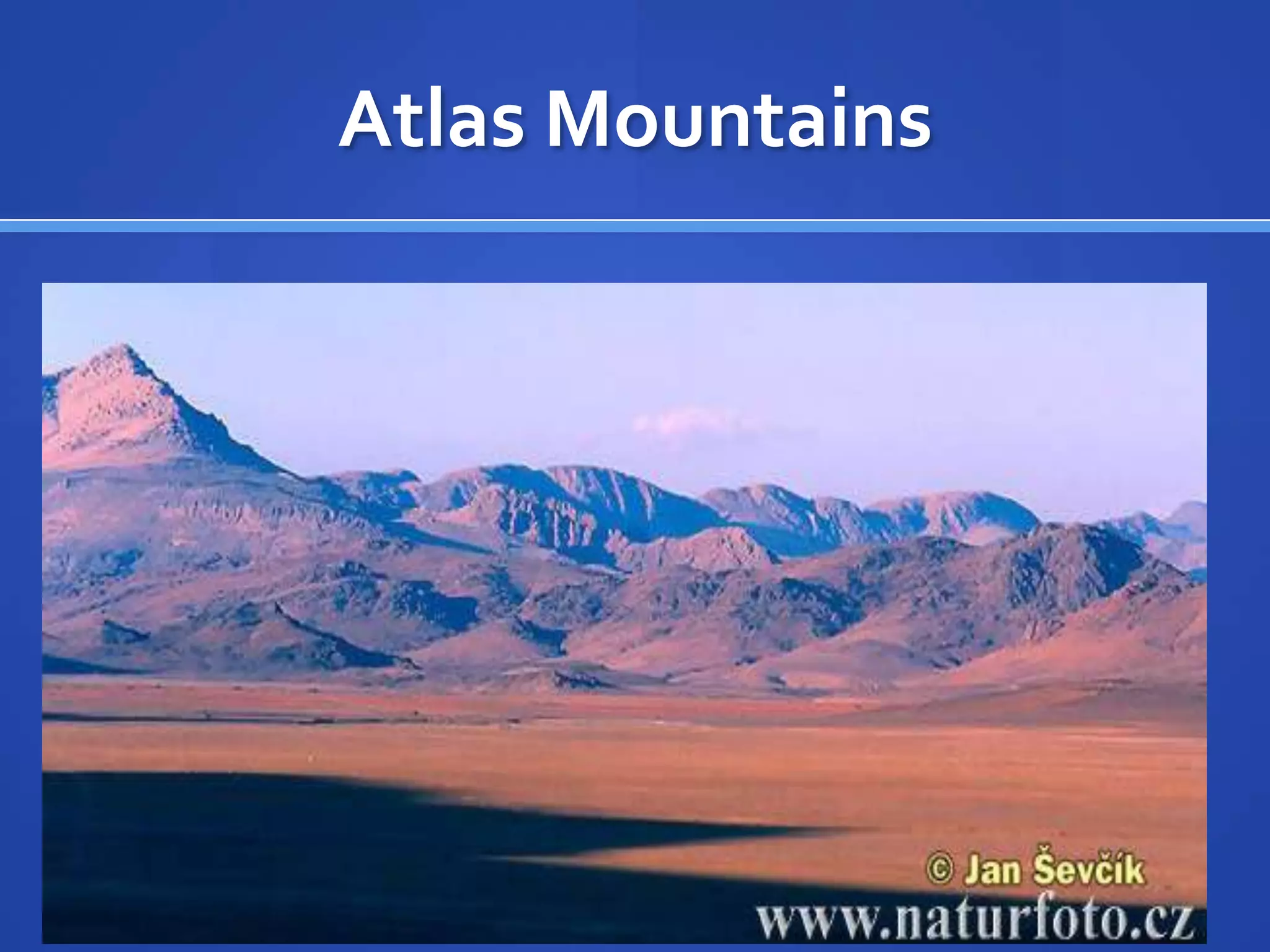
ATLAS MOUNTIANS
Atlas Mountains

Africa physical features powerpoint

  • 1.
  • 2.
    Essential QuestionHow doesAfrica’s geography, climate, and natural resources affect the way people live and work?
  • 3.
    Standard SS7G1 Thestudent will locate selected features of Africa. a. Locate on a world and regional political-physical map: the Sahara, Sahel, savanna, tropical rain forest, Congo River, Niger River, Nile River, Lake Tanganyika, Lake Victoria, Atlas Mountains, and Kalahari Desert.
  • 4.
    8/12/09 Warm UpStudentswill need to write the definition of Sahel, Sahara, Savannah and Tropical Rainforest
  • 5.
    Warm up ThursdayWARM UP: Answer the following questions:1. What is Africa’s Largest Lake?2. What is unique about the Nile River?3. What is the largest desert in Africa?4. What is unique about the tropical rain forest?
  • 6.
    What do younotice about this map?
  • 7.
  • 8.
    SaharaThe world’s largesthot desert “Sahara” is Arabic word for desert.
  • 9.
    The Sahara canexperience temperature differences of up to 100 degrees
  • 10.
    Much of theSahara is not sand. There also are vast areas of gravel, rocky plateaus, and volcanic mountains. Kalahari Desert
  • 11.
  • 12.
    What differences doyou notice in all of these deserts?
  • 13.
  • 15.
    The Sahel isin these countries.SenegalMauritaniaMaliNigerBurkina FasoNigeriaChadEritreaSudanThe Sahel is semiarid area just south of the Sahara. The Sahel suffers from desertification, and great famines have resulted.Desertification means the rapid depletion of plant life and the loss of topsoil at desert boundaries and in semiarid regions, usually caused by a combination of drought and the overexploitation of grasses and other vegetation by peopleTaken from the Classroom Atlas
  • 17.
    African SavannasIt covers40 % of Africa!It covers Guinea, Sierra Leone, Liberia, Cote D‘ Ivore, Ghana, Togo, Benin, Nigeria, Cameroon, Central African Republic, Chad, Sudan, Ethiopia, Somalia, and the Democratic Republic of the Congo, Angola, Uganda, Rwanda, Burundi, Kenya, Tanzania, Malawi, Zambia, Zimbabwe, Mozambique, Botswana, and South Africa.
  • 18.
    The Savanna EcosystemAsavanna is a rolling grassland scattered with shrubs and isolated trees, which can be found between a tropical rainforest and desert biome.Not enough rain falls on a savanna to support forests. Savannas are also known as tropical grasslands. They are found in a wide band on either side of the equator on the edges of tropical rainforests.What kind of wildlife lives in the savanna?
  • 19.
    From 40 to75% of all species on Earth are indigenous to the rainforests. It has been estimated that many millions of species of plants, insects, and microorganisms are still undiscovered. Tropical rainforests have been called the "jewels of the Earth", and the "world's largest pharmacy", because of the large number of natural medicines discovered there.Tropical Rain Forest
  • 21.
    Lake TanganyikaLake Victoria Congo River Niger River Nile River
  • 22.
    Lake Victoria Largestlake in Africa Second widest fresh water lake in the world
  • 23.
    Lake TanganyikaWorld LongestLake.Second Largest Freshwater Lake in the worldSecond Deepest Lake in the world.
  • 24.
    Nile River RunsNorth instead of South.Longest river in the world.
  • 25.
    Congo River SecondLargest River in AfricaThe Congo gets its name from the ancient Kingdom of Kongo which lived at the mouth of the river.
  • 26.
  • 27.
    Niger River ThirdLargest river in Africa Why do you thinkBodies of water are Important to Africa?
  • 28.
  • 29.
  • 30.
    Old Warm UpWARMUP: Students will cut out shapes of various countries and place them on the Africa map to compare sizes. Handouts will be provided to students. Handouts are found on page 23 in the Africa in Transition book.