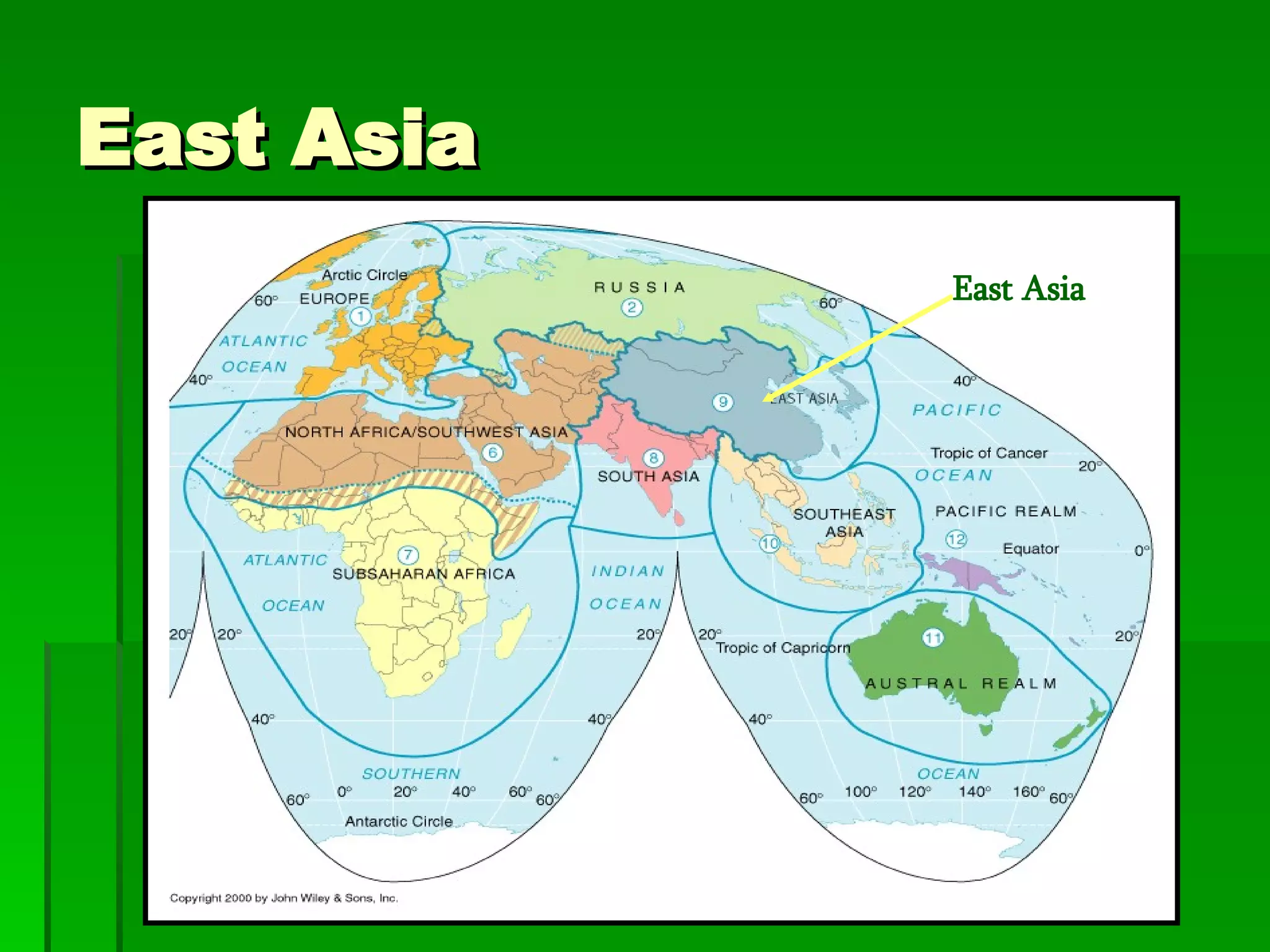
East Asia East Asia
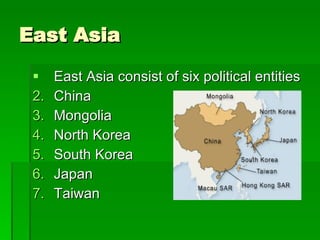
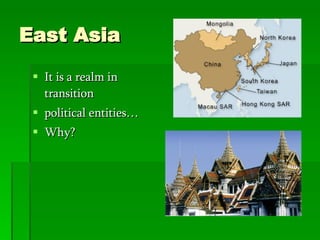
East Asia East Asia consist of six political entities China Mongolia North Korea South Korea Japan Taiwan
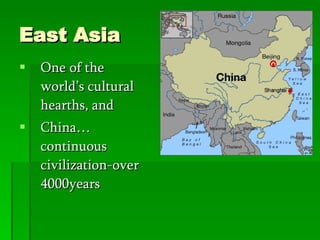
East Asia One of the world’s cultural hearths, and  China… continuous civilization-over 4000years
East Asia It is a realm in transition  political entities… Why?
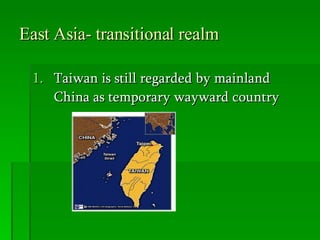
East Asia- transitional realm Taiwan is still regarded by mainland China as temporary wayward country
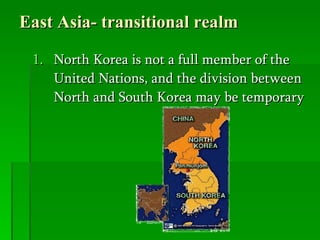
East Asia- transitional realm North Korea is not a full member of the United Nations, and the division between North and South Korea may be temporary
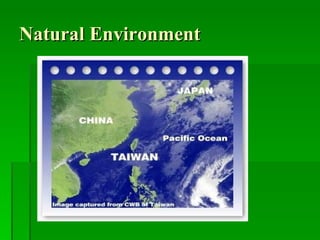
Natural Environment
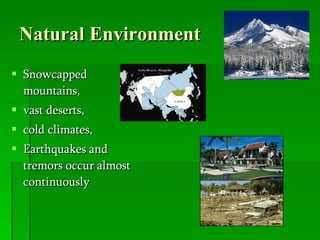
Natural Environment Snowcapped mountains,  vast deserts,  cold climates,  Earthquakes and tremors occur almost continuously
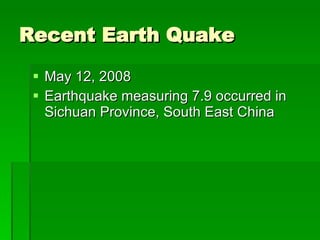
Recent Earth Quake May 12, 2008 Earthquake measuring 7.9 occurred in Sichuan Province, South East China
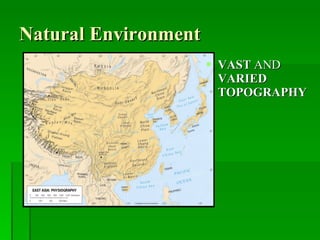
Natural Environment VAST  AND  VARIED TOPOGRAPHY
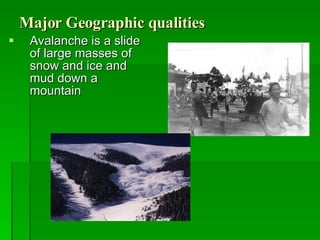
Major Geographic qualities Avalanche is a slide of large masses of snow and ice and mud down a mountain
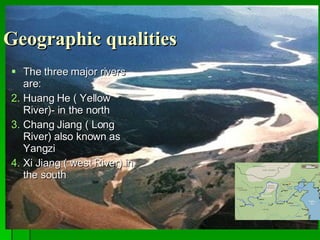
Geographic qualities The three major rivers are: Huang He ( Yellow River)- in the north Chang Jiang ( Long River) also known as Yangzi Xi Jiang ( west River) in the south
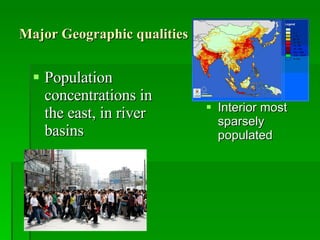
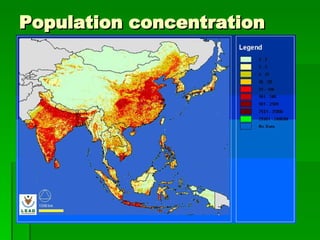
Major Geographic qualities Population concentrations in the east, in river basins Interior most sparsely populated
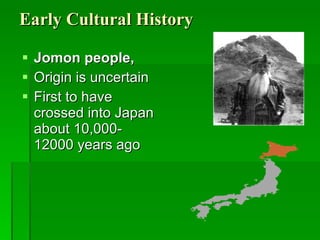
Early Cultural History Jomon people,   Origin is uncertain First to have crossed into Japan about 10,000- 12000 years ago
Ainu People Ainu people are the modern descendents of the Jomon.  Subsisted on hunting, fishing.
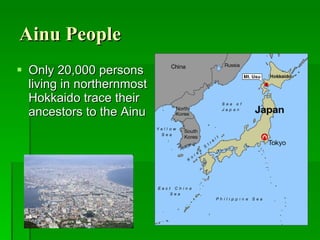
Ainu People Only 20,000 persons living in northernmost Hokkaido trace their ancestors to the Ainu
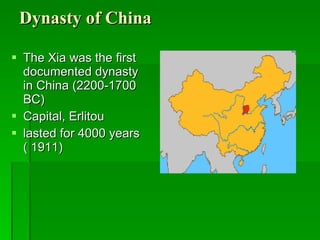
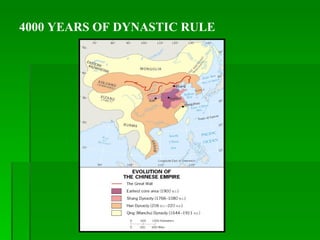
Dynasty of China The Xia was the first documented dynasty in China (2200-1700 BC) Capital, Erlitou lasted for 4000 years ( 1911)
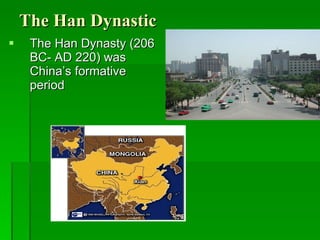
The Han Dynastic The Han Dynasty (206 BC- AD 220) was China’s formative period
Han Achievements Territorial expansion of China,  Xian, also referred to as “the Rome of China” was the greatest city in the world Time of the Silk route-the most well-known trading route of ancient Chinese civilization.  Authoritarian government and disciplined armies
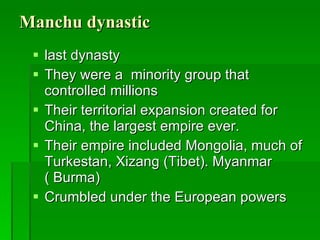
Manchu dynastic last dynasty They were a  minority group that controlled millions Their territorial expansion created for China, the largest empire ever.  Their empire included Mongolia, much of Turkestan, Xizang (Tibet). Myanmar ( Burma) Crumbled under the European powers
4000 YEARS OF DYNASTIC RULE
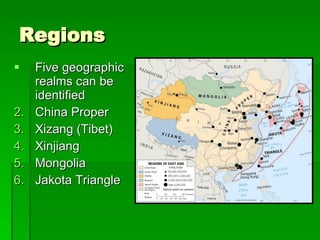
Regions Five geographic realms can be identified China Proper Xizang (Tibet) Xinjiang Mongolia Jakota Triangle
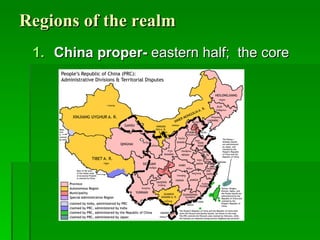
Regions of the realm China proper-  eastern half;  the core
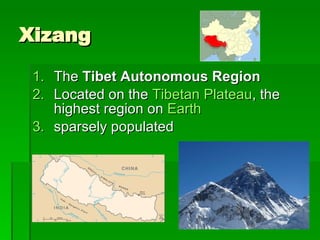
Xizang The  Tibet Autonomous Region Located on the  Tibetan Plateau , the highest region on  Earth   sparsely populated
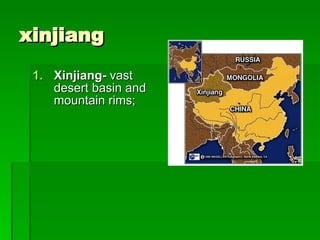
xinjiang Xinjiang-  vast desert basin and mountain rims;
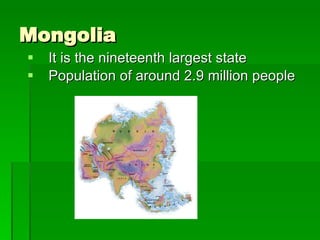
Mongolia It is the nineteenth largest state Population of around 2.9 million people
Jakota triangle The Jakota  triangle Japan, south Korea, Taiwan rapid economic development
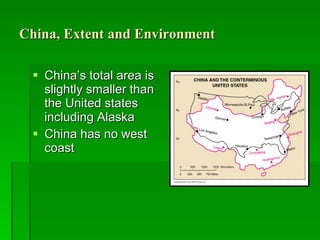
China, Extent and Environment
China, Extent and Environment China’s total area is slightly smaller than the United states including Alaska China has no west coast
Evolving China The teachings of Kongfuzi ( 551-479 BC) still known as Confucius, dominated Chinese life and thoughts for 20 years
Kongfuzi Kongfuzi abhorred supernatural mysticism Dismissed notions of divine ancestries of dynastic rulers Believes competence and merit should determine a person’s place in society He wrote the Confucius classics ,which consisted of 13 texts Until western influence began to erode their relevance, these 13 classics was the basis of education in China
A century of convulsion China’s cultural strength was a force that withstood European interferences None of the British manufactured good attracted the Chinese: Mechanical watch, British India textiles were ignored by the Chinese
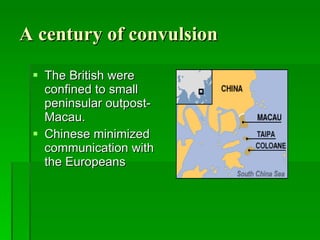
A century of convulsion The British were confined to small peninsular outpost-Macau.  Chinese minimized communication with the Europeans
Colonial Influence The colonial powers conquered China during the Manchu era, economically and Politically
Economically Economic-  lower prices and better qualities of European commodities
Politically Politically Growing presence of English and the demand of European merchants created conflicts:  Importation into China of Opium from British India Armed hostilities (The first Opium war 1839-1842) China was forced to Cede Hong Kong to the British The British opened five ports, Including Guangzhou  (Canton), and Shanghai to foreign commerce
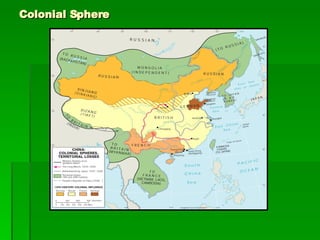
Colonial Sphere
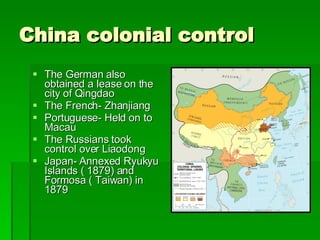
China colonial control The German also obtained a lease on the city of Qingdao The French- Zhanjiang Portuguese- Held on to Macau The Russians took control over Liaodong Japan- Annexed Ryukyu Islands ( 1879) and Formosa ( Taiwan) in 1879
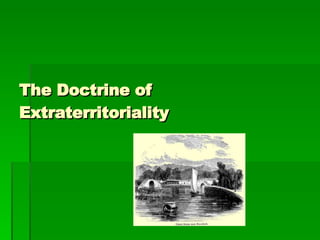
The Doctrine of Extraterritoriality
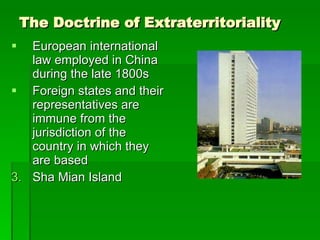
The Doctrine of Extraterritoriality European international law employed in China during the late 1800s Foreign states and their representatives are immune from the jurisdiction of the country in which they are based Sha Mian Island
China Revival Boxer rebellion in 1900 Formation of political parties – The nationalist (leader –Sun Yat-Sen) and the Chinese communist party ( prominent member-Mao Zedong) Aim: targeted  foreign presence
China’s revival By 1927 foreigners began to run for their lives Communists were also pursued by the nationalist  Mao and his cronies resisted the nationalist invasion
Japan in China Japan seized the opportunity over the nationalist and communist contest and took control over the Northeast China Chinese and Japanese war in 1937- the Nationalist party bore much of the brunt of the war The Japanese committed atrocities on the Chinese The communist party  gained power China quickly resumed after the US-led western powers defeated Japan in 1945
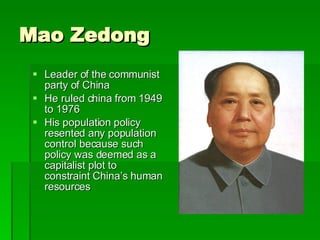
Mao Zedong Leader of the communist party of China He ruled china from 1949 to 1976 His population policy resented any population control because such policy was deemed as a capitalist plot to constraint China’s human resources
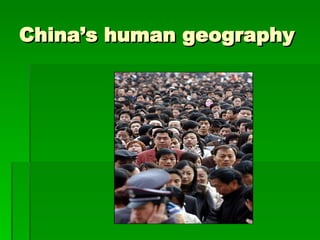
China’s human geography
Population of China 1.6 billion Annual  natural increase  0.7% (1970s - 3%) Doubling time :  100 years Life expectancy :  70 (males),  73 (females) TFR  1.8 born/women (1997) Only 10% of the land is arable and 69% of the population lives on this land
Population concentration
Economic and social problems State controlled economy. Energy shortage poorly developed transportation infrastructure Popular resistance have weakened china’s population control program.
Reorganization under communist 1950s- 1976 reconstruction and reform based on the soviet model Land was expropriated. Farming was collectivized. Industries were reorganized as state-owned communal enterprises. Emphasis on “heavy industry” Dramatic social changes- education, religion, population growth
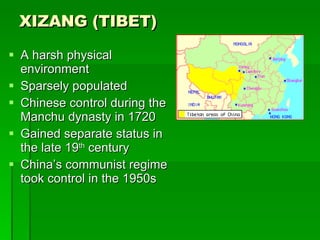
XIZANG (TIBET) A harsh physical environment Sparsely populated Chinese control during the Manchu dynasty in 1720 Gained separate status in the late 19 th  century China’s communist regime took control in the 1950s
Extra credit What is the relation between China and Tibet? Why does China want Tibet? Who is Dalai lama? What is the Future of Tibet with China?
Geography of Development Geographers view development process spatially Walt Rostow formulated a global model of the development process
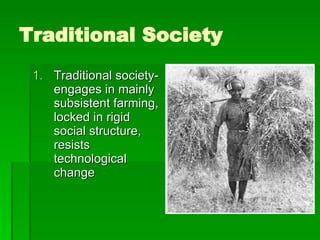
Traditional Society Traditional society-engages in mainly subsistent farming, locked in rigid social structure, resists technological change
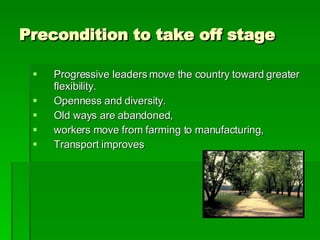
Precondition to take off stage Progressive leaders move the country toward greater flexibility. Openness and diversity.  Old ways are abandoned,  workers move from farming to manufacturing, Transport improves
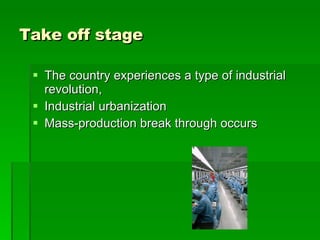
Take off stage The country experiences a type of industrial revolution,  Industrial urbanization  Mass-production break through occurs
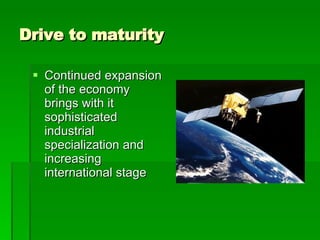
Drive to maturity Continued expansion of the economy brings with it sophisticated industrial specialization and increasing international stage
High Mass consumption High Mass consumption stage:-  The society is marked by: High income,  Widespread of goods and services Most workers are employed in the tertiary and quaternary economic sector
challenges of the theory
challenges of the theory Little account of core-periphery contrast within individual countries In China take off conditions ( stage 3) exist in much of the pacific rim, but other areas remain in stage 1
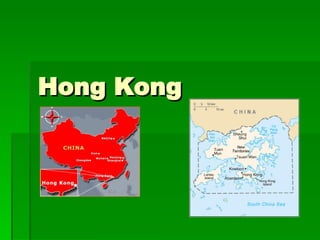
Hong Kong
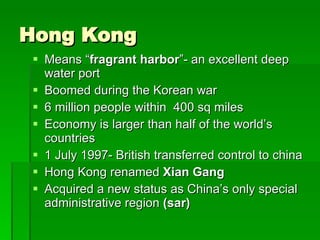
Hong Kong Means “ fragrant harbor ”- an excellent deep water port Boomed during the Korean war 6 million people within  400 sq miles Economy is larger than half of the world’s countries 1 July 1997- British transferred control to china Hong Kong renamed  Xian Gang Acquired a new status as China’s only special administrative region  (sar)
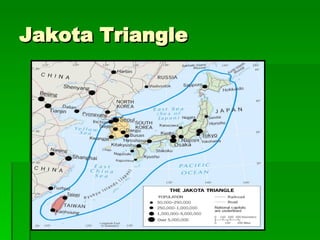
Jakota Triangle
Jakota Triangle region This region consists of Japan Korea ( South) Taiwan
The Jakota Triangle region CHARACTERISTICS Great cities Enormous consumption of raw materials State-of-the-art industries Voluminous exports Global links Trades surpluses Rapid development CHALLENGES Social problems Political uncertainties Vulnerabilities
Japan historical outline For 250 years this policy enabled Japan to enjoy stability  The Treaty of Kanagawa with the US in 1854, allowed Japan to open its ports and began to intensively modernize and industrialize.
Japan history…. It occupied Korea, Formosa (Taiwan), and southern Sakhalin Island.  In 1933 Japan occupied Manchuria, and  In 1937 it launched a full-scale invasion of China.  Japan attacked US forces in 1941 - triggering America's entry into World War II After its defeat in World War II, Japan recovered to become an economic power and a staunch ally of the US
Meiji Restoration Modernizers took control of Japan in 1868  Japan turned to Britain for guidance in reforming their nation, an event known as Meiji Restoration Adopted aspects of the British model Launched a systematic study of the industrialized world Focus was on industrialization and education system
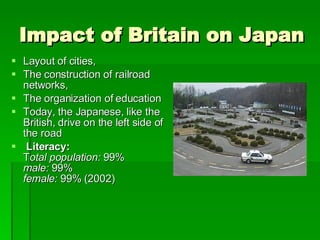
Impact of Britain on Japan Layout of cities, The construction of railroad networks,  The organization of education Today, the Japanese, like the British, drive on the left side of the road Literacy:         T otal population:  99%  male:  99%  female:  99% (2002)
Korea
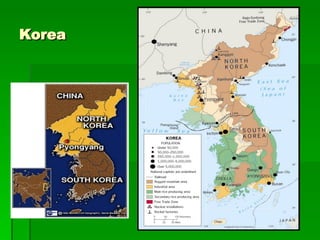
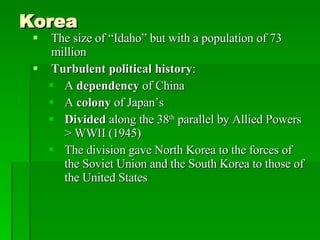
Korea The size of “Idaho” but with a population of 73 million Turbulent political history : A  dependency  of China A  colony  of Japan’s Divided  along the 38 th  parallel by Allied Powers > WWII (1945) The division gave North Korea to the forces of the Soviet Union and the South Korea to those of the United States
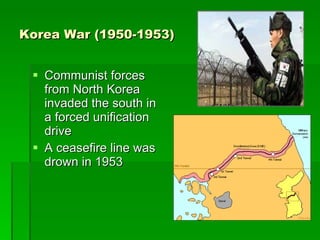
Korea War (1950-1953) Communist forces from North Korea invaded the south in a forced unification drive A ceasefire line was drown in 1953
Korea Regional complimentarity, North Korea has raw materials south Korean needs and  South Korea produces food that North Korea needs
NORTH-SOUTH CONTRASTS NORTH KOREA 55% of the land, 1/3 of the population, extremely  rural Inefficient, non-productive agriculture Limited trade  – former Soviet Union and China SOUTH KOREA 45% of the land, 2/3s of the population, highly  urbanized Modern factories Intensive, increasingly mechanized agriculture Extensive trade – US, Japan, and Western Europe
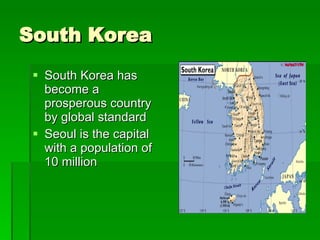
South Korea South Korea has become a prosperous country by global standard Seoul is the capital with a population of 10 million
North Korea One of the poorest nation in the world Population 23.6 million Its Capital, Pyongyang, has a population one-fifth that of Seoul Its nuclear capability became an international concern in 2003. Multinational efforts, led by the United States, Russia, China, Japan and South Korea have proved futile
Does North Korea have nuclear Weapons?
 

East Asia

  • 1.
  • 2.
    East Asia EastAsia consist of six political entities China Mongolia North Korea South Korea Japan Taiwan
  • 3.
    East Asia Oneof the world’s cultural hearths, and China… continuous civilization-over 4000years
  • 4.
    East Asia Itis a realm in transition political entities… Why?
  • 5.
    East Asia- transitionalrealm Taiwan is still regarded by mainland China as temporary wayward country
  • 6.
    East Asia- transitionalrealm North Korea is not a full member of the United Nations, and the division between North and South Korea may be temporary
  • 7.
  • 8.
    Natural Environment Snowcappedmountains, vast deserts, cold climates, Earthquakes and tremors occur almost continuously
  • 9.
    Recent Earth QuakeMay 12, 2008 Earthquake measuring 7.9 occurred in Sichuan Province, South East China
  • 10.
    Natural Environment VAST AND VARIED TOPOGRAPHY
  • 11.
    Major Geographic qualitiesAvalanche is a slide of large masses of snow and ice and mud down a mountain
  • 12.
    Geographic qualities Thethree major rivers are: Huang He ( Yellow River)- in the north Chang Jiang ( Long River) also known as Yangzi Xi Jiang ( west River) in the south
  • 13.
    Major Geographic qualitiesPopulation concentrations in the east, in river basins Interior most sparsely populated
  • 14.
    Early Cultural HistoryJomon people, Origin is uncertain First to have crossed into Japan about 10,000- 12000 years ago
  • 15.
    Ainu People Ainupeople are the modern descendents of the Jomon. Subsisted on hunting, fishing.
  • 16.
    Ainu People Only20,000 persons living in northernmost Hokkaido trace their ancestors to the Ainu
  • 17.
    Dynasty of ChinaThe Xia was the first documented dynasty in China (2200-1700 BC) Capital, Erlitou lasted for 4000 years ( 1911)
  • 18.
    The Han DynasticThe Han Dynasty (206 BC- AD 220) was China’s formative period
  • 19.
    Han Achievements Territorialexpansion of China, Xian, also referred to as “the Rome of China” was the greatest city in the world Time of the Silk route-the most well-known trading route of ancient Chinese civilization. Authoritarian government and disciplined armies
  • 20.
    Manchu dynastic lastdynasty They were a minority group that controlled millions Their territorial expansion created for China, the largest empire ever. Their empire included Mongolia, much of Turkestan, Xizang (Tibet). Myanmar ( Burma) Crumbled under the European powers
  • 21.
    4000 YEARS OFDYNASTIC RULE
  • 22.
    Regions Five geographicrealms can be identified China Proper Xizang (Tibet) Xinjiang Mongolia Jakota Triangle
  • 23.
    Regions of therealm China proper- eastern half; the core
  • 24.
    Xizang The Tibet Autonomous Region Located on the Tibetan Plateau , the highest region on Earth sparsely populated
  • 25.
    xinjiang Xinjiang- vast desert basin and mountain rims;
  • 26.
    Mongolia It isthe nineteenth largest state Population of around 2.9 million people
  • 27.
    Jakota triangle TheJakota triangle Japan, south Korea, Taiwan rapid economic development
  • 28.
    China, Extent andEnvironment
  • 29.
    China, Extent andEnvironment China’s total area is slightly smaller than the United states including Alaska China has no west coast
  • 30.
    Evolving China Theteachings of Kongfuzi ( 551-479 BC) still known as Confucius, dominated Chinese life and thoughts for 20 years
  • 31.
    Kongfuzi Kongfuzi abhorredsupernatural mysticism Dismissed notions of divine ancestries of dynastic rulers Believes competence and merit should determine a person’s place in society He wrote the Confucius classics ,which consisted of 13 texts Until western influence began to erode their relevance, these 13 classics was the basis of education in China
  • 32.
    A century ofconvulsion China’s cultural strength was a force that withstood European interferences None of the British manufactured good attracted the Chinese: Mechanical watch, British India textiles were ignored by the Chinese
  • 33.
    A century ofconvulsion The British were confined to small peninsular outpost-Macau. Chinese minimized communication with the Europeans
  • 34.
    Colonial Influence Thecolonial powers conquered China during the Manchu era, economically and Politically
  • 35.
    Economically Economic- lower prices and better qualities of European commodities
  • 36.
    Politically Politically Growingpresence of English and the demand of European merchants created conflicts: Importation into China of Opium from British India Armed hostilities (The first Opium war 1839-1842) China was forced to Cede Hong Kong to the British The British opened five ports, Including Guangzhou (Canton), and Shanghai to foreign commerce
  • 37.
  • 38.
    China colonial controlThe German also obtained a lease on the city of Qingdao The French- Zhanjiang Portuguese- Held on to Macau The Russians took control over Liaodong Japan- Annexed Ryukyu Islands ( 1879) and Formosa ( Taiwan) in 1879
  • 39.
    The Doctrine ofExtraterritoriality
  • 40.
    The Doctrine ofExtraterritoriality European international law employed in China during the late 1800s Foreign states and their representatives are immune from the jurisdiction of the country in which they are based Sha Mian Island
  • 41.
    China Revival Boxerrebellion in 1900 Formation of political parties – The nationalist (leader –Sun Yat-Sen) and the Chinese communist party ( prominent member-Mao Zedong) Aim: targeted foreign presence
  • 42.
    China’s revival By1927 foreigners began to run for their lives Communists were also pursued by the nationalist Mao and his cronies resisted the nationalist invasion
  • 43.
    Japan in ChinaJapan seized the opportunity over the nationalist and communist contest and took control over the Northeast China Chinese and Japanese war in 1937- the Nationalist party bore much of the brunt of the war The Japanese committed atrocities on the Chinese The communist party gained power China quickly resumed after the US-led western powers defeated Japan in 1945
  • 44.
    Mao Zedong Leaderof the communist party of China He ruled china from 1949 to 1976 His population policy resented any population control because such policy was deemed as a capitalist plot to constraint China’s human resources
  • 45.
  • 46.
    Population of China1.6 billion Annual natural increase 0.7% (1970s - 3%) Doubling time : 100 years Life expectancy : 70 (males), 73 (females) TFR 1.8 born/women (1997) Only 10% of the land is arable and 69% of the population lives on this land
  • 47.
  • 48.
    Economic and socialproblems State controlled economy. Energy shortage poorly developed transportation infrastructure Popular resistance have weakened china’s population control program.
  • 49.
    Reorganization under communist1950s- 1976 reconstruction and reform based on the soviet model Land was expropriated. Farming was collectivized. Industries were reorganized as state-owned communal enterprises. Emphasis on “heavy industry” Dramatic social changes- education, religion, population growth
  • 50.
    XIZANG (TIBET) Aharsh physical environment Sparsely populated Chinese control during the Manchu dynasty in 1720 Gained separate status in the late 19 th century China’s communist regime took control in the 1950s
  • 51.
    Extra credit Whatis the relation between China and Tibet? Why does China want Tibet? Who is Dalai lama? What is the Future of Tibet with China?
  • 52.
    Geography of DevelopmentGeographers view development process spatially Walt Rostow formulated a global model of the development process
  • 53.
    Traditional Society Traditionalsociety-engages in mainly subsistent farming, locked in rigid social structure, resists technological change
  • 54.
    Precondition to takeoff stage Progressive leaders move the country toward greater flexibility. Openness and diversity. Old ways are abandoned, workers move from farming to manufacturing, Transport improves
  • 55.
    Take off stageThe country experiences a type of industrial revolution, Industrial urbanization Mass-production break through occurs
  • 56.
    Drive to maturityContinued expansion of the economy brings with it sophisticated industrial specialization and increasing international stage
  • 57.
    High Mass consumptionHigh Mass consumption stage:- The society is marked by: High income, Widespread of goods and services Most workers are employed in the tertiary and quaternary economic sector
  • 58.
  • 59.
    challenges of thetheory Little account of core-periphery contrast within individual countries In China take off conditions ( stage 3) exist in much of the pacific rim, but other areas remain in stage 1
  • 60.
  • 61.
    Hong Kong Means“ fragrant harbor ”- an excellent deep water port Boomed during the Korean war 6 million people within 400 sq miles Economy is larger than half of the world’s countries 1 July 1997- British transferred control to china Hong Kong renamed Xian Gang Acquired a new status as China’s only special administrative region (sar)
  • 62.
  • 63.
    Jakota Triangle regionThis region consists of Japan Korea ( South) Taiwan
  • 64.
    The Jakota Triangleregion CHARACTERISTICS Great cities Enormous consumption of raw materials State-of-the-art industries Voluminous exports Global links Trades surpluses Rapid development CHALLENGES Social problems Political uncertainties Vulnerabilities
  • 65.
    Japan historical outlineFor 250 years this policy enabled Japan to enjoy stability The Treaty of Kanagawa with the US in 1854, allowed Japan to open its ports and began to intensively modernize and industrialize.
  • 66.
    Japan history…. Itoccupied Korea, Formosa (Taiwan), and southern Sakhalin Island. In 1933 Japan occupied Manchuria, and In 1937 it launched a full-scale invasion of China. Japan attacked US forces in 1941 - triggering America's entry into World War II After its defeat in World War II, Japan recovered to become an economic power and a staunch ally of the US
  • 67.
    Meiji Restoration Modernizerstook control of Japan in 1868 Japan turned to Britain for guidance in reforming their nation, an event known as Meiji Restoration Adopted aspects of the British model Launched a systematic study of the industrialized world Focus was on industrialization and education system
  • 68.
    Impact of Britainon Japan Layout of cities, The construction of railroad networks, The organization of education Today, the Japanese, like the British, drive on the left side of the road Literacy: T otal population: 99% male: 99% female: 99% (2002)
  • 69.
  • 70.
    Korea The sizeof “Idaho” but with a population of 73 million Turbulent political history : A dependency of China A colony of Japan’s Divided along the 38 th parallel by Allied Powers > WWII (1945) The division gave North Korea to the forces of the Soviet Union and the South Korea to those of the United States
  • 71.
    Korea War (1950-1953)Communist forces from North Korea invaded the south in a forced unification drive A ceasefire line was drown in 1953
  • 72.
    Korea Regional complimentarity,North Korea has raw materials south Korean needs and South Korea produces food that North Korea needs
  • 73.
    NORTH-SOUTH CONTRASTS NORTHKOREA 55% of the land, 1/3 of the population, extremely rural Inefficient, non-productive agriculture Limited trade – former Soviet Union and China SOUTH KOREA 45% of the land, 2/3s of the population, highly urbanized Modern factories Intensive, increasingly mechanized agriculture Extensive trade – US, Japan, and Western Europe
  • 74.
    South Korea SouthKorea has become a prosperous country by global standard Seoul is the capital with a population of 10 million
  • 75.
    North Korea Oneof the poorest nation in the world Population 23.6 million Its Capital, Pyongyang, has a population one-fifth that of Seoul Its nuclear capability became an international concern in 2003. Multinational efforts, led by the United States, Russia, China, Japan and South Korea have proved futile
  • 76.
    Does North Koreahave nuclear Weapons?
  • 77.