SOUTH AMERICA
Some facts about the continent: S. America ranks 4th in terms of area, after Asia, Africa & N. America.
 In terms of population the continent ranks 5th after Asia, Africa, Europe & N. America.
 It consists of 13 independent countries and 6 dependencies.
 The largest country is Brazil and the smallest country is Suriname. List of dependencies in the continent:
Aruba (Netherland)
Falkland Islands (UK)
French Guiana (France)
Bonaire (Netherland)
South Georgia & South Sandwich Islands (UK)
Curacao (Netherlands)
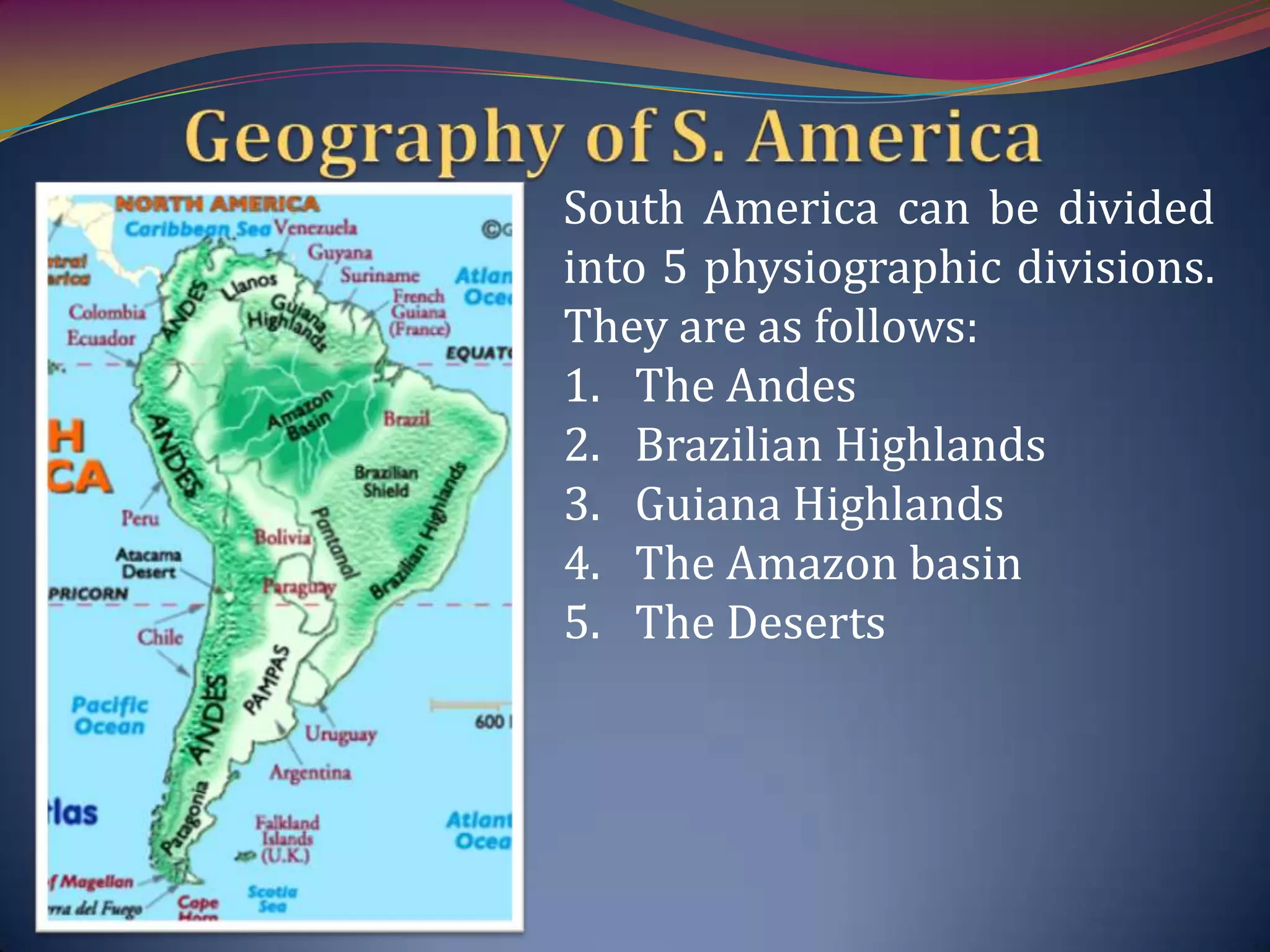
The independent countries of the continent are Argentina, Brazil, Bolivia, Paraguay, Uruguay, Venezuela, Colombia, Peru, Chile, Ecuador, Suriname, Guyana and Trinidad & Tobago.Geography of S. AmericaSouth America can be divided into 5 physiographic divisions. They are as follows:The AndesBrazilian HighlandsGuiana HighlandsThe Amazon basinThe Deserts
The Andes: Run from NW Venezuela to the southern tip of Tierra Del Fuego.

South america

  • 1.
  • 2.
    Some facts aboutthe continent: S. America ranks 4th in terms of area, after Asia, Africa & N. America.
  • 3.
    In termsof population the continent ranks 5th after Asia, Africa, Europe & N. America.
  • 4.
    It consistsof 13 independent countries and 6 dependencies.
  • 5.
    The largestcountry is Brazil and the smallest country is Suriname. List of dependencies in the continent:
  • 6.
  • 7.
  • 8.
  • 9.
  • 10.
    South Georgia &South Sandwich Islands (UK)
  • 11.
  • 12.
    The independent countriesof the continent are Argentina, Brazil, Bolivia, Paraguay, Uruguay, Venezuela, Colombia, Peru, Chile, Ecuador, Suriname, Guyana and Trinidad & Tobago.Geography of S. AmericaSouth America can be divided into 5 physiographic divisions. They are as follows:The AndesBrazilian HighlandsGuiana HighlandsThe Amazon basinThe Deserts
  • 13.
    The Andes: Runfrom NW Venezuela to the southern tip of Tierra Del Fuego.
  • 14.
    The mountain wasformed by the subduction of the Pacific plate beneath South American plate.
  • 15.
    It is theworld’s longest and second highest mountain range.
  • 16.
    The length ofthe mountain range is 7000 km and the width is 500 km approximately
  • 17.
    It is afold mountain The highest point of the mountain range is Mt. Aconcagua, which is 6962 m high.
  • 18.
    The Andes isdivided into three sub regions. They are:
  • 19.
    Northern – Venezuela,Columbia, & Ecuador
  • 20.
    Central– Ecuador, Peruand Bolivia (altiplano)
  • 21.
    Southern– defines theborder between Chile & Argentina (South of Santiago the mountains are lower)
  • 22.
    There are severalimportant cities situated within the Andean region. They are Bagota, Santiago, Cusco, La Paz, Merida & Quito.Lake TiticacaLake Titicaca is a mountainous lake found in the border of Peru & Bolivia.
  • 23.
    By volume itis the largest lake of the continent.
  • 24.
    It is thehighest commercially navigable lake of the world.
  • 25.
    It is situatedat an altitude of 3811 m.
  • 26.
    There are 42islands in the lake and some if which are densely populated.
  • 27.
    It serves asan inland drainage for about 27 local rivers.The Brazilian Highlands It is of the most important physiographical region of the continent, occupying an area of about 5,000,000 sq. km.
  • 28.
    The highland isalso know as Brazilian Plateau.
  • 29.
    The entire plateauis made up of basaltic lava. However the present landscapes are the product of intense erosional activities.
  • 30.
    The NE andSW extension of the highland measures 3500 km.
  • 31.
    The highestpoint of the plateau is Pico da Bandeira (2891 m)
  • 32.
    The entire highlandfalls inside the country of Brazil. The plateau is often divided into three parts:
  • 33.
    Atlantic Plateau: The most densely populated area of the highland.
  • 34.
    Southern Plateau: theregion is covered with tropical rainforest. Part of it consists of fertile soil, which is also knows as purple land.
  • 35.
    The Central Plateau: Majority of the area is under grassland.
  • 36.
    The NE cornerof the plateau is known as Plateau of Borborema and the western section if the highland is called Plateau of Mato Grosso.Guiana HighlandsIt occupies the area of Guyana, Suriname and French Guiana. Apart from these countries, a part of it with Colombia, Venezuela and Brazil.
  • 37.
    The shield ismade up of Greenstone, Quartzite, Sandstone, Conglomerate and Shale.
  • 38.
    The highland isclassified into three regional groups. They are:
  • 39.
    Guiana Highland Proper(Venezuela) Mt. Roraima (2810 m)
  • 40.
    The Tumuc-Humuc Mountains(Guyana & Suriname) Juliana Top (1280 m)
  • 41.
  • 42.
    The region isvery sparely populated.
  • 43.
    Here we canfind the famous Angel Falls on R. Kerep. (979 m)The Gran Chaco Region The Gran Chaco region is a lowland in the Rio de la Plata river basin .
  • 44.
    This area isa hot and semi arid region, occupying areas of Argentina, Paraguay, Bolivia and Brazil.
  • 45.
    This region isalso known as Chaco Plain.Llanos Llanos is a tropical grassland situated in between the northern Andes and Guiana Highland.
  • 46.
    It occupies few million square km of Venezuela and Colombia.
  • 47.
    This region ischaracterized by seasonal flooding, which can be as high as a meter.
  • 48.
    The principal riverdraining this region is R. Orinoco.
  • 49.
    The people workinghere as cow boys are locally known as Llaneros.
  • 50.
    Now adays, the grasslands are being cleared for agricultural purposes.DesertsAtacama Desert:Occupies the area of Chile, Argentina, Peru and Bolivia
  • 51.
    It is thedriest desert of the world.Patagonian Desert:It is situated in southern part of Argentina.