CENTRAL AMERICA
CENTRAL AMERICA Area 2 728 827 km² Population 188,2 million (2007) States  21 Dependencies   (colonies) 14 Anguilla (UK), A-B-C Islands (NL), British Virgin Islands (UK),  Cayman Islands (UK), Guadeloupe (FR), Martinique (FR),  Montserrat (UK), Navassa Island (US), Netherlands Antilles  (NL), Puerto Rico (US), St. Barthélemy (FR), St. Martin (FR +  NL), Turks & Caicos Islands (UK), US Virgin Islands (US) GDP   $ 1.416.229 trillion  (2005) Major languages Spanish, English, Mayan, French, Haitan Creole, Antillean Creole
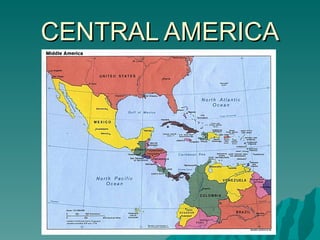
CENTRAL AMERICA Central or “Middle” America is a region in the mid-latitudes of the Americas.  In southern North America it comprises Mexico, the nations of Central America and the West Indies. Physiographically it marks the transition between North and South America and consists of 3 parts:
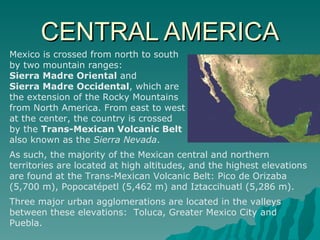
CENTRAL AMERICA Mexico is crossed from north to south  by two mountain ranges: Sierra Madre Oriental  and  Sierra Madre Occidental , which are  the extension of the Rocky Mountains  from North America. From east to west  at the center, the country is crossed  by the  Trans-Mexican Volcanic Belt   also known as the  Sierra Nevada . As such, the majority of the Mexican central and northern territories are located at high altitudes, and the highest elevations are found at the Trans-Mexican Volcanic Belt: Pico de Orizaba (5,700 m), Popocatépetl (5,462 m) and Iztaccihuatl (5,286 m).  Three major urban agglomerations are located in the valleys between these elevations:  Toluca, Greater Mexico City and Puebla.
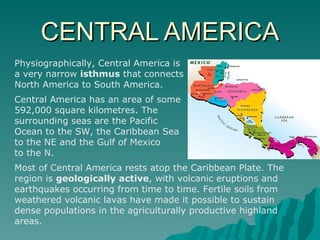
CENTRAL AMERICA Physiographically, Central America is  a very narrow  isthmus  that connects  North America to South America. Central America has an area of some  592,000 square kilometres. The  surrounding seas are the Pacific  Ocean to the SW, the Caribbean Sea  to the NE and the Gulf of Mexico  to the N.  Most of Central America rests atop the Caribbean Plate. The region is  geologically active , with volcanic eruptions and earthquakes occurring from time to time. Fertile soils from weathered volcanic lavas have made it possible to sustain dense populations in the agriculturally productive highland areas.
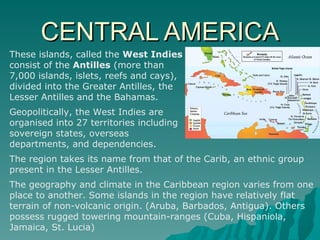
CENTRAL AMERICA These islands, called the  West Indies   consist of the  Antilles  (more than  7,000 islands, islets, reefs and cays),  divided into the Greater Antilles, the  Lesser Antilles and the Bahamas. Geopolitically, the West Indies are  organised into 27 territories including  sovereign states, overseas  departments, and dependencies.  The region takes its name from that of the Carib, an ethnic group present in the Lesser Antilles.  The geography and climate in the Caribbean region varies from one place to another. Some islands in the region have relatively flat terrain of non-volcanic origin. (Aruba, Barbados, Antigua). Others possess rugged towering mountain-ranges (Cuba, Hispaniola, Jamaica, St. Lucia)
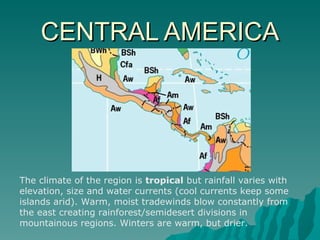
CENTRAL AMERICA The climate of the region is  tropical  but rainfall varies with elevation, size and water currents (cool currents keep some islands arid). Warm, moist tradewinds blow constantly from the east creating rainforest/semidesert divisions in mountainous regions. Winters are warm, but drier.
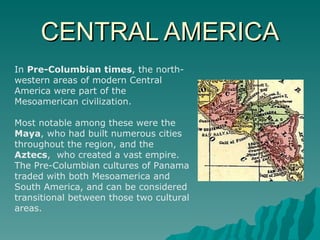
CENTRAL AMERICA In  Pre-Columbian times , the north-western areas of modern Central America were part of the Mesoamerican civilization.  Most notable among these were the  Maya , who had built numerous cities throughout the region, and the  Aztecs ,  who created a vast empire. The Pre-Columbian cultures of Panama traded with both Mesoamerica and South America, and can be considered transitional between those two cultural areas.
CENTRAL AMERICA Following Christopher Columbus’s discovery, the  Spanish  sent numerous expeditions to the region, and they began their conquest of Maya lands in the 1520s.  In 1540 the  Captaincy General of Guatemala  was set up (from S-Mexico to Costa Rica – exception British Honduras). This lasted nearly three centuries, until a  rebellion  (which followed closely on the heels of the Mexican War of Independence) in 1821. After the dissolution of Spanish authority, it became part of the  First Mexican Empire  and later turned into the  Federal Republic of Central America  which lasted from 1823 to 1838, when it began to disintegrate due to civil wars.
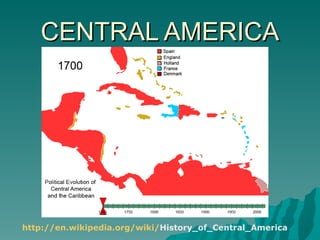
CENTRAL AMERICA All islands at some point were, and a few still are, colonies of European nations; a few are overseas or dependent territories:  Danish West Indies  – present-day United States Virgin Islands  Dutch West Indies  – present-day Netherlands Antilles and  A-B-C Islands  French West Indies  – Dominica, Grenada, Haiti, St. Vincent &  Grenadines, Martinique and Guadeloupe and the current overseas  collectivities of St. Barthélemy and Saint Martin.  Portuguese West Indies  – present-day Barbados, known as  Los Barbados  in the 1500s when the Portuguese claimed the  island en route to Brazil. The Portuguese left Barbados in 1533,  nearly a century prior to the British arrival to the island.  Spanish West Indies  – Cuba, Hispaniola (Dom. Rep. – Haiti  only until 1609), Puerto Rico, Jamaica, the Cayman Islands,  Trinidad.  Swedish West Indies  – present-day French St. Barthélemy and  Guadeloupe (briefly)
CENTRAL AMERICA http:// en.wikipedia.org / wiki / History_of_Central_America
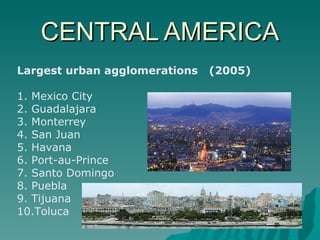
CENTRAL AMERICA Largest urban agglomerations (2005)  1. Mexico City  2. Guadalajara 3. Monterrey 4. San Juan  5. Havana 6. Port-au-Prince  7. Santo Domingo  8. Puebla 9. Tijuana 10.Toluca
CENTRAL AMERICA Current Situation: Under the Rule of Elites Most colonies got independent in the early 19th century Since then some few family clans plus favourites have  controlled the countries Due to their know-how and foreign connections they  overcame land reforms and military regimes. Even in democratic states they could save their power –  good relations to the USA brought economic advantages  or secured asylum in case of a rebellion
CENTRAL AMERICA US-Imperialism 1823  „Monroe Doctrin“    „America for the Americans“  = end of colonialism end of 19th century – USA could not resist  the temptation of taking influence on the  Central American States
CENTRAL AMERICA Examples : Panama-Canal – USA supported Panama in getting  independent of Colombia „ Dollar-Imperialism“ – governments were  „ supported with money for investments    created  dependency „ Banana Republics“ – support of „puppet regimes“  who worked for the big American companies (e.g.  United Fruit Company)
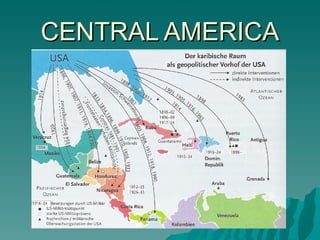
CENTRAL AMERICA Dictatorships and US-Interventions 1954 – 1986  Junta in Guatemala 1956 – 1984  Family Clan Somoza in Nicaragua 1957 – 1990  Family Clan Duvalier in Haiti 1959  Dictator Batista brought down by  the revolution of Fidel Castro 1965  US-Intervention in the Dominican  Republic (for more democracy) 1990  US-Intervention against President  Noriega in Panama
CENTRAL AMERICA There were numerous interventions in the so-called „backyard of the United States“ in Central Amerika: USA supported the „contras“ against the Sandinists, who had brought down the government of the dictator and US-friend Somoza failed invasion in Cuba (Bay of Pigs 1961) to bring down Fidel Castro who had won against US-friend Batista Interventions on Haiti, Grenada, Panama,…
CENTRAL AMERICA
CENTRAL AMERICA Neoliberalism = camouflaged US-Imperalism At the end of the 1970s there was world-wide critisism on the politics of the USA. Only the protection of democracy should be a reason for intervention. Institutions like IMF(IWF), NAFTA or WTO should now guarantee better sales possibilities for US-companies. Especially the IMF seemed to be a non-suspicious help. Money was scarse because the dictators had spent the budget for arms and had left immense foreign debts and a hyper-inflation (up to 2000% per year!). However their credits are connected to vast (economical) interventions in the concerned countries.
CENTRAL AMERICA Consequences of Neo-liberal Politics on economy : sale of public companies more debts financial crisis and recession unemployment expansion of the „informal sector“ downturn of industrialisation
CENTRAL AMERICA Consequences of Neo-liberal Politics on society : the rich become richer the poor become poorer (especially the former  „ middle class“) increase of crime rate crisis of the political parties crisis-situation for law and order (police,  justice, media)
CENTRAL AMERICA Reaction of the People  mass emigration to Europe and North America re-activation of former social movements from  the time of the dictatorship foundation of new (radical) movements     demonstrations and revolts voting out of neo-liberal governments and  establishment of „central-left“ governments e.g. Hugo Chavés in Venezuela 1998, e.g. Nestor Kirchner in  Argentina 2003, e.g. Luiz Inácio da Silva in Bolivia 2003, e.g. Correa in Ecuador 2006

Central America

  • 1.
  • 2.
    CENTRAL AMERICA Area2 728 827 km² Population 188,2 million (2007) States 21 Dependencies (colonies) 14 Anguilla (UK), A-B-C Islands (NL), British Virgin Islands (UK), Cayman Islands (UK), Guadeloupe (FR), Martinique (FR), Montserrat (UK), Navassa Island (US), Netherlands Antilles (NL), Puerto Rico (US), St. Barthélemy (FR), St. Martin (FR + NL), Turks & Caicos Islands (UK), US Virgin Islands (US) GDP $ 1.416.229 trillion (2005) Major languages Spanish, English, Mayan, French, Haitan Creole, Antillean Creole
  • 3.
    CENTRAL AMERICA Centralor “Middle” America is a region in the mid-latitudes of the Americas. In southern North America it comprises Mexico, the nations of Central America and the West Indies. Physiographically it marks the transition between North and South America and consists of 3 parts:
  • 4.
    CENTRAL AMERICA Mexicois crossed from north to south by two mountain ranges: Sierra Madre Oriental and Sierra Madre Occidental , which are the extension of the Rocky Mountains from North America. From east to west at the center, the country is crossed by the Trans-Mexican Volcanic Belt also known as the Sierra Nevada . As such, the majority of the Mexican central and northern territories are located at high altitudes, and the highest elevations are found at the Trans-Mexican Volcanic Belt: Pico de Orizaba (5,700 m), Popocatépetl (5,462 m) and Iztaccihuatl (5,286 m). Three major urban agglomerations are located in the valleys between these elevations: Toluca, Greater Mexico City and Puebla.
  • 5.
    CENTRAL AMERICA Physiographically,Central America is a very narrow isthmus that connects North America to South America. Central America has an area of some 592,000 square kilometres. The surrounding seas are the Pacific Ocean to the SW, the Caribbean Sea to the NE and the Gulf of Mexico to the N. Most of Central America rests atop the Caribbean Plate. The region is geologically active , with volcanic eruptions and earthquakes occurring from time to time. Fertile soils from weathered volcanic lavas have made it possible to sustain dense populations in the agriculturally productive highland areas.
  • 6.
    CENTRAL AMERICA Theseislands, called the West Indies consist of the Antilles (more than 7,000 islands, islets, reefs and cays), divided into the Greater Antilles, the Lesser Antilles and the Bahamas. Geopolitically, the West Indies are organised into 27 territories including sovereign states, overseas departments, and dependencies. The region takes its name from that of the Carib, an ethnic group present in the Lesser Antilles. The geography and climate in the Caribbean region varies from one place to another. Some islands in the region have relatively flat terrain of non-volcanic origin. (Aruba, Barbados, Antigua). Others possess rugged towering mountain-ranges (Cuba, Hispaniola, Jamaica, St. Lucia)
  • 7.
    CENTRAL AMERICA Theclimate of the region is tropical but rainfall varies with elevation, size and water currents (cool currents keep some islands arid). Warm, moist tradewinds blow constantly from the east creating rainforest/semidesert divisions in mountainous regions. Winters are warm, but drier.
  • 8.
    CENTRAL AMERICA In Pre-Columbian times , the north-western areas of modern Central America were part of the Mesoamerican civilization. Most notable among these were the Maya , who had built numerous cities throughout the region, and the Aztecs , who created a vast empire. The Pre-Columbian cultures of Panama traded with both Mesoamerica and South America, and can be considered transitional between those two cultural areas.
  • 9.
    CENTRAL AMERICA FollowingChristopher Columbus’s discovery, the Spanish sent numerous expeditions to the region, and they began their conquest of Maya lands in the 1520s. In 1540 the Captaincy General of Guatemala was set up (from S-Mexico to Costa Rica – exception British Honduras). This lasted nearly three centuries, until a rebellion (which followed closely on the heels of the Mexican War of Independence) in 1821. After the dissolution of Spanish authority, it became part of the First Mexican Empire and later turned into the Federal Republic of Central America which lasted from 1823 to 1838, when it began to disintegrate due to civil wars.
  • 10.
    CENTRAL AMERICA Allislands at some point were, and a few still are, colonies of European nations; a few are overseas or dependent territories: Danish West Indies – present-day United States Virgin Islands Dutch West Indies – present-day Netherlands Antilles and A-B-C Islands French West Indies – Dominica, Grenada, Haiti, St. Vincent & Grenadines, Martinique and Guadeloupe and the current overseas collectivities of St. Barthélemy and Saint Martin. Portuguese West Indies – present-day Barbados, known as Los Barbados in the 1500s when the Portuguese claimed the island en route to Brazil. The Portuguese left Barbados in 1533, nearly a century prior to the British arrival to the island. Spanish West Indies – Cuba, Hispaniola (Dom. Rep. – Haiti only until 1609), Puerto Rico, Jamaica, the Cayman Islands, Trinidad. Swedish West Indies – present-day French St. Barthélemy and Guadeloupe (briefly)
  • 11.
    CENTRAL AMERICA http://en.wikipedia.org / wiki / History_of_Central_America
  • 12.
    CENTRAL AMERICA Largesturban agglomerations (2005) 1. Mexico City 2. Guadalajara 3. Monterrey 4. San Juan 5. Havana 6. Port-au-Prince 7. Santo Domingo 8. Puebla 9. Tijuana 10.Toluca
  • 13.
    CENTRAL AMERICA CurrentSituation: Under the Rule of Elites Most colonies got independent in the early 19th century Since then some few family clans plus favourites have controlled the countries Due to their know-how and foreign connections they overcame land reforms and military regimes. Even in democratic states they could save their power – good relations to the USA brought economic advantages or secured asylum in case of a rebellion
  • 14.
    CENTRAL AMERICA US-Imperialism1823 „Monroe Doctrin“  „America for the Americans“ = end of colonialism end of 19th century – USA could not resist the temptation of taking influence on the Central American States
  • 15.
    CENTRAL AMERICA Examples: Panama-Canal – USA supported Panama in getting independent of Colombia „ Dollar-Imperialism“ – governments were „ supported with money for investments  created dependency „ Banana Republics“ – support of „puppet regimes“ who worked for the big American companies (e.g. United Fruit Company)
  • 16.
    CENTRAL AMERICA Dictatorshipsand US-Interventions 1954 – 1986 Junta in Guatemala 1956 – 1984 Family Clan Somoza in Nicaragua 1957 – 1990 Family Clan Duvalier in Haiti 1959 Dictator Batista brought down by the revolution of Fidel Castro 1965 US-Intervention in the Dominican Republic (for more democracy) 1990 US-Intervention against President Noriega in Panama
  • 17.
    CENTRAL AMERICA Therewere numerous interventions in the so-called „backyard of the United States“ in Central Amerika: USA supported the „contras“ against the Sandinists, who had brought down the government of the dictator and US-friend Somoza failed invasion in Cuba (Bay of Pigs 1961) to bring down Fidel Castro who had won against US-friend Batista Interventions on Haiti, Grenada, Panama,…
  • 18.
  • 19.
    CENTRAL AMERICA Neoliberalism= camouflaged US-Imperalism At the end of the 1970s there was world-wide critisism on the politics of the USA. Only the protection of democracy should be a reason for intervention. Institutions like IMF(IWF), NAFTA or WTO should now guarantee better sales possibilities for US-companies. Especially the IMF seemed to be a non-suspicious help. Money was scarse because the dictators had spent the budget for arms and had left immense foreign debts and a hyper-inflation (up to 2000% per year!). However their credits are connected to vast (economical) interventions in the concerned countries.
  • 20.
    CENTRAL AMERICA Consequencesof Neo-liberal Politics on economy : sale of public companies more debts financial crisis and recession unemployment expansion of the „informal sector“ downturn of industrialisation
  • 21.
    CENTRAL AMERICA Consequencesof Neo-liberal Politics on society : the rich become richer the poor become poorer (especially the former „ middle class“) increase of crime rate crisis of the political parties crisis-situation for law and order (police, justice, media)
  • 22.
    CENTRAL AMERICA Reactionof the People mass emigration to Europe and North America re-activation of former social movements from the time of the dictatorship foundation of new (radical) movements  demonstrations and revolts voting out of neo-liberal governments and establishment of „central-left“ governments e.g. Hugo Chavés in Venezuela 1998, e.g. Nestor Kirchner in Argentina 2003, e.g. Luiz Inácio da Silva in Bolivia 2003, e.g. Correa in Ecuador 2006