Gravitation
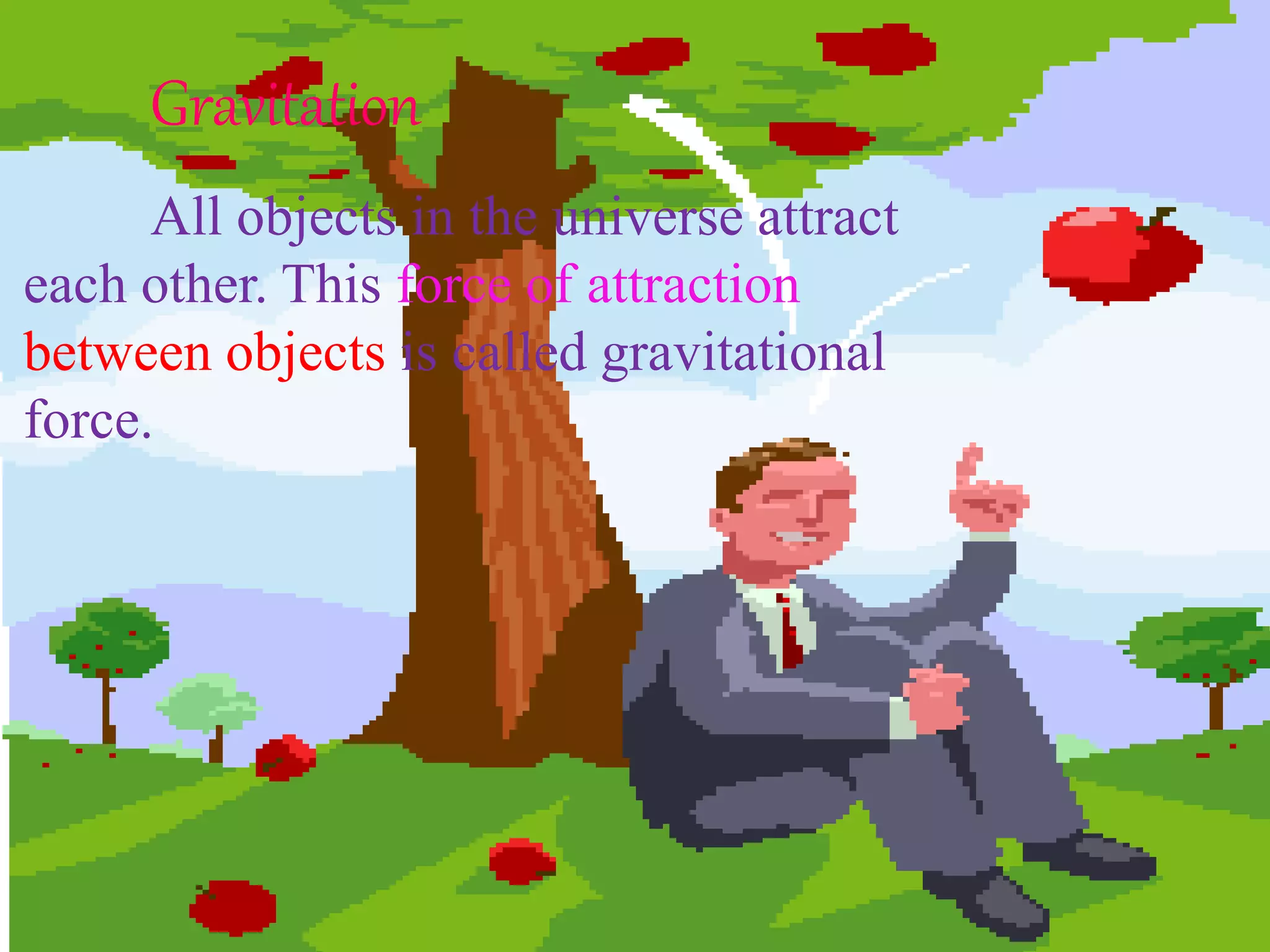
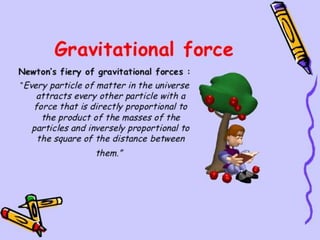
All objects in the universe attract
each other. This force of attraction
between objects is called gravitational
force.
Universal law of Gravitation
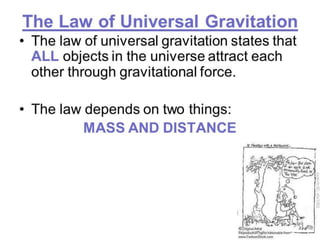
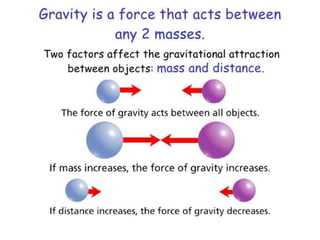
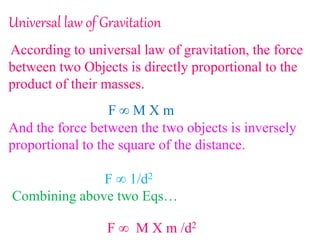
According to universal law of gravitation, the force
between two Objects is directly proportional to the
product of their masses.
F ∞ M X m
And the force between the two objects is inversely
proportional to the square of the distance.
F ∞ 1/d2
Combining above two Eqs…
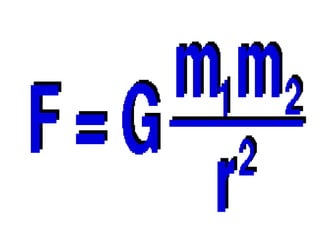
F ∞ M X m /d2
Universal law of Gravitation
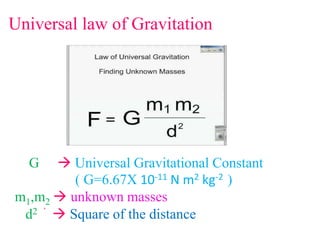
G  Universal Gravitational Constant
( G=6.67X 10⁻¹¹ N m2 kg-2 )
m1,m2  unknown masses
d2 `  Square of the distance
Importance of the Universal Law of Gravitation
* The force that binds us to the earth
* The motion of the moon around the earth
* The motion of planets around the sun
* The tides due to the moon and the sun.
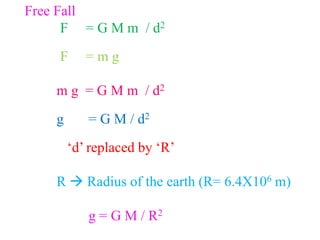
Free Fall
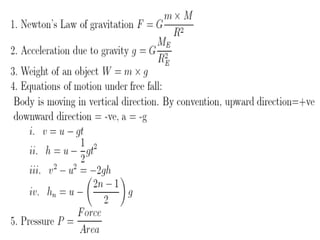
F = G M m / d2
F = m g
m g = G M m / d2
g = G M / d2
‘d’ replaced by ‘R’
R  Radius of the earth (R= 6.4X10⁶ m)
g = G M / R2
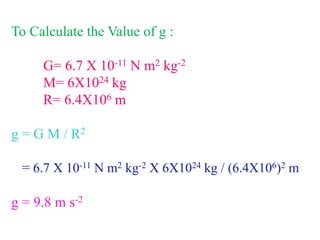
To Calculate the Value of g :
G= 6.7 X 10⁻¹¹ N m2 kg-2
M= 6X1024 kg
R= 6.4X10⁶ m
g = G M / R2
= 6.7 X 10⁻¹¹ N m2 kg-2 X 6X1024 kg / (6.4X10⁶)2 m
g = 9.8 m s-2
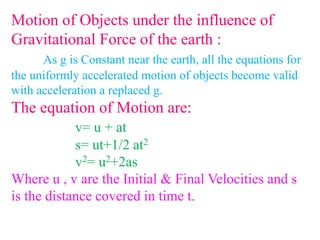
Motion of Objects under the influence of
Gravitational Force of the earth :
As g is Constant near the earth, all the equations for
the uniformly accelerated motion of objects become valid
with acceleration a replaced g.
The equation of Motion are:
v= u + at
s= ut+1/2 at2
v2= u2+2as
Where u , v are the Initial & Final Velocities and s
is the distance covered in time t.
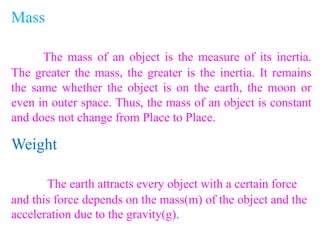
Mass
The mass of an object is the measure of its inertia.
The greater the mass, the greater is the inertia. It remains
the same whether the object is on the earth, the moon or
even in outer space. Thus, the mass of an object is constant
and does not change from Place to Place.
Weight
The earth attracts every object with a certain force
and this force depends on the mass(m) of the object and the
acceleration due to the gravity(g).
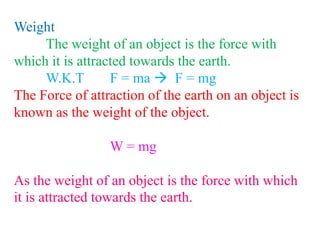
Weight
The weight of an object is the force with
which it is attracted towards the earth.
W.K.T F = ma  F = mg
The Force of attraction of the earth on an object is
known as the weight of the object.
W = mg
As the weight of an object is the force with which
it is attracted towards the earth.
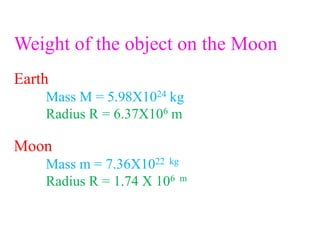
Weight of the object on the Moon
Earth
Mass M = 5.98X1024 kg
Radius R = 6.37X10⁶ m
Moon
Mass m = 7.36X10²² kg
Radius R = 1.74 X 10⁶ m
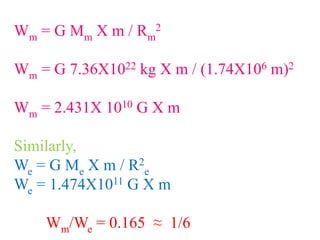
Wm = G Mm X m / Rm
2
Wm = G 7.36X10²² kg X m / (1.74X10⁶ m)2
Wm = 2.431X 10¹⁰ G X m
Similarly,
We = G Me X m / R2
e
We = 1.474X10¹¹ G X m
Wm/We = 0.165 ≈ 1/6
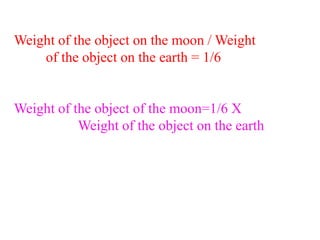
Weight of the object on the moon / Weight
of the object on the earth = 1/6
Weight of the object of the moon=1/6 X
Weight of the object on the earth
Thank You
Tomorrow We See about
“Sound”
Please Don’t miss the Classes.

Gravitation

  • 1.
    Gravitation All objects inthe universe attract each other. This force of attraction between objects is called gravitational force.
  • 7.
    Universal law ofGravitation According to universal law of gravitation, the force between two Objects is directly proportional to the product of their masses. F ∞ M X m And the force between the two objects is inversely proportional to the square of the distance. F ∞ 1/d2 Combining above two Eqs… F ∞ M X m /d2
  • 8.
    Universal law ofGravitation G  Universal Gravitational Constant ( G=6.67X 10⁻¹¹ N m2 kg-2 ) m1,m2  unknown masses d2 `  Square of the distance
  • 9.
    Importance of theUniversal Law of Gravitation * The force that binds us to the earth * The motion of the moon around the earth * The motion of planets around the sun * The tides due to the moon and the sun.
  • 10.
    Free Fall F =G M m / d2 F = m g m g = G M m / d2 g = G M / d2 ‘d’ replaced by ‘R’ R  Radius of the earth (R= 6.4X10⁶ m) g = G M / R2
  • 11.
    To Calculate theValue of g : G= 6.7 X 10⁻¹¹ N m2 kg-2 M= 6X1024 kg R= 6.4X10⁶ m g = G M / R2 = 6.7 X 10⁻¹¹ N m2 kg-2 X 6X1024 kg / (6.4X10⁶)2 m g = 9.8 m s-2
  • 12.
    Motion of Objectsunder the influence of Gravitational Force of the earth : As g is Constant near the earth, all the equations for the uniformly accelerated motion of objects become valid with acceleration a replaced g. The equation of Motion are: v= u + at s= ut+1/2 at2 v2= u2+2as Where u , v are the Initial & Final Velocities and s is the distance covered in time t.
  • 13.
    Mass The mass ofan object is the measure of its inertia. The greater the mass, the greater is the inertia. It remains the same whether the object is on the earth, the moon or even in outer space. Thus, the mass of an object is constant and does not change from Place to Place. Weight The earth attracts every object with a certain force and this force depends on the mass(m) of the object and the acceleration due to the gravity(g).
  • 14.
    Weight The weight ofan object is the force with which it is attracted towards the earth. W.K.T F = ma  F = mg The Force of attraction of the earth on an object is known as the weight of the object. W = mg As the weight of an object is the force with which it is attracted towards the earth.
  • 15.
    Weight of theobject on the Moon Earth Mass M = 5.98X1024 kg Radius R = 6.37X10⁶ m Moon Mass m = 7.36X10²² kg Radius R = 1.74 X 10⁶ m
  • 16.
    Wm = GMm X m / Rm 2 Wm = G 7.36X10²² kg X m / (1.74X10⁶ m)2 Wm = 2.431X 10¹⁰ G X m Similarly, We = G Me X m / R2 e We = 1.474X10¹¹ G X m Wm/We = 0.165 ≈ 1/6
  • 17.
    Weight of theobject on the moon / Weight of the object on the earth = 1/6 Weight of the object of the moon=1/6 X Weight of the object on the earth
  • 19.
  • 20.
    Tomorrow We Seeabout “Sound” Please Don’t miss the Classes.