PREPARED BY: TYPE YOUR NAME HERE
Describe the
characteristics of sound
using the concepts of
wavelength, velocity, and
amplitude
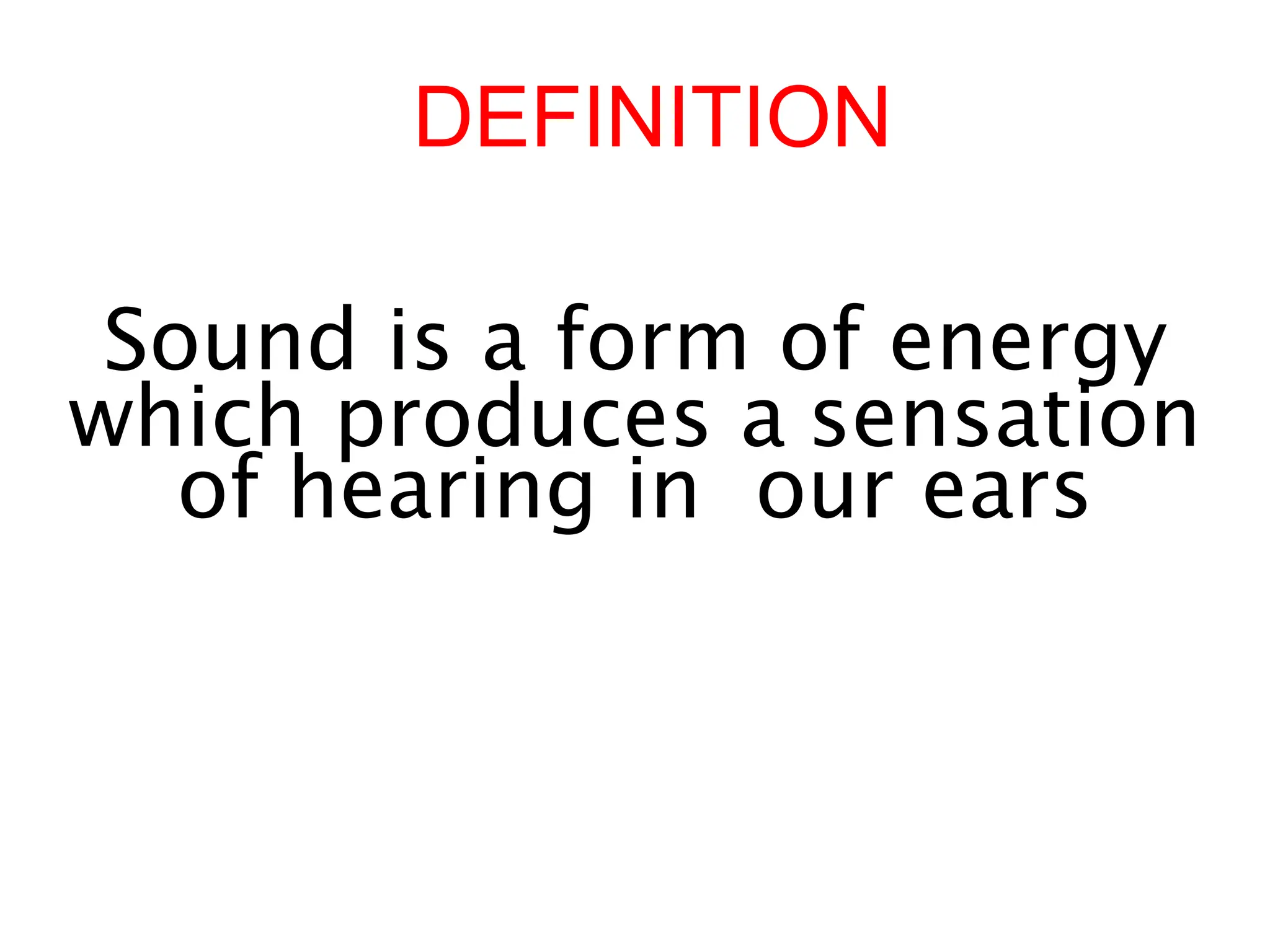
Imagine what happens when you drop a stone
into a pool of water. Waves ripple out from
the spot where the stone entered the water.
The way waves move across the water is
similar to how sound waves travel through the
air.
DEFINITION
Sound is a form of energy
which produces a sensation
of hearing in our ears
PROPAGATION OF SOUND
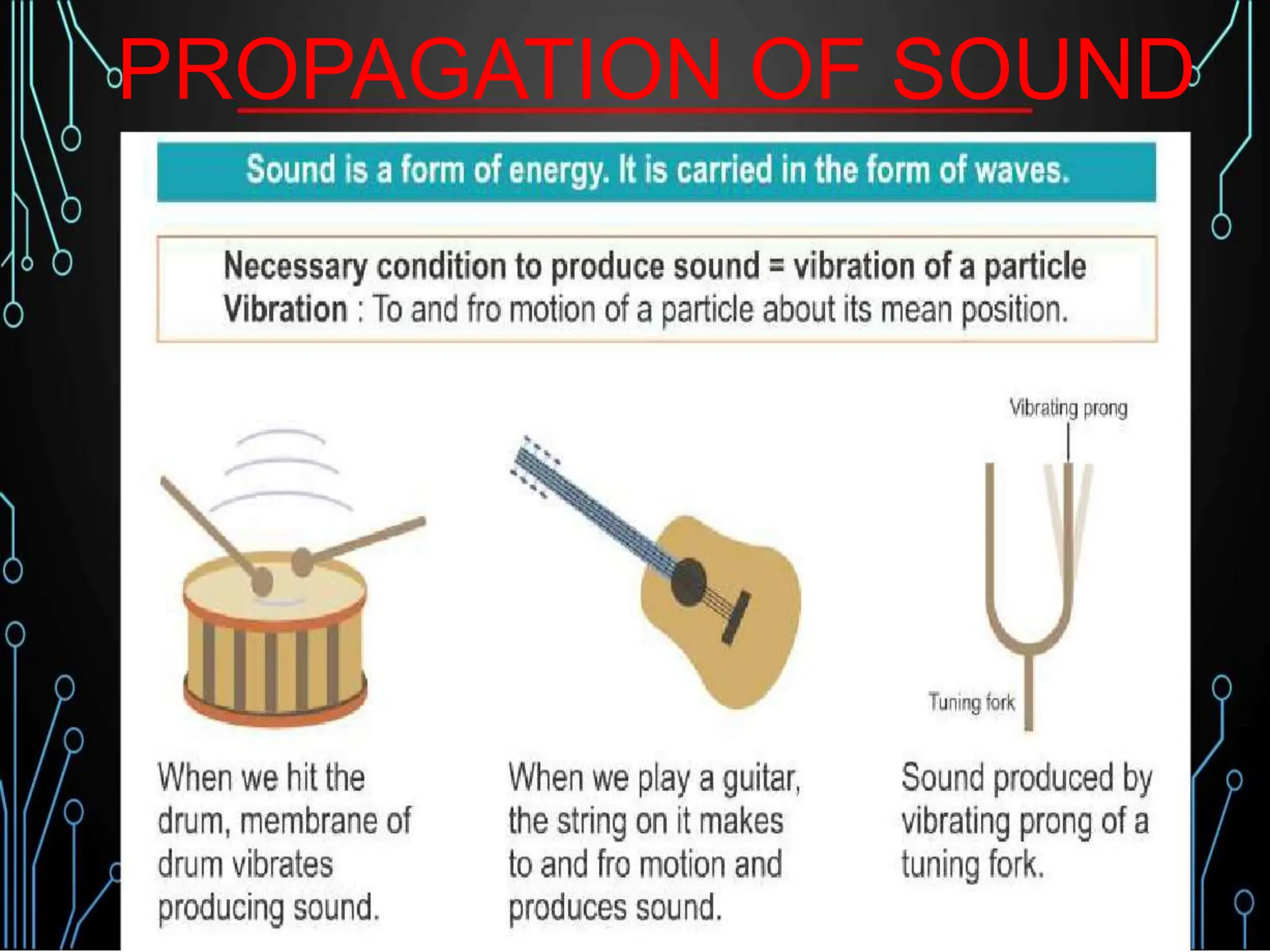
•Sound is produced by vibrating objects.
•Sound is transmitted through a medium.
•Medium can be solid, liquid or gas
•It moves from point of generation to the
listener.
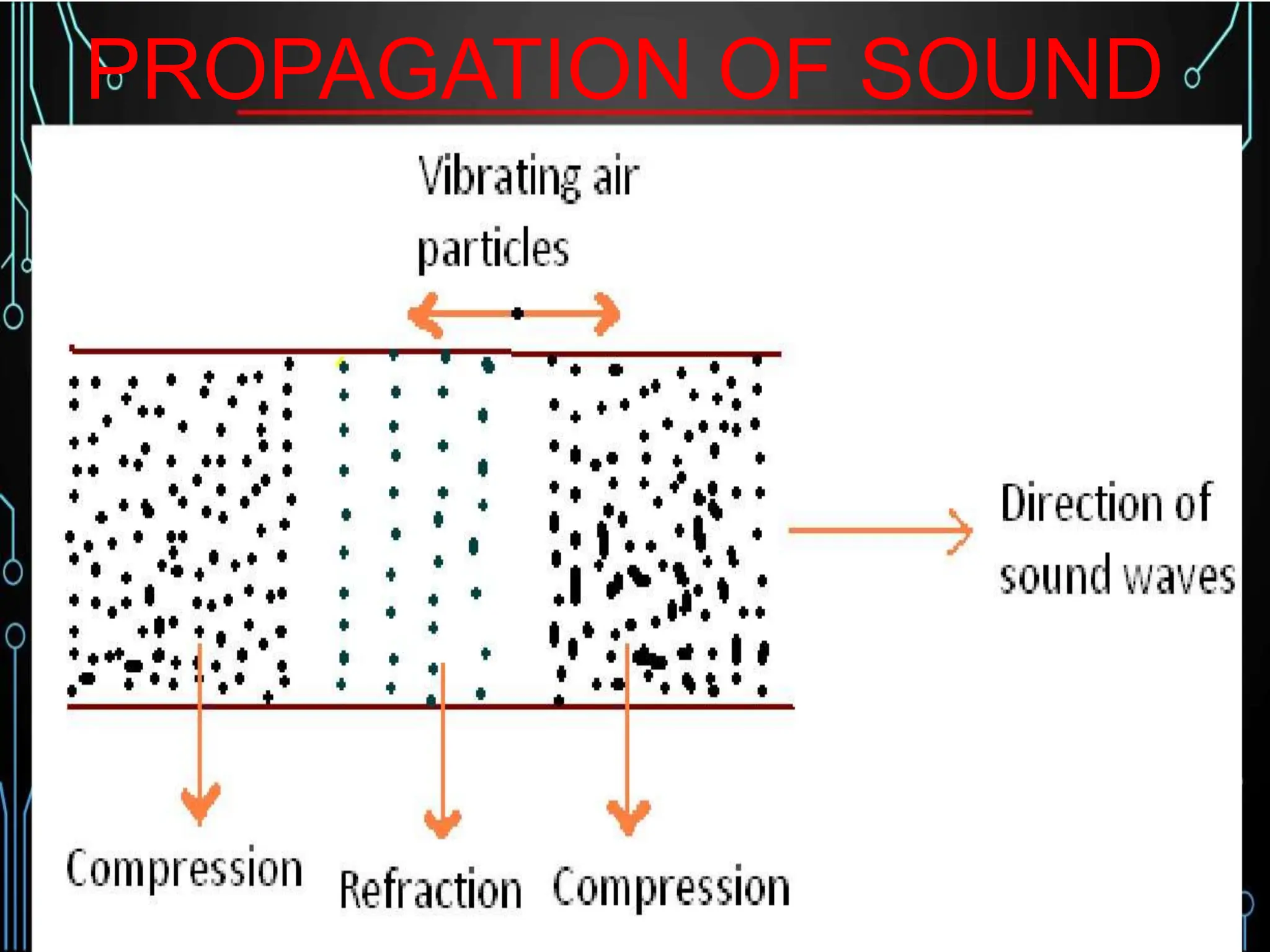
•When the object vibrates, the particles in the
medium around it start vibrating.
PROPAGATION OF SOUND
•There is no movement of the particles, they
don’t travel.
•The particles are displaced from their
equilibrium state.
•The particle exerts force on the adjacent
particle.
•The adjacent particle gets displaced while the
previous particle returns to original position.
PROPAGATION OF SOUND
SOUND WAVE
•Wave is a disturbance that moves through a
medium.
•The wave is created when particles set
neighbouring particles into motion.
•Since the particles of the medium are in
motion,
Sound wave is a mechanical wave.
PROPAGATION OF SOUND
MECHANICS OF SOUND WAVE
•Air is the most common medium through which
the sound travels.
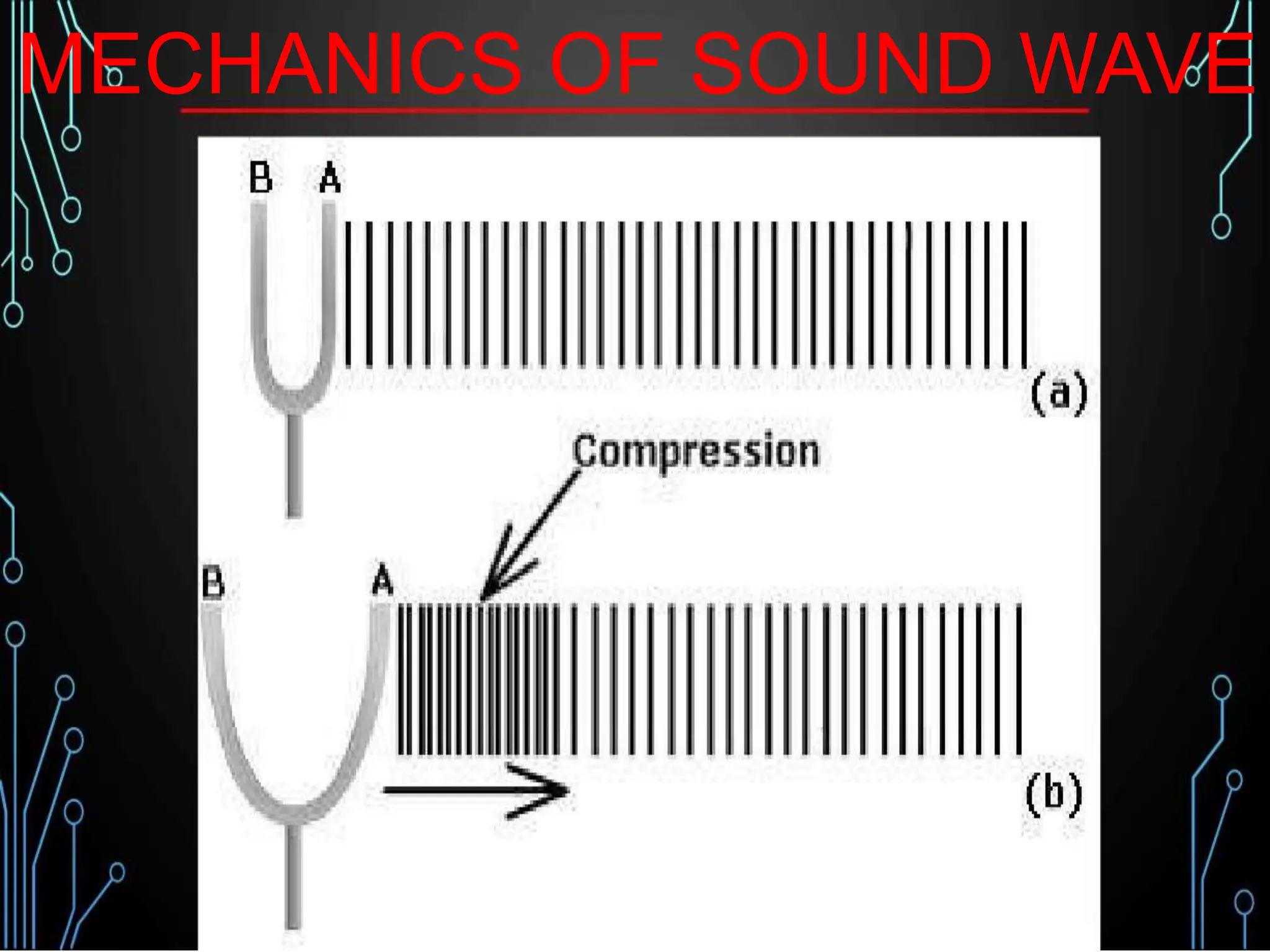
•Forward movement of vibrating object compress
the air, creating high pressure, this is called
Compression (C).
•The compression moves away from the vibrating
object.
MECHANICS OF SOUND WAVE
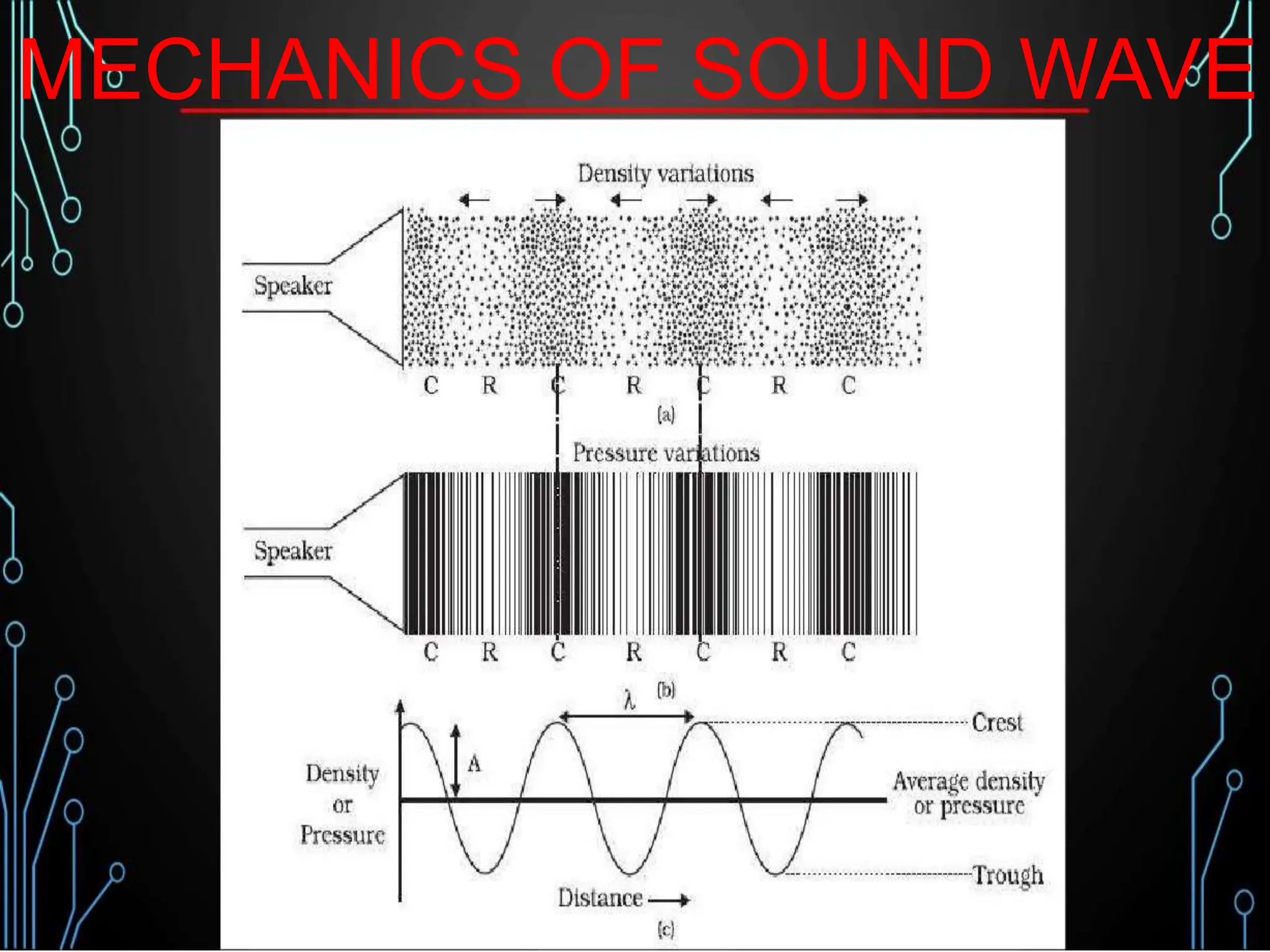
•When the vibrating object moves backwards it
creates low pressure called the Rarefaction (R).
•Pressure is related to the number of particles in
the medium in a given volume.
•The denser the medium the more the pressure.
•Thus sound propagation is a propagation of
density variation or pressure variation in the
medium.
MECHANICS OF SOUND WAVE
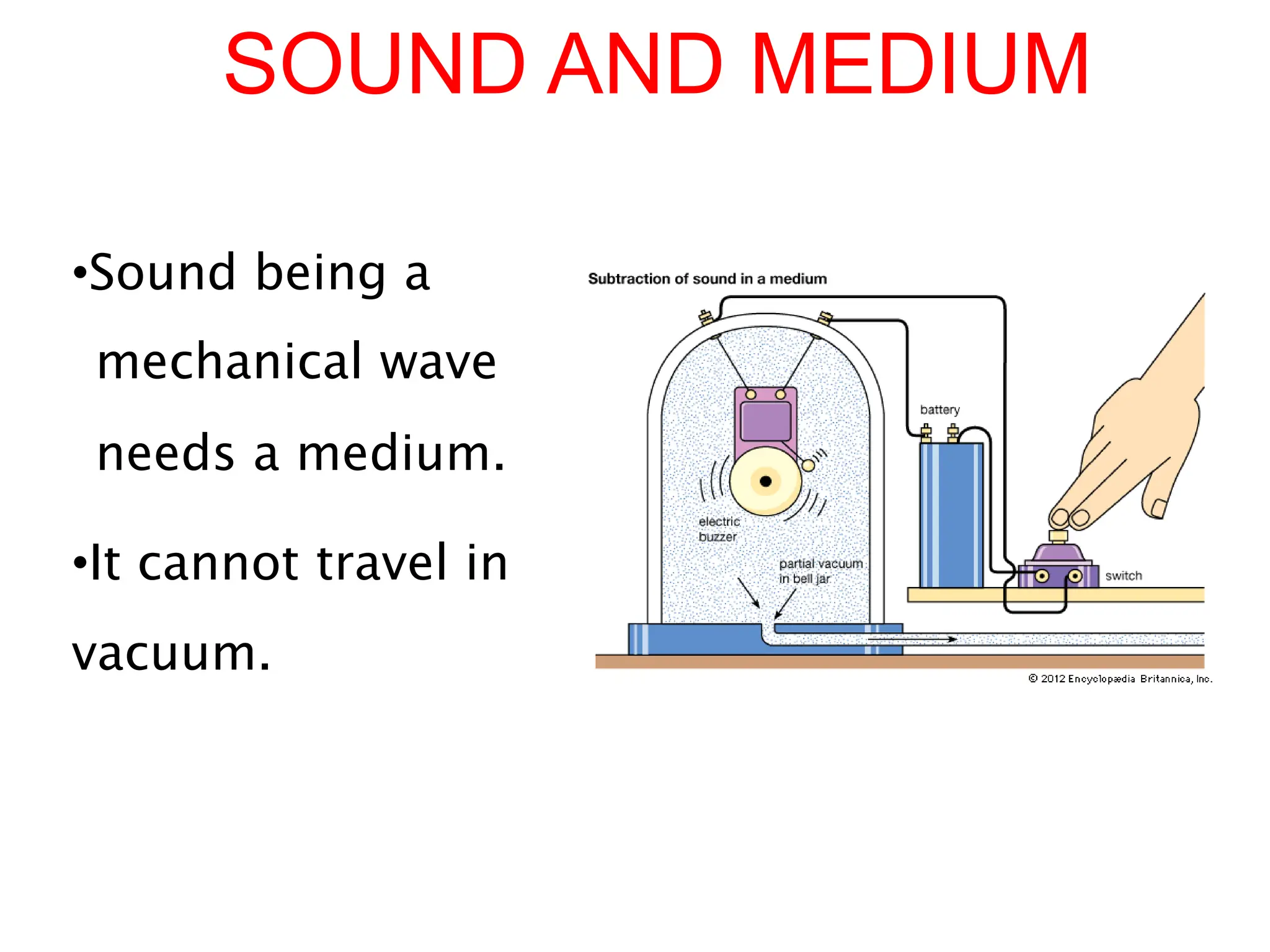
SOUND AND MEDIUM
•Sound being a
mechanical wave
needs a medium.
•It cannot travel in
vacuum.
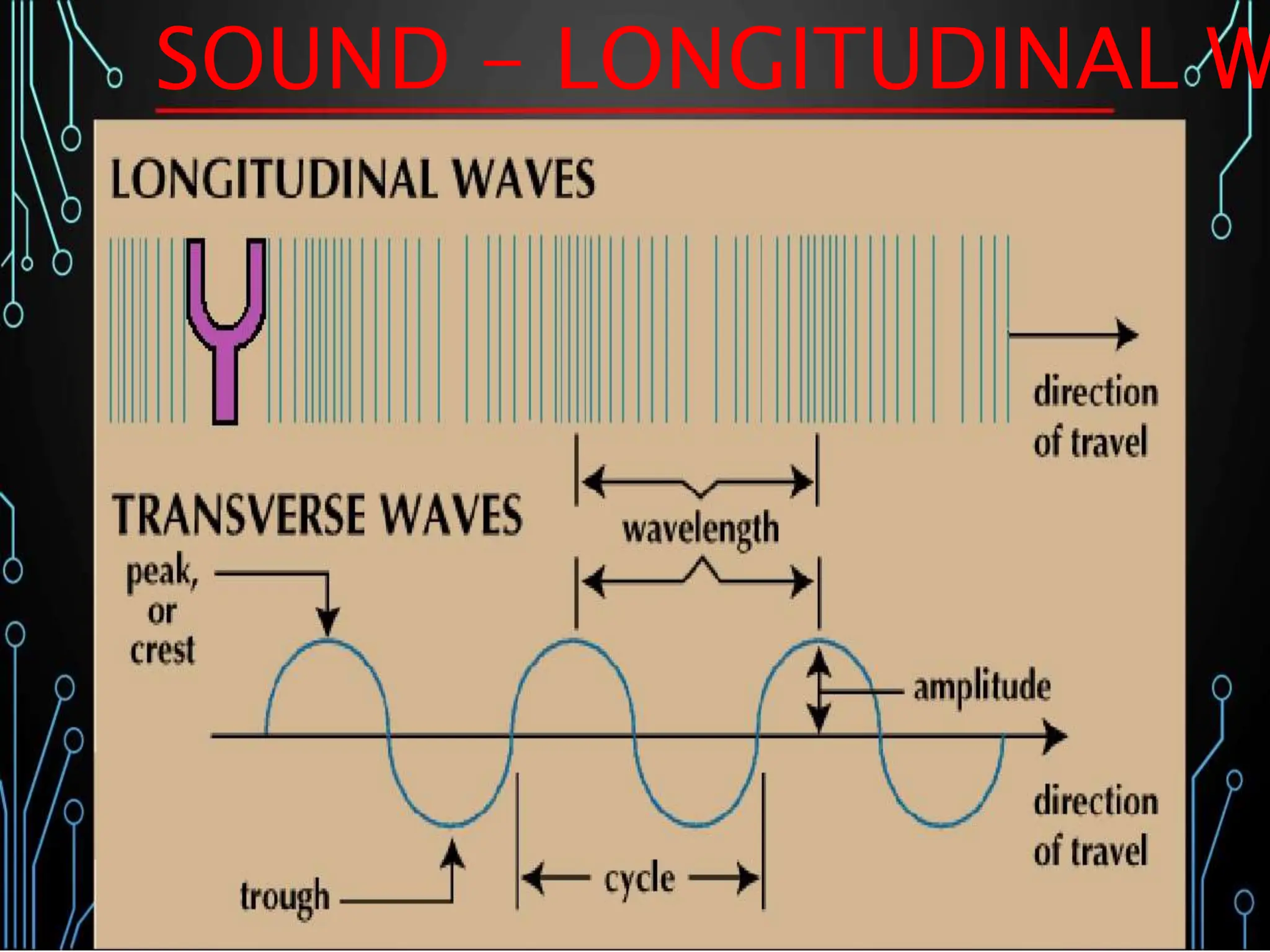
SOUND - LONGITUDINAL WAVE
•Sound waves are longitudinal
waves as
•The individual particles move in a
direction parallel to the propagation of
disturbance.
•They oscillate back and forth about their
position of rest.
•Hence it is a longitudinal wave.
SOUND - LONGITUDINAL W
CHARACTERISTICS OF SOUND
WAVE
Sound wave can be described by its
•Frequency.
•Amplitude.
•Speed.
WAVELENGTH DEFINED
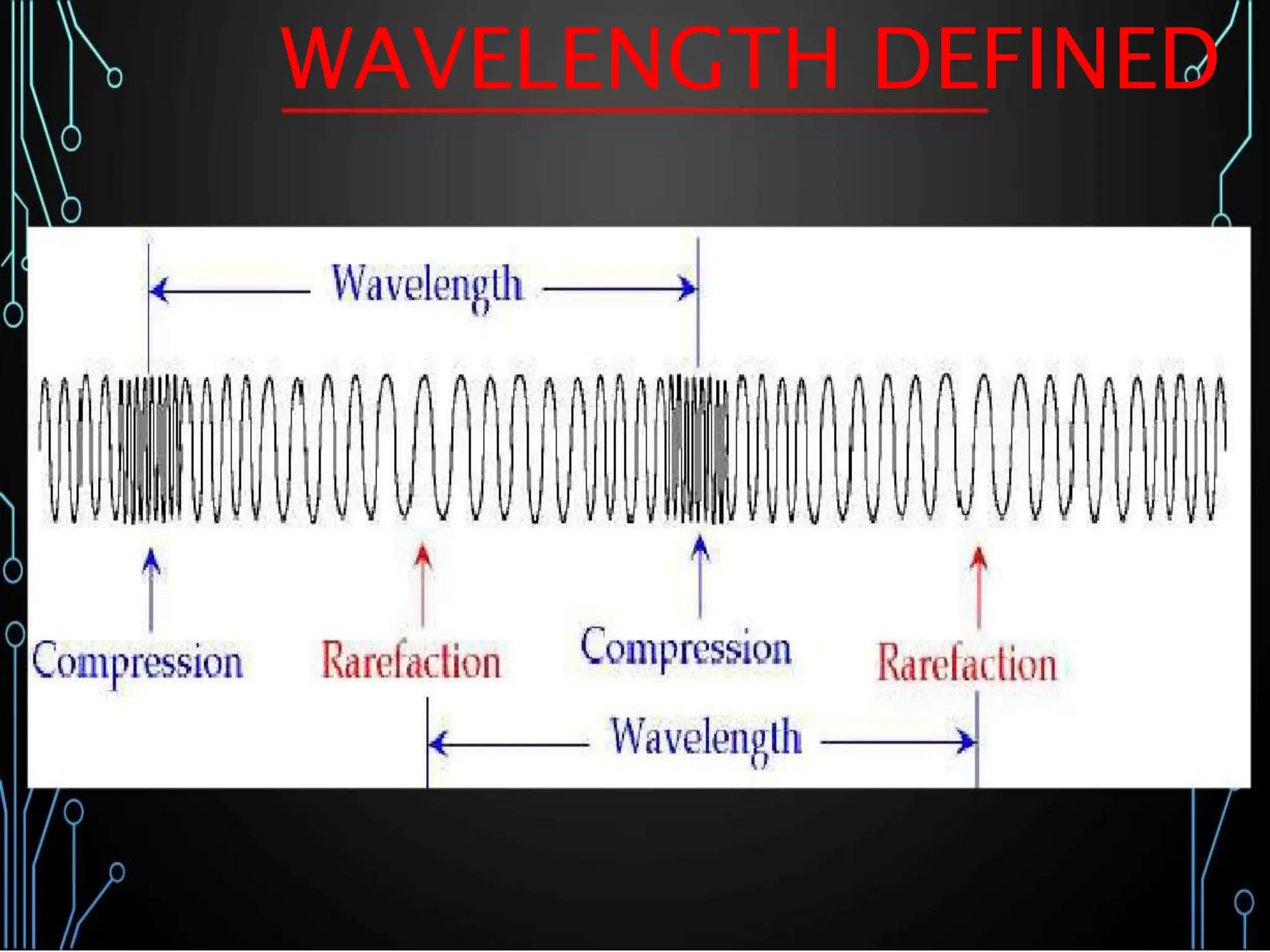
•In case of Sound waves the distance between two
consecutive Compressions (C) or two consecutive
Rarefaction (R) is called the wavelength.
•Wavelength is denoted by Lambda.
•The SI unit of wavelength is meter (m)
WAVELENGTH DEFINED
FREQUENCY DEFINED
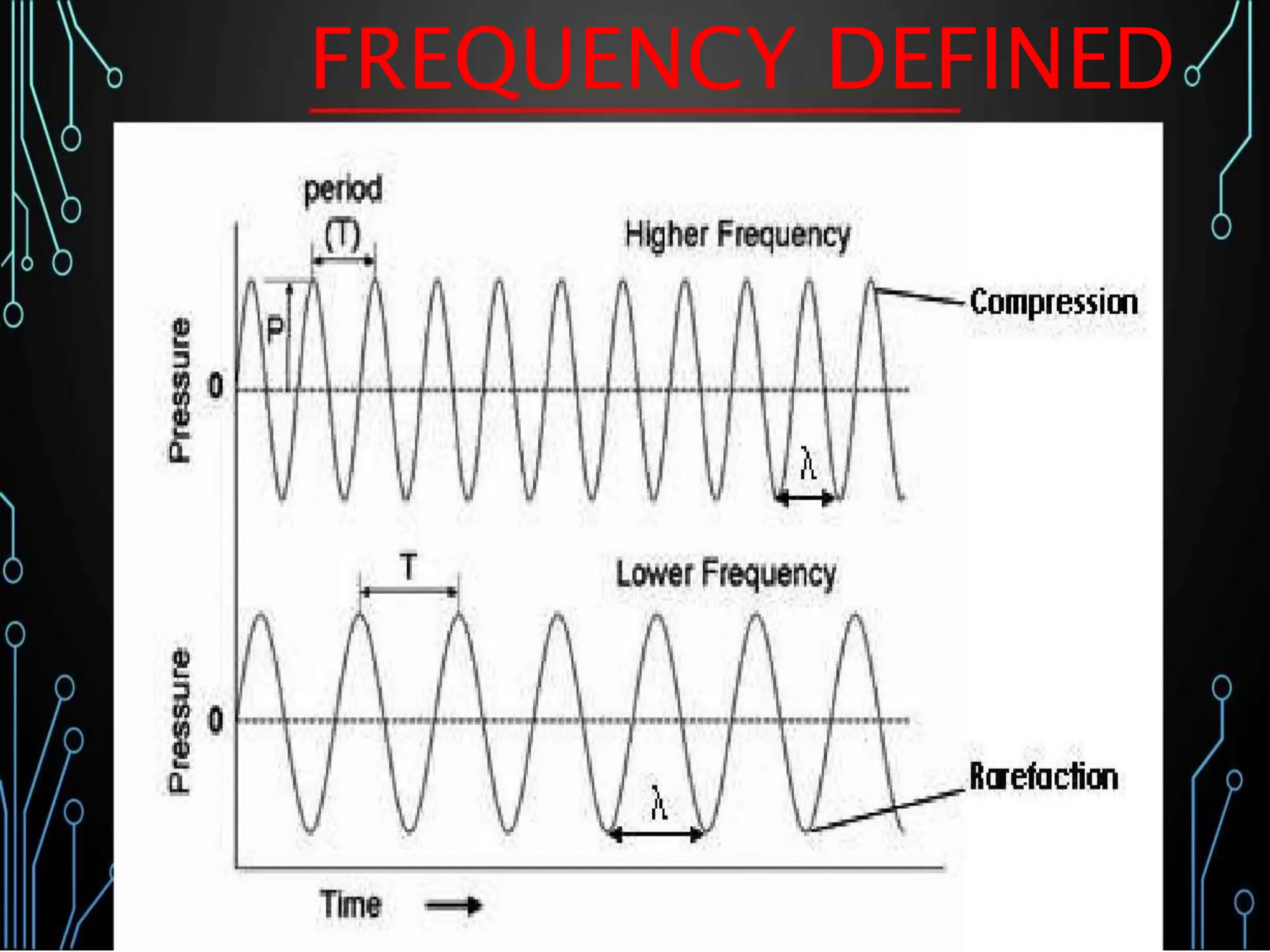
•Frequency tells us how frequently an
event occurs.
•In case of Sound waves it is the number
of Compressions (C) or number of
Rarefaction (R) per unit of time is called
the frequency of the sound wave.
•Frequency is denoted by nu.
•The SI unit of frequency is hertz (Hz)
FREQUENCY DEFINED
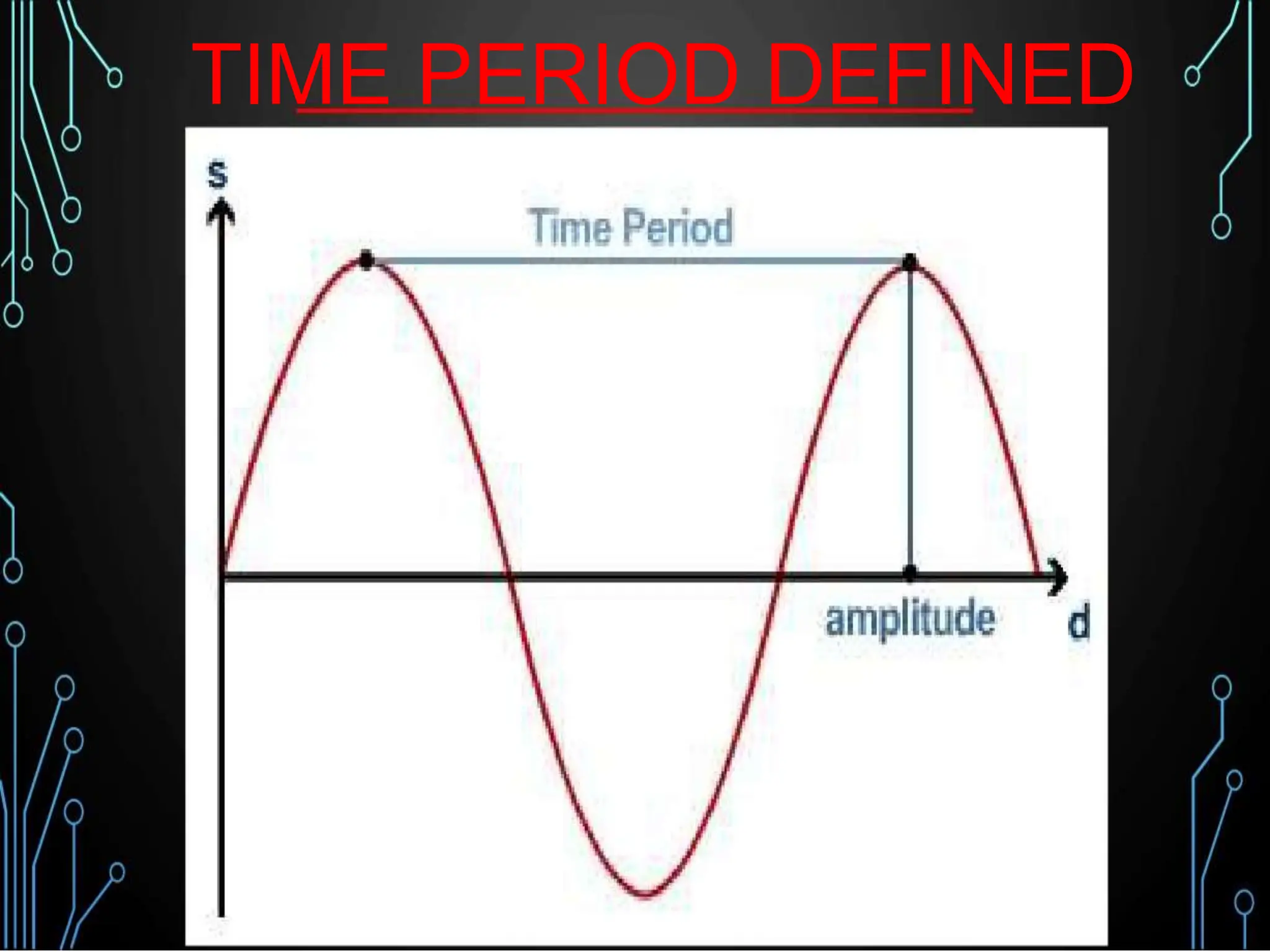
TIME PERIOD DEFINED
•The time taken by two consecutive
Compressions (C) or Rarefaction (R) to
cross a fixed point is called the time
period of the wave
.
•Time period is denoted by T.
•The SI unit of Time period is second (s).
•Frequency and Time period are related
as
• Frequency = 1/ T
TIME PERIOD DEFINED
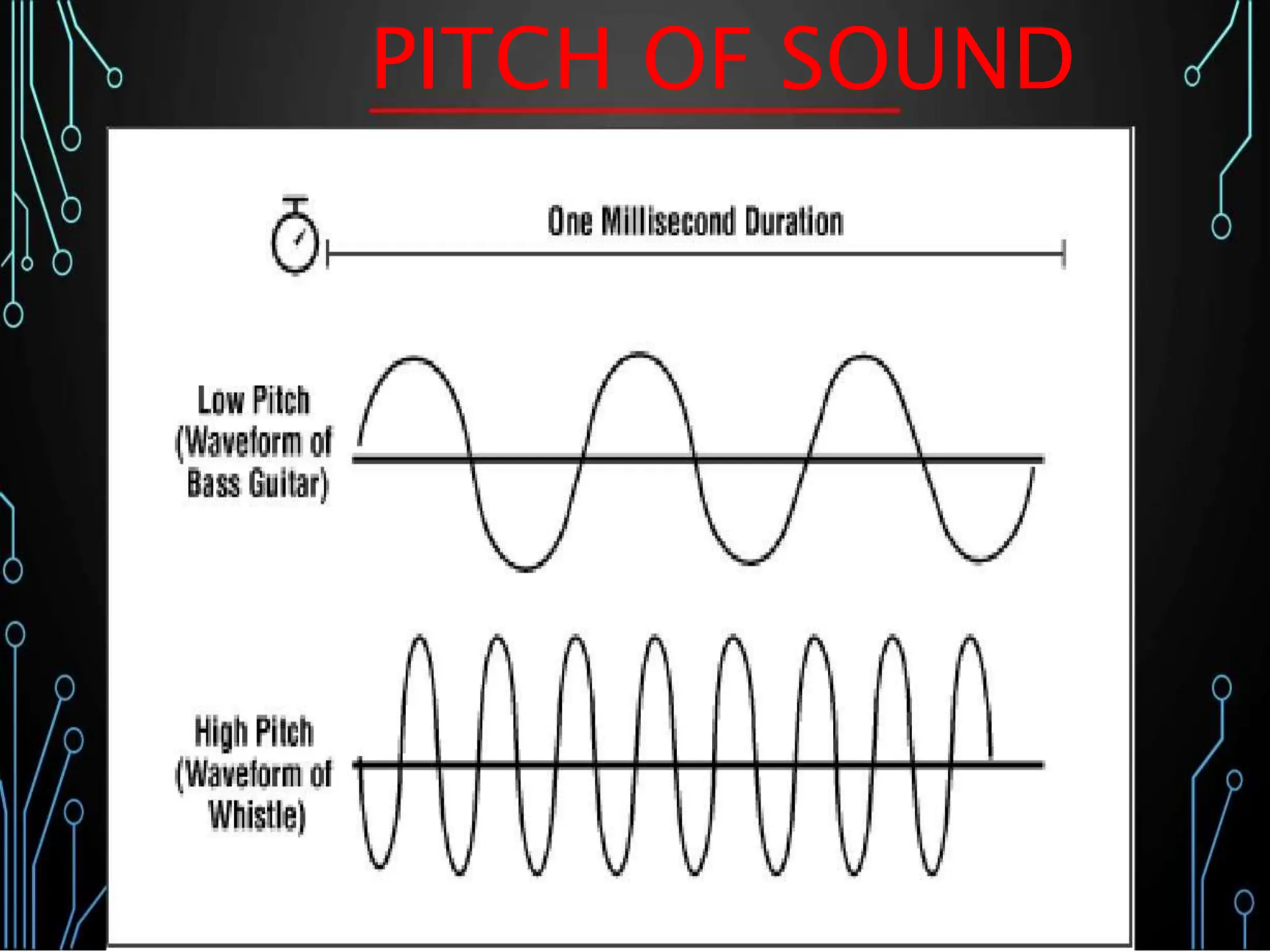
PITCH OF SOUND
•The faster the vibration of the source,
higher is the frequency and thus higher
the Pitch.
•A high pitch sound corresponds to more number
of Compressions (C) and Rarefactions (R) passing
fixed point per unit time.
PITCH OF SOUND
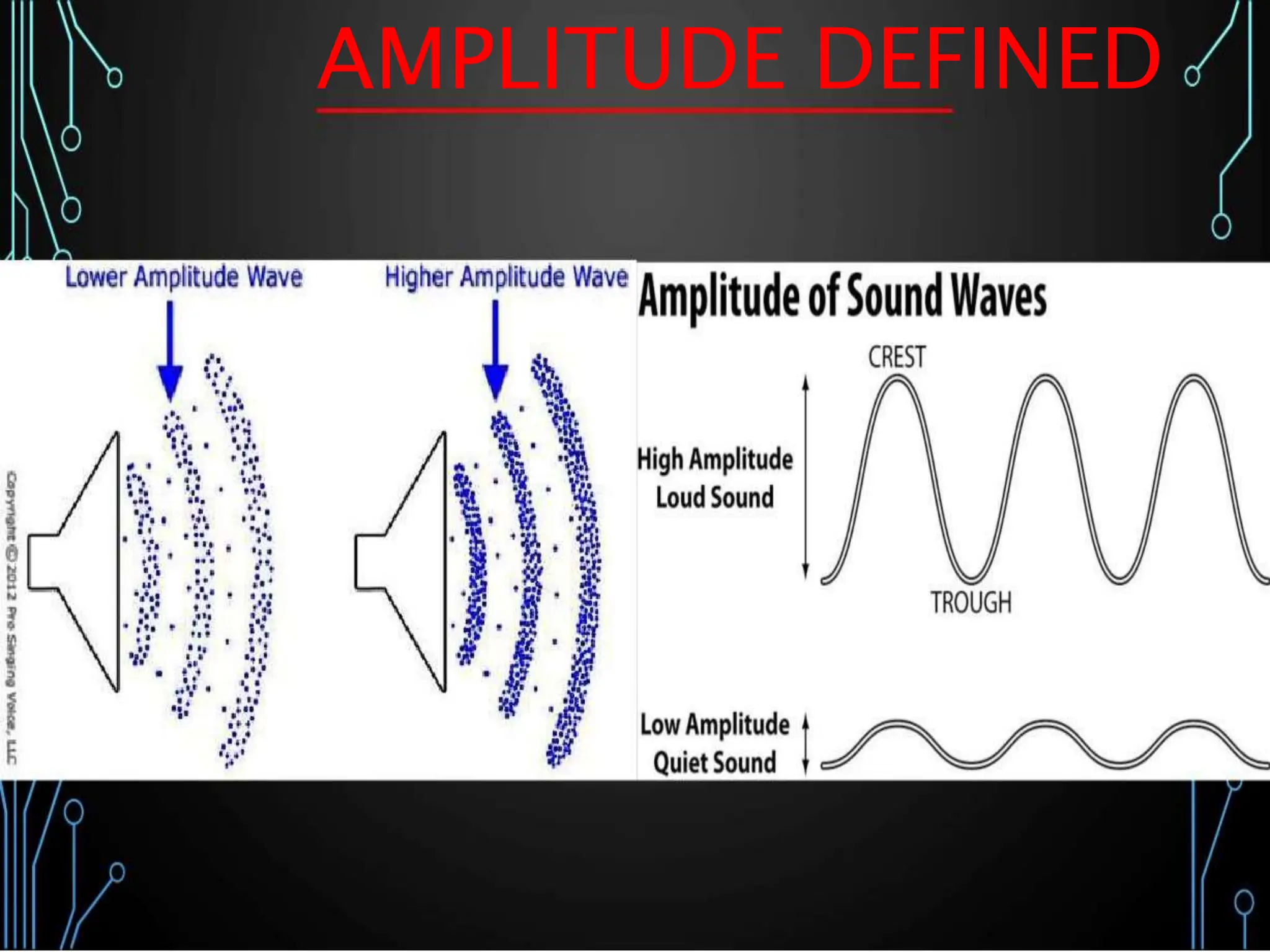
AMPLITUDE DEFINED
•The magnitude of maximum
disturbance in the medium on either side
of the mean is called Amplitude
.
•Amplitude is denoted by A.
•It depends on the force used to produce
the vibration.
•The Loudness or Softness of sound is
determined by its Amplitude.
AMPLITUDE DEFINED
AMPLITUDE DEFINED
TONE, NOTE, NOISE DEFINED
•A sound of single frequency is called Tone.
•A sound of mixed frequency is called Note
•What is pleasant to listen is called Music.
•Noise is unpleasant to the ear.
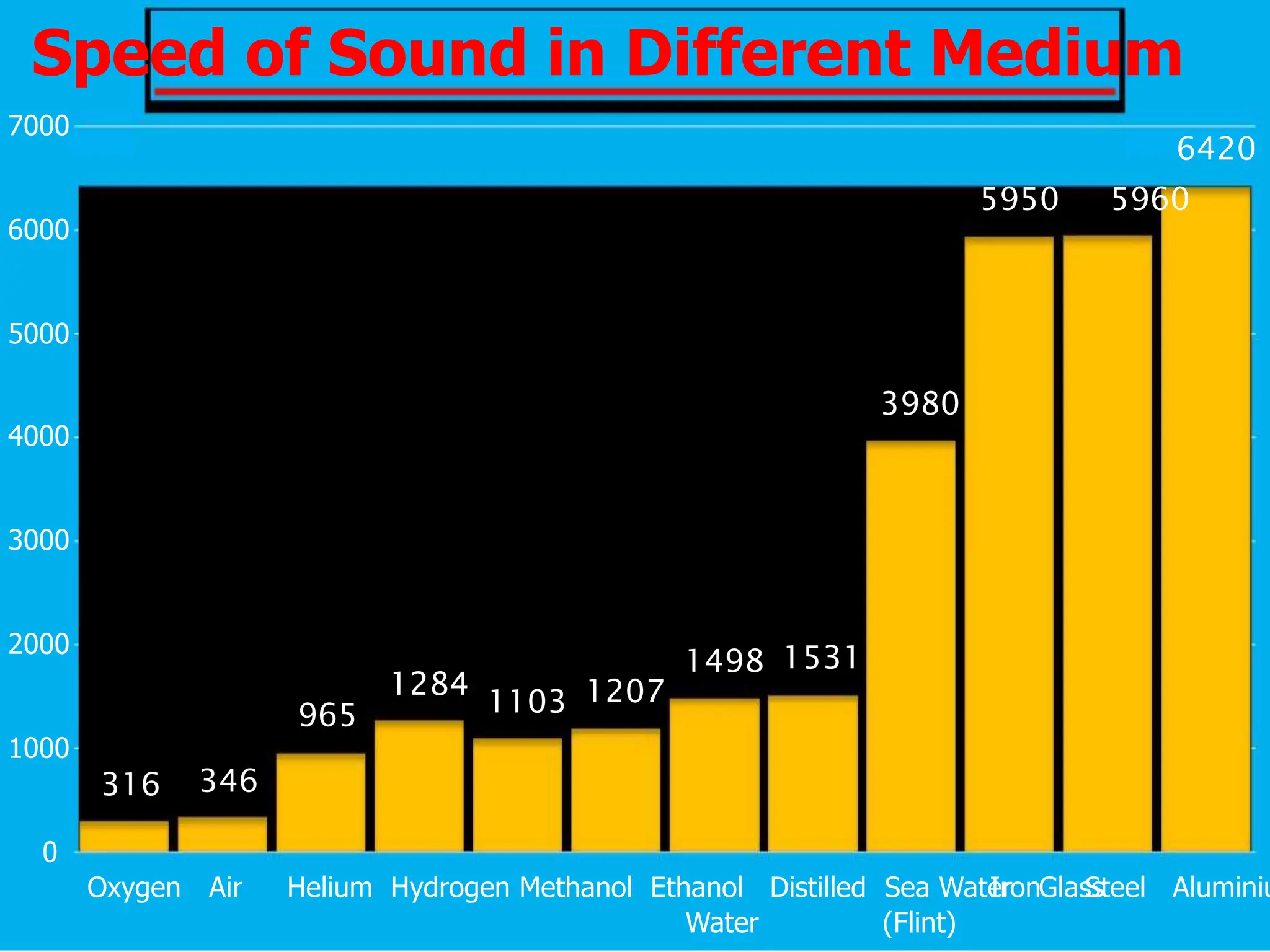
SPEED OF SOUND IN DIFFERENT
MEDIUM
•The sound propagates through a medium at a
finite speed.
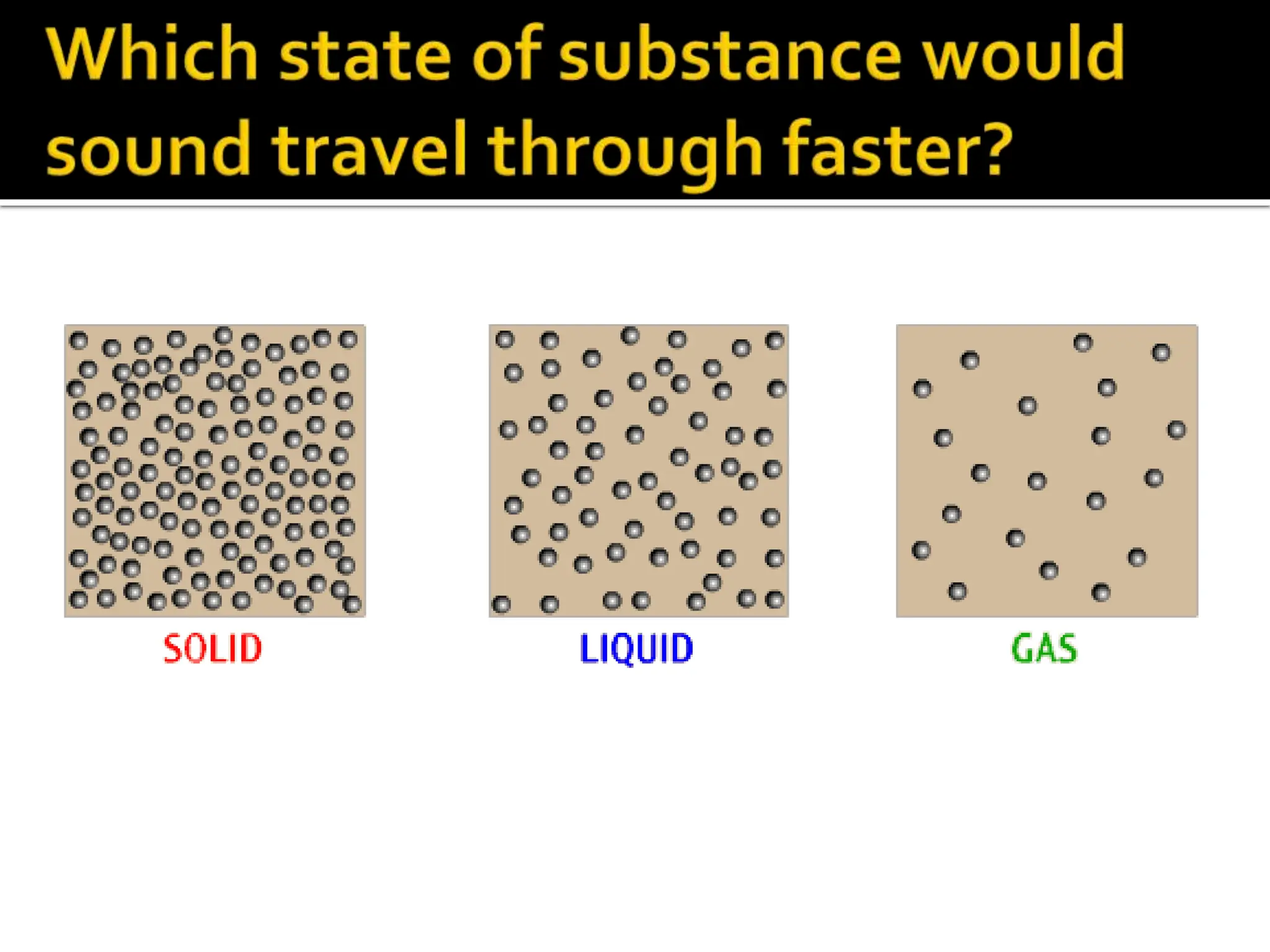
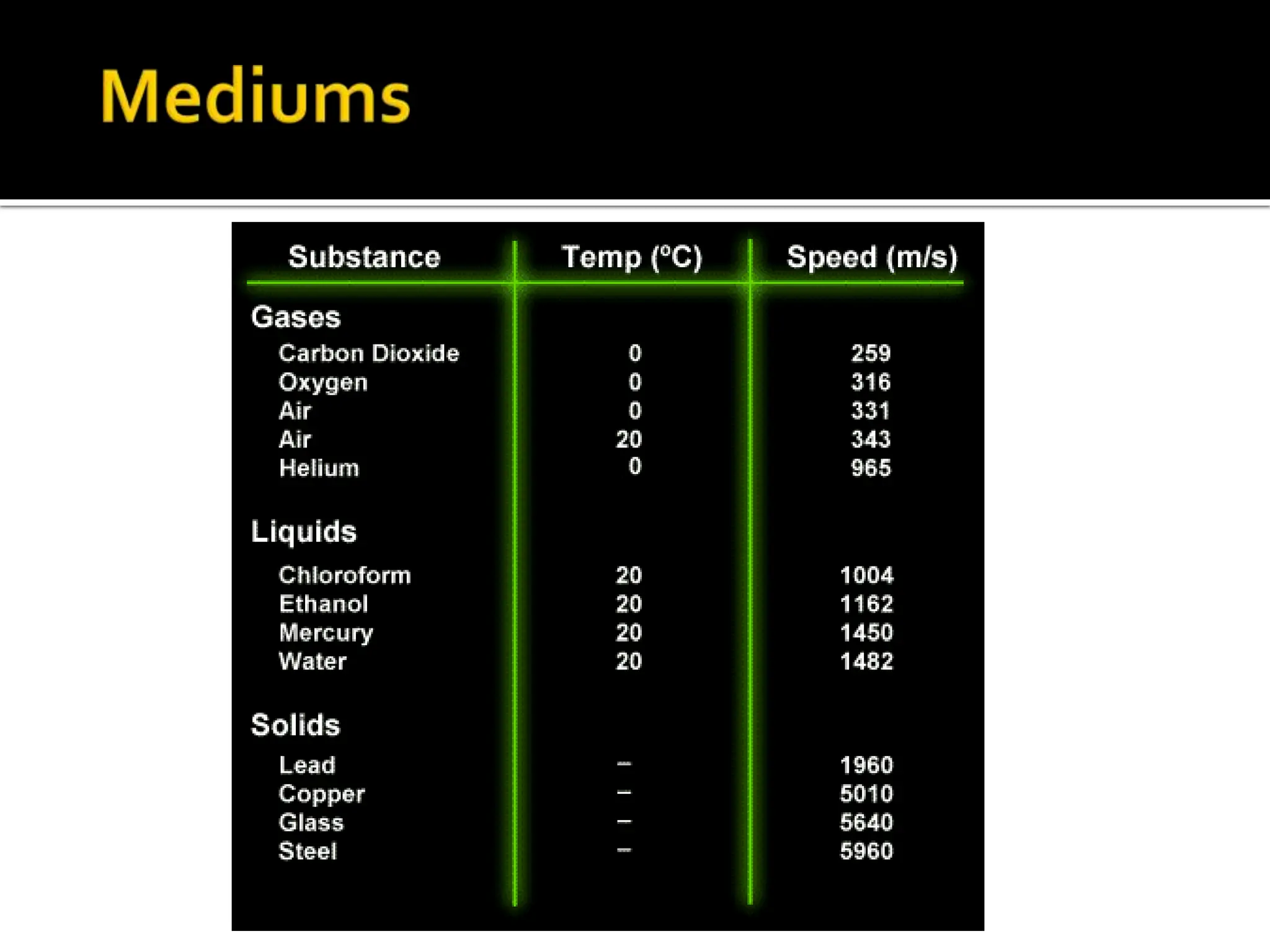
•The speed of depends on the properties of the
medium. It travels faster in a denser medium.
•The speed of sound depends on the temperature
of the medium. It increases with rise in
temperature.
Speed of Sound in Different Medium
7000
6420
6000
5000
4000
3000
2000
1000
316
0
1284
965
346
1103
1498
1207
3980
1531
5950 5960
Oxygen Air Helium Hydrogen Methanol Ethanol Distilled Sea Water Glass
Iron Steel Aluminiu
Water (Flint)
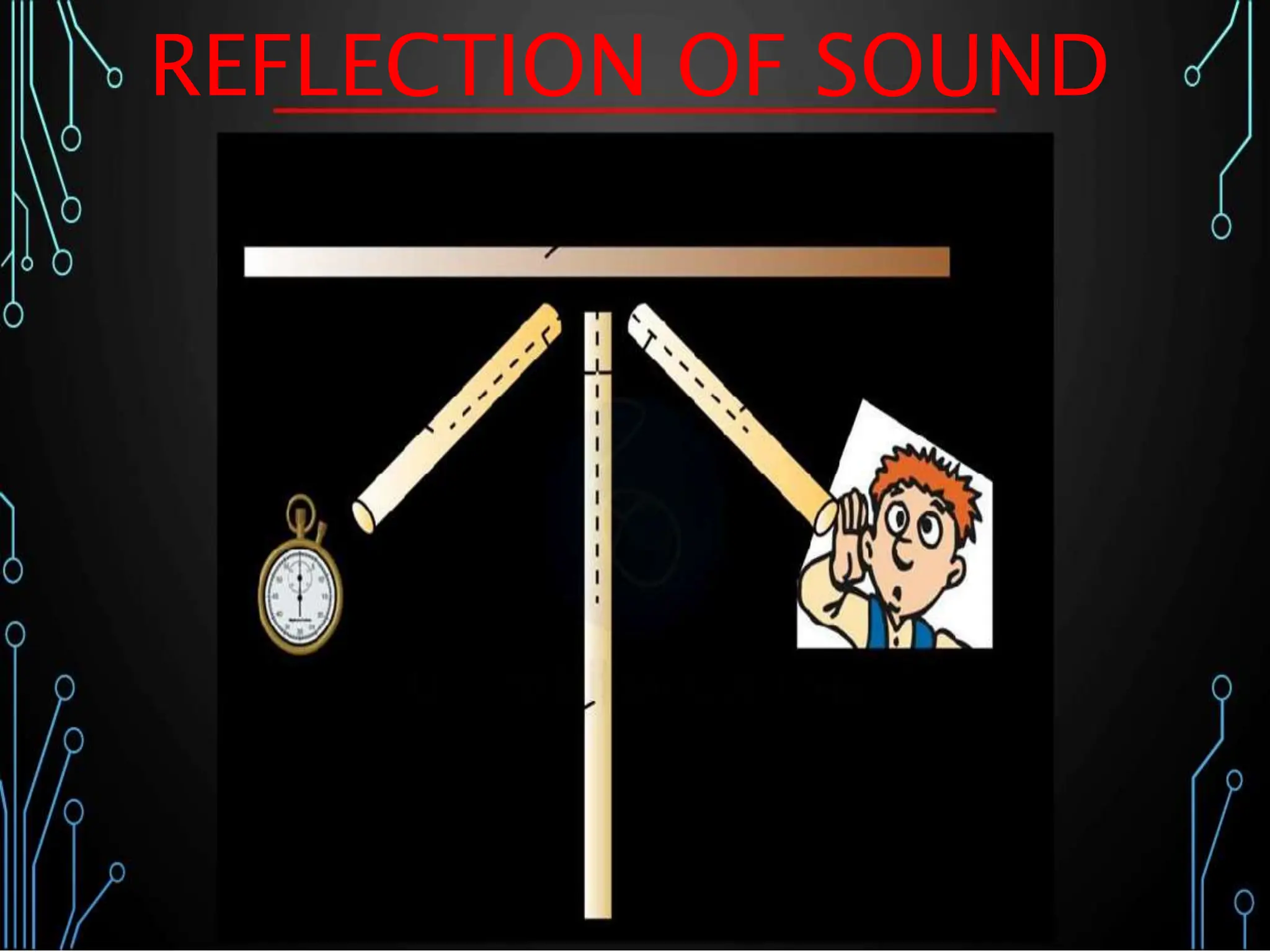
REFLECTION OF SOUND
•Sound follows the same laws of reflection as
light.
•The angle of incident sound wave and the
reflected sound is equal with the normal to the
reflecting surface.
•The incident wave the normal and the reflected
wave lie on the same plane.
REFLECTION OF SOUND
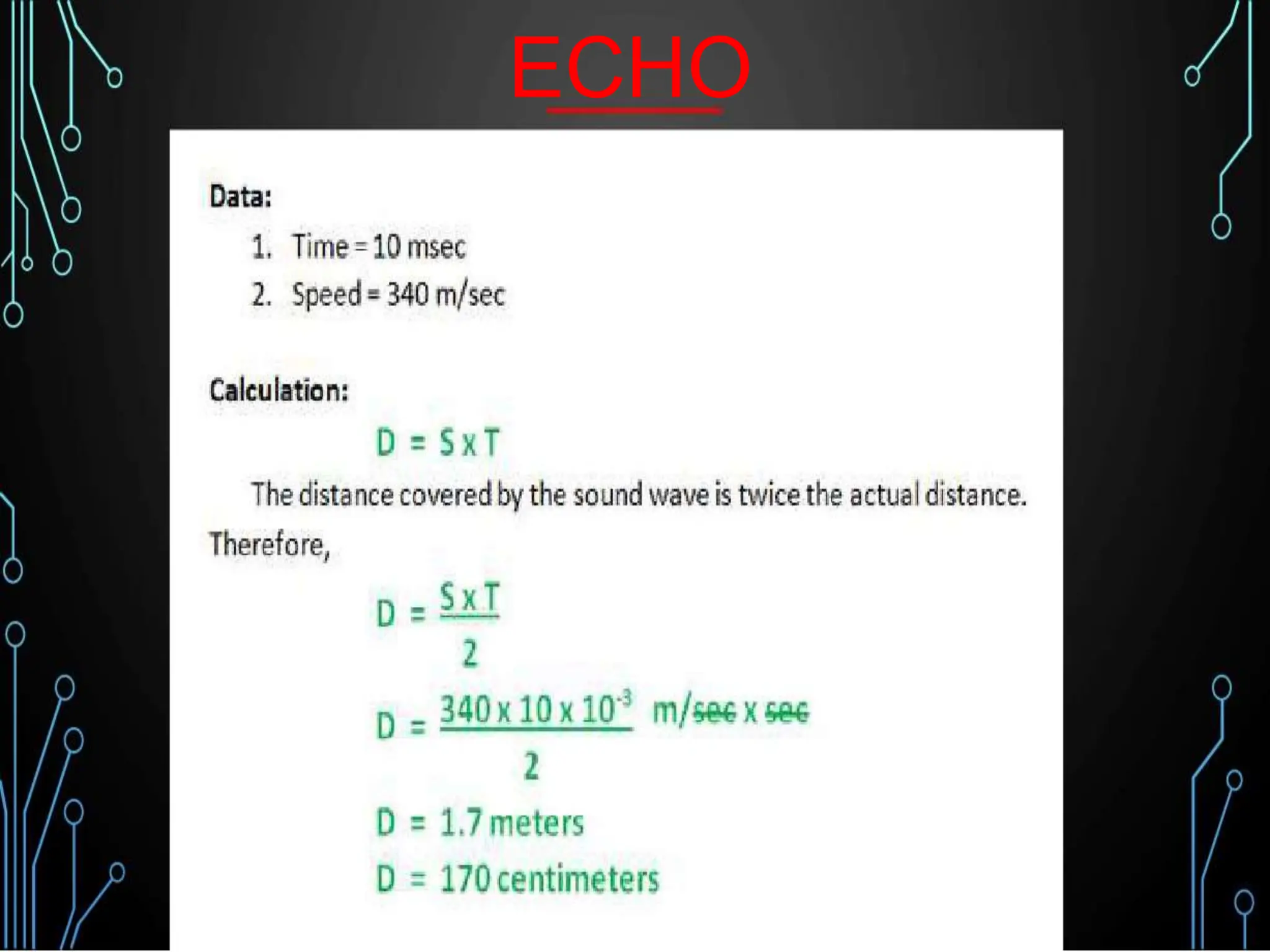
ECHO
•Echo is the reflection of Sound from buildings
and mountains.
•To hear an Echo the difference between the
initial sound and the reflected sound should be
at least 0.1 sec.
•Mathematically this distance travelled by sound
should be at least 34.4 m on an ambient
temperature of 22 degrees centigrade.
ECHO
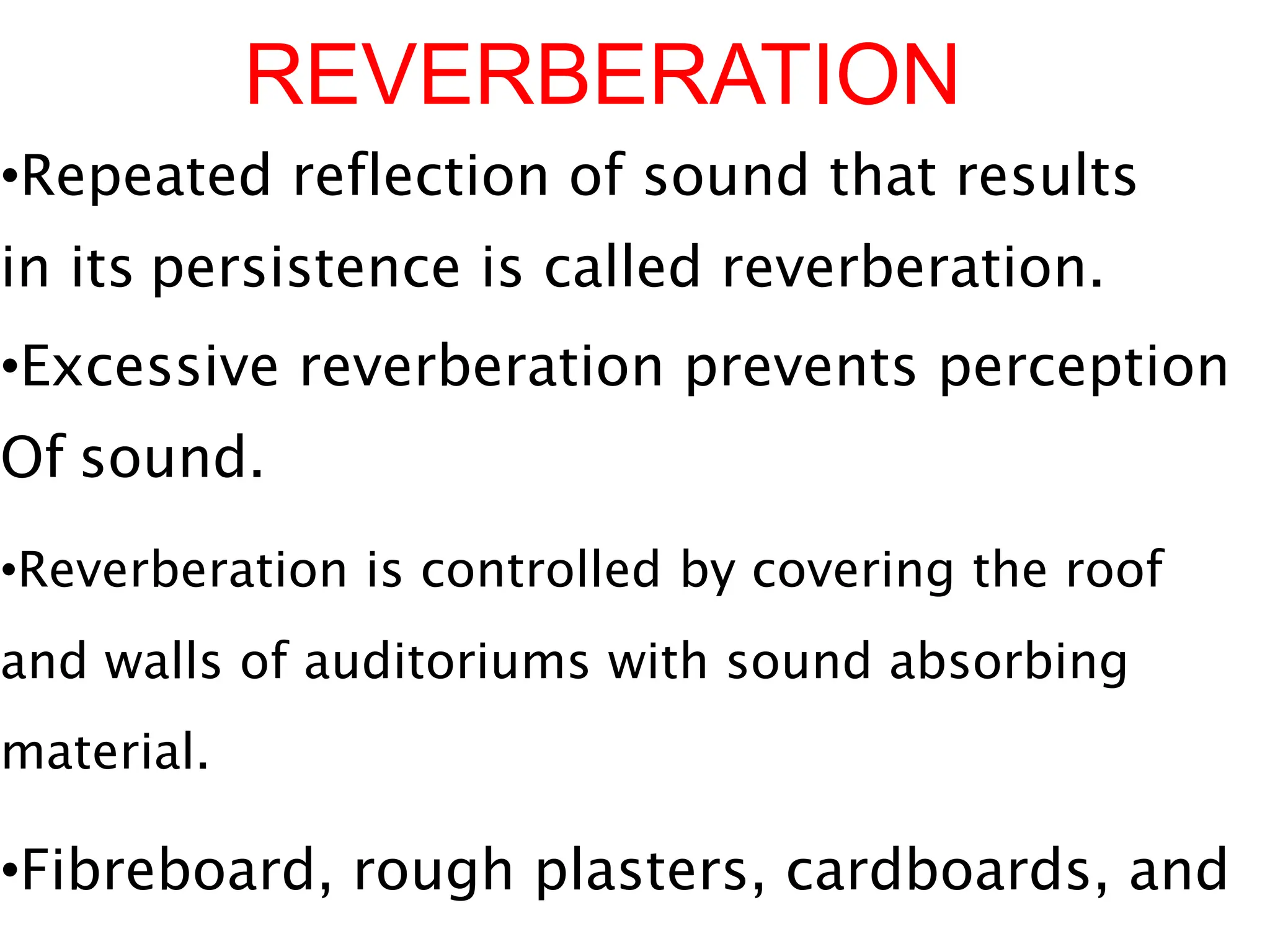
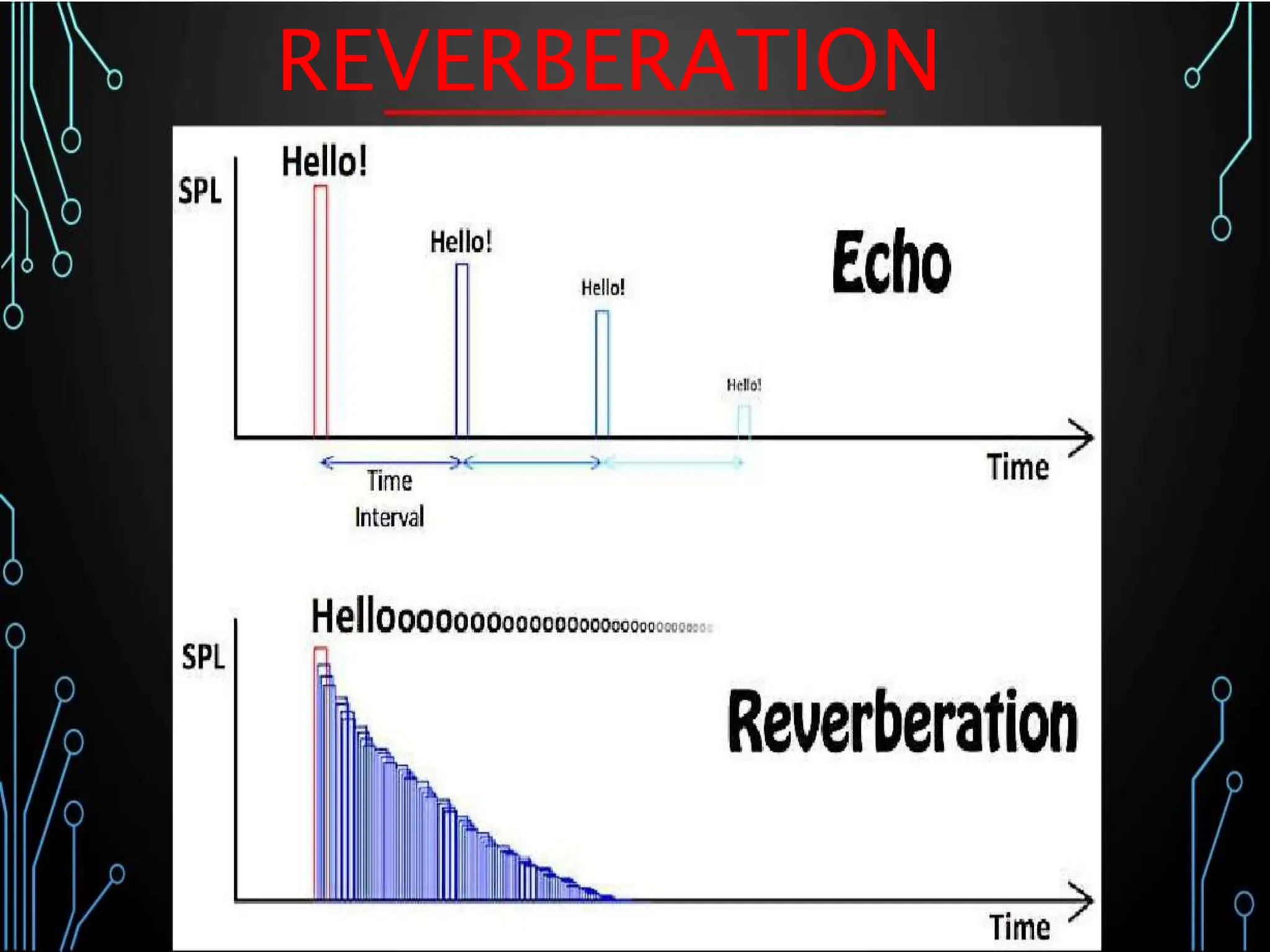
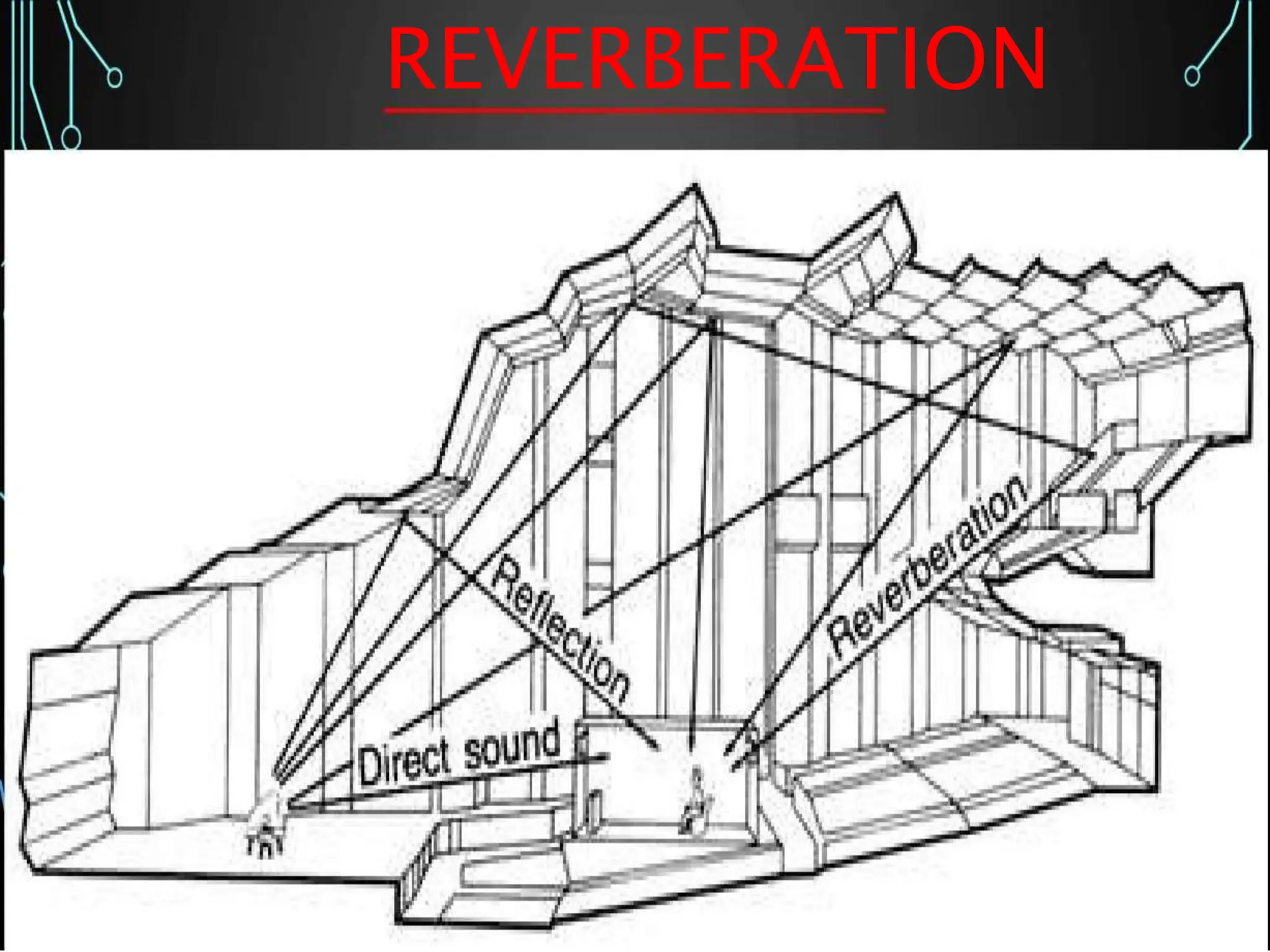
REVERBERATION
•Repeated reflection of sound that results
in its persistence is called reverberation.
•Excessive reverberation prevents perception
Of sound.
•Reverberation is controlled by covering the roof
and walls of auditoriums with sound absorbing
material.
•Fibreboard, rough plasters, cardboards, and
REVERBERATION
REVERBERATION
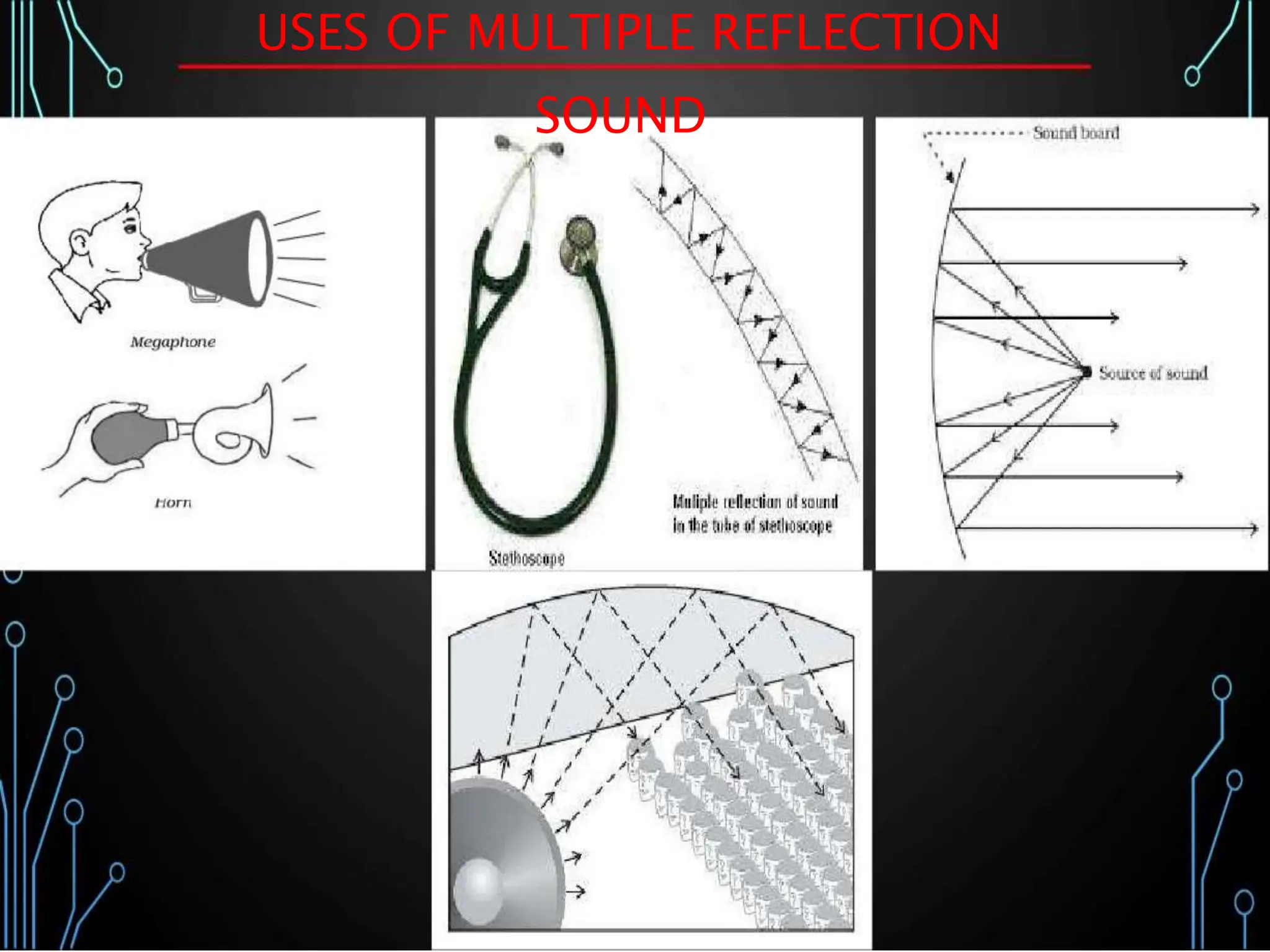
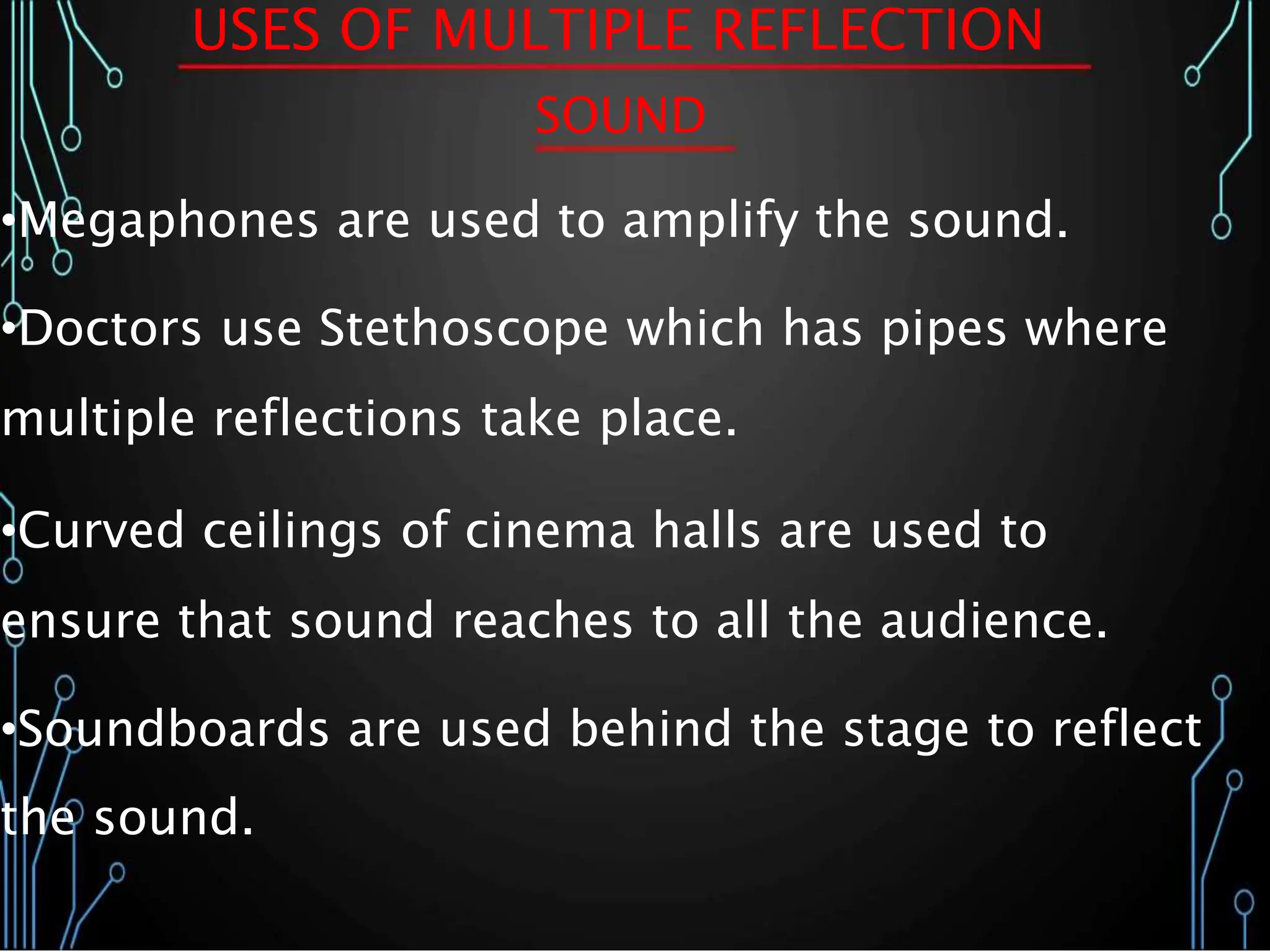
USES OF MULTIPLE REFLECTION
SOUND
•Megaphones are used to amplify the sound.
•Doctors use Stethoscope which has pipes where
multiple reflections take place.
•Curved ceilings of cinema halls are used to
ensure that sound reaches to all the audience.
•Soundboards are used behind the stage to reflect
the sound.
USES OF MULTIPLE REFLECTION
SOUND
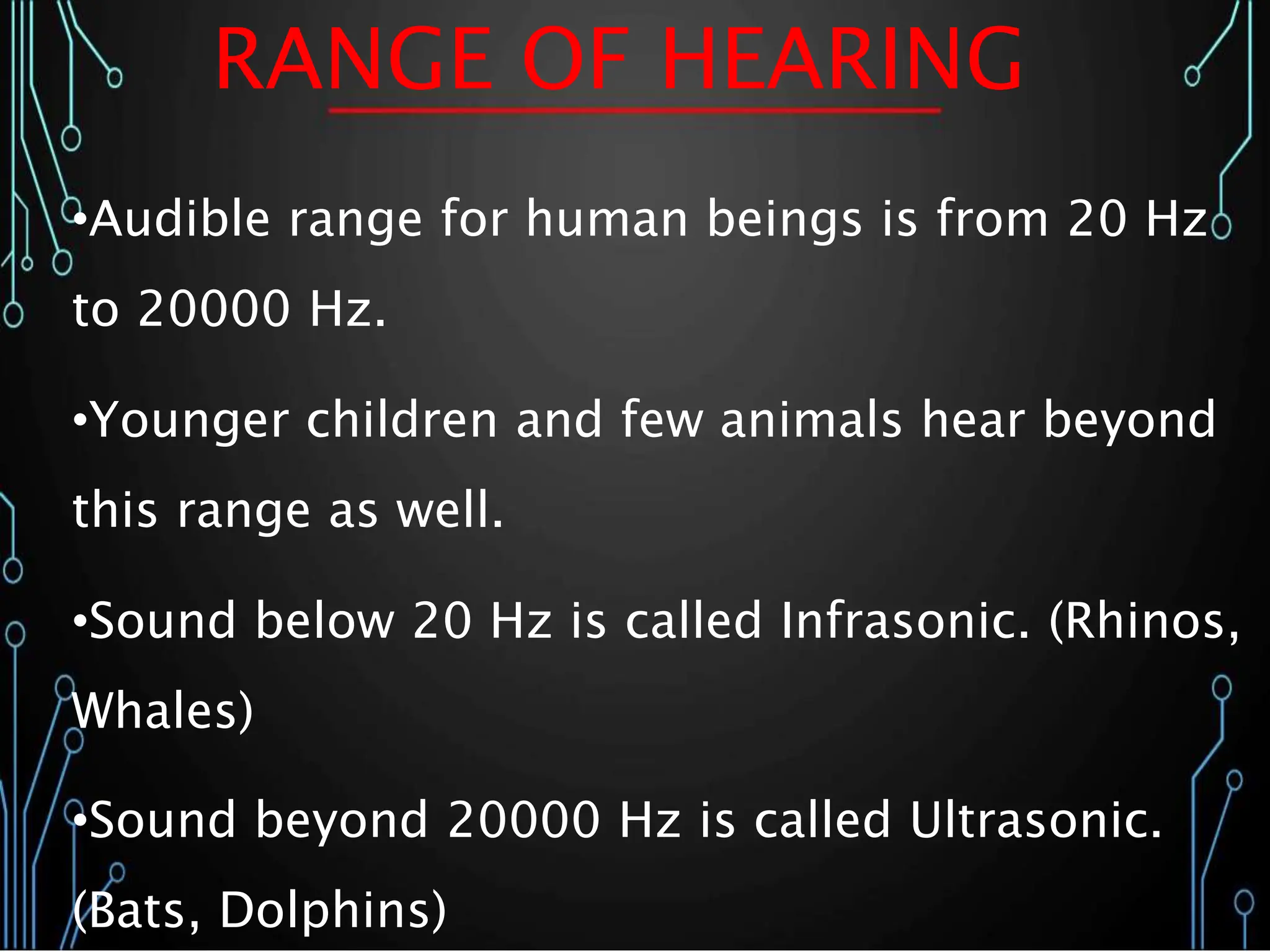
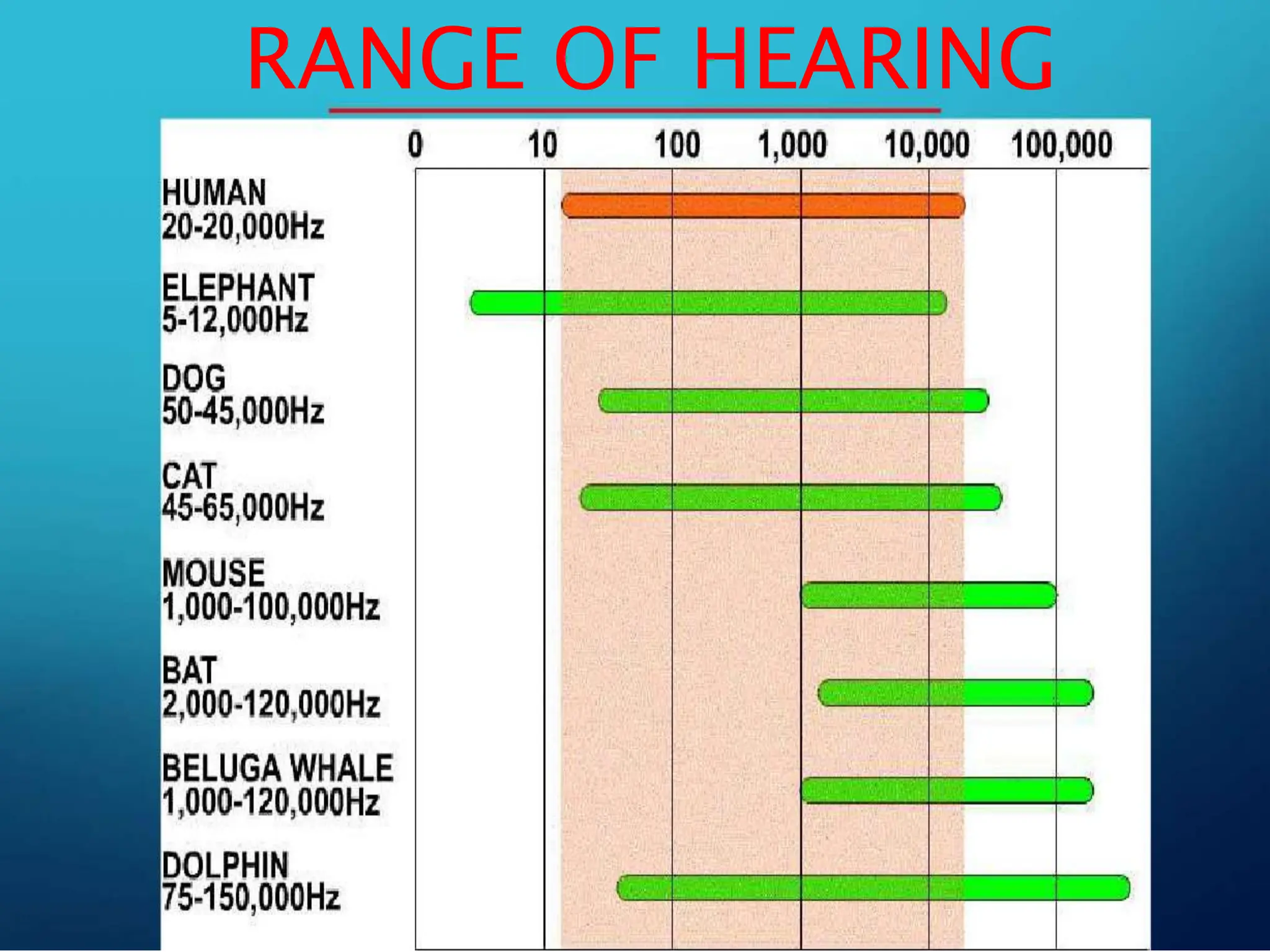
RANGE OF HEARING
•Audible range for human beings is from 20 Hz
to 20000 Hz.
•Younger children and few animals hear beyond
this range as well.
•Sound below 20 Hz is called Infrasonic. (Rhinos,
Whales)
•Sound beyond 20000 Hz is called Ultrasonic.
(Bats, Dolphins)
RANGE OF HEARING
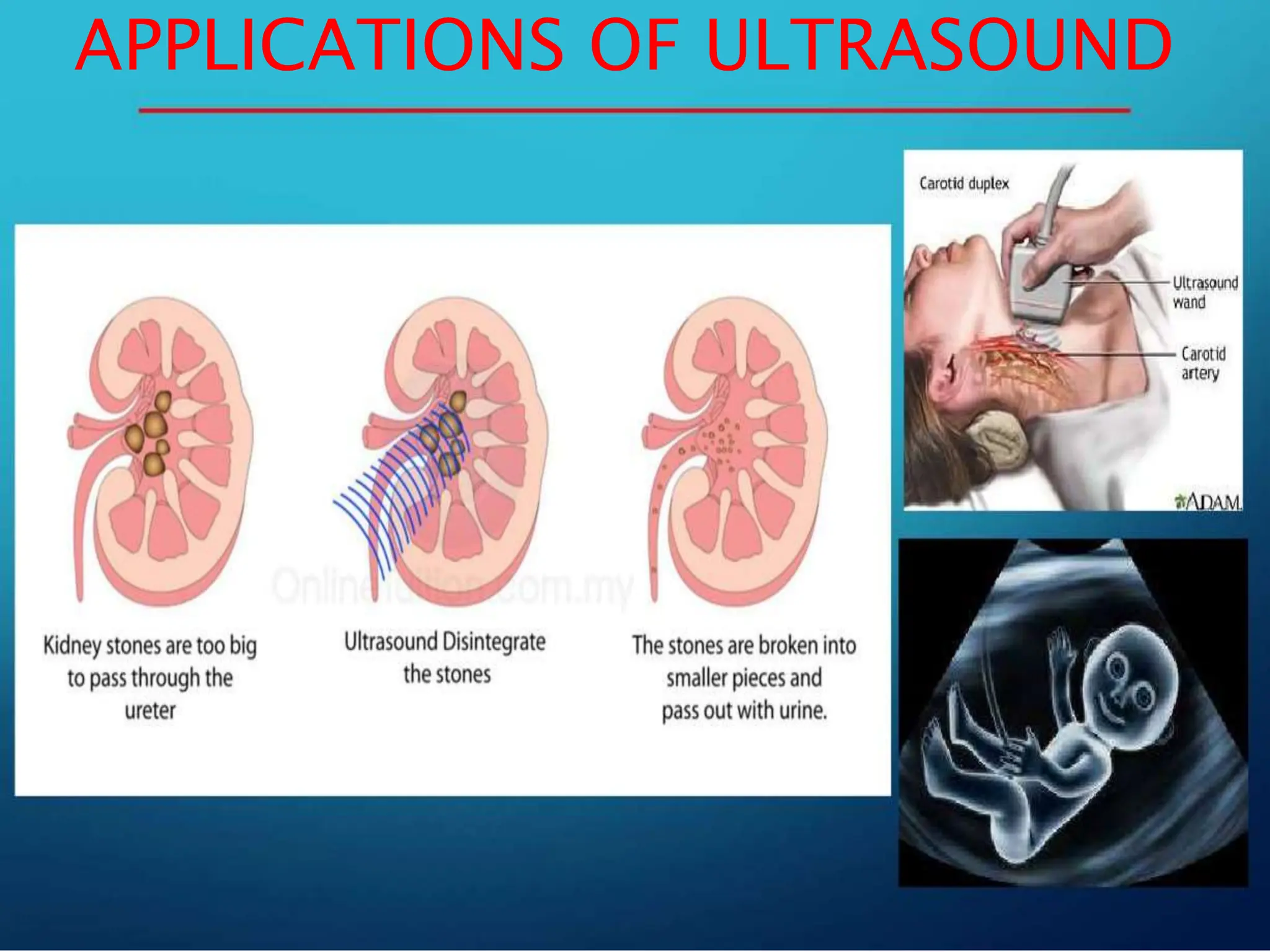
APPLICATIONS OF ULTRASOUND
•Cleaning of hard to reach places of machines.
•Detect cracks and flaws in metal blocks.
•Medical application in echocardiography.
•Ultrasound imagery of internal organs of human
body.
•Removal of kidney stones by breaking them with
ultrasound.
APPLICATIONS OF ULTRASOUND
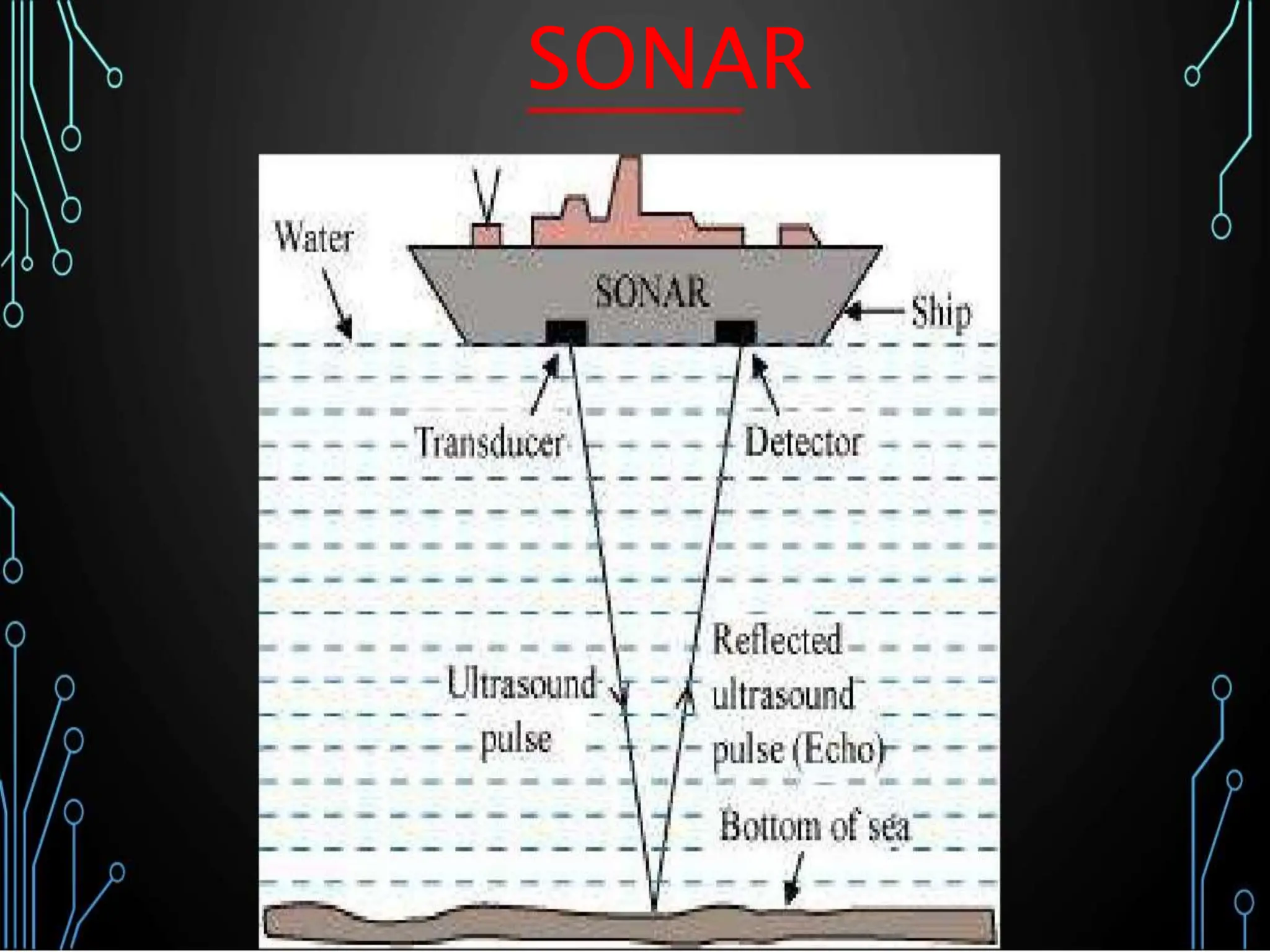
SONAR
•SONAR stand for Sound Navigation And
Ranging.
•It uses ultrasonic waves to measure dista
direction and speed of underwater object
•It has a transmitter and a detector collec
called Transducer.
•Mathematics of distance calculation is 2d
SONAR
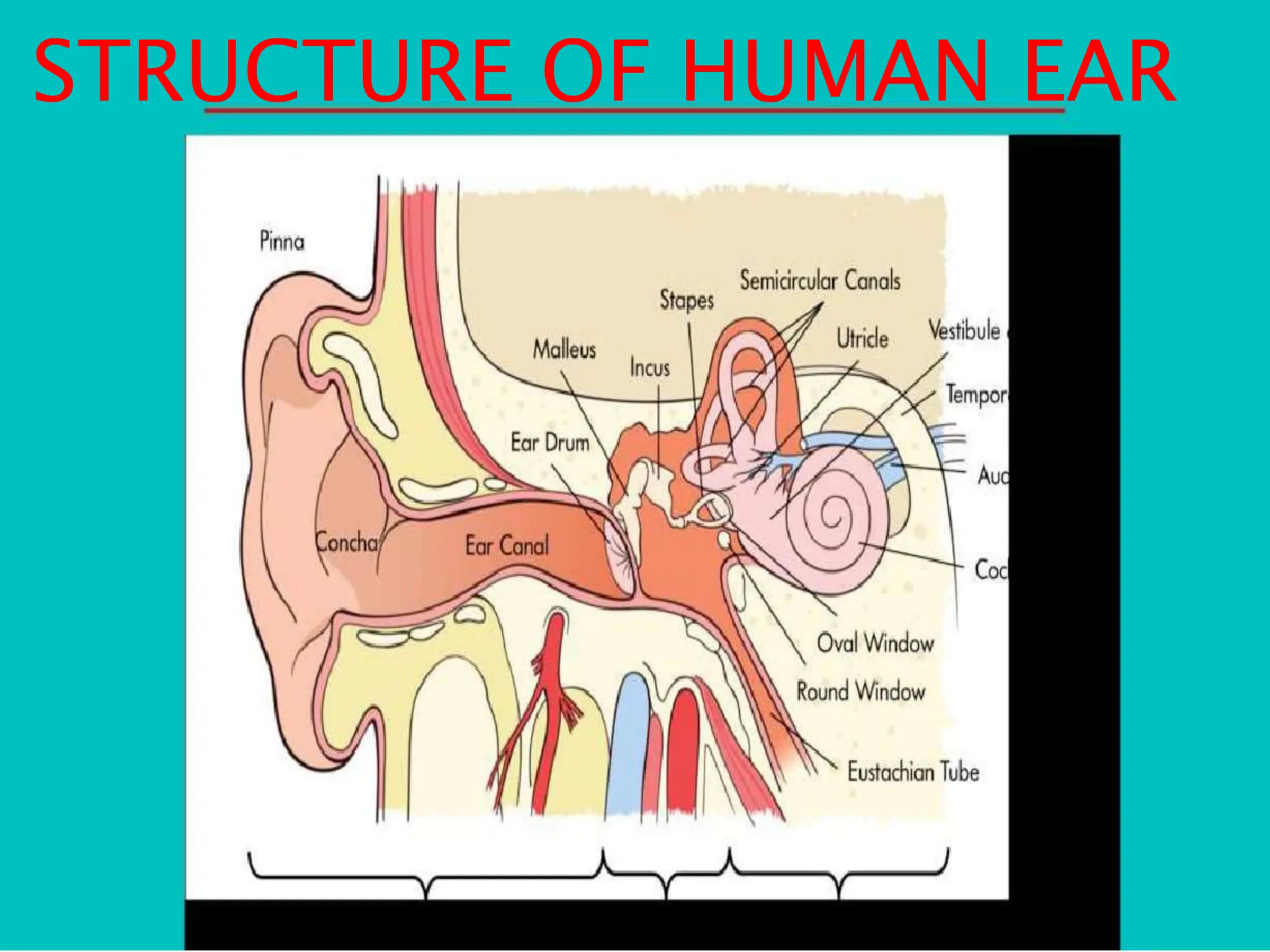
STRUCTURE OF HUMAN EAR
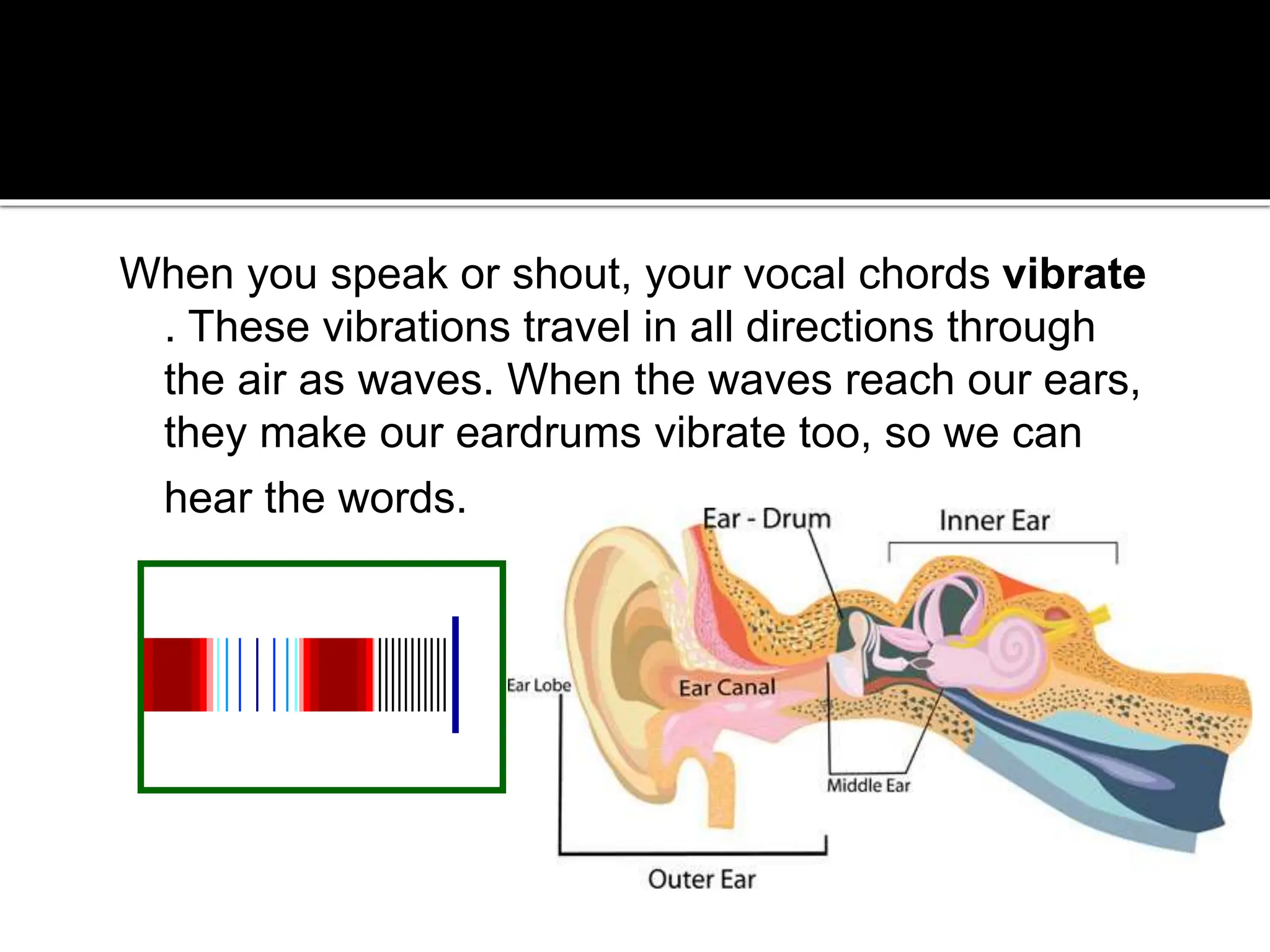
When you speak or shout, your vocal chords vibrate
. These vibrations travel in all directions through
the air as waves. When the waves reach our ears,
they make our eardrums vibrate too, so we can
hear the words.
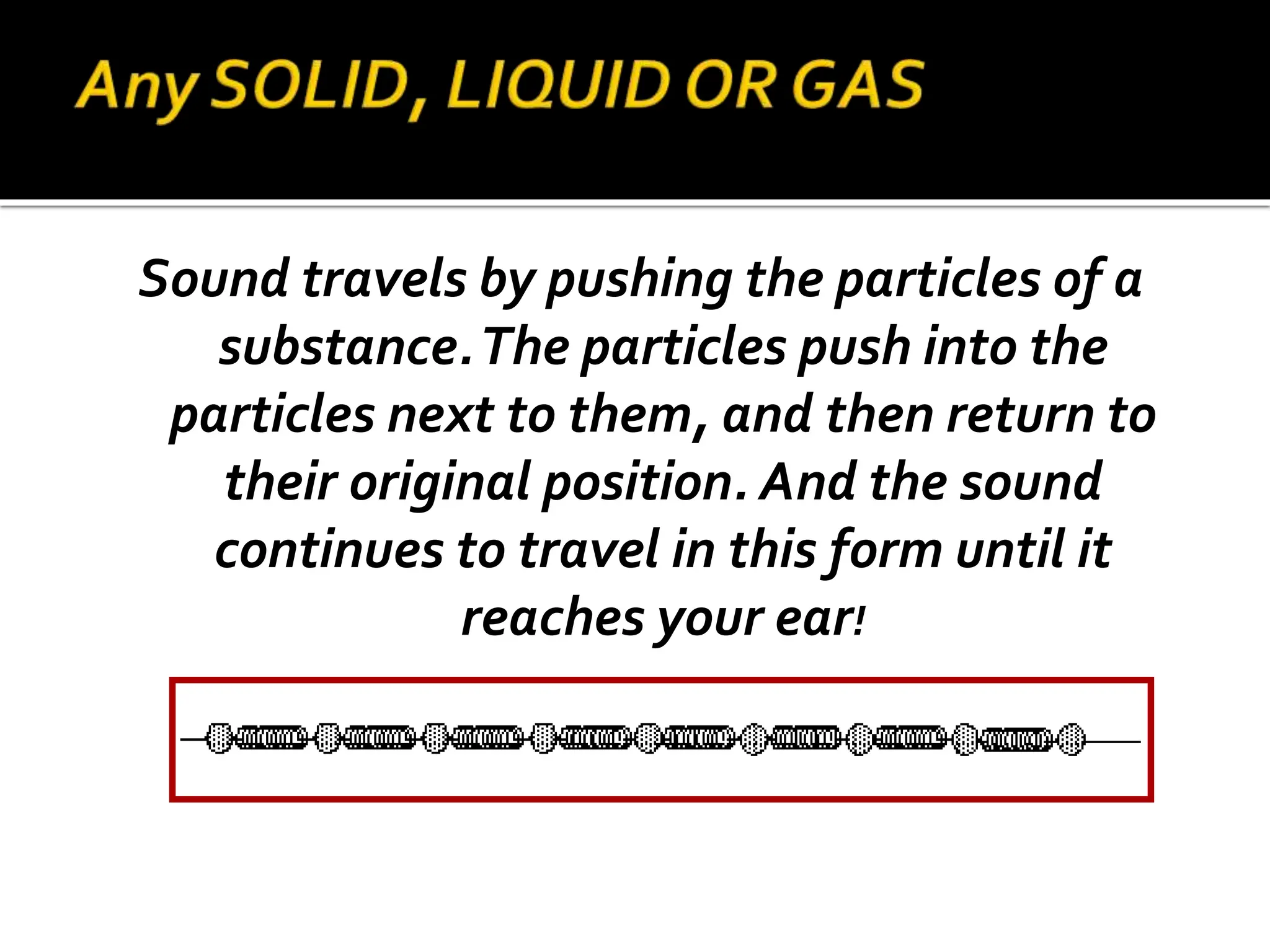
Sound waves travel on a MEDIUM:
Sound travels by pushing the particles of a
substance.The particles push into the
particles next to them, and then return to
their original position. And the sound
continues to travel in this form until it
reaches your ear!
WHY?
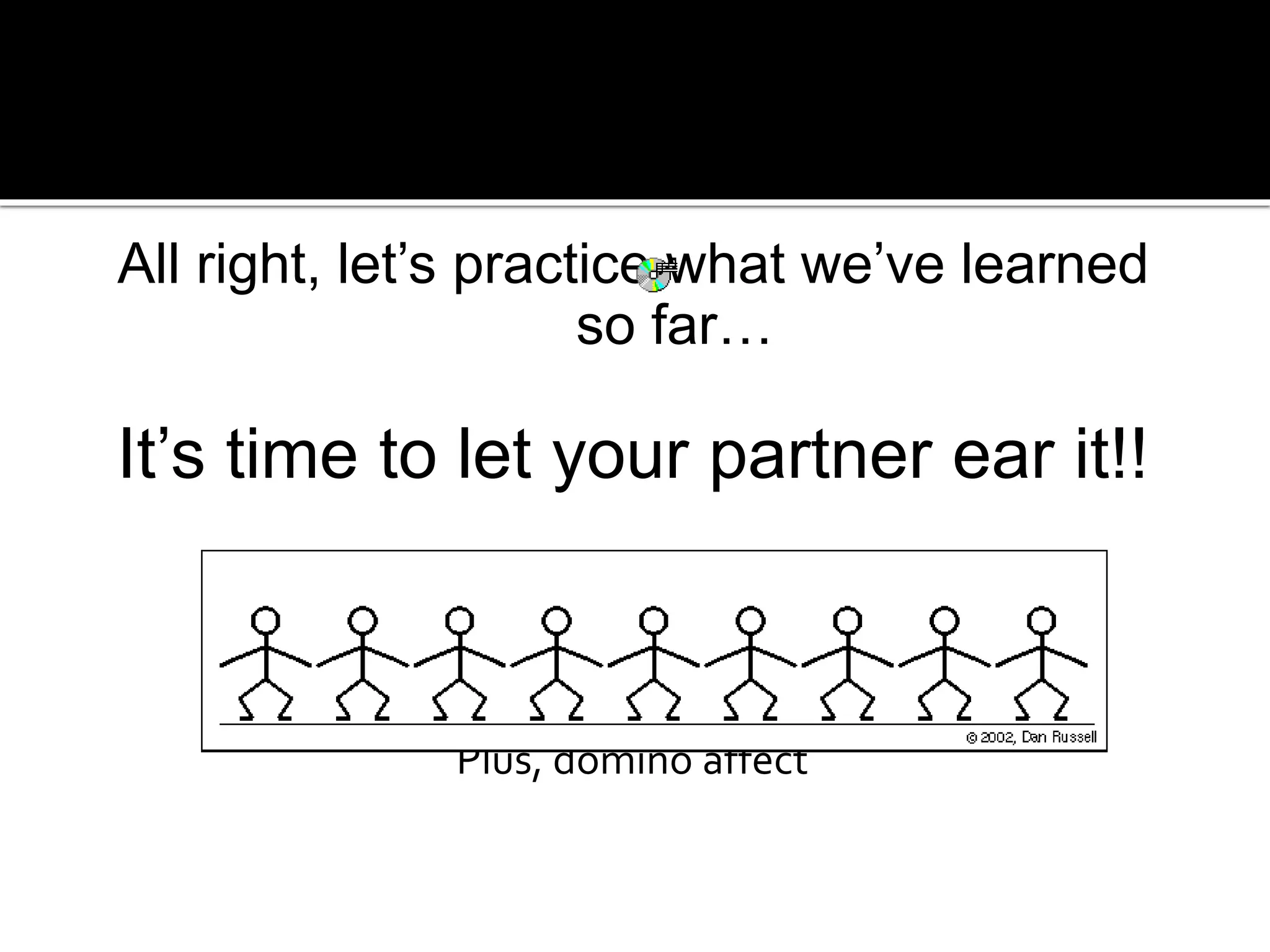
All right, let’s practice what we’ve learned
so far…
It’s time to let your partner ear it!!
Plus, domino affect
 Sound travels through a solid
faster, than through a liquid,
which is faster, than through a
gas.
 Our ears are custom to hear
sound through a gas…
In movies and on TV, you'll sometimes
see and hear things exploding in outer
space -- alien spacecraft and things like
that.
Is that really possible knowing what
we know about sound?

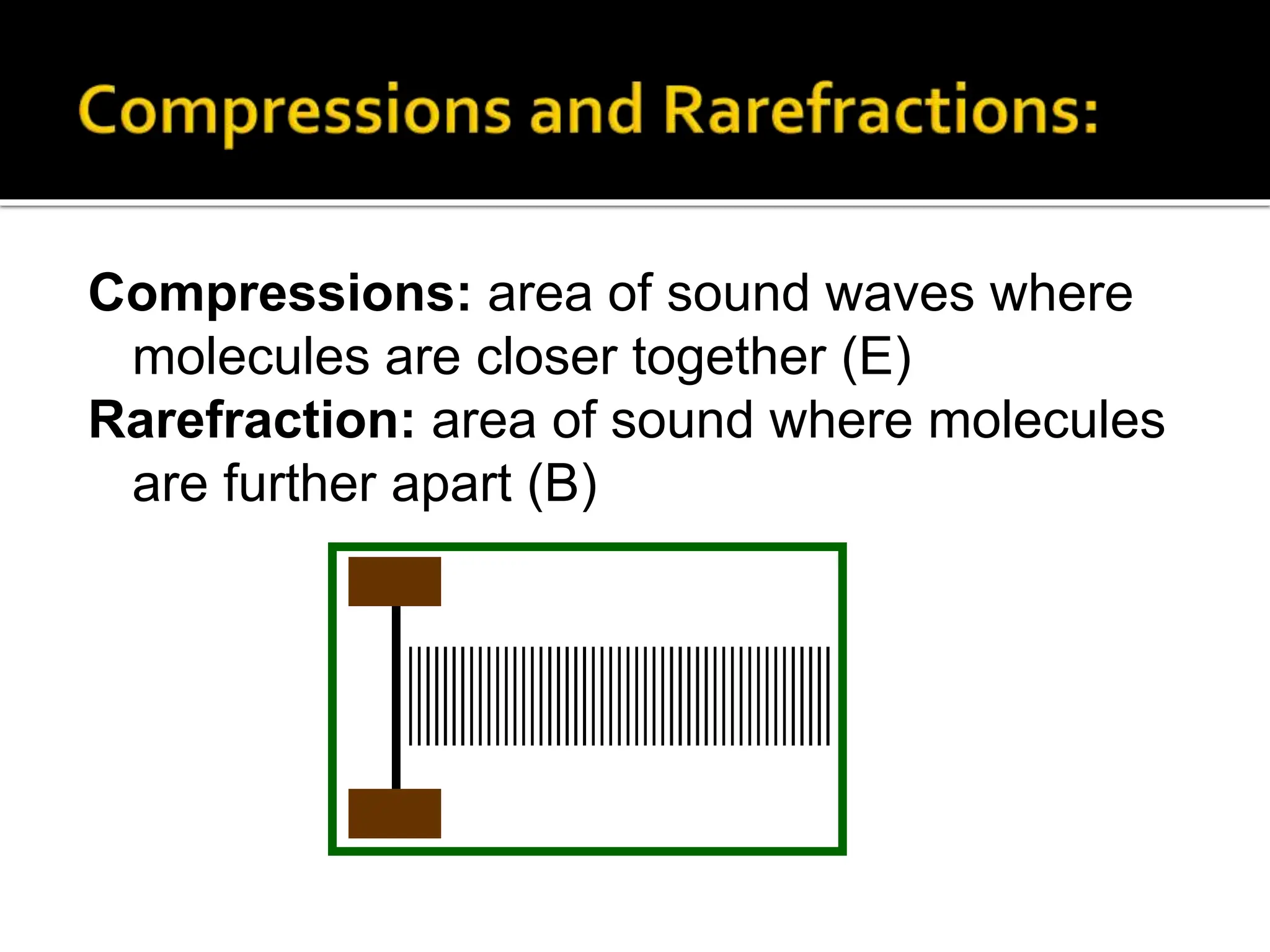
Compressions: area of sound waves where
molecules are closer together (E)
Rarefraction: area of sound where molecules
are further apart (B)
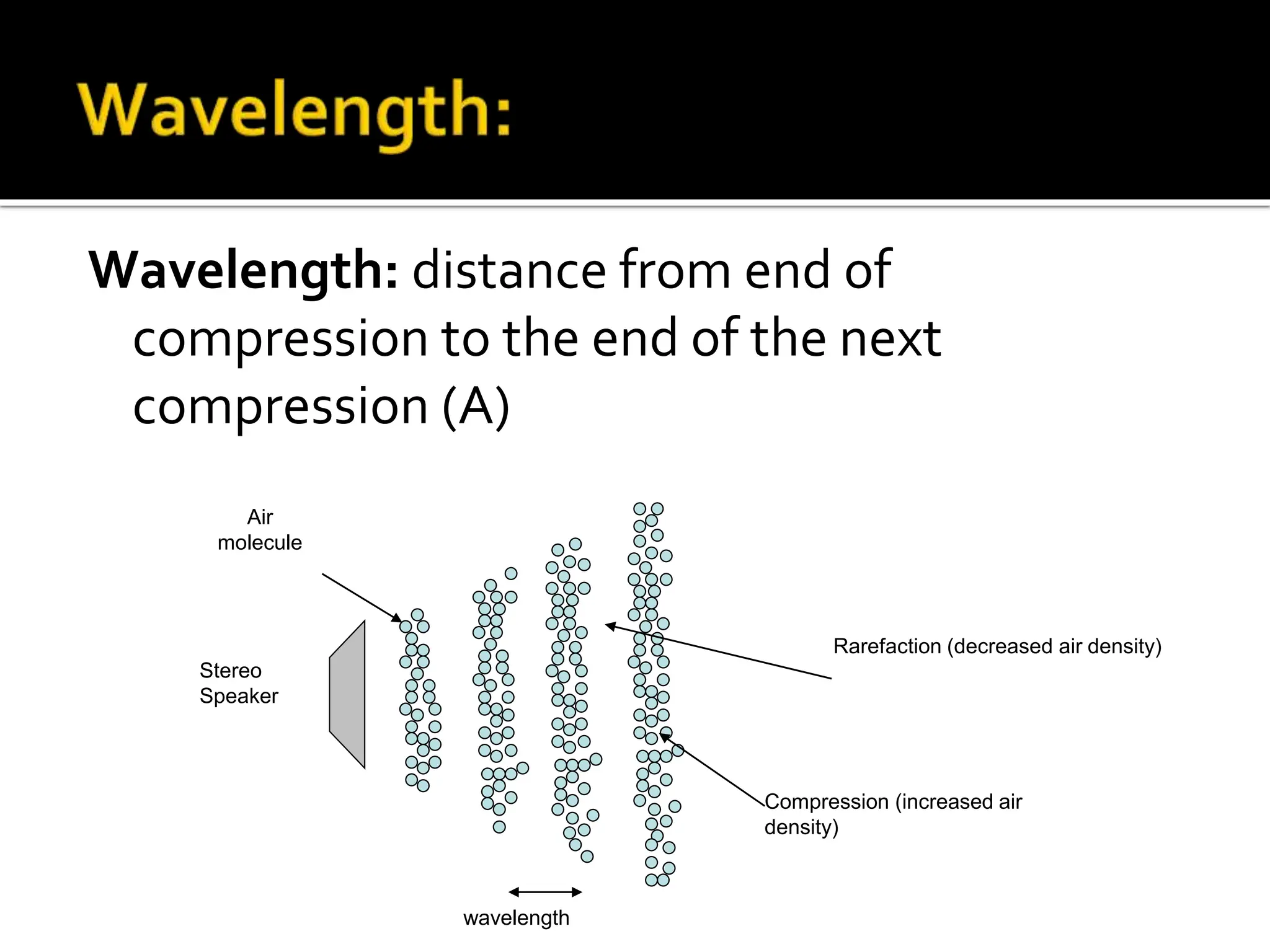
Wavelength: distance from end of
compression to the end of the next
compression (A)
Stereo
Speaker
wavelength
Compression (increased air
density)
Rarefaction (decreased air density)
Air
molecule
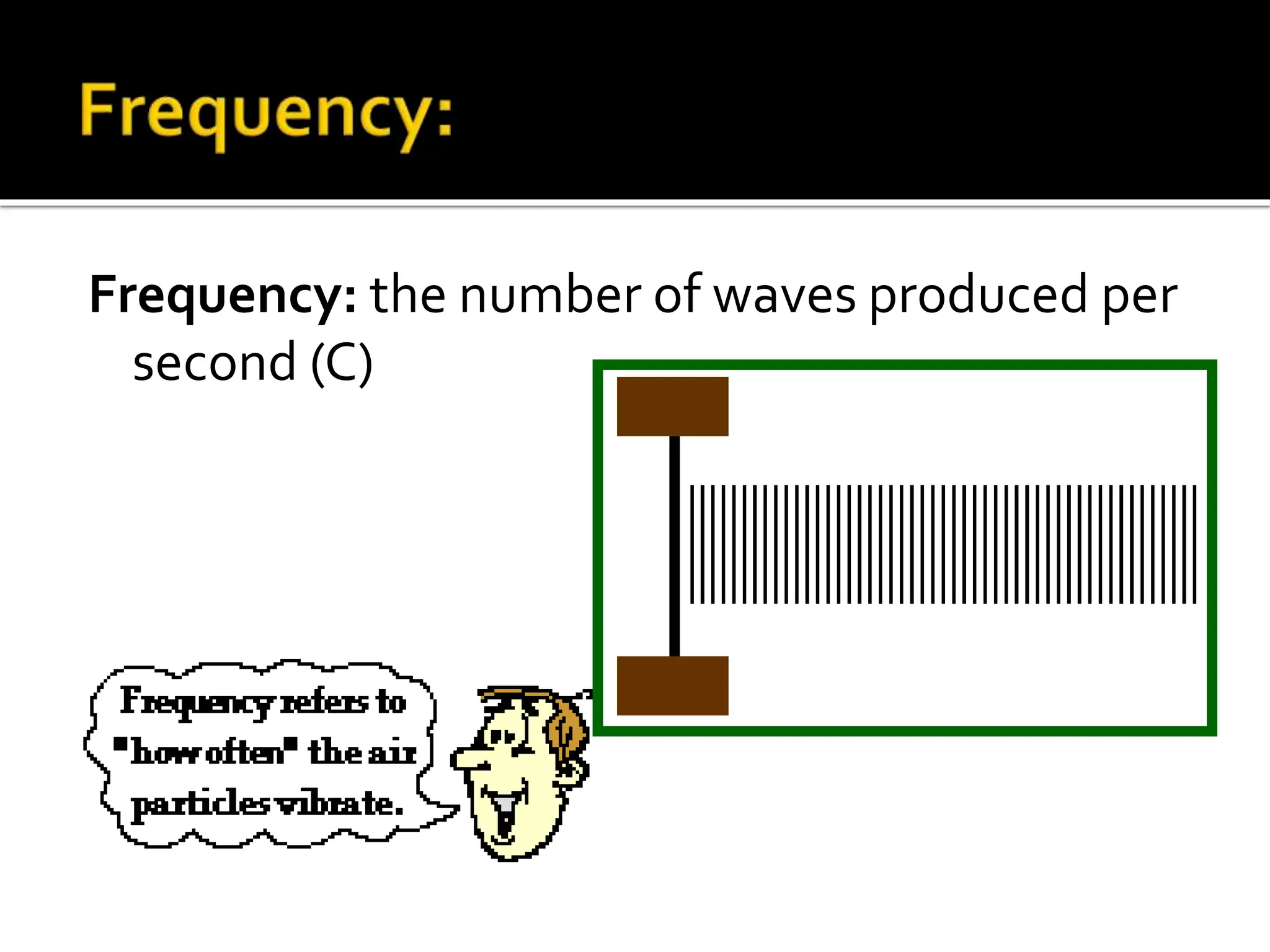
Frequency: the number of waves produced per
second (C)
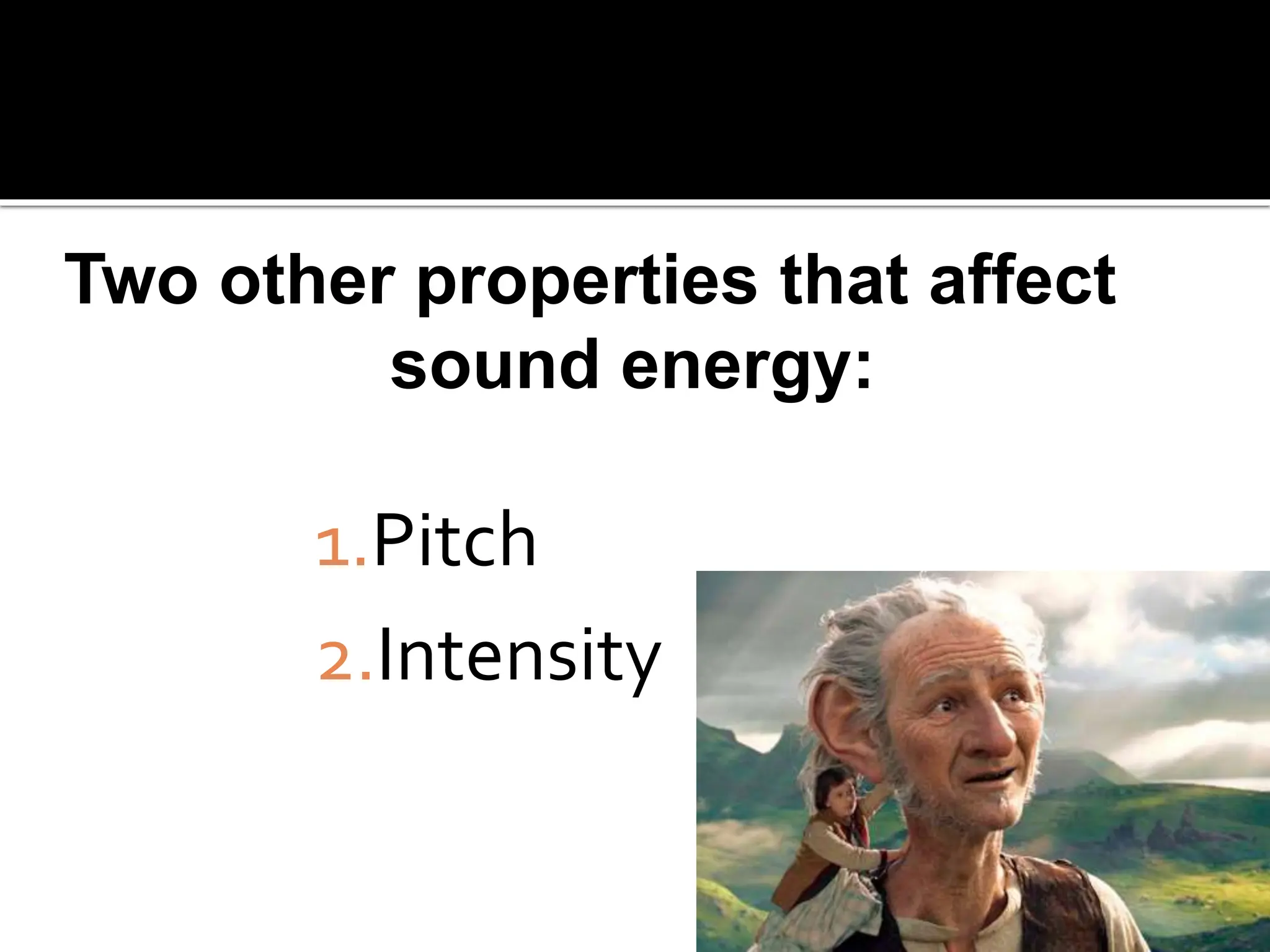
Two other properties that affect
sound energy:
1.Pitch
2.Intensity
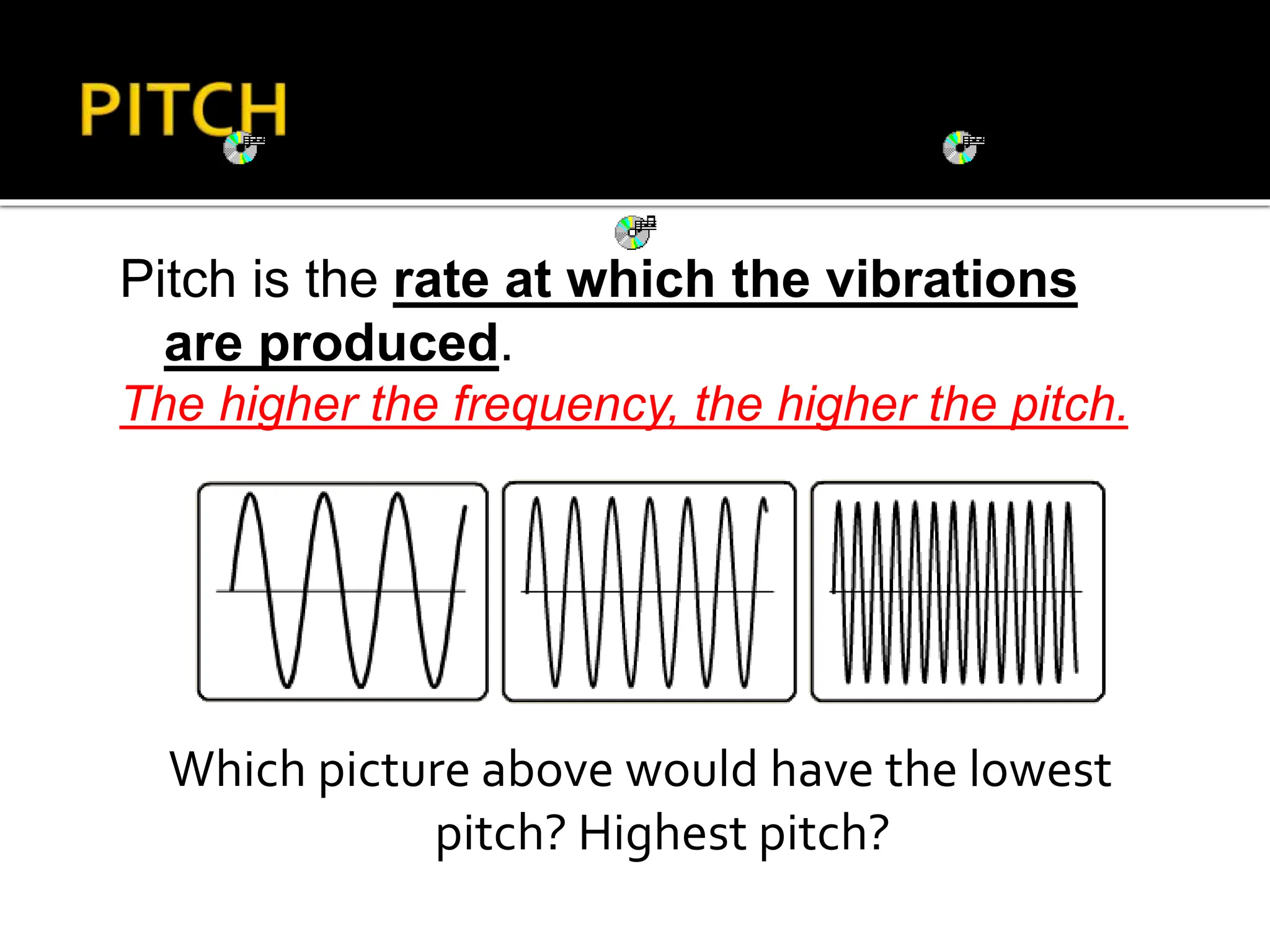
Pitch is the rate at which the vibrations
are produced.
The higher the frequency, the higher the pitch.
Which picture above would have the lowest
pitch? Highest pitch?
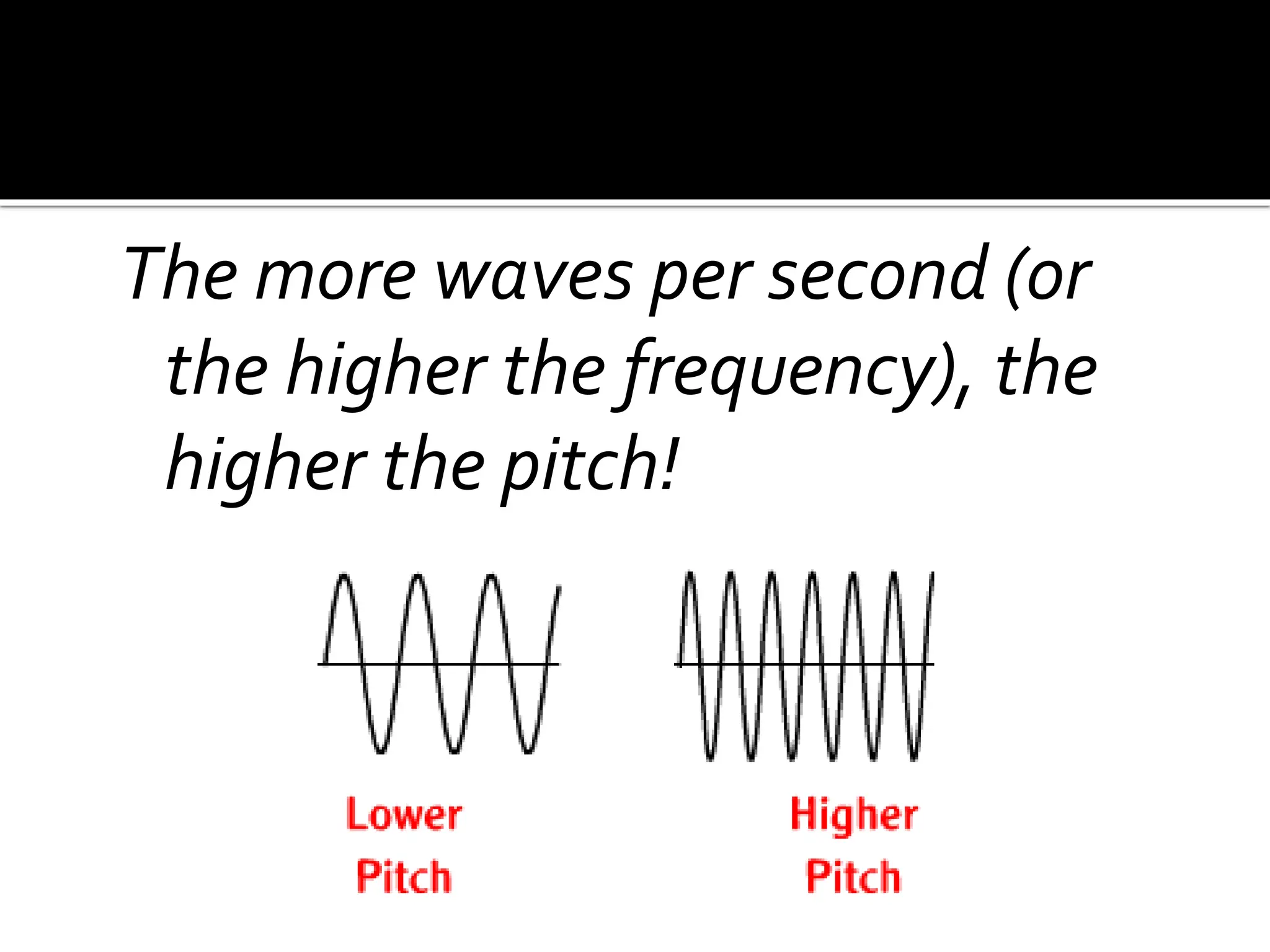
The more waves per second (or
the higher the frequency), the
higher the pitch!
Intensity depends on the strength, or
amplitude, of the vibrations producing the
sound.
If a piano string is struck forcefully the string swings
back and forth in a wider arc. The stronger
vibration then produces a louder tone since
stronger vibrations compress the molecules of the
air more forcefully and gives them greater energy,
which is interpreted by our ears as a louder sound.
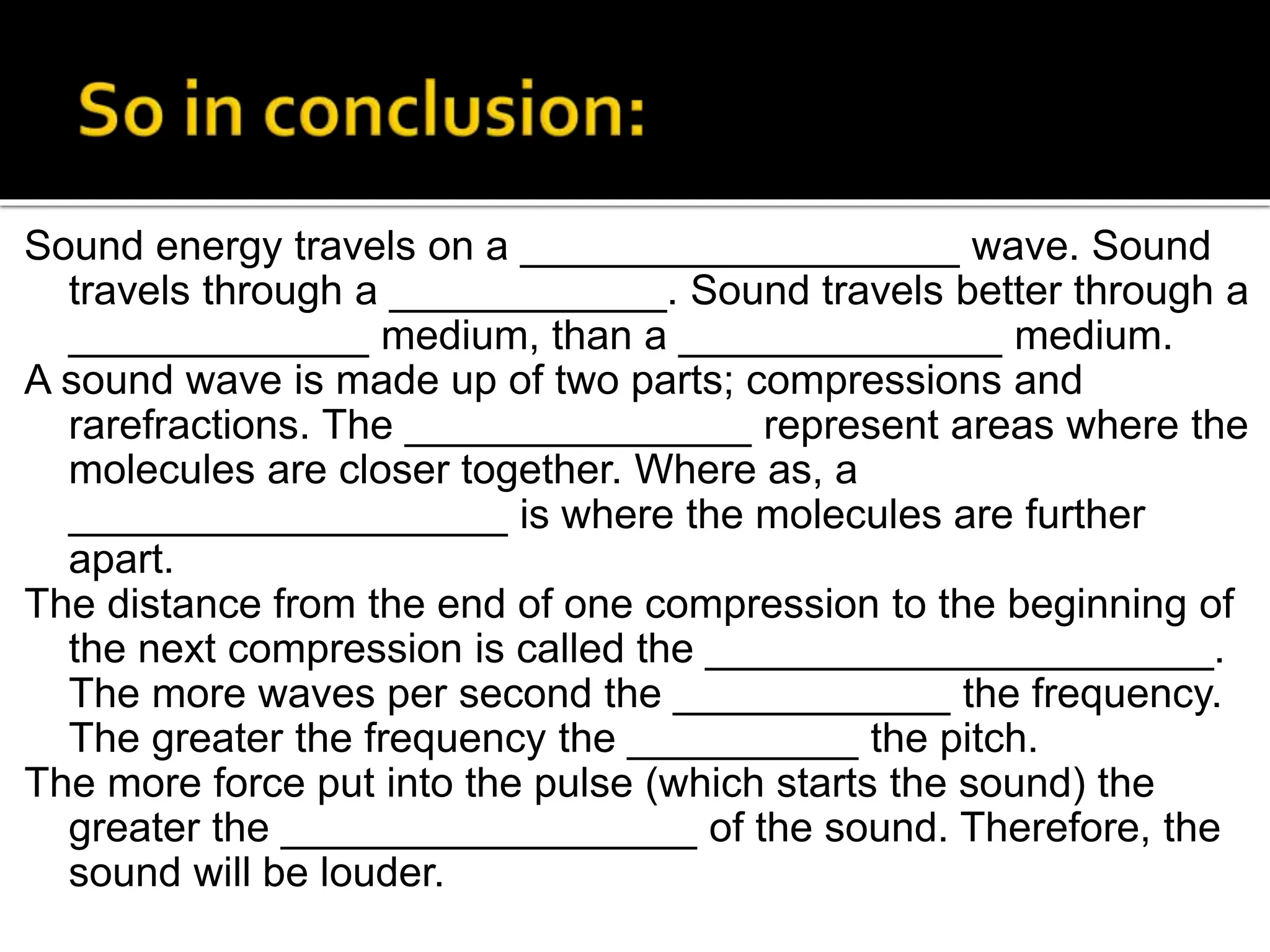
Sound energy travels on a ___________________ wave. Sound
travels through a ____________. Sound travels better through a
_____________ medium, than a ______________ medium.
A sound wave is made up of two parts; compressions and
rarefractions. The _______________ represent areas where the
molecules are closer together. Where as, a
___________________ is where the molecules are further
apart.
The distance from the end of one compression to the beginning of
the next compression is called the ______________________.
The more waves per second the ____________ the frequency.
The greater the frequency the __________ the pitch.
The more force put into the pulse (which starts the sound) the
greater the __________________ of the sound. Therefore, the
sound will be louder.
Content, images, text, etc. used belong to the
rightful owner. No copyright infringement
intended.

G7 Science Q3- Week 5- Sound Energy..ppt

  • 1.
    PREPARED BY: TYPEYOUR NAME HERE
  • 2.
    Describe the characteristics ofsound using the concepts of wavelength, velocity, and amplitude
  • 3.
    Imagine what happenswhen you drop a stone into a pool of water. Waves ripple out from the spot where the stone entered the water. The way waves move across the water is similar to how sound waves travel through the air.
  • 4.
    DEFINITION Sound is aform of energy which produces a sensation of hearing in our ears
  • 5.
    PROPAGATION OF SOUND •Soundis produced by vibrating objects. •Sound is transmitted through a medium. •Medium can be solid, liquid or gas •It moves from point of generation to the listener. •When the object vibrates, the particles in the medium around it start vibrating.
  • 6.
    PROPAGATION OF SOUND •Thereis no movement of the particles, they don’t travel. •The particles are displaced from their equilibrium state. •The particle exerts force on the adjacent particle. •The adjacent particle gets displaced while the previous particle returns to original position.
  • 7.
  • 8.
    SOUND WAVE •Wave isa disturbance that moves through a medium. •The wave is created when particles set neighbouring particles into motion. •Since the particles of the medium are in motion, Sound wave is a mechanical wave.
  • 9.
  • 10.
    MECHANICS OF SOUNDWAVE •Air is the most common medium through which the sound travels. •Forward movement of vibrating object compress the air, creating high pressure, this is called Compression (C). •The compression moves away from the vibrating object.
  • 11.
  • 12.
    MECHANICS OF SOUNDWAVE •When the vibrating object moves backwards it creates low pressure called the Rarefaction (R). •Pressure is related to the number of particles in the medium in a given volume. •The denser the medium the more the pressure. •Thus sound propagation is a propagation of density variation or pressure variation in the medium.
  • 13.
  • 14.
    SOUND AND MEDIUM •Soundbeing a mechanical wave needs a medium. •It cannot travel in vacuum.
  • 15.
    SOUND - LONGITUDINALWAVE •Sound waves are longitudinal waves as •The individual particles move in a direction parallel to the propagation of disturbance. •They oscillate back and forth about their position of rest. •Hence it is a longitudinal wave.
  • 16.
  • 17.
    CHARACTERISTICS OF SOUND WAVE Soundwave can be described by its •Frequency. •Amplitude. •Speed.
  • 18.
    WAVELENGTH DEFINED •In caseof Sound waves the distance between two consecutive Compressions (C) or two consecutive Rarefaction (R) is called the wavelength. •Wavelength is denoted by Lambda. •The SI unit of wavelength is meter (m)
  • 19.
  • 20.
    FREQUENCY DEFINED •Frequency tellsus how frequently an event occurs. •In case of Sound waves it is the number of Compressions (C) or number of Rarefaction (R) per unit of time is called the frequency of the sound wave. •Frequency is denoted by nu. •The SI unit of frequency is hertz (Hz)
  • 21.
  • 22.
    TIME PERIOD DEFINED •Thetime taken by two consecutive Compressions (C) or Rarefaction (R) to cross a fixed point is called the time period of the wave . •Time period is denoted by T. •The SI unit of Time period is second (s). •Frequency and Time period are related as • Frequency = 1/ T
  • 23.
  • 24.
    PITCH OF SOUND •Thefaster the vibration of the source, higher is the frequency and thus higher the Pitch. •A high pitch sound corresponds to more number of Compressions (C) and Rarefactions (R) passing fixed point per unit time.
  • 25.
  • 26.
    AMPLITUDE DEFINED •The magnitudeof maximum disturbance in the medium on either side of the mean is called Amplitude . •Amplitude is denoted by A.
  • 27.
    •It depends onthe force used to produce the vibration. •The Loudness or Softness of sound is determined by its Amplitude. AMPLITUDE DEFINED
  • 28.
  • 29.
    TONE, NOTE, NOISEDEFINED •A sound of single frequency is called Tone. •A sound of mixed frequency is called Note •What is pleasant to listen is called Music. •Noise is unpleasant to the ear.
  • 30.
    SPEED OF SOUNDIN DIFFERENT MEDIUM •The sound propagates through a medium at a finite speed. •The speed of depends on the properties of the medium. It travels faster in a denser medium. •The speed of sound depends on the temperature of the medium. It increases with rise in temperature.
  • 31.
    Speed of Soundin Different Medium 7000 6420 6000 5000 4000 3000 2000 1000 316 0 1284 965 346 1103 1498 1207 3980 1531 5950 5960 Oxygen Air Helium Hydrogen Methanol Ethanol Distilled Sea Water Glass Iron Steel Aluminiu Water (Flint)
  • 32.
    REFLECTION OF SOUND •Soundfollows the same laws of reflection as light. •The angle of incident sound wave and the reflected sound is equal with the normal to the reflecting surface. •The incident wave the normal and the reflected wave lie on the same plane.
  • 33.
  • 34.
    ECHO •Echo is thereflection of Sound from buildings and mountains. •To hear an Echo the difference between the initial sound and the reflected sound should be at least 0.1 sec. •Mathematically this distance travelled by sound should be at least 34.4 m on an ambient temperature of 22 degrees centigrade.
  • 35.
  • 36.
    REVERBERATION •Repeated reflection ofsound that results in its persistence is called reverberation. •Excessive reverberation prevents perception Of sound. •Reverberation is controlled by covering the roof and walls of auditoriums with sound absorbing material. •Fibreboard, rough plasters, cardboards, and
  • 37.
  • 38.
  • 39.
    USES OF MULTIPLEREFLECTION SOUND •Megaphones are used to amplify the sound. •Doctors use Stethoscope which has pipes where multiple reflections take place. •Curved ceilings of cinema halls are used to ensure that sound reaches to all the audience. •Soundboards are used behind the stage to reflect the sound.
  • 40.
    USES OF MULTIPLEREFLECTION SOUND
  • 41.
    RANGE OF HEARING •Audiblerange for human beings is from 20 Hz to 20000 Hz. •Younger children and few animals hear beyond this range as well. •Sound below 20 Hz is called Infrasonic. (Rhinos, Whales) •Sound beyond 20000 Hz is called Ultrasonic. (Bats, Dolphins)
  • 42.
  • 43.
    APPLICATIONS OF ULTRASOUND •Cleaningof hard to reach places of machines. •Detect cracks and flaws in metal blocks. •Medical application in echocardiography. •Ultrasound imagery of internal organs of human body. •Removal of kidney stones by breaking them with ultrasound.
  • 44.
  • 45.
    SONAR •SONAR stand forSound Navigation And Ranging. •It uses ultrasonic waves to measure dista direction and speed of underwater object •It has a transmitter and a detector collec called Transducer. •Mathematics of distance calculation is 2d
  • 46.
  • 47.
  • 48.
    When you speakor shout, your vocal chords vibrate . These vibrations travel in all directions through the air as waves. When the waves reach our ears, they make our eardrums vibrate too, so we can hear the words.
  • 49.
    Sound waves travelon a MEDIUM: Sound travels by pushing the particles of a substance.The particles push into the particles next to them, and then return to their original position. And the sound continues to travel in this form until it reaches your ear!
  • 50.
  • 51.
    All right, let’spractice what we’ve learned so far… It’s time to let your partner ear it!! Plus, domino affect
  • 52.
     Sound travelsthrough a solid faster, than through a liquid, which is faster, than through a gas.  Our ears are custom to hear sound through a gas…
  • 54.
    In movies andon TV, you'll sometimes see and hear things exploding in outer space -- alien spacecraft and things like that. Is that really possible knowing what we know about sound? 
  • 55.
    Compressions: area ofsound waves where molecules are closer together (E) Rarefraction: area of sound where molecules are further apart (B)
  • 56.
    Wavelength: distance fromend of compression to the end of the next compression (A) Stereo Speaker wavelength Compression (increased air density) Rarefaction (decreased air density) Air molecule
  • 57.
    Frequency: the numberof waves produced per second (C)
  • 58.
    Two other propertiesthat affect sound energy: 1.Pitch 2.Intensity
  • 59.
    Pitch is therate at which the vibrations are produced. The higher the frequency, the higher the pitch. Which picture above would have the lowest pitch? Highest pitch?
  • 60.
    The more wavesper second (or the higher the frequency), the higher the pitch!
  • 61.
    Intensity depends onthe strength, or amplitude, of the vibrations producing the sound. If a piano string is struck forcefully the string swings back and forth in a wider arc. The stronger vibration then produces a louder tone since stronger vibrations compress the molecules of the air more forcefully and gives them greater energy, which is interpreted by our ears as a louder sound.
  • 62.
    Sound energy travelson a ___________________ wave. Sound travels through a ____________. Sound travels better through a _____________ medium, than a ______________ medium. A sound wave is made up of two parts; compressions and rarefractions. The _______________ represent areas where the molecules are closer together. Where as, a ___________________ is where the molecules are further apart. The distance from the end of one compression to the beginning of the next compression is called the ______________________. The more waves per second the ____________ the frequency. The greater the frequency the __________ the pitch. The more force put into the pulse (which starts the sound) the greater the __________________ of the sound. Therefore, the sound will be louder.
  • 63.
    Content, images, text,etc. used belong to the rightful owner. No copyright infringement intended.