e-Content
Class: IX
Subject: Science
Chapter-12
SOUND
Prepared by Manjusha M Nair,PGT Physics,
JNV Wayanad,Kerala.
NAVODAYA VIDYALAYA SAMITI, NOIDA
WHICH FORM OF ENERGY HELPS US IN
HEARING?
Do you like music?
Everyday we hear from humans, birds,
bells,radio,televisions,
vehicles etc.
It is the sound energy which help us to
hear.
LEARNING OUTCOMES
 Explain the propagation of sound through a
medium.
 Identify sound waves as longitudinal waves.
 Describe the characteristics of sound waves.
 Compare the speed of sound in different
media.
 Verify laws of reflection of sound.
 Analyse the uses of multiple reflection of
sound.
 Explain the applications of ultrasound.
 Calculate the speed of sound in a medium.
WHAT IS SOUND?
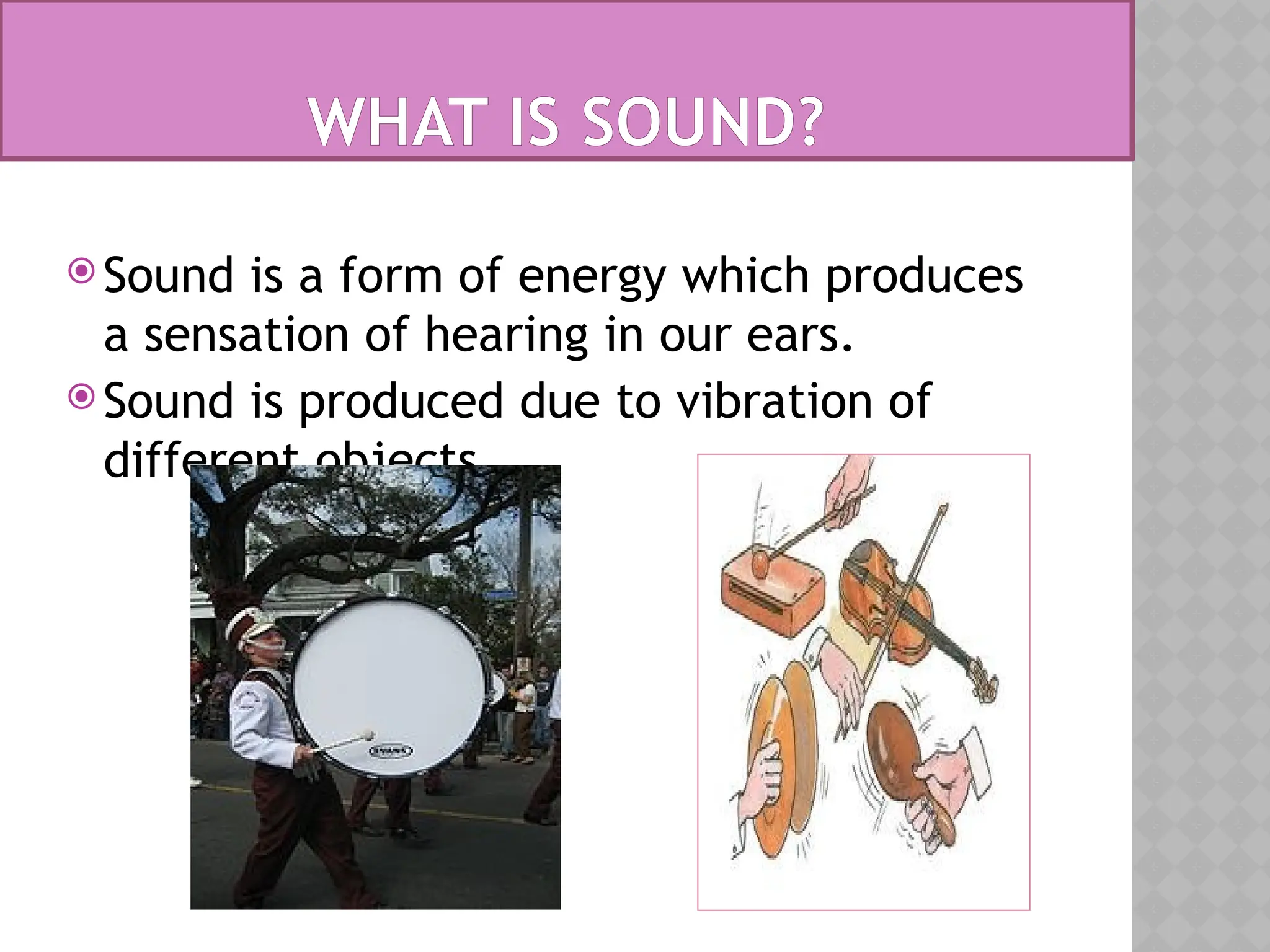
 Sound is a form of energy which produces
a sensation of hearing in our ears.
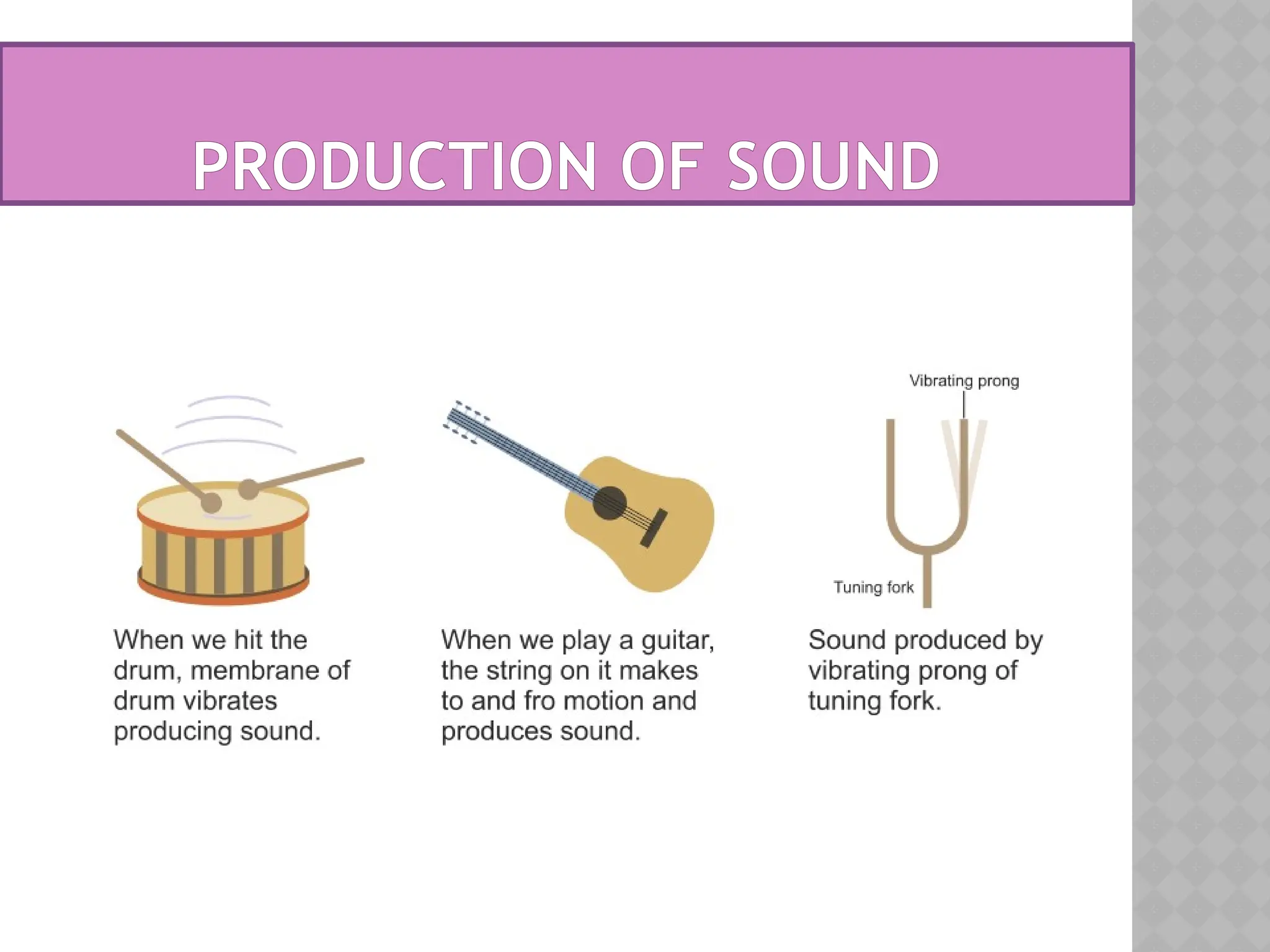
 Sound is produced due to vibration of
different objects.
PRODUCTION OF SOUND
SOUND AS A WAVE
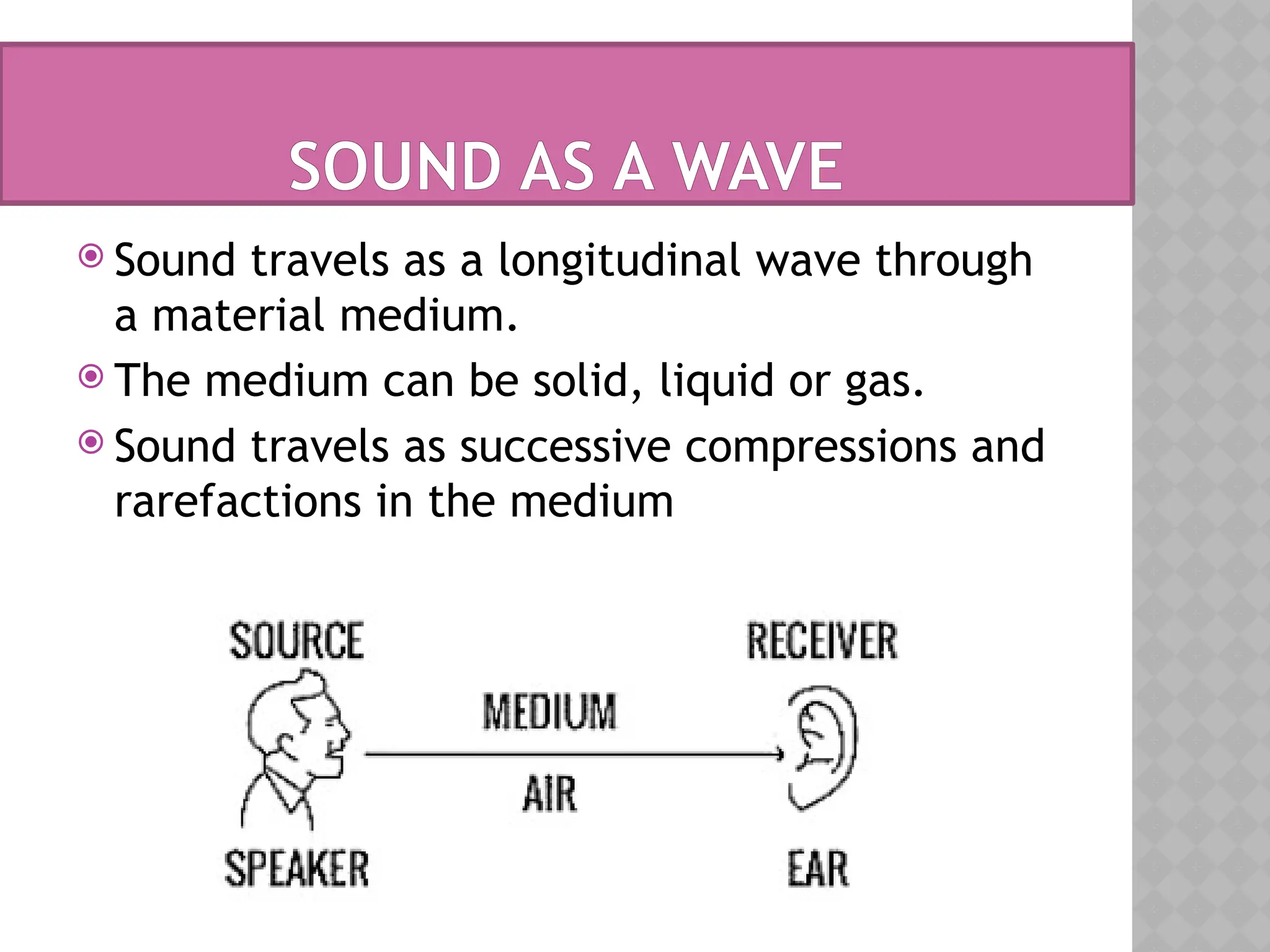
 Sound travels as a longitudinal wave through
a material medium.
 The medium can be solid, liquid or gas.
 Sound travels as successive compressions and
rarefactions in the medium
SOUND - A LONGITUDINAL WAVE
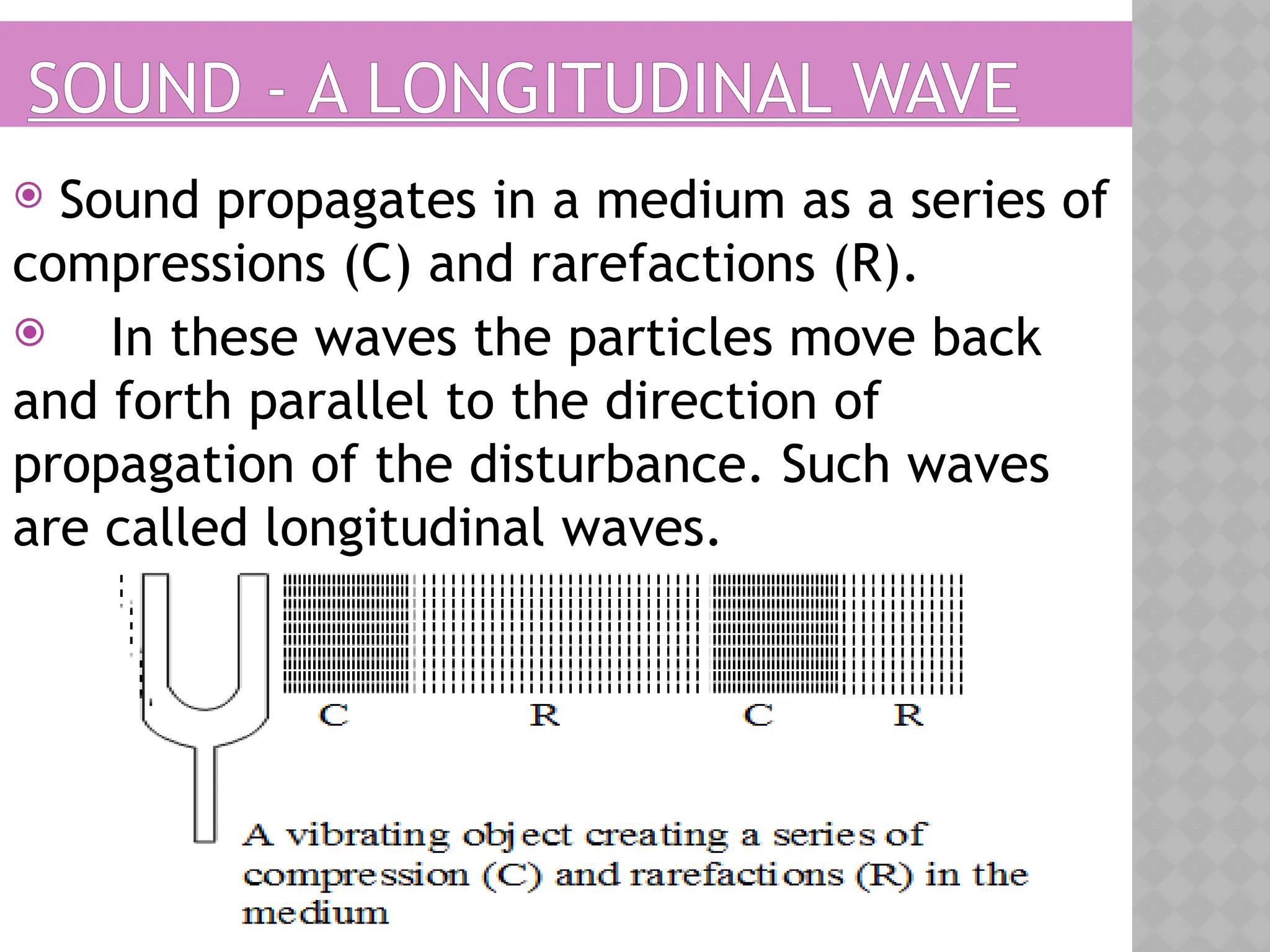
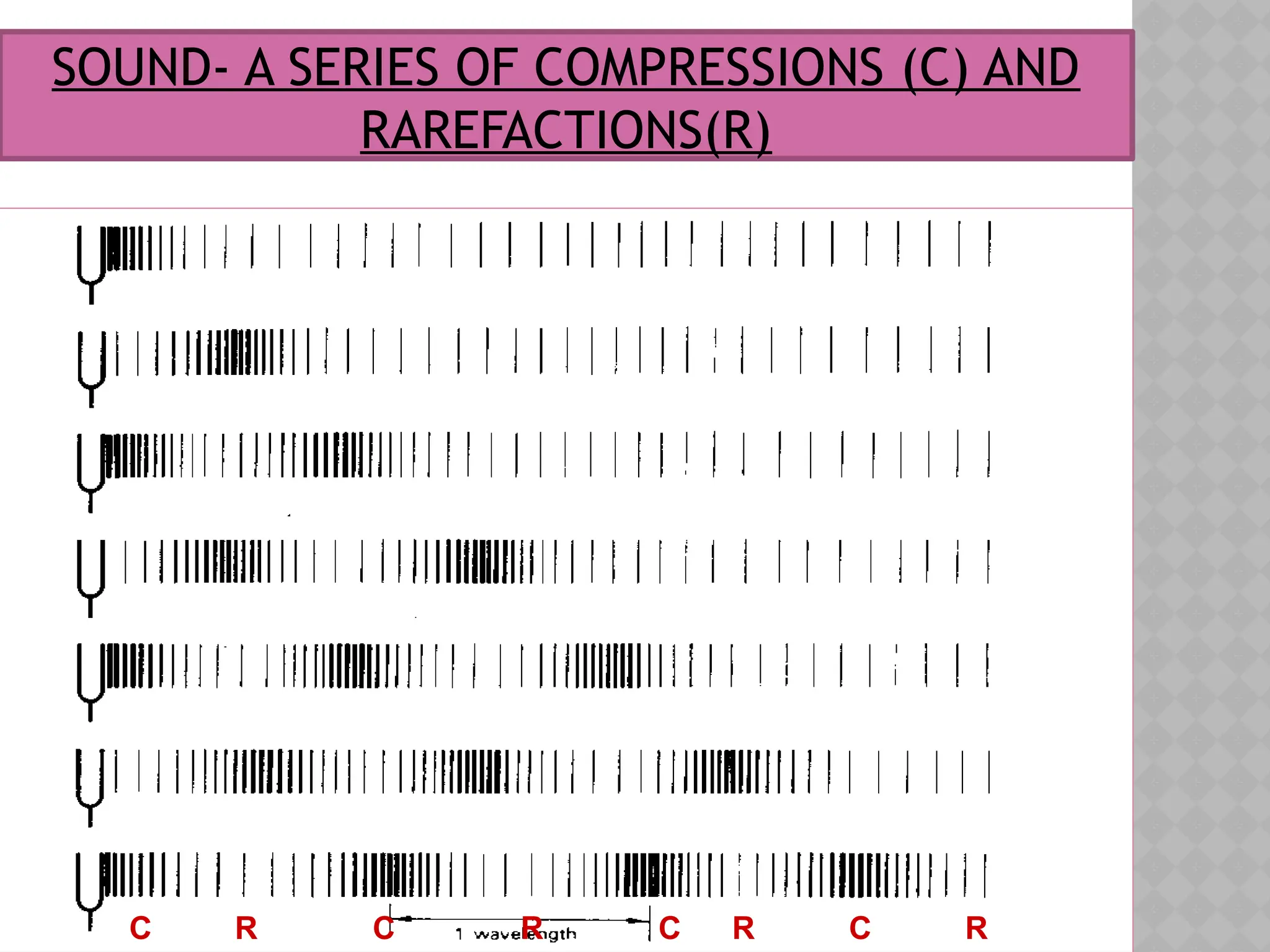
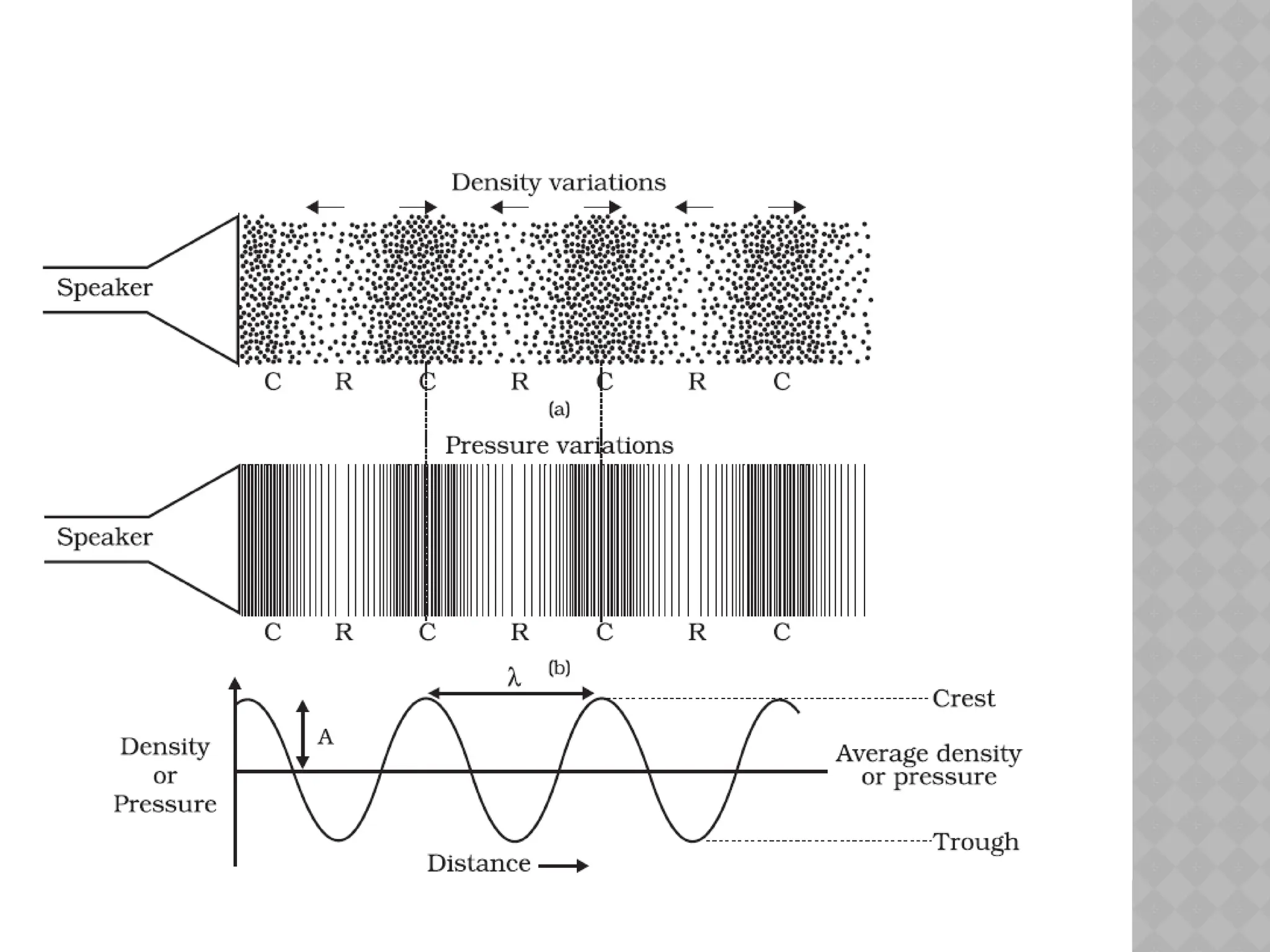
 Sound propagates in a medium as a series of
compressions (C) and rarefactions (R).
 In these waves the particles move back
and forth parallel to the direction of
propagation of the disturbance. Such waves
are called longitudinal waves.
SOUND - A LONGITUDINAL WAVE
PROPAGATION OF SOUND
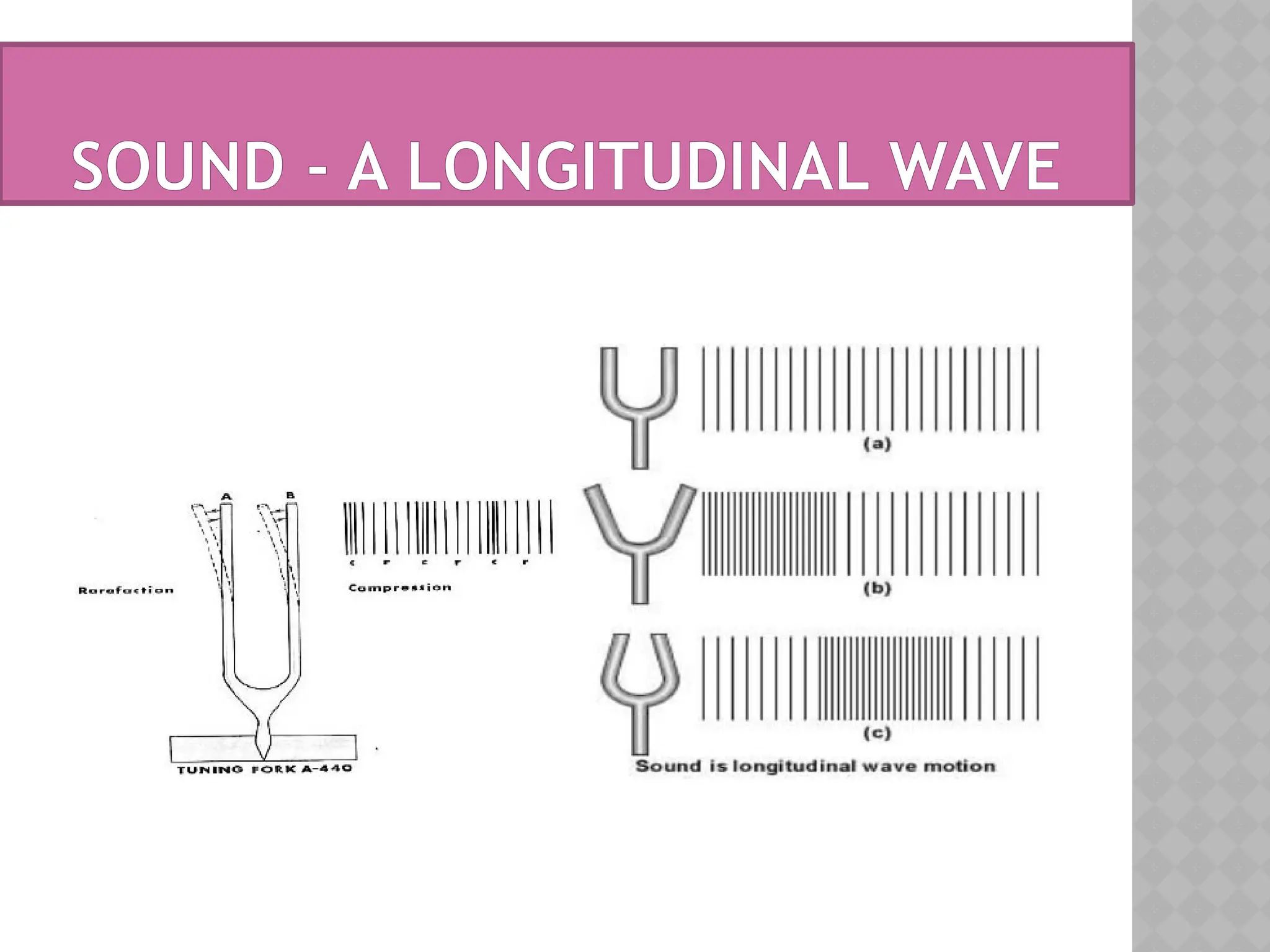
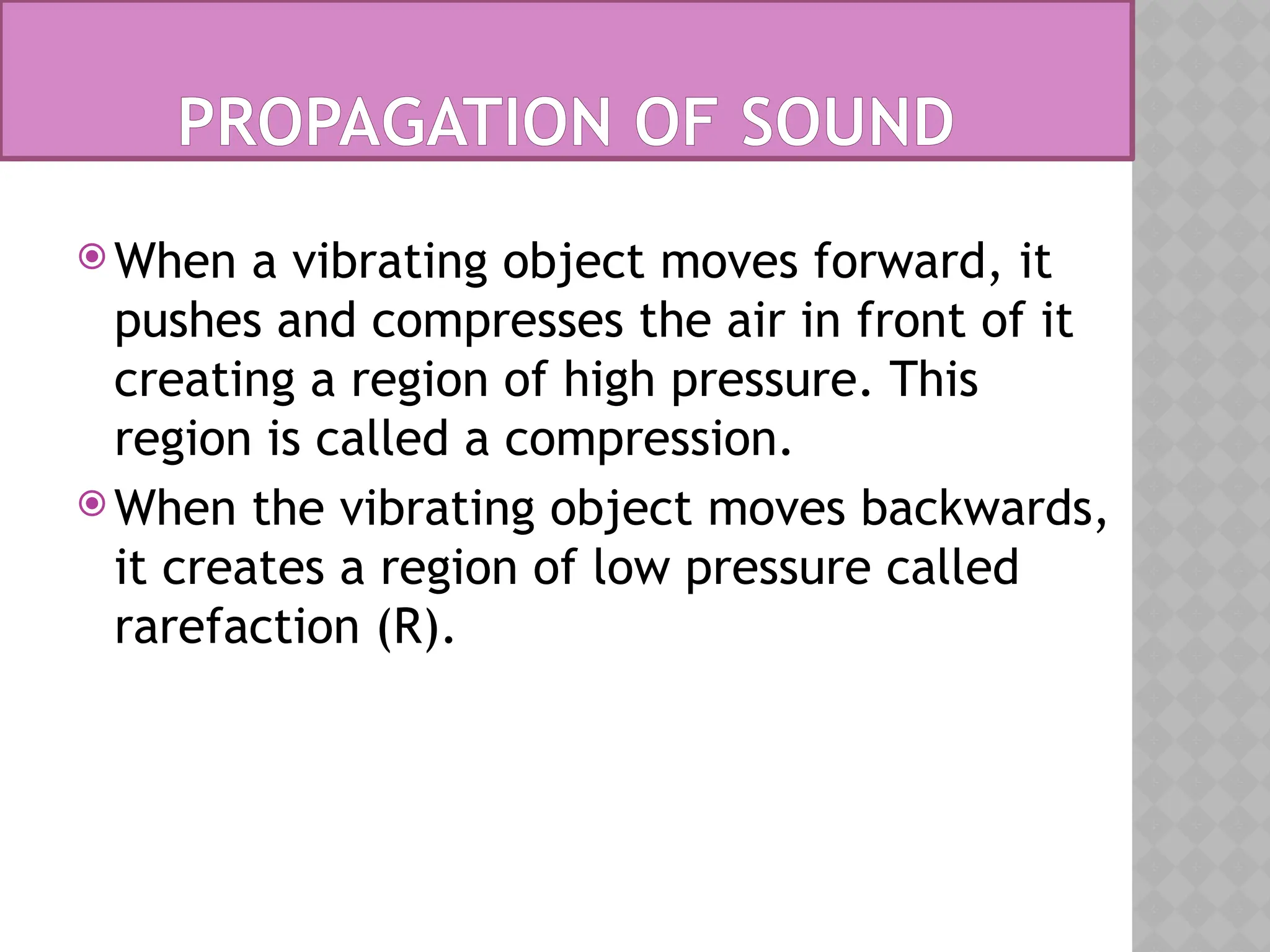
 When a vibrating object moves forward, it
pushes and compresses the air in front of it
creating a region of high pressure. This
region is called a compression.
 When the vibrating object moves backwards,
it creates a region of low pressure called
rarefaction (R).
SOUND- A SERIES OF COMPRESSIONS (C) AND
RAREFACTIONS(R)
C C C C
R
R R R
PROPAGATION OF SOUND
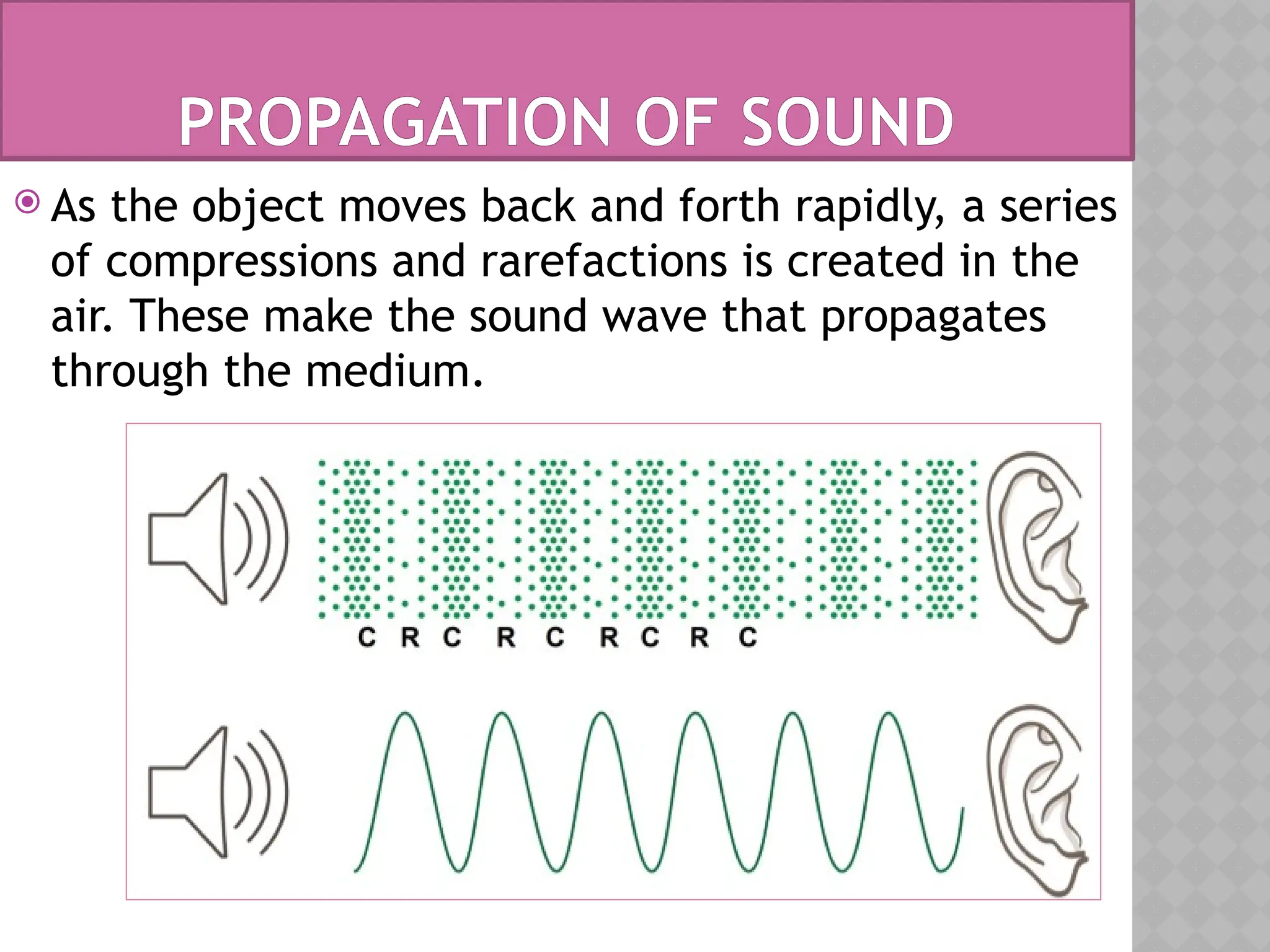
 As the object moves back and forth rapidly, a series
of compressions and rarefactions is created in the
air. These make the sound wave that propagates
through the medium.
PROPAGATION OF SOUND
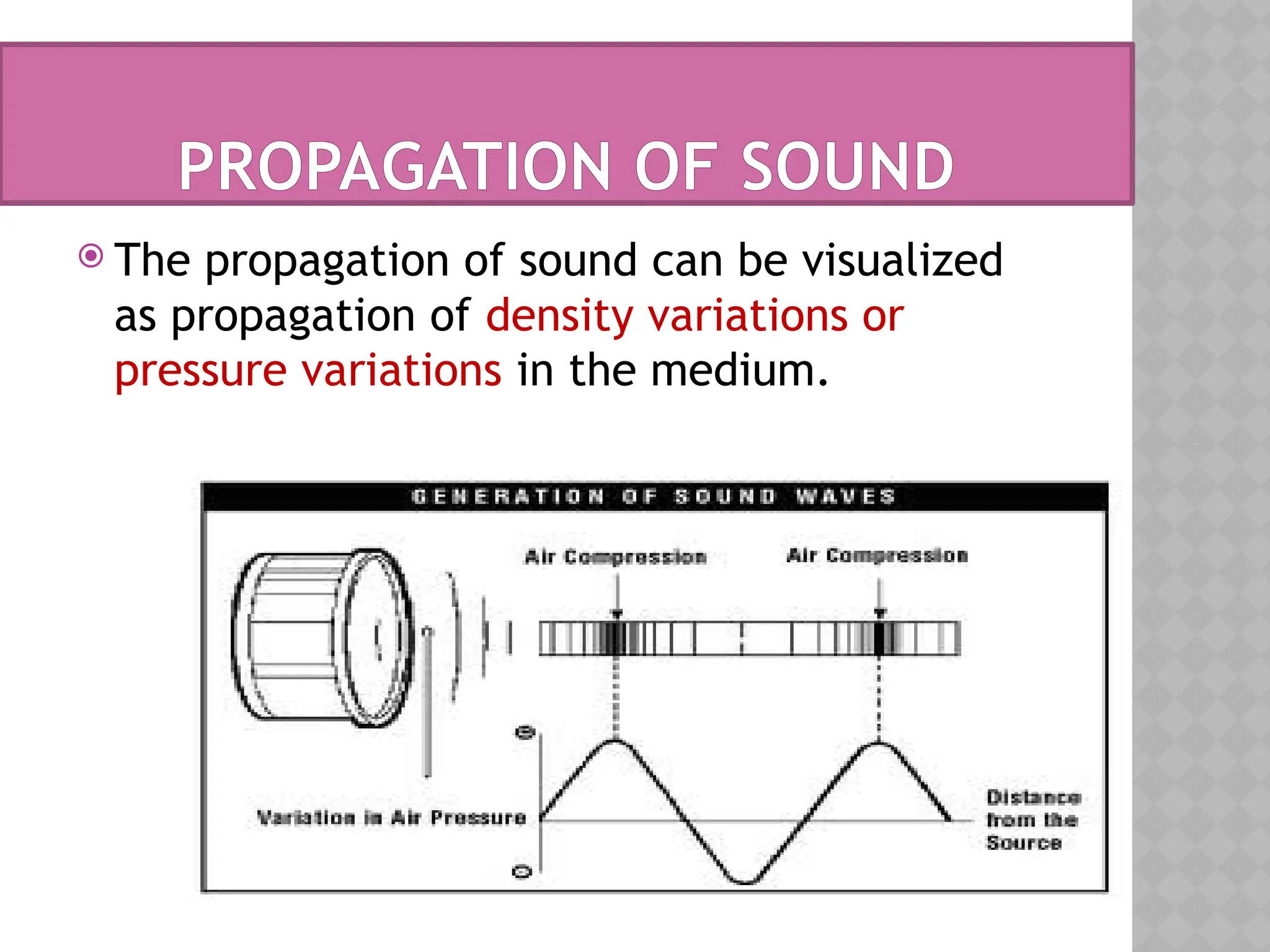
 The propagation of sound can be visualized
as propagation of density variations or
pressure variations in the medium.
SOUND-A MECHANICAL WAVE
 Sound cannot travel in vacuum.
 Sound is a mechanical wave and needs a
material medium like air, water, steel etc.
for its propagation. It cannot travel through
vacuum.
 Sound waves are characterised by the motion
of particles in the medium and are called
mechanical waves.
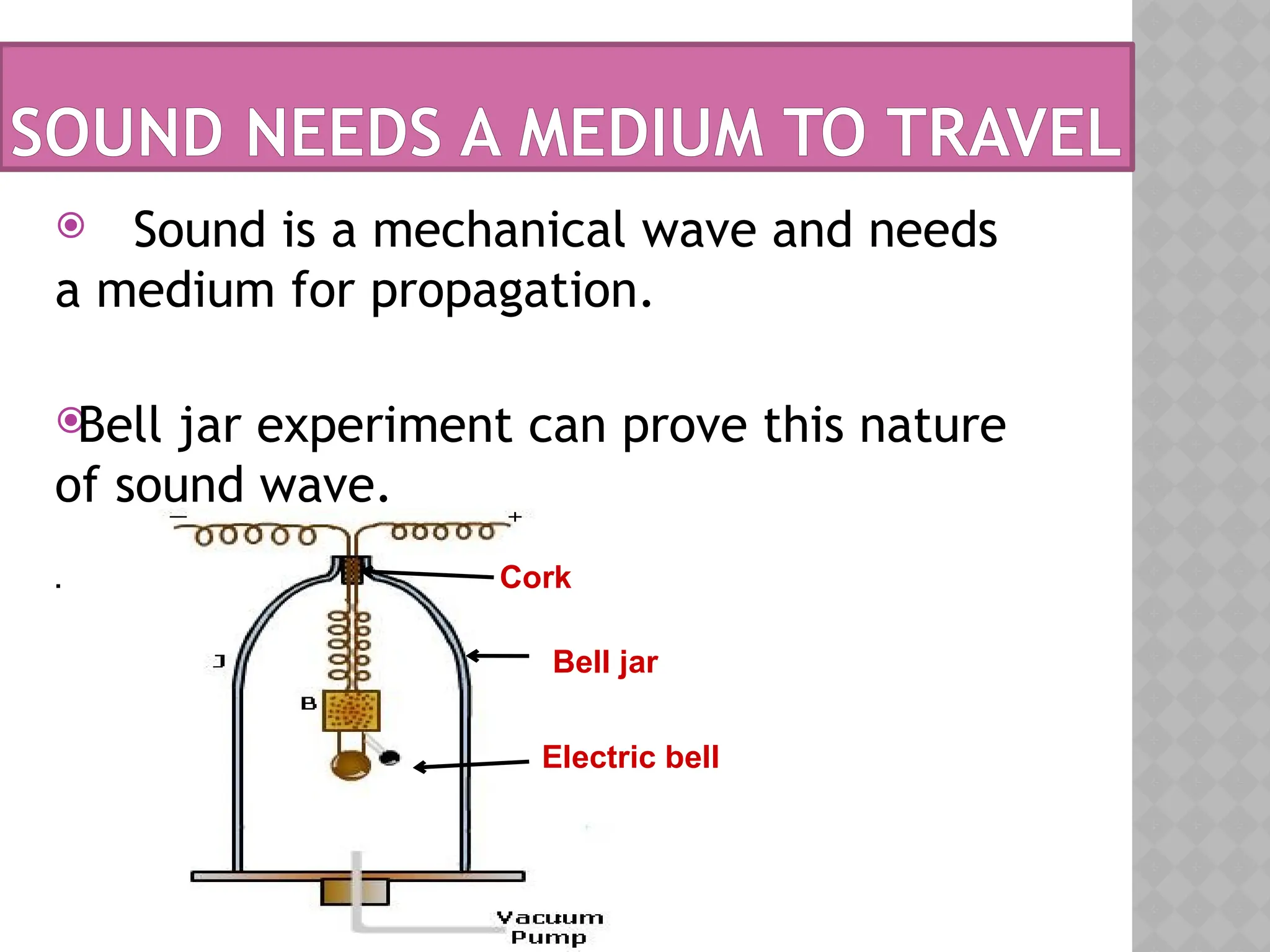
SOUND NEEDS A MEDIUM TO TRAVEL
 Sound is a mechanical wave and needs
a medium for propagation.

Bell jar experiment can prove this nature
of sound wave.
.
Bell jar
Electric bell
Cork
CHARACTERISTICS OF A SOUND WAVE
 The change in density from one maximum value
to the minimum value and again to the
maximum value makes one complete oscillation.
 The distance between two consecutive
compressions or two consecutive rarefactions is
called the wavelength,represented by λ, (Greek
letter lambda)
 The SI unit is meter(m).
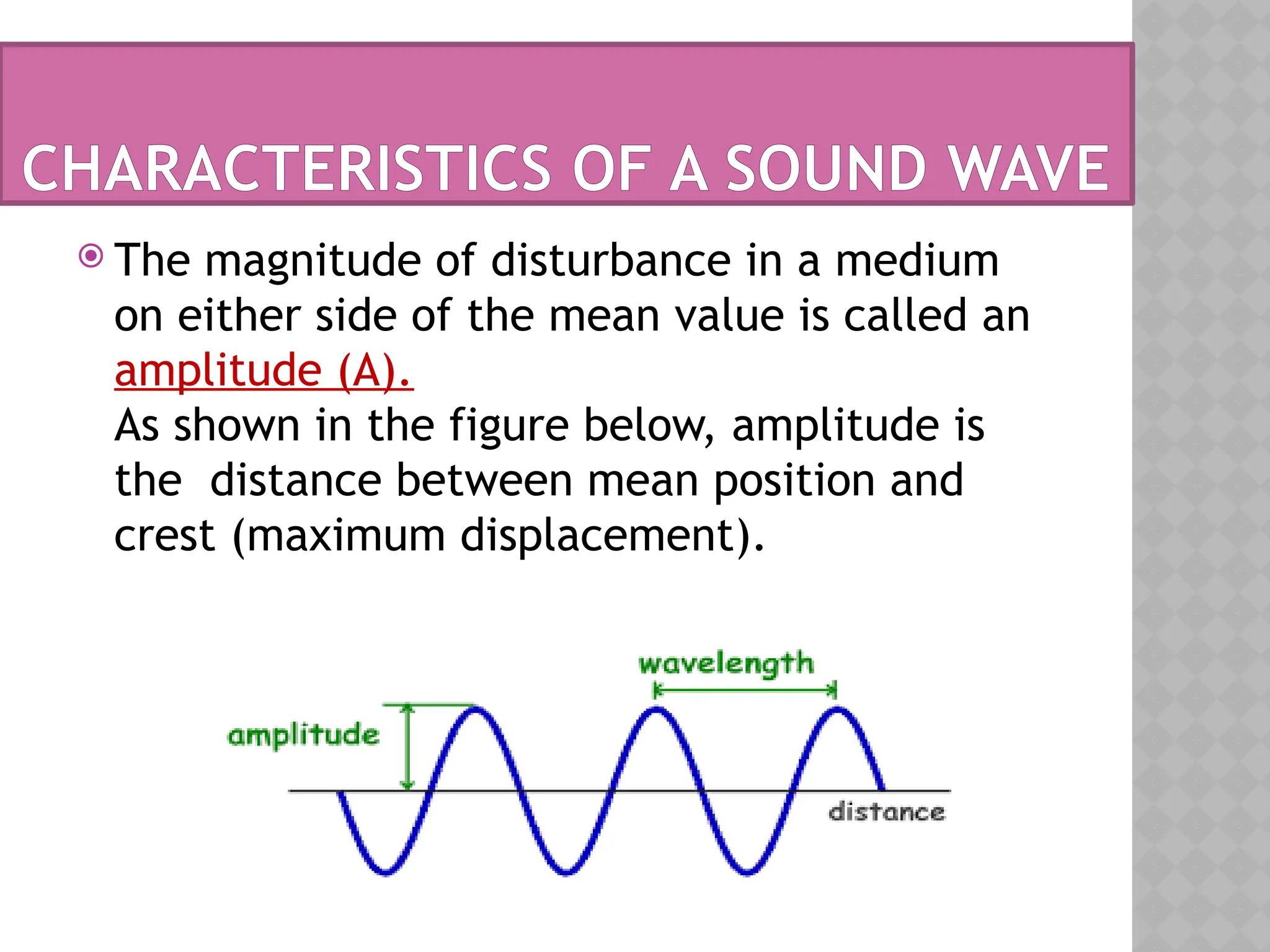
 The magnitude of disturbance in a medium
on either side of the mean value is called an
amplitude (A).
As shown in the figure below, amplitude is
the distance between mean position and
crest (maximum displacement).
CHARACTERISTICS OF A SOUND WAVE
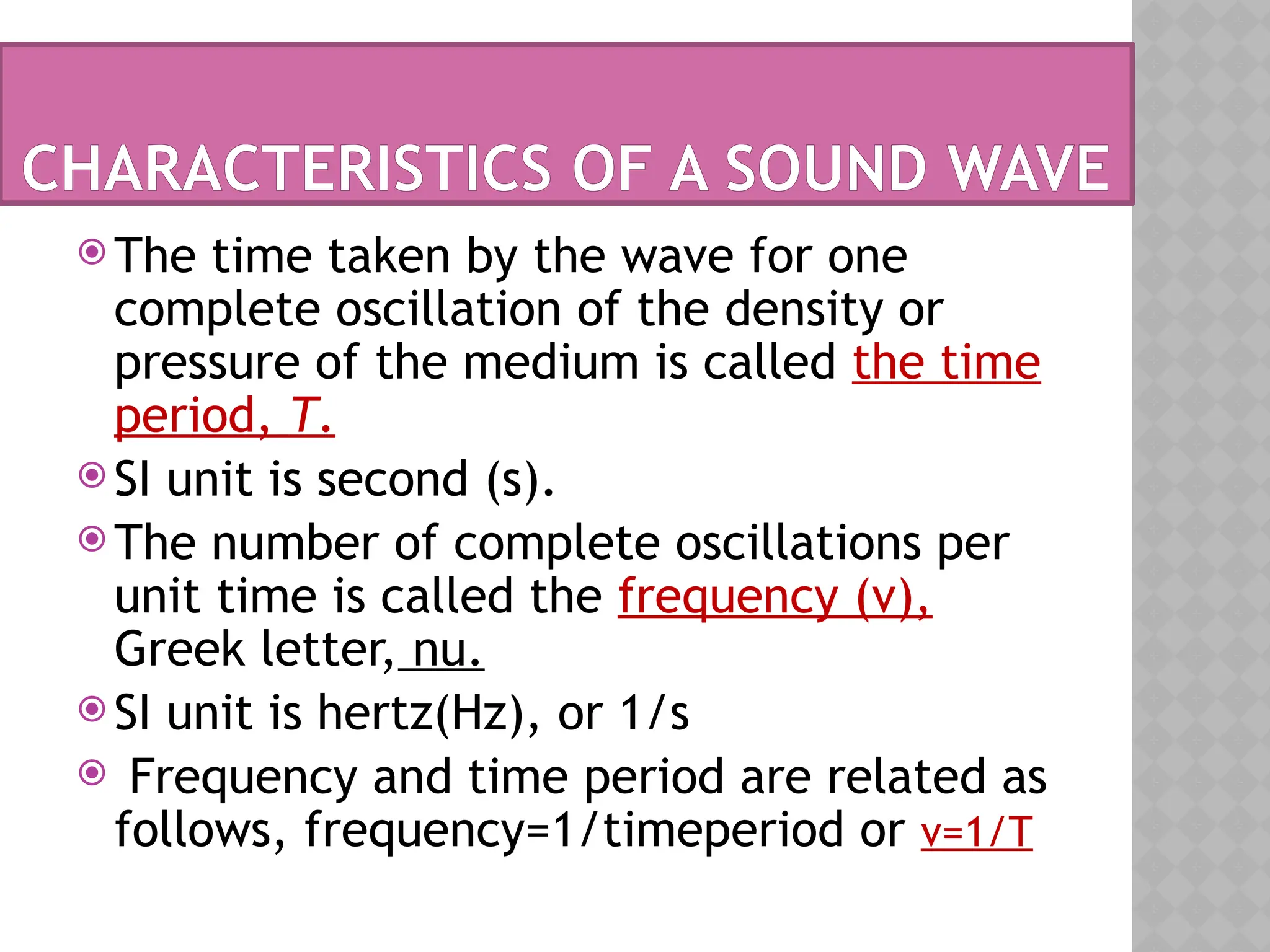
 The time taken by the wave for one
complete oscillation of the density or
pressure of the medium is called the time
period, T.
 SI unit is second (s).
 The number of complete oscillations per
unit time is called the frequency (ν),
Greek letter, nu.
 SI unit is hertz(Hz), or 1/s
 Frequency and time period are related as
follows, frequency=1/timeperiod or ν=1/T
CHARACTERISTICS OF A SOUND WAVE
SPEED OF SOUND
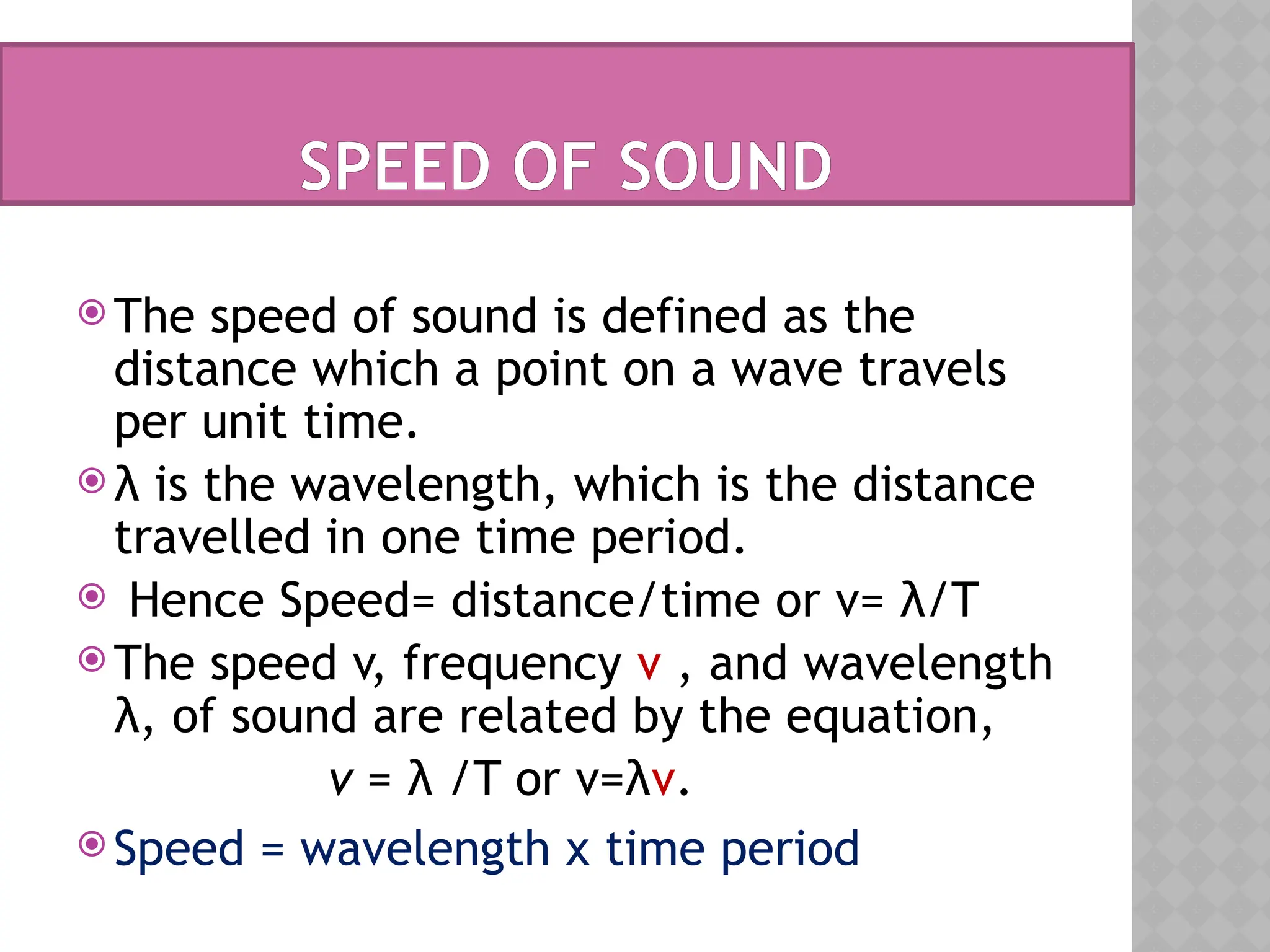
 The speed of sound is defined as the
distance which a point on a wave travels
per unit time.
 λ is the wavelength, which is the distance
travelled in one time period.
 Hence Speed= distance/time or v= λ/T
 The speed v, frequency ν , and wavelength
λ, of sound are related by the equation,
v = λ /T or v=λν.
 Speed = wavelength x time period
SPEED OF SOUND IN DIFFERENT
MEDIA
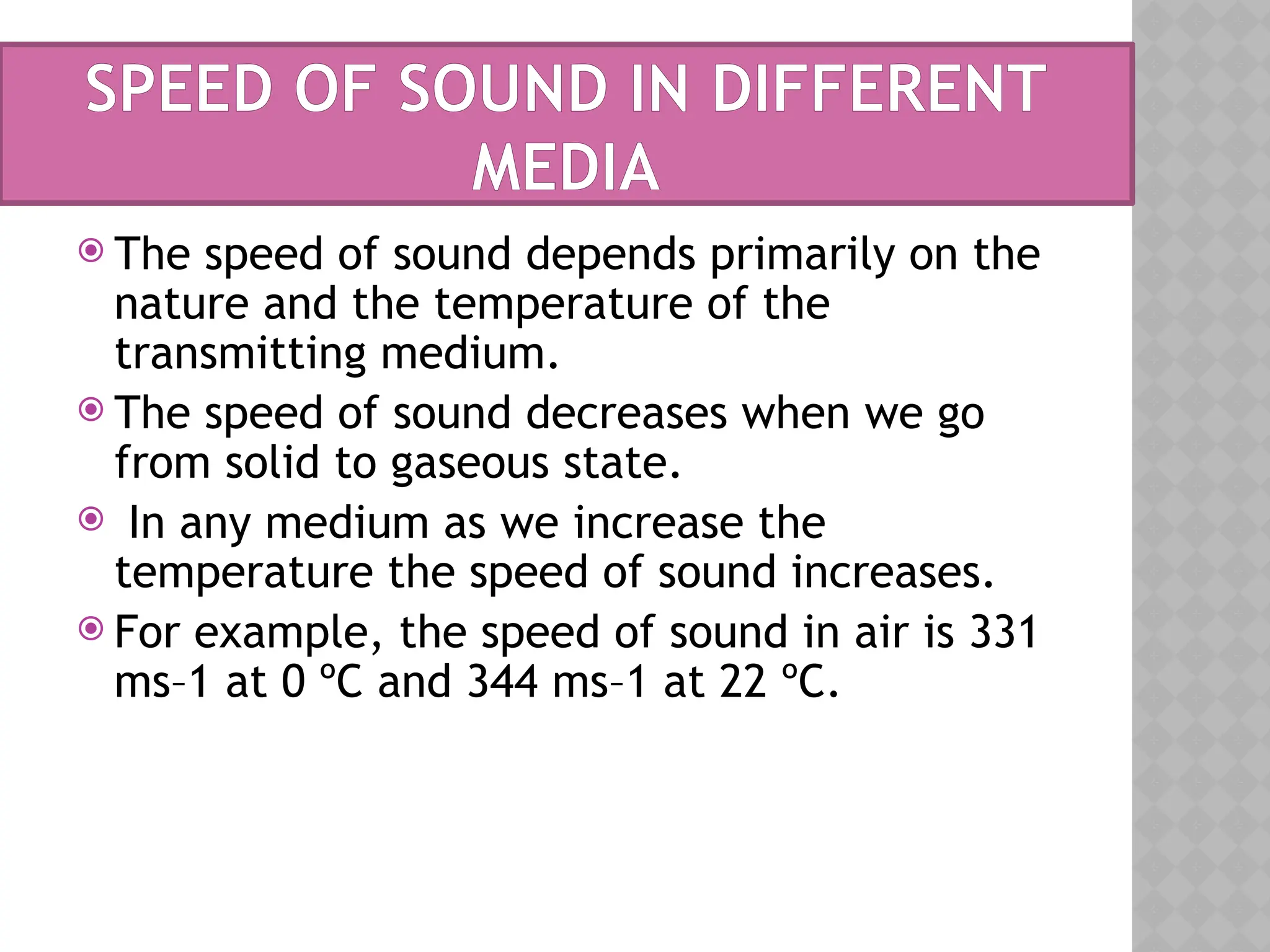
 The speed of sound depends primarily on the
nature and the temperature of the
transmitting medium.
 The speed of sound decreases when we go
from solid to gaseous state.
 In any medium as we increase the
temperature the speed of sound increases.
 For example, the speed of sound in air is 331
ms–1 at 0 ºC and 344 ms–1 at 22 ºC.
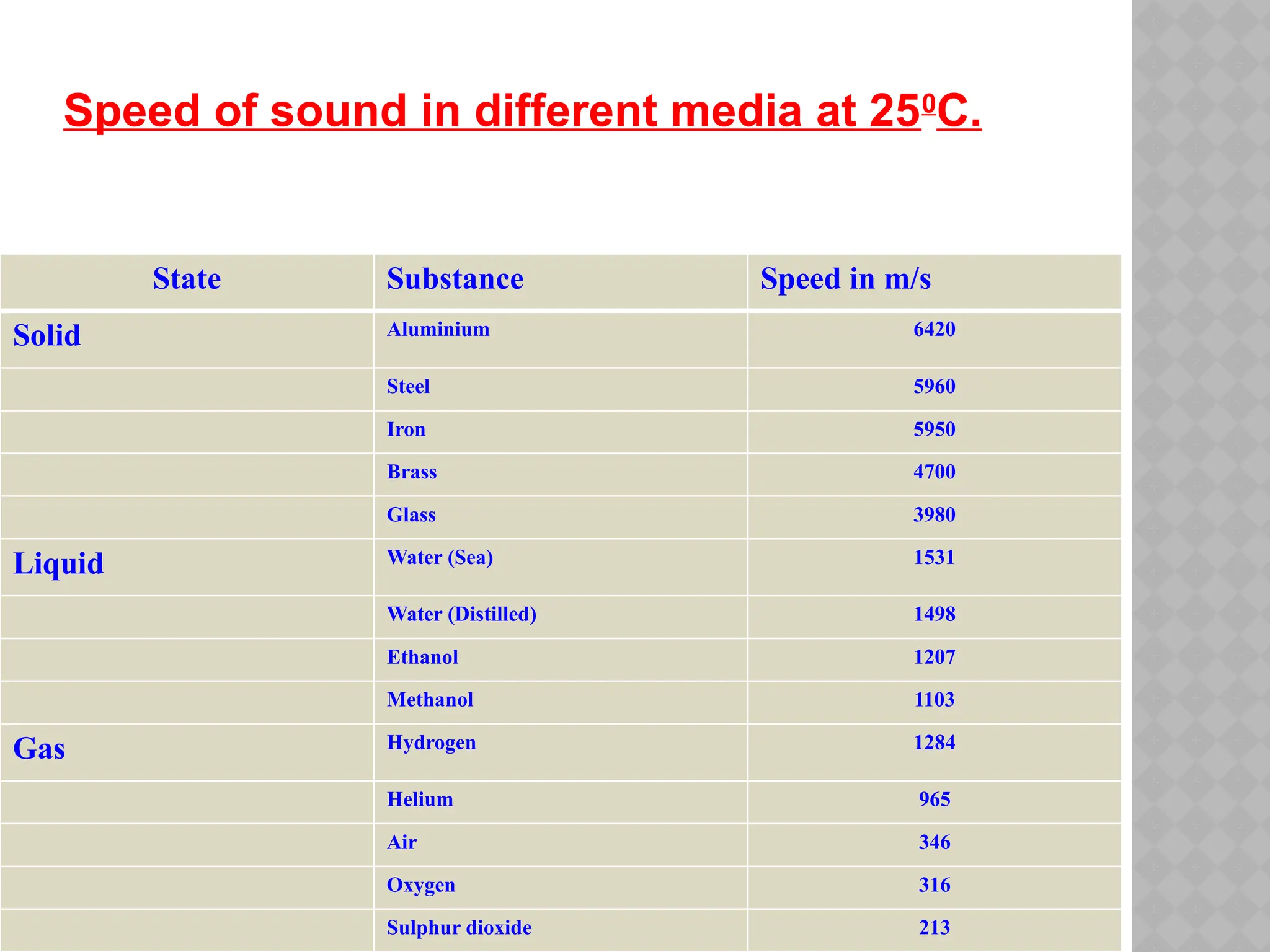
Speed of sound in different media at 250
C.
State Substance Speed in m/s
Solid Aluminium 6420
Steel 5960
Iron 5950
Brass 4700
Glass 3980
Liquid Water (Sea) 1531
Water (Distilled) 1498
Ethanol 1207
Methanol 1103
Gas Hydrogen 1284
Helium 965
Air 346
Oxygen 316
Sulphur dioxide 213
REFLECTION OF SOUND
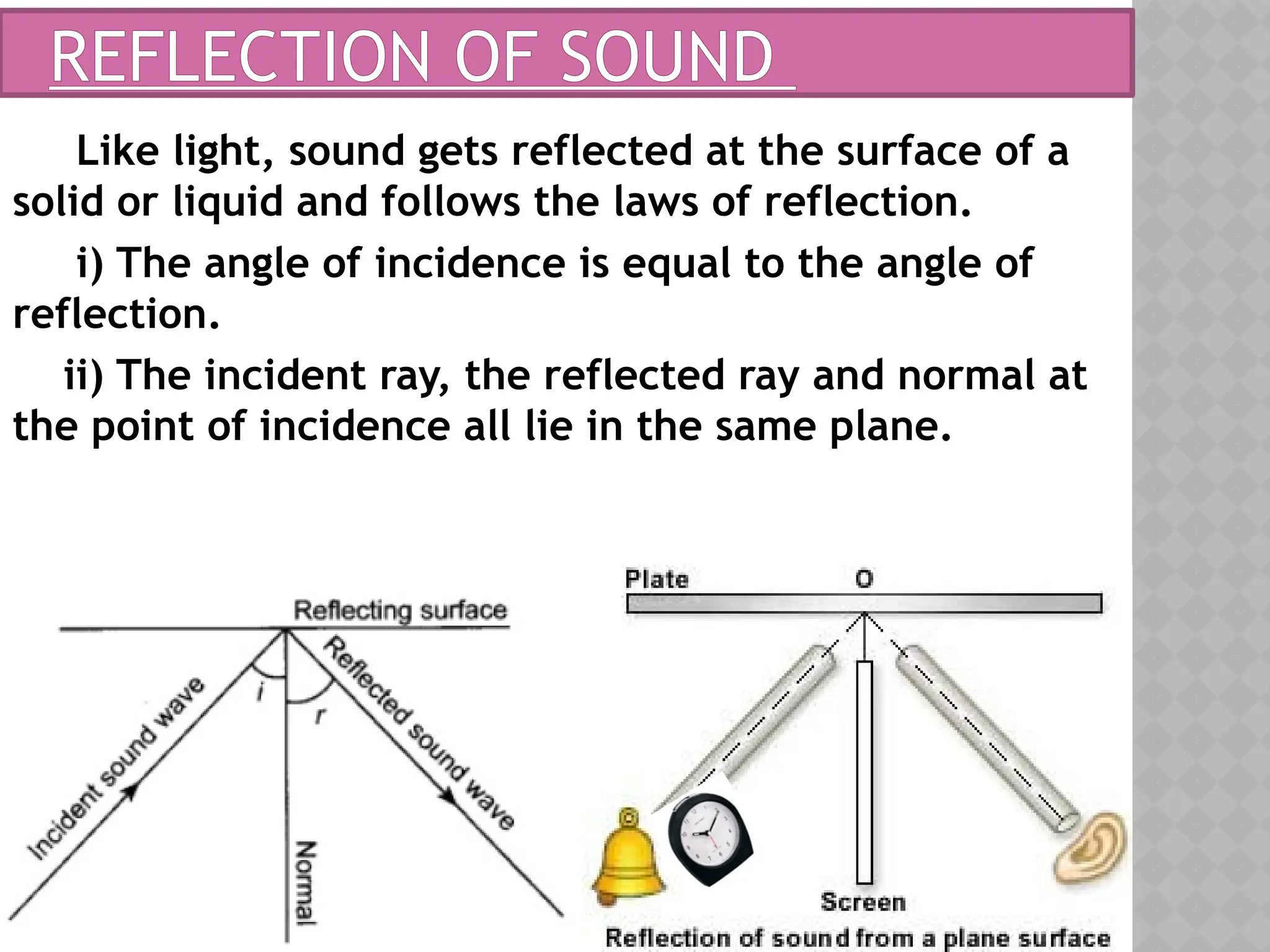
Like light, sound gets reflected at the surface of a
solid or liquid and follows the laws of reflection.
i) The angle of incidence is equal to the angle of
reflection.
ii) The incident ray, the reflected ray and normal at
the point of incidence all lie in the same plane.
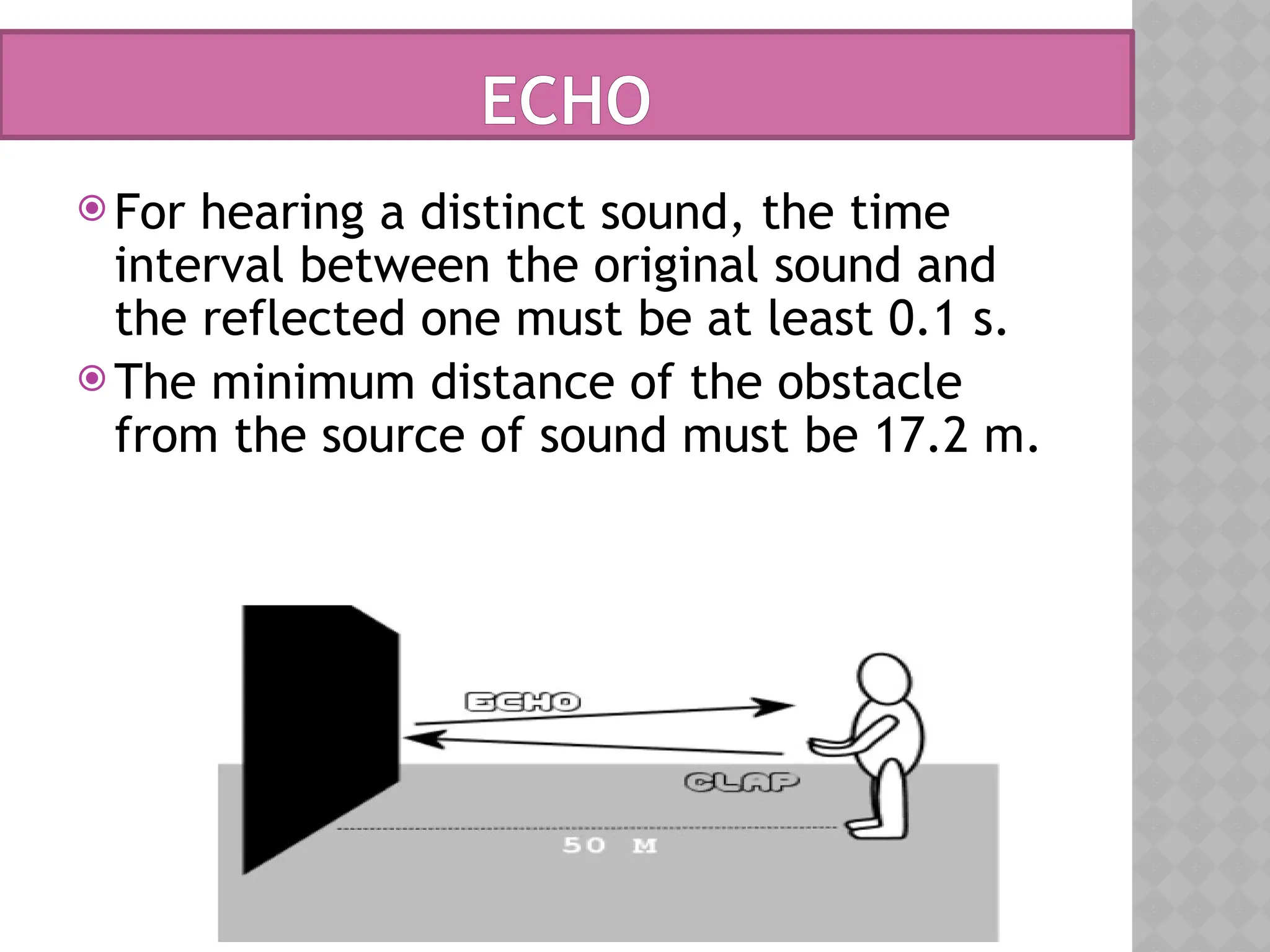
ECHO
 For hearing a distinct sound, the time
interval between the original sound and
the reflected one must be at least 0.1 s.
 The minimum distance of the obstacle
from the source of sound must be 17.2 m.
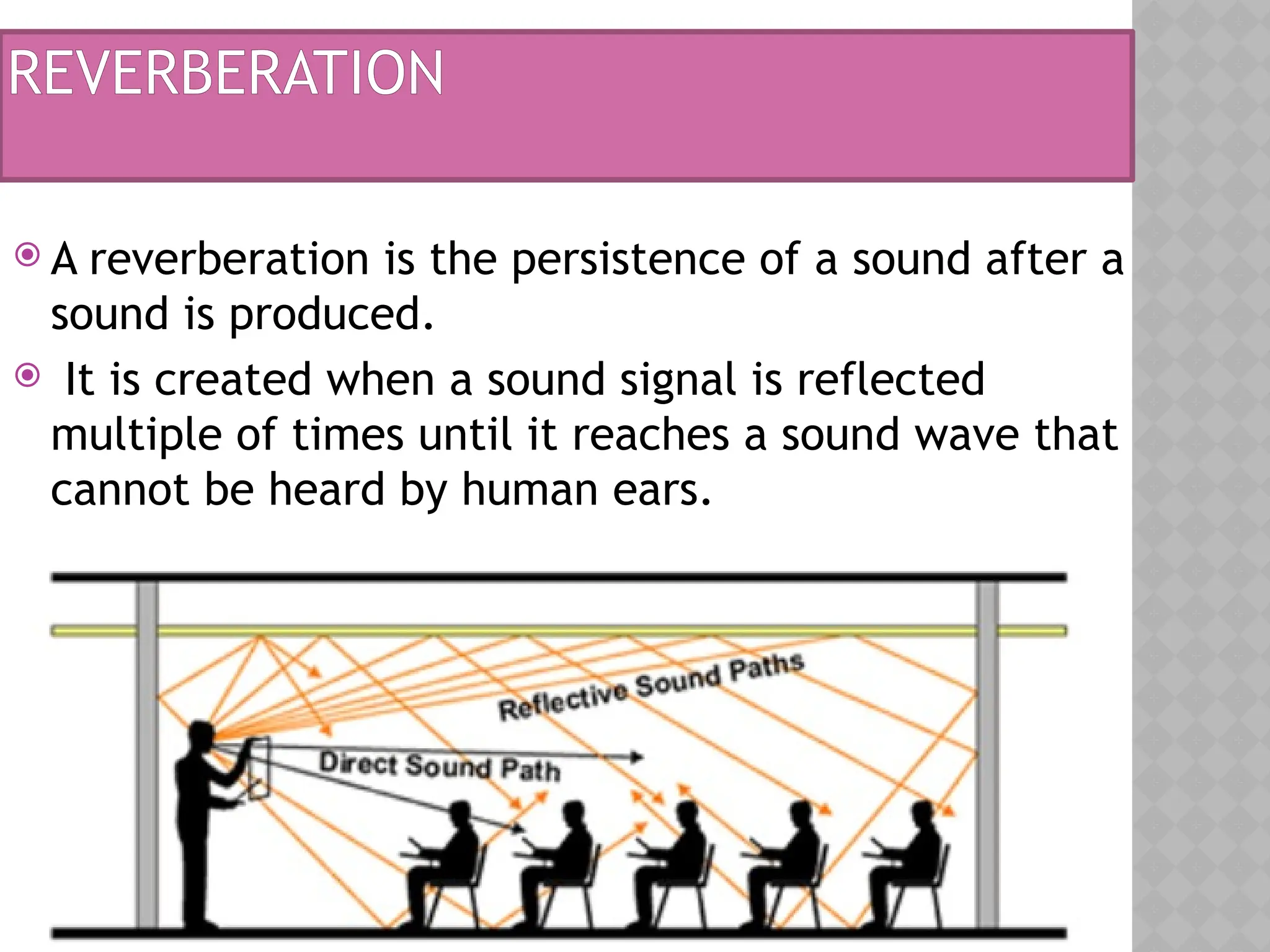
REVERBERATION
 A reverberation is the persistence of a sound after a
sound is produced.
 It is created when a sound signal is reflected
multiple of times until it reaches a sound wave that
cannot be heard by human ears.
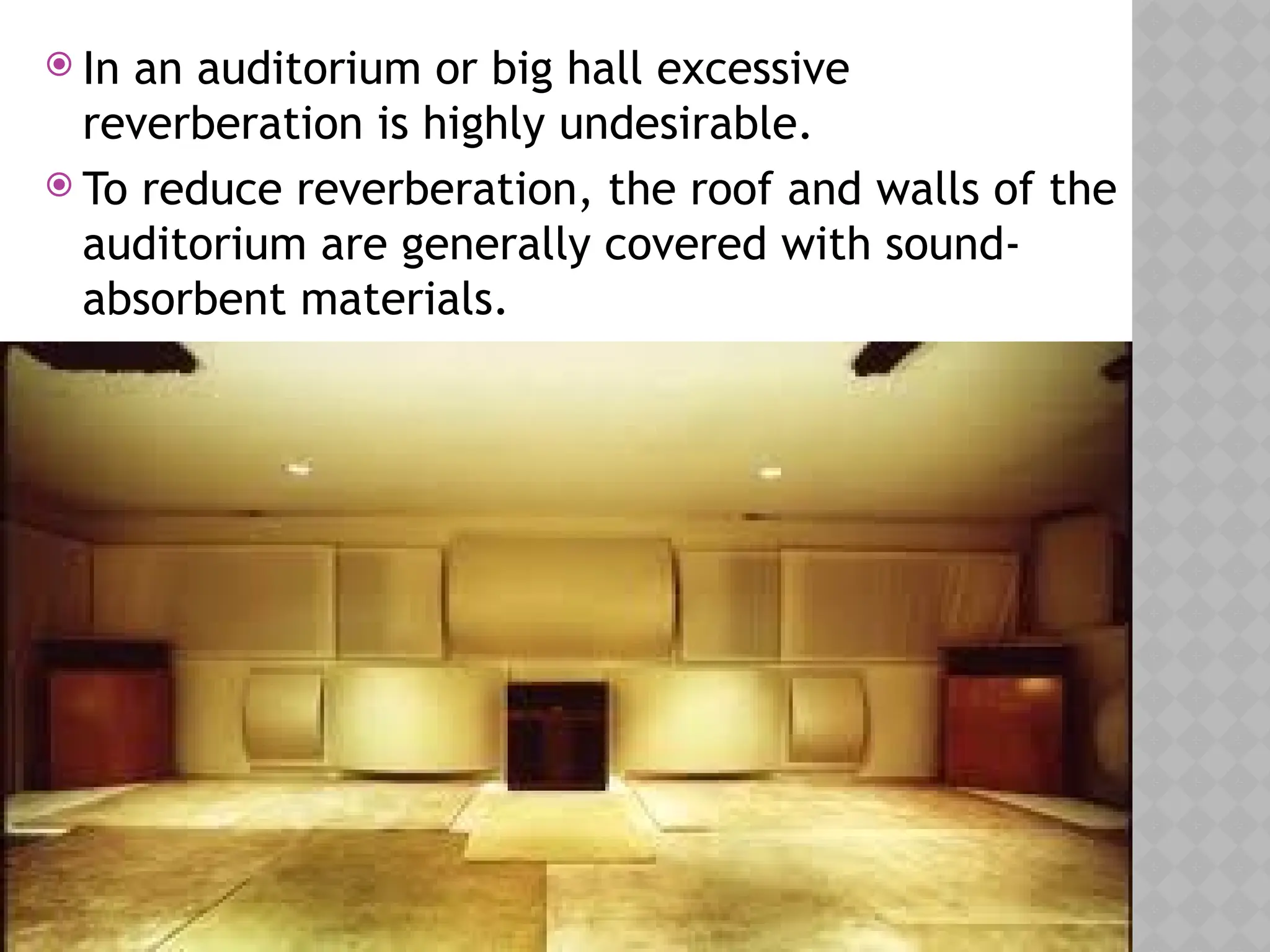
 In an auditorium or big hall excessive
reverberation is highly undesirable.
 To reduce reverberation, the roof and walls of the
auditorium are generally covered with sound-
absorbent materials.
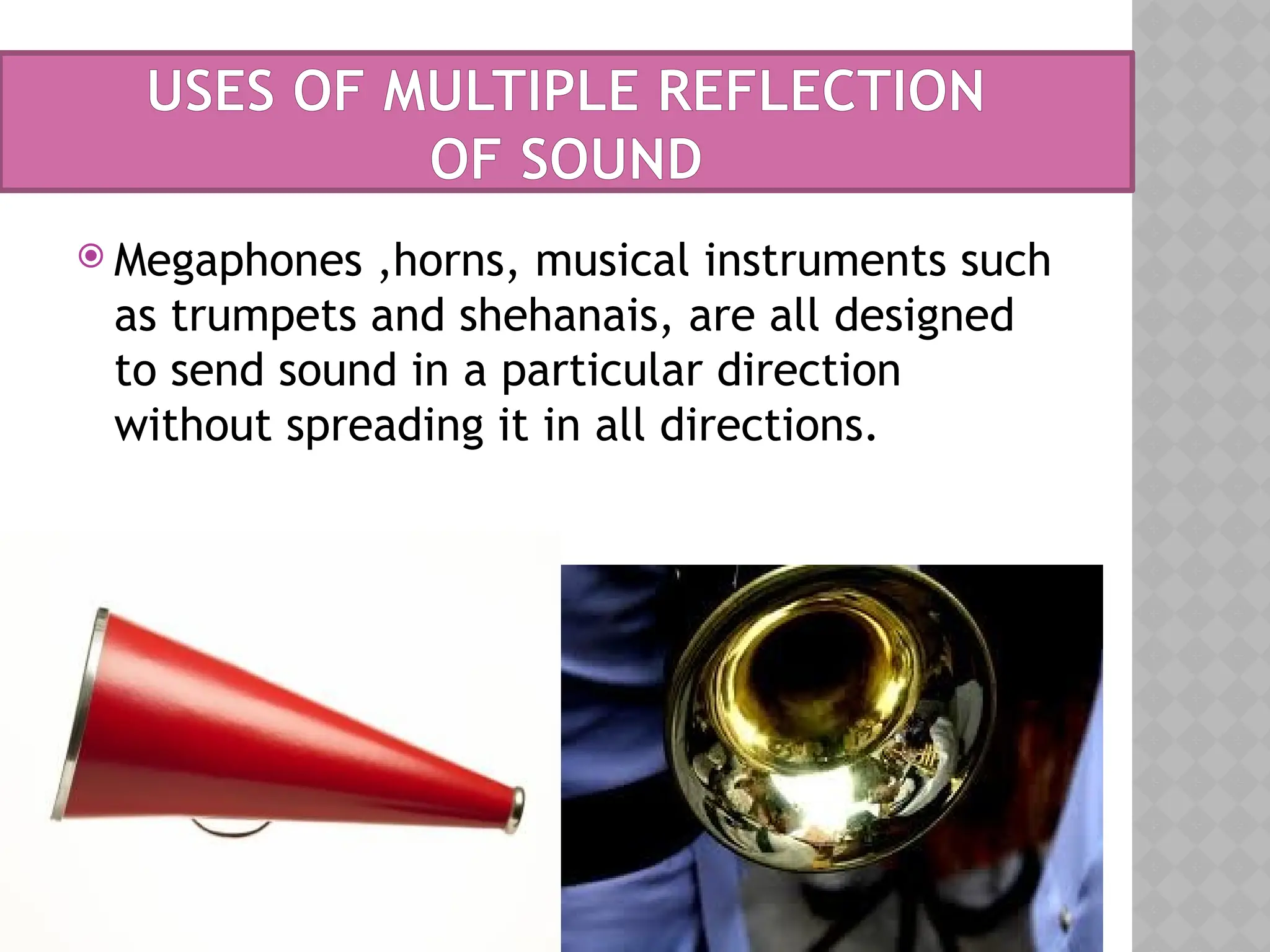
USES OF MULTIPLE REFLECTION
OF SOUND
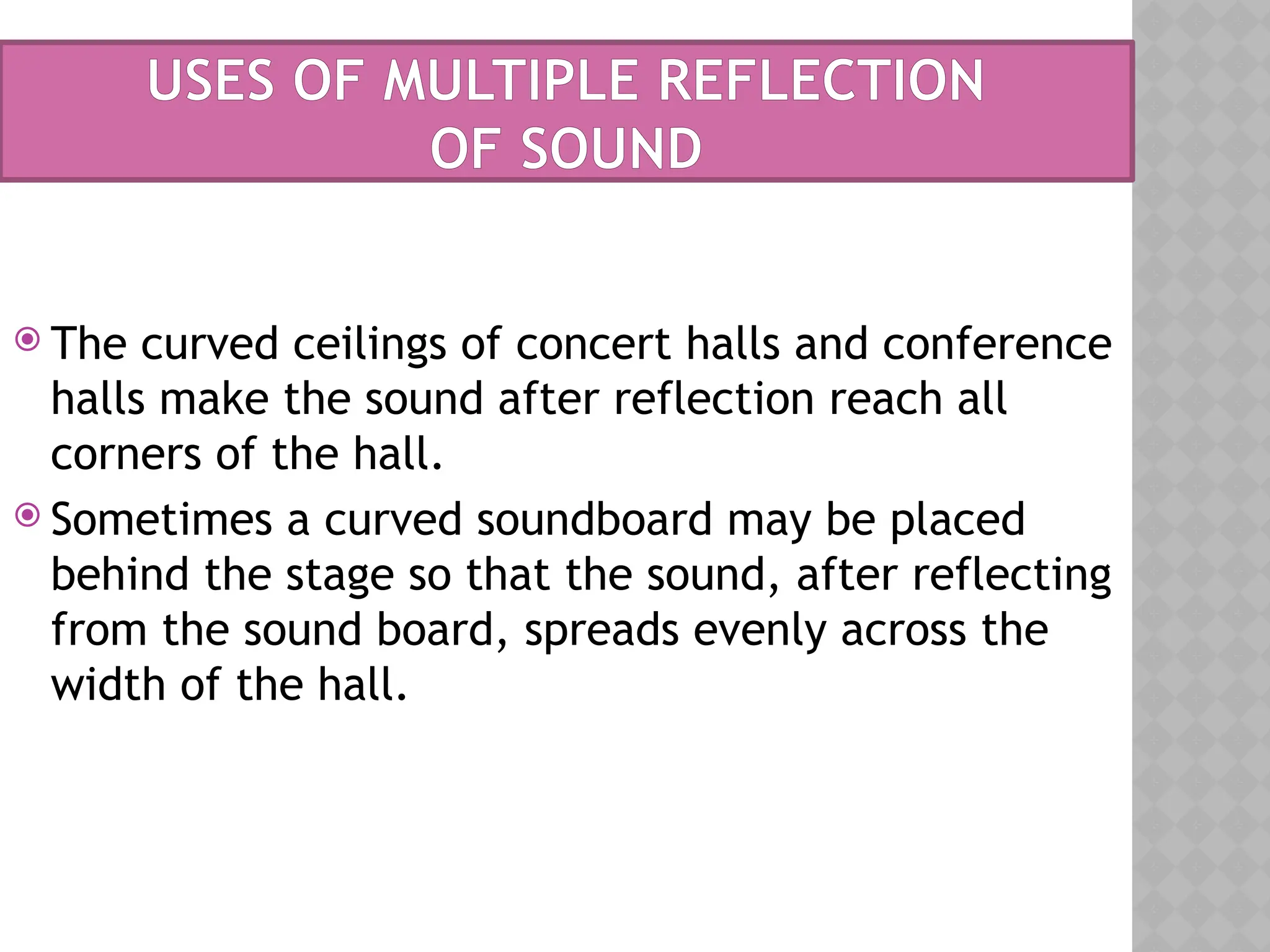
 Megaphones ,horns, musical instruments such
as trumpets and shehanais, are all designed
to send sound in a particular direction
without spreading it in all directions.
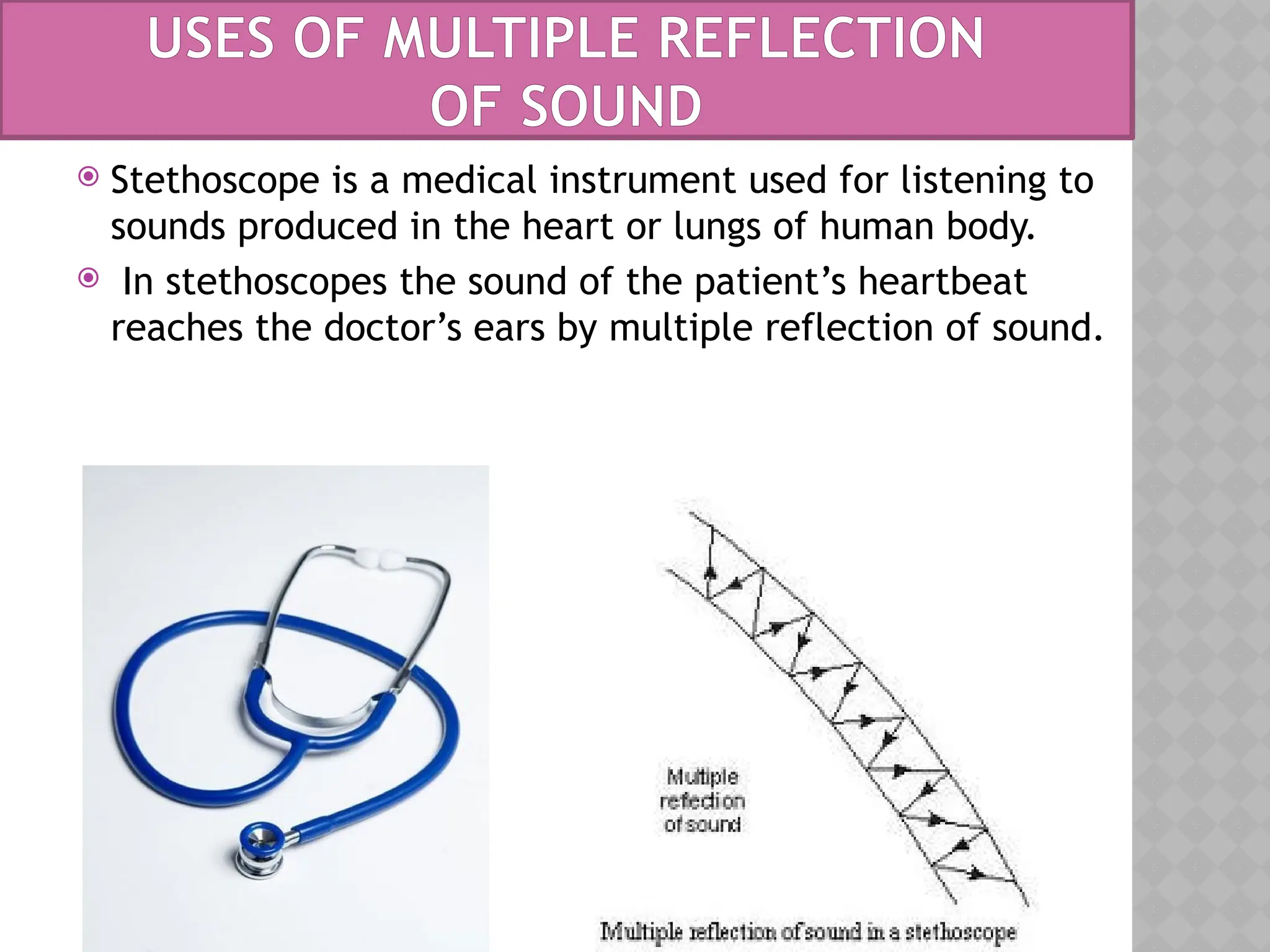
 Stethoscope is a medical instrument used for listening to
sounds produced in the heart or lungs of human body.
 In stethoscopes the sound of the patient’s heartbeat
reaches the doctor’s ears by multiple reflection of sound.
USES OF MULTIPLE REFLECTION
OF SOUND
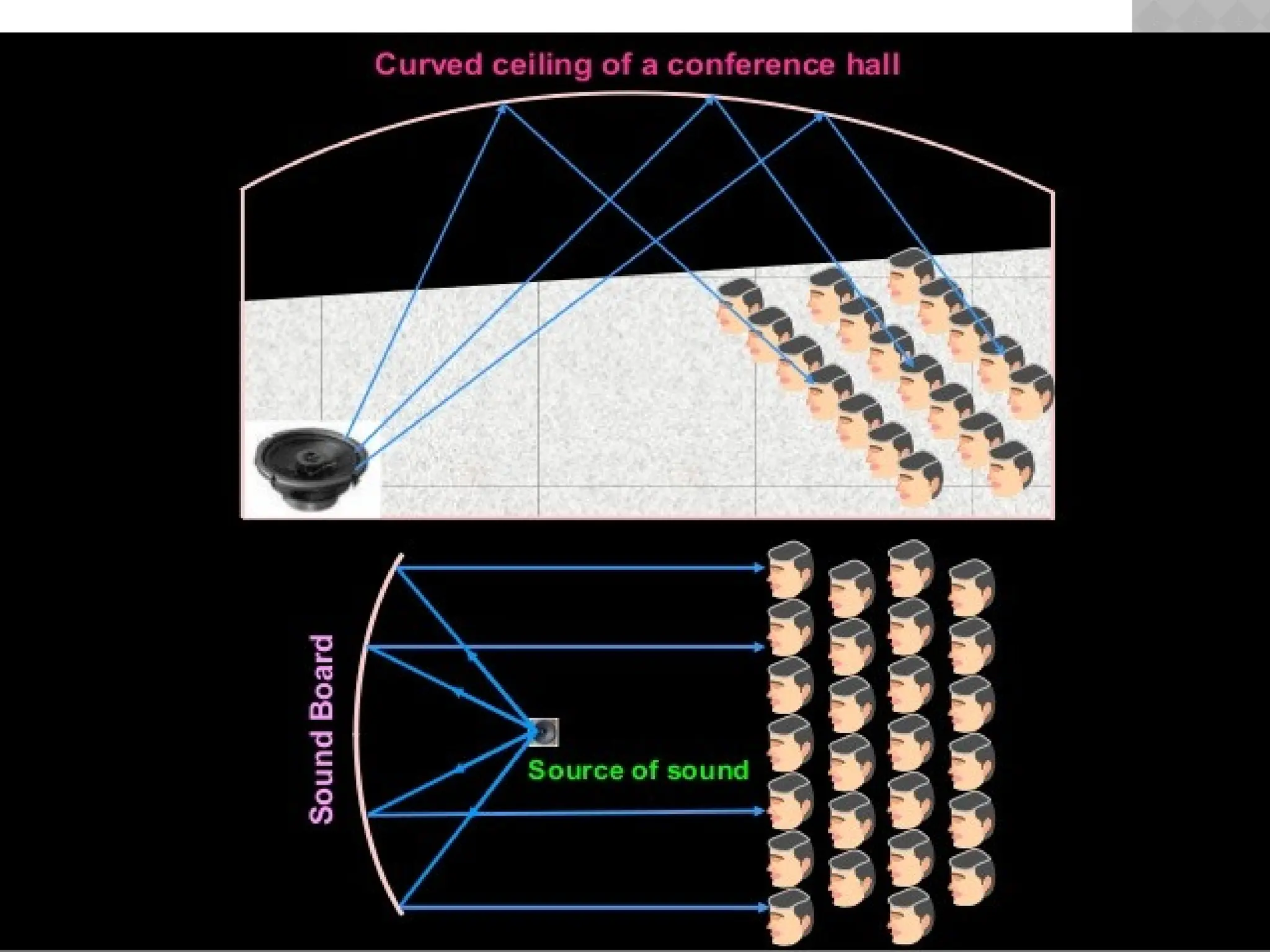
 The curved ceilings of concert halls and conference
halls make the sound after reflection reach all
corners of the hall.
 Sometimes a curved soundboard may be placed
behind the stage so that the sound, after reflecting
from the sound board, spreads evenly across the
width of the hall.
USES OF MULTIPLE REFLECTION
OF SOUND
PROPERTIES OF SOUND
 Sound properties such as pitch, loudness and
quality are determined by the corresponding
wave properties.
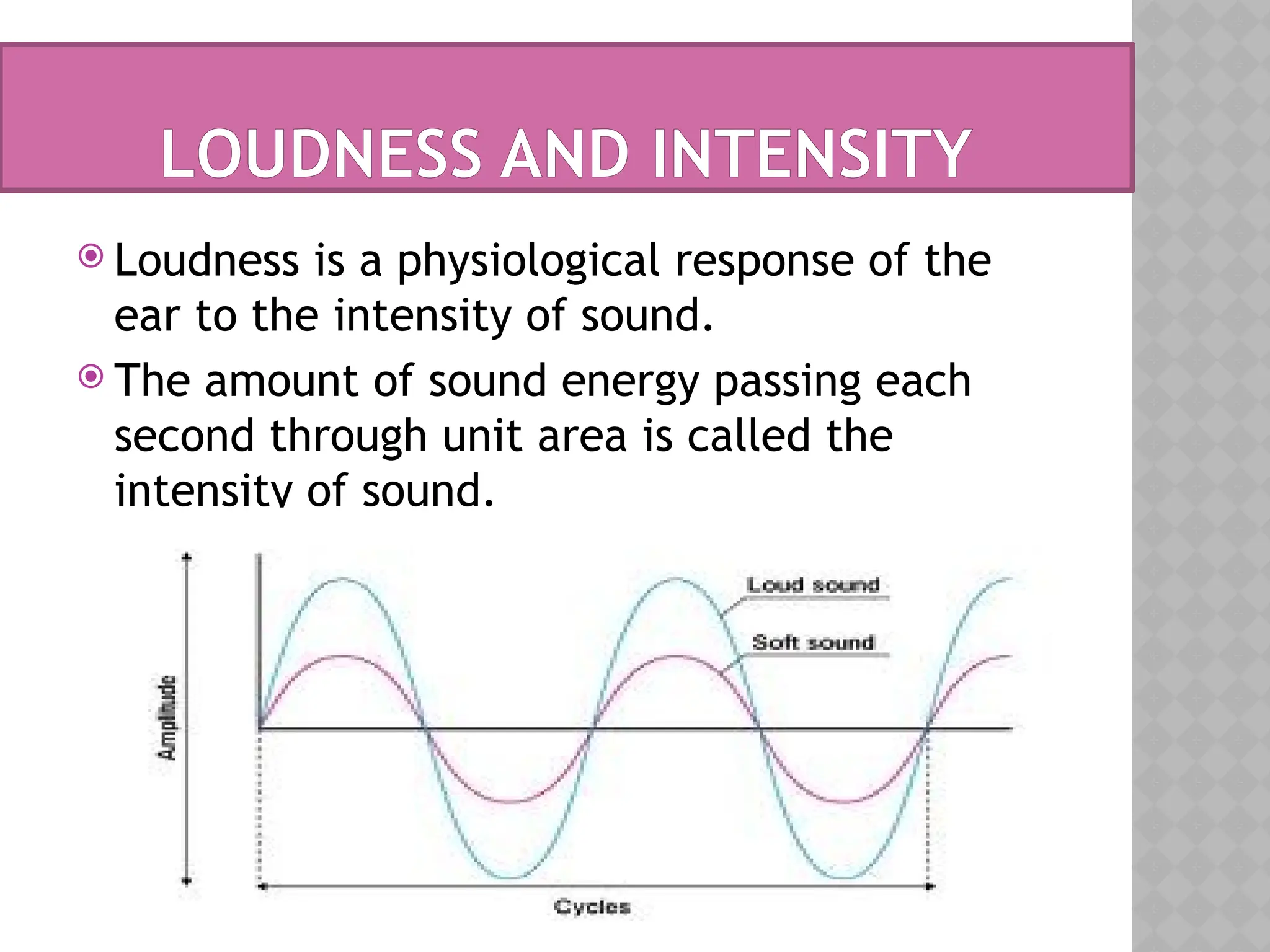
 The loudness or softness of a sound is determined
basically by its amplitude. The amplitude of the
sound wave depends upon the force with which
an object is made to vibrate.
LOUDNESS AND INTENSITY
 Loudness is a physiological response of the
ear to the intensity of sound.
 The amount of sound energy passing each
second through unit area is called the
intensity of sound.
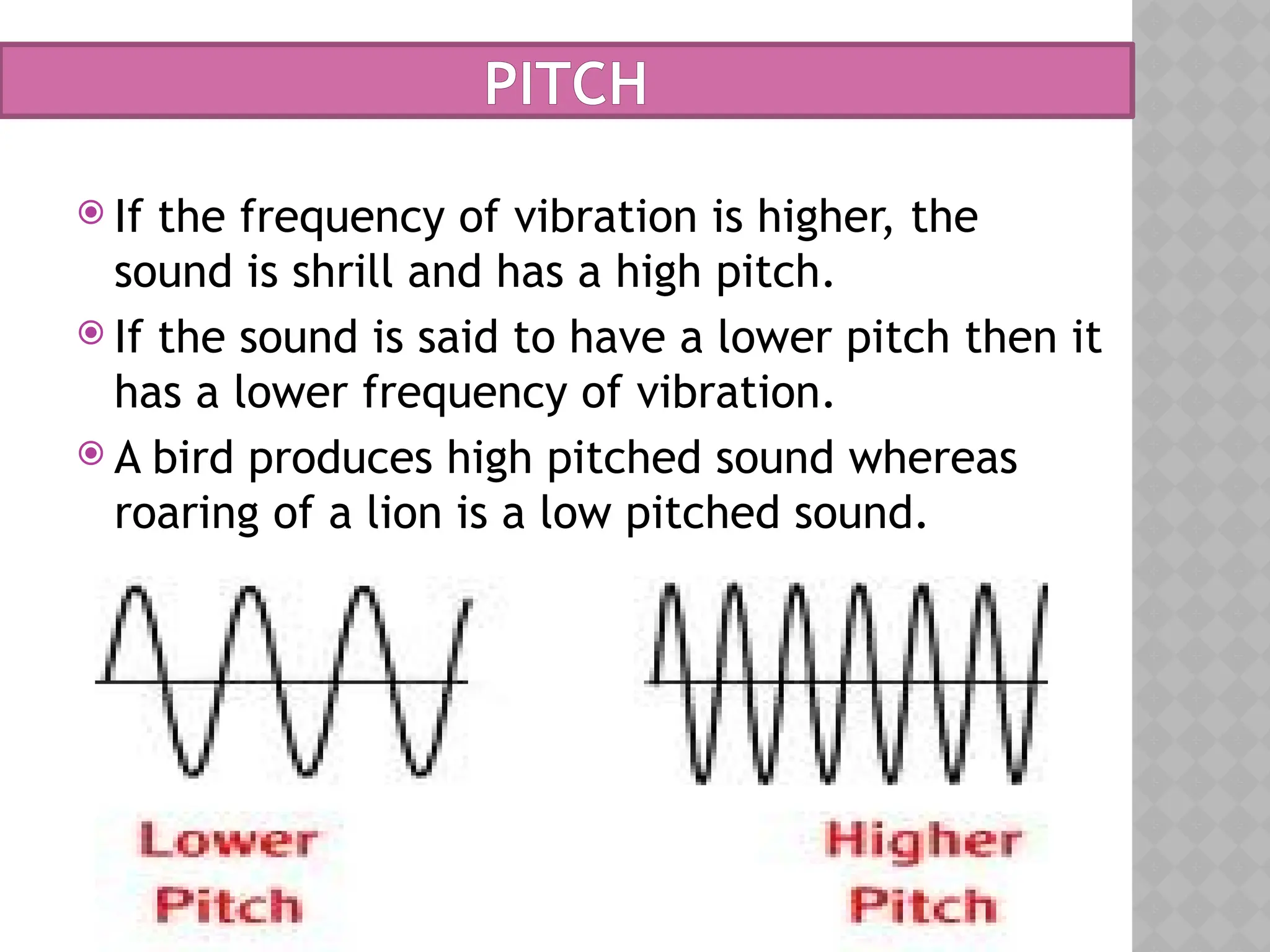
PITCH
 If the frequency of vibration is higher, the
sound is shrill and has a high pitch.
 If the sound is said to have a lower pitch then it
has a lower frequency of vibration.
 A bird produces high pitched sound whereas
roaring of a lion is a low pitched sound.
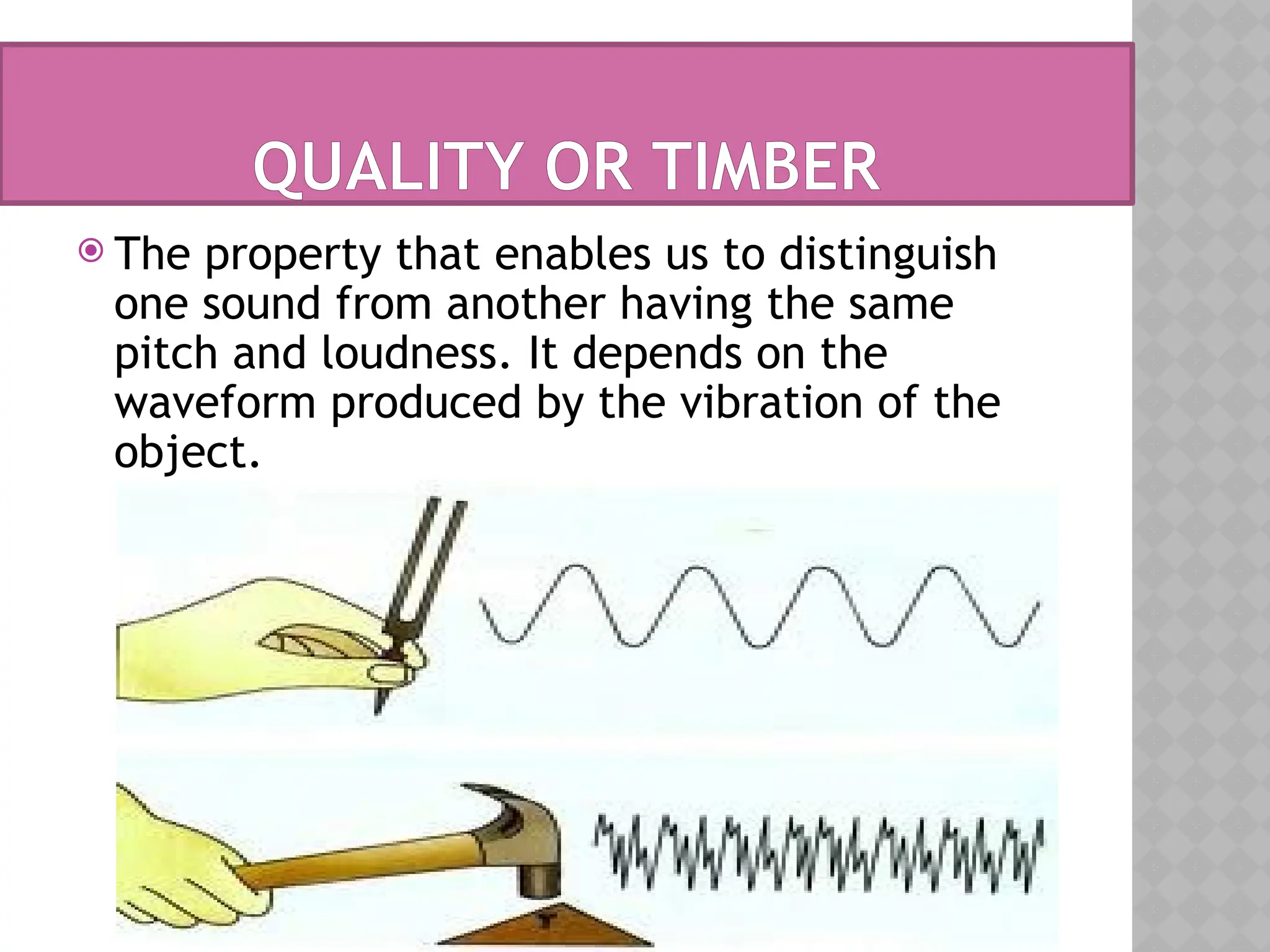
QUALITY OR TIMBER
 The property that enables us to distinguish
one sound from another having the same
pitch and loudness. It depends on the
waveform produced by the vibration of the
object.
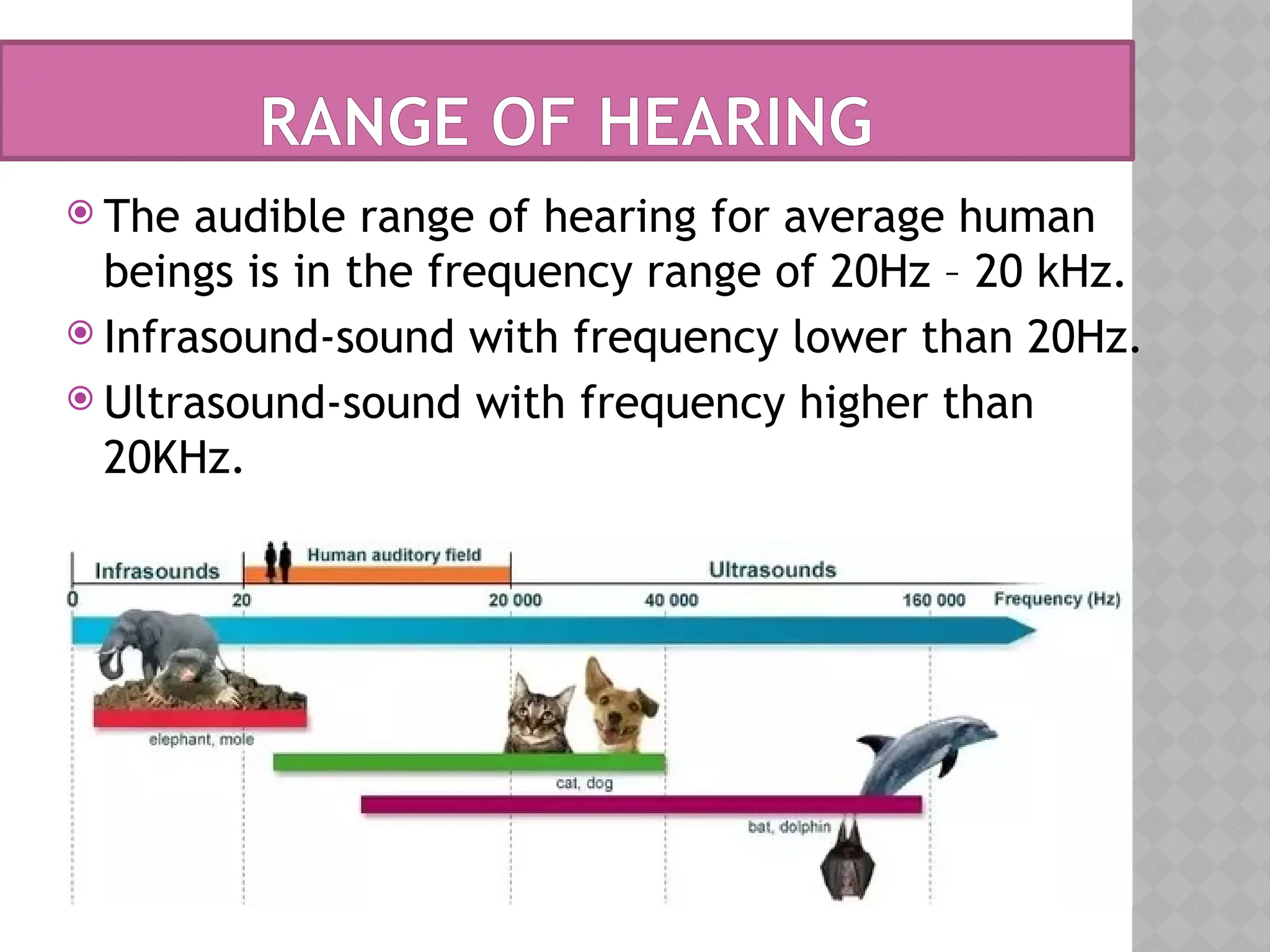
RANGE OF HEARING
 The audible range of hearing for average human
beings is in the frequency range of 20Hz – 20 kHz.
 Infrasound-sound with frequency lower than 20Hz.
 Ultrasound-sound with frequency higher than
20KHz.
ULTRASOUND & INFRASOUND
 The waves having
frequency less than 20
Hz are infrasonic waves.
 A vibrating simple
pendulum produces
infrasonic sounds.
 Elephants and whales
produces infrasonic
waves.
 Earthquakes produces
infrasonic waves
 The waves having
frequency more than
20,000 Hz are
ultrasonic waves.
 Bats and rats can
produce ultrasonic
sounds.
APPLICATIONS OF ULTRASOUND
 Industrial applications:
 To clean parts located in hard-to-reach places,
for example, spiral tube, odd shaped parts,
electronic components etc.
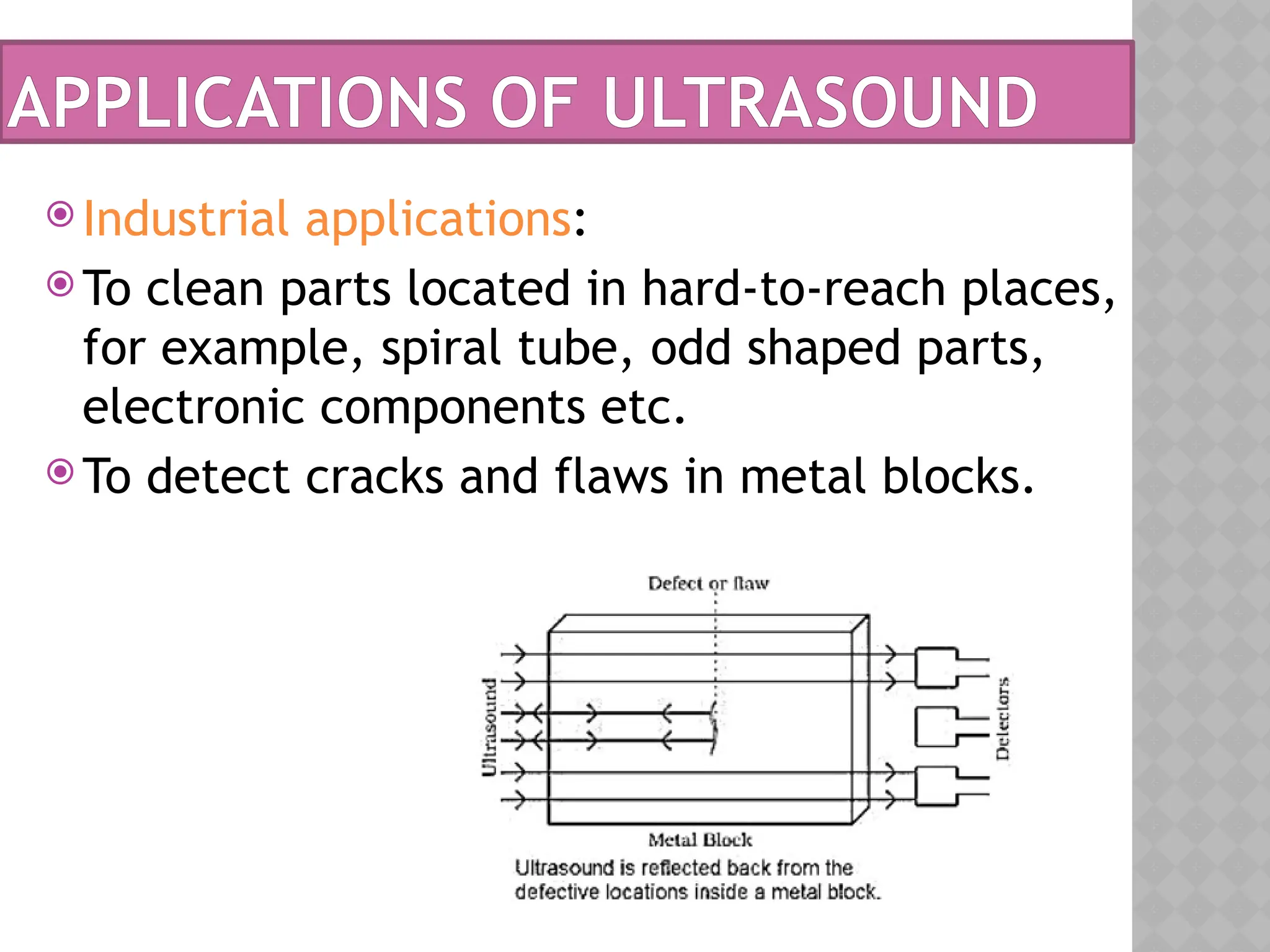
 To detect cracks and flaws in metal blocks.
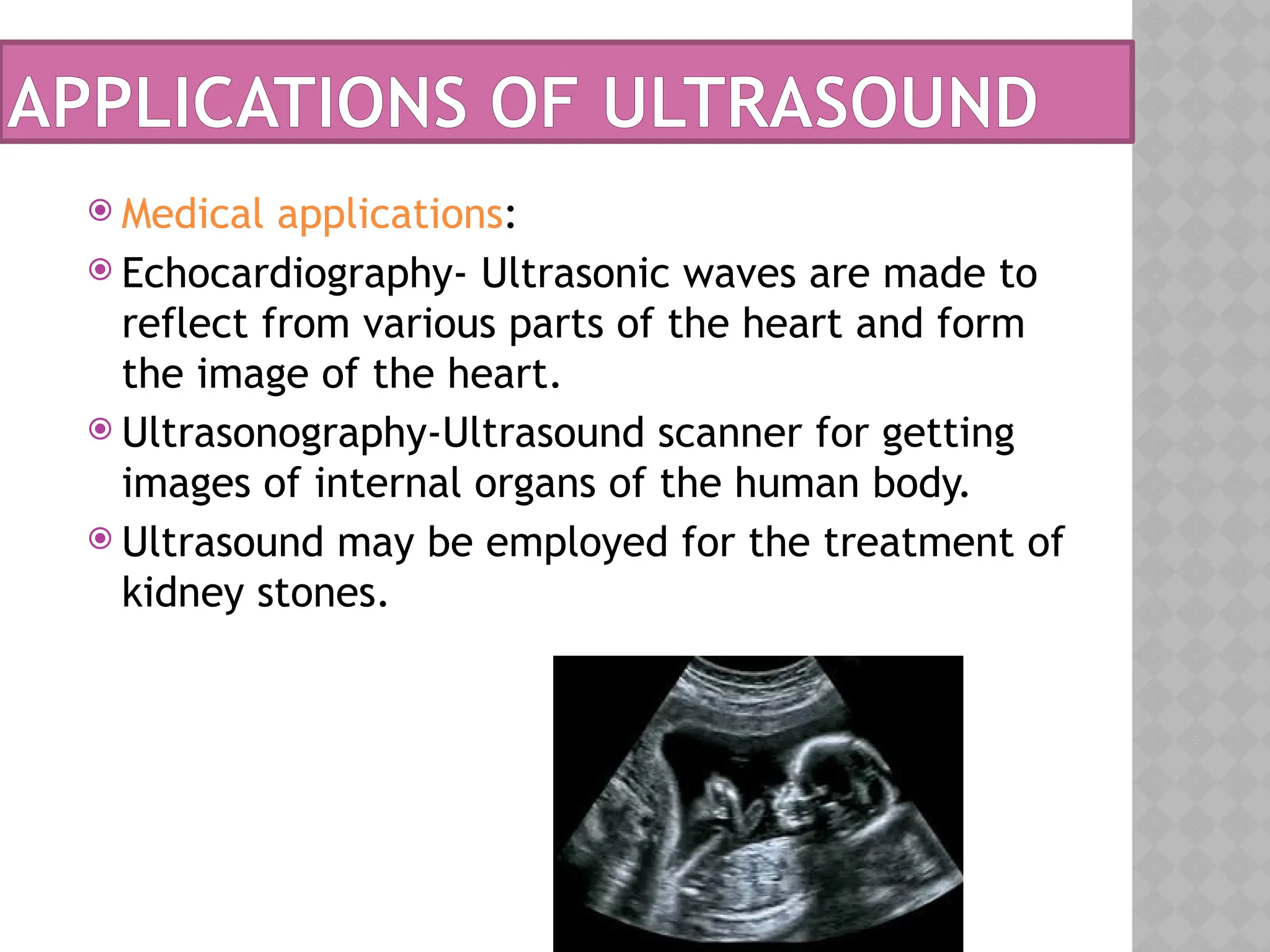
 Medical applications:
 Echocardiography- Ultrasonic waves are made to
reflect from various parts of the heart and form
the image of the heart.
 Ultrasonography-Ultrasound scanner for getting
images of internal organs of the human body.
 Ultrasound may be employed for the treatment of
kidney stones.
APPLICATIONS OF ULTRASOUND
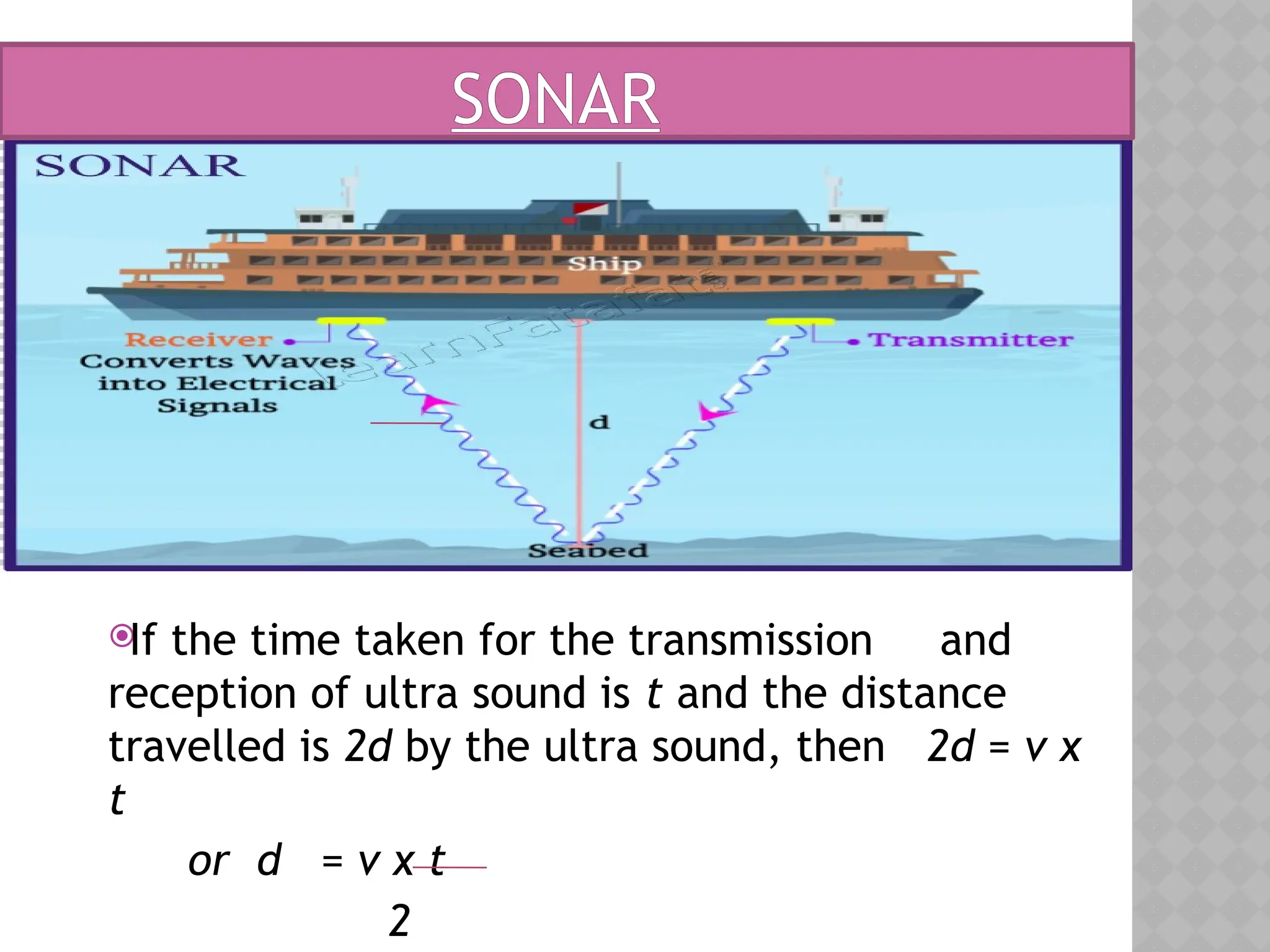
SONAR
 Sonar stands for Sound Navigation And
Ranging. It is a device which uses ultrasonic
waves to measure distance, direction and speed
of underwater objects.
This technique is used to determine the depth
of the sea and to locate underwater hills, valleys,
submarine, icebergs, sunken ship etc.

If the time taken for the transmission and
reception of ultra sound is t and the distance
travelled is 2d by the ultra sound, then 2d = v x
t
or d = v x t
2
SONAR
BATS PRODUCE ULTRASOUND?
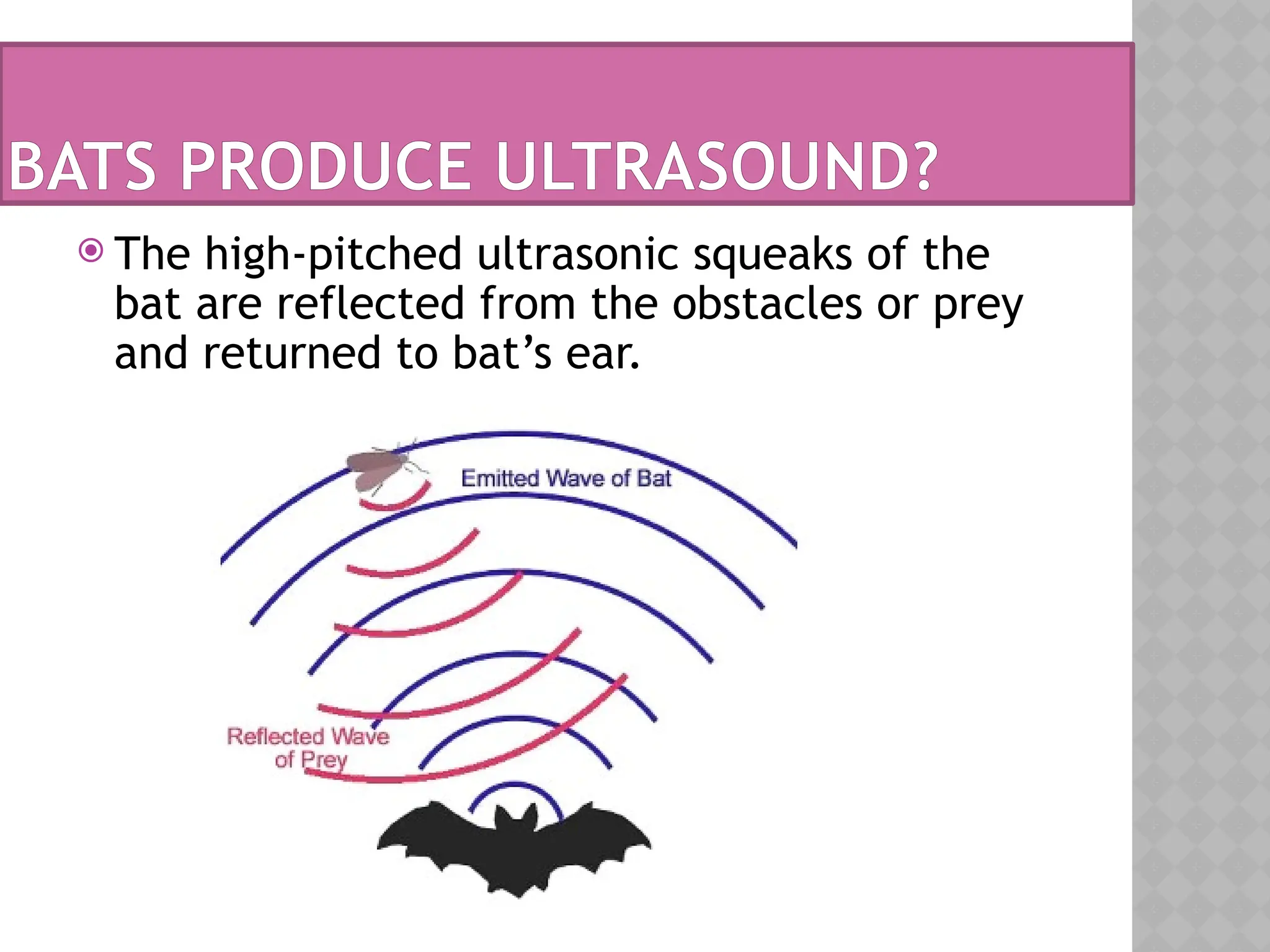
 The high-pitched ultrasonic squeaks of the
bat are reflected from the obstacles or prey
and returned to bat’s ear.
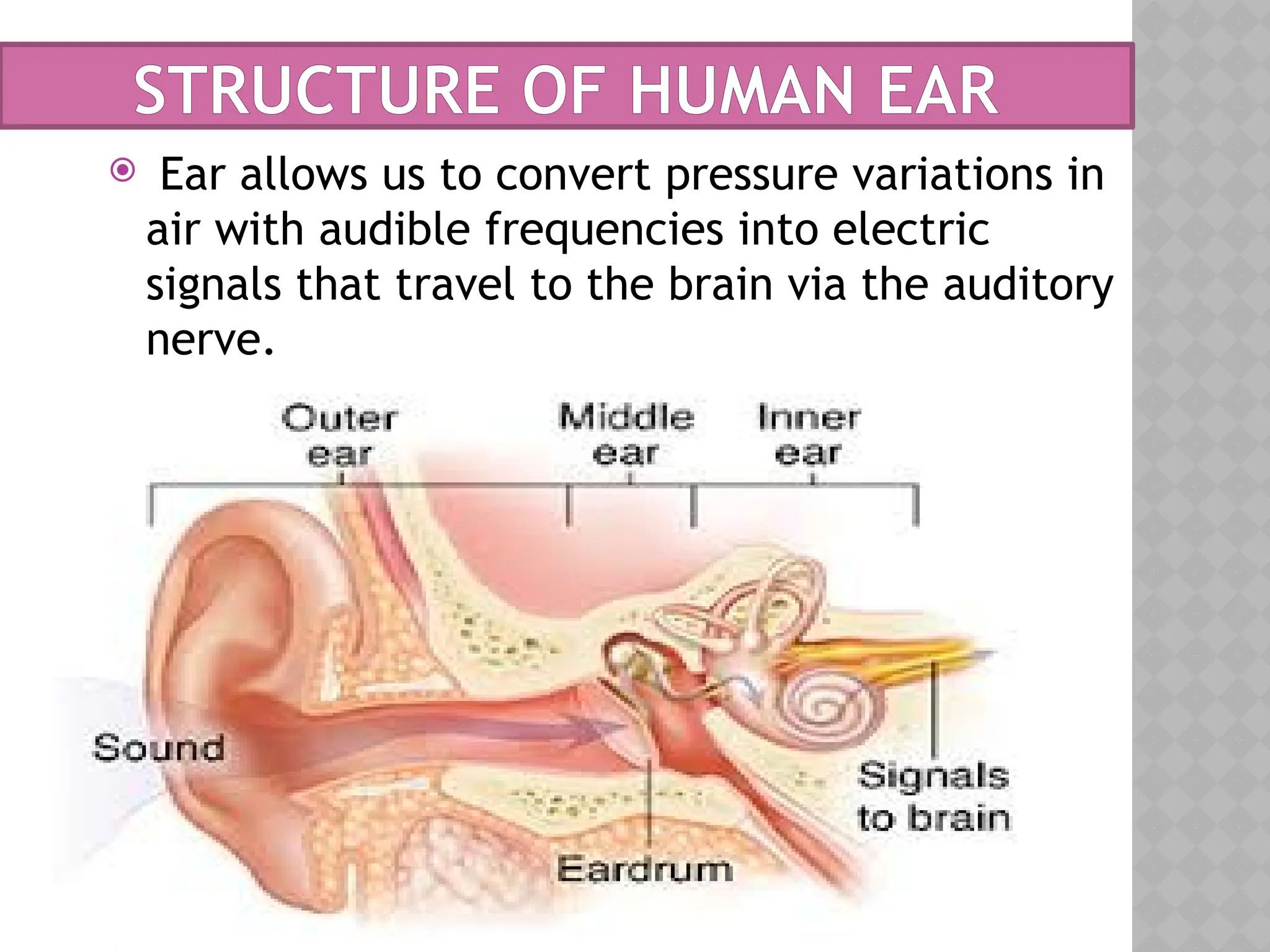
STRUCTURE OF HUMAN EAR
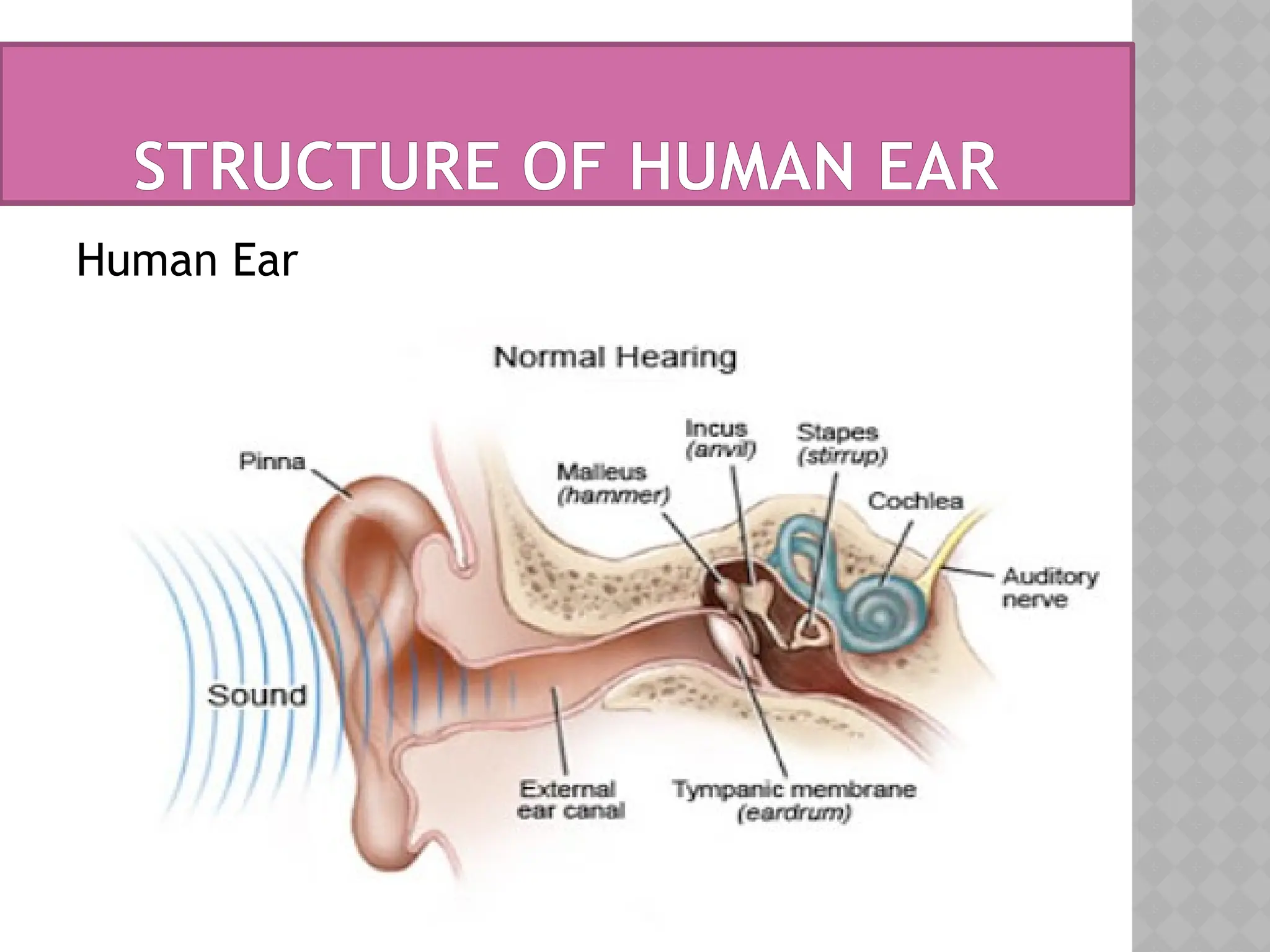
Human Ear
 Ear allows us to convert pressure variations in
air with audible frequencies into electric
signals that travel to the brain via the auditory
nerve.
STRUCTURE OF HUMAN EAR
RECAPITULATION:
 Sound is a longitudinal wave which travels in
the form of sets of compressions and
rarefactions.
 Sound requires a medium to travel.
 Frequency, time period, amplitude, speed and
wavelength are the important characteristics
of sound wave.
 Sound waves undergo reflection obeying the
laws of reflection.
 Multiple reflection of sound has many practical
applications.
 Human audible range is 20Hz to 20000Hz.
 Infrasound-sound with frequency lower than
20Hz.
 Ultrasound-sound with frequency higher than
20KHz.
 Ultrasound has many industrial as well as
medical applications.
 Human ear is a very sensitive organ which
help us to hear various kinds of sounds.
RECAPITULATION:
HOMEWORK
 Explain an activity with neat diagram to
prove that sound needs a medium to travel.
 Define pitch, loudness and quality of sound.
 Mention the applications of ultrasound.
 What is meant by reverberation?
 What is the minimum distance between the
source and the obstacle to hear a distinct
echo?
 A sound wave has a frequency of 2 kHz and
wave length 35 cm. Calculate the speed of
the wave?
THANKS

Class IX CBSCE Chapter 12 Sound

  • 1.
    e-Content Class: IX Subject: Science Chapter-12 SOUND Preparedby Manjusha M Nair,PGT Physics, JNV Wayanad,Kerala. NAVODAYA VIDYALAYA SAMITI, NOIDA
  • 2.
    WHICH FORM OFENERGY HELPS US IN HEARING? Do you like music? Everyday we hear from humans, birds, bells,radio,televisions, vehicles etc. It is the sound energy which help us to hear.
  • 3.
    LEARNING OUTCOMES  Explainthe propagation of sound through a medium.  Identify sound waves as longitudinal waves.  Describe the characteristics of sound waves.  Compare the speed of sound in different media.  Verify laws of reflection of sound.  Analyse the uses of multiple reflection of sound.  Explain the applications of ultrasound.  Calculate the speed of sound in a medium.
  • 4.
    WHAT IS SOUND? Sound is a form of energy which produces a sensation of hearing in our ears.  Sound is produced due to vibration of different objects.
  • 5.
  • 6.
    SOUND AS AWAVE  Sound travels as a longitudinal wave through a material medium.  The medium can be solid, liquid or gas.  Sound travels as successive compressions and rarefactions in the medium
  • 7.
    SOUND - ALONGITUDINAL WAVE  Sound propagates in a medium as a series of compressions (C) and rarefactions (R).  In these waves the particles move back and forth parallel to the direction of propagation of the disturbance. Such waves are called longitudinal waves.
  • 8.
    SOUND - ALONGITUDINAL WAVE
  • 9.
    PROPAGATION OF SOUND When a vibrating object moves forward, it pushes and compresses the air in front of it creating a region of high pressure. This region is called a compression.  When the vibrating object moves backwards, it creates a region of low pressure called rarefaction (R).
  • 10.
    SOUND- A SERIESOF COMPRESSIONS (C) AND RAREFACTIONS(R) C C C C R R R R
  • 11.
    PROPAGATION OF SOUND As the object moves back and forth rapidly, a series of compressions and rarefactions is created in the air. These make the sound wave that propagates through the medium.
  • 12.
    PROPAGATION OF SOUND The propagation of sound can be visualized as propagation of density variations or pressure variations in the medium.
  • 13.
    SOUND-A MECHANICAL WAVE Sound cannot travel in vacuum.  Sound is a mechanical wave and needs a material medium like air, water, steel etc. for its propagation. It cannot travel through vacuum.  Sound waves are characterised by the motion of particles in the medium and are called mechanical waves.
  • 14.
    SOUND NEEDS AMEDIUM TO TRAVEL  Sound is a mechanical wave and needs a medium for propagation.  Bell jar experiment can prove this nature of sound wave. . Bell jar Electric bell Cork
  • 15.
    CHARACTERISTICS OF ASOUND WAVE  The change in density from one maximum value to the minimum value and again to the maximum value makes one complete oscillation.  The distance between two consecutive compressions or two consecutive rarefactions is called the wavelength,represented by λ, (Greek letter lambda)  The SI unit is meter(m).
  • 16.
     The magnitudeof disturbance in a medium on either side of the mean value is called an amplitude (A). As shown in the figure below, amplitude is the distance between mean position and crest (maximum displacement). CHARACTERISTICS OF A SOUND WAVE
  • 17.
     The timetaken by the wave for one complete oscillation of the density or pressure of the medium is called the time period, T.  SI unit is second (s).  The number of complete oscillations per unit time is called the frequency (ν), Greek letter, nu.  SI unit is hertz(Hz), or 1/s  Frequency and time period are related as follows, frequency=1/timeperiod or ν=1/T CHARACTERISTICS OF A SOUND WAVE
  • 18.
    SPEED OF SOUND The speed of sound is defined as the distance which a point on a wave travels per unit time.  λ is the wavelength, which is the distance travelled in one time period.  Hence Speed= distance/time or v= λ/T  The speed v, frequency ν , and wavelength λ, of sound are related by the equation, v = λ /T or v=λν.  Speed = wavelength x time period
  • 20.
    SPEED OF SOUNDIN DIFFERENT MEDIA  The speed of sound depends primarily on the nature and the temperature of the transmitting medium.  The speed of sound decreases when we go from solid to gaseous state.  In any medium as we increase the temperature the speed of sound increases.  For example, the speed of sound in air is 331 ms–1 at 0 ºC and 344 ms–1 at 22 ºC.
  • 21.
    Speed of soundin different media at 250 C. State Substance Speed in m/s Solid Aluminium 6420 Steel 5960 Iron 5950 Brass 4700 Glass 3980 Liquid Water (Sea) 1531 Water (Distilled) 1498 Ethanol 1207 Methanol 1103 Gas Hydrogen 1284 Helium 965 Air 346 Oxygen 316 Sulphur dioxide 213
  • 22.
    REFLECTION OF SOUND Likelight, sound gets reflected at the surface of a solid or liquid and follows the laws of reflection. i) The angle of incidence is equal to the angle of reflection. ii) The incident ray, the reflected ray and normal at the point of incidence all lie in the same plane.
  • 23.
    ECHO  For hearinga distinct sound, the time interval between the original sound and the reflected one must be at least 0.1 s.  The minimum distance of the obstacle from the source of sound must be 17.2 m.
  • 24.
    REVERBERATION  A reverberationis the persistence of a sound after a sound is produced.  It is created when a sound signal is reflected multiple of times until it reaches a sound wave that cannot be heard by human ears.
  • 25.
     In anauditorium or big hall excessive reverberation is highly undesirable.  To reduce reverberation, the roof and walls of the auditorium are generally covered with sound- absorbent materials.
  • 26.
    USES OF MULTIPLEREFLECTION OF SOUND  Megaphones ,horns, musical instruments such as trumpets and shehanais, are all designed to send sound in a particular direction without spreading it in all directions.
  • 27.
     Stethoscope isa medical instrument used for listening to sounds produced in the heart or lungs of human body.  In stethoscopes the sound of the patient’s heartbeat reaches the doctor’s ears by multiple reflection of sound. USES OF MULTIPLE REFLECTION OF SOUND
  • 28.
     The curvedceilings of concert halls and conference halls make the sound after reflection reach all corners of the hall.  Sometimes a curved soundboard may be placed behind the stage so that the sound, after reflecting from the sound board, spreads evenly across the width of the hall. USES OF MULTIPLE REFLECTION OF SOUND
  • 30.
    PROPERTIES OF SOUND Sound properties such as pitch, loudness and quality are determined by the corresponding wave properties.  The loudness or softness of a sound is determined basically by its amplitude. The amplitude of the sound wave depends upon the force with which an object is made to vibrate.
  • 31.
    LOUDNESS AND INTENSITY Loudness is a physiological response of the ear to the intensity of sound.  The amount of sound energy passing each second through unit area is called the intensity of sound.
  • 32.
    PITCH  If thefrequency of vibration is higher, the sound is shrill and has a high pitch.  If the sound is said to have a lower pitch then it has a lower frequency of vibration.  A bird produces high pitched sound whereas roaring of a lion is a low pitched sound.
  • 33.
    QUALITY OR TIMBER The property that enables us to distinguish one sound from another having the same pitch and loudness. It depends on the waveform produced by the vibration of the object.
  • 34.
    RANGE OF HEARING The audible range of hearing for average human beings is in the frequency range of 20Hz – 20 kHz.  Infrasound-sound with frequency lower than 20Hz.  Ultrasound-sound with frequency higher than 20KHz.
  • 35.
    ULTRASOUND & INFRASOUND The waves having frequency less than 20 Hz are infrasonic waves.  A vibrating simple pendulum produces infrasonic sounds.  Elephants and whales produces infrasonic waves.  Earthquakes produces infrasonic waves  The waves having frequency more than 20,000 Hz are ultrasonic waves.  Bats and rats can produce ultrasonic sounds.
  • 36.
    APPLICATIONS OF ULTRASOUND Industrial applications:  To clean parts located in hard-to-reach places, for example, spiral tube, odd shaped parts, electronic components etc.  To detect cracks and flaws in metal blocks.
  • 37.
     Medical applications: Echocardiography- Ultrasonic waves are made to reflect from various parts of the heart and form the image of the heart.  Ultrasonography-Ultrasound scanner for getting images of internal organs of the human body.  Ultrasound may be employed for the treatment of kidney stones. APPLICATIONS OF ULTRASOUND
  • 38.
    SONAR  Sonar standsfor Sound Navigation And Ranging. It is a device which uses ultrasonic waves to measure distance, direction and speed of underwater objects. This technique is used to determine the depth of the sea and to locate underwater hills, valleys, submarine, icebergs, sunken ship etc.
  • 39.
     If the timetaken for the transmission and reception of ultra sound is t and the distance travelled is 2d by the ultra sound, then 2d = v x t or d = v x t 2 SONAR
  • 40.
    BATS PRODUCE ULTRASOUND? The high-pitched ultrasonic squeaks of the bat are reflected from the obstacles or prey and returned to bat’s ear.
  • 41.
    STRUCTURE OF HUMANEAR Human Ear
  • 42.
     Ear allowsus to convert pressure variations in air with audible frequencies into electric signals that travel to the brain via the auditory nerve. STRUCTURE OF HUMAN EAR
  • 43.
    RECAPITULATION:  Sound isa longitudinal wave which travels in the form of sets of compressions and rarefactions.  Sound requires a medium to travel.  Frequency, time period, amplitude, speed and wavelength are the important characteristics of sound wave.  Sound waves undergo reflection obeying the laws of reflection.  Multiple reflection of sound has many practical applications.
  • 44.
     Human audiblerange is 20Hz to 20000Hz.  Infrasound-sound with frequency lower than 20Hz.  Ultrasound-sound with frequency higher than 20KHz.  Ultrasound has many industrial as well as medical applications.  Human ear is a very sensitive organ which help us to hear various kinds of sounds. RECAPITULATION:
  • 45.
    HOMEWORK  Explain anactivity with neat diagram to prove that sound needs a medium to travel.  Define pitch, loudness and quality of sound.  Mention the applications of ultrasound.  What is meant by reverberation?  What is the minimum distance between the source and the obstacle to hear a distinct echo?  A sound wave has a frequency of 2 kHz and wave length 35 cm. Calculate the speed of the wave?
  • 46.