Prepared by: Vivek
Sawhney, PGT Physics,
KV Jalgaon
Light-
Reflection and
Refraction
Class 10
Prepared By : Vivek Sawhney, PGT PHYSICS, KV,
JALGAON
Reflection of Light
– When light falls on a highly polished surface like
a mirror most of the light is sent back into the
same medium. This process is called reflection
of light.
Prepared By : Vivek Sawhney, PGT PHYSICS, KV, JALGAON
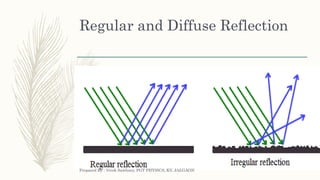
Regular and Diffuse Reflection
Prepared By : Vivek Sawhney, PGT PHYSICS, KV, JALGAON
Laws of Reflection of Light
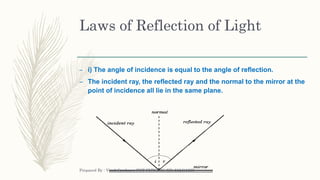
– i) The angle of incidence is equal to the angle of reflection.
– The incident ray, the reflected ray and the normal to the mirror at the
point of incidence all lie in the same plane.
Prepared By : Vivek Sawhney, PGT PHYSICS, KV, JALGAON
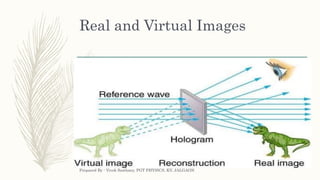
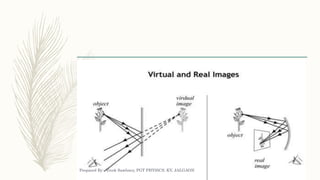
Real and Virtual Images
Prepared By : Vivek Sawhney, PGT PHYSICS, KV, JALGAON
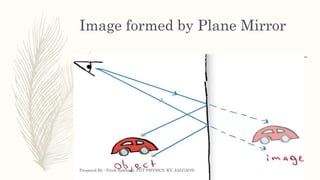
Image formed by Plane Mirror
Prepared By : Vivek Sawhney, PGT PHYSICS, KV, JALGAON
Characteristics of image formed
by plane mirror
– Plane mirror forms an erect image.
– It forms a virtual image.
– Size of the image is same as that of the object.
– Image is formed at the same distance behind the
mirror as the object stands in front of it.
– Image formed is a laterally inverted image i.e.,
right hand side of the object seems to be the left
hand side and vice-versa.
Prepared By : Vivek Sawhney, PGT PHYSICS, KV, JALGAON
Spherical Mirrors
Prepared By : Vivek Sawhney, PGT PHYSICS, KV, JALGAON
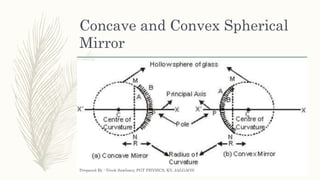
Concave and Convex Spherical
Mirror
Prepared By : Vivek Sawhney, PGT PHYSICS, KV, JALGAON
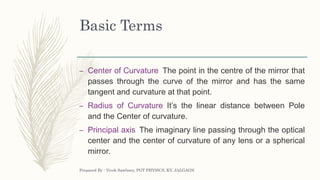
Basic Terms
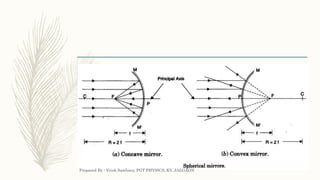
– Center of Curvature The point in the centre of the mirror that
passes through the curve of the mirror and has the same
tangent and curvature at that point.
– Radius of Curvature It’s the linear distance between Pole
and the Center of curvature.
– Principal axis The imaginary line passing through the optical
center and the center of curvature of any lens or a spherical
mirror.
Prepared By : Vivek Sawhney, PGT PHYSICS, KV, JALGAON
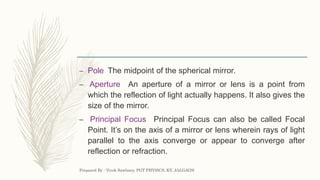
– Pole The midpoint of the spherical mirror.
– Aperture An aperture of a mirror or lens is a point from
which the reflection of light actually happens. It also gives the
size of the mirror.
– Principal Focus Principal Focus can also be called Focal
Point. It’s on the axis of a mirror or lens wherein rays of light
parallel to the axis converge or appear to converge after
reflection or refraction.
Prepared By : Vivek Sawhney, PGT PHYSICS, KV, JALGAON
Rules for Drawing Ray
Diagrams
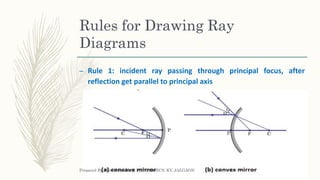
– Rule 1: incident ray passing through principal focus, after
reflection get parallel to principal axis
Prepared By : Vivek Sawhney, PGT PHYSICS, KV, JALGAON
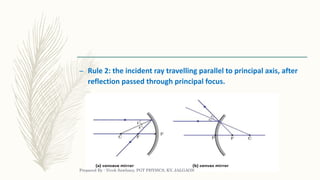
– Rule 2: the incident ray travelling parallel to principal axis, after
reflection passed through principal focus.
Prepared By : Vivek Sawhney, PGT PHYSICS, KV, JALGAON
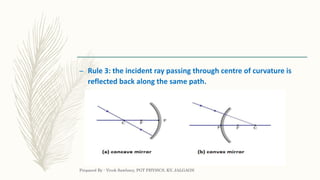
– Rule 3: the incident ray passing through centre of curvature is
reflected back along the same path.
Prepared By : Vivek Sawhney, PGT PHYSICS, KV, JALGAON
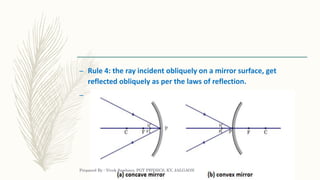
– Rule 4: the ray incident obliquely on a mirror surface, get
reflected obliquely as per the laws of reflection.
–
Prepared By : Vivek Sawhney, PGT PHYSICS, KV, JALGAON
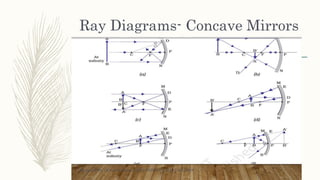
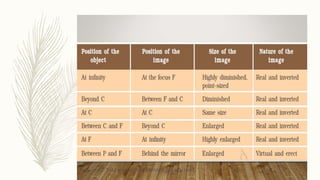
Ray Diagrams- Concave Mirrors
Prepared By : Vivek Sawhney, PGT PHYSICS, KV, JALGAON
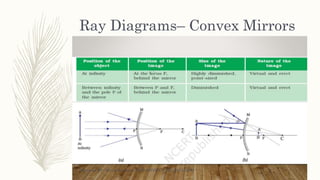
Ray Diagrams– Convex Mirrors
Prepared By : Vivek Sawhney, PGT PHYSICS, KV, JALGAON
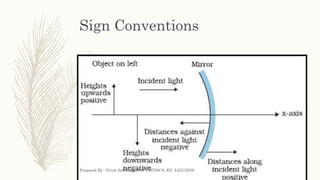
Sign Conventions
Prepared By : Vivek Sawhney, PGT PHYSICS, KV, JALGAON
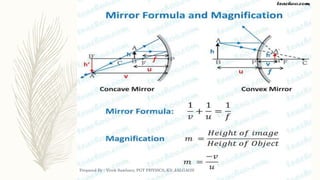
Mirror Formula
Prepared By : Vivek Sawhney, PGT PHYSICS, KV, JALGAON
Uses of Concave Mirrors
Prepared By : Vivek Sawhney, PGT PHYSICS, KV, JALGAON
Uses of Concave Mirrors
– Concave mirrors are commonly used in torches, search-lights and vehicles
headlights to get powerful parallel beams of light.
– They are often used as shaving mirrors to see a larger image of the face.
– The dentists use concave mirrors to see large images of the teeth of
patients.
–
– Large concave mirrors are used to concentrate sunlight to produce heat in
solar furnaces.
Prepared By : Vivek Sawhney, PGT PHYSICS, KV, JALGAON
Uses of Convex Mirrors
– Convex mirrors are commonly used as rear-view (wing)
mirrors in vehicles. These mirrors are fitted on the sides
of the vehicle, enabling the driver to see traffic behind
him/her to facilitate safe driving. Convex mirrors are
preferred because they always give an erect, though
diminished, image. Also, they have a wider field of view
as they are curved outwards. Thus, convex mirrors
enable the driver to view much larger area than would be
possible with a plane mirror.
Prepared By : Vivek Sawhney, PGT PHYSICS, KV, JALGAON
Fun with Lasers
– Click here to Watch
Prepared By : Vivek Sawhney, PGT PHYSICS, KV, JALGAON
Refraction of Light
Prepared By : Vivek Sawhney, PGT PHYSICS, KV, JALGAON
Refraction of Light-Amazing
Activities
– Click here to Watch
Prepared By : Vivek Sawhney, PGT PHYSICS, KV, JALGAON
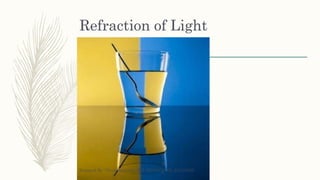
– Refraction is the bending of light (it also happens with
sound, water and other waves) as it passes from one
transparent substance into another.
– This bending by refraction makes it possible for us to
have lenses, magnifying glasses, prisms and rainbows.
– Even our eyes depend upon this bending of light.
Without refraction, we wouldn’t be able to focus light
onto our retina.
Prepared By : Vivek Sawhney, PGT PHYSICS, KV, JALGAON
Laws of Refraction
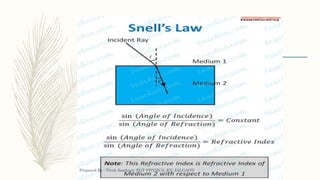
– The incident ray, reflected ray and the normal, to the
interface of any two given mediums; all lie in the same
plane.
– The ratio of the sine of the angle of incidence and sine
of the angle of refraction is constant.
Prepared By : Vivek Sawhney, PGT PHYSICS, KV, JALGAON
Refractive Index
– Refractive index, also called index of refraction, measure of the
bending of a ray of light when passing from one medium into
another.
– The refractive index n is defined as the ratio of the sine of the
angle of incidence to the sine of the angle of refraction;
– i.e., n = sin i / sin r.
– Refractive index is also equal to the velocity of light c of a given
wavelength in empty space divided by its velocity v in a
substance, or
– n = c/v
Prepared By : Vivek Sawhney, PGT PHYSICS, KV, JALGAON
Rarer and Denser Medium
– A medium in which speed of light is more is known as
optically rarer medium and a medium in which speed of
light is less is said to be optically denser medium. For
example in air and water, air is rarer and water is a
denser medium.
Prepared By : Vivek Sawhney, PGT PHYSICS, KV, JALGAON
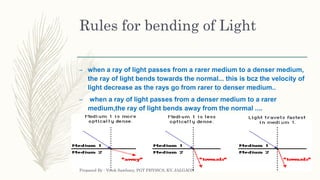
Rules for bending of Light
– when a ray of light passes from a rarer medium to a denser medium,
the ray of light bends towards the normal... this is bcz the velocity of
light decrease as the rays go from rarer to denser medium..
– when a ray of light passes from a denser medium to a rarer
medium,the ray of light bends away from the normal ....
Prepared By : Vivek Sawhney, PGT PHYSICS, KV, JALGAON
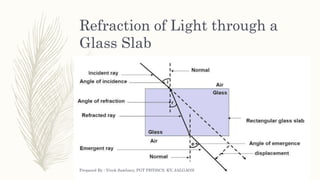
Refraction of Light through a
Glass Slab
Prepared By : Vivek Sawhney, PGT PHYSICS, KV, JALGAON
Refraction of Light through a
Glass Slab
– click here to watch
Prepared By : Vivek Sawhney, PGT PHYSICS, KV, JALGAON
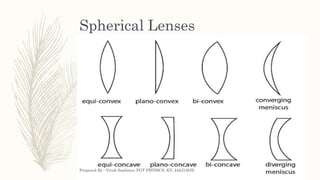
Spherical Lenses
Prepared By : Vivek Sawhney, PGT PHYSICS, KV, JALGAON
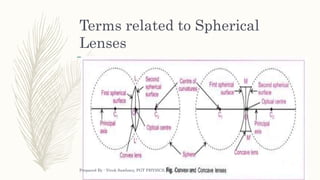
Terms related to Spherical
Lenses
Prepared By : Vivek Sawhney, PGT PHYSICS, KV, JALGAON
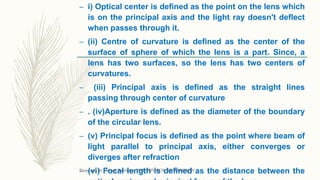
– i) Optical center is defined as the point on the lens which
is on the principal axis and the light ray doesn't deflect
when passes through it.
– (ii) Centre of curvature is defined as the center of the
surface of sphere of which the lens is a part. Since, a
lens has two surfaces, so the lens has two centers of
curvatures.
– (iii) Principal axis is defined as the straight lines
passing through center of curvature
– . (iv)Aperture is defined as the diameter of the boundary
of the circular lens.
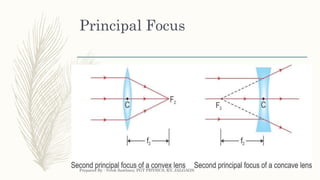
– (v) Principal focus is defined as the point where beam of
light parallel to principal axis, either converges or
diverges after refraction
– (vi) Focal length is defined as the distance between the
Prepared By : Vivek Sawhney, PGT PHYSICS, KV, JALGAON
Principal Focus
Prepared By : Vivek Sawhney, PGT PHYSICS, KV, JALGAON
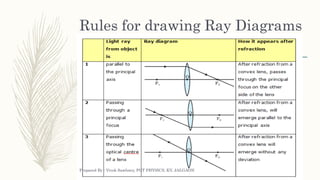
Rules for drawing Ray Diagrams
Prepared By : Vivek Sawhney, PGT PHYSICS, KV, JALGAON
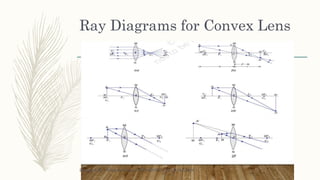
Ray Diagrams for Convex Lens
Prepared By : Vivek Sawhney, PGT PHYSICS, KV, JALGAON
Characteristics of the Image
formed
Prepared By : Vivek Sawhney, PGT PHYSICS, KV, JALGAON
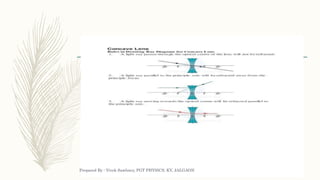
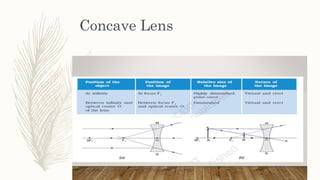
Concave Lens
Prepared By : Vivek Sawhney, PGT PHYSICS, KV, JALGAON
Power of a Lens
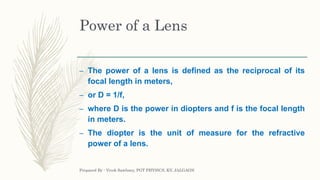
– The power of a lens is defined as the reciprocal of its
focal length in meters,
– or D = 1/f,
– where D is the power in diopters and f is the focal length
in meters.
– The diopter is the unit of measure for the refractive
power of a lens.
Prepared By : Vivek Sawhney, PGT PHYSICS, KV, JALGAON
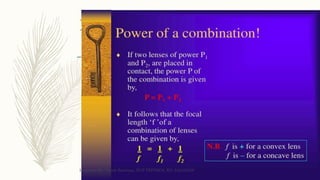
Power of combination of Lenses
Prepared By : Vivek Sawhney, PGT PHYSICS, KV, JALGAON

Class 10 light ppt

  • 1.
    Prepared by: Vivek Sawhney,PGT Physics, KV Jalgaon Light- Reflection and Refraction Class 10 Prepared By : Vivek Sawhney, PGT PHYSICS, KV, JALGAON
  • 2.
    Reflection of Light –When light falls on a highly polished surface like a mirror most of the light is sent back into the same medium. This process is called reflection of light. Prepared By : Vivek Sawhney, PGT PHYSICS, KV, JALGAON
  • 3.
    Regular and DiffuseReflection Prepared By : Vivek Sawhney, PGT PHYSICS, KV, JALGAON
  • 4.
    Laws of Reflectionof Light – i) The angle of incidence is equal to the angle of reflection. – The incident ray, the reflected ray and the normal to the mirror at the point of incidence all lie in the same plane. Prepared By : Vivek Sawhney, PGT PHYSICS, KV, JALGAON
  • 5.
    Real and VirtualImages Prepared By : Vivek Sawhney, PGT PHYSICS, KV, JALGAON
  • 6.
    Prepared By :Vivek Sawhney, PGT PHYSICS, KV, JALGAON
  • 7.
    Image formed byPlane Mirror Prepared By : Vivek Sawhney, PGT PHYSICS, KV, JALGAON
  • 8.
    Characteristics of imageformed by plane mirror – Plane mirror forms an erect image. – It forms a virtual image. – Size of the image is same as that of the object. – Image is formed at the same distance behind the mirror as the object stands in front of it. – Image formed is a laterally inverted image i.e., right hand side of the object seems to be the left hand side and vice-versa. Prepared By : Vivek Sawhney, PGT PHYSICS, KV, JALGAON
  • 9.
    Spherical Mirrors Prepared By: Vivek Sawhney, PGT PHYSICS, KV, JALGAON
  • 10.
    Concave and ConvexSpherical Mirror Prepared By : Vivek Sawhney, PGT PHYSICS, KV, JALGAON
  • 11.
    Basic Terms – Centerof Curvature The point in the centre of the mirror that passes through the curve of the mirror and has the same tangent and curvature at that point. – Radius of Curvature It’s the linear distance between Pole and the Center of curvature. – Principal axis The imaginary line passing through the optical center and the center of curvature of any lens or a spherical mirror. Prepared By : Vivek Sawhney, PGT PHYSICS, KV, JALGAON
  • 12.
    – Pole Themidpoint of the spherical mirror. – Aperture An aperture of a mirror or lens is a point from which the reflection of light actually happens. It also gives the size of the mirror. – Principal Focus Principal Focus can also be called Focal Point. It’s on the axis of a mirror or lens wherein rays of light parallel to the axis converge or appear to converge after reflection or refraction. Prepared By : Vivek Sawhney, PGT PHYSICS, KV, JALGAON
  • 13.
    Prepared By :Vivek Sawhney, PGT PHYSICS, KV, JALGAON
  • 14.
    Rules for DrawingRay Diagrams – Rule 1: incident ray passing through principal focus, after reflection get parallel to principal axis Prepared By : Vivek Sawhney, PGT PHYSICS, KV, JALGAON
  • 15.
    – Rule 2:the incident ray travelling parallel to principal axis, after reflection passed through principal focus. Prepared By : Vivek Sawhney, PGT PHYSICS, KV, JALGAON
  • 16.
    – Rule 3:the incident ray passing through centre of curvature is reflected back along the same path. Prepared By : Vivek Sawhney, PGT PHYSICS, KV, JALGAON
  • 17.
    – Rule 4:the ray incident obliquely on a mirror surface, get reflected obliquely as per the laws of reflection. – Prepared By : Vivek Sawhney, PGT PHYSICS, KV, JALGAON
  • 18.
    Ray Diagrams- ConcaveMirrors Prepared By : Vivek Sawhney, PGT PHYSICS, KV, JALGAON
  • 19.
    Prepared By :Vivek Sawhney, PGT PHYSICS, KV, JALGAON
  • 20.
    Ray Diagrams– ConvexMirrors Prepared By : Vivek Sawhney, PGT PHYSICS, KV, JALGAON
  • 21.
    Sign Conventions Prepared By: Vivek Sawhney, PGT PHYSICS, KV, JALGAON
  • 22.
    Mirror Formula Prepared By: Vivek Sawhney, PGT PHYSICS, KV, JALGAON
  • 23.
    Uses of ConcaveMirrors Prepared By : Vivek Sawhney, PGT PHYSICS, KV, JALGAON
  • 24.
    Uses of ConcaveMirrors – Concave mirrors are commonly used in torches, search-lights and vehicles headlights to get powerful parallel beams of light. – They are often used as shaving mirrors to see a larger image of the face. – The dentists use concave mirrors to see large images of the teeth of patients. – – Large concave mirrors are used to concentrate sunlight to produce heat in solar furnaces. Prepared By : Vivek Sawhney, PGT PHYSICS, KV, JALGAON
  • 25.
    Uses of ConvexMirrors – Convex mirrors are commonly used as rear-view (wing) mirrors in vehicles. These mirrors are fitted on the sides of the vehicle, enabling the driver to see traffic behind him/her to facilitate safe driving. Convex mirrors are preferred because they always give an erect, though diminished, image. Also, they have a wider field of view as they are curved outwards. Thus, convex mirrors enable the driver to view much larger area than would be possible with a plane mirror. Prepared By : Vivek Sawhney, PGT PHYSICS, KV, JALGAON
  • 26.
    Fun with Lasers –Click here to Watch Prepared By : Vivek Sawhney, PGT PHYSICS, KV, JALGAON
  • 27.
    Refraction of Light PreparedBy : Vivek Sawhney, PGT PHYSICS, KV, JALGAON
  • 28.
    Refraction of Light-Amazing Activities –Click here to Watch Prepared By : Vivek Sawhney, PGT PHYSICS, KV, JALGAON
  • 29.
    – Refraction isthe bending of light (it also happens with sound, water and other waves) as it passes from one transparent substance into another. – This bending by refraction makes it possible for us to have lenses, magnifying glasses, prisms and rainbows. – Even our eyes depend upon this bending of light. Without refraction, we wouldn’t be able to focus light onto our retina. Prepared By : Vivek Sawhney, PGT PHYSICS, KV, JALGAON
  • 30.
    Laws of Refraction –The incident ray, reflected ray and the normal, to the interface of any two given mediums; all lie in the same plane. – The ratio of the sine of the angle of incidence and sine of the angle of refraction is constant. Prepared By : Vivek Sawhney, PGT PHYSICS, KV, JALGAON
  • 31.
    Prepared By :Vivek Sawhney, PGT PHYSICS, KV, JALGAON
  • 32.
    Refractive Index – Refractiveindex, also called index of refraction, measure of the bending of a ray of light when passing from one medium into another. – The refractive index n is defined as the ratio of the sine of the angle of incidence to the sine of the angle of refraction; – i.e., n = sin i / sin r. – Refractive index is also equal to the velocity of light c of a given wavelength in empty space divided by its velocity v in a substance, or – n = c/v Prepared By : Vivek Sawhney, PGT PHYSICS, KV, JALGAON
  • 33.
    Rarer and DenserMedium – A medium in which speed of light is more is known as optically rarer medium and a medium in which speed of light is less is said to be optically denser medium. For example in air and water, air is rarer and water is a denser medium. Prepared By : Vivek Sawhney, PGT PHYSICS, KV, JALGAON
  • 34.
    Rules for bendingof Light – when a ray of light passes from a rarer medium to a denser medium, the ray of light bends towards the normal... this is bcz the velocity of light decrease as the rays go from rarer to denser medium.. – when a ray of light passes from a denser medium to a rarer medium,the ray of light bends away from the normal .... Prepared By : Vivek Sawhney, PGT PHYSICS, KV, JALGAON
  • 35.
    Refraction of Lightthrough a Glass Slab Prepared By : Vivek Sawhney, PGT PHYSICS, KV, JALGAON
  • 36.
    Refraction of Lightthrough a Glass Slab – click here to watch Prepared By : Vivek Sawhney, PGT PHYSICS, KV, JALGAON
  • 37.
    Spherical Lenses Prepared By: Vivek Sawhney, PGT PHYSICS, KV, JALGAON
  • 38.
    Terms related toSpherical Lenses Prepared By : Vivek Sawhney, PGT PHYSICS, KV, JALGAON
  • 39.
    – i) Opticalcenter is defined as the point on the lens which is on the principal axis and the light ray doesn't deflect when passes through it. – (ii) Centre of curvature is defined as the center of the surface of sphere of which the lens is a part. Since, a lens has two surfaces, so the lens has two centers of curvatures. – (iii) Principal axis is defined as the straight lines passing through center of curvature – . (iv)Aperture is defined as the diameter of the boundary of the circular lens. – (v) Principal focus is defined as the point where beam of light parallel to principal axis, either converges or diverges after refraction – (vi) Focal length is defined as the distance between the Prepared By : Vivek Sawhney, PGT PHYSICS, KV, JALGAON
  • 40.
    Principal Focus Prepared By: Vivek Sawhney, PGT PHYSICS, KV, JALGAON
  • 41.
    Rules for drawingRay Diagrams Prepared By : Vivek Sawhney, PGT PHYSICS, KV, JALGAON
  • 42.
    Prepared By :Vivek Sawhney, PGT PHYSICS, KV, JALGAON
  • 43.
    Ray Diagrams forConvex Lens Prepared By : Vivek Sawhney, PGT PHYSICS, KV, JALGAON
  • 44.
    Characteristics of theImage formed Prepared By : Vivek Sawhney, PGT PHYSICS, KV, JALGAON
  • 45.
    Concave Lens Prepared By: Vivek Sawhney, PGT PHYSICS, KV, JALGAON
  • 46.
    Prepared By :Vivek Sawhney, PGT PHYSICS, KV, JALGAON
  • 47.
    Prepared By :Vivek Sawhney, PGT PHYSICS, KV, JALGAON
  • 48.
    Power of aLens – The power of a lens is defined as the reciprocal of its focal length in meters, – or D = 1/f, – where D is the power in diopters and f is the focal length in meters. – The diopter is the unit of measure for the refractive power of a lens. Prepared By : Vivek Sawhney, PGT PHYSICS, KV, JALGAON
  • 49.
    Power of combinationof Lenses Prepared By : Vivek Sawhney, PGT PHYSICS, KV, JALGAON
  • 50.
    Prepared By :Vivek Sawhney, PGT PHYSICS, KV, JALGAON