N
E
S
W
BS1271
Environmental sciences
Mitigation steps to be taken for
Drought disaster
CONTENTS
Introduction
Concept of drought
Mitigation techniques
Mitigation through crop management
practices
Soil and water conservation techniques
Conclusion
INTRODUCTION
INTRODUCTION
Definition:
Drought is defined by deviation from the normal rainfall, it can happen in all
rainfall regions. It also occurs in high rainfall area but severity or frequency
may vary.
deficient by more than twice the mean deviation
It is also a complex phenomenon whose severity depends on the ;
 Precipitation
 Amount, its time
 Space distribution
 Evapo- transpiration
 Hydrological factors.
Drought is a situation when the actual seasonal rainfall is
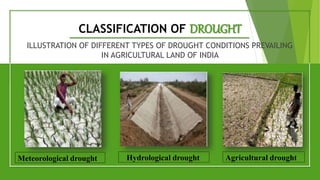
CLASSIFICATION OF DROUGHT
ILLUSTRATION OF DIFFERENT TYPES OF DROUGHT CONDITIONS PREVAILING
IN AGRICULTURAL LAND OF INDIA
Meteorological drought Hydrological drought Agricultural drought
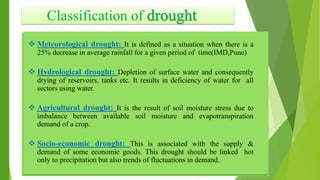
Classification of drought
 Meteorological drought: It is defined as a situation when there is a
25% decrease in average rainfall for a given period of time(IMD,Pune)
 Hydrological drought: Depletion of surface water and consequently
drying of reservoirs, tanks etc. It results in deficiency of water for all
sectors using water.
 Agricultural drought: It is the result of soil moisture stress due to
imbalance between available soil moisture and evapotranspiration
demand of a crop.
 Socio-economic drought: This is associated with the supply &
demand of some economic goods. This drought should be linked hot
only to precipitation but also trends of fluctuations in demand.
o Shortage of water
o Desertification
o Death of livestock
o Lack of water for irrigation
o Reduced crop yield
o Migration of people
o Scarcity of seed
Consequence of drought
Effects of drought on plants
o Loss of turgidity
o Photosynthesis
o Increase in number of stomata
o ABA accumulation
o Rolling and wilting of leaves
o Reduced tillering
o Forced maturity
o Reduction in productivity
Source-NICRA,2014
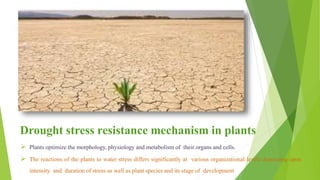
Drought stress resistance mechanism in plants
 Plants optimize the morphology, physiology and metabolism of their organs and cells.
 The reactions of the plants to water stress differs significantly at various organizational levels depending upon
intensity and duration of stress as well as plant species and its stage of development
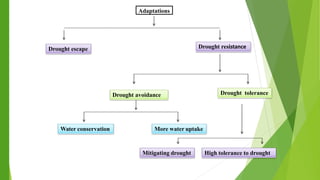
Adaptations
Drought escape Drought resistance
Drought tolerance
Drought avoidance
Water conservation More water uptake
Mitigating drought High tolerance to drought
Mitigation strategies
Mitigation of Stress by Crop
Management
Soil and moisture conservation
measures
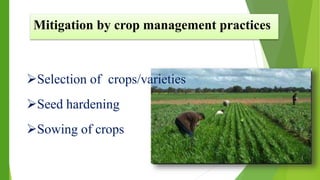
Mitigation by crop management practices
Selection of crops/varieties
Seed hardening
Sowing of crops
Soil and water conservation methods
In-situ moisture conservation practices
Water harvesting structures
Mulching
Anti-transpirants
Adopting modern irrigation techniques
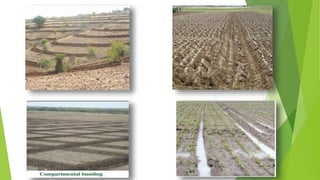
In-situ moisture
conservation
practices
Water harvesting
structures
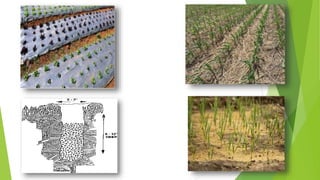
MULCHING
ANTI-TRANSPIRANTS
 Anti-transpirants are the materials or chemicals that applied to transpiring plant
surfaces for reducing water loss from the plant. The purpose of ATs is to maintain
the growth and productivity under stress conditions and it is never recommended
for high productivity / unit area.
 The severity of intermittent drought of 6-10 days during critical stages of the crop
can reasonably be avoided by the use of antitranspirants and thus crops can be
save
Mainly four types of anti-transpirants:
1.Stomatal closing type
2.Film forming type
3.Reflectance type
4.Growth retardant
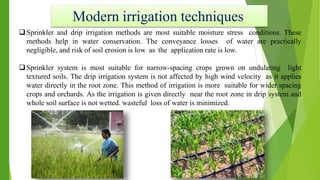
Modern irrigation techniques
Sprinkler and drip irrigation methods are most suitable moisture stress conditions. These
methods help in water conservation. The conveyance losses of water are practically
negligible, and risk of soil erosion is low as the application rate is low.
Sprinkler system is most suitable for narrow-spacing crops grown on undulating light
textured soils. The drip irrigation system is not affected by high wind velocity as it applies
water directly in the root zone. This method of irrigation is more suitable for wider spacing
crops and orchards. As the irrigation is given directly near the root zone in drip system and
whole soil surface is not wetted. wasteful loss of water is minimized.
SOME OTHER LONG TERM
STRATEGIES TO
MITIGATE DROUGHT
Long-range forecast :
It is in purview of IMD and accurate oceanographic pre-monsoon conditions.Besides, date of
onset and withdrawal of monsoon, accurate forecast about amount and distribution of rainfall in
ensuing kharif season would be of great value for planners as well as farmers to develop
contingent plans, rather a all season weather coat, for drought.as well as floods.
IRS P-4 satellite with Oceansat OCM, MSMR sensor may prove of great value in studying
ocean situation. Great emphasis is to be laid in future on long-range forecasts to combat
drought.
These forecasts are given for the benefit of farmers for planning their agricultural operations
and crop selection and for planners for advance planning in case of an anticipated flood or
drought
Source- CAZRI,2000. Strategy to combat drought and famine
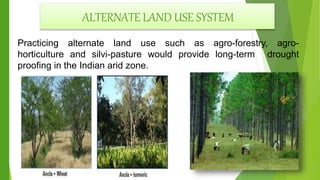
ALTERNATE LAND USE SYSTEM
Practicing alternate land use such as agro-forestry, agro-
horticulture and silvi-pasture would provide long-term drought
proofing in the Indian arid zone.
• Crop improvement for drought tolerance or escape, seed priming, early sowing, soil
conservation practices including tillage which conserve moisture, in-situ moisture
conservation practices and water harvesting and use of antitranspirants and reflectants are
some of the mitigation strategies
• Breeding for drought resistance crop varieties i.e development of
transgenic plants for drought tolerance
• Adoption of long term strategies like integration of small reservoirs with major reservoirs,
integrated basin planning, etc.
• Long range rainfall forecast can prove as a warning tool for
drought mitigation
Conclusion
WATCH THE VIDEO
 TO UNDERSTAND THE ADVERSE
EFFECTS OF DROUGHT IN
CULTIVABLE LAND
 TO KNOW THE MITIGATIONS TO
TAKEN UNDER GOVERNMENT ACTS
 TO CREATE AWARENESS AMONG
ILLITRATE PEOPLE ABOUT THE
SERIOUSNESS IN THE PREVENTION
 LIST DOWN THE ALTERNATIVE
METRHODS WHICH IS MORE
EFFICIENT THAN A PRIMITIVE
METHOD FOR A SPEEDY ACTION TO
PREVENT LOSS OF LIVES.
Let us just
Summarise through a video
I HOPE YOU ALL YOU KNOW THE
MITIGATIONS TO PROTECT THE
EARTH FROM DROUGHT
BY:
S.MALAIAPPAN SRIKANTH
20UCS079 (CSE-B)
THANK YOU

Disaster mitigation - drought

  • 1.
  • 2.
    CONTENTS Introduction Concept of drought Mitigationtechniques Mitigation through crop management practices Soil and water conservation techniques Conclusion
  • 3.
  • 4.
    Definition: Drought is definedby deviation from the normal rainfall, it can happen in all rainfall regions. It also occurs in high rainfall area but severity or frequency may vary. deficient by more than twice the mean deviation It is also a complex phenomenon whose severity depends on the ;  Precipitation  Amount, its time  Space distribution  Evapo- transpiration  Hydrological factors. Drought is a situation when the actual seasonal rainfall is
  • 5.
    CLASSIFICATION OF DROUGHT ILLUSTRATIONOF DIFFERENT TYPES OF DROUGHT CONDITIONS PREVAILING IN AGRICULTURAL LAND OF INDIA Meteorological drought Hydrological drought Agricultural drought
  • 6.
    Classification of drought Meteorological drought: It is defined as a situation when there is a 25% decrease in average rainfall for a given period of time(IMD,Pune)  Hydrological drought: Depletion of surface water and consequently drying of reservoirs, tanks etc. It results in deficiency of water for all sectors using water.  Agricultural drought: It is the result of soil moisture stress due to imbalance between available soil moisture and evapotranspiration demand of a crop.  Socio-economic drought: This is associated with the supply & demand of some economic goods. This drought should be linked hot only to precipitation but also trends of fluctuations in demand.
  • 7.
    o Shortage ofwater o Desertification o Death of livestock o Lack of water for irrigation o Reduced crop yield o Migration of people o Scarcity of seed Consequence of drought
  • 8.
    Effects of droughton plants o Loss of turgidity o Photosynthesis o Increase in number of stomata o ABA accumulation o Rolling and wilting of leaves o Reduced tillering o Forced maturity o Reduction in productivity
  • 9.
  • 10.
    Drought stress resistancemechanism in plants  Plants optimize the morphology, physiology and metabolism of their organs and cells.  The reactions of the plants to water stress differs significantly at various organizational levels depending upon intensity and duration of stress as well as plant species and its stage of development
  • 11.
    Adaptations Drought escape Droughtresistance Drought tolerance Drought avoidance Water conservation More water uptake Mitigating drought High tolerance to drought
  • 12.
    Mitigation strategies Mitigation ofStress by Crop Management Soil and moisture conservation measures
  • 13.
    Mitigation by cropmanagement practices Selection of crops/varieties Seed hardening Sowing of crops
  • 14.
    Soil and waterconservation methods In-situ moisture conservation practices Water harvesting structures Mulching Anti-transpirants Adopting modern irrigation techniques
  • 15.
  • 17.
  • 19.
  • 21.
    ANTI-TRANSPIRANTS  Anti-transpirants arethe materials or chemicals that applied to transpiring plant surfaces for reducing water loss from the plant. The purpose of ATs is to maintain the growth and productivity under stress conditions and it is never recommended for high productivity / unit area.  The severity of intermittent drought of 6-10 days during critical stages of the crop can reasonably be avoided by the use of antitranspirants and thus crops can be save Mainly four types of anti-transpirants: 1.Stomatal closing type 2.Film forming type 3.Reflectance type 4.Growth retardant
  • 22.
    Modern irrigation techniques Sprinklerand drip irrigation methods are most suitable moisture stress conditions. These methods help in water conservation. The conveyance losses of water are practically negligible, and risk of soil erosion is low as the application rate is low. Sprinkler system is most suitable for narrow-spacing crops grown on undulating light textured soils. The drip irrigation system is not affected by high wind velocity as it applies water directly in the root zone. This method of irrigation is more suitable for wider spacing crops and orchards. As the irrigation is given directly near the root zone in drip system and whole soil surface is not wetted. wasteful loss of water is minimized.
  • 23.
    SOME OTHER LONGTERM STRATEGIES TO MITIGATE DROUGHT
  • 24.
    Long-range forecast : Itis in purview of IMD and accurate oceanographic pre-monsoon conditions.Besides, date of onset and withdrawal of monsoon, accurate forecast about amount and distribution of rainfall in ensuing kharif season would be of great value for planners as well as farmers to develop contingent plans, rather a all season weather coat, for drought.as well as floods. IRS P-4 satellite with Oceansat OCM, MSMR sensor may prove of great value in studying ocean situation. Great emphasis is to be laid in future on long-range forecasts to combat drought. These forecasts are given for the benefit of farmers for planning their agricultural operations and crop selection and for planners for advance planning in case of an anticipated flood or drought Source- CAZRI,2000. Strategy to combat drought and famine
  • 25.
    ALTERNATE LAND USESYSTEM Practicing alternate land use such as agro-forestry, agro- horticulture and silvi-pasture would provide long-term drought proofing in the Indian arid zone.
  • 26.
    • Crop improvementfor drought tolerance or escape, seed priming, early sowing, soil conservation practices including tillage which conserve moisture, in-situ moisture conservation practices and water harvesting and use of antitranspirants and reflectants are some of the mitigation strategies • Breeding for drought resistance crop varieties i.e development of transgenic plants for drought tolerance • Adoption of long term strategies like integration of small reservoirs with major reservoirs, integrated basin planning, etc. • Long range rainfall forecast can prove as a warning tool for drought mitigation Conclusion
  • 27.
    WATCH THE VIDEO TO UNDERSTAND THE ADVERSE EFFECTS OF DROUGHT IN CULTIVABLE LAND  TO KNOW THE MITIGATIONS TO TAKEN UNDER GOVERNMENT ACTS  TO CREATE AWARENESS AMONG ILLITRATE PEOPLE ABOUT THE SERIOUSNESS IN THE PREVENTION  LIST DOWN THE ALTERNATIVE METRHODS WHICH IS MORE EFFICIENT THAN A PRIMITIVE METHOD FOR A SPEEDY ACTION TO PREVENT LOSS OF LIVES.
  • 30.
    Let us just Summarisethrough a video
  • 31.
    I HOPE YOUALL YOU KNOW THE MITIGATIONS TO PROTECT THE EARTH FROM DROUGHT BY: S.MALAIAPPAN SRIKANTH 20UCS079 (CSE-B) THANK YOU

Editor's Notes

  • #2 A template for students to design a field trip to a location for other students to view. Includes directions to the student of what to include on each slide and what content should be considered. 
  • #29 You can use this type of slide for text, images, shapes and tables to help add information in a different way. Duplicate this slide to add additional images of important location in your visit.