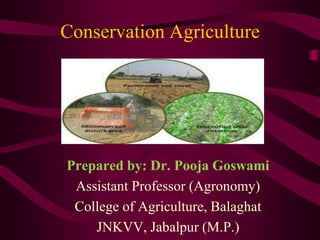
Conservation Agriculture
Prepared by: Dr. Pooja Goswami
Assistant Professor (Agronomy)
College of Agriculture, Balaghat
JNKVV, Jabalpur (M.P.)
Indian Scenario:-
Total cultivable area- 142.2 m ha
Rainfed - 87 m ha (Contributes 44% of food needs)
Irrigated – 62 m ha (Contributes 56% of food needs)
Total degraded area – 120.7 m ha
Water erosion – 73.3 m ha
Wind erosion – 12.4 m ha
 Salinlty & alkalinity – 6.64 m ha
 Soil acidity – 5.7 m ha
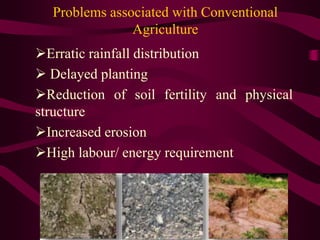
Problems associated with Conventional
Agriculture
Erratic rainfall distribution
 Delayed planting
Reduction of soil fertility and physical
structure
Increased erosion
High labour/ energy requirement
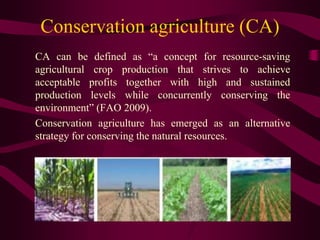
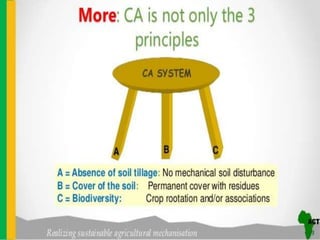
Conservation agriculture (CA)
CA can be defined as “a concept for resource-saving
agricultural crop production that strives to achieve
acceptable profits together with high and sustained
production levels while concurrently conserving the
environment” (FAO 2009).
Conservation agriculture has emerged as an alternative
strategy for conserving the natural resources.
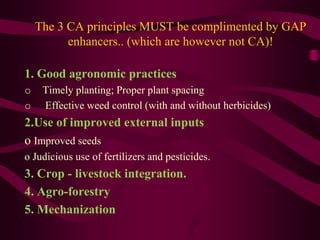
The 3 CA principles MUST be complimented by GAP
enhancers.. (which are however not CA)!
1. Good agronomic practices
o Timely planting; Proper plant spacing
o Effective weed control (with and without herbicides)
2.Use of improved external inputs
o Improved seeds
o Judicious use of fertilizers and pesticides.
3. Crop - livestock integration.
4. Agro-forestry
5. Mechanization
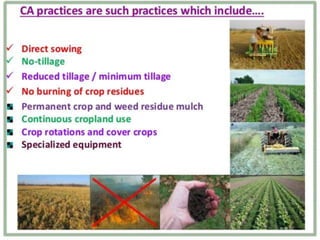
Why Zero or Minimum Tillage?
Tillage or ploughing – is the most time and
power consuming operation is avoided, saving
costs and time
 Undisturbed weed seeds remain in the soil
without germinating – reducing weeds
 Ploughing disturbs the soil – making it
susceptible to erosion by water and wind;
causes plough pans
Ploughing releases CO2 contributing to
climate change
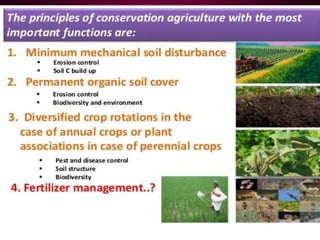
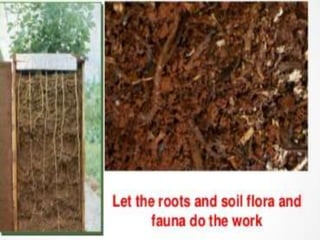
Minimum soil disturbance
The “Deceiving” effects of ploughing
IMMEDIATE EFFECTS
• Weeds are controlled • Seedbed is prepared • Water
infiltration improves • Soil aeration improves • Nutrients are
released, availed • Incorporation of manure, fertilizers and
organic matter • Loose soil eroded and nutrients are leached
LONG TERM EFFECTS
• Depleted soil organic matter • Damaged soil structure and
macro pores • Soil flora and fauna disappear • Hard/plough
pan formation • Acute soil water availability and restricted
aeration • Distortion of pH levels • Decline in nutrient
availability
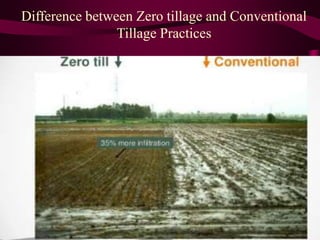
Difference between Zero tillage and Conventional
Tillage Practices
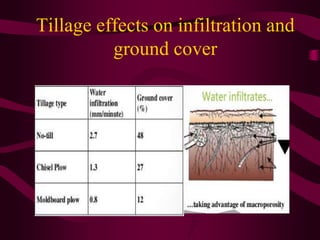
Tillage effects on infiltration and
ground cover
Residue cover/ Cover crops
Reduce surface runoff and control
erosion.
Add organic matter and improves soil
structure and tilth.
 Legumes fix atmospheric nitrogen.
Help to control weeds.
Increase soil productivity .
SOIL COVER - the most important
principle??
Soil cover by crop residues (dead plant
matter) or imported mulch
Soil cover by cover crops
Soil cover by living plants – synchronized
for all year round production
imported mulch Intercropping with cover crops
Benefits of soil cover
More soil organic matter and available
nutrients
 Promotes biological activity-soil organisms
(earthworms, insects, rodents, microbes) leading
to increased humus (decomposed organic
matter)
Increased humus leads to soil enrichment &
improved soil structure (aggregation/ pores)
 Increased water infiltration, decreased water
evaporation, water (& nutrient) holding capacity
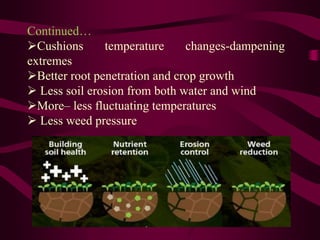
Continued…
Cushions temperature changes-dampening
extremes
Better root penetration and crop growth
 Less soil erosion from both water and wind
More– less fluctuating temperatures
 Less weed pressure
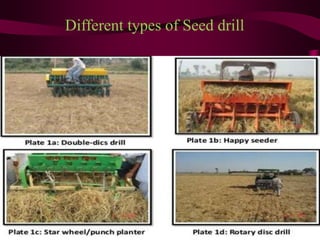
Different types of Seed drill
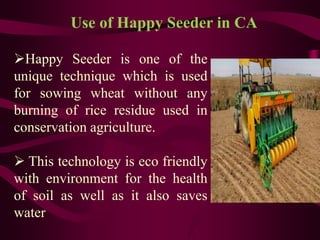
Happy Seeder is one of the
unique technique which is used
for sowing wheat without any
burning of rice residue used in
conservation agriculture.
 This technology is eco friendly
with environment for the health
of soil as well as it also saves
water
Use of Happy Seeder in CA
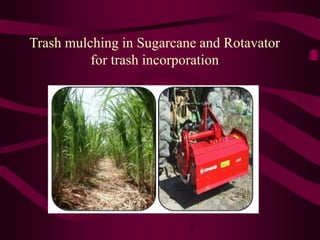
Trash mulching in Sugarcane and Rotavator
for trash incorporation
Conclusion
CA known to improve physical, chemical
and biological properties of soil.
Nutrient, water, energy, labor and time
saving was observed with high efficiency.
Ecological balance is attained with sustained
yield and returns.
CA is specific to site, crop and environment
conditions.