Soil and Climatic conditions Prevalent
in Rainfed agriculture
Prepared By: Dr. Pooja Goswami
College of Agriculture, Balaghat,
Jawaharlal Nehru Krishi Viswa Vidyalaya Jabalpur
Introduction
Out of an estimated 142 million ha net cultivated area,
about 86 million ha (60%) is rainfed.
Rainfed area covers 218 districts in the states of Punjab,
Haryana, Rajasthan, Uttar Pradesh, Madhya Pradesh,
Chhattisgarh, Gujarat, Maharashtra, Andhra Pradesh,
Karnataka and Tamil Nadu.
Physiographically the rainfed region encompasses the
desert terrain of Rajasthan in the northwest, the plateau
region of central India, the alluvial plains of the Ganga-
Yamuna river basin, the central highlands of Gujarat,
Maharashtra, Madhya Pradesh and Chhattisgarh, the rain
shadow region of Deccan in Maharashtra, the Deccan
plateau in Andhra Pradesh and the Tamil Nadu highlands
Continued…
In rainfed areas cultivation of coarse cereals
(91%), pulses (91%), oilseeds (80%) and cotton
(65%) predominate Besides, farmers’ dependence
is very high on livestock as an alternative source
of income, apart from arable cropping.
Thus, rainfed agriculture would continue to play
a crucial role in the Indian economy and food
security for a long period.
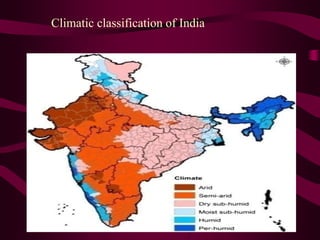
Climatic classification of India
Soil in Rainfed Areas
Rainfed soils are generally of poor quality (low fertility,
high erodibility, fragile, shallow and susceptible to loss of
physical integrity).
These have very weak buffering and resilience capacity.
The soils suffer from excess of salts (saline-alkali soils) in
arid and semi-arid areas and acids (acid soils) in sub-humid
and humid areas. Micronutrients and ameliorants (mainly
lime) are deficient and need supplementation periodically.
The soils are mostly coarse textured, highly degraded
with low water retentive capacity, multiple nutrient
deficiencies, and thus are not conducive for intensive
cropping.
Distribution of Soil in Rainfed Areas
In dryland regions, nearly 30 per cent of soils are covered by
Alfisols and associated soils, 35% by Vertisols and
associated soils (having vertic properties) and 10 per cent by
Entisols of the alluvial areas.
Most of the Alfisols are sandy loams with a sub-soil alluvial
layer of clay, less water retentive and prone to drought. The
Vertisols are deep (15-240 cm) with a clay content of 30-
70% and rich in bases. The clay types are smectite,
montmorillonite and beidellite. The soils have high water
holding capacity, frequently fertile and less drought prone.
 Rainfed soils are generally low in organic matter and alkaline
to slightly acidic in reaction in the surface have calcium
carbonate (CaCo3) accumulation in the upper 150 cm
Coarse to medium texture and having low biological activity.
The top soil shows many textural groups like loamy sand,
sandy loam, loam, silt loam to clay loam.
The soils are predominantly coarse textured and hence retain
less water and nutrients.
The low organic matter content is due to sparse vegetation
producing little residues.
The top soil when eroded, is devoid of organic matter, thus
resulting in deficiencies of several nutrients.
Removal of vegetation, intensive agriculture, uncontrolled and
excessive grazing, and large unprotected fields devoid of
protective vegetation are known to cause wind erosion.
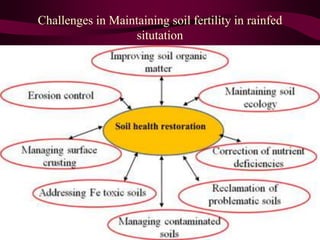
Challenges in Maintaining soil fertility in rainfed
situtation
Climate studies in rainfed areas
Climate is one of the major factors influencing
crop growth.
Weather, which is part of climate, plays an
important role in crop plannin in dry farming area.
Out of the several elements of weather, rainfall has
key position in success of dry farming.
 Favourable weather is essential for good harvests.
Weather abnormalities like cyclones, droughts,
hailstorms, frost, high winds, extreme temperature
and insufficient photosynthetic radiation etc., may
generally lead to very low or even no yields.
1. Rainfall
In dry land areas, South West Monsoon brings
the bulk of rainfall. The South West Monsoon is
followed by North East Monsoon which
supplements to South West Monsoon are the
main source of rainfall. There are four types of
rainfall characterized by the nature in different
parts of India.
Uncertain and ill distributions of rainfall are two
qualities which makes the Rainfed farming
difficult.
2. Dry spells: - It is another rainfall feature. Breaks
in monsoon a normally experienced (observed)
during rate July and August. They month extend by
2 week to 13 weeks at a stretch. A break is defined
as period receiving less than 15 mm rainfall in
consecutive weeks.
3. Water availability period: - Water availability
depends on rainfall and PE. Humid (when rainfall
exceeds PE) and moist (when rainfall is less than PE
but exceeds PET) period together provides congenial
weather for active crop growth.
4.Wind velocity: - Wind velocity is generally hitch during
July and August. If wind velocity exceeds 18 - 20 km./hr.
Such period coincided with dry spell. Hence
Evapotranspiration is at high degree. If velocity is low the
lowest evaporation rates are observed during November and
December.
5.Humidity: - Humidity is high during July and Sept. During
Feb. to May it is low. During dry spell, less relative humidity
is noticed. Evaporation demands are also accelerated with
high temperature and low humidity.
6.Temperature: - a Maximum temperature exceeds during
late April and early May. Minimum temp. is noticed during
December.
Conclusion
Problems of Crop Production in Rainfed
areas
Inadequate and uneven distribution of
Rainfall
Late onset and early cession of rains
Prolonged dry spells during the crop growth
stage
Low moisture retention capacity of the soil
 Low fertility of Soils
Rainfed agriculture and watershed management  lecture 2