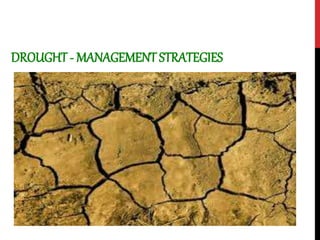
DROUGHT - MANAGEMENT STRATEGIES
DROUGHT
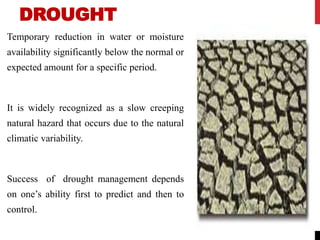
Temporary reduction in water or moisture
availability significantly below the normal or
expected amount for a specific period.
It is widely recognized as a slow creeping
natural hazard that occurs due to the natural
climatic variability.
Success of drought management depends
on one’s ability first to predict and then to
control.
THE STRATEGY FOR DROUGHT MANAGEMENT
IS AS FOLLOWS:
• To develop an advance warning system.
• Providing relief measures immediately to the affected
population.
• Coming with an alternative crop strategy
EARLY WARNING SYSTEMS
• Provide accurate, timely and integrated information on drought
conditions at the level of regions, states and districts.
• Weekly data from Indian Meteorological Department (IMD).
• When drought is detected early it allows for activation of the drought
management plan and evokes both proactive (mitigation) and reactive
(emergency) responses.
• Drought resistant plants are those varieties that are able to grow and
yield satisfactorily in areas liable to periodic drought (Hounam et al.
1975).
Adjusting the plant population: The plant population should be lesser
in dryland conditions than under irrigated conditions. The rectangular
type of planting pattern should always be followed under dryland
conditions.
Under limited moisture supply the adjustment of plant population can be
done by
a) Increasing the inter row distance
b) Increasing the intra row distance
Mid season corrections:
• Thinning
• Spraying : 2 per cent urea at week to 10 days interval
• Ratooning : In crops like sorghum and bajra, ratooning can be
practiced as mid season correction measure after break of dry spell.
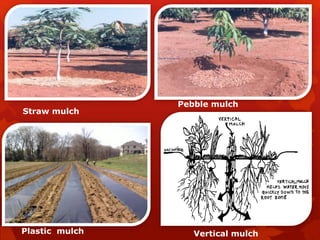
Mulching
• Soil or dust mulch
• Straw and stubble mulch
• Plastic mulch
• Pebble mulch
• Vertical mulching
Straw mulch
Pebble mulch
Plastic mulch Vertical mulch
Weed control
Water harvesting and life saving irrigation
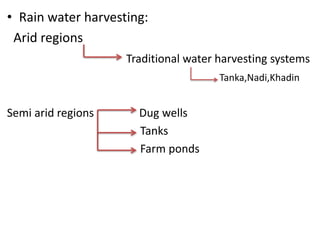
• Rain water harvesting:
Arid regions
Traditional water harvesting systems
Tanka,Nadi,Khadin
Semi arid regions Dug wells
Tanks
Farm ponds
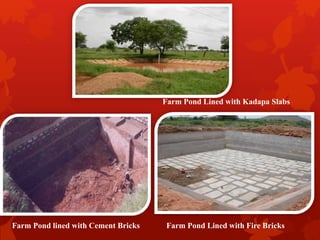
Farm Pond Lined with Kadapa Slabs
Farm Pond lined with Cement Bricks Farm Pond Lined with Fire Bricks
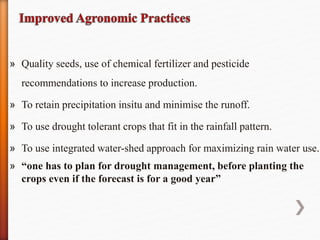
» Quality seeds, use of chemical fertilizer and pesticide
recommendations to increase production.
» To retain precipitation insitu and minimise the runoff.
» To use drought tolerant crops that fit in the rainfall pattern.
» To use integrated water-shed approach for maximizing rain water use.
» “one has to plan for drought management, before planting the
crops even if the forecast is for a good year”
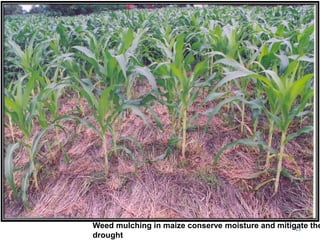
13Weed mulching in maize conserve moisture and mitigate the
drought
Public health measures
 People should be accustomed to live on rationed water.
 Ensure supply of good drinking water in rural areas for human and
livestock in drought affected areas.
 Immunisation and Surveillance of public health measures be taken.
 Rainwater harvesting for both the drinking and cropping purposes.
Cattle care:
Cattle camps on village basis can be opened to take
complete care of cattle population.
Assessment of fodder requirement on district basis in
affected area and import fodder from outside.
State Forest Department to arrange for cutting of grass in
the forest.
Fodder cultivation to be encouraged.
Implementation of crop and livestock insurance schemes.
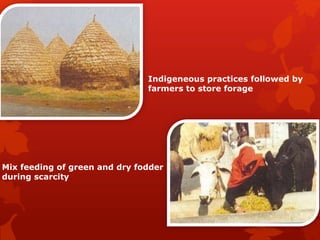
Indigeneous practices followed by
farmers to store forage
Mix feeding of green and dry fodder
during scarcity
Drinking and irrigation water
 Continuous monitoring of rural and urban water availability in
drought affected area.
 Preparing a water budget for each irrigation reservoir.
 Undertake repairs of tube-wells needing repairs. Prevent over
exploitation and damage to ground water regime.
 Regulating supply to water intensive industries, if necessary.
 Minimizing evaporation losses in tanks and small reservoirs.
» If IMD predicts less rainfall, alternative crop strategy is
implemented by providing extra power, getting seeds for
alternative crops and fertilizers.
» The farmers are informed and advised for alternative crop.
» Seeds and fertilizers are given on subsidized rates by the
government.
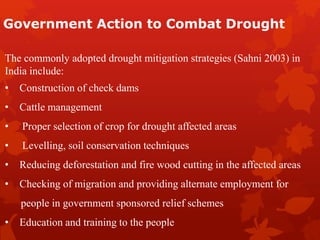
Government Action to Combat Drought
The commonly adopted drought mitigation strategies (Sahni 2003) in
India include:
• Construction of check dams
• Cattle management
• Proper selection of crop for drought affected areas
• Levelling, soil conservation techniques
• Reducing deforestation and fire wood cutting in the affected areas
• Checking of migration and providing alternate employment for
people in government sponsored relief schemes
• Education and training to the people
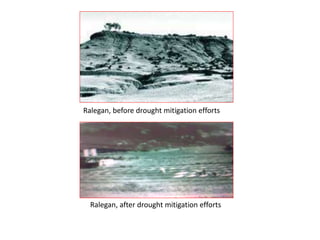
Ralegan, before drought mitigation efforts
Ralegan, after drought mitigation efforts
CONCLUSION
DROUGHT A MANAGEMENT ISSUE
Drought can be mitigated
Hardships can be minimised
Alternate crop strategy
If we at all levels work together
Drought is not a Disaster but
a Management Issue
R Reddi Manoja
TAM/13-06
Dept. of Agronomy

Drought tam 2013-06

  • 2.
  • 3.
    DROUGHT Temporary reduction inwater or moisture availability significantly below the normal or expected amount for a specific period. It is widely recognized as a slow creeping natural hazard that occurs due to the natural climatic variability. Success of drought management depends on one’s ability first to predict and then to control.
  • 4.
    THE STRATEGY FORDROUGHT MANAGEMENT IS AS FOLLOWS: • To develop an advance warning system. • Providing relief measures immediately to the affected population. • Coming with an alternative crop strategy
  • 5.
    EARLY WARNING SYSTEMS •Provide accurate, timely and integrated information on drought conditions at the level of regions, states and districts. • Weekly data from Indian Meteorological Department (IMD). • When drought is detected early it allows for activation of the drought management plan and evokes both proactive (mitigation) and reactive (emergency) responses. • Drought resistant plants are those varieties that are able to grow and yield satisfactorily in areas liable to periodic drought (Hounam et al. 1975).
  • 6.
    Adjusting the plantpopulation: The plant population should be lesser in dryland conditions than under irrigated conditions. The rectangular type of planting pattern should always be followed under dryland conditions. Under limited moisture supply the adjustment of plant population can be done by a) Increasing the inter row distance b) Increasing the intra row distance
  • 7.
    Mid season corrections: •Thinning • Spraying : 2 per cent urea at week to 10 days interval • Ratooning : In crops like sorghum and bajra, ratooning can be practiced as mid season correction measure after break of dry spell. Mulching • Soil or dust mulch • Straw and stubble mulch • Plastic mulch • Pebble mulch • Vertical mulching
  • 8.
  • 9.
    Weed control Water harvestingand life saving irrigation
  • 10.
    • Rain waterharvesting: Arid regions Traditional water harvesting systems Tanka,Nadi,Khadin Semi arid regions Dug wells Tanks Farm ponds
  • 11.
    Farm Pond Linedwith Kadapa Slabs Farm Pond lined with Cement Bricks Farm Pond Lined with Fire Bricks
  • 12.
    » Quality seeds,use of chemical fertilizer and pesticide recommendations to increase production. » To retain precipitation insitu and minimise the runoff. » To use drought tolerant crops that fit in the rainfall pattern. » To use integrated water-shed approach for maximizing rain water use. » “one has to plan for drought management, before planting the crops even if the forecast is for a good year”
  • 13.
    13Weed mulching inmaize conserve moisture and mitigate the drought
  • 14.
    Public health measures People should be accustomed to live on rationed water.  Ensure supply of good drinking water in rural areas for human and livestock in drought affected areas.  Immunisation and Surveillance of public health measures be taken.  Rainwater harvesting for both the drinking and cropping purposes.
  • 15.
    Cattle care: Cattle campson village basis can be opened to take complete care of cattle population. Assessment of fodder requirement on district basis in affected area and import fodder from outside. State Forest Department to arrange for cutting of grass in the forest. Fodder cultivation to be encouraged. Implementation of crop and livestock insurance schemes.
  • 16.
    Indigeneous practices followedby farmers to store forage Mix feeding of green and dry fodder during scarcity
  • 17.
    Drinking and irrigationwater  Continuous monitoring of rural and urban water availability in drought affected area.  Preparing a water budget for each irrigation reservoir.  Undertake repairs of tube-wells needing repairs. Prevent over exploitation and damage to ground water regime.  Regulating supply to water intensive industries, if necessary.  Minimizing evaporation losses in tanks and small reservoirs.
  • 18.
    » If IMDpredicts less rainfall, alternative crop strategy is implemented by providing extra power, getting seeds for alternative crops and fertilizers. » The farmers are informed and advised for alternative crop. » Seeds and fertilizers are given on subsidized rates by the government.
  • 19.
    Government Action toCombat Drought The commonly adopted drought mitigation strategies (Sahni 2003) in India include: • Construction of check dams • Cattle management • Proper selection of crop for drought affected areas • Levelling, soil conservation techniques • Reducing deforestation and fire wood cutting in the affected areas • Checking of migration and providing alternate employment for people in government sponsored relief schemes • Education and training to the people
  • 20.
    Ralegan, before droughtmitigation efforts Ralegan, after drought mitigation efforts
  • 21.
    CONCLUSION DROUGHT A MANAGEMENTISSUE Drought can be mitigated Hardships can be minimised Alternate crop strategy If we at all levels work together Drought is not a Disaster but a Management Issue
  • 22.