Chapter 17 SONET/SDH Copyright © The McGraw-Hill Companies, Inc. Permission required for reproduction or display.
SONET was developed by ANSI; SDH was developed by ITU-T. Note
17-1  ARCHITECTURE Let us first introduce the architecture of a SONET system: signals, devices, and connections. Signals SONET Devices Connections Topics discussed in this section:
Table 17.1  SONET/SDH rates
Figure 17.1  A simple network using SONET equipment
17-2  SONET LAYERS The SONET standard includes four functional layers: the  photonic , the  section , the  line , and the  path  layer. They correspond to both the physical and the data link layers. Path Layer Line Layer Section Layer Photonic Layer Device–Layer Relationships Topics discussed in this section:
SONET defines four layers: path, line, section, and photonic. Note
Figure 17.2  SONET layers compared with OSI or the Internet layers
Figure 17.3  Device–layer relationship in SONET
17-3  SONET FRAMES Each synchronous transfer signal STS-n is composed of 8000 frames. Each frame is a two-dimensional matrix of bytes with 9 rows by 90 × n columns. Frame, Byte, and Bit Transmission STS-1 Frame Format Encapsulation Topics discussed in this section:
Figure 17.4  An STS-1 and an STS-n frame
Figure 17.5  STS-1 frames in transmission
A SONET STS-n signal is transmitted at  8000 frames per second. Note
Each byte in a SONET frame can carry a digitized voice channel. Note
Find the data rate of an STS-1 signal. Solution STS-1, like other STS signals, sends 8000 frames per second. Each STS-1 frame is made of 9 by (1 × 90) bytes. Each byte is made of 8 bits. The data rate is Example 17.1
Find the data rate of an STS-3 signal. Solution STS-3, like other STS signals, sends 8000 frames per second. Each STS-3 frame is made of 9 by (3 × 90) bytes. Each byte is made of 8 bits. The data rate is Example 17.2
In SONET, the data rate of an STS-n signal is  n  times the data rate  of an STS-1 signal. Note
What is the duration of an STS-1 frame? STS-3 frame? STS-n frame? Solution In SONET, 8000 frames are sent per second. This means that the duration of an STS-1, STS-3, or STS-n frame is the same and equal to 1/8000 s, or  125 μs. Example 17.3
In SONET,  the duration of any frame is 125 μs. Note
Figure 17.6  STS-1 frame overheads
Figure 17.7  STS-1 frame: section overhead
Section overhead is recalculated for each SONET device (regenerators and multiplexers). Note
Figure 17.8  STS-1 frame: line overhead
Figure 17.9  STS-1 frame: path overhead
Path overhead is only calculated for end-to-end (at STS multiplexers). Note
Table 17.2  Overhead bytes
What is the user data rate of an STS-1 frame (without considering the overheads)? Solution The user data part in an STS-1 frame is made of 9 rows and 86 columns. So we have Example 17.4
Figure 17.10  Offsetting of SPE related to frame boundary
Figure 17.11  The use of H1 and H2 pointers to show the start of    an SPE in a frame
What are the values of H1 and H2 if an SPE starts at byte number 650? Solution The number 650 can be expressed in four hexadecimal digits as 0x028A. This means the value of H1 is  0x02  and the value of H2 is  0x8A . Example 17.5
17-4  STS MULTIPLEXING In SONET, frames of lower rate can be synchronously time-division multiplexed into a higher-rate frame. For example, three STS-1 signals (channels) can be combined into one STS-3 signal (channel), four  STS-3s can be multiplexed into one STS-12, and so on. Byte Interleaving Concatenated Signal Add/Drop Multiplexer Topics discussed in this section:
Figure 17.12  STS multiplexing/demultiplexing
In SONET, all clocks in the network are locked to a master clock. Note
Figure 17.13  Byte interleaving
Figure 17.14  An STS-3 frame
Figure 17.15  A concatenated STS-3c signal
An STS-3c signal can carry  44 ATM cells as its SPE. Note
Figure 17.16  Dropping and adding STS-1 frames in an add/drop multiplexer
17-5  SONET NETWORKS Using SONET equipment, we can create a SONET network that can be used as a high-speed backbone carrying loads from other networks. We can roughly divide SONET networks into three categories:  linear ,  ring , and  mesh  networks. Linear Networks Ring Networks Mesh Networks Topics discussed in this section:
Figure 17.17  Taxonomy of SONET networks
Figure 17.18  A point-to-point SONET network
Figure 17.19  A multipoint SONET network
Figure 17.20  Automatic protection switching in linear networks
Figure 17.21  A unidirectional path switching ring
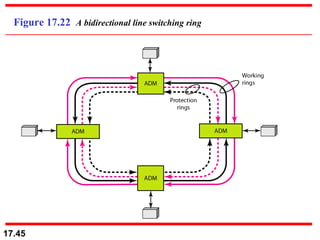
Figure 17.22  A bidirectional line switching ring
Figure 17.23  A combination of rings in a SONET network
Figure 17.24  A mesh SONET network
17-6  VIRTUAL TRIBUTARIES SONET is designed to carry broadband payloads. Current digital hierarchy data rates, however, are lower than STS-1. To make SONET backward-compatible with the current hierarchy, its frame design includes a system of virtual tributaries (VTs). A virtual tributary is a partial payload that can be inserted into an STS-1.  Types of VTs Topics discussed in this section:
Figure 17.25  Virtual tributaries
Figure 17.26  Virtual tributary types

Ch17

  • 1.
    Chapter 17 SONET/SDHCopyright © The McGraw-Hill Companies, Inc. Permission required for reproduction or display.
  • 2.
    SONET was developedby ANSI; SDH was developed by ITU-T. Note
  • 3.
    17-1 ARCHITECTURELet us first introduce the architecture of a SONET system: signals, devices, and connections. Signals SONET Devices Connections Topics discussed in this section:
  • 4.
    Table 17.1 SONET/SDH rates
  • 5.
    Figure 17.1 A simple network using SONET equipment
  • 6.
    17-2 SONETLAYERS The SONET standard includes four functional layers: the photonic , the section , the line , and the path layer. They correspond to both the physical and the data link layers. Path Layer Line Layer Section Layer Photonic Layer Device–Layer Relationships Topics discussed in this section:
  • 7.
    SONET defines fourlayers: path, line, section, and photonic. Note
  • 8.
    Figure 17.2 SONET layers compared with OSI or the Internet layers
  • 9.
    Figure 17.3 Device–layer relationship in SONET
  • 10.
    17-3 SONETFRAMES Each synchronous transfer signal STS-n is composed of 8000 frames. Each frame is a two-dimensional matrix of bytes with 9 rows by 90 × n columns. Frame, Byte, and Bit Transmission STS-1 Frame Format Encapsulation Topics discussed in this section:
  • 11.
    Figure 17.4 An STS-1 and an STS-n frame
  • 12.
    Figure 17.5 STS-1 frames in transmission
  • 13.
    A SONET STS-nsignal is transmitted at 8000 frames per second. Note
  • 14.
    Each byte ina SONET frame can carry a digitized voice channel. Note
  • 15.
    Find the datarate of an STS-1 signal. Solution STS-1, like other STS signals, sends 8000 frames per second. Each STS-1 frame is made of 9 by (1 × 90) bytes. Each byte is made of 8 bits. The data rate is Example 17.1
  • 16.
    Find the datarate of an STS-3 signal. Solution STS-3, like other STS signals, sends 8000 frames per second. Each STS-3 frame is made of 9 by (3 × 90) bytes. Each byte is made of 8 bits. The data rate is Example 17.2
  • 17.
    In SONET, thedata rate of an STS-n signal is n times the data rate of an STS-1 signal. Note
  • 18.
    What is theduration of an STS-1 frame? STS-3 frame? STS-n frame? Solution In SONET, 8000 frames are sent per second. This means that the duration of an STS-1, STS-3, or STS-n frame is the same and equal to 1/8000 s, or 125 μs. Example 17.3
  • 19.
    In SONET, the duration of any frame is 125 μs. Note
  • 20.
    Figure 17.6 STS-1 frame overheads
  • 21.
    Figure 17.7 STS-1 frame: section overhead
  • 22.
    Section overhead isrecalculated for each SONET device (regenerators and multiplexers). Note
  • 23.
    Figure 17.8 STS-1 frame: line overhead
  • 24.
    Figure 17.9 STS-1 frame: path overhead
  • 25.
    Path overhead isonly calculated for end-to-end (at STS multiplexers). Note
  • 26.
    Table 17.2 Overhead bytes
  • 27.
    What is theuser data rate of an STS-1 frame (without considering the overheads)? Solution The user data part in an STS-1 frame is made of 9 rows and 86 columns. So we have Example 17.4
  • 28.
    Figure 17.10 Offsetting of SPE related to frame boundary
  • 29.
    Figure 17.11 The use of H1 and H2 pointers to show the start of an SPE in a frame
  • 30.
    What are thevalues of H1 and H2 if an SPE starts at byte number 650? Solution The number 650 can be expressed in four hexadecimal digits as 0x028A. This means the value of H1 is 0x02 and the value of H2 is 0x8A . Example 17.5
  • 31.
    17-4 STSMULTIPLEXING In SONET, frames of lower rate can be synchronously time-division multiplexed into a higher-rate frame. For example, three STS-1 signals (channels) can be combined into one STS-3 signal (channel), four STS-3s can be multiplexed into one STS-12, and so on. Byte Interleaving Concatenated Signal Add/Drop Multiplexer Topics discussed in this section:
  • 32.
    Figure 17.12 STS multiplexing/demultiplexing
  • 33.
    In SONET, allclocks in the network are locked to a master clock. Note
  • 34.
    Figure 17.13 Byte interleaving
  • 35.
    Figure 17.14 An STS-3 frame
  • 36.
    Figure 17.15 A concatenated STS-3c signal
  • 37.
    An STS-3c signalcan carry 44 ATM cells as its SPE. Note
  • 38.
    Figure 17.16 Dropping and adding STS-1 frames in an add/drop multiplexer
  • 39.
    17-5 SONETNETWORKS Using SONET equipment, we can create a SONET network that can be used as a high-speed backbone carrying loads from other networks. We can roughly divide SONET networks into three categories: linear , ring , and mesh networks. Linear Networks Ring Networks Mesh Networks Topics discussed in this section:
  • 40.
    Figure 17.17 Taxonomy of SONET networks
  • 41.
    Figure 17.18 A point-to-point SONET network
  • 42.
    Figure 17.19 A multipoint SONET network
  • 43.
    Figure 17.20 Automatic protection switching in linear networks
  • 44.
    Figure 17.21 A unidirectional path switching ring
  • 45.
    Figure 17.22 A bidirectional line switching ring
  • 46.
    Figure 17.23 A combination of rings in a SONET network
  • 47.
    Figure 17.24 A mesh SONET network
  • 48.
    17-6 VIRTUALTRIBUTARIES SONET is designed to carry broadband payloads. Current digital hierarchy data rates, however, are lower than STS-1. To make SONET backward-compatible with the current hierarchy, its frame design includes a system of virtual tributaries (VTs). A virtual tributary is a partial payload that can be inserted into an STS-1. Types of VTs Topics discussed in this section:
  • 49.
    Figure 17.25 Virtual tributaries
  • 50.
    Figure 17.26 Virtual tributary types