SIGNAL MODELING


             BY
       DEBANGI GOSWAMI
CONTENTS
   Introduction
        1.Title description
        2.Need and importance of signal modeling
   Theory
        1.Least mean square direct method.
              1.1. Brief Overview
              1.2. Disadvantages
        2.Pade Approximation
        3.Prony’s Approximation
        4.Shanks Method
        5.Stochastic process-ARMA,MA,AR
   Application
        Least Mean Square Inverse FIR filter
   Conclusion
   References
WHAT IS MODELING:
 Modelling of signal is basically mathematical
  representation of signal.
 Fourier series, Fourier transform are kind of signal
  models.
                  WHY MODELLING
NEED OF MODELING:

1.EFFICIENCY OF TRANSMISSION

        2.PREDICTION
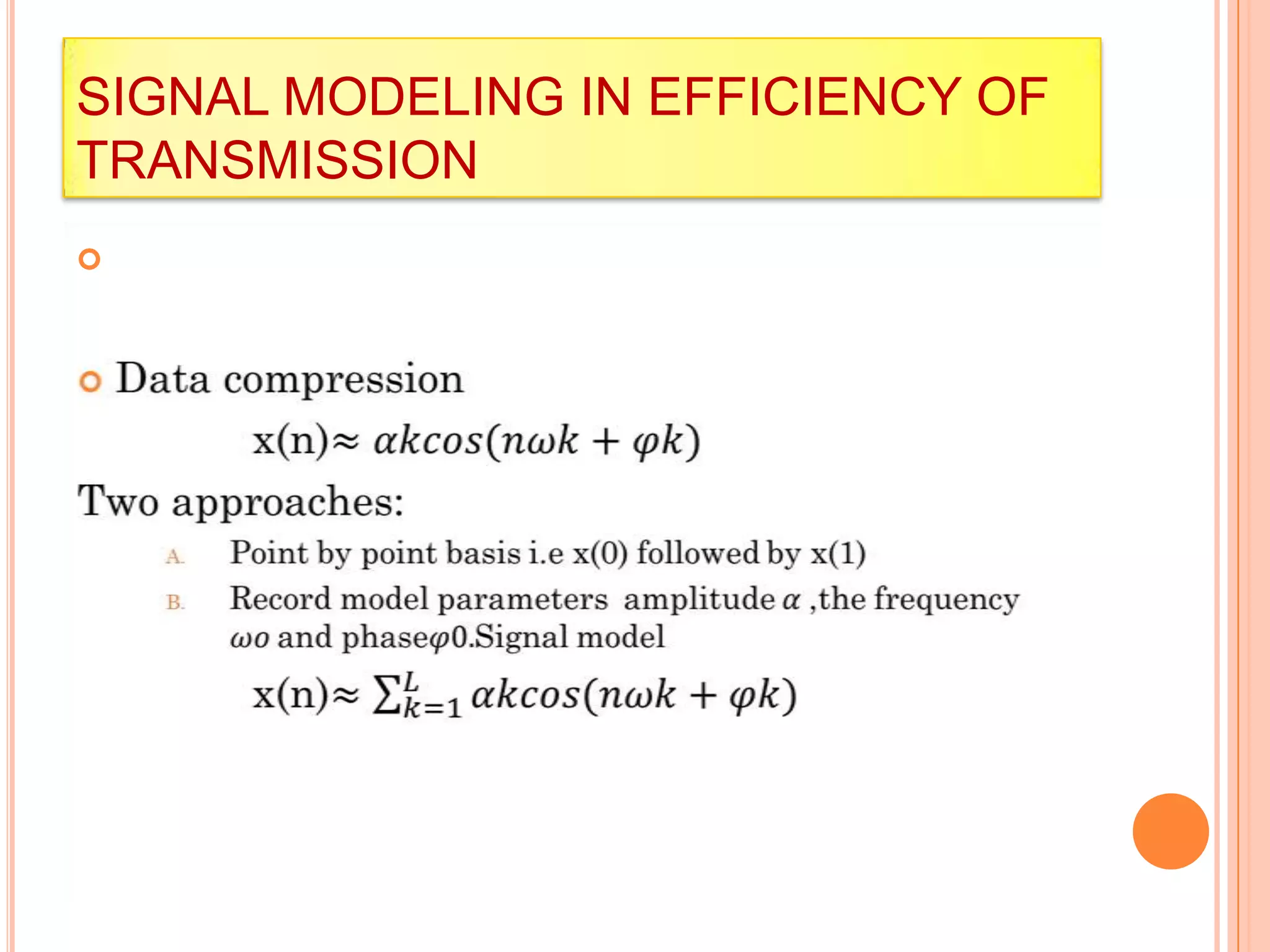
SIGNAL MODELING IN EFFICIENCY OF
TRANSMISSION

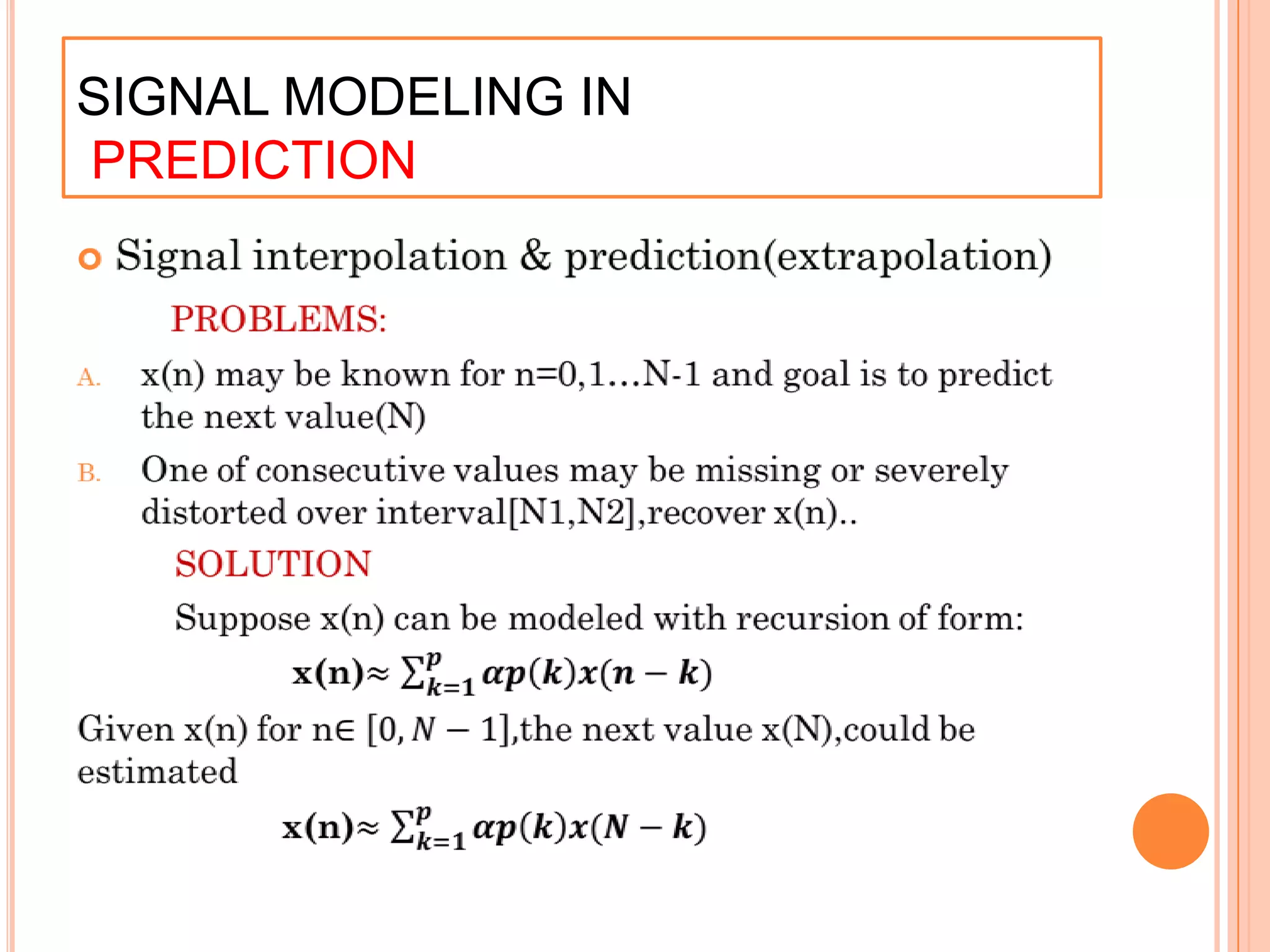
SIGNAL MODELING IN
PREDICTION

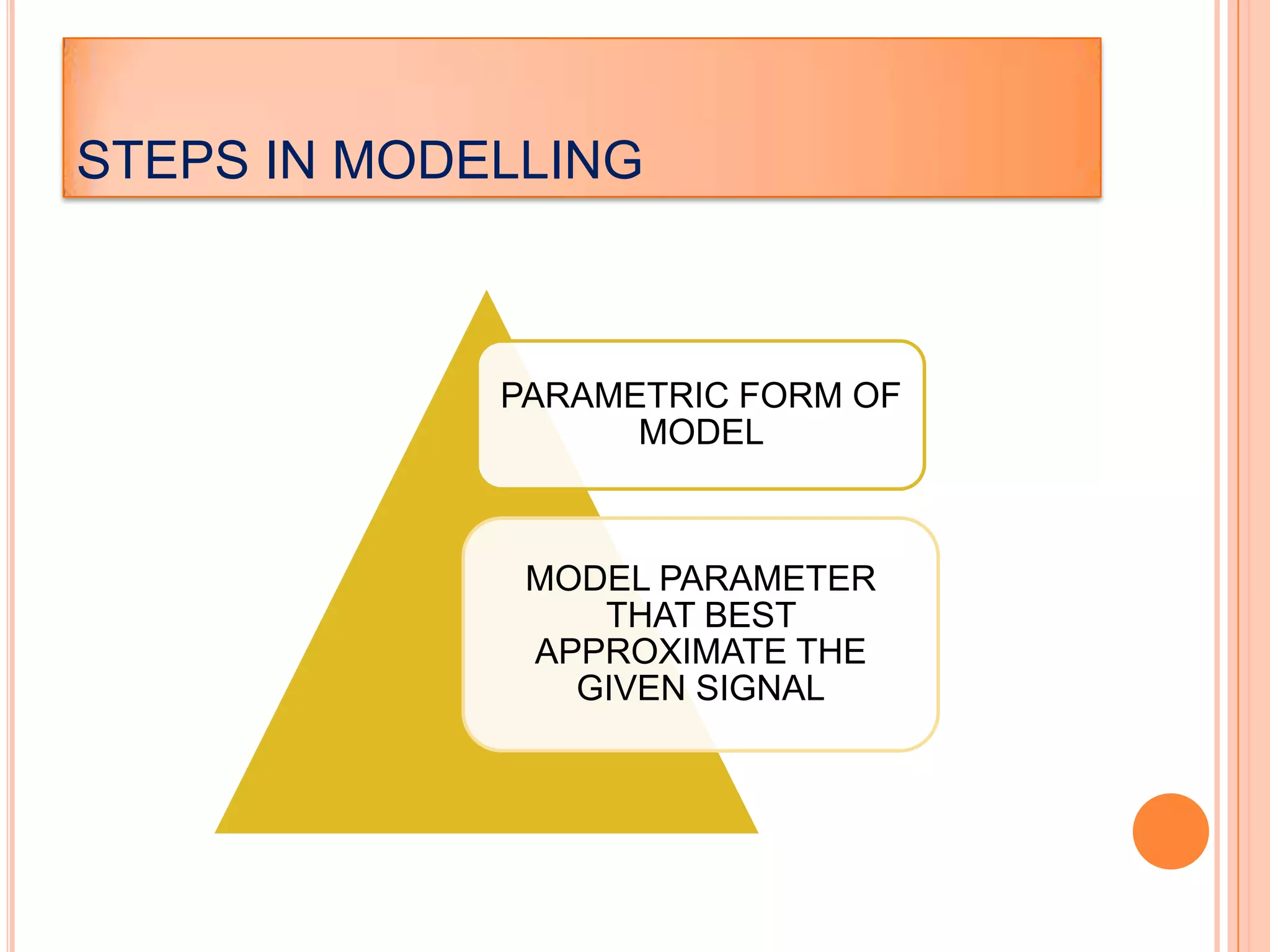
STEPS IN MODELLING


             PARAMETRIC FORM OF
                   MODEL


              MODEL PARAMETER
                 THAT BEST
              APPROXIMATE THE
                GIVEN SIGNAL
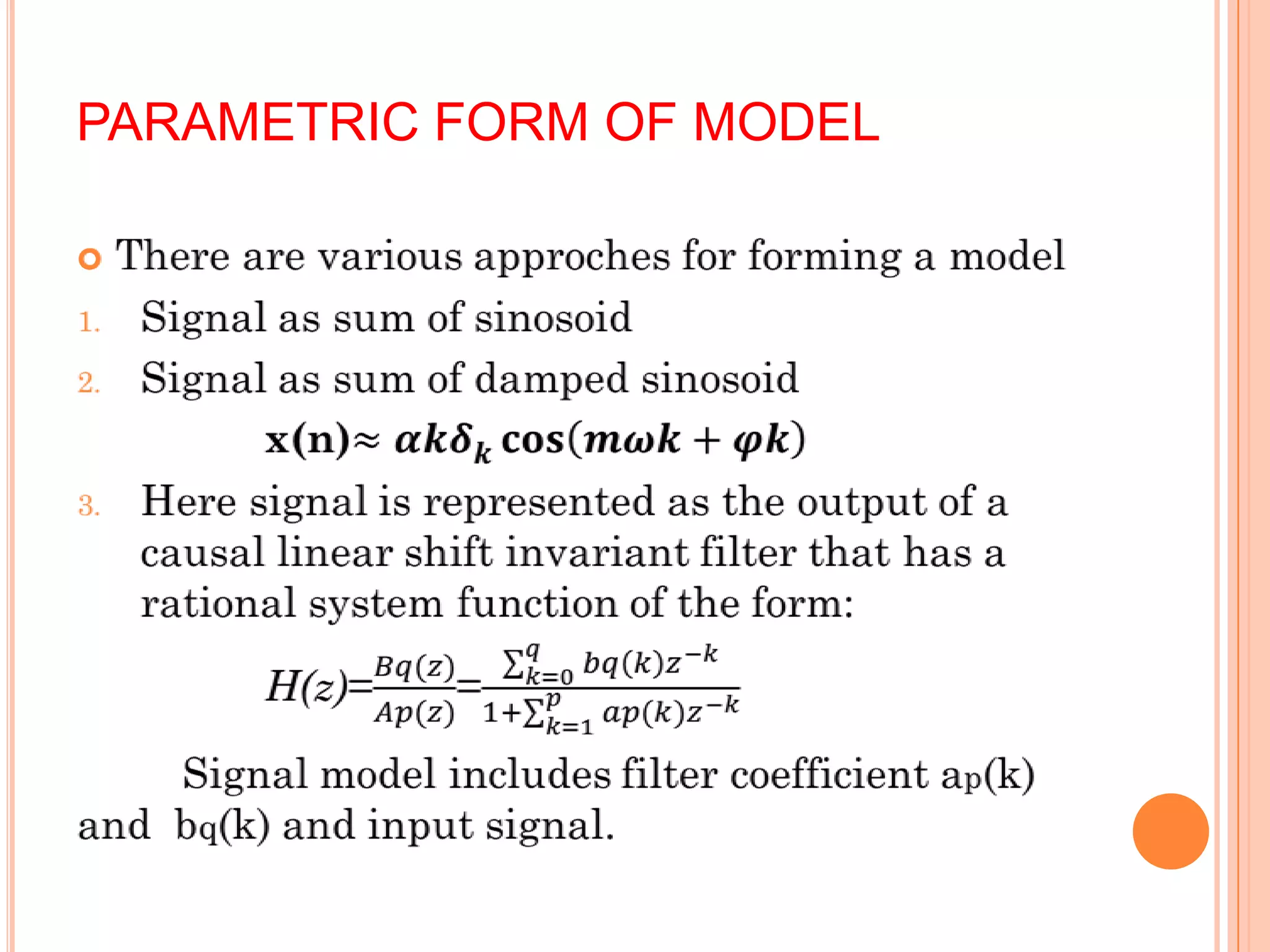
PARAMETRIC FORM OF MODEL


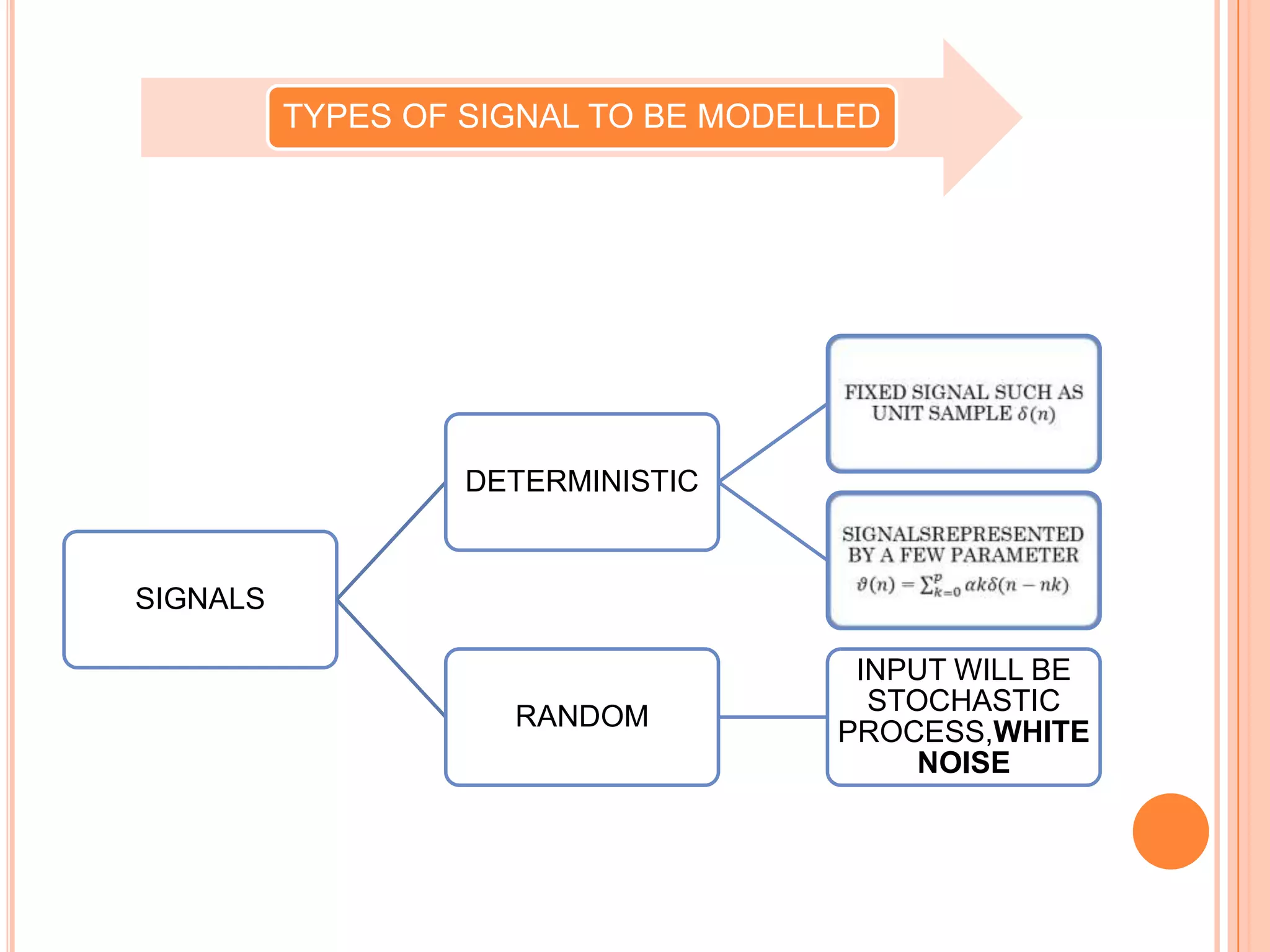
TYPES OF SIGNAL TO BE MODELLED


                   DETERMINISTIC


SIGNALS

                                      INPUT WILL BE
                                       STOCHASTIC
                     RANDOM
                                     PROCESS,WHITE
                                          NOISE
MODEL PARAMETER
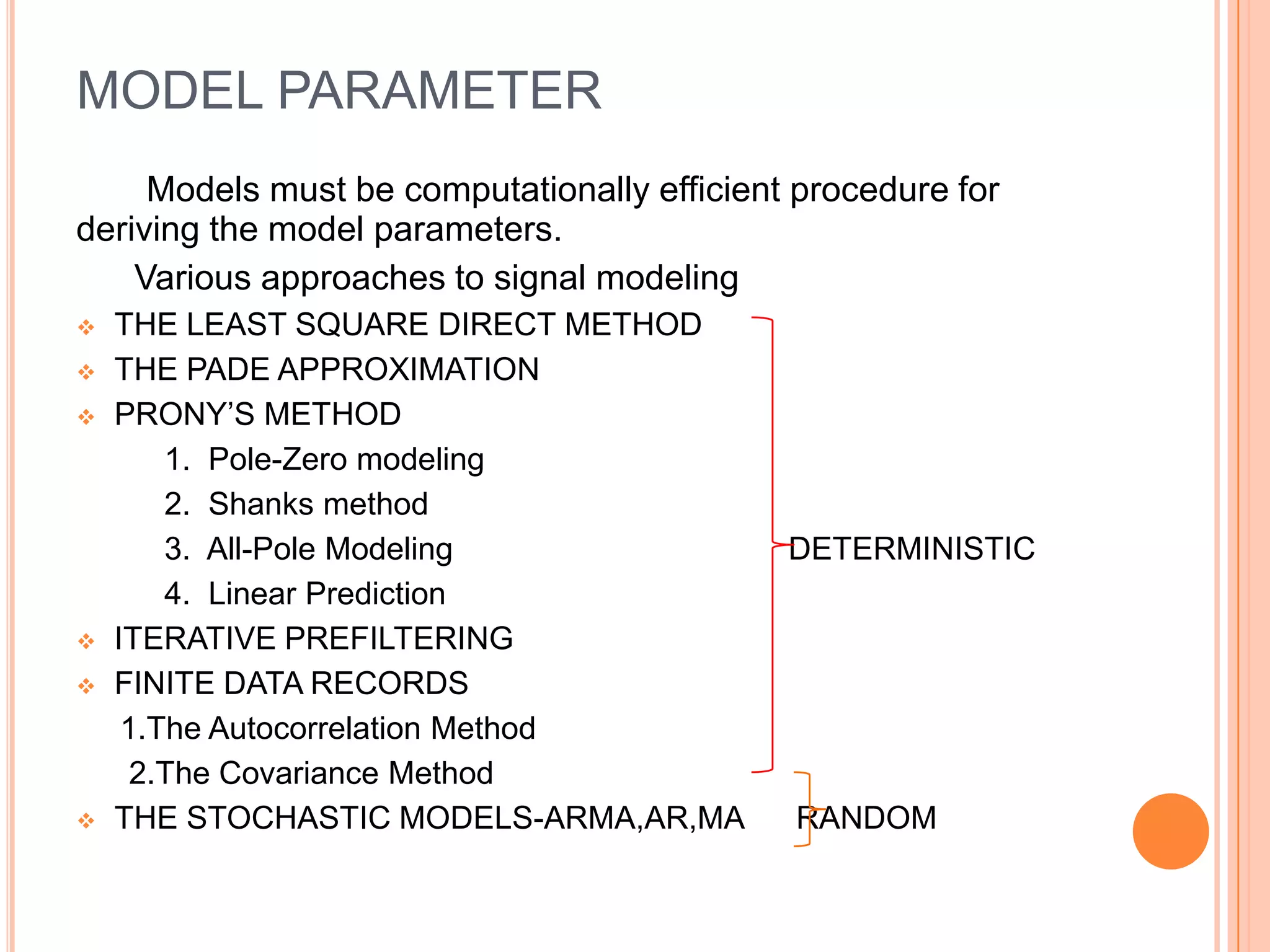
     Models must be computationally efficient procedure for
deriving the model parameters.
    Various approaches to signal modeling
   THE LEAST SQUARE DIRECT METHOD
   THE PADE APPROXIMATION
   PRONY’S METHOD
        1. Pole-Zero modeling
        2. Shanks method
        3. All-Pole Modeling                 DETERMINISTIC
        4. Linear Prediction
   ITERATIVE PREFILTERING
   FINITE DATA RECORDS
     1.The Autocorrelation Method
      2.The Covariance Method
   THE STOCHASTIC MODELS-ARMA,AR,MA          RANDOM

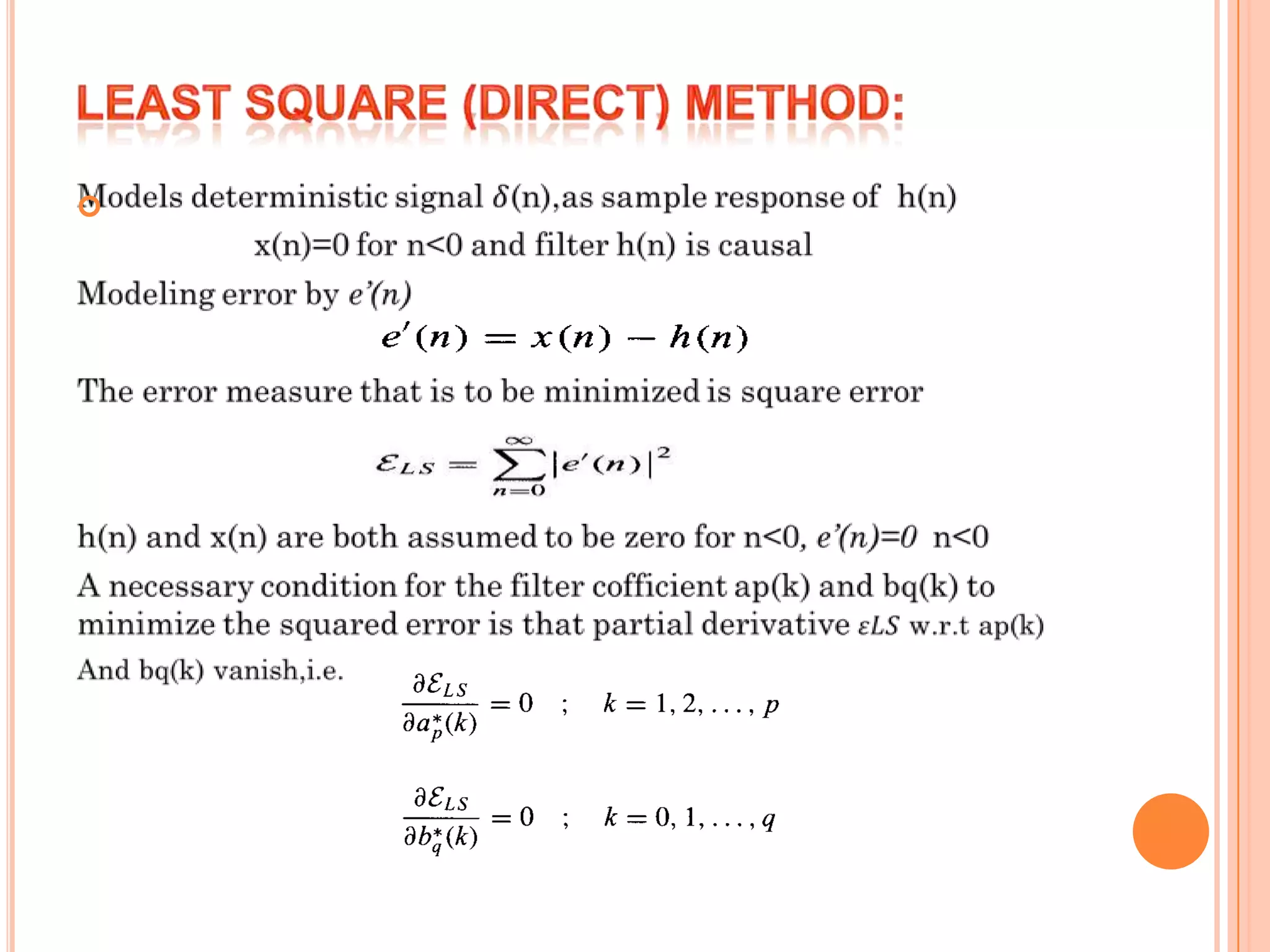
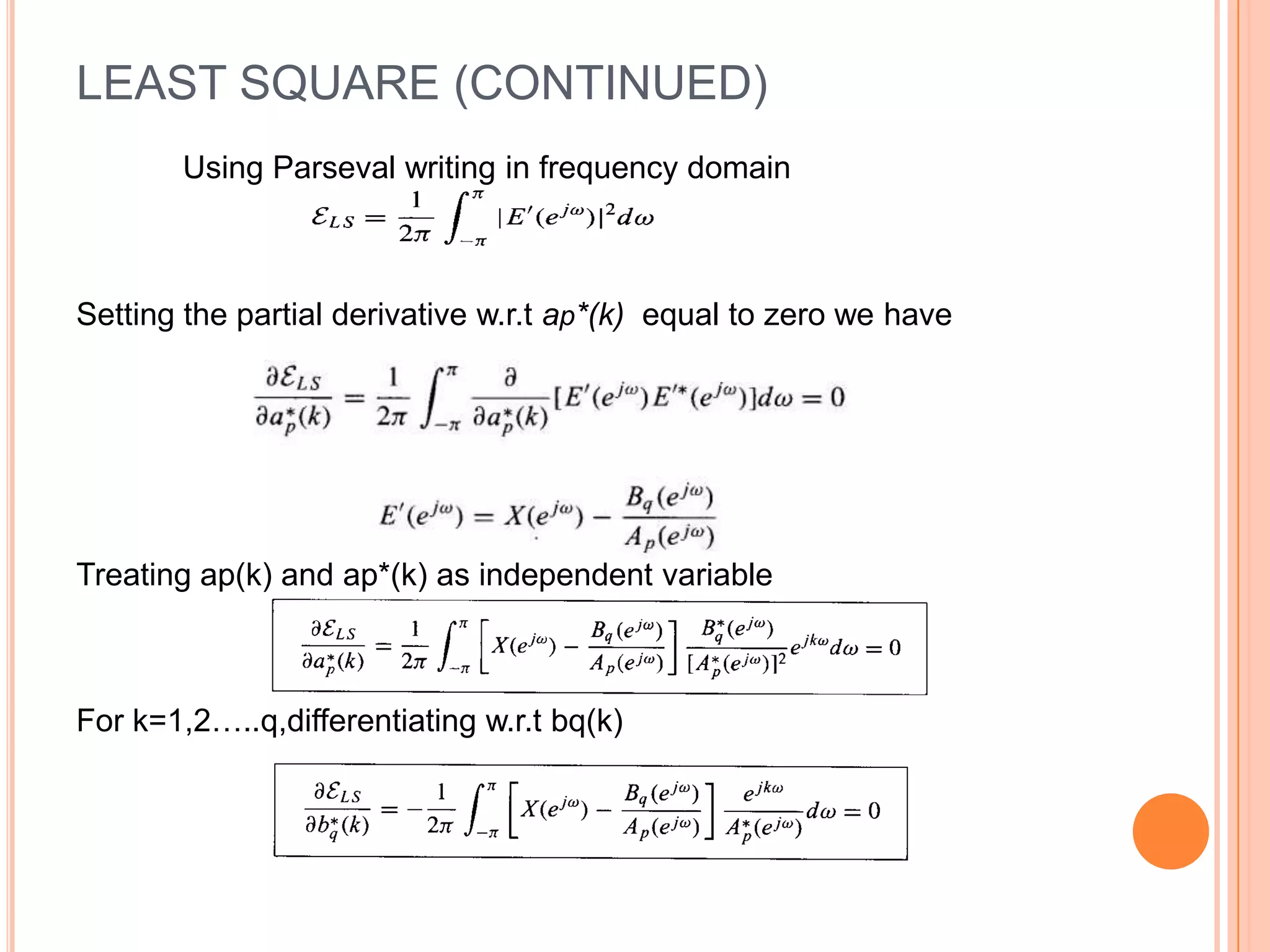
LEAST SQUARE (CONTINUED)
       Using Parseval writing in frequency domain


Setting the partial derivative w.r.t ap*(k) equal to zero we have


Treating ap(k) and ap*(k) as independent variable


For k=1,2…..q,differentiating w.r.t bq(k)
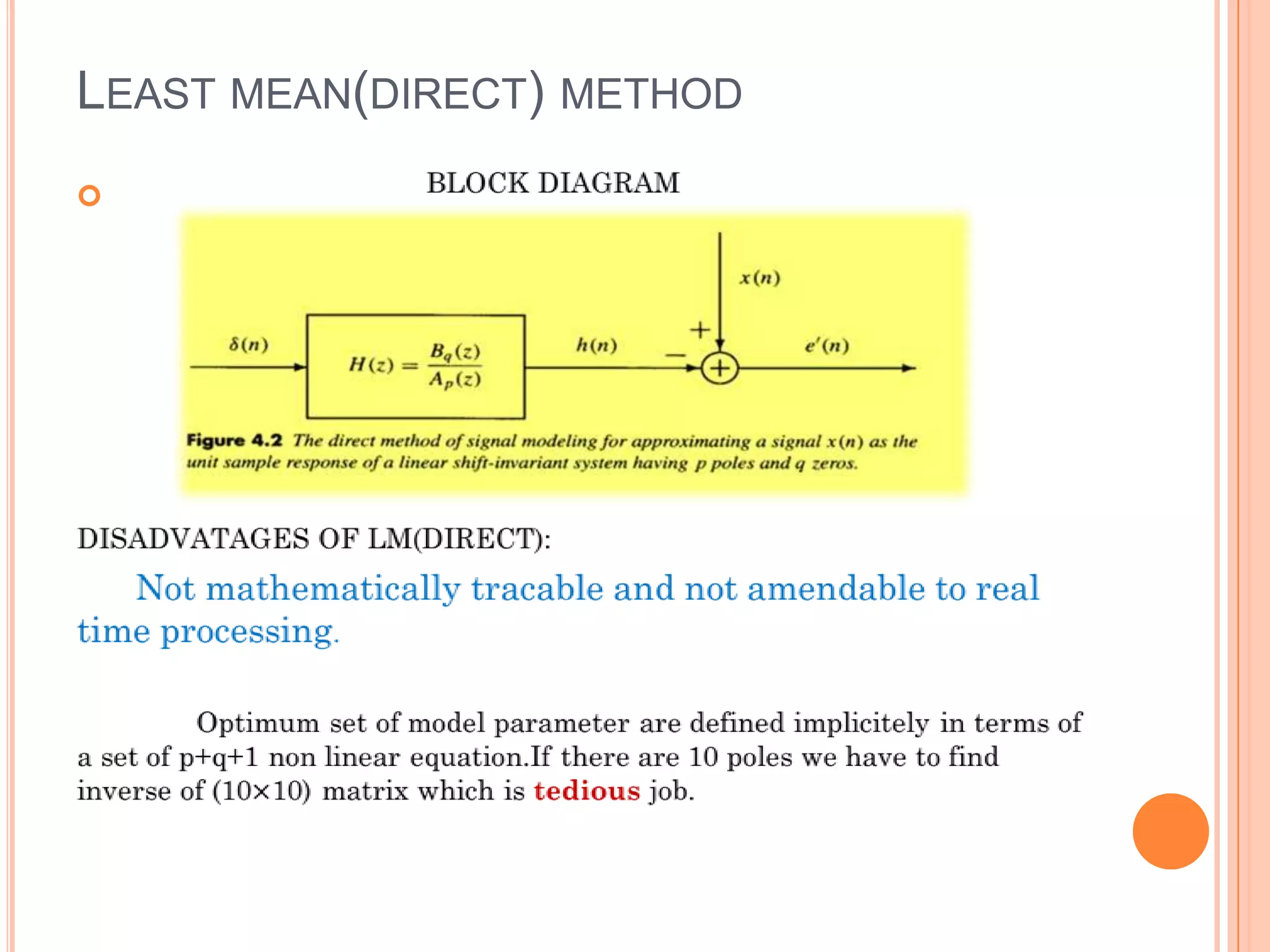
LEAST MEAN(DIRECT) METHOD

PADE APPROXIMATION
   Pade approximation only requires solving a set linear equation.
   In Pade we force the filter output h(n) to be equal to given signal x(n)
    for p+q+1 values of n.


In time domain,


Where h(n)=0 for n<0 and n>q.To find the cofficients ap(k) and bq(k)
that gives an exact fit of data model in [0,p+q] we set h(n)=x(n)
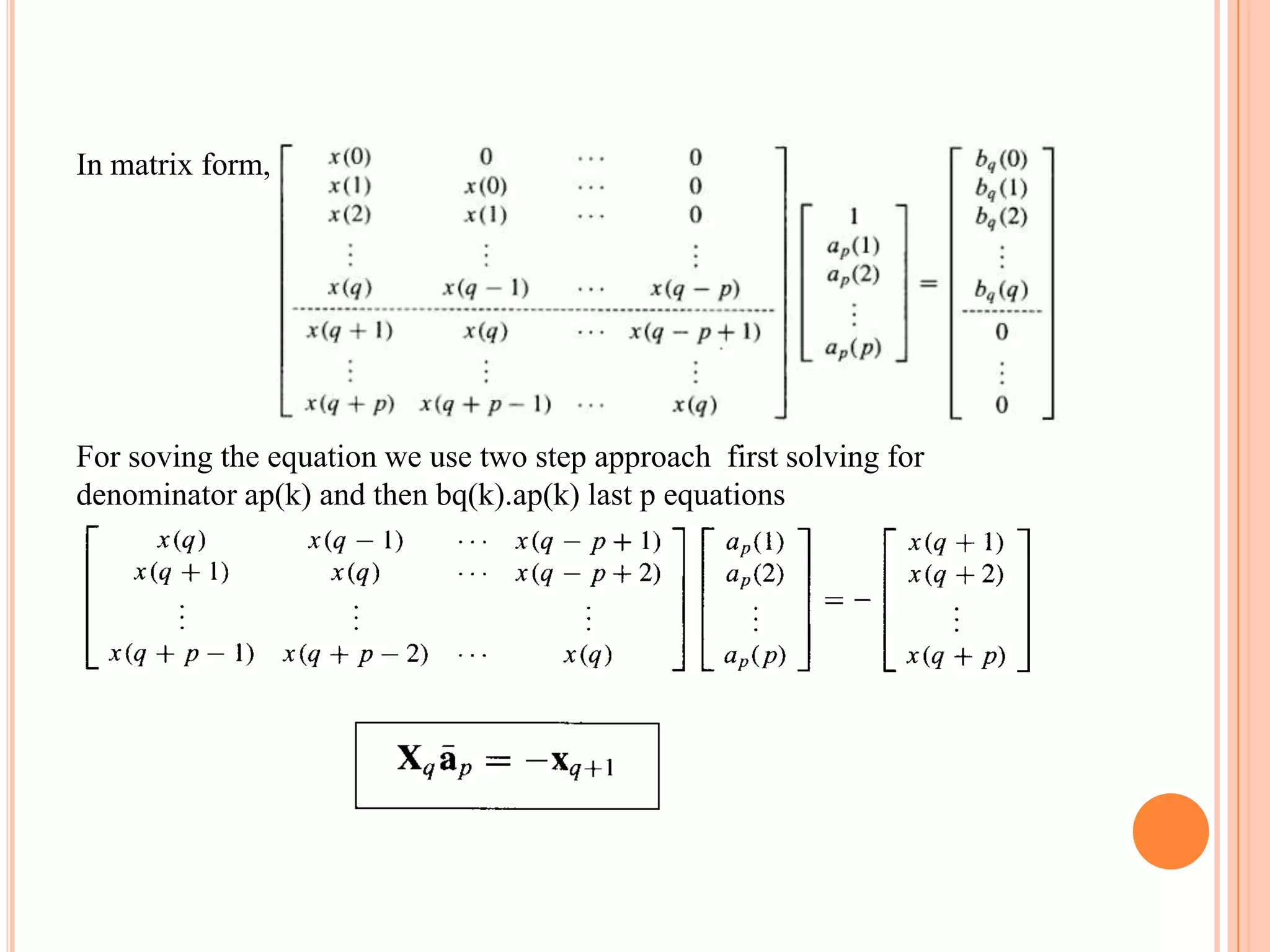
In matrix form,


For soving the equation we use two step approach first solving for
denominator ap(k) and then bq(k).ap(k) last p equations
CONCLUSIONS ON PADE APPROXIMATION

 The model formed from Pade approximation will
  produce an exact fit to data over the
  interval[0,p+q].But has no guarantee on how
  accurate the model will be for n>p+q.
 Pade approximation will give correct model
  parameters provided the model order is chosen to
  be large enough.
 Since the Pade approximation forces the model to
  match the signal only over limited range of
  values,the model generated is not stable
PRONY’S METHOD
 The limitation of Pade approximation-Only uses values of the
signal x(n) over the interval [0,p+q] to determine model
parameter and over this interval, it models the signal without
error.
There is no guarantee on how well the model will
approximate the signal for n>p+q

POLE ZERO MODELLING:
Similar to pade x(n)=0 for n<0.A least square minimization of e’(n)
results in set of non-linear equation for filter cofficient
                              Multiplying by Ap(z) we have new error

That is linear cofficients.In time domain:
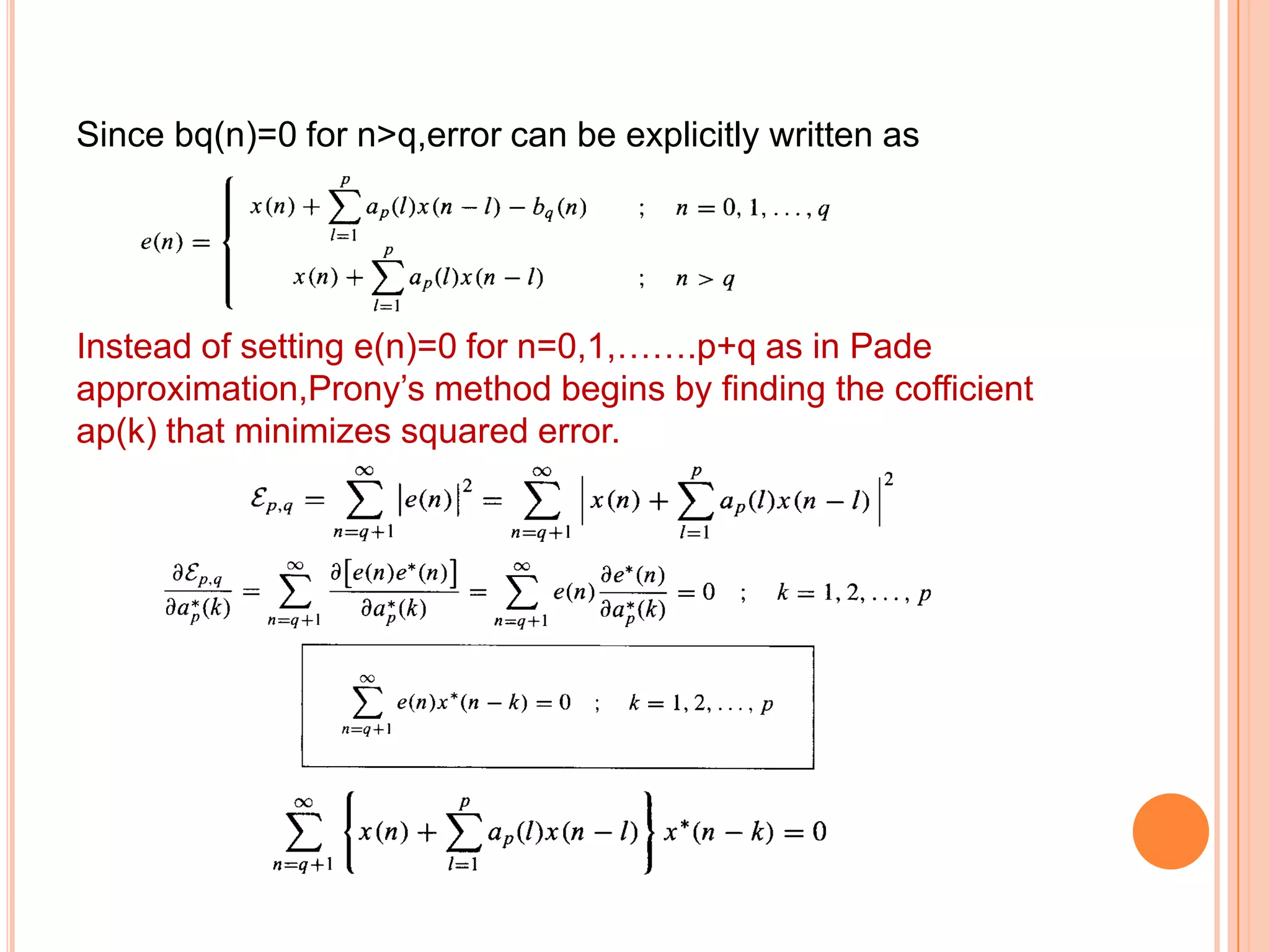
Since bq(n)=0 for n>q,error can be explicitly written as


Instead of setting e(n)=0 for n=0,1,…….p+q as in Pade
approximation,Prony’s method begins by finding the cofficient
ap(k) that minimizes squared error.
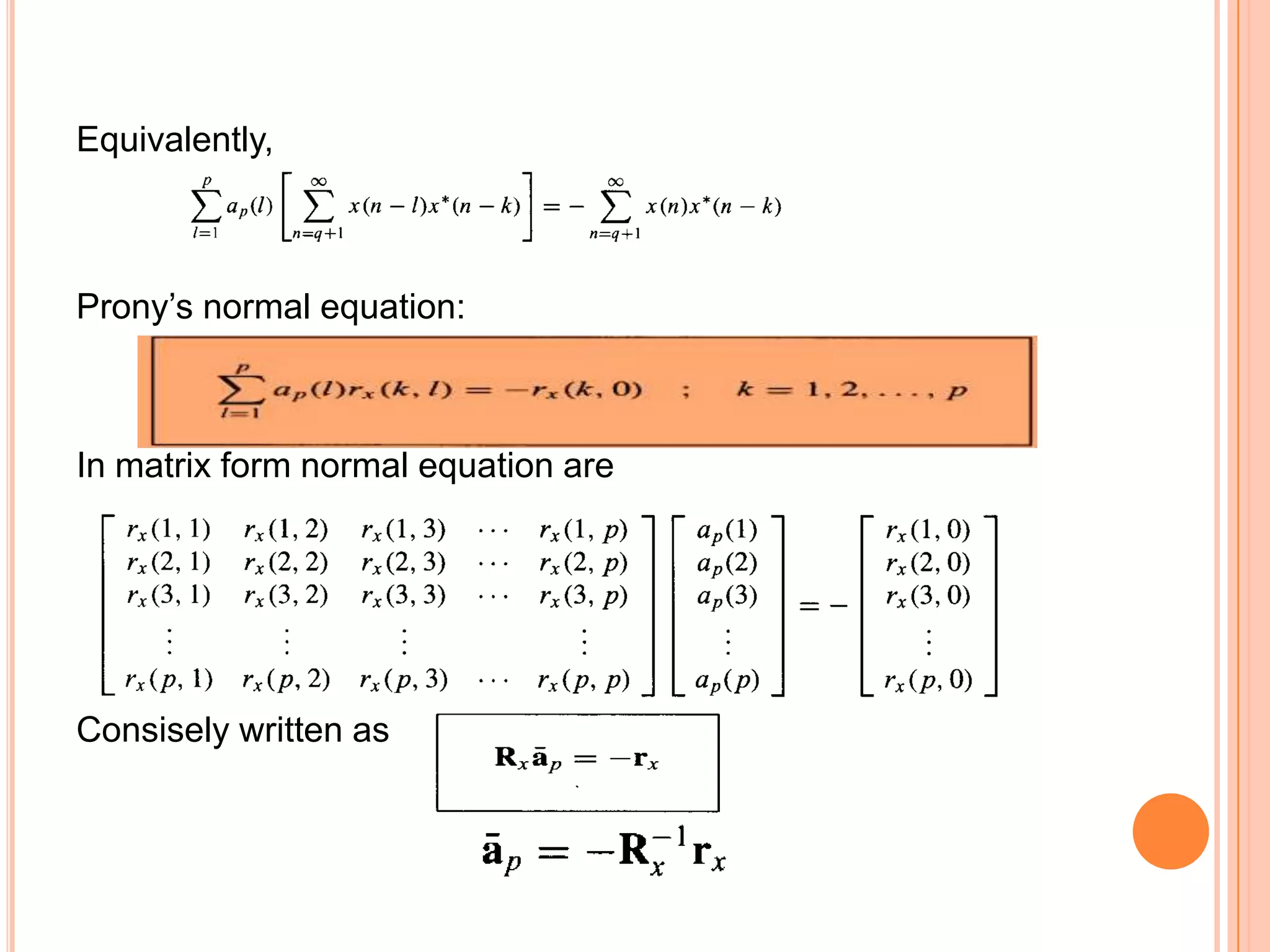
Equivalently,


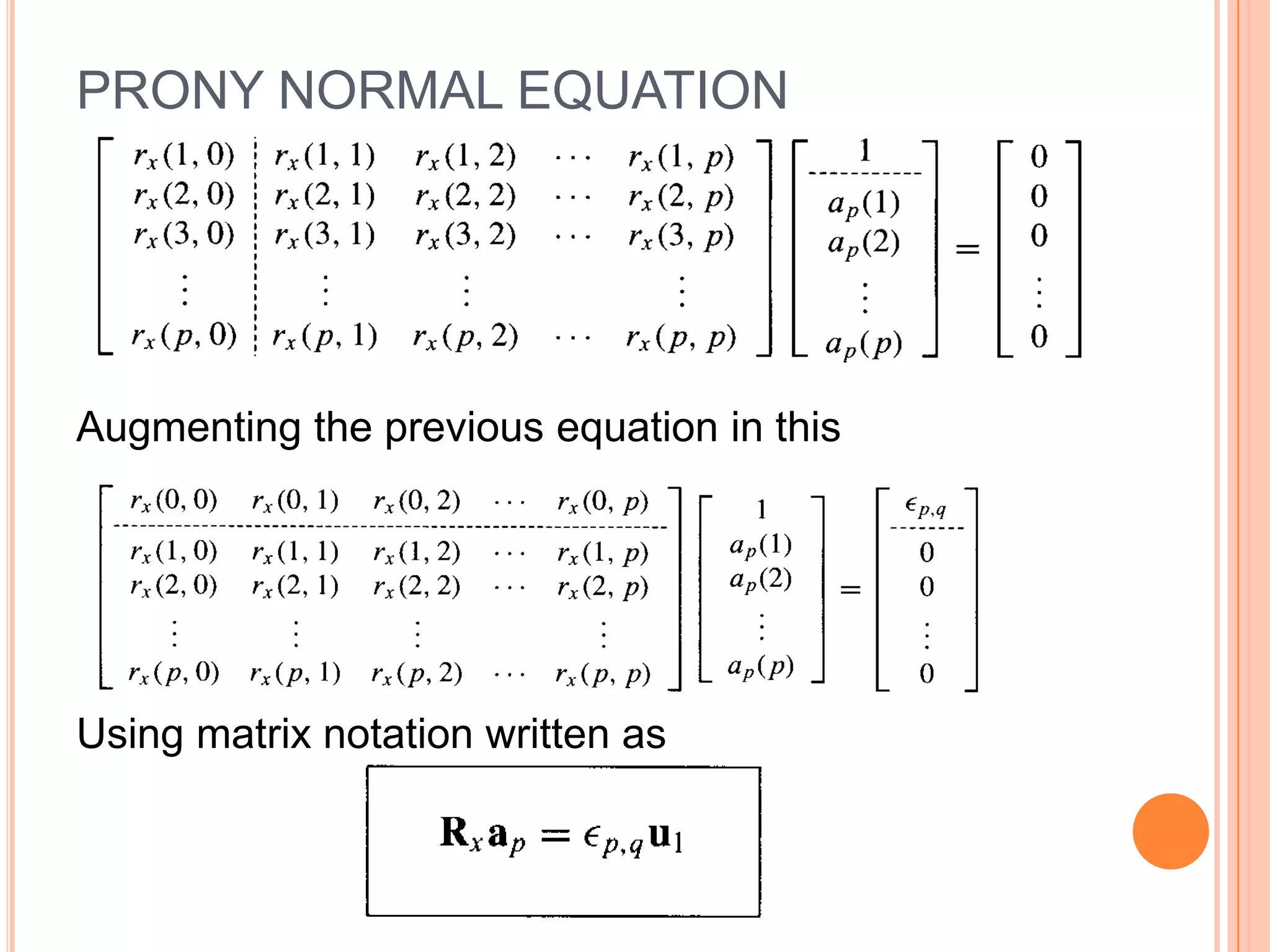
Prony’s normal equation:


In matrix form normal equation are


Consisely written as
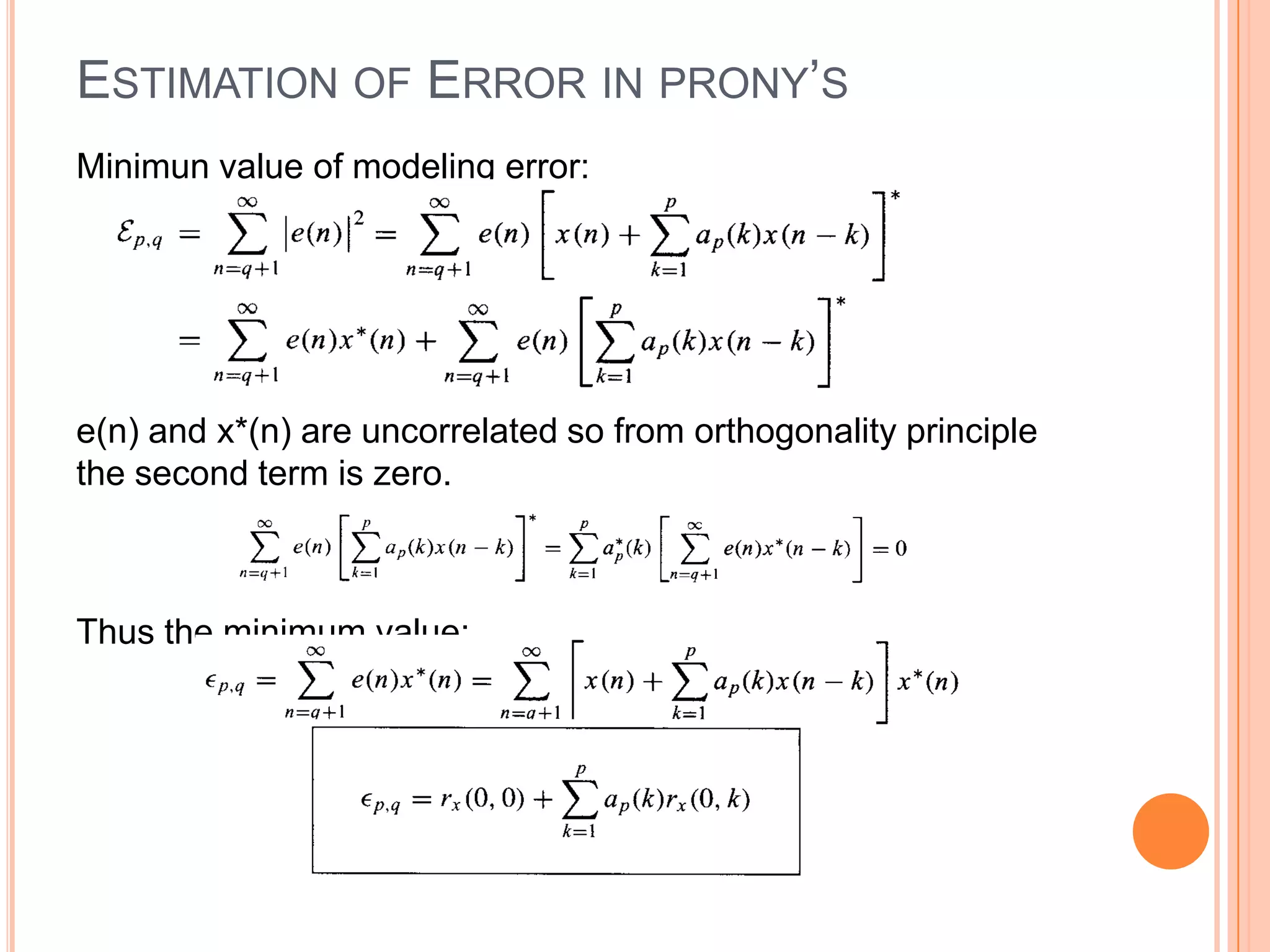
ESTIMATION OF ERROR IN PRONY’S
Minimun value of modeling error:


e(n) and x*(n) are uncorrelated so from orthogonality principle
the second term is zero.


Thus the minimum value:
PRONY NORMAL EQUATION


Augmenting the previous equation in this


Using matrix notation written as
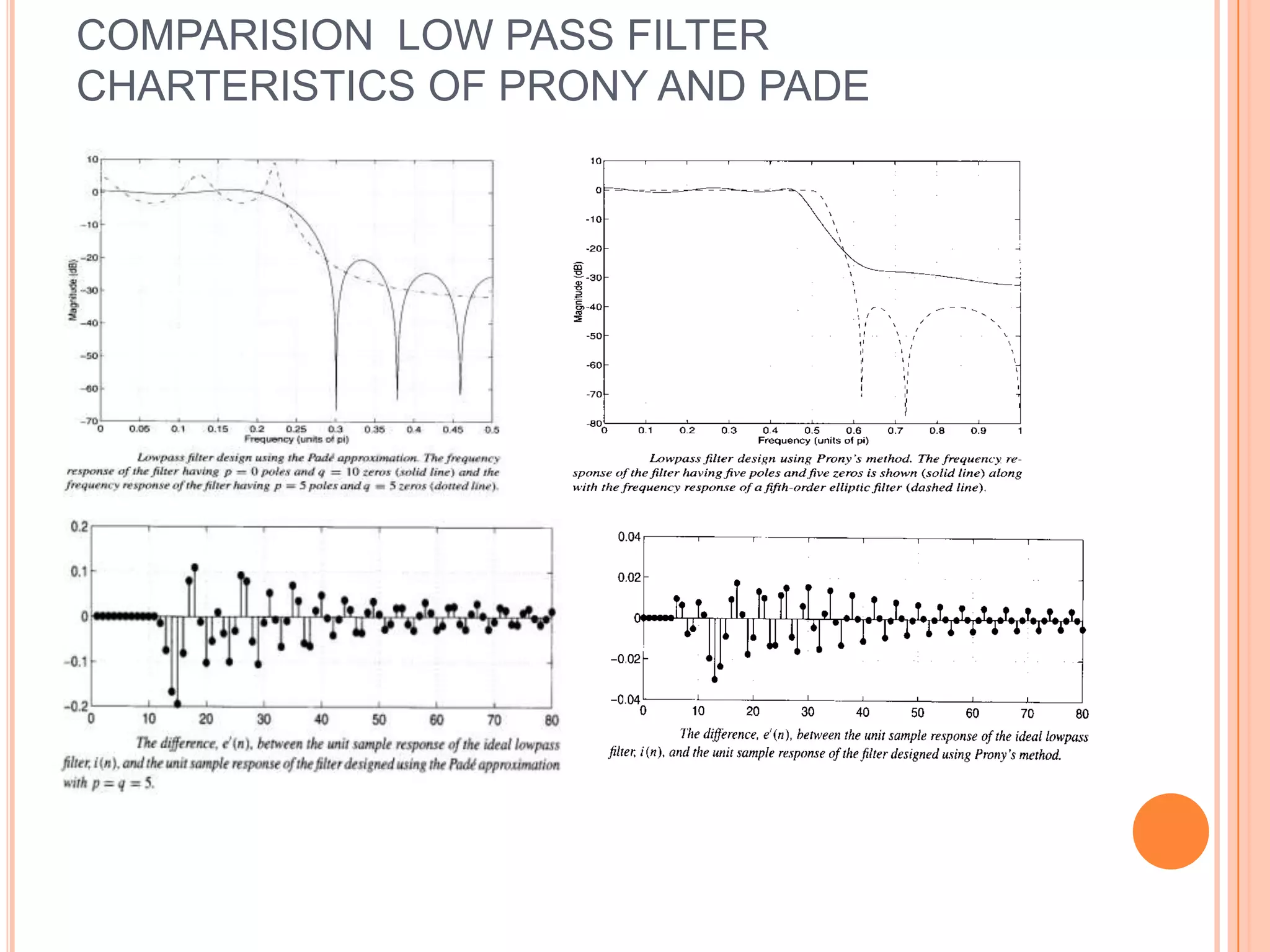
COMPARISION LOW PASS FILTER
CHARTERISTICS OF PRONY AND PADE
SHANKS APPROXIMATION
In Prony e(n)=0 for n=1, 2,….q.Although this allows the model to be exact
over [0,q],this does not take into account data for n>q.
Shanks performs mininization of model error over entire length of data record.
Filter can be viewed as cascade of two filter Ap(z) and Bq(z)


g(n) can be computed using the equation:
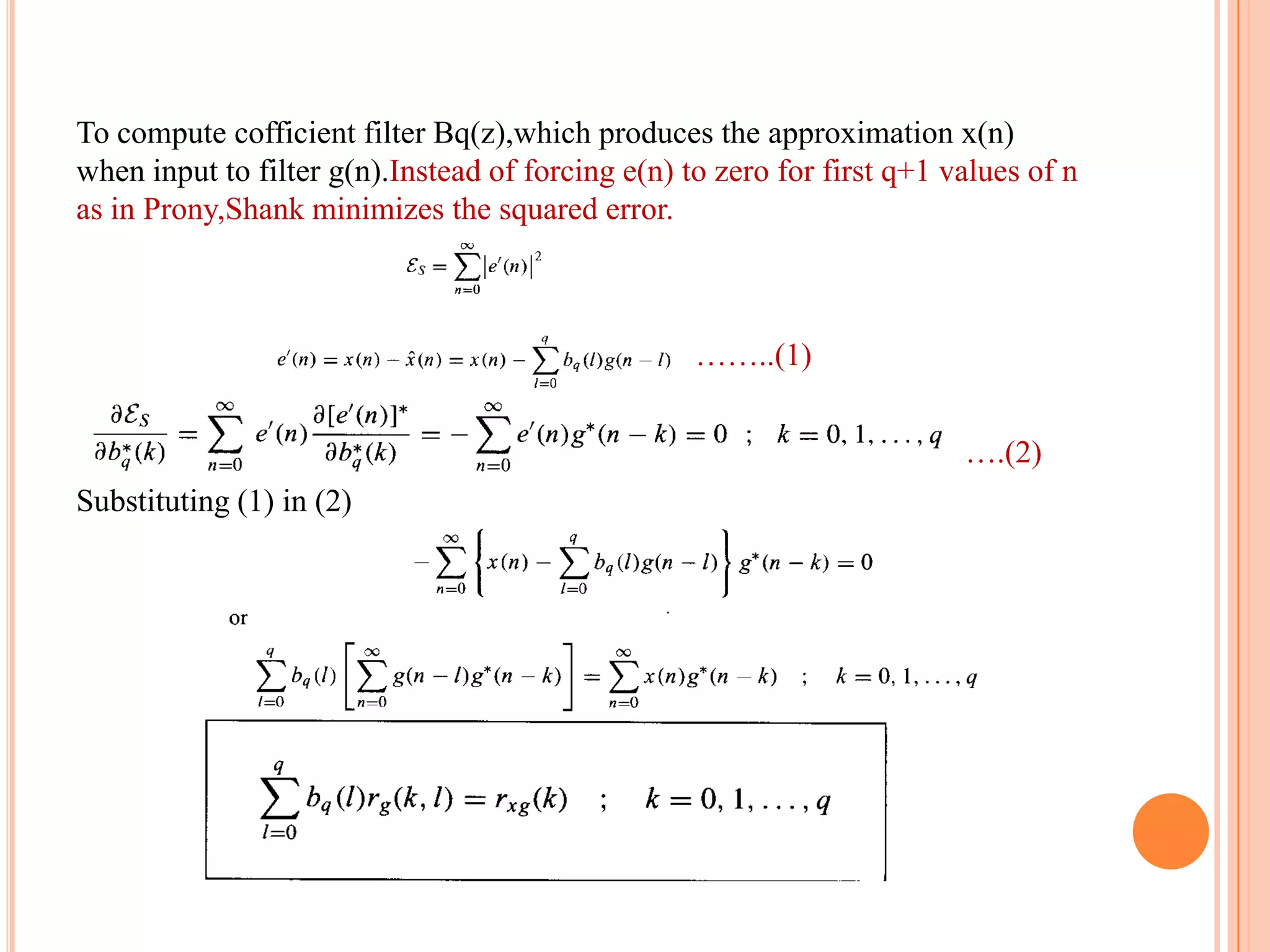
To compute cofficient filter Bq(z),which produces the approximation x(n)
when input to filter g(n).Instead of forcing e(n) to zero for first q+1 values of n
as in Prony,Shank minimizes the squared error.


                                                   ……..(1)


                                                                 ………….(2)
Substituting (1) in (2)
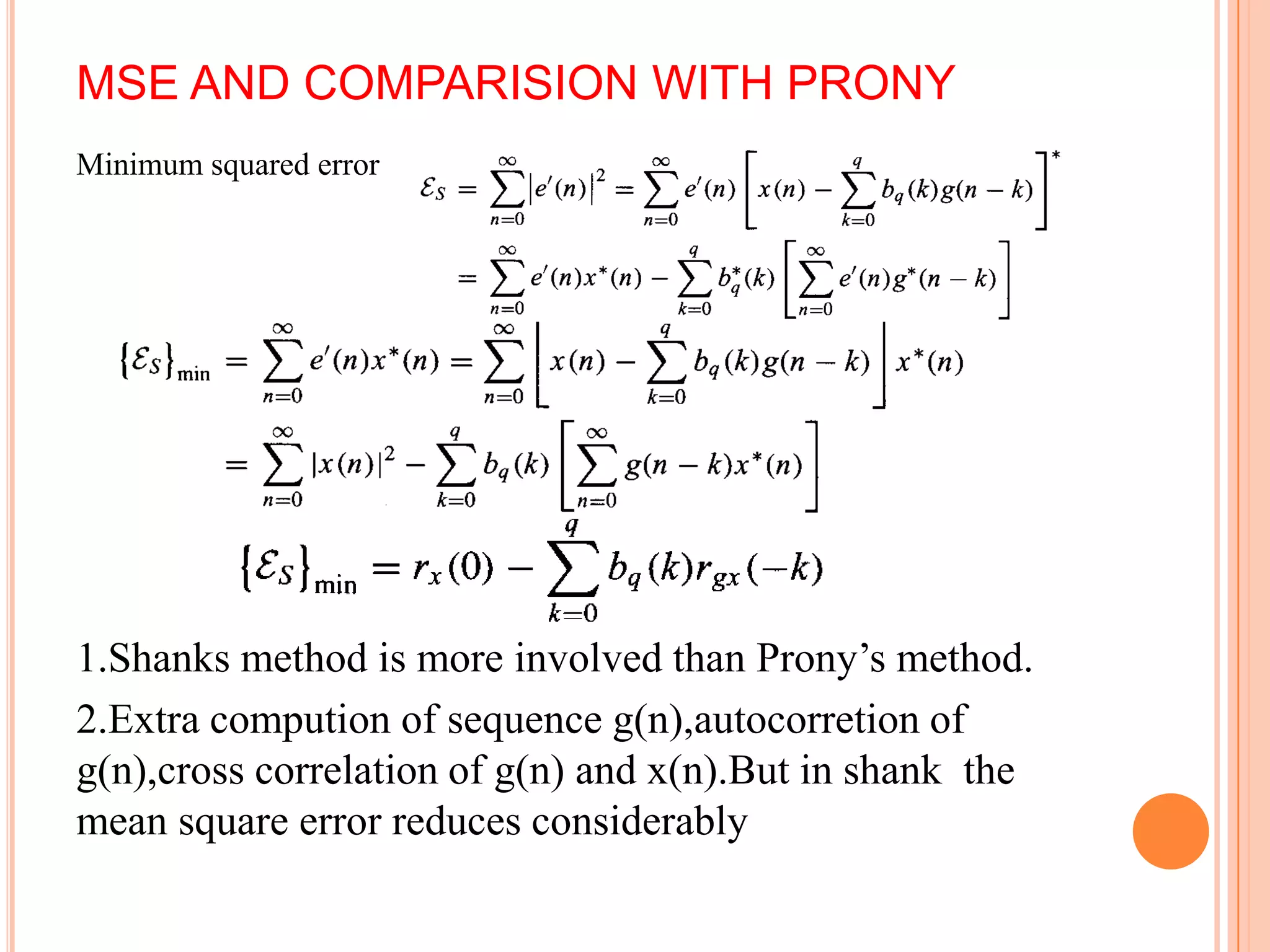
MSE AND COMPARISION WITH PRONY
Minimum squared error


1.Shanks method is more involved than Prony’s method.
2.Extra compution of sequence g(n),autocorretion of
g(n),cross correlation of g(n) and x(n).But in shank the
mean square error reduces considerably
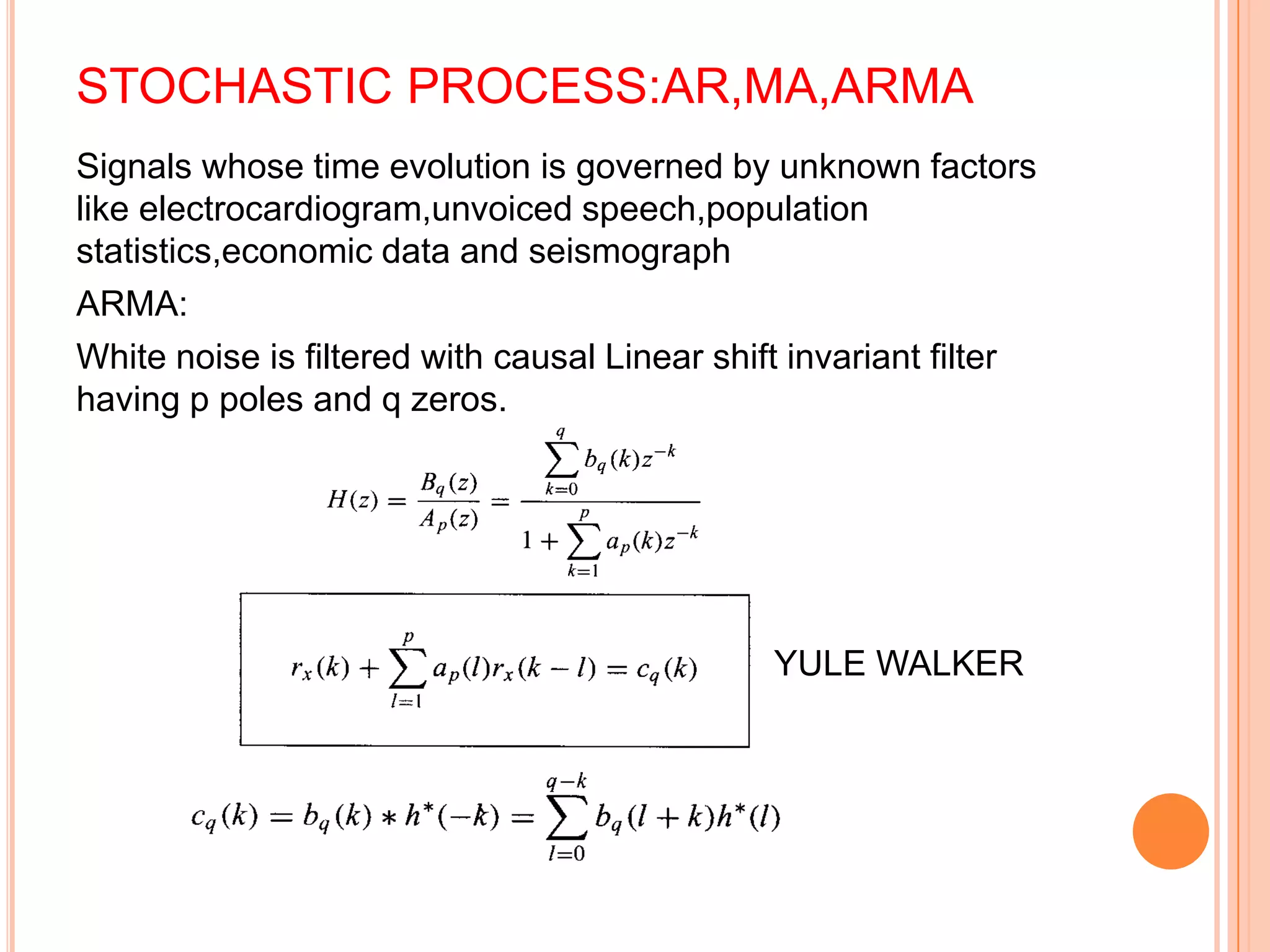
STOCHASTIC PROCESS:AR,MA,ARMA
Signals whose time evolution is governed by unknown factors
like electrocardiogram,unvoiced speech,population
statistics,economic data and seismograph
ARMA:
White noise is filtered with causal Linear shift invariant filter
having p poles and q zeros.


                                               YULE WALKER
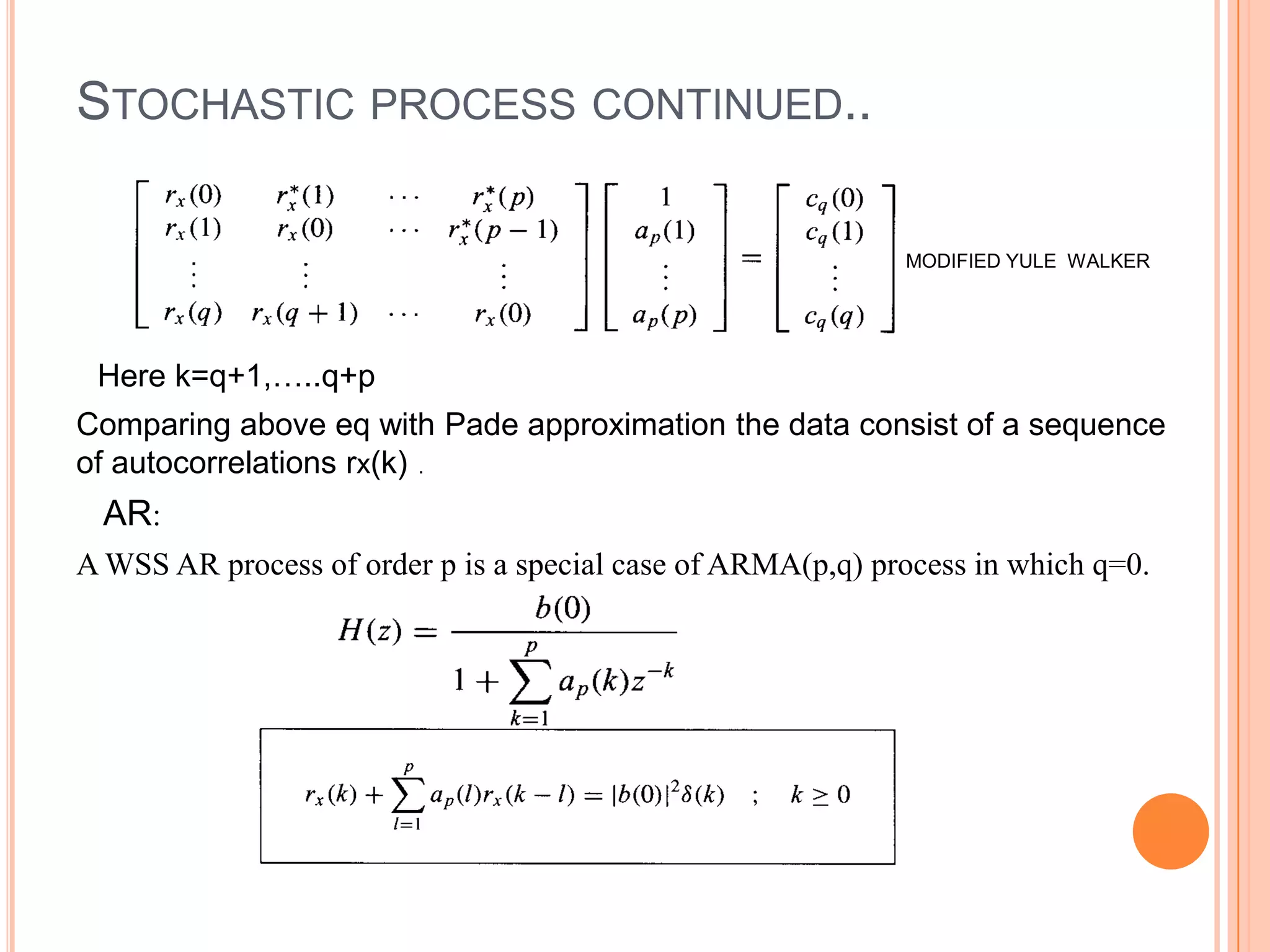
STOCHASTIC PROCESS CONTINUED..

                                                             MODIFIED YULE WALKER


 Here k=q+1,…..q+p
Comparing above eq with Pade approximation the data consist of a sequence
of autocorrelations rx(k) .
  AR:
A WSS AR process of order p is a special case of ARMA(p,q) process in which q=0.
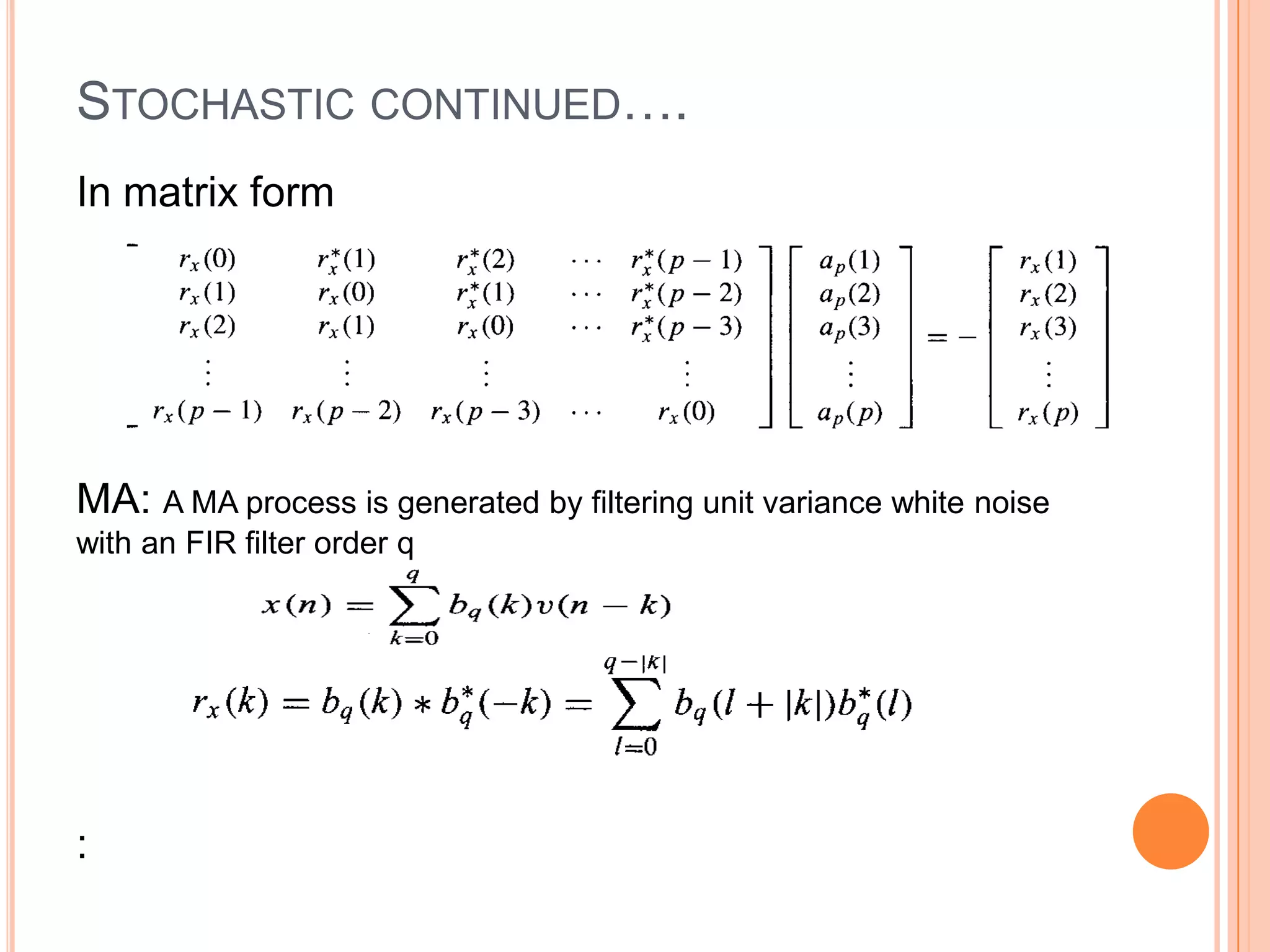
STOCHASTIC CONTINUED….
In matrix form


MA: A MA process is generated by filtering unit variance white noise
with an FIR filter order q


:
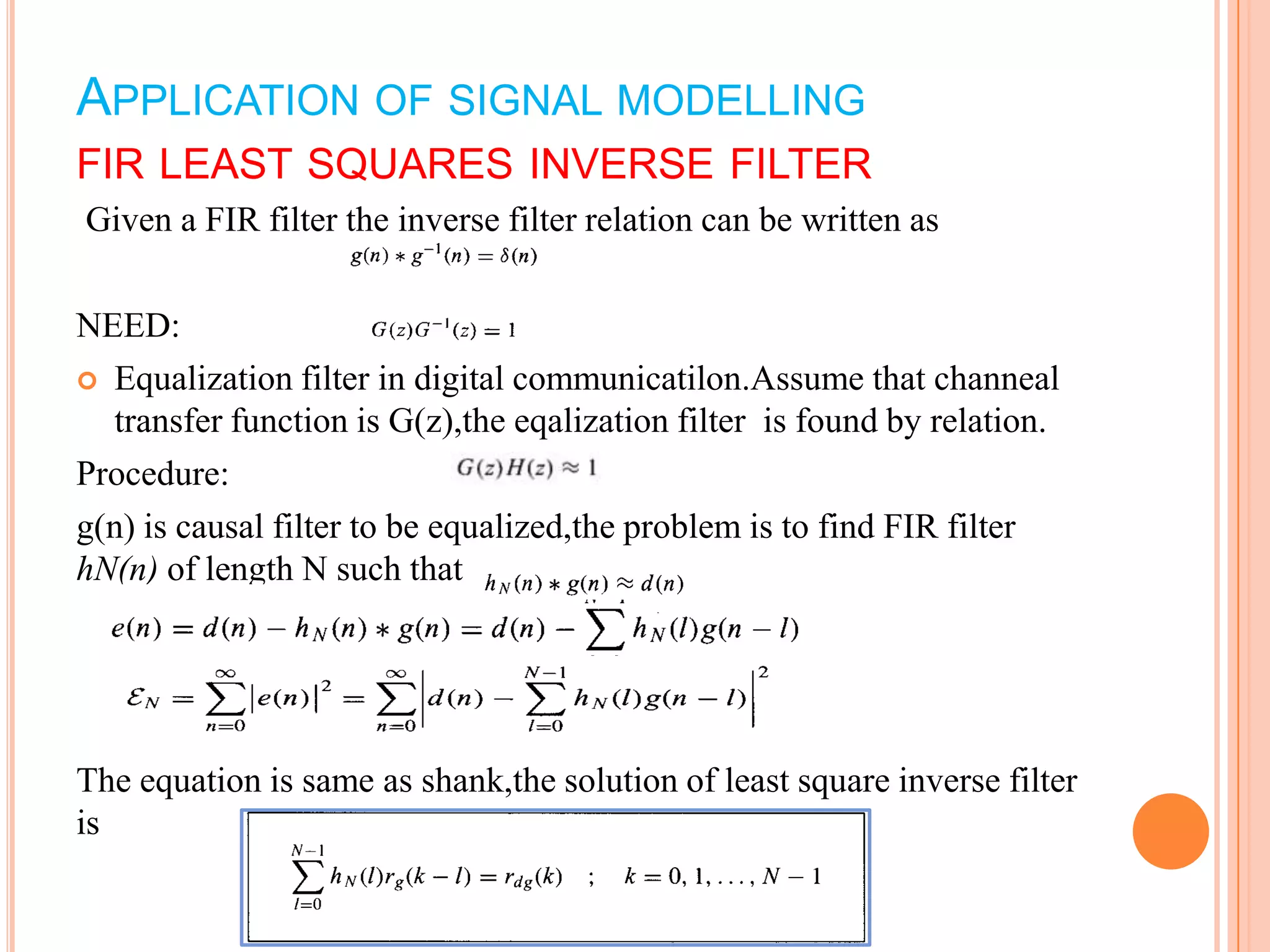
APPLICATION OF SIGNAL MODELLING
FIR LEAST SQUARES INVERSE FILTER
Given a FIR filter the inverse filter relation can be written as

NEED:
 Equalization filter in digital communicatilon.Assume that channeal
  transfer function is G(z),the eqalization filter is found by relation.
Procedure:
g(n) is causal filter to be equalized,the problem is to find FIR filter
hN(n) of length N such that


The equation is same as shank,the solution of least square inverse filter
is
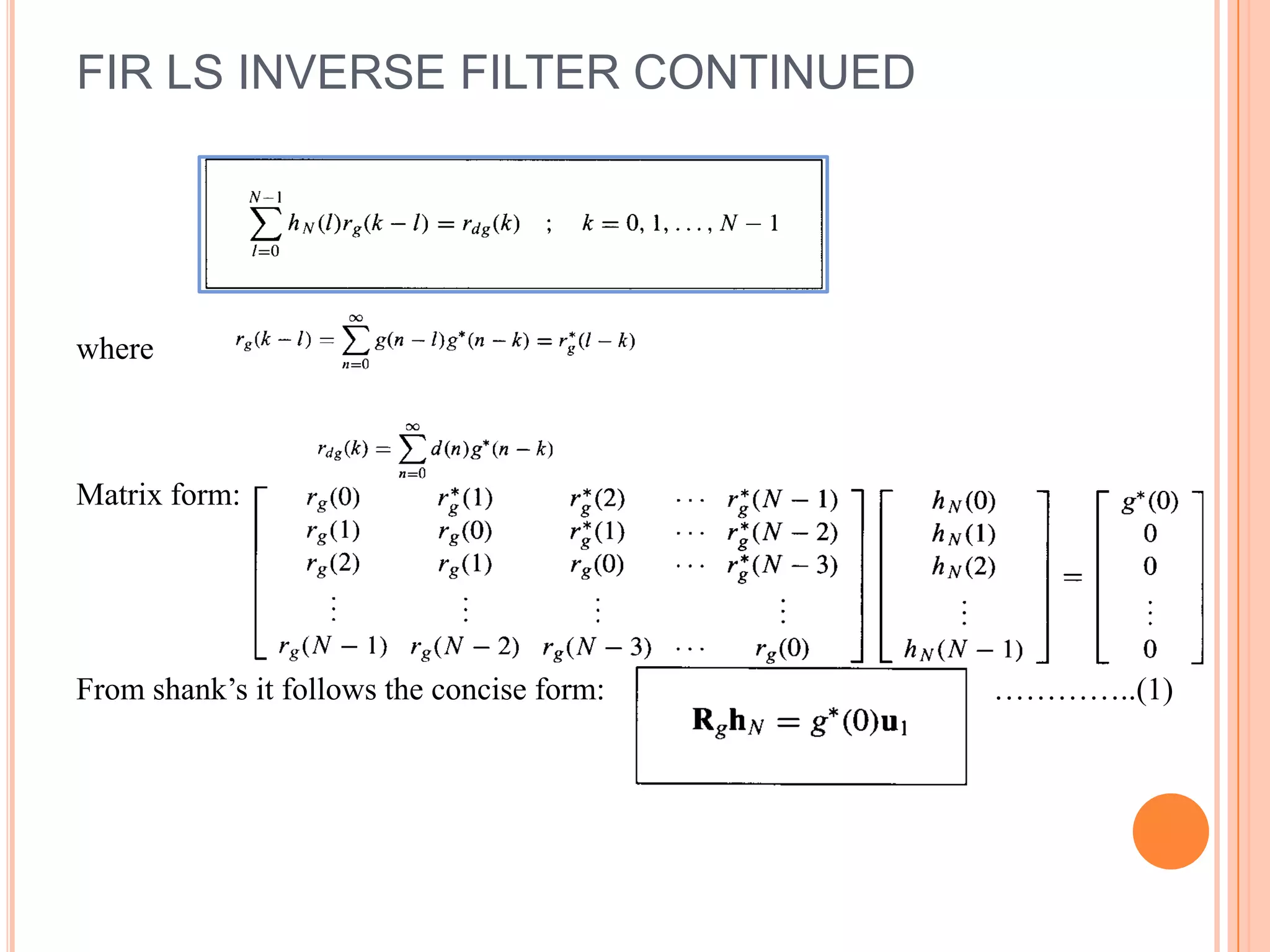
FIR LS INVERSE FILTER CONTINUED


where


Matrix form:


From shank’s it follows the concise form:   …………..(1)
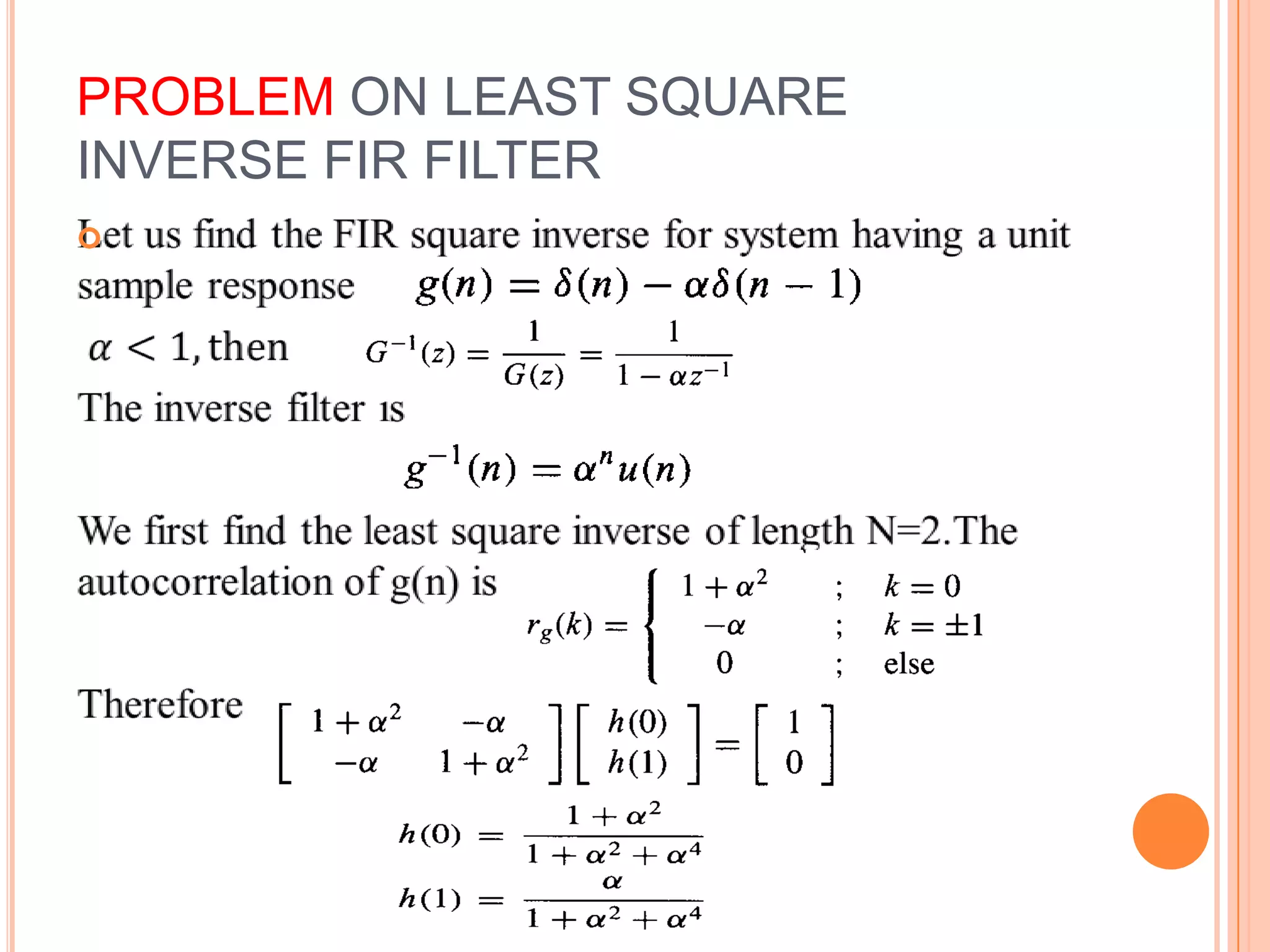
PROBLEM ON LEAST SQUARE
INVERSE FIR FILTER

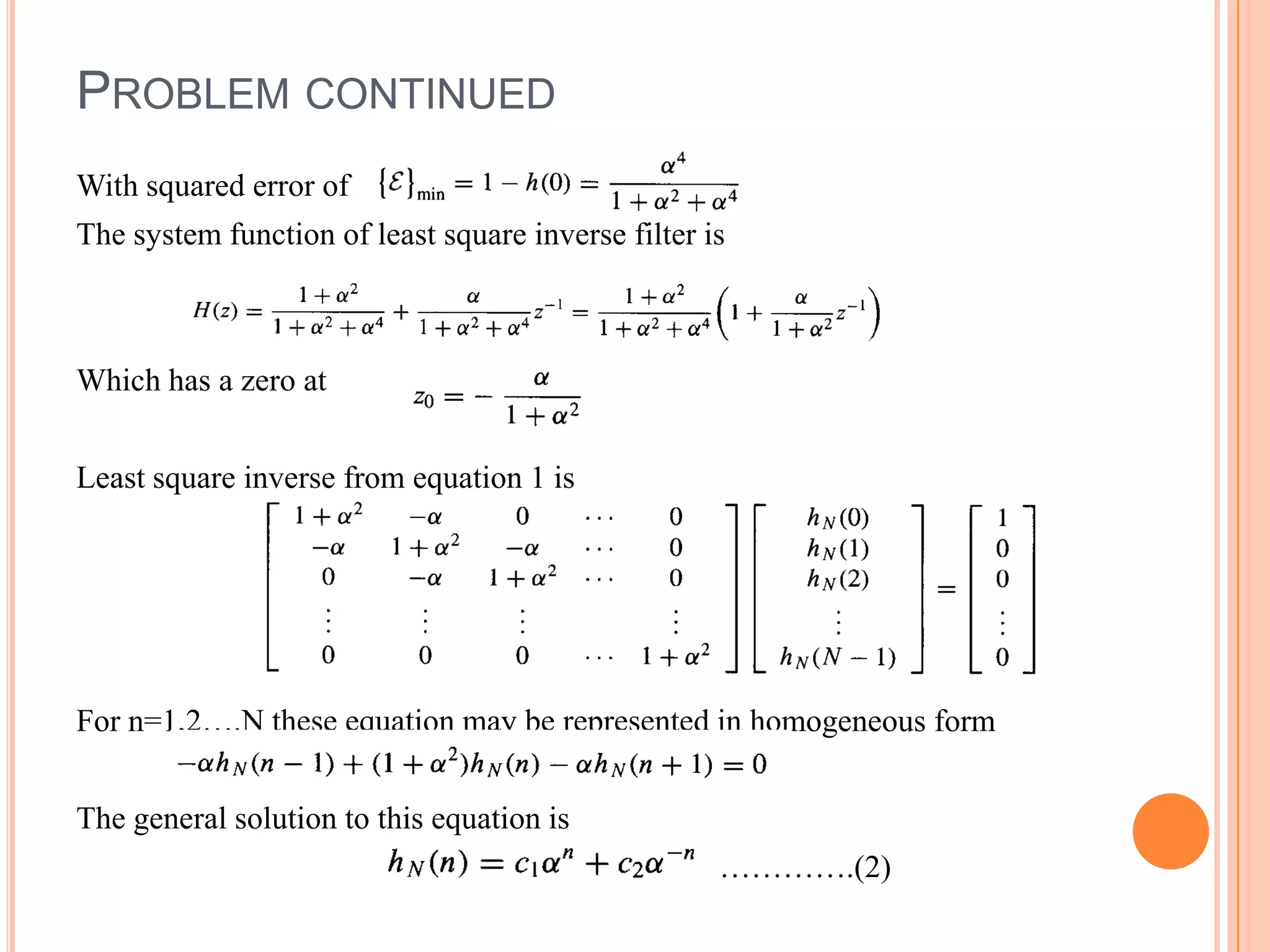
PROBLEM CONTINUED
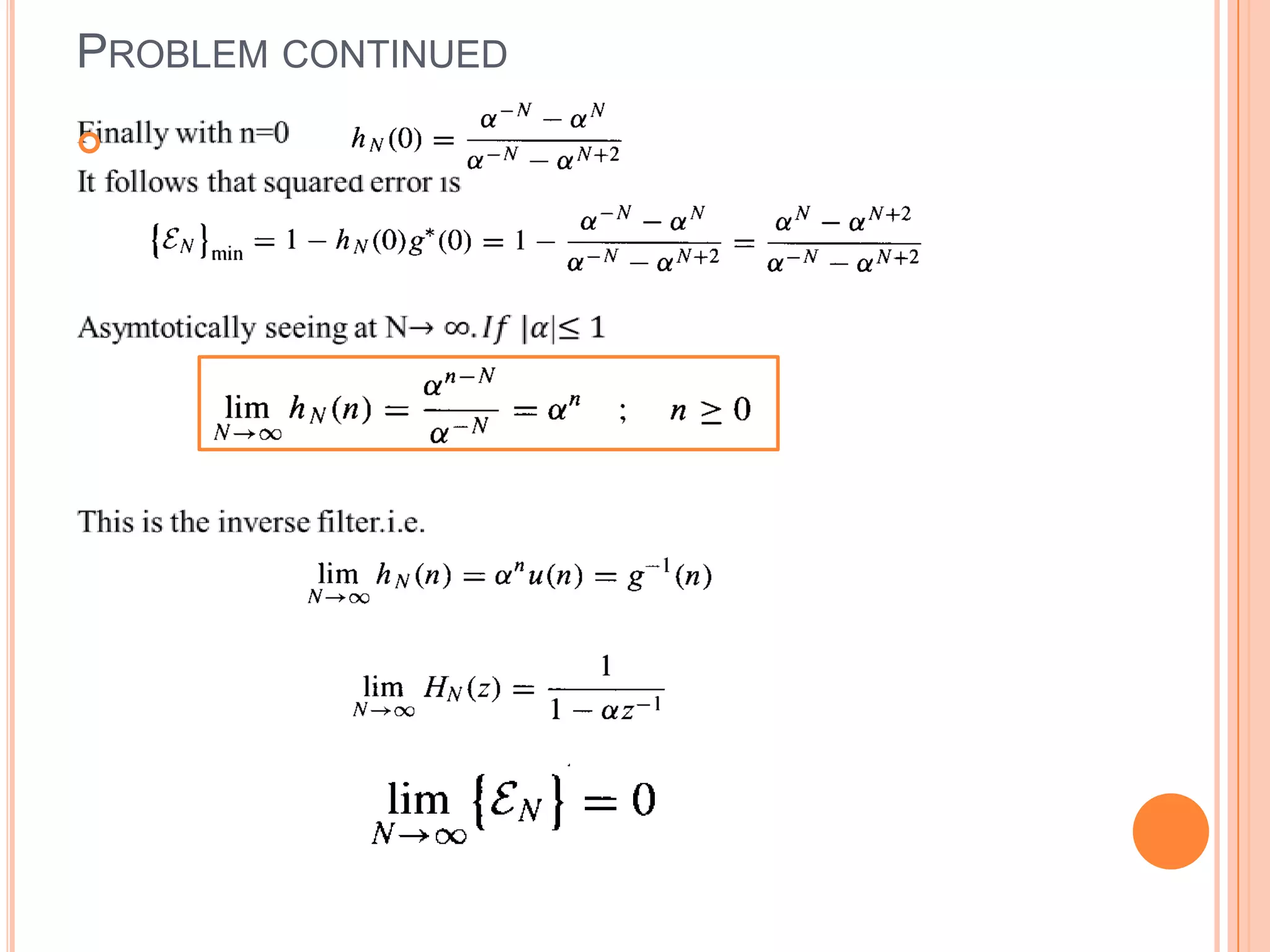
With squared error of
The system function of least square inverse filter is


Which has a zero at


Least square inverse from equation 1 is


For n=1,2….N these equation may be represented in homogeneous form


The general solution to this equation is
                                                    ………….(2)
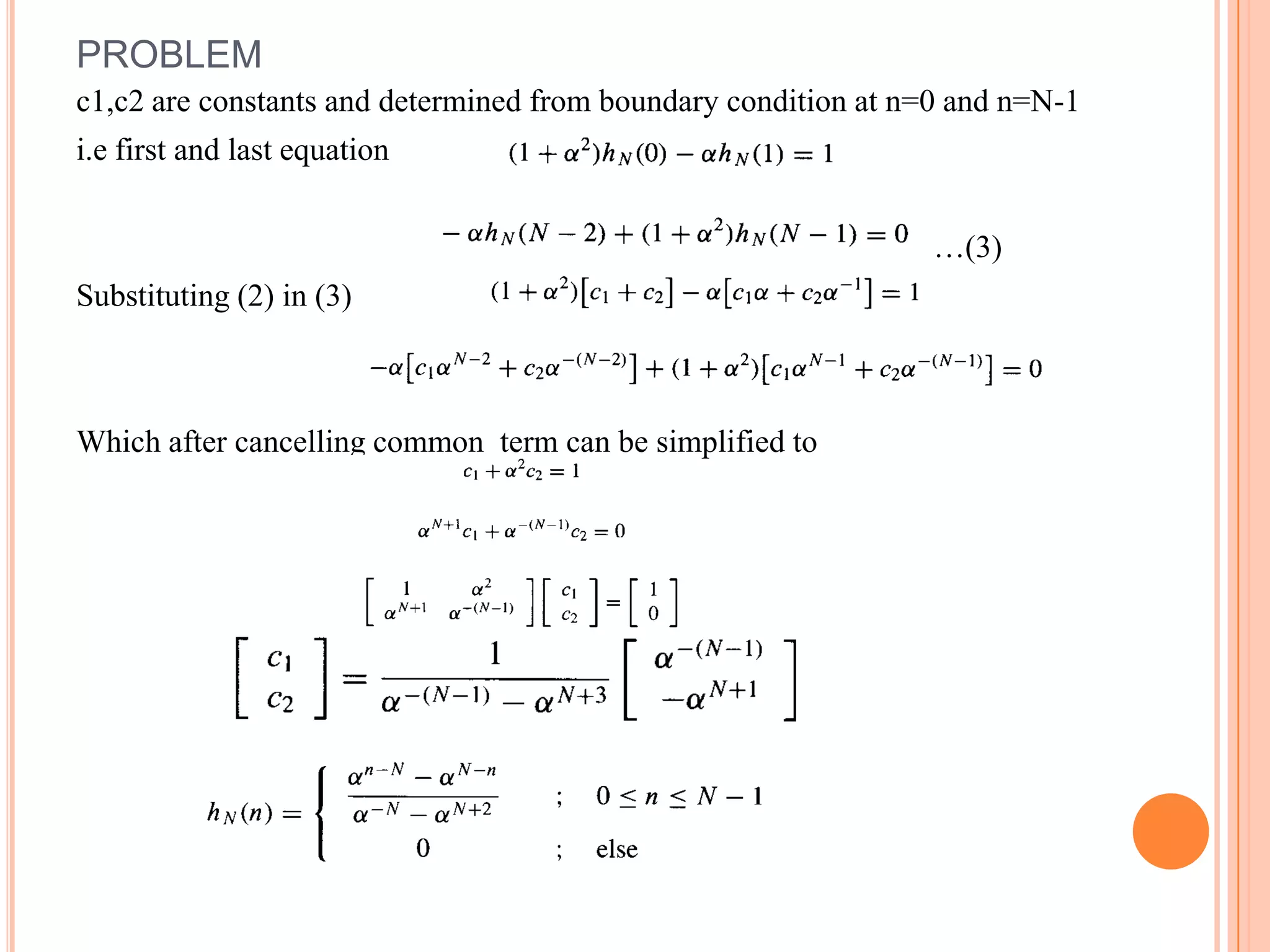
PROBLEM
c1,c2 are constants and determined from boundary condition at n=0 and n=N-1
i.e first and last equation


                                                                …(3)
Substituting (2) in (3)


Which after cancelling common term can be simplified to
PROBLEM CONTINUED

CONCLUSION
 The various methods of signal modelling for both
  deterministic and stochastic process are discussed.
 PROBLEM IN SIGNAL MODELING

MODEL ORDER ESTIMATION:
In the cases assumed so far we have assumed that a model of given
order to be found.In the absence of any information about the correct
model order ,it becomes necessary to estimate what an appropiate
model order should be.Misleading information may result in an
inappropiate model order.
REFERENCES

   STATISTICAL SIGNAL PROCESSING AND MODELING…
    MONSON H.HAYES
   Signal Modeling Techniques In Speech Recognition
    by,Joseph Picone
   Spectrum Estimation and Modeling by Petar M. Djuri´c State
    University of New York at Stony Brook Steven M. Kay
    University of Rhode Island
   SOME REMARKS ON PADÉ-APPROXIMATIONS M.Vajta
   Comparing Autoregressive Moving Average(ARMA)
    coefficients determination using Artificial Neural Networks with
    other techniques Abiodun M. Aibinu, Momoh J. E. Salami,
    Amir A. Shafie and Athaur Rahman Najeeb
THANKS FOR YOUR ATTENTION

Signal modelling

  • 1.
    SIGNAL MODELING BY DEBANGI GOSWAMI
  • 2.
    CONTENTS  Introduction 1.Title description 2.Need and importance of signal modeling  Theory 1.Least mean square direct method. 1.1. Brief Overview 1.2. Disadvantages 2.Pade Approximation 3.Prony’s Approximation 4.Shanks Method 5.Stochastic process-ARMA,MA,AR  Application Least Mean Square Inverse FIR filter  Conclusion  References
  • 3.
    WHAT IS MODELING: Modelling of signal is basically mathematical representation of signal.  Fourier series, Fourier transform are kind of signal models. WHY MODELLING NEED OF MODELING: 1.EFFICIENCY OF TRANSMISSION 2.PREDICTION
  • 4.
    SIGNAL MODELING INEFFICIENCY OF TRANSMISSION 
  • 5.
  • 6.
    STEPS IN MODELLING PARAMETRIC FORM OF MODEL MODEL PARAMETER THAT BEST APPROXIMATE THE GIVEN SIGNAL
  • 7.
  • 8.
    TYPES OF SIGNALTO BE MODELLED DETERMINISTIC SIGNALS INPUT WILL BE STOCHASTIC RANDOM PROCESS,WHITE NOISE
  • 9.
    MODEL PARAMETER Models must be computationally efficient procedure for deriving the model parameters. Various approaches to signal modeling  THE LEAST SQUARE DIRECT METHOD  THE PADE APPROXIMATION  PRONY’S METHOD 1. Pole-Zero modeling 2. Shanks method 3. All-Pole Modeling DETERMINISTIC 4. Linear Prediction  ITERATIVE PREFILTERING  FINITE DATA RECORDS 1.The Autocorrelation Method 2.The Covariance Method  THE STOCHASTIC MODELS-ARMA,AR,MA RANDOM
  • 10.
  • 11.
    LEAST SQUARE (CONTINUED) Using Parseval writing in frequency domain Setting the partial derivative w.r.t ap*(k) equal to zero we have Treating ap(k) and ap*(k) as independent variable For k=1,2…..q,differentiating w.r.t bq(k)
  • 12.
  • 13.
    PADE APPROXIMATION  Pade approximation only requires solving a set linear equation.  In Pade we force the filter output h(n) to be equal to given signal x(n) for p+q+1 values of n. In time domain, Where h(n)=0 for n<0 and n>q.To find the cofficients ap(k) and bq(k) that gives an exact fit of data model in [0,p+q] we set h(n)=x(n)
  • 14.
    In matrix form, Forsoving the equation we use two step approach first solving for denominator ap(k) and then bq(k).ap(k) last p equations
  • 15.
    CONCLUSIONS ON PADEAPPROXIMATION  The model formed from Pade approximation will produce an exact fit to data over the interval[0,p+q].But has no guarantee on how accurate the model will be for n>p+q.  Pade approximation will give correct model parameters provided the model order is chosen to be large enough.  Since the Pade approximation forces the model to match the signal only over limited range of values,the model generated is not stable
  • 16.
    PRONY’S METHOD Thelimitation of Pade approximation-Only uses values of the signal x(n) over the interval [0,p+q] to determine model parameter and over this interval, it models the signal without error. There is no guarantee on how well the model will approximate the signal for n>p+q POLE ZERO MODELLING: Similar to pade x(n)=0 for n<0.A least square minimization of e’(n) results in set of non-linear equation for filter cofficient Multiplying by Ap(z) we have new error That is linear cofficients.In time domain:
  • 17.
    Since bq(n)=0 forn>q,error can be explicitly written as Instead of setting e(n)=0 for n=0,1,…….p+q as in Pade approximation,Prony’s method begins by finding the cofficient ap(k) that minimizes squared error.
  • 18.
    Equivalently, Prony’s normal equation: Inmatrix form normal equation are Consisely written as
  • 19.
    ESTIMATION OF ERRORIN PRONY’S Minimun value of modeling error: e(n) and x*(n) are uncorrelated so from orthogonality principle the second term is zero. Thus the minimum value:
  • 20.
    PRONY NORMAL EQUATION Augmentingthe previous equation in this Using matrix notation written as
  • 21.
    COMPARISION LOW PASSFILTER CHARTERISTICS OF PRONY AND PADE
  • 22.
    SHANKS APPROXIMATION In Pronye(n)=0 for n=1, 2,….q.Although this allows the model to be exact over [0,q],this does not take into account data for n>q. Shanks performs mininization of model error over entire length of data record. Filter can be viewed as cascade of two filter Ap(z) and Bq(z) g(n) can be computed using the equation:
  • 23.
    To compute cofficientfilter Bq(z),which produces the approximation x(n) when input to filter g(n).Instead of forcing e(n) to zero for first q+1 values of n as in Prony,Shank minimizes the squared error. ……..(1) ………….(2) Substituting (1) in (2)
  • 24.
    MSE AND COMPARISIONWITH PRONY Minimum squared error 1.Shanks method is more involved than Prony’s method. 2.Extra compution of sequence g(n),autocorretion of g(n),cross correlation of g(n) and x(n).But in shank the mean square error reduces considerably
  • 25.
    STOCHASTIC PROCESS:AR,MA,ARMA Signals whosetime evolution is governed by unknown factors like electrocardiogram,unvoiced speech,population statistics,economic data and seismograph ARMA: White noise is filtered with causal Linear shift invariant filter having p poles and q zeros. YULE WALKER
  • 26.
    STOCHASTIC PROCESS CONTINUED.. MODIFIED YULE WALKER Here k=q+1,…..q+p Comparing above eq with Pade approximation the data consist of a sequence of autocorrelations rx(k) . AR: A WSS AR process of order p is a special case of ARMA(p,q) process in which q=0.
  • 27.
    STOCHASTIC CONTINUED…. In matrixform MA: A MA process is generated by filtering unit variance white noise with an FIR filter order q :
  • 28.
    APPLICATION OF SIGNALMODELLING FIR LEAST SQUARES INVERSE FILTER Given a FIR filter the inverse filter relation can be written as NEED:  Equalization filter in digital communicatilon.Assume that channeal transfer function is G(z),the eqalization filter is found by relation. Procedure: g(n) is causal filter to be equalized,the problem is to find FIR filter hN(n) of length N such that The equation is same as shank,the solution of least square inverse filter is
  • 29.
    FIR LS INVERSEFILTER CONTINUED where Matrix form: From shank’s it follows the concise form: …………..(1)
  • 30.
    PROBLEM ON LEASTSQUARE INVERSE FIR FILTER 
  • 31.
    PROBLEM CONTINUED With squarederror of The system function of least square inverse filter is Which has a zero at Least square inverse from equation 1 is For n=1,2….N these equation may be represented in homogeneous form The general solution to this equation is ………….(2)
  • 32.
    PROBLEM c1,c2 are constantsand determined from boundary condition at n=0 and n=N-1 i.e first and last equation …(3) Substituting (2) in (3) Which after cancelling common term can be simplified to
  • 33.
  • 34.
    CONCLUSION  The variousmethods of signal modelling for both deterministic and stochastic process are discussed.  PROBLEM IN SIGNAL MODELING MODEL ORDER ESTIMATION: In the cases assumed so far we have assumed that a model of given order to be found.In the absence of any information about the correct model order ,it becomes necessary to estimate what an appropiate model order should be.Misleading information may result in an inappropiate model order.
  • 35.
    REFERENCES  STATISTICAL SIGNAL PROCESSING AND MODELING… MONSON H.HAYES  Signal Modeling Techniques In Speech Recognition by,Joseph Picone  Spectrum Estimation and Modeling by Petar M. Djuri´c State University of New York at Stony Brook Steven M. Kay University of Rhode Island  SOME REMARKS ON PADÉ-APPROXIMATIONS M.Vajta  Comparing Autoregressive Moving Average(ARMA) coefficients determination using Artificial Neural Networks with other techniques Abiodun M. Aibinu, Momoh J. E. Salami, Amir A. Shafie and Athaur Rahman Najeeb
  • 36.
    THANKS FOR YOURATTENTION