SOMATOFORM
DISORDERS
PREPARED BY
MRS. DIVYA PANCHOLI
ASSISTANT PROFESSOR, SSRCN, VAPI
MRS. DIVYA PANCHOLI
1
DEFINITION
•These disorders are characterized by repeated
presentation with physical symptoms which
do not have any physical basis, and a
persistent request for investigations and
treatment despite repeated assurance by the
treating doctors.
MRS. DIVYA PANCHOLI
2
ETIOLOGY FOR
SOMATIC DISORDERS
•1. Physiological
•a. Genetic. anxiety disorder in first-degree relatives,
implying a possible inheritable predisposition
• b. Biochemical. Decreased levels of serotonin and
endorphins may play a role in the etiology of somatic
symptom disorder,
MRS. DIVYA PANCHOLI
3
2. PSYCHOSOCIAL
• a. Psychodynamic Theory.
• low self-esteem and feelings of worthlessness and that the individual believes
it is easier to feel something is wrong with the body than to feel something is
wrong with the self.
• The individual views the self as “bad,” based on real or imagined past
misconduct, and views physical suffering as the deserved punishment.
• The psychodynamic theory of conversion disorder proposes that emotions
associated with a traumatic event that the individual cannot express because of
moral or ethical unacceptability are “converted” into physical symptoms.MRS. DIVYA PANCHOLI
4
CONTI…
• The unacceptable emotions are repressed and converted to a
somatic hysterical symptom that is symbolic in some way of the
original emotional trauma.
• Frequent childhood hospitalizations provided a reprieve from the
traumatic home situation and a loving and caring environment
that was absent in the child’s family.
• MRS. DIVYA PANCHOLI
5
B . FAMILY DYNAMICS.
• Some families have difficulty expressing emotions openly and resolving conflicts
verbally.
• When this occurs, the child may become ill, and a shift in focus is made from the
open conflict to the child’s illness, leaving unresolved the underlying issues that
the family cannot confront openly.
• Thus, somatization by the child brings some stability to the family, as harmony
replaces discord and the child’s welfare becomes the common concern.
• The child in turn receives positive reinforcement for the illness. This shift in
focus from family discord to concern for the child is sometimes called tertiary
gain.MRS. DIVYA PANCHOLI
6
C. LEARNING THEORY.
• Somatic complaints are often reinforced when the sick role relieves the
individual from the need to deal with a stressful situation, whether it be within
society or within the family.
• The sick person learns that he or she may avoid stressful obligations, may
postpone unwelcome challenges, and is excused from troublesome duties
(primary gain);
• becomes the prominent focus of attention because of the illness (secondary
gain); or relieves conflict within the family as concern is shifted to the ill person
and away from the real issue (tertiary gain).
• These types of positive reinforcements virtually guarantee repetition of the
response.
MRS. DIVYA PANCHOLI
7
D. PAST EXPERIENCE WITH
PHYSICAL ILLNESS.
•Past experience with serious or life-threatening physical
illness, either personal or that of close family members, can
predispose an individual to illness anxiety disorder.
•Once an individual has experienced a threat to biological
integrity, he or she may develop a fear of recurrence. The
fear of recurring illness generates an exaggerated response
to minor physical changes, leading to excessive anxiety and
health concerns.
MRS. DIVYA PANCHOLI
8
MRS. DIVYA PANCHOLI
9
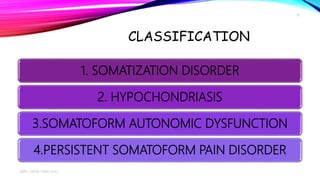
CLASSIFICATION
1. SOMATIZATION DISORDER
2. HYPOCHONDRIASIS
3.SOMATOFORM AUTONOMIC DYSFUNCTION
4.PERSISTENT SOMATOFORM PAIN DISORDER
MRS. DIVYA PANCHOLI
10
1. SOMATIZATION DISORDER
•Somatization disorder is characterized by
chronic multiple somatic symptoms in the
absence of physical disorder.
•The symptoms are vague, presented in a
dramatic manner and involve multiple organ
systems.
MRS. DIVYA PANCHOLI
11
SYMPTOMS OF
SOMATIZATION DISORDER
• Multiple somatic complaints, unexplained by medical findings
• Complaints of pain in at least four different locations- 2 Gastrointestinal,
1 sexual or reproductive and 1 neurologic symptom
• Moderate to severe anxiety
• Inability to voluntarily control the symptoms
• Dependency with demanding, attention getting behaviours
• Secondary gain
• Significant distress or impairment in social or occupational areas
MRS. DIVYA PANCHOLI
12
MRS. DIVYA PANCHOLI
13
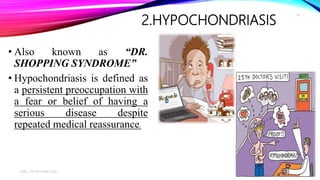
2.HYPOCHONDRIASIS
• Also known as “DR.
SHOPPING SYNDROME”
• Hypochondriasis is defined as
a persistent preoccupation with
a fear or belief of having a
serious disease despite
repeated medical reassurance.
MRS. DIVYA PANCHOLI
14
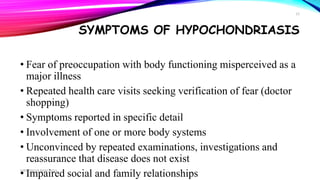
SYMPTOMS OF HYPOCHONDRIASIS
• Fear of preoccupation with body functioning misperceived as a
major illness
• Repeated health care visits seeking verification of fear (doctor
shopping)
• Symptoms reported in specific detail
• Involvement of one or more body systems
• Unconvinced by repeated examinations, investigations and
reassurance that disease does not exist
• Impaired social and family relationshipsMRS. DIVYA PANCHOLI
15
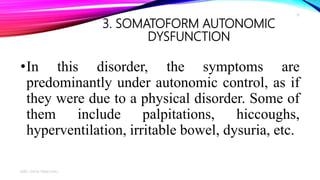
3. SOMATOFORM AUTONOMIC
DYSFUNCTION
•In this disorder, the symptoms are
predominantly under autonomic control, as if
they were due to a physical disorder. Some of
them include palpitations, hiccoughs,
hyperventilation, irritable bowel, dysuria, etc.
MRS. DIVYA PANCHOLI
16
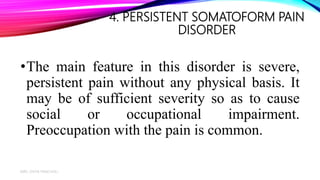
4. PERSISTENT SOMATOFORM PAIN
DISORDER
•The main feature in this disorder is severe,
persistent pain without any physical basis. It
may be of sufficient severity so as to cause
social or occupational impairment.
Preoccupation with the pain is common.
MRS. DIVYA PANCHOLI
17
TREATMENT
•DRUG THERAPY
• Antidepressants
• Benzodiazepines
•PSYCHOLOGICAL
TREATMENT.
• Supportive psychotherapy
• Relaxation therapy
MRS. DIVYA PANCHOLI
18
NURSING INTERVENTIONS
• Before a somatoform determination, a physical examination
and diagnostic testing are necessary to rule out any underlying
pathology
• Create an accepting safe and supportive atmosphere that allows
open communication with the patient
• Should focus on the whole person, including psychological,
social and family factors in addition to the physical symptoms
• It must be remembered that they are not consciously trying to
be sick or avoid responsibilities
MRS. DIVYA PANCHOLI
19
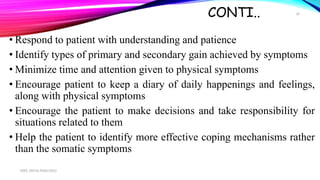
CONTI..
• Respond to patient with understanding and patience
• Identify types of primary and secondary gain achieved by symptoms
• Minimize time and attention given to physical symptoms
• Encourage patient to keep a diary of daily happenings and feelings,
along with physical symptoms
• Encourage the patient to make decisions and take responsibility for
situations related to them
• Help the patient to identify more effective coping mechanisms rather
than the somatic symptoms
MRS. DIVYA PANCHOLI
20
MRS. DIVYA PANCHOLI
21
YOU CAN REFER FOLLOWING LINK ALSO
• https://www.youtube.com/watch?v=oVO7tZS2ZdI
• https://www.youtube.com/watch?v=ViZskHsUdBU
• https://www.youtube.com/watch?v=8G5WFKUzvA8
• https://www.youtube.com/watch?v=gaAdSGVgd3Y
• https://www.youtube.com/watch?v=719a0kAzeo4&t=5s
MRS. DIVYA PANCHOLI
22
MRS. DIVYA PANCHOLI
23

SOMATOFORM DISORDERS

  • 1.
    SOMATOFORM DISORDERS PREPARED BY MRS. DIVYAPANCHOLI ASSISTANT PROFESSOR, SSRCN, VAPI MRS. DIVYA PANCHOLI 1
  • 2.
    DEFINITION •These disorders arecharacterized by repeated presentation with physical symptoms which do not have any physical basis, and a persistent request for investigations and treatment despite repeated assurance by the treating doctors. MRS. DIVYA PANCHOLI 2
  • 3.
    ETIOLOGY FOR SOMATIC DISORDERS •1.Physiological •a. Genetic. anxiety disorder in first-degree relatives, implying a possible inheritable predisposition • b. Biochemical. Decreased levels of serotonin and endorphins may play a role in the etiology of somatic symptom disorder, MRS. DIVYA PANCHOLI 3
  • 4.
    2. PSYCHOSOCIAL • a.Psychodynamic Theory. • low self-esteem and feelings of worthlessness and that the individual believes it is easier to feel something is wrong with the body than to feel something is wrong with the self. • The individual views the self as “bad,” based on real or imagined past misconduct, and views physical suffering as the deserved punishment. • The psychodynamic theory of conversion disorder proposes that emotions associated with a traumatic event that the individual cannot express because of moral or ethical unacceptability are “converted” into physical symptoms.MRS. DIVYA PANCHOLI 4
  • 5.
    CONTI… • The unacceptableemotions are repressed and converted to a somatic hysterical symptom that is symbolic in some way of the original emotional trauma. • Frequent childhood hospitalizations provided a reprieve from the traumatic home situation and a loving and caring environment that was absent in the child’s family. • MRS. DIVYA PANCHOLI 5
  • 6.
    B . FAMILYDYNAMICS. • Some families have difficulty expressing emotions openly and resolving conflicts verbally. • When this occurs, the child may become ill, and a shift in focus is made from the open conflict to the child’s illness, leaving unresolved the underlying issues that the family cannot confront openly. • Thus, somatization by the child brings some stability to the family, as harmony replaces discord and the child’s welfare becomes the common concern. • The child in turn receives positive reinforcement for the illness. This shift in focus from family discord to concern for the child is sometimes called tertiary gain.MRS. DIVYA PANCHOLI 6
  • 7.
    C. LEARNING THEORY. •Somatic complaints are often reinforced when the sick role relieves the individual from the need to deal with a stressful situation, whether it be within society or within the family. • The sick person learns that he or she may avoid stressful obligations, may postpone unwelcome challenges, and is excused from troublesome duties (primary gain); • becomes the prominent focus of attention because of the illness (secondary gain); or relieves conflict within the family as concern is shifted to the ill person and away from the real issue (tertiary gain). • These types of positive reinforcements virtually guarantee repetition of the response. MRS. DIVYA PANCHOLI 7
  • 8.
    D. PAST EXPERIENCEWITH PHYSICAL ILLNESS. •Past experience with serious or life-threatening physical illness, either personal or that of close family members, can predispose an individual to illness anxiety disorder. •Once an individual has experienced a threat to biological integrity, he or she may develop a fear of recurrence. The fear of recurring illness generates an exaggerated response to minor physical changes, leading to excessive anxiety and health concerns. MRS. DIVYA PANCHOLI 8
  • 9.
  • 10.
    CLASSIFICATION 1. SOMATIZATION DISORDER 2.HYPOCHONDRIASIS 3.SOMATOFORM AUTONOMIC DYSFUNCTION 4.PERSISTENT SOMATOFORM PAIN DISORDER MRS. DIVYA PANCHOLI 10
  • 11.
    1. SOMATIZATION DISORDER •Somatizationdisorder is characterized by chronic multiple somatic symptoms in the absence of physical disorder. •The symptoms are vague, presented in a dramatic manner and involve multiple organ systems. MRS. DIVYA PANCHOLI 11
  • 12.
    SYMPTOMS OF SOMATIZATION DISORDER •Multiple somatic complaints, unexplained by medical findings • Complaints of pain in at least four different locations- 2 Gastrointestinal, 1 sexual or reproductive and 1 neurologic symptom • Moderate to severe anxiety • Inability to voluntarily control the symptoms • Dependency with demanding, attention getting behaviours • Secondary gain • Significant distress or impairment in social or occupational areas MRS. DIVYA PANCHOLI 12
  • 13.
  • 14.
    2.HYPOCHONDRIASIS • Also knownas “DR. SHOPPING SYNDROME” • Hypochondriasis is defined as a persistent preoccupation with a fear or belief of having a serious disease despite repeated medical reassurance. MRS. DIVYA PANCHOLI 14
  • 15.
    SYMPTOMS OF HYPOCHONDRIASIS •Fear of preoccupation with body functioning misperceived as a major illness • Repeated health care visits seeking verification of fear (doctor shopping) • Symptoms reported in specific detail • Involvement of one or more body systems • Unconvinced by repeated examinations, investigations and reassurance that disease does not exist • Impaired social and family relationshipsMRS. DIVYA PANCHOLI 15
  • 16.
    3. SOMATOFORM AUTONOMIC DYSFUNCTION •Inthis disorder, the symptoms are predominantly under autonomic control, as if they were due to a physical disorder. Some of them include palpitations, hiccoughs, hyperventilation, irritable bowel, dysuria, etc. MRS. DIVYA PANCHOLI 16
  • 17.
    4. PERSISTENT SOMATOFORMPAIN DISORDER •The main feature in this disorder is severe, persistent pain without any physical basis. It may be of sufficient severity so as to cause social or occupational impairment. Preoccupation with the pain is common. MRS. DIVYA PANCHOLI 17
  • 18.
    TREATMENT •DRUG THERAPY • Antidepressants •Benzodiazepines •PSYCHOLOGICAL TREATMENT. • Supportive psychotherapy • Relaxation therapy MRS. DIVYA PANCHOLI 18
  • 19.
    NURSING INTERVENTIONS • Beforea somatoform determination, a physical examination and diagnostic testing are necessary to rule out any underlying pathology • Create an accepting safe and supportive atmosphere that allows open communication with the patient • Should focus on the whole person, including psychological, social and family factors in addition to the physical symptoms • It must be remembered that they are not consciously trying to be sick or avoid responsibilities MRS. DIVYA PANCHOLI 19
  • 20.
    CONTI.. • Respond topatient with understanding and patience • Identify types of primary and secondary gain achieved by symptoms • Minimize time and attention given to physical symptoms • Encourage patient to keep a diary of daily happenings and feelings, along with physical symptoms • Encourage the patient to make decisions and take responsibility for situations related to them • Help the patient to identify more effective coping mechanisms rather than the somatic symptoms MRS. DIVYA PANCHOLI 20
  • 21.
  • 22.
    YOU CAN REFERFOLLOWING LINK ALSO • https://www.youtube.com/watch?v=oVO7tZS2ZdI • https://www.youtube.com/watch?v=ViZskHsUdBU • https://www.youtube.com/watch?v=8G5WFKUzvA8 • https://www.youtube.com/watch?v=gaAdSGVgd3Y • https://www.youtube.com/watch?v=719a0kAzeo4&t=5s MRS. DIVYA PANCHOLI 22
  • 23.