Somatoform and Dissociative
        Disorders
          Chapter 5
Basic definitions
• Somatoform disorders
  – pathological concern of individuals with the
    appearance or functioning of their bodies when there
    is no identifiable medical condition causing the
    physical complaints
• Dissociative disorders
  – individuals feel detached from themselves or their
    surroundings, and reality, experience, and identity
    may disintegrate
• Historically, both somatoform and dissociative
  disorders used to be categorized as hysterical
  neurosis
  – in psychoanalytic theory neurotic disorders result from
    underlying unconscious conflicts, anxiety that resulted
    from those conflicts and ego defense mechanisms
Somatoform Disorders
• Soma – Meaning Body
  – Preoccupation with health and/or body appearance and
    functioning
  – No identifiable medical condition causing the physical
    complaints
• Types of DSM-IV Somatoform Disorders
  – Hypochondriasis
  – Somatization disorder
  – Conversion disorder
  – Pain disorder
  – Body dysmorphic disorder
Somatoform Disorders
• Hypochondriasis
  – severe anxiety focused on the possibility of having a
    serious disease
  – shares age of onset, personality characteristics anf
    running in families with panic disorder
  – illness phobia vs. hypochondriasis
  – 60% of patients with illness phobia develop
    hypochondriasis
  – 1% to 14% of medical patients
  – treatment usually invoves cognitive-behavioral
    therapy and general stress management treatment
    (gain retained after 1 year follow-up)
Somatoform Disorders
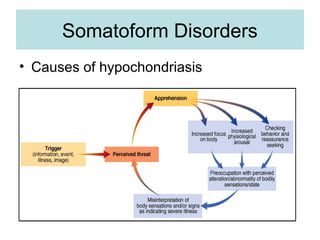
• Causes of hypochondriasis
Somatoform Disorders
• Somatization disorder
  – Briquet’s syndrome (100 years ago)
  – patients have a history of many physical complaints
    that can not be explained by a medical condition, the
    complaints are not intentionally produced
  – 20% of patients in primary care setting
  – develops during adolescence (majority women)
  – may be connected to Antisocial personality disorder
  – difficult to treat (reassurance, stress reduction, more
    adoptive methods of interacting with family are
    encouraged)
Somatoform Disorders
• Conversion Disorder
  – Physical malfunctioning without any physical or organic
    pathology
  – Malfunctioning often involves sensory-motor areas
  – Persons show la belle indifference
  – Retain most normal functions, but without awareness of
    this ability
  – Statistics
     • Rare condition, with a chronic intermittent course
     • Seen primarily in females, with onset usually in adolescence
     • Not uncommon in some cultural and/or religious groups
Somatoform Disorders
• Conversion disorder (cont.)
  – Freudian psychodynamic view is still popular (anxiety converted into
    physical symptoms)
  – Emphasis on the role of trauma (stress), conversion, and
    primary/secondary gain
  – Detachment from the trauma and negative reinforcement seem critical
  – Different from factitious disorder (intentional)
  – Treatment
      • Similar to somatization disorder
      • Core strategy is attending to the trauma
      • Remove sources of secondary gain
      • Reduce supportive consequences of talk about physical symptoms
Somatoform Disorders
• Body Dysmorphic Disorder
  – Preoccupation with imagined defect in appearance
  – Either fixation or avoidance of mirrors
  – Previously known as dysmorphophobia
  – Suicidal ideation and behavior are common
  – Often display ideas of reference for imagined defect
  – Statistics
     • More common than previously thought
     • Usually runs a lifelong chronic course
     • Seen equally in males and females, with onset usually in early
       20s
     • Most remain single, and many seek out plastic surgeons
Somatoform Disorders
• Body Dysmorphic Disorder (cont.)
  – Causes
     • Little is known – Disorder tends to run in families
     • Shares similarities with obsessive-compulsive disorder

  – Treatment
     • Treatment parallels that for obsessive compulsive disorder
     • Medications (i.e., SSRIs) that work for OCD provide some
       relief
     • Exposure and response prevention are also helpful
     • Plastic surgery is often unhelpful
Dissociative Disorders
• Derealization
  – Loss of sense of the reality of the external world
• Depersonalization
  – Loss of sense of your own reality
• 5 types
  –   Depesonalization disorder
  –   Dissociative amnesia
  –   Dissociative fugue
  –   Dissociative trance disorder
  –   Dissociative identity disorder
Dissociative Disorders
• Depersonalization disorder
  – Severe feelings of depersonalization
    dominate the individual’s life and prevent
    normal functioning
  – It is chronic
  – 50% suffer from additional mood and anxiety
    disorders
  – Cognitive profile (cognitive deficits in
    attention, STM, spatial reasoning, perception
    (3D))
Dissociative Disorders
• Dissociative Amnesia
  – Inability to recall personal information, usually
    of a stressful or traumatic nature
  – Generalized vs. selective amnesia
• Dissociative Fugue
  – Sudden, unexpected travel away from home,
    along with an inability to recall one’s past
    (new identity)
  – Occur in adulthood and usually end abruptly
Dissociative Disorders
• Dissociative trance disorder
  – Altered state of consciousness in which the person
    believes firmly that he or she is possessed by spirits;
    considered a disorder only where there is distress and
    dysfunction
  – Trance and possession are a common part of some
    traditional religious and cultural practices and are not
    considered abnormal in that context
  – Only undesirable trance considered pathological
    within that culture is characterized as disorder
Dissociative Disorders
• Dissociative Identity Disorder
  – Formerly multiple personality disorder
  – Many personalities (alters) or fragments of
    personalities coexist within one body
  – The personalities or fragments are dissociated
  – Switch (transition form one personality to another,
    includes physical changes)
  – Can be simulated by malingers are usually eager to
    demonstrate their symptoms whereas individuals with
    DID attempt to hide symptoms
  – Very high comorbidity
  – Prevalence about 3%
Dissociative Disorders
• Dissociative Identity Disorder
  – Auditory hallucinations (coming from inside
    their heads)
  – 97% severe child abuse
  – Extreme subtype of PTSD
  – Onset – approximately 9 years
  – Suggestible people may use dissociation as
    defense against severe trauma
  – Real and false memories
  – Temporal lobe pathology (out of body
    experiences)
Dissociative Disorders
• Treatment
  – Dissociative amnesia and fugue
    • Get better on their own
    • Coping mechanisms to prevent future episodes
  – DID
    •   Reintegration of identities
    •   Neutralization of cues
    •   Confrontation of early trauma
    •   hypnosis

Somatoform& disaasociative disorders nov 9

  • 1.
    Somatoform and Dissociative Disorders Chapter 5
  • 2.
    Basic definitions • Somatoformdisorders – pathological concern of individuals with the appearance or functioning of their bodies when there is no identifiable medical condition causing the physical complaints • Dissociative disorders – individuals feel detached from themselves or their surroundings, and reality, experience, and identity may disintegrate • Historically, both somatoform and dissociative disorders used to be categorized as hysterical neurosis – in psychoanalytic theory neurotic disorders result from underlying unconscious conflicts, anxiety that resulted from those conflicts and ego defense mechanisms
  • 3.
    Somatoform Disorders • Soma– Meaning Body – Preoccupation with health and/or body appearance and functioning – No identifiable medical condition causing the physical complaints • Types of DSM-IV Somatoform Disorders – Hypochondriasis – Somatization disorder – Conversion disorder – Pain disorder – Body dysmorphic disorder
  • 4.
    Somatoform Disorders • Hypochondriasis – severe anxiety focused on the possibility of having a serious disease – shares age of onset, personality characteristics anf running in families with panic disorder – illness phobia vs. hypochondriasis – 60% of patients with illness phobia develop hypochondriasis – 1% to 14% of medical patients – treatment usually invoves cognitive-behavioral therapy and general stress management treatment (gain retained after 1 year follow-up)
  • 5.
  • 6.
    Somatoform Disorders • Somatizationdisorder – Briquet’s syndrome (100 years ago) – patients have a history of many physical complaints that can not be explained by a medical condition, the complaints are not intentionally produced – 20% of patients in primary care setting – develops during adolescence (majority women) – may be connected to Antisocial personality disorder – difficult to treat (reassurance, stress reduction, more adoptive methods of interacting with family are encouraged)
  • 7.
    Somatoform Disorders • ConversionDisorder – Physical malfunctioning without any physical or organic pathology – Malfunctioning often involves sensory-motor areas – Persons show la belle indifference – Retain most normal functions, but without awareness of this ability – Statistics • Rare condition, with a chronic intermittent course • Seen primarily in females, with onset usually in adolescence • Not uncommon in some cultural and/or religious groups
  • 8.
    Somatoform Disorders • Conversiondisorder (cont.) – Freudian psychodynamic view is still popular (anxiety converted into physical symptoms) – Emphasis on the role of trauma (stress), conversion, and primary/secondary gain – Detachment from the trauma and negative reinforcement seem critical – Different from factitious disorder (intentional) – Treatment • Similar to somatization disorder • Core strategy is attending to the trauma • Remove sources of secondary gain • Reduce supportive consequences of talk about physical symptoms
  • 9.
    Somatoform Disorders • BodyDysmorphic Disorder – Preoccupation with imagined defect in appearance – Either fixation or avoidance of mirrors – Previously known as dysmorphophobia – Suicidal ideation and behavior are common – Often display ideas of reference for imagined defect – Statistics • More common than previously thought • Usually runs a lifelong chronic course • Seen equally in males and females, with onset usually in early 20s • Most remain single, and many seek out plastic surgeons
  • 10.
    Somatoform Disorders • BodyDysmorphic Disorder (cont.) – Causes • Little is known – Disorder tends to run in families • Shares similarities with obsessive-compulsive disorder – Treatment • Treatment parallels that for obsessive compulsive disorder • Medications (i.e., SSRIs) that work for OCD provide some relief • Exposure and response prevention are also helpful • Plastic surgery is often unhelpful
  • 11.
    Dissociative Disorders • Derealization – Loss of sense of the reality of the external world • Depersonalization – Loss of sense of your own reality • 5 types – Depesonalization disorder – Dissociative amnesia – Dissociative fugue – Dissociative trance disorder – Dissociative identity disorder
  • 12.
    Dissociative Disorders • Depersonalizationdisorder – Severe feelings of depersonalization dominate the individual’s life and prevent normal functioning – It is chronic – 50% suffer from additional mood and anxiety disorders – Cognitive profile (cognitive deficits in attention, STM, spatial reasoning, perception (3D))
  • 13.
    Dissociative Disorders • DissociativeAmnesia – Inability to recall personal information, usually of a stressful or traumatic nature – Generalized vs. selective amnesia • Dissociative Fugue – Sudden, unexpected travel away from home, along with an inability to recall one’s past (new identity) – Occur in adulthood and usually end abruptly
  • 14.
    Dissociative Disorders • Dissociativetrance disorder – Altered state of consciousness in which the person believes firmly that he or she is possessed by spirits; considered a disorder only where there is distress and dysfunction – Trance and possession are a common part of some traditional religious and cultural practices and are not considered abnormal in that context – Only undesirable trance considered pathological within that culture is characterized as disorder
  • 15.
    Dissociative Disorders • DissociativeIdentity Disorder – Formerly multiple personality disorder – Many personalities (alters) or fragments of personalities coexist within one body – The personalities or fragments are dissociated – Switch (transition form one personality to another, includes physical changes) – Can be simulated by malingers are usually eager to demonstrate their symptoms whereas individuals with DID attempt to hide symptoms – Very high comorbidity – Prevalence about 3%
  • 16.
    Dissociative Disorders • DissociativeIdentity Disorder – Auditory hallucinations (coming from inside their heads) – 97% severe child abuse – Extreme subtype of PTSD – Onset – approximately 9 years – Suggestible people may use dissociation as defense against severe trauma – Real and false memories – Temporal lobe pathology (out of body experiences)
  • 17.
    Dissociative Disorders • Treatment – Dissociative amnesia and fugue • Get better on their own • Coping mechanisms to prevent future episodes – DID • Reintegration of identities • Neutralization of cues • Confrontation of early trauma • hypnosis