PREPARED BY
MRS. DIVYA PANCHOLI
ASSISTANT PROFESSOR, SSRCN, VAPI
Mrs. Divya Pancholi 1
INTRODUCTION
• Conduct disorder is characterized by persistent
antisocial behavior in children and adolescents
that significantly impairs their ability to
function in social, academic, or occupational
areas.
Mrs. Divya Pancholi 2
DEFINITION
A repetitive and persistent pattern of
behavior in which the basic rights of others
or major age-appropriate social norms or
rules are violated.
Mrs. Divya Pancholi 3
INCIDENCE
• Conduct disorder affects 1 to 4 percent of 9-
to 17-year-olds.
• More common in boys than in girls.
• More common in cities than in rural areas.
• The rate among boys in the general
population ranges from 6% to 16% while the
rate among girls ranges from 2% to 9%.
Mrs. Divya Pancholi 4
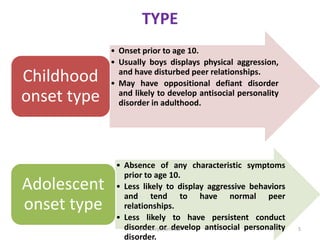
TYPE
• Onset prior to age 10.
• Usually boys displays physical aggression,
and have disturbed peer relationships.
• May have oppositional defiant disorder
and likely to develop antisocial personality
disorder in adulthood.
Childhood
onset type
• Absence of any characteristic symptoms
prior to age 10.
• Less likely to display aggressive behaviors
and tend to have normal peer
relationships.
• Less likely to have persistent conduct
disorder or develop antisocial personality
disorder.
Adolescent
onset type
Mrs. Divya Pancholi 5
ETIOLOGY
• Biological influences
–Genetics
–temperament
–Biochemical factors
Mrs. Divya Pancholi 6
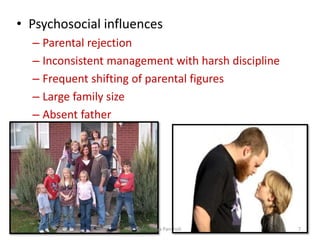
• Psychosocial influences
– Parental rejection
– Inconsistent management with harsh discipline
– Frequent shifting of parental figures
– Large family size
– Absent father
Mrs. Divya Pancholi 7
CONTI..
– Parents with antisocial personality disorder or
alcohol dependence
– Marital conflict & divorce in parents
– Associations with delinquent subgroups
– Inadequate communication pattern within family
Mrs. Divya Pancholi 8
Mrs. Divya Pancholi 9
• Aggression to people
and animals
• Bullies, threatens, or
intimidates others
• Physical fights
• Use of weapons
• Deliberate
property destruction
Mrs. Divya Pancholi 10
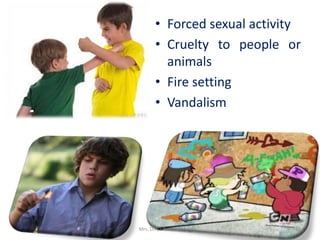
• Forced sexual activity
• Cruelty to people or
animals
• Fire setting
• Vandalism
Mrs. Divya Pancholi 11
• Deceitfulness and theft
• Lying
• Shoplifting
Mrs. Divya Pancholi 12
• Breaking into house,
building, or car
• Cons others to avoid
responsibility
• Serious violation of
rules
Mrs. Divya Pancholi 13
• Stays out overnight
without parental
consent
• Runs away from home
overnight
• Truancy from school
Mrs. Divya Pancholi 14
The diagnostic criteria for Conduct Disorder (DSM-5)
• A. repetitive and persistent pattern of behavior in
which the basic rights of others or major age-
appropriate societal norms or rules are violated, as
manifested by the presence of three (or more) of
the following criteria in the past 12 months, with at
least one criterion present in the past 6 months.
– Aggression to people and animals
– Destruction of property
– Deceitfulness or theft
– Serious violations of rulesMrs. Divya Pancholi 15
CONTI..
1. Aggression to people and animals
a. Often bullies, threatens, or intimidates others.
b. Often initiates physical fights.
c. Has used a weapon that can cause serious physical harm
to others (e.g., a bat, brick, broken bottle, knife, gun)
d. Has been physically cruel to people.
e. Has been physically cruel to animals.
f. Has stolen while confronting a victim (e.g., mugging,
purse snatching, extortion, armed robbery).
g. Has forced someone into sexual activity.
2. Destruction of property
a. Has deliberately engaged in fire setting with the intention
of causing serious damage.
b. Has deliberately destroyed others’ property (other than
by fire setting). Mrs. Divya Pancholi 16
3. Deceitfulness or theft
a. Has broken into someone else’s house, building, or car.
b. Often lies to obtain goods or favours or to avoid obligations (i.e.,
“cons” others).
c. Has stolen items of nontrivial value without confronting a victim (e.g.,
shoplifting, but without breaking and entering; forgery).
4. Serious violations of rules
a. Often stays out at night despite parental prohibitions, beginning
before age 13 years.
b. Has run away from home overnight at least twice while living in
parental or parental surrogate home (or once without returning for a
lengthy period).
c. Is often truant from school, beginning before age 13 years.
Mrs. Divya Pancholi 17
CONTI..
B. The disturbance in behaviour causes clinically
significant impairment in social, academic, or
occupational functioning.
C. If the individual is age 18 years or older,
criteria are not met for antisocial personality
disorder.
Mrs. Divya Pancholi 18
NURSING DIAGNOSIS
• Risk for violence related to peer
rejection and dysfunctional family
dynamics.
• Impaired social interaction related to
impaired peer relations leading to
inappropriate social behavior.
• Defensive coping related to low self
esteem and dysfunctional family
system.
• Low self esteem related to
unsatisfactory parent/child
relationship.
Mrs. Divya Pancholi 19
PHARMACOLOGICAL
INTERVENTIONS
• Commonly used when comorbidity exists (ADHD,
mood disorders)
• Used in combination with other treatments
• Treats specific symptoms:
• Stimulants (aggression)
• Anti-convulsants (rage and temper outbursts)
• Lithium (aggression)
• Clonidine (over-arousal)
• Neuroleptics and Atypical Antipsychotics (severe CD)Mrs. Divya Pancholi 20
TREATMENT
 Limit Television
 Limit all media use to no more than
1 to 2 hours per day.
 Monitor their children's use of the
media.
 Co view television with their
children.
 Eliminate or reduce video and
Computer games
Mrs. Divya Pancholi 21
CONTI…………
School-Based Treatment
Programs
A safe community
Family Therapy
Social Skills Training
Cognitive-Behavioral
Therapy
Mrs. Divya Pancholi 22
INTERVENTIONS FOR CONDUCT DISORDER
• Decreasing violence and
increasing compliance with
treatment
• Protect others from client’s
aggression and manipulation.
• Set limits for unacceptable
behavior.
• Provide consistency with
client’s treatment plan.
• Use behavioral contracts.
• Institute time-out.
• Provide a routine schedule of
daily activities.
• Improving coping skills and self-
esteem
• Show acceptance of the person,
not necessarily the behavior.
• Encourage the client to keep a
diary.
• Teach and practice problem-
solving skills.
• Promoting social interaction
• Teach age-appropriate social
skills.
• Role-model and practice social
skills.
• Provide positive feedback for
acceptable behavior.
• Providing client and family
educationMrs. Divya Pancholi 23
CLIENT/FAMILY TEACHING
FOR CONDUCT DISORDER
• Teach parents social and problem-solving skills
when needed.
• Encourage parents to seek treatment for their
own problems.
• Help parents to identify age-appropriate activities
and expectations.
• Assist parents with direct, clear communication.
• Help parents to avoid “rescuing” the client.
Mrs. Divya Pancholi 24
Different Types
of Treatment
School-Based Intervention Strategies
• Specialized Programming: Classroom Level
• Specialized Programming: Comprehensive
Strategies
Mrs. Divya Pancholi 25
CONTI…
• Interventions to Promote Prosocial Skills
• Parent Management Training
• Contingency Management Programs
• Cognitive Problem-Solving Skills Training
• Functional Family Therapy
• Group Therapy
• Psychopharmacologic Interventions
• Multidimensional Interventions
• Multisystemic Therapy
• Families and Schools Together (FAST TRACK)
Mrs. Divya Pancholi 26
WHAT SCHOOLS CAN DO
• With a 504 plan or a behavioral plan, accommodations
can be made for students with CD
• Specialized Programming: Classroom Level
• Create a structured, predictable environment
• Instruction should be consistent and methodical
• Sufficiently staffed environment
• Material should be presented in:
– Consistent manner
– Systematic instructional routines
– Cumulative manner
Mrs. Divya Pancholi 27
SPECIALIZED PROGRAMMING:
COMPREHENSIVE STRATEGIES
Student-Focused Approaches
• Teachers and mental health professionals address mental
• and social processes that affect behavior
• Examples of interventions: modeling, role-play,
immediate
• positive reinforcement of target behaviors
Parent-Focused Approaches
• Parents can recognize influences at home that are
affecting
• the child’s behaviors
• Examples of interventions: coaching, prompting,
• feedback, graduated homework assignments
Mrs. Divya Pancholi 28
School-Focused Approaches
• Through instruction, teachers need to create a
balance in the classroom between the needs of
specific children and the rest of the classroom
• Examples of interventions: smooth transitions,
being consistent and direct with praise and
redirection, clear classroom rules stated first day
of class and emphasize throughout the year,
social skills curriculum, teamwork curriculum
Mrs. Divya Pancholi 29
Parent Management Training
• Parents are trained to use specific procedures in
the home:
1. Improve parent-child interactions
warmth and responsiveness
2. Promote pro-social behaviors
• reinforcement of desirable behaviors
3. Discourage negative behaviors
structured home environment
clear rules and expectations
consistent discipline
Mrs. Divya Pancholi 30
CONTI…
• Functional Family Therapy
• Focus on making changes within the family system
• Improve communication skills and family interactions
• Cognitive Problem-Solving Skills Training
• Focus on improving child’s social skills using problem-
solving techniques
• Self-statements
• Multiple solutions
• Understanding others’ perspectives
• Group Therapy
• Focus on development of interpersonal skills
• Interaction with positive peer role models
Mrs. Divya Pancholi 31
You can refer following link also
• https://youtu.be/XH46Nm1QOcg
• https://www.youtube.com/watch?v=gVILmwjL
EAA
• https://www.youtube.com/watch?v=EUCIKfNI
NYU
Mrs. Divya Pancholi 32
Mrs. Divya Pancholi 33

CONDUCT DISORDER

  • 1.
    PREPARED BY MRS. DIVYAPANCHOLI ASSISTANT PROFESSOR, SSRCN, VAPI Mrs. Divya Pancholi 1
  • 2.
    INTRODUCTION • Conduct disorderis characterized by persistent antisocial behavior in children and adolescents that significantly impairs their ability to function in social, academic, or occupational areas. Mrs. Divya Pancholi 2
  • 3.
    DEFINITION A repetitive andpersistent pattern of behavior in which the basic rights of others or major age-appropriate social norms or rules are violated. Mrs. Divya Pancholi 3
  • 4.
    INCIDENCE • Conduct disorderaffects 1 to 4 percent of 9- to 17-year-olds. • More common in boys than in girls. • More common in cities than in rural areas. • The rate among boys in the general population ranges from 6% to 16% while the rate among girls ranges from 2% to 9%. Mrs. Divya Pancholi 4
  • 5.
    TYPE • Onset priorto age 10. • Usually boys displays physical aggression, and have disturbed peer relationships. • May have oppositional defiant disorder and likely to develop antisocial personality disorder in adulthood. Childhood onset type • Absence of any characteristic symptoms prior to age 10. • Less likely to display aggressive behaviors and tend to have normal peer relationships. • Less likely to have persistent conduct disorder or develop antisocial personality disorder. Adolescent onset type Mrs. Divya Pancholi 5
  • 6.
  • 7.
    • Psychosocial influences –Parental rejection – Inconsistent management with harsh discipline – Frequent shifting of parental figures – Large family size – Absent father Mrs. Divya Pancholi 7
  • 8.
    CONTI.. – Parents withantisocial personality disorder or alcohol dependence – Marital conflict & divorce in parents – Associations with delinquent subgroups – Inadequate communication pattern within family Mrs. Divya Pancholi 8
  • 9.
  • 10.
    • Aggression topeople and animals • Bullies, threatens, or intimidates others • Physical fights • Use of weapons • Deliberate property destruction Mrs. Divya Pancholi 10
  • 11.
    • Forced sexualactivity • Cruelty to people or animals • Fire setting • Vandalism Mrs. Divya Pancholi 11
  • 12.
    • Deceitfulness andtheft • Lying • Shoplifting Mrs. Divya Pancholi 12
  • 13.
    • Breaking intohouse, building, or car • Cons others to avoid responsibility • Serious violation of rules Mrs. Divya Pancholi 13
  • 14.
    • Stays outovernight without parental consent • Runs away from home overnight • Truancy from school Mrs. Divya Pancholi 14
  • 15.
    The diagnostic criteriafor Conduct Disorder (DSM-5) • A. repetitive and persistent pattern of behavior in which the basic rights of others or major age- appropriate societal norms or rules are violated, as manifested by the presence of three (or more) of the following criteria in the past 12 months, with at least one criterion present in the past 6 months. – Aggression to people and animals – Destruction of property – Deceitfulness or theft – Serious violations of rulesMrs. Divya Pancholi 15
  • 16.
    CONTI.. 1. Aggression topeople and animals a. Often bullies, threatens, or intimidates others. b. Often initiates physical fights. c. Has used a weapon that can cause serious physical harm to others (e.g., a bat, brick, broken bottle, knife, gun) d. Has been physically cruel to people. e. Has been physically cruel to animals. f. Has stolen while confronting a victim (e.g., mugging, purse snatching, extortion, armed robbery). g. Has forced someone into sexual activity. 2. Destruction of property a. Has deliberately engaged in fire setting with the intention of causing serious damage. b. Has deliberately destroyed others’ property (other than by fire setting). Mrs. Divya Pancholi 16
  • 17.
    3. Deceitfulness ortheft a. Has broken into someone else’s house, building, or car. b. Often lies to obtain goods or favours or to avoid obligations (i.e., “cons” others). c. Has stolen items of nontrivial value without confronting a victim (e.g., shoplifting, but without breaking and entering; forgery). 4. Serious violations of rules a. Often stays out at night despite parental prohibitions, beginning before age 13 years. b. Has run away from home overnight at least twice while living in parental or parental surrogate home (or once without returning for a lengthy period). c. Is often truant from school, beginning before age 13 years. Mrs. Divya Pancholi 17
  • 18.
    CONTI.. B. The disturbancein behaviour causes clinically significant impairment in social, academic, or occupational functioning. C. If the individual is age 18 years or older, criteria are not met for antisocial personality disorder. Mrs. Divya Pancholi 18
  • 19.
    NURSING DIAGNOSIS • Riskfor violence related to peer rejection and dysfunctional family dynamics. • Impaired social interaction related to impaired peer relations leading to inappropriate social behavior. • Defensive coping related to low self esteem and dysfunctional family system. • Low self esteem related to unsatisfactory parent/child relationship. Mrs. Divya Pancholi 19
  • 20.
    PHARMACOLOGICAL INTERVENTIONS • Commonly usedwhen comorbidity exists (ADHD, mood disorders) • Used in combination with other treatments • Treats specific symptoms: • Stimulants (aggression) • Anti-convulsants (rage and temper outbursts) • Lithium (aggression) • Clonidine (over-arousal) • Neuroleptics and Atypical Antipsychotics (severe CD)Mrs. Divya Pancholi 20
  • 21.
    TREATMENT  Limit Television Limit all media use to no more than 1 to 2 hours per day.  Monitor their children's use of the media.  Co view television with their children.  Eliminate or reduce video and Computer games Mrs. Divya Pancholi 21
  • 22.
    CONTI………… School-Based Treatment Programs A safecommunity Family Therapy Social Skills Training Cognitive-Behavioral Therapy Mrs. Divya Pancholi 22
  • 23.
    INTERVENTIONS FOR CONDUCTDISORDER • Decreasing violence and increasing compliance with treatment • Protect others from client’s aggression and manipulation. • Set limits for unacceptable behavior. • Provide consistency with client’s treatment plan. • Use behavioral contracts. • Institute time-out. • Provide a routine schedule of daily activities. • Improving coping skills and self- esteem • Show acceptance of the person, not necessarily the behavior. • Encourage the client to keep a diary. • Teach and practice problem- solving skills. • Promoting social interaction • Teach age-appropriate social skills. • Role-model and practice social skills. • Provide positive feedback for acceptable behavior. • Providing client and family educationMrs. Divya Pancholi 23
  • 24.
    CLIENT/FAMILY TEACHING FOR CONDUCTDISORDER • Teach parents social and problem-solving skills when needed. • Encourage parents to seek treatment for their own problems. • Help parents to identify age-appropriate activities and expectations. • Assist parents with direct, clear communication. • Help parents to avoid “rescuing” the client. Mrs. Divya Pancholi 24
  • 25.
    Different Types of Treatment School-BasedIntervention Strategies • Specialized Programming: Classroom Level • Specialized Programming: Comprehensive Strategies Mrs. Divya Pancholi 25
  • 26.
    CONTI… • Interventions toPromote Prosocial Skills • Parent Management Training • Contingency Management Programs • Cognitive Problem-Solving Skills Training • Functional Family Therapy • Group Therapy • Psychopharmacologic Interventions • Multidimensional Interventions • Multisystemic Therapy • Families and Schools Together (FAST TRACK) Mrs. Divya Pancholi 26
  • 27.
    WHAT SCHOOLS CANDO • With a 504 plan or a behavioral plan, accommodations can be made for students with CD • Specialized Programming: Classroom Level • Create a structured, predictable environment • Instruction should be consistent and methodical • Sufficiently staffed environment • Material should be presented in: – Consistent manner – Systematic instructional routines – Cumulative manner Mrs. Divya Pancholi 27
  • 28.
    SPECIALIZED PROGRAMMING: COMPREHENSIVE STRATEGIES Student-FocusedApproaches • Teachers and mental health professionals address mental • and social processes that affect behavior • Examples of interventions: modeling, role-play, immediate • positive reinforcement of target behaviors Parent-Focused Approaches • Parents can recognize influences at home that are affecting • the child’s behaviors • Examples of interventions: coaching, prompting, • feedback, graduated homework assignments Mrs. Divya Pancholi 28
  • 29.
    School-Focused Approaches • Throughinstruction, teachers need to create a balance in the classroom between the needs of specific children and the rest of the classroom • Examples of interventions: smooth transitions, being consistent and direct with praise and redirection, clear classroom rules stated first day of class and emphasize throughout the year, social skills curriculum, teamwork curriculum Mrs. Divya Pancholi 29
  • 30.
    Parent Management Training •Parents are trained to use specific procedures in the home: 1. Improve parent-child interactions warmth and responsiveness 2. Promote pro-social behaviors • reinforcement of desirable behaviors 3. Discourage negative behaviors structured home environment clear rules and expectations consistent discipline Mrs. Divya Pancholi 30
  • 31.
    CONTI… • Functional FamilyTherapy • Focus on making changes within the family system • Improve communication skills and family interactions • Cognitive Problem-Solving Skills Training • Focus on improving child’s social skills using problem- solving techniques • Self-statements • Multiple solutions • Understanding others’ perspectives • Group Therapy • Focus on development of interpersonal skills • Interaction with positive peer role models Mrs. Divya Pancholi 31
  • 32.
    You can referfollowing link also • https://youtu.be/XH46Nm1QOcg • https://www.youtube.com/watch?v=gVILmwjL EAA • https://www.youtube.com/watch?v=EUCIKfNI NYU Mrs. Divya Pancholi 32
  • 33.