MEDICALLY UNEXPLAINED
SYMPTOMS
SCHEME OF PRESENTATION
• INTRODUCTION
• HISTORY
• CONCEPT OF SOMATOFORM
• ETIOLOGY
• FUNCTIONAL SOMATIC SYNDROME
• DSM 5 AND ICD 10
• SPECIFIC SOMATIC SYMPTOM AND RELATED DISORDERS
• REFERENCES
INTRODUCTION
• There appears to be a universal tendency to experience and
communicate psychological distress in the form of physical symptoms
• Often, these physical symptoms remain poorly explained
• Through decades various terms were used to describe the symptoms
• gradually replaced by terms such as “medically unexplained
symptoms,” “unexplained symptoms,” “functional somatic symptoms.
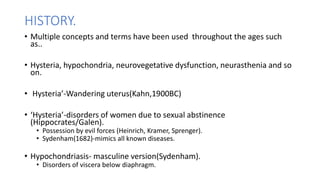
HISTORY.
• Multiple concepts and terms have been used throughout the ages such
as..
• Hysteria, hypochondria, neurovegetative dysfunction, neurasthenia and so
on.
• Hysteria’-Wandering uterus(Kahn,1900BC)
• ‘Hysteria’-disorders of women due to sexual abstinence
(Hippocrates/Galen).
• Possession by evil forces (Heinrich, Kramer, Sprenger).
• Sydenham(1682)-mimics all known diseases.
• Hypochondriasis- masculine version(Sydenham).
• Disorders of viscera below diaphragm.
• In the 17th century, Thomas Sydenham attributed “pain,” “convulsions,”
“diarrhea,” and “dropsy” are signs and symptoms of disturbances of the
mind
• Michel Foucault, in his book, included “hysteria” and “hypochondria”
among the four classic syndromes in psychopathology
• In 20th century HENRY EY devoted a full chapter to hysteria, which he
defined as “the somatic hyperexpressivity of unconscious ideas, images,
and affects
• The Spanish psychiatrist Juan José Lopez-Ibor was perhaps the first to
highlight the somatic component of some forms of anxiety and depression,
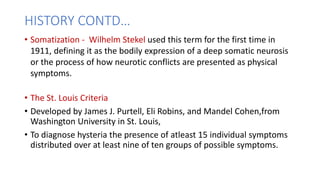
HISTORY CONTD…
• Somatization - Wilhelm Stekel used this term for the first time in
1911, defining it as the bodily expression of a deep somatic neurosis
or the process of how neurotic conflicts are presented as physical
symptoms.
• The St. Louis Criteria
• Developed by James J. Purtell, Eli Robins, and Mandel Cohen,from
Washington University in St. Louis,
• To diagnose hysteria the presence of atleast 15 individual symptoms
distributed over at least nine of ten groups of possible symptoms.
CONCEPT OF SOMATOFORM
• ROBERT SPITZER coined the term “somatoform” by which made its
formal entry in North American psychiatry
• But patient presenting with multiple unexplained symptoms didn’t fit
easily into taxonomies provided by DSM AND ICD SYSTEMS
• Two main dimensions that may have practical value. One is high levels
of physical symptoms (the former somatization) and the other, by
amplification of somatic presentations (hypochondriasis or health
anxiety). This dimensional approach has been taken into account in
(DSM-5)
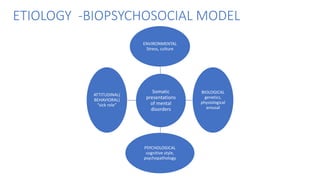
ETIOLOGY -BIOPSYCHOSOCIAL MODEL
Somatic
presentations
of mental
disorders
ENVIRONMENTAL
Stress, culture
BIOLOGICAL
genetics,
physiological
arousal
PSYCHOLOGICAL
cognitive style,
psychopathology
ATTITUDINAL(
BEHAVIORAL)
“sick role”
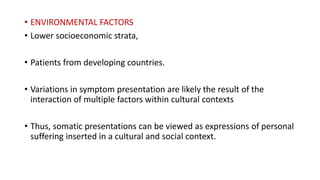
• ENVIRONMENTAL FACTORS
• Lower socioeconomic strata,
• Patients from developing countries.
• Variations in symptom presentation are likely the result of the
interaction of multiple factors within cultural contexts
• Thus, somatic presentations can be viewed as expressions of personal
suffering inserted in a cultural and social context.
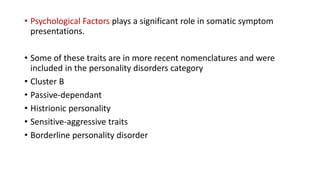
• Psychological Factors plays a significant role in somatic symptom
presentations.
• Some of these traits are in more recent nomenclatures and were
included in the personality disorders category
• Cluster B
• Passive-dependant
• Histrionic personality
• Sensitive-aggressive traits
• Borderline personality disorder
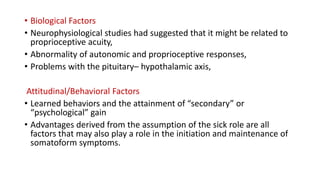
• Biological Factors
• Neurophysiological studies had suggested that it might be related to
proprioceptive acuity,
• Abnormality of autonomic and proprioceptive responses,
• Problems with the pituitary– hypothalamic axis,
Attitudinal/Behavioral Factors
• Learned behaviors and the attainment of “secondary” or
“psychological” gain
• Advantages derived from the assumption of the sick role are all
factors that may also play a role in the initiation and maintenance of
somatoform symptoms.
Functional Somatic Syndromes
• Besides the high levels of idiopathic symptoms, these syndromes also
share common elements as the following:
• The absence of a gold standard against which a specific diagnosis can
be confirmed or ruled out.
• The absence of clearly articulated pathophysiology (e.g. muscle
contraction, catecholamine release,neurological hyper reactivity,etc.).
Functional Somatic Syndromes
• The simultaneous presence of multiple unexplained physical
symptoms originating from several different organ systems.
• High levels of psychiatric symptoms and “comorbidities.
• Comparable responses to certain psychological (e.g., cognitive
behavioral therapy [CBT]) and pharmacologic (e.g., antidepressants)
interventions.
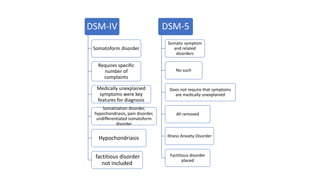
DSM-IV
Somatoform disorder
Requires specific
number of
complaints
Medically unexplained
symptoms were key
features for diagnosis
Somatization disorder,
hypochondriasis, pain disorder,
undifferentiated somatoform
disorder
Hypochondriasis
factitious disorder
not included
DSM-5
Somatic symptom
and related
disorders
No such
Does not require that symptoms
are medically unexplained
All removed
Illness Anxiety Disorder
Factitious disorder
placed
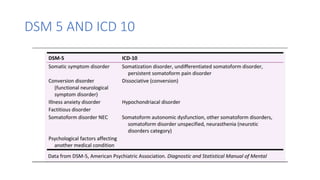
DSM 5 AND ICD 10
SPECIFIC SOMATIC SYMPTOM AND RELATED
DISORDERS
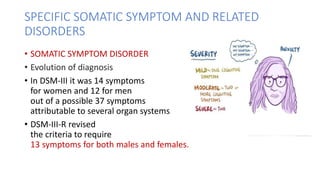
• SOMATIC SYMPTOM DISORDER
• Evolution of diagnosis
• In DSM-III it was 14 symptoms
for women and 12 for men
out of a possible 37 symptoms
attributable to several organ systems
• DSM-III-R revised
the criteria to require
13 symptoms for both males and females.
SOMATIC SYMPTOM DISORDER
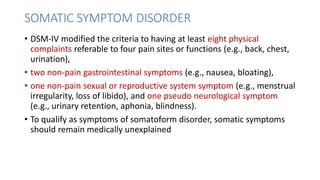
• DSM-IV modified the criteria to having at least eight physical
complaints referable to four pain sites or functions (e.g., back, chest,
urination),
• two non-pain gastrointestinal symptoms (e.g., nausea, bloating),
• one non-pain sexual or reproductive system symptom (e.g., menstrual
irregularity, loss of libido), and one pseudo neurological symptom
(e.g., urinary retention, aphonia, blindness).
• To qualify as symptoms of somatoform disorder, somatic symptoms
should remain medically unexplained
SOMATIC SYMPTOM DISORDER
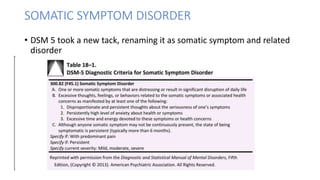
• DSM 5 took a new tack, renaming it as somatic symptom and related
disorder
SOMATIC SYMPTOM DISORDER
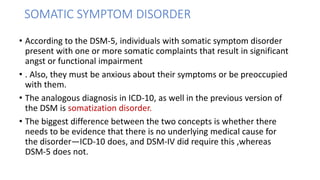
• According to the DSM-5, individuals with somatic symptom disorder
present with one or more somatic complaints that result in significant
angst or functional impairment
• . Also, they must be anxious about their symptoms or be preoccupied
with them.
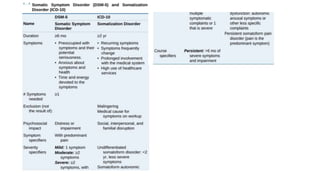
• The analogous diagnosis in ICD-10, as well in the previous version of
the DSM is somatization disorder.
• The biggest difference between the two concepts is whether there
needs to be evidence that there is no underlying medical cause for
the disorder—ICD-10 does, and DSM-IV did require this ,whereas
DSM-5 does not.
SOMATIC SYMPTOM DISORDER
• COURSE AND PROGNOSIS: The course of most somatic symptom
disorders tends to be chronic
• Epidemiological studies have shown that type and number of physical
symptoms often change during follow-up periods.
• Research shown that depression or anxiety become more severe and
disabling if associated with medically unexplained physical symptoms.
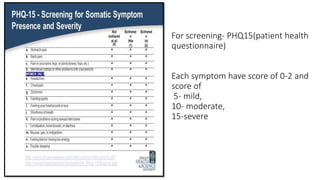
For screening- PHQ15(patient health
questionnaire)
Each symptom have score of 0-2 and
score of
5- mild,
10- moderate,
15-severe
• The following features can help in deciding whether idiopathic
physical symptoms may have a psychiatric etiology:
• The symptoms coexist with major psychiatric disorders such as
depression or panic.
• The symptoms closely follow traumatic events.
• The symptoms lead to psychological “gratification” or “secondary
gain.
• The symptoms represent predictable personality traits (coping
mechanisms).
MANAGEMENT
• Build Rapport with patient.
• Review medical records.
• History taking.
• MSE & physical examination.
• Minimal lab tests.
• Exclude medical causes.
• Avoid unnecessary tests.
• Exclude.
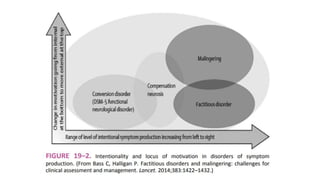
• Factitious disorder
• Malingering.
TREATMENT
• Reassurance: The role of reassurance in this disorder has been a
controversial one.
• The ease with which patients with health anxiety can be successfully
reassured may be related to patient factors
• Such as chronicity, severity of symptoms, and personality
characteristics
Cognitive behavioral therapy(CBT)
• 1st line/after failure in simpler strategies
• Improvement due to
• Better coping.
• Decreased illness worry.
• Lessened avoidant behaviour.
• Greater perceived control.
• In the typical CBT program, patients are systematically exposed to a
number of behavioral techniques,
• Relaxation training and graded increases in activities.
• SMITH’S CONSULTATION LETTER : (BY RICHARD SMITH)
• For primary care physicians. Providing “do’s and don’t’s” for pt with
MUS
• Avoid using statements such as “symptoms are all in your head,” and
briefly allow/encourage patients to talk about “stressors.
• RESULT OF LETTER- Improved functional capacity, Decreased
utilization of health care services ,Cost savings.
• PSYCHOTHERAPY :
• Robert Kellner, was one of the first to report positive results of
behavioral interventions in health anxiety
• Various group and individual therapies, including psychodynamic
types, have been proposed over the years to manage patients.
• Specific Management strategies
• Screening for Depression & Anxiety
• Treatment of comorbid Psychiatric disorders
ILLNESS ANXIETY DISORDER
• DSM-5 recognizes that most cases of
hypochondriasis can be included under
Somatic Symptom Disorder.
• However, a minority of patients with
hypochondriasis (~20 percent)
are now given a diagnosis of Illness
Anxiety Disorder.
IAD VS SSD
• When somatic symptoms are relatively minor and patients instead
focus on concerns that they will get sick or have an undiagnosed
illness, the diagnosis is Illness Anxiety Disorder.
• When there is preoccupation with health concerns superimposed by
substantial somatic symptoms, the diagnosis is somatic symptom
disorder.
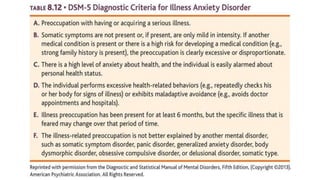
• In DSM-5, illness anxiety is defined as the preoccupation with fears of
having, or the idea that one has, a serious disease based on the person’s
misinterpretation of bodily symptoms, with a duration of at least 6
months.
• The belief is not of delusional intensity and is not restricted to a
circumscribed concern about appearance
• The preoccupation causes clinically significant distress or impairment in
social, occupational, or other important areas of functioning;
• ICD-10 the preoccupation with disease extends to a minimum of two
disease entities, leads the patient to seek medical help or
investigations, and does not involve phobic fears.
• In addition, in ICD-10, body disfigurement or deformity is included in
the diagnostic definition.
• Hypochondriasis/Illness anxiety disorder(DSM 5) has also been
classified as “primary” or “transient” or “secondary”
TREATMENT
• REASSURANCE
• PSYCHOTHERAPIES.
Various group and individual therapies, including psychodynamic
types, to manage patients. Unfortunately, there is a paucity of
controlled studies.
• Cognitive-Behavioral Therapy.
Several recent controlled studies have confirmed the earlier
suggestions of the efficacy of CBT interventions. This substantive
evidence places CBT as the prototype, first-line treatment for this
condition
PHARMACOLOGICAL TREATMENT.
• The only double blind, placebo-controlled clinical trial in patients with
hypochondriasis was that of Brian Fallon
• Studies showing efficacy with SSRI>TCA(Fallon et al)
• Fluoxetine(80 mg/day)
• Fluvoxamine (50mg/day..weekly increase..300mg/day)
• Paroxetine(max 60mg/day)
• Nefazodone(mean dose 432mg/day)
• Imipramine (max 150mg/day)
• The authors conclude that fluoxetine is a moderately effective and
well-tolerated treatment for illness anxiety disorder(hypochondriasis)
FACTITIOUS DISORDER
• Factitious means “artificial, false,” from the Latin facticius, “made by
art.”
• Patients with factitious disorder simulate, induce, or aggravate illness
to receive medical attention, regardless of whether they are ill or not.
• The primary motivation is to seek attention by playing the role of a
patient.
• Factitious disorder patients, in contrast to malingerers, lack an
obvious external reward, such as avoidance of duties, or financial
gain.
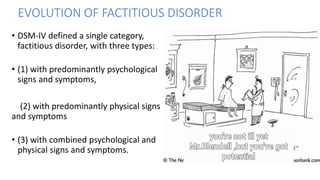
• DSM-IV defined a single category,
factitious disorder, with three types:
• (1) with predominantly psychological
signs and symptoms,
(2) with predominantly physical signs
and symptoms
• (3) with combined psychological and
physical signs and symptoms.
EVOLUTION OF FACTITIOUS DISORDER
• In DSM-5 :divides the general category of factitious disorders into
two groups:
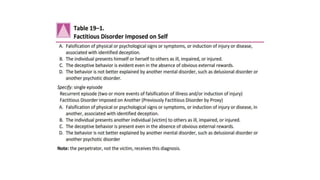
1)factitious disorder imposed on self,
2)factitious disorder imposed on another.
The diagnosis of factitious disorder NOS was eliminated.
• Second, there is no longer a distinction between physical or
psychological presentations.
• Factitious disorders are now specified as being a single episode or
recurrent episodes.
• ICD-10 lists factitious disorder (F68.1) under the category “other disorders
of adult personality and behaviour,”
• The diagnostic label is “intentional production or feigning of symptoms or
disabilities, either physical or psychological (factitious disorder).”
• There are four subtypes:
(1) unspecified
(2) with predominantly psychological signs and symptoms;
(3) with predominantly physical signs and symptoms; and
(4) with combined psychological and physical signs and symptoms
Munchausen’s syndrome
• The term coined by Richard Asher in his 1951 publication, known as
chronic factitious disorder with predominantly physical signs and
symptoms
• Munchausen syndrome comprises approximately 10 percent of all
cases of factitious disorder.
• Constantly seeking medical care and hospitalization, such patients
often assume grandiose false identities, sometimes claiming to be
royalty, relatives of celebrities etc..
• They travel from hospital to hospital, and when they become well
known in one city, they go to new city begin the behavior anew
elsewhere.
• Previous terms applied to these patients included hospital addicts,
and professional patients.
• Two distinguishing features of Munchausen syndrome beyond the
simulation of disease are 1) Pseudologia fantastica—the telling of
vague, heroic tales often containing a kernel of truth
• And 2) Peregrination—the tendency to travel widely.
• There is evidence to support a second durable phenotype of factitious
disorder imposed on self, called common factitious disorder,
• In which factitious behavior is confined to one locality and a
relatively circumscribed set of complaints.
• The prototypical patient tends to be young, female, socially
connected, employed, and working in health care.
Factitious Disorder Imposed on Another
• In this diagnosis, a person intentionally produces physical signs or
symptoms in another person who is under the first person’s care.
• One apparent purpose of the behavior is for the caretaker to assume
the sick role indirectly
• Another is to be relieved of the caretaking role by having the child
hospitalized.
• The most common cause of factitious disorder imposed on another
involves a mother who deceives medical personnel into believing that
her child is ill.
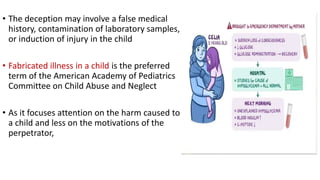
• The deception may involve a false medical
history, contamination of laboratory samples,
or induction of injury in the child
• Fabricated illness in a child is the preferred
term of the American Academy of Pediatrics
Committee on Child Abuse and Neglect
• As it focuses attention on the harm caused to
a child and less on the motivations of the
perpetrator,
• TREATMENT
• Factitious Disorder Imposed on Self : Three major goals
• (1) to reduce the risk of morbidity and mortality,
• (2) to address the underlying emotional needs or psychiatric diagnosis
that may be driving factitious illness behavior,
• (3) to be mindful of legal and ethical issues.
• Management of countertransference is a priority to reduce risk,
because a clinician’s negative feelings can interfere with appropriate
patient care.
• Addressing Psychiatric Issues
• Several behavioral strategies have been successfully used to facilitate
the healing of factitiously produced symptoms
• Eisendrath advocated a double-bind technique whereby patients are
told that if the symptoms are genuine, then they should improve with
the treatment administered.
• If the symptoms do not improve, then they must be factitious
• Pharmacologic and psychotherapeutic treatments should be
employed according to the diagnosis.
• Other than targeting comorbid psychiatric disorders, there is no
standard pharmacologic treatment for factitious disorder
TREATMENT
• Factitious Disorder Imposed on Another. Protection of the victim is
the first priority.
• Active pursuit of the diagnosis and then prompt intervention is
essential.
• Child protective services should be informed.
• If harm has been done to the child, reporting of factitious disorder
imposed on another to child abuse protection to be done.
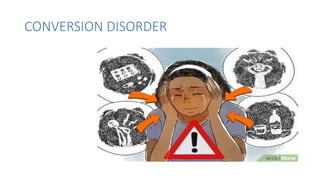
CONVERSION DISORDER
CONVERSION DISORDER
• Definition:
A conversion reaction is a rather acute and temporary loss or
alteration in motor or sensory function that is incompatible with
known neurological disorders
• Or that requires substantial discordance between the symptoms
displayed and any neurologic condition
• It would be impossible for the patient’s presentation to be consistent
with a neurologic disease
• Many patients present with conversion even when no stressor has
been demonstrated.
• Conversion motor symptoms mimic syndromes such as paralysis,
ataxia, dysphagia, or seizure disorder (pseudo seizures)
• The sensory ones mimic neurological deficits such as blindness,
deafness, or anesthesia.
• DSM-I(1951)
• Hysteria
• DSM-II(1968)
• Hysterical neurosis, conversion type
• DSM-III(1980)
• Conversion disorder
• In DSM-IV, conversion symptoms are not limited to pain or sexual
dysfunction and it should not be a component of somatization disorder,
and should not be considered due to or caused by another mental disorder.
• DSM-5 emphasizes that the neurological symptoms are incompatible with
recognized neurological or medical disorders and provides a specifier to
denote whether or not a psychological stressor has been identified
Etiology
• PERSONALITY FACTORS. A severe and turbulent illness, a trait known
as “la belle indifference.”
• “Histrionic personality” is currently the term that summarizes the
drama, flair, and flamboyance and exhibitionism attributed to these
patients.
• BIOLOGICAL FACTORS. The neurophysiologic aspect says defect in
certain brain functions, especially those in the dominant hemisphere
that may interfere with verbal associations.
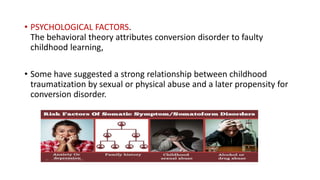
• PSYCHOLOGICAL FACTORS.
The behavioral theory attributes conversion disorder to faulty
childhood learning,
• Some have suggested a strong relationship between childhood
traumatization by sexual or physical abuse and a later propensity for
conversion disorder.
• Sensory Symptoms
Anesthesia and paresthesia are common, especially of the extremities.
All sensory modalities can be involved
• Characteristic stocking-and-glove anesthesia of the hands or feet or
the hemianesthesia of the body beginning precisely along the midline.
• Conversion disorder symptoms may involve the organs of special sense
and can produce deafness, blindness, and tunnel vision.
• In conversion disorder -blindness, for example, patients walk around
without collisions or self-injury, their pupils react to light, and their
cortical-evoked potentials are normal.
• Motor Symptoms
• The motor symptoms of conversion disorder include abnormal
movements, gait disturbance, weakness, and paralysis, ticks ,jerks..
• The movements generally worsen when calling attention to them.
• One gait disturbance seen in conversion disorder is astasia–abasia,
• Seizure Symptoms. Non epileptic seizure (NESs) are another symptom
of conversion disorder.
• Tongue-biting, urinary incontinence, symptoms are generally not
present.
• Patients with NESs retain pupillary and gag reflexes after their seizure-
like activity.
• Several psychological symptoms are also associated with conversion
disorder.
MANAGEMENT
• History taking.
• Trauma
• Childhood Sexual abuse
• F/H of conversion disorder
• Physical examination
• Rule out neurological diseases(multiple sclerosis,PNS/CNS disorders).
• EEG(To diff b/w pseudoseizures and seizures), MRI, xray spine etc,
• PSYCHOTHERAPY. Once chronicity has developed, intensive treatment
may use all treatment modalities,
• PHARMACOLOGICAL TREATMENT. Accompanying comorbid
depression, anxiety, and behavior problems may respond to
pharmacologic interventions.
• PHYSICAL THERAPY. With chronic conversion, muscle contractures can
occur and physical therapy is necessary.
• Even in the absence of such contractures, however, many conversion
patients find that physical therapy can be helpful
Dissociative Disorders
• Dissociation is an unconscious defense mechanism involving the
segregation of any group of mental or behavioral processes from the
rest of the person’s psychic activity.
• Dissociative disorders involve this mechanism so that there is a
disruption in one or more mental functions, such as memory, identity,
perception, consciousness, or motor behavior.
• The disturbance may be sudden or gradual, transient or chronic, and
psychological trauma is often the cause.
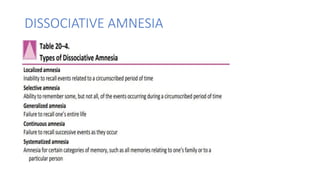
DISSOCIATIVE AMNESIA
• FEATURES
• The main feature of dissociative amnesia is the inability to recall
important personal information, usually related to a significant
trauma or stressor,
• The disorder cannot result from the direct physiologic effects of a
substance or a neurologic or other general medical condition.
• The classic disorder is an overt, florid, dramatic clinical disturbance
that quickly presents for medical attention
• A history of extreme acute trauma is typical.
• Patients may present with physical symptoms, alterations in
consciousness, depersonalization, derealization, trance states,
spontaneous age regression, and even ongoing anterograde
dissociative amnesia.
• Many of these patients have histories of prior adult or childhood
abuse or trauma.
• In wartime cases, as in other forms of combat related posttraumatic
disorders, the most crucial variable in the development of dissociative
symptoms.
• MSE Questions for Dissociative Amnesia.
• Do you ever have blackouts? Blank spells? Memory lapses?
• Do you lose time? Have gaps in your experience of time?
• Have you ever traveled a considerable distance without recollection
of how you did this or where you went exactly?
• Do you find objects in your possession (such as clothes, personal
items etc.) that you do not remember acquiring?
• Do you have gaps in your memory of your life? Are you missing parts
of your memory for your life history? For ex: weddings, birthdays etc
• What is the longest period of time that you have lost? Minutes?
Hours? Days? Weeks? Months? Years?
• Dissociative Trance
• Manifest by a temporary, marked alteration in the state of
consciousness or by loss of the customary sense of personal identity
without the replacement by an alternate sense of identity.
• A variant of this, possession trance, involves single or episodic
alternations in the state of consciousness,
• characterized by the exchange of the person’s customary identity with
a new identity usually attributed to a spirit, divine power, deity, or
another person.
• In this possessed state, the individual exhibits stereotypical and
culturally determined behaviors or experiences an entity controlling
them
• There must be partial or full amnesia for the event. The trance or
possession state must not be a commonly accepted part of cultural or
religious practice and must cause significant distress or functional
impairment in one or more of the usual domains.
• Finally, the dissociative trance state must not occur exclusively during
a psychotic disorder and is not the result of any substance use or
general medical condition.
• COMORBIDITY
• Include
PTSD, depressive disorders, adjustment disorder, anxiety disorders, ,
OCD, somatic symptom disorders,
• Individuals with dissociative disorders may also meet the criteria for
personality disorders,
• Avoidant, borderline, dependent, and obsessive-compulsive
personality disorders predominating
• TREATMENT
• PHASE-ORIENTED TREATMENT. Phase-oriented treatment is the
current standard of care for the treatment of dissociative amnesia,
• 3-stage phasic treatment model developed for the treatment of
complex PTSD
• Stage 1: Stabilization and safety
• Stage 2: Work on Traumatic Memories.
• Stage 3: Fusion, Integration, Resolution, and Recovery.
• GROUP PSYCHOTHERAPY
• Time-limited and longer-term group psychotherapies can help combat
veterans with PTSD and survivors of childhood abuse.
• During group sessions, patients may recover memories for which they
have had amnesia.
• Supportive interventions by the group members or the group
therapist, or both, may facilitate integration and mastery of the
dissociated material
• Cognitive therapy may have specific benefits for individuals with
trauma disorders.
• Identifying the specific cognitive distortions about the trauma may
provide an entry into memory for which the patient experiences
amnesia.
• When patient able to correct cognitive distortions, particularly about
the meaning of prior trauma, a more detailed recall of traumatic
events may occur.
• Somatic Therapies. No known pharmacotherapy exists for dissociative
amnesia other than pharmacologically facilitated interviews.
• The interviews done using sodium amobarbital, thiopental, oral
benzodiazepines, and amphetamines.
• This procedure occasionally useful in refractory cases of chronic
dissociative amnesia when patients are unresponsive to other
interventions.
Psychological Factors Affecting Other Medical
Conditions
• Patients with this disorder have physical disorders caused by or
adversely affected by emotional or psychological factors.
• A medical condition must always be present to make the diagnosis.
• Common clinical examples include denial and refusal of treatment for
an acute condition (such as myocardial infarct or abdominal
emergencies) by individuals with certain personality styles (e.g.,
domineering or controlling),
• Treatment
Communication with the patient’s primary medical team as well as
family.
• The psychoeducational intervention clarifies the role that emotional
and behavioral factors play in aggravating the underlying medical
condition.
• Medication to treat another underlying psychiatric disorder may be
necessary.
REFERENCES
• KAPLAN & SADOCK’S COMPREHENSIVE TEXTBOOK OF
PSYCHIATRY(10TH EDITION)
• KAPLAN & SADOCK’S SYNOPSIS OF PSYCHIATRY (TWELFTH EDITION)
• Fallon; Pharmacotherapy of Somatoform disorders(Journal of
Psychosomatic Research)
• Woolfolk et al; CBT for Somatoform Disorders.
Thank you

Medically Unexplained Symptoms final 2 15 AUG 2022.pptx

  • 1.
  • 2.
    SCHEME OF PRESENTATION •INTRODUCTION • HISTORY • CONCEPT OF SOMATOFORM • ETIOLOGY • FUNCTIONAL SOMATIC SYNDROME • DSM 5 AND ICD 10 • SPECIFIC SOMATIC SYMPTOM AND RELATED DISORDERS • REFERENCES
  • 3.
    INTRODUCTION • There appearsto be a universal tendency to experience and communicate psychological distress in the form of physical symptoms • Often, these physical symptoms remain poorly explained • Through decades various terms were used to describe the symptoms • gradually replaced by terms such as “medically unexplained symptoms,” “unexplained symptoms,” “functional somatic symptoms.
  • 4.
    HISTORY. • Multiple conceptsand terms have been used throughout the ages such as.. • Hysteria, hypochondria, neurovegetative dysfunction, neurasthenia and so on. • Hysteria’-Wandering uterus(Kahn,1900BC) • ‘Hysteria’-disorders of women due to sexual abstinence (Hippocrates/Galen). • Possession by evil forces (Heinrich, Kramer, Sprenger). • Sydenham(1682)-mimics all known diseases. • Hypochondriasis- masculine version(Sydenham). • Disorders of viscera below diaphragm.
  • 5.
    • In the17th century, Thomas Sydenham attributed “pain,” “convulsions,” “diarrhea,” and “dropsy” are signs and symptoms of disturbances of the mind • Michel Foucault, in his book, included “hysteria” and “hypochondria” among the four classic syndromes in psychopathology • In 20th century HENRY EY devoted a full chapter to hysteria, which he defined as “the somatic hyperexpressivity of unconscious ideas, images, and affects • The Spanish psychiatrist Juan José Lopez-Ibor was perhaps the first to highlight the somatic component of some forms of anxiety and depression,
  • 6.
    HISTORY CONTD… • Somatization- Wilhelm Stekel used this term for the first time in 1911, defining it as the bodily expression of a deep somatic neurosis or the process of how neurotic conflicts are presented as physical symptoms. • The St. Louis Criteria • Developed by James J. Purtell, Eli Robins, and Mandel Cohen,from Washington University in St. Louis, • To diagnose hysteria the presence of atleast 15 individual symptoms distributed over at least nine of ten groups of possible symptoms.
  • 7.
    CONCEPT OF SOMATOFORM •ROBERT SPITZER coined the term “somatoform” by which made its formal entry in North American psychiatry • But patient presenting with multiple unexplained symptoms didn’t fit easily into taxonomies provided by DSM AND ICD SYSTEMS • Two main dimensions that may have practical value. One is high levels of physical symptoms (the former somatization) and the other, by amplification of somatic presentations (hypochondriasis or health anxiety). This dimensional approach has been taken into account in (DSM-5)
  • 8.
    ETIOLOGY -BIOPSYCHOSOCIAL MODEL Somatic presentations ofmental disorders ENVIRONMENTAL Stress, culture BIOLOGICAL genetics, physiological arousal PSYCHOLOGICAL cognitive style, psychopathology ATTITUDINAL( BEHAVIORAL) “sick role”
  • 9.
    • ENVIRONMENTAL FACTORS •Lower socioeconomic strata, • Patients from developing countries. • Variations in symptom presentation are likely the result of the interaction of multiple factors within cultural contexts • Thus, somatic presentations can be viewed as expressions of personal suffering inserted in a cultural and social context.
  • 10.
    • Psychological Factorsplays a significant role in somatic symptom presentations. • Some of these traits are in more recent nomenclatures and were included in the personality disorders category • Cluster B • Passive-dependant • Histrionic personality • Sensitive-aggressive traits • Borderline personality disorder
  • 11.
    • Biological Factors •Neurophysiological studies had suggested that it might be related to proprioceptive acuity, • Abnormality of autonomic and proprioceptive responses, • Problems with the pituitary– hypothalamic axis, Attitudinal/Behavioral Factors • Learned behaviors and the attainment of “secondary” or “psychological” gain • Advantages derived from the assumption of the sick role are all factors that may also play a role in the initiation and maintenance of somatoform symptoms.
  • 12.
  • 13.
    Functional Somatic Syndromes •Besides the high levels of idiopathic symptoms, these syndromes also share common elements as the following: • The absence of a gold standard against which a specific diagnosis can be confirmed or ruled out. • The absence of clearly articulated pathophysiology (e.g. muscle contraction, catecholamine release,neurological hyper reactivity,etc.).
  • 14.
    Functional Somatic Syndromes •The simultaneous presence of multiple unexplained physical symptoms originating from several different organ systems. • High levels of psychiatric symptoms and “comorbidities. • Comparable responses to certain psychological (e.g., cognitive behavioral therapy [CBT]) and pharmacologic (e.g., antidepressants) interventions.
  • 15.
    DSM-IV Somatoform disorder Requires specific numberof complaints Medically unexplained symptoms were key features for diagnosis Somatization disorder, hypochondriasis, pain disorder, undifferentiated somatoform disorder Hypochondriasis factitious disorder not included DSM-5 Somatic symptom and related disorders No such Does not require that symptoms are medically unexplained All removed Illness Anxiety Disorder Factitious disorder placed
  • 16.
    DSM 5 ANDICD 10
  • 17.
    SPECIFIC SOMATIC SYMPTOMAND RELATED DISORDERS • SOMATIC SYMPTOM DISORDER • Evolution of diagnosis • In DSM-III it was 14 symptoms for women and 12 for men out of a possible 37 symptoms attributable to several organ systems • DSM-III-R revised the criteria to require 13 symptoms for both males and females.
  • 18.
    SOMATIC SYMPTOM DISORDER •DSM-IV modified the criteria to having at least eight physical complaints referable to four pain sites or functions (e.g., back, chest, urination), • two non-pain gastrointestinal symptoms (e.g., nausea, bloating), • one non-pain sexual or reproductive system symptom (e.g., menstrual irregularity, loss of libido), and one pseudo neurological symptom (e.g., urinary retention, aphonia, blindness). • To qualify as symptoms of somatoform disorder, somatic symptoms should remain medically unexplained
  • 19.
    SOMATIC SYMPTOM DISORDER •DSM 5 took a new tack, renaming it as somatic symptom and related disorder
  • 20.
    SOMATIC SYMPTOM DISORDER •According to the DSM-5, individuals with somatic symptom disorder present with one or more somatic complaints that result in significant angst or functional impairment • . Also, they must be anxious about their symptoms or be preoccupied with them. • The analogous diagnosis in ICD-10, as well in the previous version of the DSM is somatization disorder. • The biggest difference between the two concepts is whether there needs to be evidence that there is no underlying medical cause for the disorder—ICD-10 does, and DSM-IV did require this ,whereas DSM-5 does not.
  • 22.
    SOMATIC SYMPTOM DISORDER •COURSE AND PROGNOSIS: The course of most somatic symptom disorders tends to be chronic • Epidemiological studies have shown that type and number of physical symptoms often change during follow-up periods. • Research shown that depression or anxiety become more severe and disabling if associated with medically unexplained physical symptoms.
  • 23.
    For screening- PHQ15(patienthealth questionnaire) Each symptom have score of 0-2 and score of 5- mild, 10- moderate, 15-severe
  • 24.
    • The followingfeatures can help in deciding whether idiopathic physical symptoms may have a psychiatric etiology: • The symptoms coexist with major psychiatric disorders such as depression or panic. • The symptoms closely follow traumatic events. • The symptoms lead to psychological “gratification” or “secondary gain. • The symptoms represent predictable personality traits (coping mechanisms).
  • 25.
    MANAGEMENT • Build Rapportwith patient. • Review medical records. • History taking. • MSE & physical examination. • Minimal lab tests. • Exclude medical causes. • Avoid unnecessary tests. • Exclude. • Factitious disorder • Malingering.
  • 26.
    TREATMENT • Reassurance: Therole of reassurance in this disorder has been a controversial one. • The ease with which patients with health anxiety can be successfully reassured may be related to patient factors • Such as chronicity, severity of symptoms, and personality characteristics
  • 27.
    Cognitive behavioral therapy(CBT) •1st line/after failure in simpler strategies • Improvement due to • Better coping. • Decreased illness worry. • Lessened avoidant behaviour. • Greater perceived control. • In the typical CBT program, patients are systematically exposed to a number of behavioral techniques, • Relaxation training and graded increases in activities.
  • 28.
    • SMITH’S CONSULTATIONLETTER : (BY RICHARD SMITH) • For primary care physicians. Providing “do’s and don’t’s” for pt with MUS • Avoid using statements such as “symptoms are all in your head,” and briefly allow/encourage patients to talk about “stressors. • RESULT OF LETTER- Improved functional capacity, Decreased utilization of health care services ,Cost savings.
  • 29.
    • PSYCHOTHERAPY : •Robert Kellner, was one of the first to report positive results of behavioral interventions in health anxiety • Various group and individual therapies, including psychodynamic types, have been proposed over the years to manage patients. • Specific Management strategies • Screening for Depression & Anxiety • Treatment of comorbid Psychiatric disorders
  • 30.
    ILLNESS ANXIETY DISORDER •DSM-5 recognizes that most cases of hypochondriasis can be included under Somatic Symptom Disorder. • However, a minority of patients with hypochondriasis (~20 percent) are now given a diagnosis of Illness Anxiety Disorder.
  • 31.
    IAD VS SSD •When somatic symptoms are relatively minor and patients instead focus on concerns that they will get sick or have an undiagnosed illness, the diagnosis is Illness Anxiety Disorder. • When there is preoccupation with health concerns superimposed by substantial somatic symptoms, the diagnosis is somatic symptom disorder.
  • 32.
    • In DSM-5,illness anxiety is defined as the preoccupation with fears of having, or the idea that one has, a serious disease based on the person’s misinterpretation of bodily symptoms, with a duration of at least 6 months. • The belief is not of delusional intensity and is not restricted to a circumscribed concern about appearance • The preoccupation causes clinically significant distress or impairment in social, occupational, or other important areas of functioning;
  • 34.
    • ICD-10 thepreoccupation with disease extends to a minimum of two disease entities, leads the patient to seek medical help or investigations, and does not involve phobic fears. • In addition, in ICD-10, body disfigurement or deformity is included in the diagnostic definition. • Hypochondriasis/Illness anxiety disorder(DSM 5) has also been classified as “primary” or “transient” or “secondary”
  • 36.
    TREATMENT • REASSURANCE • PSYCHOTHERAPIES. Variousgroup and individual therapies, including psychodynamic types, to manage patients. Unfortunately, there is a paucity of controlled studies. • Cognitive-Behavioral Therapy. Several recent controlled studies have confirmed the earlier suggestions of the efficacy of CBT interventions. This substantive evidence places CBT as the prototype, first-line treatment for this condition
  • 37.
    PHARMACOLOGICAL TREATMENT. • Theonly double blind, placebo-controlled clinical trial in patients with hypochondriasis was that of Brian Fallon • Studies showing efficacy with SSRI>TCA(Fallon et al) • Fluoxetine(80 mg/day) • Fluvoxamine (50mg/day..weekly increase..300mg/day) • Paroxetine(max 60mg/day) • Nefazodone(mean dose 432mg/day) • Imipramine (max 150mg/day) • The authors conclude that fluoxetine is a moderately effective and well-tolerated treatment for illness anxiety disorder(hypochondriasis)
  • 38.
    FACTITIOUS DISORDER • Factitiousmeans “artificial, false,” from the Latin facticius, “made by art.” • Patients with factitious disorder simulate, induce, or aggravate illness to receive medical attention, regardless of whether they are ill or not. • The primary motivation is to seek attention by playing the role of a patient. • Factitious disorder patients, in contrast to malingerers, lack an obvious external reward, such as avoidance of duties, or financial gain.
  • 39.
    • DSM-IV defineda single category, factitious disorder, with three types: • (1) with predominantly psychological signs and symptoms, (2) with predominantly physical signs and symptoms • (3) with combined psychological and physical signs and symptoms. EVOLUTION OF FACTITIOUS DISORDER
  • 40.
    • In DSM-5:divides the general category of factitious disorders into two groups: 1)factitious disorder imposed on self, 2)factitious disorder imposed on another. The diagnosis of factitious disorder NOS was eliminated. • Second, there is no longer a distinction between physical or psychological presentations. • Factitious disorders are now specified as being a single episode or recurrent episodes.
  • 41.
    • ICD-10 listsfactitious disorder (F68.1) under the category “other disorders of adult personality and behaviour,” • The diagnostic label is “intentional production or feigning of symptoms or disabilities, either physical or psychological (factitious disorder).” • There are four subtypes: (1) unspecified (2) with predominantly psychological signs and symptoms; (3) with predominantly physical signs and symptoms; and (4) with combined psychological and physical signs and symptoms
  • 42.
    Munchausen’s syndrome • Theterm coined by Richard Asher in his 1951 publication, known as chronic factitious disorder with predominantly physical signs and symptoms • Munchausen syndrome comprises approximately 10 percent of all cases of factitious disorder. • Constantly seeking medical care and hospitalization, such patients often assume grandiose false identities, sometimes claiming to be royalty, relatives of celebrities etc..
  • 43.
    • They travelfrom hospital to hospital, and when they become well known in one city, they go to new city begin the behavior anew elsewhere. • Previous terms applied to these patients included hospital addicts, and professional patients. • Two distinguishing features of Munchausen syndrome beyond the simulation of disease are 1) Pseudologia fantastica—the telling of vague, heroic tales often containing a kernel of truth • And 2) Peregrination—the tendency to travel widely.
  • 44.
    • There isevidence to support a second durable phenotype of factitious disorder imposed on self, called common factitious disorder, • In which factitious behavior is confined to one locality and a relatively circumscribed set of complaints. • The prototypical patient tends to be young, female, socially connected, employed, and working in health care.
  • 46.
    Factitious Disorder Imposedon Another • In this diagnosis, a person intentionally produces physical signs or symptoms in another person who is under the first person’s care. • One apparent purpose of the behavior is for the caretaker to assume the sick role indirectly • Another is to be relieved of the caretaking role by having the child hospitalized. • The most common cause of factitious disorder imposed on another involves a mother who deceives medical personnel into believing that her child is ill.
  • 47.
    • The deceptionmay involve a false medical history, contamination of laboratory samples, or induction of injury in the child • Fabricated illness in a child is the preferred term of the American Academy of Pediatrics Committee on Child Abuse and Neglect • As it focuses attention on the harm caused to a child and less on the motivations of the perpetrator,
  • 48.
    • TREATMENT • FactitiousDisorder Imposed on Self : Three major goals • (1) to reduce the risk of morbidity and mortality, • (2) to address the underlying emotional needs or psychiatric diagnosis that may be driving factitious illness behavior, • (3) to be mindful of legal and ethical issues.
  • 49.
    • Management ofcountertransference is a priority to reduce risk, because a clinician’s negative feelings can interfere with appropriate patient care. • Addressing Psychiatric Issues • Several behavioral strategies have been successfully used to facilitate the healing of factitiously produced symptoms
  • 50.
    • Eisendrath advocateda double-bind technique whereby patients are told that if the symptoms are genuine, then they should improve with the treatment administered. • If the symptoms do not improve, then they must be factitious • Pharmacologic and psychotherapeutic treatments should be employed according to the diagnosis. • Other than targeting comorbid psychiatric disorders, there is no standard pharmacologic treatment for factitious disorder
  • 51.
    TREATMENT • Factitious DisorderImposed on Another. Protection of the victim is the first priority. • Active pursuit of the diagnosis and then prompt intervention is essential. • Child protective services should be informed. • If harm has been done to the child, reporting of factitious disorder imposed on another to child abuse protection to be done.
  • 52.
  • 53.
    CONVERSION DISORDER • Definition: Aconversion reaction is a rather acute and temporary loss or alteration in motor or sensory function that is incompatible with known neurological disorders • Or that requires substantial discordance between the symptoms displayed and any neurologic condition • It would be impossible for the patient’s presentation to be consistent with a neurologic disease
  • 54.
    • Many patientspresent with conversion even when no stressor has been demonstrated. • Conversion motor symptoms mimic syndromes such as paralysis, ataxia, dysphagia, or seizure disorder (pseudo seizures) • The sensory ones mimic neurological deficits such as blindness, deafness, or anesthesia.
  • 55.
    • DSM-I(1951) • Hysteria •DSM-II(1968) • Hysterical neurosis, conversion type • DSM-III(1980) • Conversion disorder • In DSM-IV, conversion symptoms are not limited to pain or sexual dysfunction and it should not be a component of somatization disorder, and should not be considered due to or caused by another mental disorder. • DSM-5 emphasizes that the neurological symptoms are incompatible with recognized neurological or medical disorders and provides a specifier to denote whether or not a psychological stressor has been identified
  • 56.
    Etiology • PERSONALITY FACTORS.A severe and turbulent illness, a trait known as “la belle indifference.” • “Histrionic personality” is currently the term that summarizes the drama, flair, and flamboyance and exhibitionism attributed to these patients. • BIOLOGICAL FACTORS. The neurophysiologic aspect says defect in certain brain functions, especially those in the dominant hemisphere that may interfere with verbal associations.
  • 57.
    • PSYCHOLOGICAL FACTORS. Thebehavioral theory attributes conversion disorder to faulty childhood learning, • Some have suggested a strong relationship between childhood traumatization by sexual or physical abuse and a later propensity for conversion disorder.
  • 58.
    • Sensory Symptoms Anesthesiaand paresthesia are common, especially of the extremities. All sensory modalities can be involved • Characteristic stocking-and-glove anesthesia of the hands or feet or the hemianesthesia of the body beginning precisely along the midline. • Conversion disorder symptoms may involve the organs of special sense and can produce deafness, blindness, and tunnel vision. • In conversion disorder -blindness, for example, patients walk around without collisions or self-injury, their pupils react to light, and their cortical-evoked potentials are normal.
  • 59.
    • Motor Symptoms •The motor symptoms of conversion disorder include abnormal movements, gait disturbance, weakness, and paralysis, ticks ,jerks.. • The movements generally worsen when calling attention to them. • One gait disturbance seen in conversion disorder is astasia–abasia,
  • 60.
    • Seizure Symptoms.Non epileptic seizure (NESs) are another symptom of conversion disorder. • Tongue-biting, urinary incontinence, symptoms are generally not present. • Patients with NESs retain pupillary and gag reflexes after their seizure- like activity. • Several psychological symptoms are also associated with conversion disorder.
  • 62.
    MANAGEMENT • History taking. •Trauma • Childhood Sexual abuse • F/H of conversion disorder • Physical examination • Rule out neurological diseases(multiple sclerosis,PNS/CNS disorders). • EEG(To diff b/w pseudoseizures and seizures), MRI, xray spine etc,
  • 63.
    • PSYCHOTHERAPY. Oncechronicity has developed, intensive treatment may use all treatment modalities, • PHARMACOLOGICAL TREATMENT. Accompanying comorbid depression, anxiety, and behavior problems may respond to pharmacologic interventions. • PHYSICAL THERAPY. With chronic conversion, muscle contractures can occur and physical therapy is necessary. • Even in the absence of such contractures, however, many conversion patients find that physical therapy can be helpful
  • 64.
    Dissociative Disorders • Dissociationis an unconscious defense mechanism involving the segregation of any group of mental or behavioral processes from the rest of the person’s psychic activity. • Dissociative disorders involve this mechanism so that there is a disruption in one or more mental functions, such as memory, identity, perception, consciousness, or motor behavior. • The disturbance may be sudden or gradual, transient or chronic, and psychological trauma is often the cause.
  • 65.
  • 66.
    • FEATURES • Themain feature of dissociative amnesia is the inability to recall important personal information, usually related to a significant trauma or stressor, • The disorder cannot result from the direct physiologic effects of a substance or a neurologic or other general medical condition. • The classic disorder is an overt, florid, dramatic clinical disturbance that quickly presents for medical attention • A history of extreme acute trauma is typical.
  • 67.
    • Patients maypresent with physical symptoms, alterations in consciousness, depersonalization, derealization, trance states, spontaneous age regression, and even ongoing anterograde dissociative amnesia. • Many of these patients have histories of prior adult or childhood abuse or trauma. • In wartime cases, as in other forms of combat related posttraumatic disorders, the most crucial variable in the development of dissociative symptoms.
  • 68.
    • MSE Questionsfor Dissociative Amnesia. • Do you ever have blackouts? Blank spells? Memory lapses? • Do you lose time? Have gaps in your experience of time? • Have you ever traveled a considerable distance without recollection of how you did this or where you went exactly? • Do you find objects in your possession (such as clothes, personal items etc.) that you do not remember acquiring? • Do you have gaps in your memory of your life? Are you missing parts of your memory for your life history? For ex: weddings, birthdays etc • What is the longest period of time that you have lost? Minutes? Hours? Days? Weeks? Months? Years?
  • 69.
    • Dissociative Trance •Manifest by a temporary, marked alteration in the state of consciousness or by loss of the customary sense of personal identity without the replacement by an alternate sense of identity. • A variant of this, possession trance, involves single or episodic alternations in the state of consciousness, • characterized by the exchange of the person’s customary identity with a new identity usually attributed to a spirit, divine power, deity, or another person.
  • 70.
    • In thispossessed state, the individual exhibits stereotypical and culturally determined behaviors or experiences an entity controlling them • There must be partial or full amnesia for the event. The trance or possession state must not be a commonly accepted part of cultural or religious practice and must cause significant distress or functional impairment in one or more of the usual domains. • Finally, the dissociative trance state must not occur exclusively during a psychotic disorder and is not the result of any substance use or general medical condition.
  • 71.
    • COMORBIDITY • Include PTSD,depressive disorders, adjustment disorder, anxiety disorders, , OCD, somatic symptom disorders, • Individuals with dissociative disorders may also meet the criteria for personality disorders, • Avoidant, borderline, dependent, and obsessive-compulsive personality disorders predominating
  • 72.
    • TREATMENT • PHASE-ORIENTEDTREATMENT. Phase-oriented treatment is the current standard of care for the treatment of dissociative amnesia, • 3-stage phasic treatment model developed for the treatment of complex PTSD • Stage 1: Stabilization and safety • Stage 2: Work on Traumatic Memories. • Stage 3: Fusion, Integration, Resolution, and Recovery.
  • 73.
    • GROUP PSYCHOTHERAPY •Time-limited and longer-term group psychotherapies can help combat veterans with PTSD and survivors of childhood abuse. • During group sessions, patients may recover memories for which they have had amnesia. • Supportive interventions by the group members or the group therapist, or both, may facilitate integration and mastery of the dissociated material
  • 74.
    • Cognitive therapymay have specific benefits for individuals with trauma disorders. • Identifying the specific cognitive distortions about the trauma may provide an entry into memory for which the patient experiences amnesia. • When patient able to correct cognitive distortions, particularly about the meaning of prior trauma, a more detailed recall of traumatic events may occur.
  • 75.
    • Somatic Therapies.No known pharmacotherapy exists for dissociative amnesia other than pharmacologically facilitated interviews. • The interviews done using sodium amobarbital, thiopental, oral benzodiazepines, and amphetamines. • This procedure occasionally useful in refractory cases of chronic dissociative amnesia when patients are unresponsive to other interventions.
  • 76.
    Psychological Factors AffectingOther Medical Conditions • Patients with this disorder have physical disorders caused by or adversely affected by emotional or psychological factors. • A medical condition must always be present to make the diagnosis. • Common clinical examples include denial and refusal of treatment for an acute condition (such as myocardial infarct or abdominal emergencies) by individuals with certain personality styles (e.g., domineering or controlling),
  • 77.
    • Treatment Communication withthe patient’s primary medical team as well as family. • The psychoeducational intervention clarifies the role that emotional and behavioral factors play in aggravating the underlying medical condition. • Medication to treat another underlying psychiatric disorder may be necessary.
  • 78.
    REFERENCES • KAPLAN &SADOCK’S COMPREHENSIVE TEXTBOOK OF PSYCHIATRY(10TH EDITION) • KAPLAN & SADOCK’S SYNOPSIS OF PSYCHIATRY (TWELFTH EDITION) • Fallon; Pharmacotherapy of Somatoform disorders(Journal of Psychosomatic Research) • Woolfolk et al; CBT for Somatoform Disorders.
  • 79.

Editor's Notes

  • #4 2) and are associated with increased medical visits
  • #6 3) proposing antidepressant treatments for them as early as the 1960s
  • #8 1) with the publication of the DSM-III in the 1970s
  • #9 According to this model, a number of contributing factors converge into the final common pathway of “somatic presentations
  • #10 2 point that affect how individuals identify and classify bodily sensations, perceive illness, and seek medical attention for them.
  • #11 The concept of “alexithymia,” an inability to express and normally process emotions, has also been associated with somatic rather than psychological symptom presentations Patients somatize since they are unable to express feelings in words.
  • #13 Those are the list of syndromes frequently diagnosed in medical practice.Despite the fact tat these functional disgnoses are used in practice, their association with psychopathology and psychological distress suggest tat these may fall under realm of somatic symp disorser Despite the fact that these functional diagnoses are “legitimately” used in many specialties, their association with psychopathology and psychological distress suggests that many of them would fall within the realm of the somatic symptom disorders
  • #19 4) although “exaggerations” of ordinarily expected symptoms of coexisting physical disease can be also considered in the symptom count.
  • #23 3)Although idiopathic symptoms change, the number of symptoms present appears to remain high.
  • #24 American psychosomatic society Spitzer RL , williams,jb utility of new procedure for diagnosing mental disorder in primary care. The prime- md 1000 study. Jama 1994;272 : 1749-56
  • #27 Although the criteria includes inability to reassure the patient as a criterion for diagnosis, all therapeutic interventions include reassurance as one of their main features.
  • #30 1) by focusing on patients’ misinformation and cognitive distortions.
  • #35 4) If symptoms are observed temporarily to follow a major physical event (e.g., cancer surgery) or if they are due to another mental disorder such as depression.
  • #38 Tricyclics, SSRIs and nefazodone (Serzone) have been reported to be clinically useful particularly in cases associated with depressive symptoms.
  • #42 1) emphasizing the strong association of personality disorders and factitious disorders.
  • #44 The patient mixes limited factual material with extensive and colorful fantasies. The listener’s interest pleases the patient and, thus, reinforces the symptom. In addition to distortions of the history, patients often give false and conflicting accounts about other areas of their lives
  • #47 (formerly Factitious Disorder by Proxy).
  • #50 Allowing the patient to save face is essential toward establishing a therapeutic alliance and toward preventing the patient from simply taking the factitious illness behavior elsewhere.
  • #51 3 This technique can be used with nonhealing wounds, factitious paralysis, or psychological factitious symptoms that should improve with medications.
  • #52 2} for minimizing the risk of morbidity and mortality to the victim, who is usually a vulnerable child
  • #55 The demarcation between conversion disorder and somatic symptom disorder is not that clear, and conversion symptoms may form part of the constellation of symptoms seen in somatization disorder.
  • #57 La belle indifférence (“beautiful indifference”) is a patient’s inappropriate attitude toward severe symptoms; that is, the patient seems to be unconcerned about what appears to be a significant impairment. That bland indifference may also occur in some seriously ill medical patients who develop a stoic attitude. The presence or absence of la belle indifférence is not pathognomonic of conversion disorder, but it is often associated with the condition
  • #58 1} with the nonadaptive behavioral responses used for secondary gain and control of interpersonal relationships. 4) The distribution of the disturbance is usually inconsistent with either central or peripheral neurologic disease.
  • #59 2} These symptoms can be unilateral or bilateral, but neurologic evaluation reveals intact sensory pathways.
  • #60 which is a wildly ataxic, staggering gait accompanied by gross, irregular, jerky truncal movements and thrashing and waving arm movements. Patients with the symptoms rarely fall; if they do, they are generally not injured.
  • #61 PRIMARY GAIN. Patients achieve primary gain by keeping internal conflicts outside their awareness. Symptoms have symbolic value; they represent an unconscious psychological conflict. seccondary gain - being excused from obligations and difficult life situations, receiving support and assistance that might not otherwise be forthcoming, and controlling others’ behavior.
  • #63 To rule out organicity
  • #64 1) including hospitalization, individual or group therapy, insight-oriented therapies, behavioral techniques, hypnosis, sodium amytal interview, physical therapy, biofeedback, relaxation training, and medication (primarily for comorbid anxiety, depression, or other somatoform disorders)..
  • #66 DISSOCIATIVE AMNESIA DISSOCIATIVE FUGUE DISSOCIATIVE STUPOR TRANCE AND POSSESSION DISORDER DISSOCIATIVE MOTOR DISORDER DISSOCIATIVE CONVULSION DISSOCIATIVE ANAESTHESIA AND SENSORY LOSS MIXED DISSOCIATIVE (CONVERSION DISORDER) DISORDER OTHER DISSOCIATIVE DISORDER(CONVERSION DISORDER)
  • #67 2} That is too extensive to be explained by ordinary forgetfulness.
  • #68 3} There is a significant risk of depression and suicidal ideation.
  • #69 If answers are positive, ask the patient to describe the event. Make sure to specify that the symptom does not occur during an episode of intoxication
  • #73 When applied to dissociative amnesia treatment, memory recall is a central issue
  • #76 The Joint Commission now considers pharmacologically facilitated interviews to be conscious sedation, requiring the presence of an anesthesiologist.