Somatoform
Disorders
Jayesh Patidar
www.drjayeshpatidar.blogspot.com
Objectives: Somatoform disorders
 Identify the diagnostic features of the most
common somatoform disorders
 List characteristics differentiating somatoform
disorders from malingering and factitious
disorders
 Outline management strategies for patients with
somatoform disorders.
By the conclusion of the presentation, the student
will be able to:
www.drjayeshpatidar.blogspot.com
Somatoform disorders
 Context and definitions
 Epidemiology
 Social and medical cost
www.drjayeshpatidar.blogspot.com
Ms. A
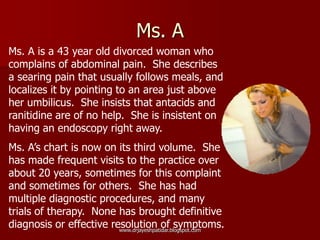
Ms. A is a 43 year old divorced woman who
complains of abdominal pain. She describes
a searing pain that usually follows meals, and
localizes it by pointing to an area just above
her umbilicus. She insists that antacids and
ranitidine are of no help. She is insistent on
having an endoscopy right away.
Ms. A’s chart is now on its third volume. She
has made frequent visits to the practice over
about 20 years, sometimes for this complaint
and sometimes for others. She has had
multiple diagnostic procedures, and many
trials of therapy. None has brought definitive
diagnosis or effective resolution of symptoms.www.drjayeshpatidar.blogspot.com
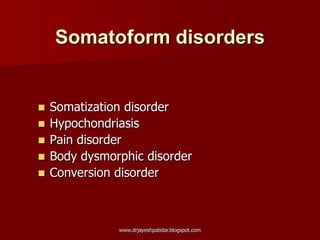
Somatoform disorders
 Somatization disorder
 Hypochondriasis
 Pain disorder
 Body dysmorphic disorder
 Conversion disorder
www.drjayeshpatidar.blogspot.com
Somatization disorder
 “Briquet’s syndrome”
 Clinical features
 Epidemiology
www.drjayeshpatidar.blogspot.com
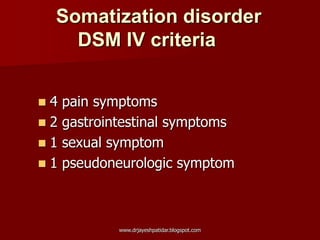
 4 pain symptoms
 2 gastrointestinal symptoms
 1 sexual symptom
 1 pseudoneurologic symptom
Somatization disorder
DSM IV criteria
www.drjayeshpatidar.blogspot.com
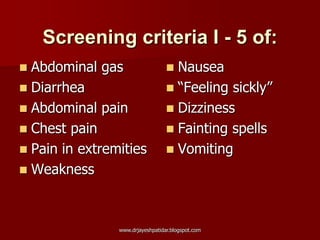
Screening criteria I - 5 of:
 Abdominal gas
 Diarrhea
 Abdominal pain
 Chest pain
 Pain in extremities
 Weakness
 Nausea
 “Feeling sickly”
 Dizziness
 Fainting spells
 Vomiting
www.drjayeshpatidar.blogspot.com
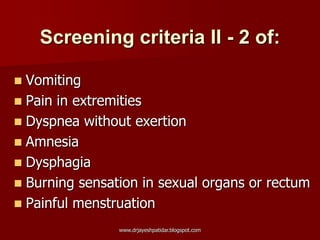
Screening criteria II - 2 of:
 Vomiting
 Pain in extremities
 Dyspnea without exertion
 Amnesia
 Dysphagia
 Burning sensation in sexual organs or rectum
 Painful menstruation
www.drjayeshpatidar.blogspot.com
Frequency of common symptoms
in somatization disorder
See Andreasen & Black (4th Ed.), Table 8-3
www.drjayeshpatidar.blogspot.com
Ms. A - 2
You remind Ms. A that she had an upper GI
series of X-ray studies less than a year ago,
and an upper endoscopy about six months
ago. The complaints were identical then, and
the results were negative. You begin to make
some recommendations about changes in
eating patterns, when she interrupts.
“I’ve tried all that and it doesn’t work. I know
I have an ulcer and the exams last year were
negative because they missed it. I never had
much faith in that gastroenterologist you
referred me to, anyway. You’ve got to find
someone who can make the diagnosis and
take care of it properly.”
www.drjayeshpatidar.blogspot.com
Hypochondriasis
 Generalized fear of or belief in illness
 Prevalence in men = women
 Pervasive disruption of psychosocial
function
www.drjayeshpatidar.blogspot.com
Hypochondriasis - clinical
features
 Complaints: GI, pain, cardiovascular
 Chronic, variable
 Preoccupied, disabled
 Attitudes towards physicians
www.drjayeshpatidar.blogspot.com
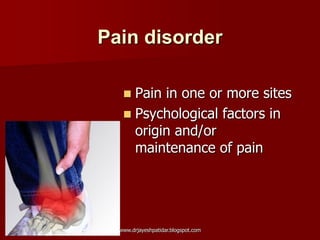
Pain disorder
 Pain in one or more sites
 Psychological factors in
origin and/or
maintenance of pain
www.drjayeshpatidar.blogspot.com
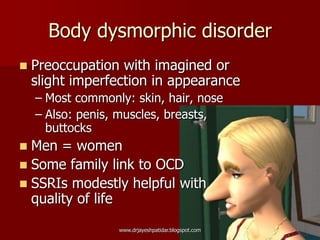
Body dysmorphic disorder
 Preoccupation with imagined or
slight imperfection in appearance
– Most commonly: skin, hair, nose
– Also: penis, muscles, breasts,
buttocks
 Men = women
 Some family link to OCD
 SSRIs modestly helpful with
quality of life
www.drjayeshpatidar.blogspot.com
Conversion disorder
 Loss of, or alteration in, physical function,
resulting from psychologic need or conflict
 Historical roots
www.drjayeshpatidar.blogspot.com
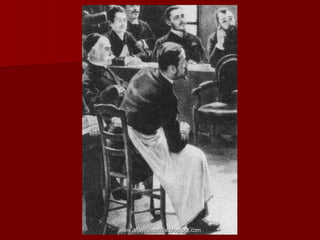
Jean-Marie Charcot
www.drjayeshpatidar.blogspot.com
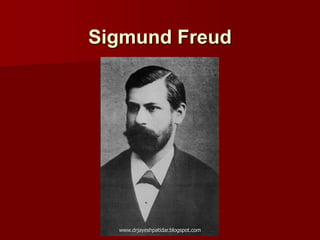
Sigmund Freud
www.drjayeshpatidar.blogspot.com
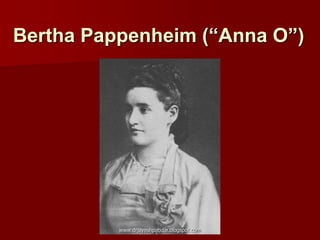
Bertha Pappenheim (“Anna O”)
www.drjayeshpatidar.blogspot.com
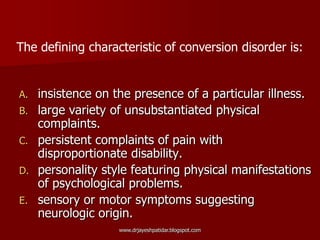
A. insistence on the presence of a particular illness.
B. large variety of unsubstantiated physical
complaints.
C. persistent complaints of pain with
disproportionate disability.
D. personality style featuring physical manifestations
of psychological problems.
E. sensory or motor symptoms suggesting
neurologic origin.
The defining characteristic of conversion disorder is:
www.drjayeshpatidar.blogspot.com
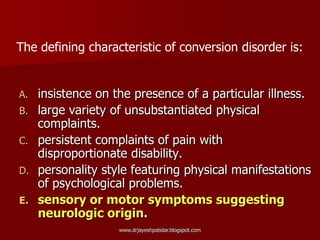
A. insistence on the presence of a particular illness.
B. large variety of unsubstantiated physical
complaints.
C. persistent complaints of pain with
disproportionate disability.
D. personality style featuring physical manifestations
of psychological problems.
E. sensory or motor symptoms suggesting
neurologic origin.
The defining characteristic of conversion disorder is:
www.drjayeshpatidar.blogspot.com
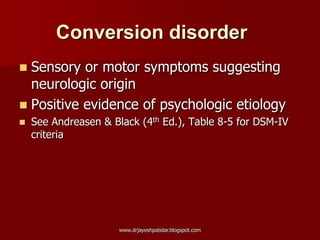
 Sensory or motor symptoms suggesting
neurologic origin
 Positive evidence of psychologic etiology
 See Andreasen & Black (4th Ed.), Table 8-5 for DSM-IV
criteria
Conversion disorder
www.drjayeshpatidar.blogspot.com
Differential diagnosis
 Malingering / factitious disorder
 Somatic delusions
 Mood disorder
www.drjayeshpatidar.blogspot.com
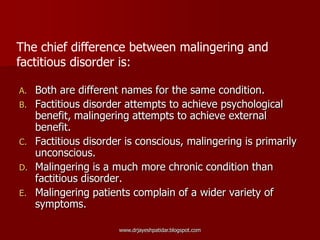
A. Both are different names for the same condition.
B. Factitious disorder attempts to achieve psychological
benefit, malingering attempts to achieve external
benefit.
C. Factitious disorder is conscious, malingering is primarily
unconscious.
D. Malingering is a much more chronic condition than
factitious disorder.
E. Malingering patients complain of a wider variety of
symptoms.
The chief difference between malingering and
factitious disorder is:
www.drjayeshpatidar.blogspot.com
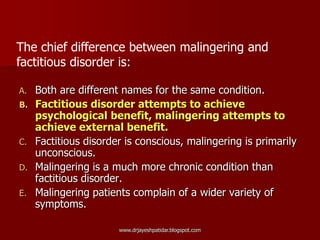
A. Both are different names for the same condition.
B. Factitious disorder attempts to achieve
psychological benefit, malingering attempts to
achieve external benefit.
C. Factitious disorder is conscious, malingering is primarily
unconscious.
D. Malingering is a much more chronic condition than
factitious disorder.
E. Malingering patients complain of a wider variety of
symptoms.
The chief difference between malingering and
factitious disorder is:
www.drjayeshpatidar.blogspot.com
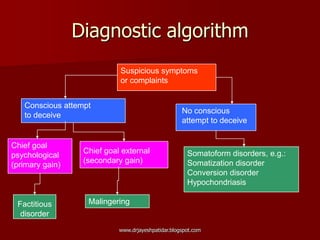
Diagnostic algorithm
Suspicious symptoms
or complaints
Conscious attempt
to deceive
No conscious
attempt to deceive
Somatoform disorders, e.g.:
Somatization disorder
Conversion disorder
Hypochondriasis
Chief goal
psychological
(primary gain)
Factitious
disorder
Chief goal external
(secondary gain)
Malingering
www.drjayeshpatidar.blogspot.com
Primary gain Solution to an
internal problem
Secondary gain Environmental
influences that
perpetuate somatization
www.drjayeshpatidar.blogspot.com
Factitious Disorder
 Production of symptoms under voluntary
control
− Worsen when observed
− Bizarre or ridiculous
− Wax and wane with environmental events
 Goal is to assume “patient role”
 External incentives absent
www.drjayeshpatidar.blogspot.com
Malingering: DSM-IV (V65.2)
Intentional production of
false or grossly
exaggerated symptoms,
motivated by external
incentives such as
obtaining financial
compensation or drugs, or
avoiding work, military
duty, or criminal
prosecution
www.drjayeshpatidar.blogspot.com
Malingering
 Symptoms under voluntary control
− Patient acknowledgement
− Direct observation
− Failure to cooperate with treatment
− Rapid remission when incentives removed
 Causal relationship to environmental incentive
− Avoidance of work, punishment, military service
− Financial gain
− Acquisition of drugs
 Cannot be explained by desire to assume
patient role, or by other mental disorder
www.drjayeshpatidar.blogspot.com
ALL PAIN
IS REAL
www.drjayeshpatidar.blogspot.com
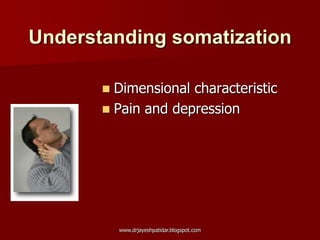
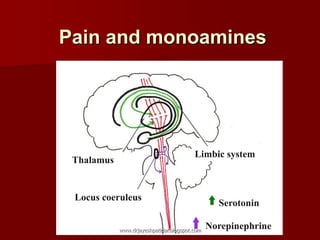
Understanding somatization
 Dimensional characteristic
 Pain and depression
www.drjayeshpatidar.blogspot.com
Pain and monoamines
Limbic system
Thalamus
Locus coeruleus
Serotonin
Norepinephrinewww.drjayeshpatidar.blogspot.com
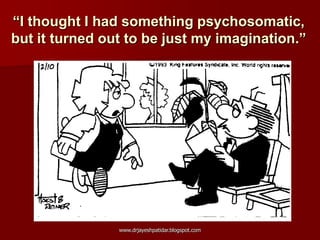
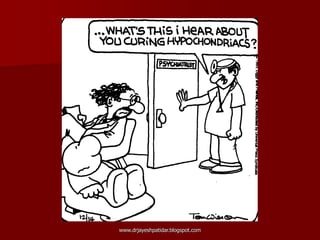
“I thought I had something psychosomatic,
but it turned out to be just my imagination.”
www.drjayeshpatidar.blogspot.com
The goal is
MANAGEMENT,
not cure
www.drjayeshpatidar.blogspot.com
Keep in
control of the
case
www.drjayeshpatidar.blogspot.com
Schedule regular
appointments
Break the cycle of symptoms ↔ attention
www.drjayeshpatidar.blogspot.com
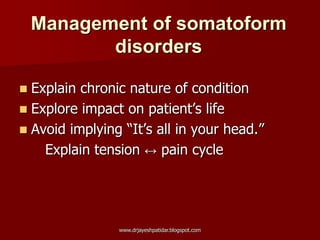
Management of somatoform
disorders
 Explain chronic nature of condition
 Explore impact on patient’s life
 Avoid implying “It’s all in your head.”
Explain tension ↔ pain cycle
www.drjayeshpatidar.blogspot.com
Management of somatoform
disorders
•Explain chronic nature of condition
•Explore impact on patient’s life
•Avoid implying “It’s all in your head.”
• Explain tension ↔ pain cycle
•Brief physical exam
www.drjayeshpatidar.blogspot.com
20 minutes / month
= 4 hours / year
www.drjayeshpatidar.blogspot.com
Signs and symptoms of
depression
 Hopelessness
 Guilt
 Irritability
 Diminished interest or pleasure
 Diminished energy
 Sleep or appetite disturbance
www.drjayeshpatidar.blogspot.com

Somatoform disorders

  • 1.
  • 2.
    Objectives: Somatoform disorders Identify the diagnostic features of the most common somatoform disorders  List characteristics differentiating somatoform disorders from malingering and factitious disorders  Outline management strategies for patients with somatoform disorders. By the conclusion of the presentation, the student will be able to: www.drjayeshpatidar.blogspot.com
  • 3.
    Somatoform disorders  Contextand definitions  Epidemiology  Social and medical cost www.drjayeshpatidar.blogspot.com
  • 4.
    Ms. A Ms. Ais a 43 year old divorced woman who complains of abdominal pain. She describes a searing pain that usually follows meals, and localizes it by pointing to an area just above her umbilicus. She insists that antacids and ranitidine are of no help. She is insistent on having an endoscopy right away. Ms. A’s chart is now on its third volume. She has made frequent visits to the practice over about 20 years, sometimes for this complaint and sometimes for others. She has had multiple diagnostic procedures, and many trials of therapy. None has brought definitive diagnosis or effective resolution of symptoms.www.drjayeshpatidar.blogspot.com
  • 5.
    Somatoform disorders  Somatizationdisorder  Hypochondriasis  Pain disorder  Body dysmorphic disorder  Conversion disorder www.drjayeshpatidar.blogspot.com
  • 6.
    Somatization disorder  “Briquet’ssyndrome”  Clinical features  Epidemiology www.drjayeshpatidar.blogspot.com
  • 7.
     4 painsymptoms  2 gastrointestinal symptoms  1 sexual symptom  1 pseudoneurologic symptom Somatization disorder DSM IV criteria www.drjayeshpatidar.blogspot.com
  • 8.
    Screening criteria I- 5 of:  Abdominal gas  Diarrhea  Abdominal pain  Chest pain  Pain in extremities  Weakness  Nausea  “Feeling sickly”  Dizziness  Fainting spells  Vomiting www.drjayeshpatidar.blogspot.com
  • 9.
    Screening criteria II- 2 of:  Vomiting  Pain in extremities  Dyspnea without exertion  Amnesia  Dysphagia  Burning sensation in sexual organs or rectum  Painful menstruation www.drjayeshpatidar.blogspot.com
  • 10.
    Frequency of commonsymptoms in somatization disorder See Andreasen & Black (4th Ed.), Table 8-3 www.drjayeshpatidar.blogspot.com
  • 11.
    Ms. A -2 You remind Ms. A that she had an upper GI series of X-ray studies less than a year ago, and an upper endoscopy about six months ago. The complaints were identical then, and the results were negative. You begin to make some recommendations about changes in eating patterns, when she interrupts. “I’ve tried all that and it doesn’t work. I know I have an ulcer and the exams last year were negative because they missed it. I never had much faith in that gastroenterologist you referred me to, anyway. You’ve got to find someone who can make the diagnosis and take care of it properly.” www.drjayeshpatidar.blogspot.com
  • 12.
    Hypochondriasis  Generalized fearof or belief in illness  Prevalence in men = women  Pervasive disruption of psychosocial function www.drjayeshpatidar.blogspot.com
  • 13.
    Hypochondriasis - clinical features Complaints: GI, pain, cardiovascular  Chronic, variable  Preoccupied, disabled  Attitudes towards physicians www.drjayeshpatidar.blogspot.com
  • 14.
    Pain disorder  Painin one or more sites  Psychological factors in origin and/or maintenance of pain www.drjayeshpatidar.blogspot.com
  • 15.
    Body dysmorphic disorder Preoccupation with imagined or slight imperfection in appearance – Most commonly: skin, hair, nose – Also: penis, muscles, breasts, buttocks  Men = women  Some family link to OCD  SSRIs modestly helpful with quality of life www.drjayeshpatidar.blogspot.com
  • 16.
    Conversion disorder  Lossof, or alteration in, physical function, resulting from psychologic need or conflict  Historical roots www.drjayeshpatidar.blogspot.com
  • 17.
  • 18.
  • 19.
  • 20.
    Bertha Pappenheim (“AnnaO”) www.drjayeshpatidar.blogspot.com
  • 21.
    A. insistence onthe presence of a particular illness. B. large variety of unsubstantiated physical complaints. C. persistent complaints of pain with disproportionate disability. D. personality style featuring physical manifestations of psychological problems. E. sensory or motor symptoms suggesting neurologic origin. The defining characteristic of conversion disorder is: www.drjayeshpatidar.blogspot.com
  • 22.
    A. insistence onthe presence of a particular illness. B. large variety of unsubstantiated physical complaints. C. persistent complaints of pain with disproportionate disability. D. personality style featuring physical manifestations of psychological problems. E. sensory or motor symptoms suggesting neurologic origin. The defining characteristic of conversion disorder is: www.drjayeshpatidar.blogspot.com
  • 23.
     Sensory ormotor symptoms suggesting neurologic origin  Positive evidence of psychologic etiology  See Andreasen & Black (4th Ed.), Table 8-5 for DSM-IV criteria Conversion disorder www.drjayeshpatidar.blogspot.com
  • 24.
    Differential diagnosis  Malingering/ factitious disorder  Somatic delusions  Mood disorder www.drjayeshpatidar.blogspot.com
  • 25.
    A. Both aredifferent names for the same condition. B. Factitious disorder attempts to achieve psychological benefit, malingering attempts to achieve external benefit. C. Factitious disorder is conscious, malingering is primarily unconscious. D. Malingering is a much more chronic condition than factitious disorder. E. Malingering patients complain of a wider variety of symptoms. The chief difference between malingering and factitious disorder is: www.drjayeshpatidar.blogspot.com
  • 26.
    A. Both aredifferent names for the same condition. B. Factitious disorder attempts to achieve psychological benefit, malingering attempts to achieve external benefit. C. Factitious disorder is conscious, malingering is primarily unconscious. D. Malingering is a much more chronic condition than factitious disorder. E. Malingering patients complain of a wider variety of symptoms. The chief difference between malingering and factitious disorder is: www.drjayeshpatidar.blogspot.com
  • 27.
    Diagnostic algorithm Suspicious symptoms orcomplaints Conscious attempt to deceive No conscious attempt to deceive Somatoform disorders, e.g.: Somatization disorder Conversion disorder Hypochondriasis Chief goal psychological (primary gain) Factitious disorder Chief goal external (secondary gain) Malingering www.drjayeshpatidar.blogspot.com
  • 28.
    Primary gain Solutionto an internal problem Secondary gain Environmental influences that perpetuate somatization www.drjayeshpatidar.blogspot.com
  • 29.
    Factitious Disorder  Productionof symptoms under voluntary control − Worsen when observed − Bizarre or ridiculous − Wax and wane with environmental events  Goal is to assume “patient role”  External incentives absent www.drjayeshpatidar.blogspot.com
  • 30.
    Malingering: DSM-IV (V65.2) Intentionalproduction of false or grossly exaggerated symptoms, motivated by external incentives such as obtaining financial compensation or drugs, or avoiding work, military duty, or criminal prosecution www.drjayeshpatidar.blogspot.com
  • 31.
    Malingering  Symptoms undervoluntary control − Patient acknowledgement − Direct observation − Failure to cooperate with treatment − Rapid remission when incentives removed  Causal relationship to environmental incentive − Avoidance of work, punishment, military service − Financial gain − Acquisition of drugs  Cannot be explained by desire to assume patient role, or by other mental disorder www.drjayeshpatidar.blogspot.com
  • 32.
  • 33.
    Understanding somatization  Dimensionalcharacteristic  Pain and depression www.drjayeshpatidar.blogspot.com
  • 34.
    Pain and monoamines Limbicsystem Thalamus Locus coeruleus Serotonin Norepinephrinewww.drjayeshpatidar.blogspot.com
  • 35.
    “I thought Ihad something psychosomatic, but it turned out to be just my imagination.” www.drjayeshpatidar.blogspot.com
  • 36.
    The goal is MANAGEMENT, notcure www.drjayeshpatidar.blogspot.com
  • 37.
    Keep in control ofthe case www.drjayeshpatidar.blogspot.com
  • 38.
    Schedule regular appointments Break thecycle of symptoms ↔ attention www.drjayeshpatidar.blogspot.com
  • 39.
    Management of somatoform disorders Explain chronic nature of condition  Explore impact on patient’s life  Avoid implying “It’s all in your head.” Explain tension ↔ pain cycle www.drjayeshpatidar.blogspot.com
  • 40.
  • 41.
    Management of somatoform disorders •Explainchronic nature of condition •Explore impact on patient’s life •Avoid implying “It’s all in your head.” • Explain tension ↔ pain cycle •Brief physical exam www.drjayeshpatidar.blogspot.com
  • 42.
    20 minutes /month = 4 hours / year www.drjayeshpatidar.blogspot.com
  • 43.
    Signs and symptomsof depression  Hopelessness  Guilt  Irritability  Diminished interest or pleasure  Diminished energy  Sleep or appetite disturbance www.drjayeshpatidar.blogspot.com
  • 44.