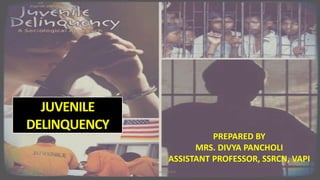
JUVENILE
DELINQUENCY
PREPARED BY
MRS. DIVYA PANCHOLI
ASSISTANT PROFESSOR, SSRCN, VAPI
4/9/2020 Mrs. Divya Pancholi 1
INTRODUCTION
•Delinquency is a kind of abnormality when an
individual deviates from the course of normal
social life, his behaviour is called ‘delinquency’.
• When a juvenile below an age specified in their
state exhibits behaviour which may prove to be
dangerous to society, he may be called ‘Juvenile
delinquent’.
4/9/2020 Mrs. Divya Pancholi 2
DEFINITION
•Juvenile delinquency is illegal behaviour by a
minor that would be considered criminal against
the state (vandalism, petty theft, auto theft, rape
etc)
4/9/2020 Mrs. Divya Pancholi 3
4/9/2020 Mrs. Divya Pancholi 4
4/9/2020 Mrs. Divya Pancholi 5
4/9/2020 Mrs. Divya Pancholi 6
4/9/2020 Mrs. Divya Pancholi 7
4/9/2020 Mrs. Divya Pancholi 8
4/9/2020 Mrs. Divya Pancholi 9
4/9/2020 Mrs. Divya Pancholi 10
4/9/2020 Mrs. Divya Pancholi 11
4/9/2020 Mrs. Divya Pancholi 12
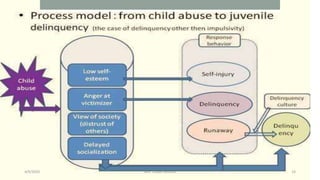
4/9/2020 Mrs. Divya Pancholi 13
4/9/2020 Mrs. Divya Pancholi 14
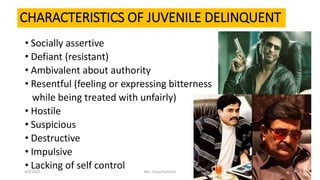
CHARACTERISTICS OF JUVENILE DELINQUENT
• Socially assertive
• Defiant (resistant)
• Ambivalent about authority
• Resentful (feeling or expressing bitterness
while being treated with unfairly)
• Hostile
• Suspicious
• Destructive
• Impulsive
• Lacking of self control4/9/2020 Mrs. Divya Pancholi 15
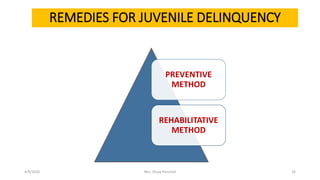
REMEDIES FOR JUVENILE DELINQUENCY
PREVENTIVE
METHOD
REHABILITATIVE
METHOD
4/9/2020 Mrs. Divya Pancholi 16
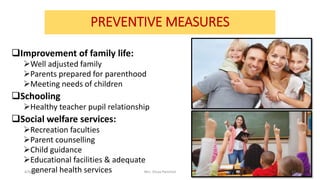
PREVENTIVE MEASURES
Improvement of family life:
Well adjusted family
Parents prepared for parenthood
Meeting needs of children
Schooling
Healthy teacher pupil relationship
Social welfare services:
Recreation faculties
Parent counselling
Child guidance
Educational facilities & adequate
general health services4/9/2020 Mrs. Divya Pancholi 17
REHABILITATIVE MEASURES
•Legislative measures
•Remand home
4/9/2020 Mrs. Divya Pancholi 18
Juvenile Justice (care and protection of children)
Act, 2015
• It has been passed by parliament of India in 2015.
• According to this act,
• “ A juvenile is the person who has not completed 18
years of age and hence juvenile delinquency refers to
antisocial or illegal behaviour by children. There are
many reasons like family environment, mental
disorder, social disorganization etc. because of which
child commits a crime he is known as Juvenile
delinquent.”4/9/2020 Mrs. Divya Pancholi 19
Penalties for juveniledelinquents
• House arrest- The judge can order the minor to remain at home, with
exceptions (attend school, work, counseling, and so on).
• Juvenile hall/juvenile detention facility- facilities designed for short-
term stays.
• Probation after juvenile hall- Probation is a program of supervision
in which the minor's freedom is limited and activities restricted.
• Secured juvenile facilities- facilities designed for longer term stays,
like months or years.
• Adult jail- In some cases, a judge can send a juvenile to adult
facilities like country jail or state prison.
4/9/2020 Mrs. Divya Pancholi 20
•Verbal warning
•Rehab
•Fine- May be required to pay a fine to the government
or pay compensation to the victim.
•Counselling
•Community service
•Electronic monitoring- Juveniles may be required to
wear a wrist or ankle bracelet that verifies their
location at all times.
4/9/2020 Mrs. Divya Pancholi 21
PSYCHOTHERAPIES
The Reality Therapy
• Approach to counselling and problem- solving focuses on the here-
and-now of the client and how to create a better future, instead of
concentrating at length on the past.
• It emphasizes making decisions, and taking action and control of
one's own life.
• Typically, clients seek to discover what they really want and
whether what they are currently doing (how they are choosing to
behave) is actually bringing them nearer to, or further away from,
that goal.4/9/2020 Mrs. Divya Pancholi 22
PSYCHOTHERAPIES
Milieu Therapy
•It is the psychiatric treatment of mental disorders by making
changes to a patient's immediate environment.
•It involves the patient joining a group and using the
combined elements of positive peer pressure, trust, safety
and repetition, it provides an idealized setting for group
members to work through their psychological issues.
4/9/2020 Mrs. Divya Pancholi 23
• Behaviour therapy is focused on helping an individual understand how changing their
behaviour can lead to changes in how they are feeling. The goal of behaviour therapy is
usually focused on increasing the person’s engagement in positive or socially reinforcing
activities.
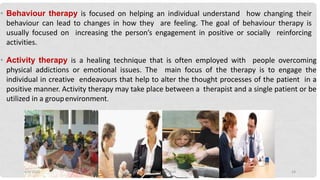
• Activity therapy is a healing technique that is often employed with people overcoming
physical addictions or emotional issues. The main focus of the therapy is to engage the
individual in creative endeavours that help to alter the thought processes of the patient in a
positive manner. Activity therapy may take place between a therapist and a single patient or be
utilized in a groupenvironment.
4/9/2020 Mrs. Divya Pancholi 24
4/9/2020 Mrs. Divya Pancholi 25

JUVENILE DELINQUENCY

  • 1.
    JUVENILE DELINQUENCY PREPARED BY MRS. DIVYAPANCHOLI ASSISTANT PROFESSOR, SSRCN, VAPI 4/9/2020 Mrs. Divya Pancholi 1
  • 2.
    INTRODUCTION •Delinquency is akind of abnormality when an individual deviates from the course of normal social life, his behaviour is called ‘delinquency’. • When a juvenile below an age specified in their state exhibits behaviour which may prove to be dangerous to society, he may be called ‘Juvenile delinquent’. 4/9/2020 Mrs. Divya Pancholi 2
  • 3.
    DEFINITION •Juvenile delinquency isillegal behaviour by a minor that would be considered criminal against the state (vandalism, petty theft, auto theft, rape etc) 4/9/2020 Mrs. Divya Pancholi 3
  • 4.
  • 5.
  • 6.
  • 7.
  • 8.
  • 9.
  • 10.
  • 11.
  • 12.
  • 13.
  • 14.
  • 15.
    CHARACTERISTICS OF JUVENILEDELINQUENT • Socially assertive • Defiant (resistant) • Ambivalent about authority • Resentful (feeling or expressing bitterness while being treated with unfairly) • Hostile • Suspicious • Destructive • Impulsive • Lacking of self control4/9/2020 Mrs. Divya Pancholi 15
  • 16.
    REMEDIES FOR JUVENILEDELINQUENCY PREVENTIVE METHOD REHABILITATIVE METHOD 4/9/2020 Mrs. Divya Pancholi 16
  • 17.
    PREVENTIVE MEASURES Improvement offamily life: Well adjusted family Parents prepared for parenthood Meeting needs of children Schooling Healthy teacher pupil relationship Social welfare services: Recreation faculties Parent counselling Child guidance Educational facilities & adequate general health services4/9/2020 Mrs. Divya Pancholi 17
  • 18.
  • 19.
    Juvenile Justice (careand protection of children) Act, 2015 • It has been passed by parliament of India in 2015. • According to this act, • “ A juvenile is the person who has not completed 18 years of age and hence juvenile delinquency refers to antisocial or illegal behaviour by children. There are many reasons like family environment, mental disorder, social disorganization etc. because of which child commits a crime he is known as Juvenile delinquent.”4/9/2020 Mrs. Divya Pancholi 19
  • 20.
    Penalties for juveniledelinquents •House arrest- The judge can order the minor to remain at home, with exceptions (attend school, work, counseling, and so on). • Juvenile hall/juvenile detention facility- facilities designed for short- term stays. • Probation after juvenile hall- Probation is a program of supervision in which the minor's freedom is limited and activities restricted. • Secured juvenile facilities- facilities designed for longer term stays, like months or years. • Adult jail- In some cases, a judge can send a juvenile to adult facilities like country jail or state prison. 4/9/2020 Mrs. Divya Pancholi 20
  • 21.
    •Verbal warning •Rehab •Fine- Maybe required to pay a fine to the government or pay compensation to the victim. •Counselling •Community service •Electronic monitoring- Juveniles may be required to wear a wrist or ankle bracelet that verifies their location at all times. 4/9/2020 Mrs. Divya Pancholi 21
  • 22.
    PSYCHOTHERAPIES The Reality Therapy •Approach to counselling and problem- solving focuses on the here- and-now of the client and how to create a better future, instead of concentrating at length on the past. • It emphasizes making decisions, and taking action and control of one's own life. • Typically, clients seek to discover what they really want and whether what they are currently doing (how they are choosing to behave) is actually bringing them nearer to, or further away from, that goal.4/9/2020 Mrs. Divya Pancholi 22
  • 23.
    PSYCHOTHERAPIES Milieu Therapy •It isthe psychiatric treatment of mental disorders by making changes to a patient's immediate environment. •It involves the patient joining a group and using the combined elements of positive peer pressure, trust, safety and repetition, it provides an idealized setting for group members to work through their psychological issues. 4/9/2020 Mrs. Divya Pancholi 23
  • 24.
    • Behaviour therapyis focused on helping an individual understand how changing their behaviour can lead to changes in how they are feeling. The goal of behaviour therapy is usually focused on increasing the person’s engagement in positive or socially reinforcing activities. • Activity therapy is a healing technique that is often employed with people overcoming physical addictions or emotional issues. The main focus of the therapy is to engage the individual in creative endeavours that help to alter the thought processes of the patient in a positive manner. Activity therapy may take place between a therapist and a single patient or be utilized in a groupenvironment. 4/9/2020 Mrs. Divya Pancholi 24
  • 25.