(ACUTE ORGANIC BRAIN SYNDROME)
DELIRIUM
PREPARED BY
MRS. DIVYA PANCHOLI
ASSISTANT PROFESSOR, SSRCN, VAPI
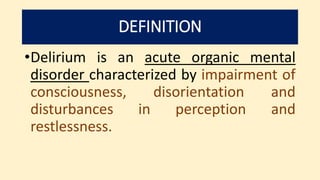
DEFINITION
•Delirium is an acute organic mental
disorder characterized by impairment of
consciousness, disorientation and
disturbances in perception and
restlessness.
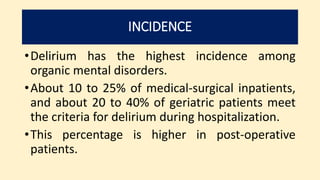
INCIDENCE
•Delirium has the highest incidence among
organic mental disorders.
•About 10 to 25% of medical-surgical inpatients,
and about 20 to 40% of geriatric patients meet
the criteria for delirium during hospitalization.
•This percentage is higher in post-operative
patients.
ETIOLOGY
• Vascular: hypertensive
encephalopathy, cerebral
arteriosclerosis, intracranial
haemorrhage
• Infections: encephalitis, meningitis
• Neoplastic: space occupying lesions
• Intoxication: chronic intoxication or
withdrawal effect of sedative-
hypnotic drugs
• Traumatic: subdural and epidural
hematoma, contusion, laceration,
post-operative, heatstroke
• Vitamin deficiency, e.g.thiamine
• Endocrine and metabolic: diabetic
coma and shock, uremia,
myxedema, hyperthyroidism,
hepatic failure
• Metals: heavy metals (lead,
manganese,' mercury), carbon
monoxide and toxins
• Anoxia: anemia, pulmonary or
cardiac failure
CLINICAL FEATURES
• Impairment of consciousness: clouding
of consciousness ranging from
drowsiness to stupor and coma.
• Impairment of attention: difficulty in
shifting, focusing and sustaining
attention.
• Perceptual disturbances: illusions and
hallucinations, most often visual.
• Disturbance of cognition: impairment
of abstract thinking and
comprehension, impairment of
immediate and recent memory,
hyperactivity, aimless groping or picking
at the bed clothes (flocculation),
enhanced startle reaction.
• Disturbance of the sleep-wake cycle:
insomnia or in severe cases total sleep
loss or reversal of sleep-wake cycle,
daytime drowsiness, nocturnal
worsening of symptoms, disturbing
dreams or nightmares, which may
continue as hallucinations after
awakening.
• Emotional disturbances: depression,
anxiety, fear, irritability, euphoria,
apathy or wondering perplexity.
COURSE AND PROGNOSIS
•The onset is usually abrupt.
•The duration of an episode is usually brief ,
lasting for about a week
TREATMENT
• Identification of cause and its immediate correction,
e.g., 50 mg of 50% dextrose IV for hypoglycemia,
0xygen for hypoxia, 100mg of B1 IV for thiamine
deficiency, IV fluids for fluid and electrolyte
imbalance.
• Symptomatic measures: benzodiazepines (10 mg
diazepam or 2 mg lorazepam IV) or antipsychotics (5
mg haloparidol or 50 mg chlorpromazine IM)may be
given.
Nursing Intervention
•Providing safe environments
•Alleviating patient’s fear and anxiety
•Meeting the physical needs of the patient
•Facilitate orientation
ORGANIC AMNESTIC SYNDROME
•Organic amnestic syndrome is characterized
by impairment of memory and global
intellectual functioning due to an underlying
organic cause.
•There is no disturbance of consciousness.
ETIOLOGY
• Thiamine deficiency, the most
common cause being chronic
alcoholism. It is also called as
"Wernicke-Korsakoff syndrome.“
• Wernicke's encephalopathy is an
acute phase of delirium
preceding amnestic syndrome,
while Korsakoff's syndrome is a
chronic phase of amnestic
syndrome.
• Head trauma
• Bilateral temporal lobectomy
• Hypoxia
• Brain tumors
• Herpes simplex encephalitis
• Stroke
CLINICAL FEATURES
• Recent memory impairment
• Anterograde and retrograde amnesia
• There is no impairment of immediate memory
MANAGEMENT
•Treatment for underlying cause.
MENTAL DISORDERS DUE TO BRAIN DAMAGE,
DYSFUNCTION AND PHYSICAL DISEASE
•These are mental disorders, which are
causally related to brain dysfunction due to
primary cerebral disease, systemic disease
or toxic substances.
CONTI….
• Primary cerebral diseases: Epilepsy,
encephalitis, head trauma, brain
neoplasms, vascular cerebral disease
and cerebral malformations.
• Systemic diseases: Hypothyroidism,
Cushing's disease, hypoxia,
hypoglycemia, systemic lupus
erythematosis and extracranial
neoplasms.
• Drugs: Steroids, antihypertensives,
antimalarials, alcohol and
psychoactive substances.
• The following mental disorders
come under this category:
Organic hallucinosis
Organic catatonic disorder
Organic delusional disorder
Organic mood disorder
Organic anxiety disorder.
PERSONALITY AND BEHAVIORAL DISORDERS DUE
TO BRAIN DISEASE, DAMAGE AND DYSFUNCTION
• These disorders are characterized by significant
alteration of the premorbid personality due to
underlying organic cause. There is no disturbance of
consciousness and global intellectual function.
• The personality change may be characterized by
emotional lability, poor impulse control, apathy,
hostility or accentuation of earlier personality traits.
ETIOLOGY
•Complex partial seizures (temporal lobe
seizures)
•Cerebral neoplasms
•Cerebrovascular disease
•Head injury.
MANAGEMENT
•Treatment for the underlying cause.
•Symptomatic treatment with lithium,
carbamazepine or with antipsychotics.
You can refer following link also
• https://www.youtube.com/watch?v=qmMYsVaZ0zo
• https://www.youtube.com/watch?v=FstSYkold5c
• https://www.youtube.com/watch?v=dhlkyIiD_RA
• https://www.youtube.com/watch?v=Y4IR8qETJik
Delirium

Delirium

  • 1.
    (ACUTE ORGANIC BRAINSYNDROME) DELIRIUM PREPARED BY MRS. DIVYA PANCHOLI ASSISTANT PROFESSOR, SSRCN, VAPI
  • 2.
    DEFINITION •Delirium is anacute organic mental disorder characterized by impairment of consciousness, disorientation and disturbances in perception and restlessness.
  • 3.
    INCIDENCE •Delirium has thehighest incidence among organic mental disorders. •About 10 to 25% of medical-surgical inpatients, and about 20 to 40% of geriatric patients meet the criteria for delirium during hospitalization. •This percentage is higher in post-operative patients.
  • 4.
    ETIOLOGY • Vascular: hypertensive encephalopathy,cerebral arteriosclerosis, intracranial haemorrhage • Infections: encephalitis, meningitis • Neoplastic: space occupying lesions • Intoxication: chronic intoxication or withdrawal effect of sedative- hypnotic drugs • Traumatic: subdural and epidural hematoma, contusion, laceration, post-operative, heatstroke • Vitamin deficiency, e.g.thiamine • Endocrine and metabolic: diabetic coma and shock, uremia, myxedema, hyperthyroidism, hepatic failure • Metals: heavy metals (lead, manganese,' mercury), carbon monoxide and toxins • Anoxia: anemia, pulmonary or cardiac failure
  • 5.
    CLINICAL FEATURES • Impairmentof consciousness: clouding of consciousness ranging from drowsiness to stupor and coma. • Impairment of attention: difficulty in shifting, focusing and sustaining attention. • Perceptual disturbances: illusions and hallucinations, most often visual. • Disturbance of cognition: impairment of abstract thinking and comprehension, impairment of immediate and recent memory, hyperactivity, aimless groping or picking at the bed clothes (flocculation), enhanced startle reaction. • Disturbance of the sleep-wake cycle: insomnia or in severe cases total sleep loss or reversal of sleep-wake cycle, daytime drowsiness, nocturnal worsening of symptoms, disturbing dreams or nightmares, which may continue as hallucinations after awakening. • Emotional disturbances: depression, anxiety, fear, irritability, euphoria, apathy or wondering perplexity.
  • 6.
    COURSE AND PROGNOSIS •Theonset is usually abrupt. •The duration of an episode is usually brief , lasting for about a week
  • 7.
    TREATMENT • Identification ofcause and its immediate correction, e.g., 50 mg of 50% dextrose IV for hypoglycemia, 0xygen for hypoxia, 100mg of B1 IV for thiamine deficiency, IV fluids for fluid and electrolyte imbalance. • Symptomatic measures: benzodiazepines (10 mg diazepam or 2 mg lorazepam IV) or antipsychotics (5 mg haloparidol or 50 mg chlorpromazine IM)may be given.
  • 8.
    Nursing Intervention •Providing safeenvironments •Alleviating patient’s fear and anxiety •Meeting the physical needs of the patient •Facilitate orientation
  • 9.
    ORGANIC AMNESTIC SYNDROME •Organicamnestic syndrome is characterized by impairment of memory and global intellectual functioning due to an underlying organic cause. •There is no disturbance of consciousness.
  • 10.
    ETIOLOGY • Thiamine deficiency,the most common cause being chronic alcoholism. It is also called as "Wernicke-Korsakoff syndrome.“ • Wernicke's encephalopathy is an acute phase of delirium preceding amnestic syndrome, while Korsakoff's syndrome is a chronic phase of amnestic syndrome. • Head trauma • Bilateral temporal lobectomy • Hypoxia • Brain tumors • Herpes simplex encephalitis • Stroke
  • 11.
    CLINICAL FEATURES • Recentmemory impairment • Anterograde and retrograde amnesia • There is no impairment of immediate memory
  • 12.
  • 13.
    MENTAL DISORDERS DUETO BRAIN DAMAGE, DYSFUNCTION AND PHYSICAL DISEASE •These are mental disorders, which are causally related to brain dysfunction due to primary cerebral disease, systemic disease or toxic substances.
  • 14.
    CONTI…. • Primary cerebraldiseases: Epilepsy, encephalitis, head trauma, brain neoplasms, vascular cerebral disease and cerebral malformations. • Systemic diseases: Hypothyroidism, Cushing's disease, hypoxia, hypoglycemia, systemic lupus erythematosis and extracranial neoplasms. • Drugs: Steroids, antihypertensives, antimalarials, alcohol and psychoactive substances. • The following mental disorders come under this category: Organic hallucinosis Organic catatonic disorder Organic delusional disorder Organic mood disorder Organic anxiety disorder.
  • 15.
    PERSONALITY AND BEHAVIORALDISORDERS DUE TO BRAIN DISEASE, DAMAGE AND DYSFUNCTION • These disorders are characterized by significant alteration of the premorbid personality due to underlying organic cause. There is no disturbance of consciousness and global intellectual function. • The personality change may be characterized by emotional lability, poor impulse control, apathy, hostility or accentuation of earlier personality traits.
  • 16.
    ETIOLOGY •Complex partial seizures(temporal lobe seizures) •Cerebral neoplasms •Cerebrovascular disease •Head injury.
  • 17.
    MANAGEMENT •Treatment for theunderlying cause. •Symptomatic treatment with lithium, carbamazepine or with antipsychotics.
  • 18.
    You can referfollowing link also • https://www.youtube.com/watch?v=qmMYsVaZ0zo • https://www.youtube.com/watch?v=FstSYkold5c • https://www.youtube.com/watch?v=dhlkyIiD_RA • https://www.youtube.com/watch?v=Y4IR8qETJik