Solving
Quadratic Equations
by Graphing
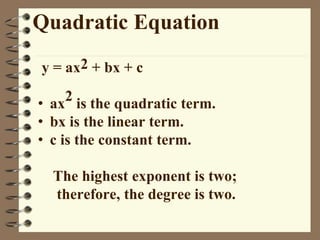
Quadratic Equation
y = ax2 + bx + c
• ax2 is the quadratic term.
• bx is the linear term.
• c is the constant term.
The highest exponent is two;
therefore, the degree is two.
Solving Equations
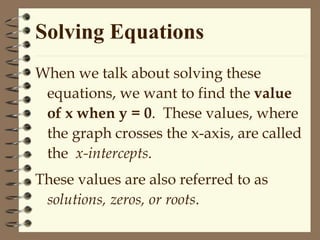
When we talk about solving these
equations, we want to find the value
of x when y = 0. These values, where
the graph crosses the x-axis, are called
the x-intercepts.
These values are also referred to as
solutions, zeros, or roots.
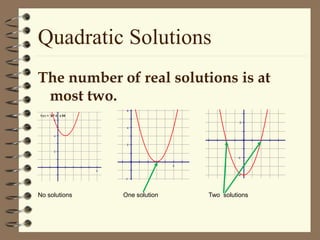
The number of real solutions is at
most two.
Quadratic Solutions
No solutions
6
4
2
-2
5
f x  = x2-2 x +5
6
4
2
-2
5
2
-2
-4
-5 5
One solution Two solutions
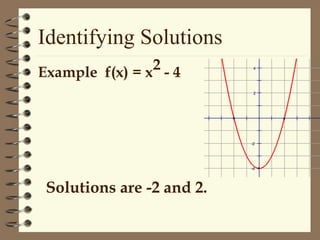
Example f(x) = x2 - 4
Identifying Solutions
4
2
-2
-4
-5
Solutions are -2 and 2.
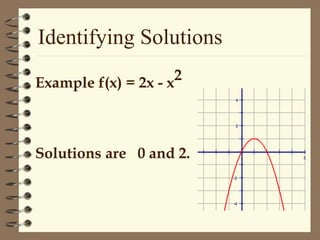
Example f(x) = 2x - x2
Solutions are 0 and 2.
Identifying Solutions
4
2
-2
-4
5
Vertex
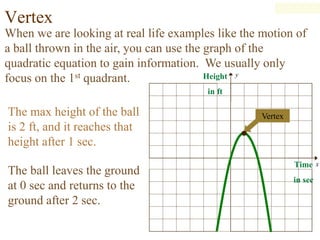
When we are looking at real life examples like the motion of
a ball thrown in the air, you can use the graph of the
quadratic equation to gain information. We usually only
focus on the 1st quadrant. y
x
VertexThe max height of the ball
is 2 ft, and it reaches that
height after 1 sec.
The ball leaves the ground
at 0 sec and returns to the
ground after 2 sec.
Height
in ft
Time
in sec
Graphing a Quadratic Function
Remember, the steps to graphing a parabola in
standard form:
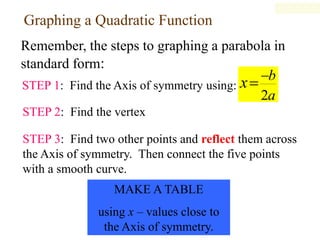
STEP 1: Find the Axis of symmetry using:
STEP 2: Find the vertex
STEP 3: Find two other points and reflect them across
the Axis of symmetry. Then connect the five points
with a smooth curve.
MAKE A TABLE
using x – values close to
the Axis of symmetry.
2
b
a
x 

The graph of a quadratic equation is a
parabola.
The roots or zeros are the x-intercepts.
The vertex is the maximum or
minimum point.
All parabolas have an axis of
symmetry.
Graphing Quadratic
Equations
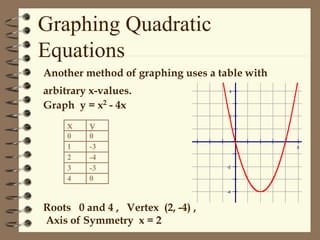
Another method of graphing uses a table with
arbitrary x-values.
Graph y = x2 - 4x
Roots 0 and 4 , Vertex (2, -4) ,
Axis of Symmetry x = 2
Graphing Quadratic
Equations
x y
0 0
1 -3
2 -4
3 -3
4 0
4
2
-2
-4
5

Solving Quadratics by Graphing

  • 1.
  • 2.
    Quadratic Equation y =ax2 + bx + c • ax2 is the quadratic term. • bx is the linear term. • c is the constant term. The highest exponent is two; therefore, the degree is two.
  • 3.
    Solving Equations When wetalk about solving these equations, we want to find the value of x when y = 0. These values, where the graph crosses the x-axis, are called the x-intercepts. These values are also referred to as solutions, zeros, or roots.
  • 4.
    The number ofreal solutions is at most two. Quadratic Solutions No solutions 6 4 2 -2 5 f x  = x2-2 x +5 6 4 2 -2 5 2 -2 -4 -5 5 One solution Two solutions
  • 5.
    Example f(x) =x2 - 4 Identifying Solutions 4 2 -2 -4 -5 Solutions are -2 and 2.
  • 6.
    Example f(x) =2x - x2 Solutions are 0 and 2. Identifying Solutions 4 2 -2 -4 5
  • 7.
    Vertex When we arelooking at real life examples like the motion of a ball thrown in the air, you can use the graph of the quadratic equation to gain information. We usually only focus on the 1st quadrant. y x VertexThe max height of the ball is 2 ft, and it reaches that height after 1 sec. The ball leaves the ground at 0 sec and returns to the ground after 2 sec. Height in ft Time in sec
  • 8.
    Graphing a QuadraticFunction Remember, the steps to graphing a parabola in standard form: STEP 1: Find the Axis of symmetry using: STEP 2: Find the vertex STEP 3: Find two other points and reflect them across the Axis of symmetry. Then connect the five points with a smooth curve. MAKE A TABLE using x – values close to the Axis of symmetry. 2 b a x  
  • 9.
    The graph ofa quadratic equation is a parabola. The roots or zeros are the x-intercepts. The vertex is the maximum or minimum point. All parabolas have an axis of symmetry. Graphing Quadratic Equations
  • 10.
    Another method ofgraphing uses a table with arbitrary x-values. Graph y = x2 - 4x Roots 0 and 4 , Vertex (2, -4) , Axis of Symmetry x = 2 Graphing Quadratic Equations x y 0 0 1 -3 2 -4 3 -3 4 0 4 2 -2 -4 5

Editor's Notes

  • #8 Let students know that in Algebra I we concentrate only on parabolas that are functions; In Algebra II, they will study parabolas that open left or right.