M3L1 SEQUENCES & SERIES
BY M WILLATT
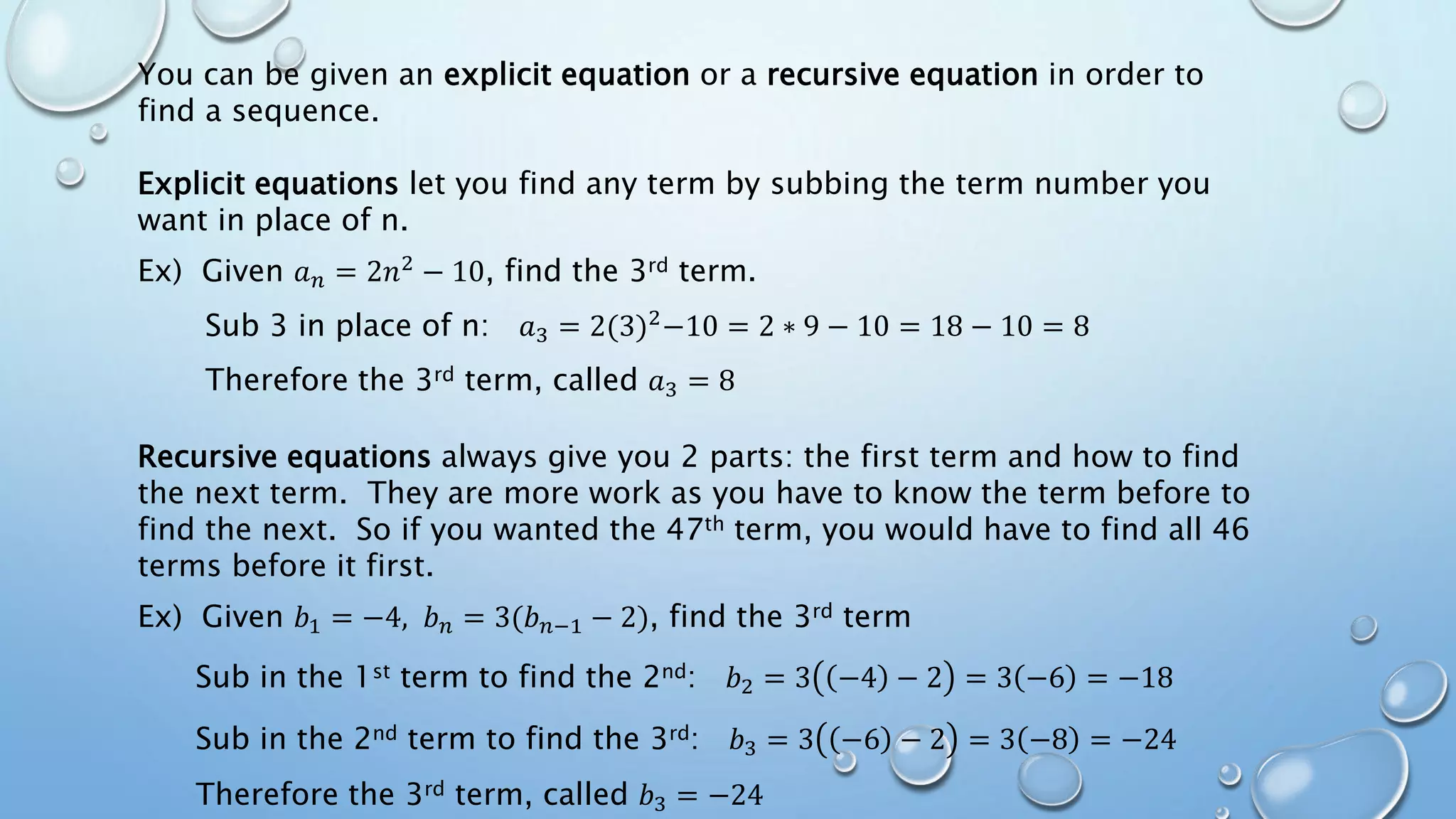
You can be given an explicit equation or a recursive equation in order to
find a sequence.
Explicit equations let you find any term by subbing the term number you
want in place of n.
Ex) Given 𝑎 𝑛 = 2𝑛2 − 10, find the 3rd term.
Sub 3 in place of n: 𝑎3 = 2(3)2
−10 = 2 ∗ 9 − 10 = 18 − 10 = 8
Therefore the 3rd term, called 𝑎3 = 8
Recursive equations always give you 2 parts: the first term and how to find
the next term. They are more work as you have to know the term before to
find the next. So if you wanted the 47th term, you would have to find all 46
terms before it first.
Ex) Given 𝑏1 = −4, 𝑏 𝑛 = 3(𝑏 𝑛−1 − 2), find the 3rd term
Sub in the 1st term to find the 2nd: 𝑏2 = 3 −4 − 2 = 3 −6 = −18
Sub in the 2nd term to find the 3rd: 𝑏3 = 3 −6 − 2 = 3 −8 = −24
Therefore the 3rd term, called 𝑏3 = −24
Notice the subscript lets you know what term you have.
For example, 𝑎6 would be the 6th term
For recursive equations, since 𝒂 𝒏 is the term you’re looking
for, 𝒂 𝒏−𝟏 refers to the term before it.
For example, if we are looking for 𝑎6 then we would need
the term before 𝑎6−1 = 𝑎5 in order to help us find 𝑎6.
Also, the letters a or b can be used to define the equations. It
doesn’t refer to what type of equation. The letters are
arbitrary.
Let’s try some for practice!
Find the 4th term for each sequence below:
1) Given 𝑎 𝑛 = −4 𝑛 + 5 − 2  EXPLICIT, just sub in 4 for n.
Sub 4 in place of n: 𝑎4 = −4 4 + 5 − 2 = −4 9 − 2 = −36 − 2 = −38
Therefore the 4th term, called 𝑎4 = −38
2) Given 𝑎1 = 10, 𝑎 𝑛 = −2𝑎 𝑛−1  RECURSIVE, find each term before.
Sub in the 1st term to find the 2nd: 𝑎2 = −2 10 = −20
Sub in the 2nd term to find the 3rd: 𝑎3 = −2 −20 = 40
Sub in the 3rd term to find the 4th: 𝑎4 = −2 40 = −80
Therefore the 4th term, called 𝑎4 = −80
My explicit 4th term -38 is bigger than my recursive term -80 by 42.
A sequence is a list of numbers. Ex) {2, 4, 6, 8, 10,…}
A series is when you add up that list of numbers. Ex)
2+4+6+8+10+…
Notice that an ellipse “…” at the end is telling you that it
continues infinitely.
Sigma (the large
Greek letter to
the right) also
called
summation
notation can be
used to define a
series (sum of
terms).
For example, the problem below says we need to add up
the first 4 terms. The explicit equation is 3𝑖 + 5 where we
substitute the term number in for i.
𝑖=1
4
3𝑖 + 5 = 3 1 + 5 + 3 2 + 5 + 3 3 + 5 + (3 4 + 5)
𝑖=1
4
3𝑖 + 5 = 8 + 11 + 14 + 17 = 50
Therefore, the sum of the first 4 terms is 50.
Does the Series Converge or Diverge?
If the sum of the terms approaches a finite number, it
converges.
This is true for ALL *finite sums when you’re only adding up
a certain number of terms like the first 20, for example.
This is true for some infinite sums try graphing to see if the
function approaches a finite height as you go to the right.
This happens if the absolute value of each term is smaller than
the one before it.
If the sum of the terms DOES NOT approach a finite number, it
diverges.
This is true for many infinite sums often the terms are
getting bigger or smaller infinitely which means their sum
would be headed towards + or -∞ .
If you are given an INFINITE SERIES and
the graph of the equation grows very
quickly as your x values increase, it
DIVERGES. You would not be able to
find the sum.
If you are given an INFINITE
SERIES and the graph of the
equation approaches a finite
height, it CONVERGES. You
would be able to find the sum.
Let’s try a couple series problems written in summation notation.
First identify if it is an infinite or finite series. Second, determine if it converges or diverges.
1) 𝒊=𝟏
∞
𝟔𝒊
This series is infinite because we start at 1 and add up through ∞. When I graphed 6 𝑥 in my
calculator, it went up towards infinity instead of approaching a finite number. That means it
diverges and we cannot find the sum.
2) 𝒊=𝟏
𝟖
𝟔𝒊
This series is finite because we are only adding the first 8 terms. Because it is a finite sum,
it will converge and we could find the sum.
3) 𝒊=𝟏
∞
𝟓𝒊 + 𝟐
This series is infinite because we start at 1 and add up through ∞. When I graphed 5𝑥 + 2 in
my calculator, it went up towards infinity instead of approaching a finite number. That
means it diverges and we cannot find the sum.
4) 𝒊=𝟏
𝟒
𝟓𝒊 + 𝟐
This series is finite because we are only adding the first 4 terms. Because it is a finite sum,
it will converge and we could find the sum.
Let’s try a couple more series problems this time with the terms shown in a list format.
First identify if it is an infinite or finite series. Second, determine if it converges or
diverges.
1) {2, 4, 6, 8, 10} This series is finite because we are only adding the first 5 terms.
Because it is a finite sum, it will converge and we could find the sum.
2) {2, 4, 6, 8, 10, …} This series is infinite because it has an ellipse at the end. Notice
the terms are each larger than the one before it. That means it diverges and we
would not be able to find the sum.
3) {5, 5/3, 5/9, 5/27, …} This series is infinite because it has an ellipse at the end.
Notice the absolute value of the terms are each smaller than the one before it. That
means it will converge and we would be able to find the sum.
If you want more info on intro to sequences & series, check out these websites:
• https://www.onlinemathlearning.com/sequences.html
• http://www.classzone.com/eservices/home/pdf/teacher/LA211AAD.pdf

M3 l1 sequences & series

  • 1.
    M3L1 SEQUENCES &SERIES BY M WILLATT
  • 2.
    You can begiven an explicit equation or a recursive equation in order to find a sequence. Explicit equations let you find any term by subbing the term number you want in place of n. Ex) Given 𝑎 𝑛 = 2𝑛2 − 10, find the 3rd term. Sub 3 in place of n: 𝑎3 = 2(3)2 −10 = 2 ∗ 9 − 10 = 18 − 10 = 8 Therefore the 3rd term, called 𝑎3 = 8 Recursive equations always give you 2 parts: the first term and how to find the next term. They are more work as you have to know the term before to find the next. So if you wanted the 47th term, you would have to find all 46 terms before it first. Ex) Given 𝑏1 = −4, 𝑏 𝑛 = 3(𝑏 𝑛−1 − 2), find the 3rd term Sub in the 1st term to find the 2nd: 𝑏2 = 3 −4 − 2 = 3 −6 = −18 Sub in the 2nd term to find the 3rd: 𝑏3 = 3 −6 − 2 = 3 −8 = −24 Therefore the 3rd term, called 𝑏3 = −24
  • 3.
    Notice the subscriptlets you know what term you have. For example, 𝑎6 would be the 6th term For recursive equations, since 𝒂 𝒏 is the term you’re looking for, 𝒂 𝒏−𝟏 refers to the term before it. For example, if we are looking for 𝑎6 then we would need the term before 𝑎6−1 = 𝑎5 in order to help us find 𝑎6. Also, the letters a or b can be used to define the equations. It doesn’t refer to what type of equation. The letters are arbitrary.
  • 4.
    Let’s try somefor practice! Find the 4th term for each sequence below: 1) Given 𝑎 𝑛 = −4 𝑛 + 5 − 2  EXPLICIT, just sub in 4 for n. Sub 4 in place of n: 𝑎4 = −4 4 + 5 − 2 = −4 9 − 2 = −36 − 2 = −38 Therefore the 4th term, called 𝑎4 = −38 2) Given 𝑎1 = 10, 𝑎 𝑛 = −2𝑎 𝑛−1  RECURSIVE, find each term before. Sub in the 1st term to find the 2nd: 𝑎2 = −2 10 = −20 Sub in the 2nd term to find the 3rd: 𝑎3 = −2 −20 = 40 Sub in the 3rd term to find the 4th: 𝑎4 = −2 40 = −80 Therefore the 4th term, called 𝑎4 = −80 My explicit 4th term -38 is bigger than my recursive term -80 by 42.
  • 5.
    A sequence isa list of numbers. Ex) {2, 4, 6, 8, 10,…} A series is when you add up that list of numbers. Ex) 2+4+6+8+10+… Notice that an ellipse “…” at the end is telling you that it continues infinitely.
  • 6.
    Sigma (the large Greekletter to the right) also called summation notation can be used to define a series (sum of terms).
  • 7.
    For example, theproblem below says we need to add up the first 4 terms. The explicit equation is 3𝑖 + 5 where we substitute the term number in for i. 𝑖=1 4 3𝑖 + 5 = 3 1 + 5 + 3 2 + 5 + 3 3 + 5 + (3 4 + 5) 𝑖=1 4 3𝑖 + 5 = 8 + 11 + 14 + 17 = 50 Therefore, the sum of the first 4 terms is 50.
  • 8.
    Does the SeriesConverge or Diverge? If the sum of the terms approaches a finite number, it converges. This is true for ALL *finite sums when you’re only adding up a certain number of terms like the first 20, for example. This is true for some infinite sums try graphing to see if the function approaches a finite height as you go to the right. This happens if the absolute value of each term is smaller than the one before it. If the sum of the terms DOES NOT approach a finite number, it diverges. This is true for many infinite sums often the terms are getting bigger or smaller infinitely which means their sum would be headed towards + or -∞ .
  • 9.
    If you aregiven an INFINITE SERIES and the graph of the equation grows very quickly as your x values increase, it DIVERGES. You would not be able to find the sum. If you are given an INFINITE SERIES and the graph of the equation approaches a finite height, it CONVERGES. You would be able to find the sum.
  • 10.
    Let’s try acouple series problems written in summation notation. First identify if it is an infinite or finite series. Second, determine if it converges or diverges. 1) 𝒊=𝟏 ∞ 𝟔𝒊 This series is infinite because we start at 1 and add up through ∞. When I graphed 6 𝑥 in my calculator, it went up towards infinity instead of approaching a finite number. That means it diverges and we cannot find the sum. 2) 𝒊=𝟏 𝟖 𝟔𝒊 This series is finite because we are only adding the first 8 terms. Because it is a finite sum, it will converge and we could find the sum. 3) 𝒊=𝟏 ∞ 𝟓𝒊 + 𝟐 This series is infinite because we start at 1 and add up through ∞. When I graphed 5𝑥 + 2 in my calculator, it went up towards infinity instead of approaching a finite number. That means it diverges and we cannot find the sum. 4) 𝒊=𝟏 𝟒 𝟓𝒊 + 𝟐 This series is finite because we are only adding the first 4 terms. Because it is a finite sum, it will converge and we could find the sum.
  • 11.
    Let’s try acouple more series problems this time with the terms shown in a list format. First identify if it is an infinite or finite series. Second, determine if it converges or diverges. 1) {2, 4, 6, 8, 10} This series is finite because we are only adding the first 5 terms. Because it is a finite sum, it will converge and we could find the sum. 2) {2, 4, 6, 8, 10, …} This series is infinite because it has an ellipse at the end. Notice the terms are each larger than the one before it. That means it diverges and we would not be able to find the sum. 3) {5, 5/3, 5/9, 5/27, …} This series is infinite because it has an ellipse at the end. Notice the absolute value of the terms are each smaller than the one before it. That means it will converge and we would be able to find the sum.
  • 12.
    If you wantmore info on intro to sequences & series, check out these websites: • https://www.onlinemathlearning.com/sequences.html • http://www.classzone.com/eservices/home/pdf/teacher/LA211AAD.pdf