Maths Methods
Types of Functions 1
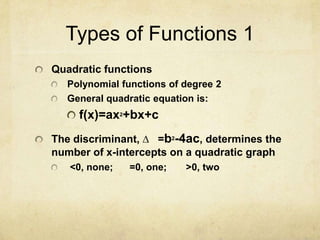
Quadratic functions
  Polynomial functions of degree 2
  General quadratic equation is:
     f(x)=ax2+bx+c
The discriminant, ∆ =b2-4ac, determines the
number of x-intercepts on a quadratic graph
   <0, none;   =0, one;   >0, two
Types of Functions
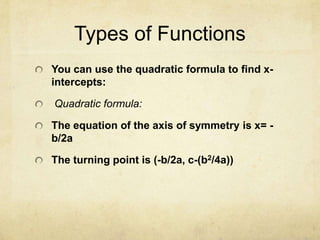
You can use the quadratic formula to find x-
intercepts:

Quadratic formula:

The equation of the axis of symmetry is x= -
b/2a

The turning point is (-b/2a, c-(b2/4a))
Types of Functions
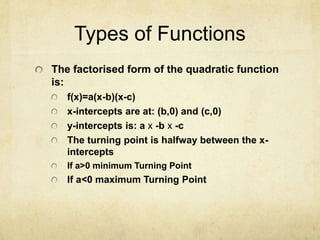
The factorised form of the quadratic function
is:
   f(x)=a(x-b)(x-c)
   x-intercepts are at: (b,0) and (c,0)
   y-intercepts is: a x -b x -c
   The turning point is halfway between the x-
   intercepts
   If a>0 minimum Turning Point
   If a<0 maximum Turning Point
Types of Functions
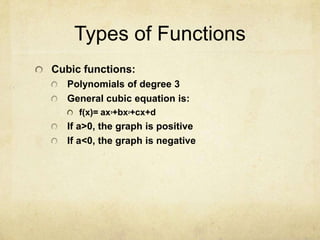
Cubic functions:
   Polynomials of degree 3
   General cubic equation is:
     f(x)= ax3+bx2+cx+d
   If a>0, the graph is positive
   If a<0, the graph is negative
Types of Functions
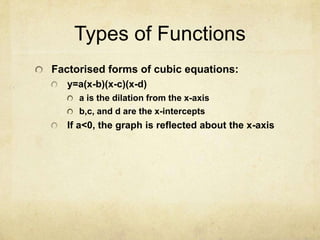
Factorised forms of cubic equations:
   y=a(x-b)(x-c)(x-d)
     a is the dilation from the x-axis
     b,c, and d are the x-intercepts
   If a<0, the graph is reflected about the x-axis
Types of Functions
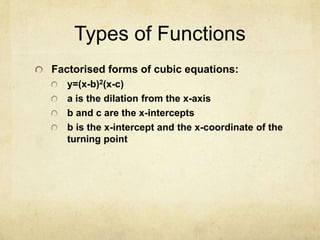
Factorised forms of cubic equations:
   y=(x-b)2(x-c)
   a is the dilation from the x-axis
   b and c are the x-intercepts
   b is the x-intercept and the x-coordinate of the
   turning point
Types of Functions
Power form of cubic equations:
  y=(x-b)3
  b is the x-intercept and the x-coordinate of the
  point of inflection
Types of Functions
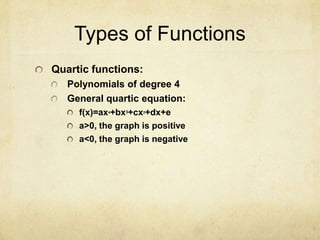
Quartic functions:
   Polynomials of degree 4
   General quartic equation:
     f(x)=ax4+bx3+cx2+dx+e
     a>0, the graph is positive
     a<0, the graph is negative
Types of Functions
Quartic functions in factorised form:
   f(x)=a(x-b)(x-c)(x-d)(x-e)
     x-intercepts at x=b,c,d and e
Types of Functions
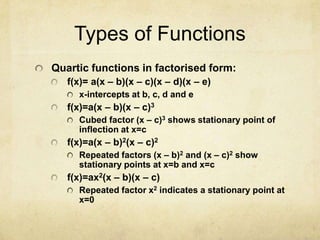
Quartic functions in factorised form:
   f(x)= a(x – b)(x – c)(x – d)(x – e)
     x-intercepts at b, c, d and e
   f(x)=a(x – b)(x – c)3
     Cubed factor (x – c)3 shows stationary point of
     inflection at x=c
   f(x)=a(x – b)2(x – c)2
     Repeated factors (x – b)2 and (x – c)2 show
     stationary points at x=b and x=c
   f(x)=ax2(x – b)(x – c)
     Repeated factor x2 indicates a stationary point at
     x=0

Methods3 types of functions1

  • 1.
  • 2.
    Types of Functions1 Quadratic functions Polynomial functions of degree 2 General quadratic equation is: f(x)=ax2+bx+c The discriminant, ∆ =b2-4ac, determines the number of x-intercepts on a quadratic graph <0, none; =0, one; >0, two
  • 3.
    Types of Functions Youcan use the quadratic formula to find x- intercepts: Quadratic formula: The equation of the axis of symmetry is x= - b/2a The turning point is (-b/2a, c-(b2/4a))
  • 4.
    Types of Functions Thefactorised form of the quadratic function is: f(x)=a(x-b)(x-c) x-intercepts are at: (b,0) and (c,0) y-intercepts is: a x -b x -c The turning point is halfway between the x- intercepts If a>0 minimum Turning Point If a<0 maximum Turning Point
  • 5.
    Types of Functions Cubicfunctions: Polynomials of degree 3 General cubic equation is: f(x)= ax3+bx2+cx+d If a>0, the graph is positive If a<0, the graph is negative
  • 6.
    Types of Functions Factorisedforms of cubic equations: y=a(x-b)(x-c)(x-d) a is the dilation from the x-axis b,c, and d are the x-intercepts If a<0, the graph is reflected about the x-axis
  • 7.
    Types of Functions Factorisedforms of cubic equations: y=(x-b)2(x-c) a is the dilation from the x-axis b and c are the x-intercepts b is the x-intercept and the x-coordinate of the turning point
  • 8.
    Types of Functions Powerform of cubic equations: y=(x-b)3 b is the x-intercept and the x-coordinate of the point of inflection
  • 9.
    Types of Functions Quarticfunctions: Polynomials of degree 4 General quartic equation: f(x)=ax4+bx3+cx2+dx+e a>0, the graph is positive a<0, the graph is negative
  • 10.
    Types of Functions Quarticfunctions in factorised form: f(x)=a(x-b)(x-c)(x-d)(x-e) x-intercepts at x=b,c,d and e
  • 11.
    Types of Functions Quarticfunctions in factorised form: f(x)= a(x – b)(x – c)(x – d)(x – e) x-intercepts at b, c, d and e f(x)=a(x – b)(x – c)3 Cubed factor (x – c)3 shows stationary point of inflection at x=c f(x)=a(x – b)2(x – c)2 Repeated factors (x – b)2 and (x – c)2 show stationary points at x=b and x=c f(x)=ax2(x – b)(x – c) Repeated factor x2 indicates a stationary point at x=0