Solving complex problems through design


Julia Moisand Egéa
15 OCT 2010
Describe the difficulties in solving complex problems.   2


Contents

1. What is a complex problem?
   Well-structured, ill-structured and wicked problems.
2. Solving techniques:
   insight, process and creative strategic thinking.
3. Difficulties:
   design literacy, design education and responsibility.
4. Conclusion
Describe the difficulties in solving complex problems.                                                             3


Well-structured problems (H.Simon)
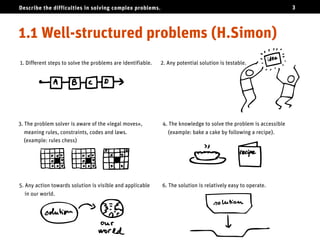
1. Different steps to solve the problems are identifiable.   2. Any potential solution is testable.


3. The problem solver is aware of the «legal moves»,         4. The knowledge to solve the problem is accessible
   meaning rules, constraints, codes and laws.                  (example: bake a cake by following a recipe).
   (example: rules chess)


5. Any action towards solution is visible and applicable     6. The solution is relatively easy to operate.
   in our world.
Describe the difficulties in solving complex problems.                                                               4


Ill-structured problems (H.Simon)
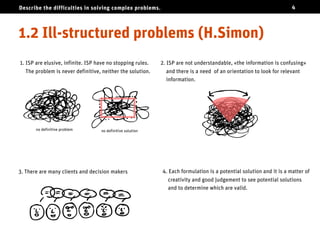
1. ISP are elusive, infinite. ISP have no stopping rules.   2. ISP are not understandable, «the information is confusing»
   The problem is never definitive, neither the solution.      and there is a need of an orientation to look for relevant
                                                               information.


       no definitive problem       no definitive solution


3. There are many clients and decision makers               4. Each formulation is a potential solution and it is a matter of
                                                               creativity and good judgement to see potential solutions
                                                               and to determine which are valid.
Describe the difficulties in solving complex problems.                                                                        5


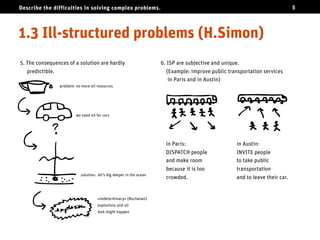
5. The consequences of a solution are hardly                         6. ISP are subjective and unique.
   predictible.                                                         (Example: improve public transportation services
                                                                         in Paris and in Austin)
                problem: no more oil resources


                         we need oil for cars


                                                                       in Paris:                    in Austin:
                                                                       DISPATCH people              INVITE people
                                                                       and make room                to take public
                                                                       because it is too            transportation
                           solution: let’s dig deeper in the ocean
                                                                       crowded.                     and to leave their car.


                                     «indeterminacy» (Buchanan)
                                     explosions and oil
                                     leak might happen
Describe the difficulties in solving complex problems.                                                                                       6


Wicked problems (R.Buchanan)
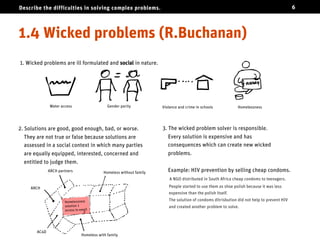
1. Wicked problems are ill formulated and social in nature.


              Water access                     Gender parity           Violence and crime in schools           Homelessness


2. Solutions are good, good enough, bad, or worse.                     3. The wicked problem solver is responsible.
   They are not true or false because solutions are                       Every solution is expensive and has
   assessed in a social context in which many parties                     consequences which can create new wicked
   are equally equipped, interested, concerned and                        problems.
   entitled to judge them.
              ARCH partners                  Homeless without family      Example: HIV prevention by selling cheap condoms.
                                                                           A NGO distributed in South Africa cheap condoms to teenagers.

     ARCH                                                                 People started to use them as shoe polish because it was less
                                                                          expensive than the polish itself.

                      Homelessness
                                                                          The solution of condoms ditrisbution did not help to prevent HIV
                      solution 1                                          and created another problem to solve.
                      access to email


       AC4D
                                 Homeless with family
Describe the difficulties in solving complex problems.                                                              7


Complex problems (Julia)
1. Well structured problems (WSP) can be solved either by a person or by a computer.
   It requires using algorithmic logic, following steps that are very identifiable: bake a cake with a receipe,
   build a standard home with instructions, resize images by using a script in Photoshop.


2. Only people can solve ill structured problems (ISP) because it requires both logic and emotion.
   Most of our problems in life are ill structured: buy a used car, build a unique home from scratch, find a job,
   play golf.

3. All design problems are ill structured problems and it’s the role of the designer to transform them in WSP.
   If they already have clear structure, then, it is not a design problem.


4. Design problems are wicked when they have a social impact: there is always a risk that solutions may have
   consequences that turn out to be worse than the problem itself.
Describe the difficulties in solving complex problems.                                                            8


Solving complex problems by following
a process (H.Simon)
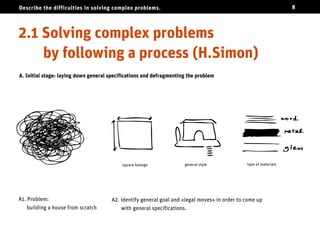
A. Initial stage: laying down general specifications and defragmenting the problem


                                           square footage            general style            type of materials


A1. Problem:                          A2. identify general goal and «legal moves» in order to come up
    building a house from scratch         with general specifications.
Describe the difficulties in solving complex problems.                                                   9


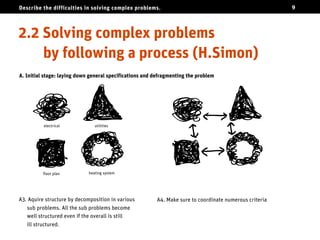
A. Initial stage: laying down general specifications and defragmenting the problem


          electrical            utilities


          floor plan         heating system


A3. Aquire structure by decomposition in various         A4. Make sure to coordinate numerous criteria
   sub problems. All the sub problems become
   well structured even if the overall is still
   ill structured.
Describe the difficulties in solving complex problems.                                                            10


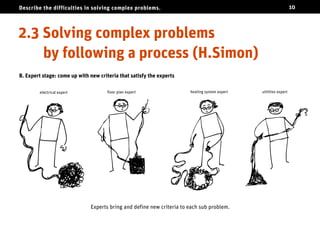
B. Expert stage: come up with new criteria that satisfy the experts

        electrical expert             floor plan expert                heating system expert   utilities expert


                              Experts bring and define new criteria to each sub problem.
Describe the difficulties in solving complex problems.                                                 11


   Solving complex problems by developing
   creative strategic thinking ( P.Johnson-
   Laird)
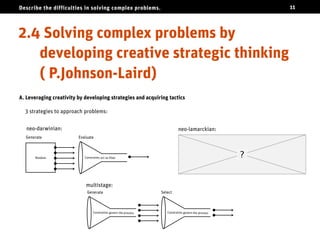
A. Leveraging creativity by developing strategies and acquiring tactics

  3 strategies to approach problems:


   neo-darwinian:                                                            neo-lamarckian:
  Generate               Evaluate


      Random                Constraints act as filter


                             multistage:
                             Generate                              Select


                                  Constraints govern the process      Constraints govern the process
Describe the difficulties in solving complex problems.                                                        12


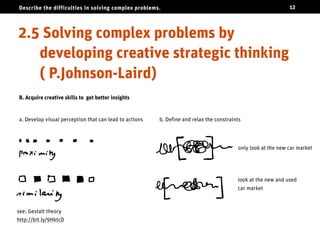
B. Acquire creative skills to get better insights


a. Develop visual perception that can lead to actions   b. Define and relax the constraints


                                                                                         only look at the new car market


                                                                                         look at the new and used
                                                                                         car market


see: Gestalt theory
http://bit.ly/9HktcD
Describe the difficulties in solving complex problems.                                                      13


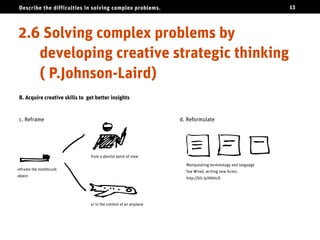
 B. Acquire creative skills to get better insights


 c. Reframe                                                        d. Reformulate


                                from a dentist point of view

                                                                     Manipulating terminology and language
reframe the toothbrush
                                                                     See Wired, writing new forms:
object
                                                                     http://bit.ly/9HktcD


                                or in the context of an airplane
Describe the difficulties in solving complex problems.              14


Solving techniques (Julia)
A good problem solver must:

1. formulate
2. visualize
3. reframe
4. be comfortable with multi-facetted problems
5. define, structure and relax the constraints
6. know how to use personal experience
7. acquire repertoire of tactics


The abductive logic summarizes and combines these skills:

I saw (understand, formulate, visualize)


I know (tactics, constraints, multi-facetted)


I’ve made (experience)

= my best guess to solve this problem


see J.Kolko: http://www.jonkolko.com/writingAbductiveThinking.php
Describe the difficulties in solving complex problems.                                                     15


Difficulties: design literacy (C.Pacione)

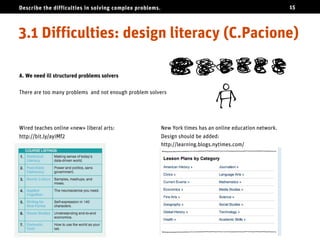
A. We need ill structured problems solvers

There are too many problems and not enough problem solvers


Wired teaches online «new» liberal arts:                 New York times has an online education network.
http://bit.ly/ayiMf2                                     Design should be added:
                                                         http://learning.blogs.nytimes.com/
Describe the difficulties in solving complex problems.                                              16


Difficulties: design education
(R.Buchanan)
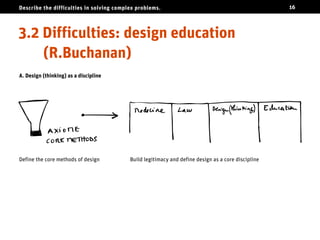
A. Design (thinking) as a discipline


Define the core methods of design         Build legitimacy and define design as a core discipline
Describe the difficulties in solving complex problems.                                             17


A. Design (thinking) as a discipline

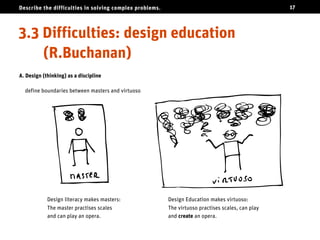
  define boundaries between masters and virtuoso


            Design literacy makes masters:               Design Education makes virtuoso:
            The master practises scales                  The virtuoso practises scales, can play
            and can play an opera.                       and create an opera.
Describe the difficulties in solving complex problems.                                      18


Difficulties: responsibility

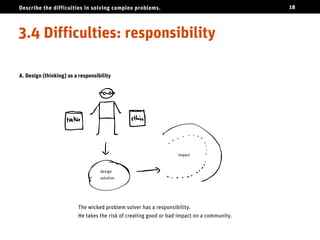
A. Design (thinking) as a responsibility


                                                                  impact


                                   design
                                   solution


                         The wicked problem solver has a responsibility.
                         He takes the risk of creating good or bad impact on a community.
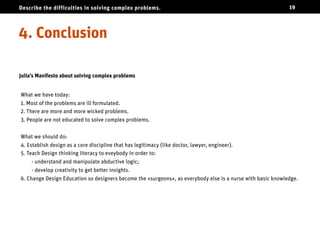
Describe the difficulties in solving complex problems.                                                       19


Conclusion

Julia’s Manifesto about solving complex problems


What we have today:
1. Most of the problems are ill formulated.
2. There are more and more wicked problems.
3. People are not educated to solve complex problems.


What we should do:
4. Establish design as a core discipline that has legitimacy (like doctor, lawyer, engineer).
5. Teach Design thinking literacy to eveybody in order to:
     - understand and manipulate abductive logic;
     - develop creativity to get better insights.
6. Change Design Education so designers become the «surgeons», as everybody else is a nurse with basic knowledge.
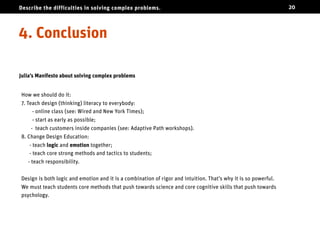
Describe the difficulties in solving complex problems.                                                           20


Julia’s Manifesto about solving complex problems


How we should do it:
7. Teach design (thinking) literacy to everybody:
       - online class (see: Wired and New York Times);
       - start as early as possible;
      - teach customers inside companies (see: Adaptive Path workshops).
8. Change Design Education:
     - teach logic and emotion together;
     - teach core strong methods and tactics to students;
    - teach responsibility.


Design is both logic and emotion and it is a combination of rigor and intuition. That’s why it is so powerful.
We must teach students core methods that push towards science and core cognitive skills that push towards
psychology.

Solving complex problems through design

  • 1.
    Solving complex problemsthrough design Julia Moisand Egéa 15 OCT 2010
  • 2.
    Describe the difficultiesin solving complex problems. 2 Contents 1. What is a complex problem? Well-structured, ill-structured and wicked problems. 2. Solving techniques: insight, process and creative strategic thinking. 3. Difficulties: design literacy, design education and responsibility. 4. Conclusion
  • 3.
    Describe the difficultiesin solving complex problems. 3 Well-structured problems (H.Simon) 1. Different steps to solve the problems are identifiable. 2. Any potential solution is testable. 3. The problem solver is aware of the «legal moves», 4. The knowledge to solve the problem is accessible meaning rules, constraints, codes and laws. (example: bake a cake by following a recipe). (example: rules chess) 5. Any action towards solution is visible and applicable 6. The solution is relatively easy to operate. in our world.
  • 4.
    Describe the difficultiesin solving complex problems. 4 Ill-structured problems (H.Simon) 1. ISP are elusive, infinite. ISP have no stopping rules. 2. ISP are not understandable, «the information is confusing» The problem is never definitive, neither the solution. and there is a need of an orientation to look for relevant information. no definitive problem no definitive solution 3. There are many clients and decision makers 4. Each formulation is a potential solution and it is a matter of creativity and good judgement to see potential solutions and to determine which are valid.
  • 5.
    Describe the difficultiesin solving complex problems. 5 5. The consequences of a solution are hardly 6. ISP are subjective and unique. predictible. (Example: improve public transportation services in Paris and in Austin) problem: no more oil resources we need oil for cars in Paris: in Austin: DISPATCH people INVITE people and make room to take public because it is too transportation solution: let’s dig deeper in the ocean crowded. and to leave their car. «indeterminacy» (Buchanan) explosions and oil leak might happen
  • 6.
    Describe the difficultiesin solving complex problems. 6 Wicked problems (R.Buchanan) 1. Wicked problems are ill formulated and social in nature. Water access Gender parity Violence and crime in schools Homelessness 2. Solutions are good, good enough, bad, or worse. 3. The wicked problem solver is responsible. They are not true or false because solutions are Every solution is expensive and has assessed in a social context in which many parties consequences which can create new wicked are equally equipped, interested, concerned and problems. entitled to judge them. ARCH partners Homeless without family Example: HIV prevention by selling cheap condoms. A NGO distributed in South Africa cheap condoms to teenagers. ARCH People started to use them as shoe polish because it was less expensive than the polish itself. Homelessness The solution of condoms ditrisbution did not help to prevent HIV solution 1 and created another problem to solve. access to email AC4D Homeless with family
  • 7.
    Describe the difficultiesin solving complex problems. 7 Complex problems (Julia) 1. Well structured problems (WSP) can be solved either by a person or by a computer. It requires using algorithmic logic, following steps that are very identifiable: bake a cake with a receipe, build a standard home with instructions, resize images by using a script in Photoshop. 2. Only people can solve ill structured problems (ISP) because it requires both logic and emotion. Most of our problems in life are ill structured: buy a used car, build a unique home from scratch, find a job, play golf. 3. All design problems are ill structured problems and it’s the role of the designer to transform them in WSP. If they already have clear structure, then, it is not a design problem. 4. Design problems are wicked when they have a social impact: there is always a risk that solutions may have consequences that turn out to be worse than the problem itself.
  • 8.
    Describe the difficultiesin solving complex problems. 8 Solving complex problems by following a process (H.Simon) A. Initial stage: laying down general specifications and defragmenting the problem square footage general style type of materials A1. Problem: A2. identify general goal and «legal moves» in order to come up building a house from scratch with general specifications.
  • 9.
    Describe the difficultiesin solving complex problems. 9 A. Initial stage: laying down general specifications and defragmenting the problem electrical utilities floor plan heating system A3. Aquire structure by decomposition in various A4. Make sure to coordinate numerous criteria sub problems. All the sub problems become well structured even if the overall is still ill structured.
  • 10.
    Describe the difficultiesin solving complex problems. 10 B. Expert stage: come up with new criteria that satisfy the experts electrical expert floor plan expert heating system expert utilities expert Experts bring and define new criteria to each sub problem.
  • 11.
    Describe the difficultiesin solving complex problems. 11 Solving complex problems by developing creative strategic thinking ( P.Johnson- Laird) A. Leveraging creativity by developing strategies and acquiring tactics 3 strategies to approach problems: neo-darwinian: neo-lamarckian: Generate Evaluate Random Constraints act as filter multistage: Generate Select Constraints govern the process Constraints govern the process
  • 12.
    Describe the difficultiesin solving complex problems. 12 B. Acquire creative skills to get better insights a. Develop visual perception that can lead to actions b. Define and relax the constraints only look at the new car market look at the new and used car market see: Gestalt theory http://bit.ly/9HktcD
  • 13.
    Describe the difficultiesin solving complex problems. 13 B. Acquire creative skills to get better insights c. Reframe d. Reformulate from a dentist point of view Manipulating terminology and language reframe the toothbrush See Wired, writing new forms: object http://bit.ly/9HktcD or in the context of an airplane
  • 14.
    Describe the difficultiesin solving complex problems. 14 Solving techniques (Julia) A good problem solver must: 1. formulate 2. visualize 3. reframe 4. be comfortable with multi-facetted problems 5. define, structure and relax the constraints 6. know how to use personal experience 7. acquire repertoire of tactics The abductive logic summarizes and combines these skills: I saw (understand, formulate, visualize) I know (tactics, constraints, multi-facetted) I’ve made (experience) = my best guess to solve this problem see J.Kolko: http://www.jonkolko.com/writingAbductiveThinking.php
  • 15.
    Describe the difficultiesin solving complex problems. 15 Difficulties: design literacy (C.Pacione) A. We need ill structured problems solvers There are too many problems and not enough problem solvers Wired teaches online «new» liberal arts: New York times has an online education network. http://bit.ly/ayiMf2 Design should be added: http://learning.blogs.nytimes.com/
  • 16.
    Describe the difficultiesin solving complex problems. 16 Difficulties: design education (R.Buchanan) A. Design (thinking) as a discipline Define the core methods of design Build legitimacy and define design as a core discipline
  • 17.
    Describe the difficultiesin solving complex problems. 17 A. Design (thinking) as a discipline define boundaries between masters and virtuoso Design literacy makes masters: Design Education makes virtuoso: The master practises scales The virtuoso practises scales, can play and can play an opera. and create an opera.
  • 18.
    Describe the difficultiesin solving complex problems. 18 Difficulties: responsibility A. Design (thinking) as a responsibility impact design solution The wicked problem solver has a responsibility. He takes the risk of creating good or bad impact on a community.
  • 19.
    Describe the difficultiesin solving complex problems. 19 Conclusion Julia’s Manifesto about solving complex problems What we have today: 1. Most of the problems are ill formulated. 2. There are more and more wicked problems. 3. People are not educated to solve complex problems. What we should do: 4. Establish design as a core discipline that has legitimacy (like doctor, lawyer, engineer). 5. Teach Design thinking literacy to eveybody in order to: - understand and manipulate abductive logic; - develop creativity to get better insights. 6. Change Design Education so designers become the «surgeons», as everybody else is a nurse with basic knowledge.
  • 20.
    Describe the difficultiesin solving complex problems. 20 Julia’s Manifesto about solving complex problems How we should do it: 7. Teach design (thinking) literacy to everybody: - online class (see: Wired and New York Times); - start as early as possible; - teach customers inside companies (see: Adaptive Path workshops). 8. Change Design Education: - teach logic and emotion together; - teach core strong methods and tactics to students; - teach responsibility. Design is both logic and emotion and it is a combination of rigor and intuition. That’s why it is so powerful. We must teach students core methods that push towards science and core cognitive skills that push towards psychology.