Chapter 1
Problems, Opportunities and
        Decisions
     Aj. Sounay Phothisane
Problems, problems, problems!
• What is a problem?
  – Problem solving is the art of finding ways to get
    from where you are to where want to be. The
    problem, therefore, is the gap between the
    present situation and a more desirable one. –
    Vincent Nolan (1989)
  – A problem can defined as any situation in which a
    gap is perceived to exist between what is and
    what should be. - Arthur B. Van Gundy Jr. (1988)
Problems, problems, problems!
• What is a problem?
  – A problem is any situation in which an expected level
    of performance is not being achieved and in which the
    cause of the unacceptable performance is unknown. –
    Charles Kepner and Benjamin Tregoe (1981)
  – A problem is a situation in which a decision-making
    individual or group has alternative courses of action
    available, … the choice made can have a significant
    effect, and … the decision-maker has some doubt as
    to which alternative should be selected. – Russell
    Ackoff (1981)
Do I have a problem? Recognizing a
                problem
• A problem must be perceived or recognized by
  somebody, otherwise, it is not a problem.
  – Problems are everywhere, depending on one’s
    perception to the problem that it is a problem.
• We may not realize that we have a
  problem, but that does not stop us from
  having one.
Do I have a problem? Recognizing a
            problem (Cont.)
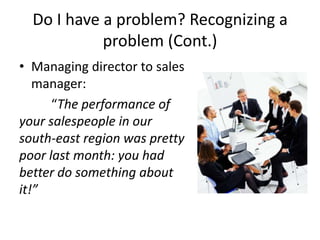
• Managing director to sales
   manager:
      “The performance of
your salespeople in our
south-east region was pretty
poor last month: you had
better do something about
it!”
Do I have a problem? Recognizing a
            problem (Cont.)
• From the sentence above, we can see some
  points about problems:
  – We thought that things were fine about sales
  – After the saying of the manager director, now we
    have one!
     • The problem could be: unexpected sales target, Market
       share, Profits, Performance… etc.,
  – We do not have to know about a problem in order
    to have one but have to perceived a problem.
Can I solve this problem? Having the
              power to act
• We may have 2 difficulties if we do not know
  how to resolve the problem.
  – Difficulty in defining what the problem is
  – Difficulty in finding a possible solution
  No matter what, we must be able to do something
  about a problem situation once we have decided
  what this should be
Can I solve this problem? Having the
               power to act
• Authority and Resources is essential to implement our
  solutions.
• Our perceptions play a key role in many aspects of problem
  solving because they determine what we think about the way
  we solve problem.
   – Perception: Power to Act (skills and knowledge)
       • Do we have the power to motivate people to act or solving problem
   – Culture:
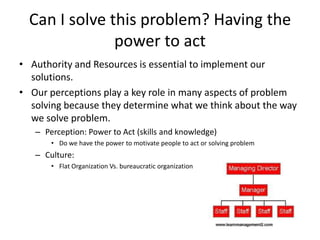
       • Flat Organization Vs. bureaucratic organization
Who owns a problem? Problem
            ownership
• Who is “dissatisfied” with the problem
  situation is the owner.
• Recognition of the problem
• But what of situations where we are asked to
  help somebody else who has a problem?
  – Will we have the ownership of the problem too?
     • Do not solve it for them. If we are called as a
       consultant, our role is solely to help them resolve their
       own problem or to facilitate the problem-resolving
       process.
Are there different types of problem?
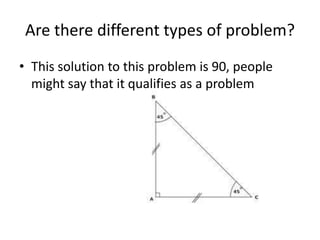
• This solution to this problem is 90, people
  might say that it qualifies as a problem
Classifying Problems: Complex Vs
                 Simple
• Complex: Problems situation with lots of
  interacting components
  – Complex problems should be broken down into
    manageable portions. Referred to “Restructuring”
    the problem
  – Ex: we might break down the problem into
    bits, then solve all the bits and fail to realize that a
    problem existed solely in the interaction between
    these bits. We call it “Boundary problem”
Ex: Boundary Problems
• The marketing section of a company complains that
  the production section is not effective. They feel
  frustrated because after all their efforts seeking out
  new customers and obtaining more orders than ever in
  the past, they are being embarrassed by complaints
  from these customers about the failure of orders to
  arrive before agreed delivery dates. The production
  section, on the other hand, claims that they are already
  working to maximum capacity, and that impossible
  demands and deadlines are being imposed on them by
  unrealistic promises that the marketing section has
  been making to customers.
Ex: Boundary Problems
The fault mat lie within a particular section
       - Perhaps marketing is making unrealistic
promises
       - Perhaps production is understaffed in
relation to the recent increase in business.
However, the problem may be one of bad
communications between the sections.
Thus, if this complex problem were to broken down
on a sectional basis it might never be solved
The problem of knowing what a
  problem is! Redefining the problem
• Is the problem “well defined” or “ill defined”?
  – The triangle problem is extremely well defined.
    We knew exactly what we are dealing with: a
    plane triangular structure some of whose
    dimensions were known exactly
  – When a problem is ill defined, and even when we
    think we know what the problem is, we should try
    to view the problem from many angles to ensure
    that we are actually attempting to solve the right
    or most appropriate one.
  – This process of looking around the stated problem
    is referred to as redefining the problem.
Breakdown: Redefining the problem
• You are traveling alone in your car to a very
  important meeting. Fifteen minutes from your
  destination (30 minutes before the
  meeting), your car engine loses power, cuts
  out and you glide to a standstill on a busy
  clearway in the middle of a thunderstorm.
  – You certainly have a problem. But what is it?
Breakdown: Redefining the problem
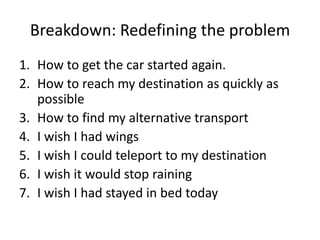
1. How to get the car started again.
2. How to reach my destination as quickly as
   possible
3. How to find my alternative transport
4. I wish I had wings
5. I wish I could teleport to my destination
6. I wish it would stop raining
7. I wish I had stayed in bed today
Decisions, decisions!
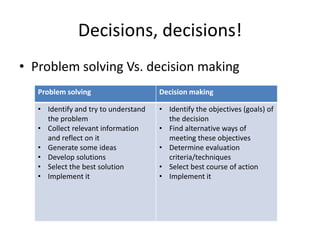
• Problem solving Vs. decision making
   Problem solving                    Decision making

   • Identify and try to understand   • Identify the objectives (goals) of
     the problem                        the decision
   • Collect relevant information     • Find alternative ways of
     and reflect on it                  meeting these objectives
   • Generate some ideas              • Determine evaluation
   • Develop solutions                  criteria/techniques
   • Select the best solution         • Select best course of action
   • Implement it                     • Implement it

Problems, Opportunities and Decisions

  • 1.
    Chapter 1 Problems, Opportunitiesand Decisions Aj. Sounay Phothisane
  • 2.
    Problems, problems, problems! •What is a problem? – Problem solving is the art of finding ways to get from where you are to where want to be. The problem, therefore, is the gap between the present situation and a more desirable one. – Vincent Nolan (1989) – A problem can defined as any situation in which a gap is perceived to exist between what is and what should be. - Arthur B. Van Gundy Jr. (1988)
  • 3.
    Problems, problems, problems! •What is a problem? – A problem is any situation in which an expected level of performance is not being achieved and in which the cause of the unacceptable performance is unknown. – Charles Kepner and Benjamin Tregoe (1981) – A problem is a situation in which a decision-making individual or group has alternative courses of action available, … the choice made can have a significant effect, and … the decision-maker has some doubt as to which alternative should be selected. – Russell Ackoff (1981)
  • 4.
    Do I havea problem? Recognizing a problem • A problem must be perceived or recognized by somebody, otherwise, it is not a problem. – Problems are everywhere, depending on one’s perception to the problem that it is a problem. • We may not realize that we have a problem, but that does not stop us from having one.
  • 5.
    Do I havea problem? Recognizing a problem (Cont.) • Managing director to sales manager: “The performance of your salespeople in our south-east region was pretty poor last month: you had better do something about it!”
  • 6.
    Do I havea problem? Recognizing a problem (Cont.) • From the sentence above, we can see some points about problems: – We thought that things were fine about sales – After the saying of the manager director, now we have one! • The problem could be: unexpected sales target, Market share, Profits, Performance… etc., – We do not have to know about a problem in order to have one but have to perceived a problem.
  • 7.
    Can I solvethis problem? Having the power to act • We may have 2 difficulties if we do not know how to resolve the problem. – Difficulty in defining what the problem is – Difficulty in finding a possible solution No matter what, we must be able to do something about a problem situation once we have decided what this should be
  • 8.
    Can I solvethis problem? Having the power to act • Authority and Resources is essential to implement our solutions. • Our perceptions play a key role in many aspects of problem solving because they determine what we think about the way we solve problem. – Perception: Power to Act (skills and knowledge) • Do we have the power to motivate people to act or solving problem – Culture: • Flat Organization Vs. bureaucratic organization
  • 9.
    Who owns aproblem? Problem ownership • Who is “dissatisfied” with the problem situation is the owner. • Recognition of the problem • But what of situations where we are asked to help somebody else who has a problem? – Will we have the ownership of the problem too? • Do not solve it for them. If we are called as a consultant, our role is solely to help them resolve their own problem or to facilitate the problem-resolving process.
  • 10.
    Are there differenttypes of problem? • This solution to this problem is 90, people might say that it qualifies as a problem
  • 11.
    Classifying Problems: ComplexVs Simple • Complex: Problems situation with lots of interacting components – Complex problems should be broken down into manageable portions. Referred to “Restructuring” the problem – Ex: we might break down the problem into bits, then solve all the bits and fail to realize that a problem existed solely in the interaction between these bits. We call it “Boundary problem”
  • 12.
    Ex: Boundary Problems •The marketing section of a company complains that the production section is not effective. They feel frustrated because after all their efforts seeking out new customers and obtaining more orders than ever in the past, they are being embarrassed by complaints from these customers about the failure of orders to arrive before agreed delivery dates. The production section, on the other hand, claims that they are already working to maximum capacity, and that impossible demands and deadlines are being imposed on them by unrealistic promises that the marketing section has been making to customers.
  • 13.
    Ex: Boundary Problems Thefault mat lie within a particular section - Perhaps marketing is making unrealistic promises - Perhaps production is understaffed in relation to the recent increase in business. However, the problem may be one of bad communications between the sections. Thus, if this complex problem were to broken down on a sectional basis it might never be solved
  • 14.
    The problem ofknowing what a problem is! Redefining the problem • Is the problem “well defined” or “ill defined”? – The triangle problem is extremely well defined. We knew exactly what we are dealing with: a plane triangular structure some of whose dimensions were known exactly – When a problem is ill defined, and even when we think we know what the problem is, we should try to view the problem from many angles to ensure that we are actually attempting to solve the right or most appropriate one. – This process of looking around the stated problem is referred to as redefining the problem.
  • 15.
    Breakdown: Redefining theproblem • You are traveling alone in your car to a very important meeting. Fifteen minutes from your destination (30 minutes before the meeting), your car engine loses power, cuts out and you glide to a standstill on a busy clearway in the middle of a thunderstorm. – You certainly have a problem. But what is it?
  • 16.
    Breakdown: Redefining theproblem 1. How to get the car started again. 2. How to reach my destination as quickly as possible 3. How to find my alternative transport 4. I wish I had wings 5. I wish I could teleport to my destination 6. I wish it would stop raining 7. I wish I had stayed in bed today
  • 17.
    Decisions, decisions! • Problemsolving Vs. decision making Problem solving Decision making • Identify and try to understand • Identify the objectives (goals) of the problem the decision • Collect relevant information • Find alternative ways of and reflect on it meeting these objectives • Generate some ideas • Determine evaluation • Develop solutions criteria/techniques • Select the best solution • Select best course of action • Implement it • Implement it