THINKING  TOOLS  -­‐‑  
EMPOWERING  STUDENTS  TO  GET  THE  JOB  DONE
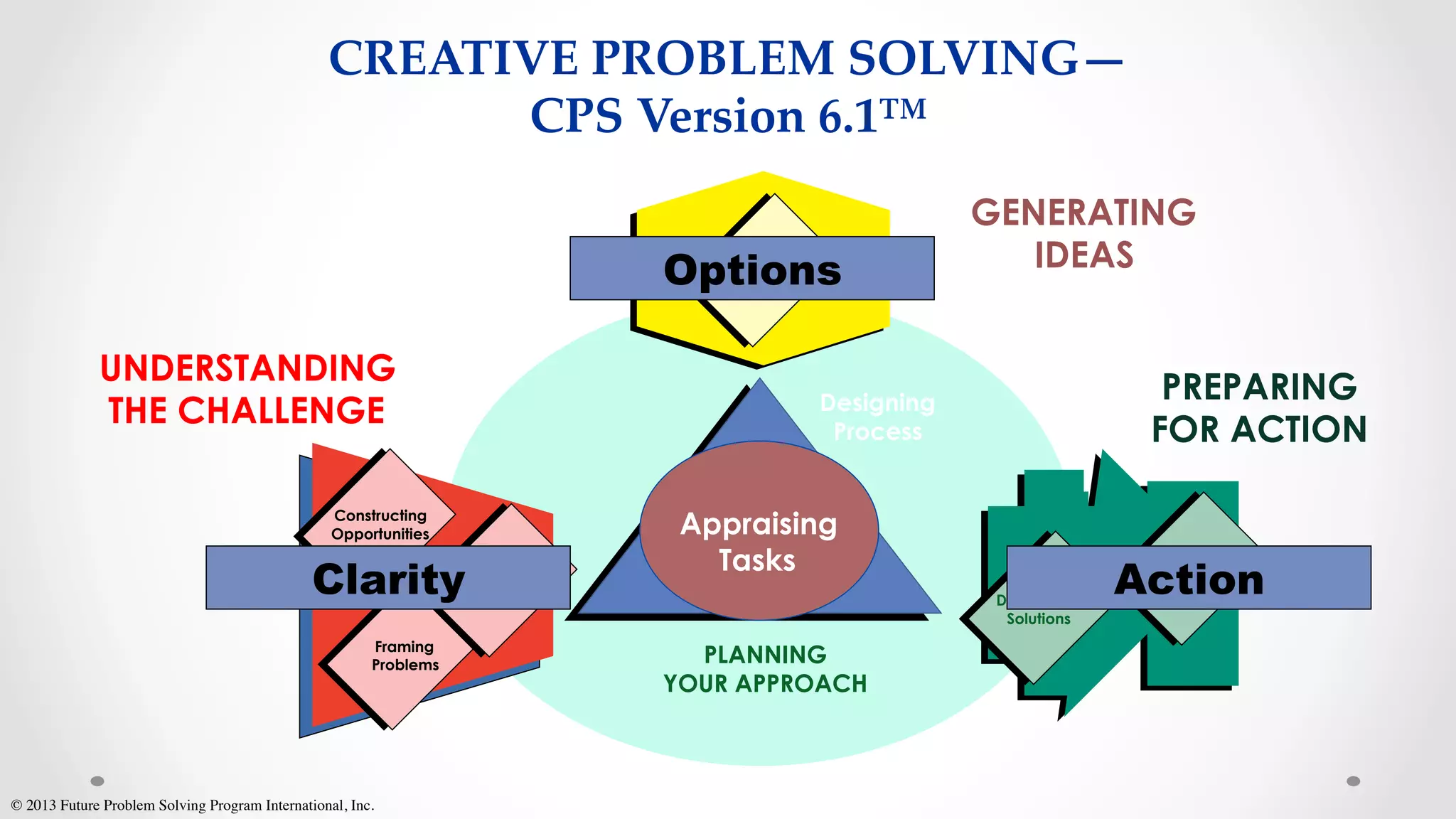
UNDERSTANDING
THE CHALLENGE
Constructing
Opportunities
Framing
Problems
Exploring
Data
PREPARING
FOR ACTION
Developing
Solutions
Building
Acceptance
GENERATING
IDEASGenerating
Ideas
Designing
Process
PLANNING
YOUR APPROACH
Appraising
Tasks
CREATIVE  PROBLEM  SOLVING—  	
CPS  Version  6.1™	
Clarity
Options
Action
© 2013 Future Problem Solving Program International, Inc.
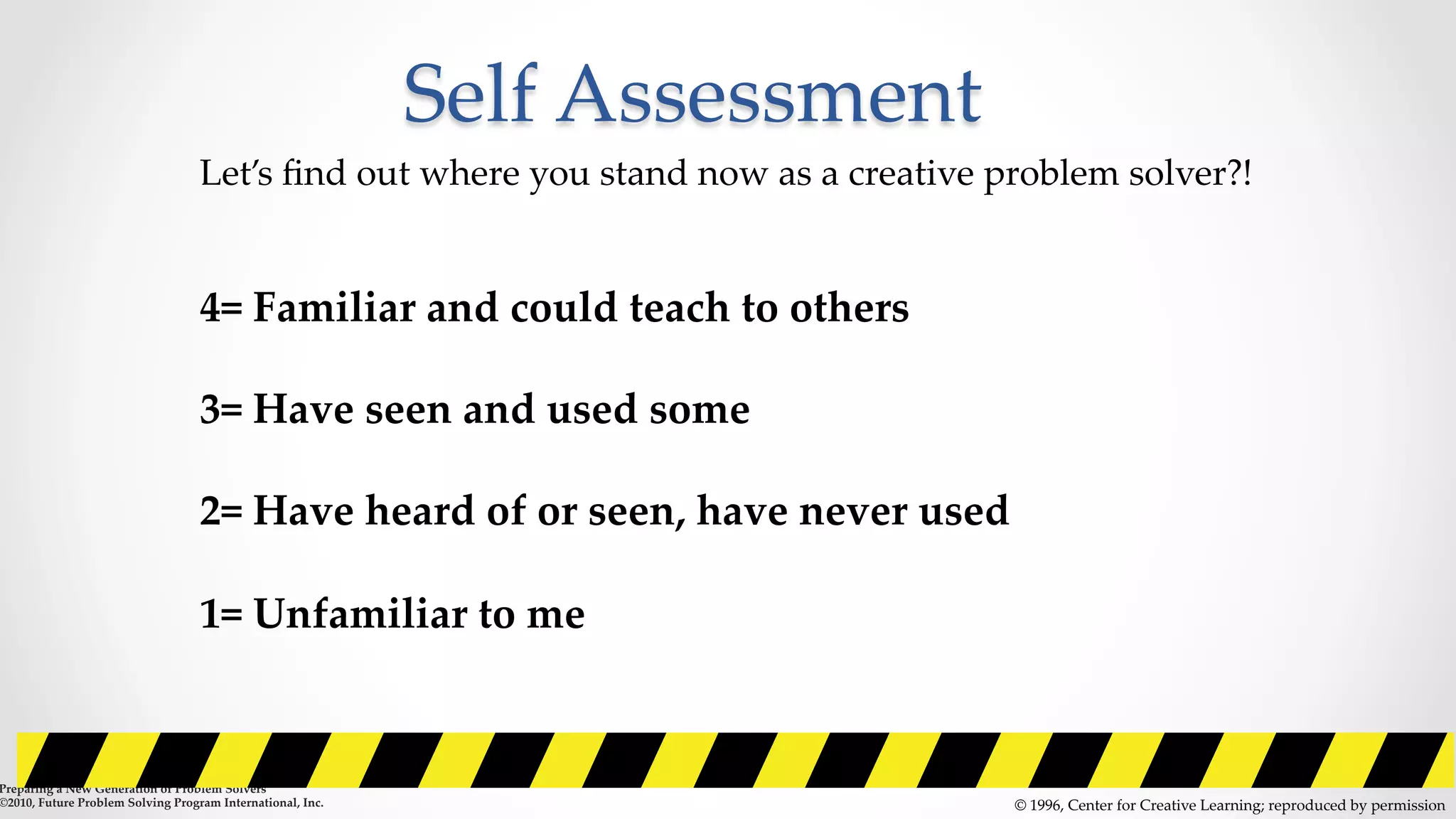
Self  Assessment	
©  1996,  Center  for  Creative  Learning;  reproduced  by  permission	
Let’s  find  out  where  you  stand  now  as  a  creative  problem  solver?!	
	
	
4=  Familiar  and  could  teach  to  others	
	
3=  Have  seen  and  used  some	
	
2=  Have  heard  of  or  seen,  have  never  used	
	
1=  Unfamiliar  to  me	


Preparing  a  New  Generation  of  Problem  Solvers  	
©2010,  Future  Problem  Solving  Program  International,  Inc.
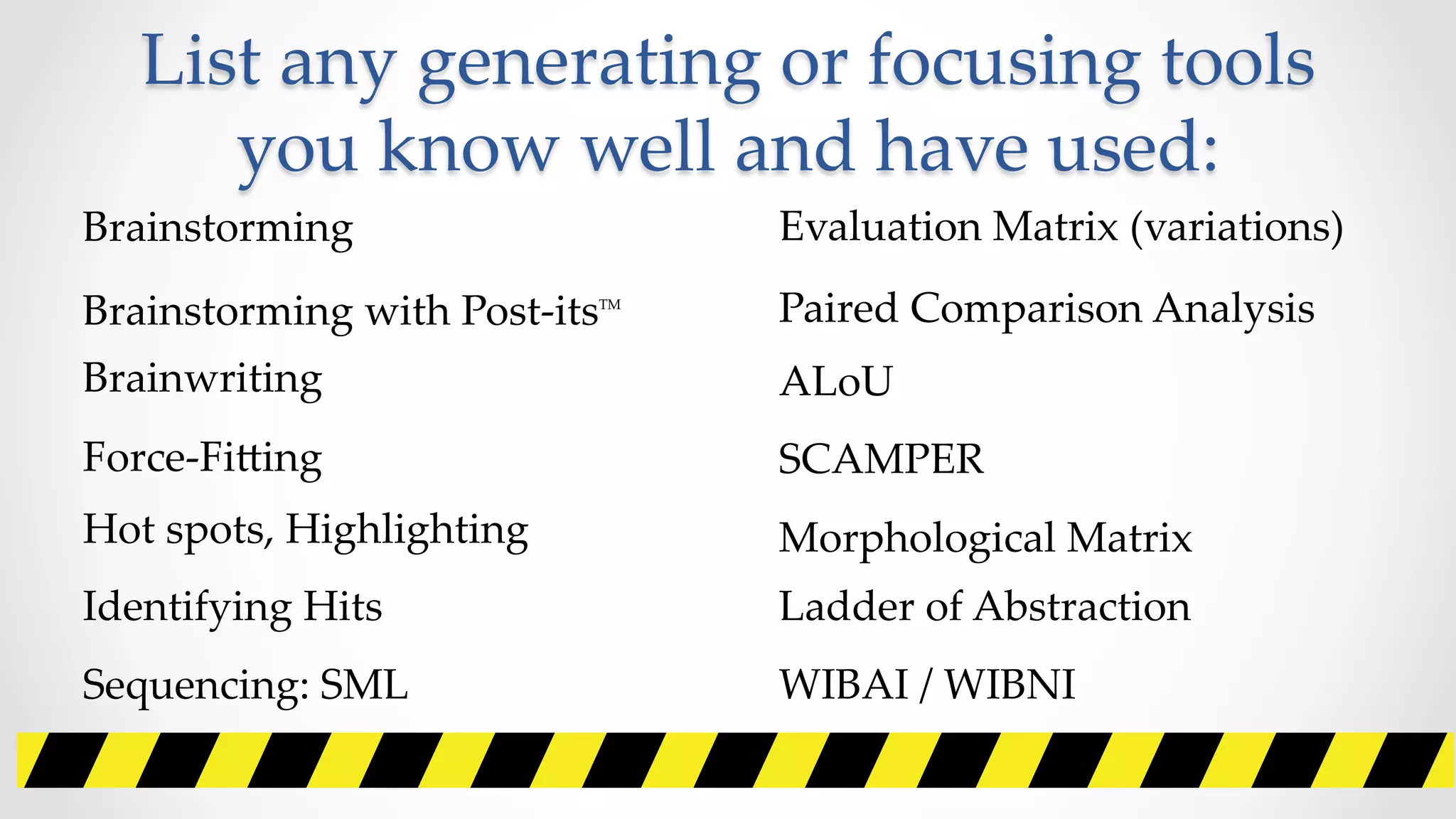
List  any  generating  or  focusing  tools  
you  know  well  and  have  used:	
Brainstorming	
Brainstorming  with  Post-­‐‑itsTM	
Brainwriting	
Force-­‐‑FiZing	
Hot  spots,  Highlighting	
Identifying  Hits	
Sequencing:  SML	
Evaluation  Matrix  (variations)	
Paired  Comparison  Analysis	
ALoU	
SCAMPER	
Morphological  Matrix	
Ladder  of  Abstraction	
WIBAI  /  WIBNI
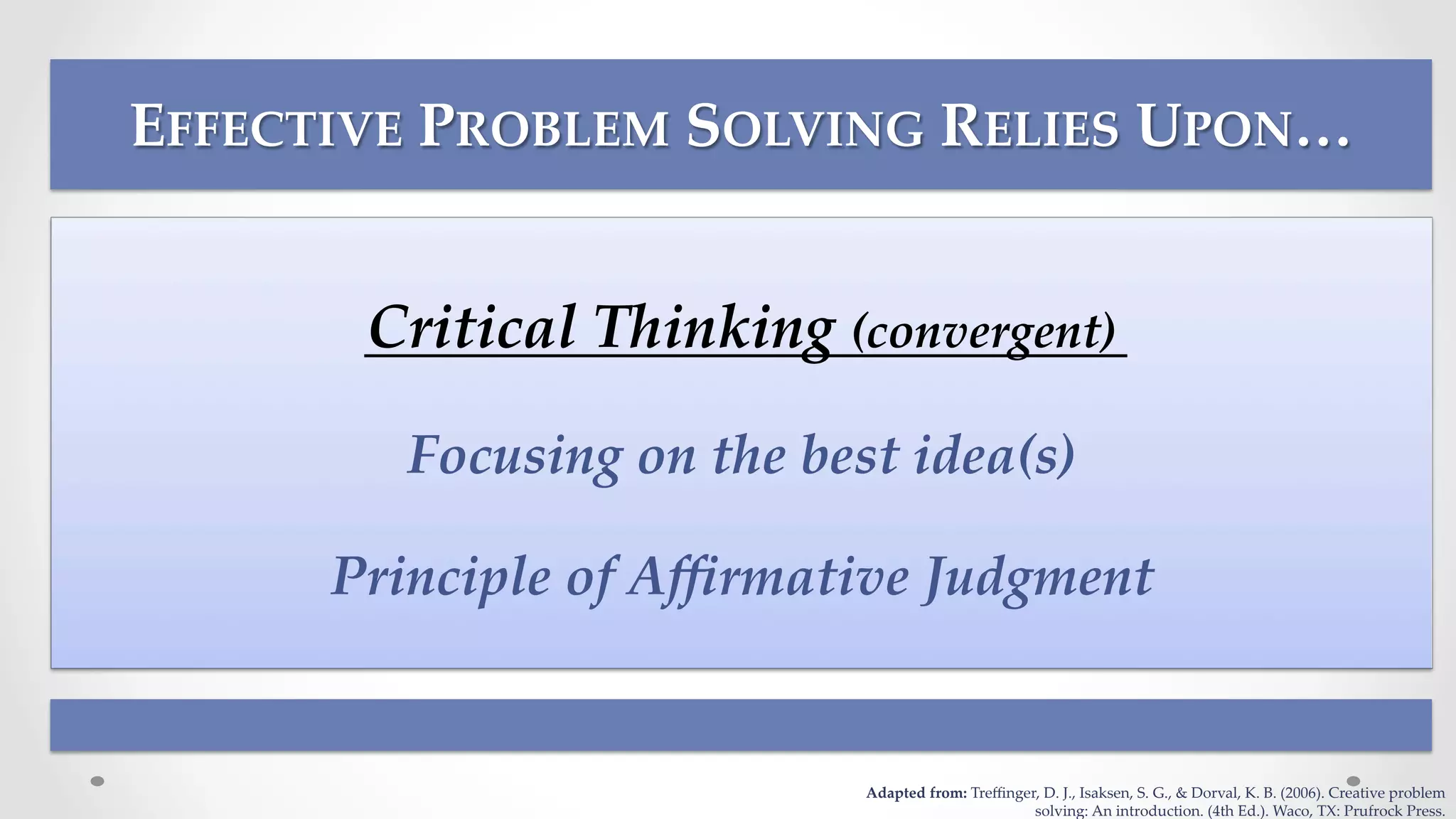
EFFECTIVE  PROBLEM  SOLVING  RELIES  UPON…	
  
	
Creative  Thinking  (divergent)	
Generating  new  &  many  ideas	
Principle  of  Deferred  Judgment	
	
	
 Adapted  from:  Treffinger,  D.  J.,  Isaksen,  S.  G.,  &  Dorval,  K.  B.  (2006).  Creative  problem	
solving:  An  introduction.  (4th  Ed.).  Waco,  TX:  Prufrock  Press.
Preparing  a  New  Generation  of  Problem  Solvers  	
©2010,  Future  Problem  Solving  Program  International,  Inc.	
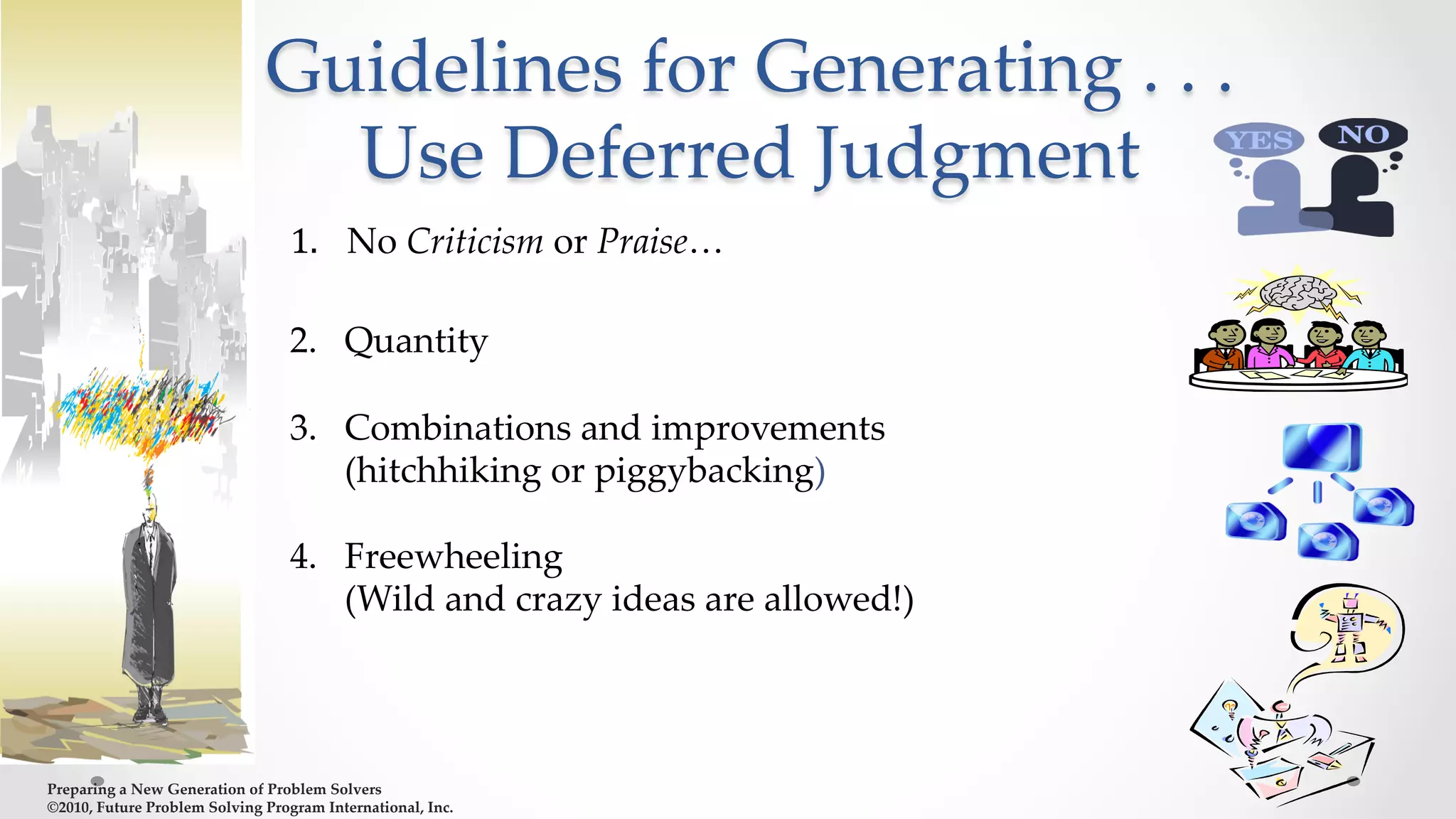
Guidelines  for  Generating  .  .  .  
Use  Deferred  Judgment	
1.  	
  	
  No  Criticism  or  Praise…  
	
2.  Quantity      
	
3.  Combinations  and  improvements  	
	
(hitchhiking  or  piggybacking)      
	
4.  Freewheeling  	
	
(Wild  and  crazy  ideas  are  allowed!)      
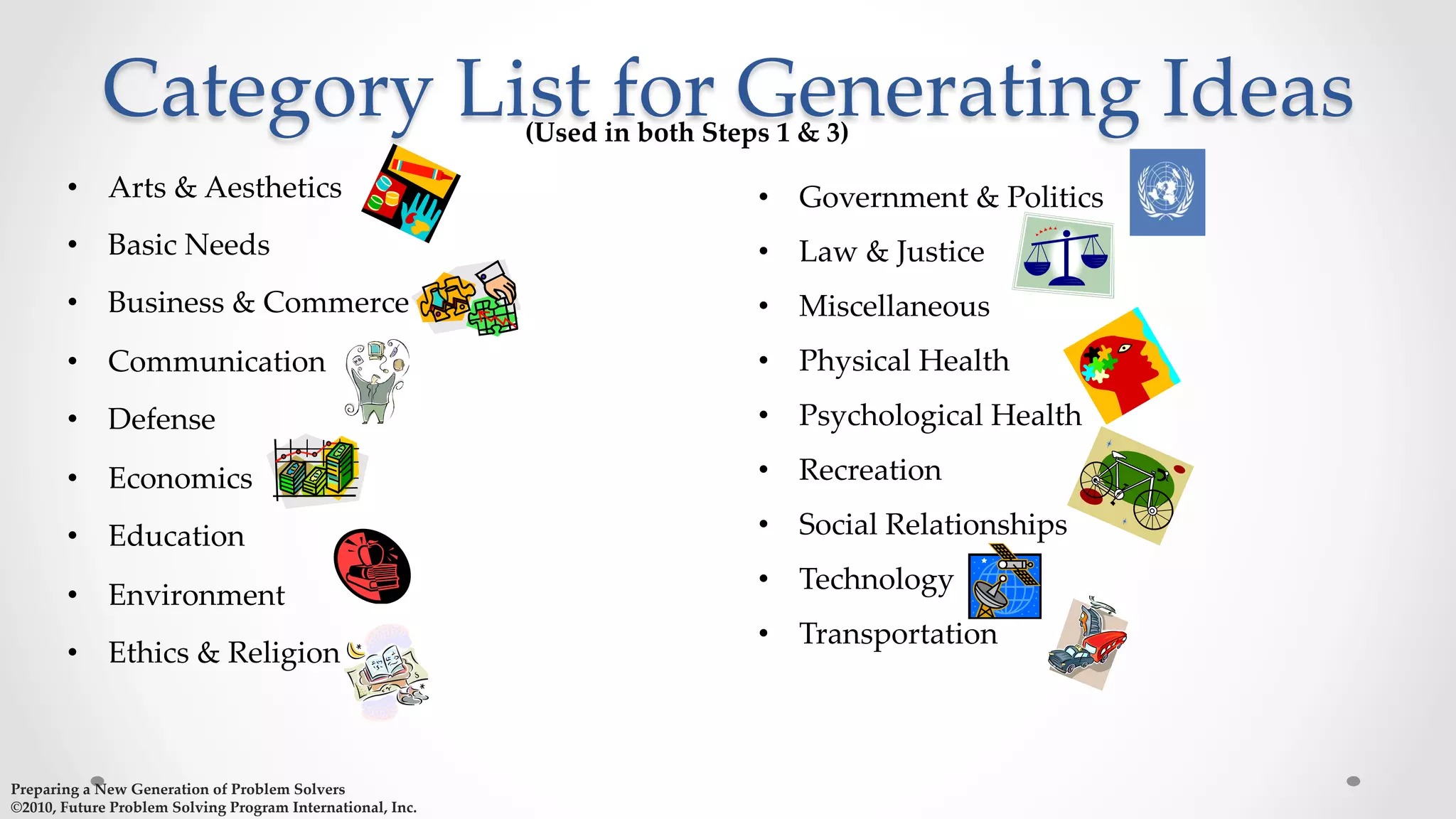
Category  List  for  Generating  Ideas	
•  Arts  &  Aesthetics  	
•  Basic  Needs  	
•  Business  &  Commerce  	
•  Communication  	
•  Defense  	
•  Economics  	
•  Education  	
•  Environment  	
•  Ethics  &  Religion	
•  Government  &  Politics  	
•  Law  &  Justice	
•  Miscellaneous	
•  Physical  Health	
•  Psychological  Health	
•  Recreation	
•  Social  Relationships	
•  Technology	
•  Transportation  	
(Used  in  both  Steps  1  &  3)	
Preparing  a  New  Generation  of  Problem  Solvers  	
©2010,  Future  Problem  Solving  Program  International,  Inc.


  Brainwriting  Directions  	
There  should  be  enough  sheets  for  everyone  in  the  group,  
Identify  the  question  or  problem  on  which  the  group  will  
be  working.  Write  your  name  on  the  top  of  this  sheet.  
Next:  	
1.  Take  a  blank  brainwriting  sheet  and  write  three  ideas  
for  dealing  with  the  problem,  entering  one  idea  in  boxes  1,  
1,  and  1.  	
2.  Pass  your  sheet  to  the  right  when  finished  and  take  the  
one  passed  to  you  from  your  left.  	
3.  You  should  always  have  a  new  sheet,  not  the  one  you  
just  wrote  on.  	
4.  Read  the  ideas  on  the  sheet  you  received  and  use  the  
ideas  to  make  new  connections.  	
5.  Add  three  more  ideas  to  the  new  sheet,  and  then  repeat  
steps  1-­‐‑4.  (write  in  boxes  2,2,2;  then  3,3,3;  and  finally  4,4,4)  	
6.  Continue  until  all  the  sheets  have  been  filled  with  ideas!  	
7.  Duplicate  ideas  should  not  be  wriZen  on  any  sheet;  
however,  if  one  of  your  ideas  is  not  on  the  sheet  you  
receive  and  you  cannot  think  of  a  novel  idea,  you  may  
repeat  it.  
1.	
 1.	


1.	
2.	
 2.	


2.	
3.	
 3.  	


3.	
4.	
 4.	


4.
EFFECTIVE  PROBLEM  SOLVING  RELIES  UPON…	
  
	
Critical  Thinking  (convergent)	
Focusing  on  the  best  idea(s)	
Principle  of  Affirmative  Judgment	


   Adapted  from:  Treffinger,  D.  J.,  Isaksen,  S.  G.,  &  Dorval,  K.  B.  (2006).  Creative  problem	
solving:  An  introduction.  (4th  Ed.).  Waco,  TX:  Prufrock  Press.
Preparing  a  New  Generation  of  Problem  Solvers  	
©2010,  Future  Problem  Solving  Program  International,  Inc.	
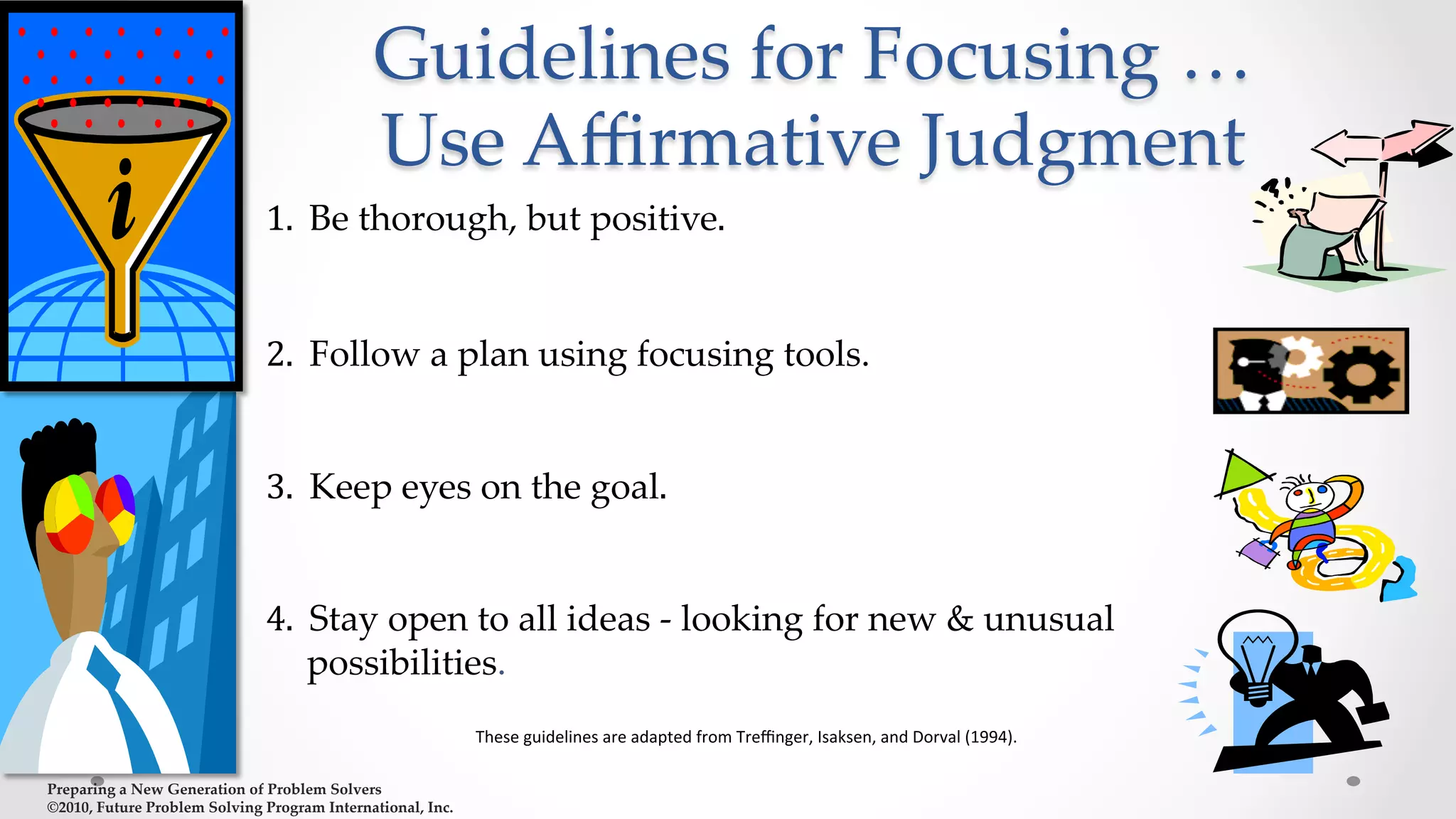
Guidelines  for  Focusing  …  
Use  Affirmative  Judgment	
	
  
1.	
  	
  Be  thorough,  but  positive.	


2.	
  	
  Follow  a  plan  using  focusing  tools.	
	
  
3.	
  	
  Keep  eyes  on  the  goal.	


4.	
  	
  Stay  open  to  all  ideas  -­‐‑  looking  for  new  &  unusual  
possibilities.	
These	
  guidelines	
  are	
  adapted	
  from	
  Treffinger,	
  Isaksen,	
  and	
  Dorval	
  (1994).	
  
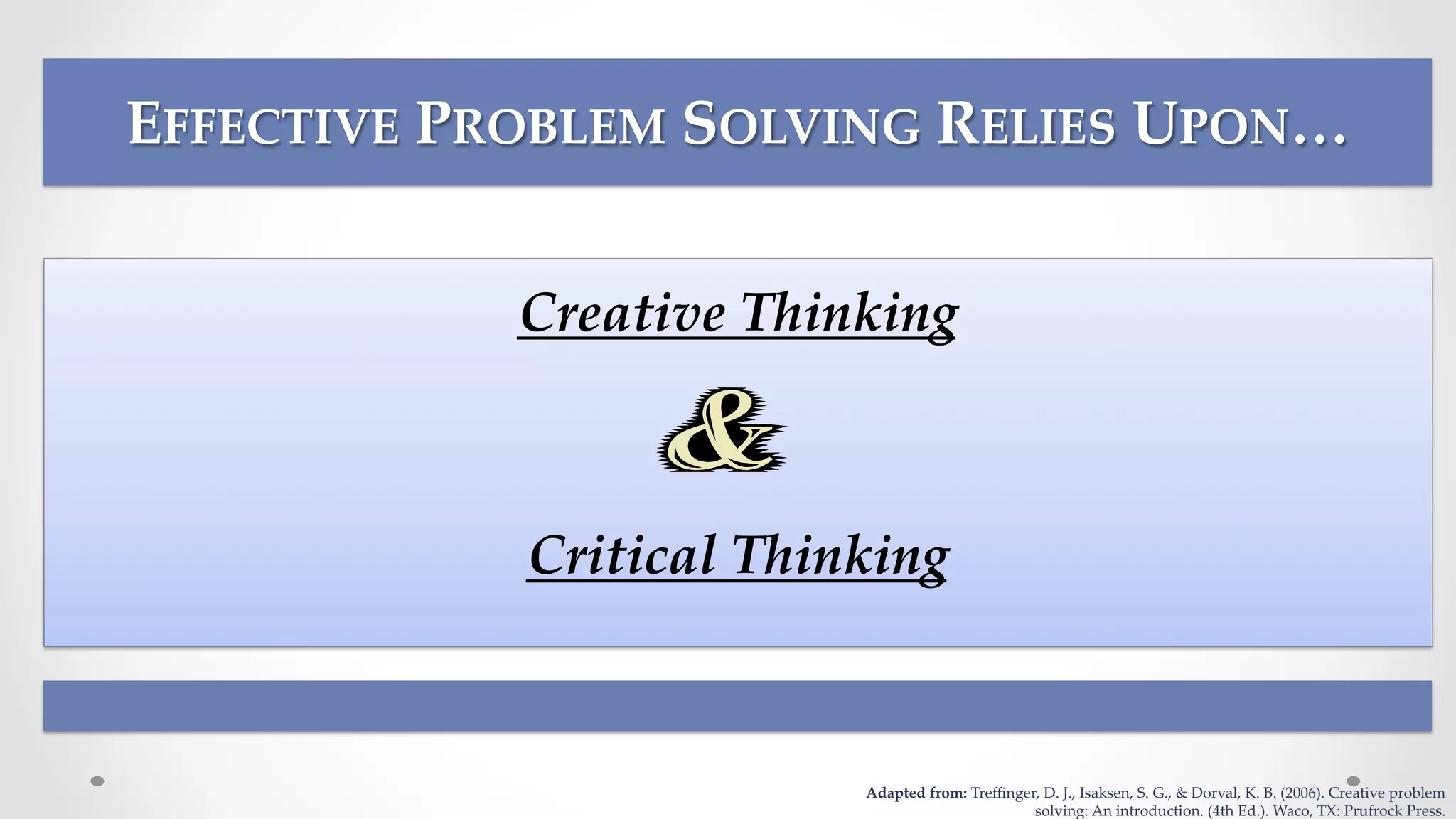
EFFECTIVE  PROBLEM  SOLVING  RELIES  UPON…	
  
  
Creative  Thinking	
	
Critical  Thinking	


Adapted  from:  Treffinger,  D.  J.,  Isaksen,  S.  G.,  &  Dorval,  K.  B.  (2006).  Creative  problem	
solving:  An  introduction.  (4th  Ed.).  Waco,  TX:  Prufrock  Press.
CHESS	
    	
*A]ribute  Listing  -­‐‑  	
	
What parts or game pieces are needed?	


(Generating/Focusing)
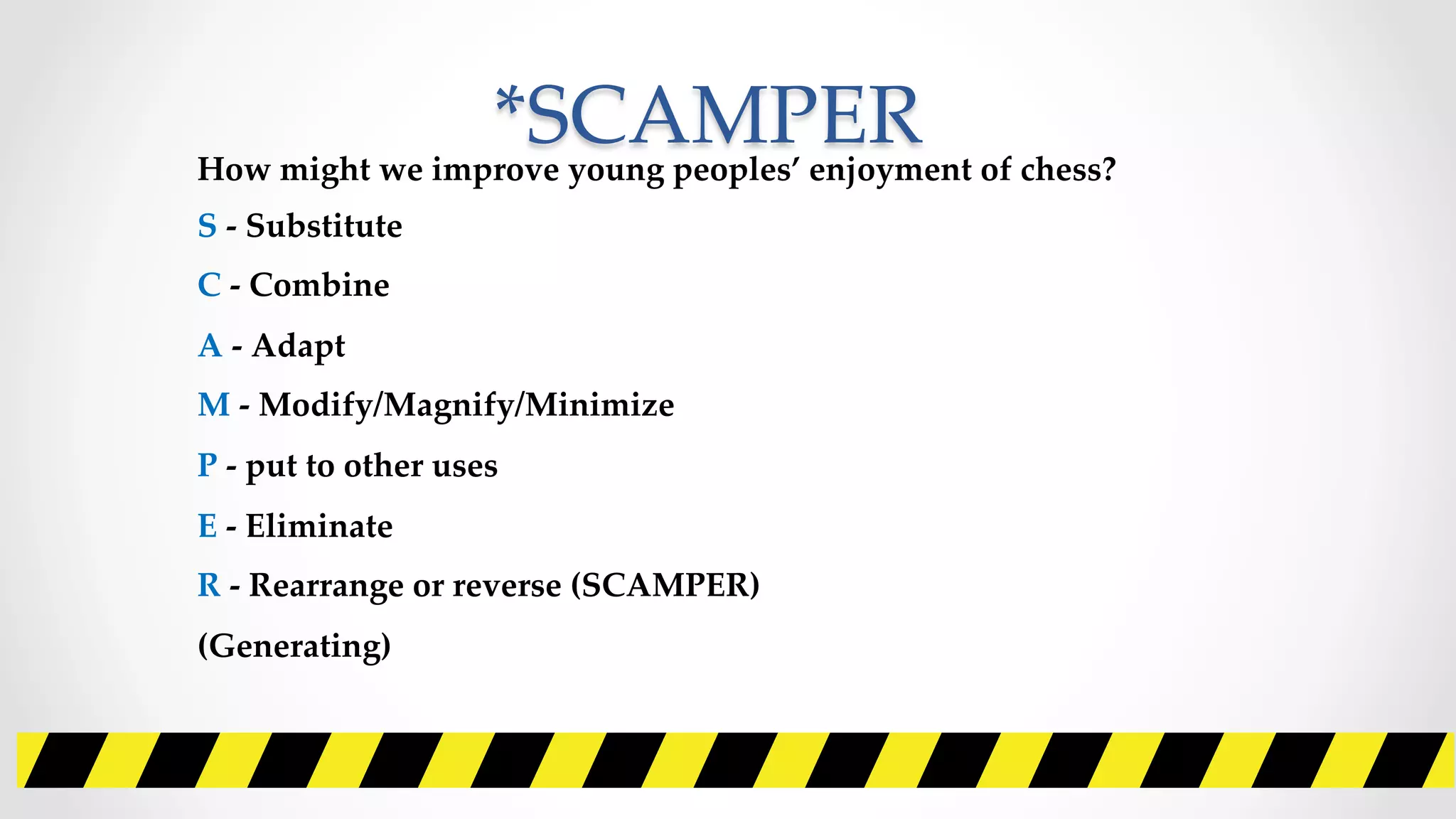
*SCAMPER	
How  might  we  improve  young  peoples’  enjoyment  of  chess?    	
S  -­‐‑  Substitute  	
C  -­‐‑  Combine	
A  -­‐‑  Adapt	
M  -­‐‑  Modify/Magnify/Minimize	
P  -­‐‑  put  to  other  uses  	
E  -­‐‑  Eliminate	
R  -­‐‑  Rearrange  or  reverse  (SCAMPER)	
(Generating)
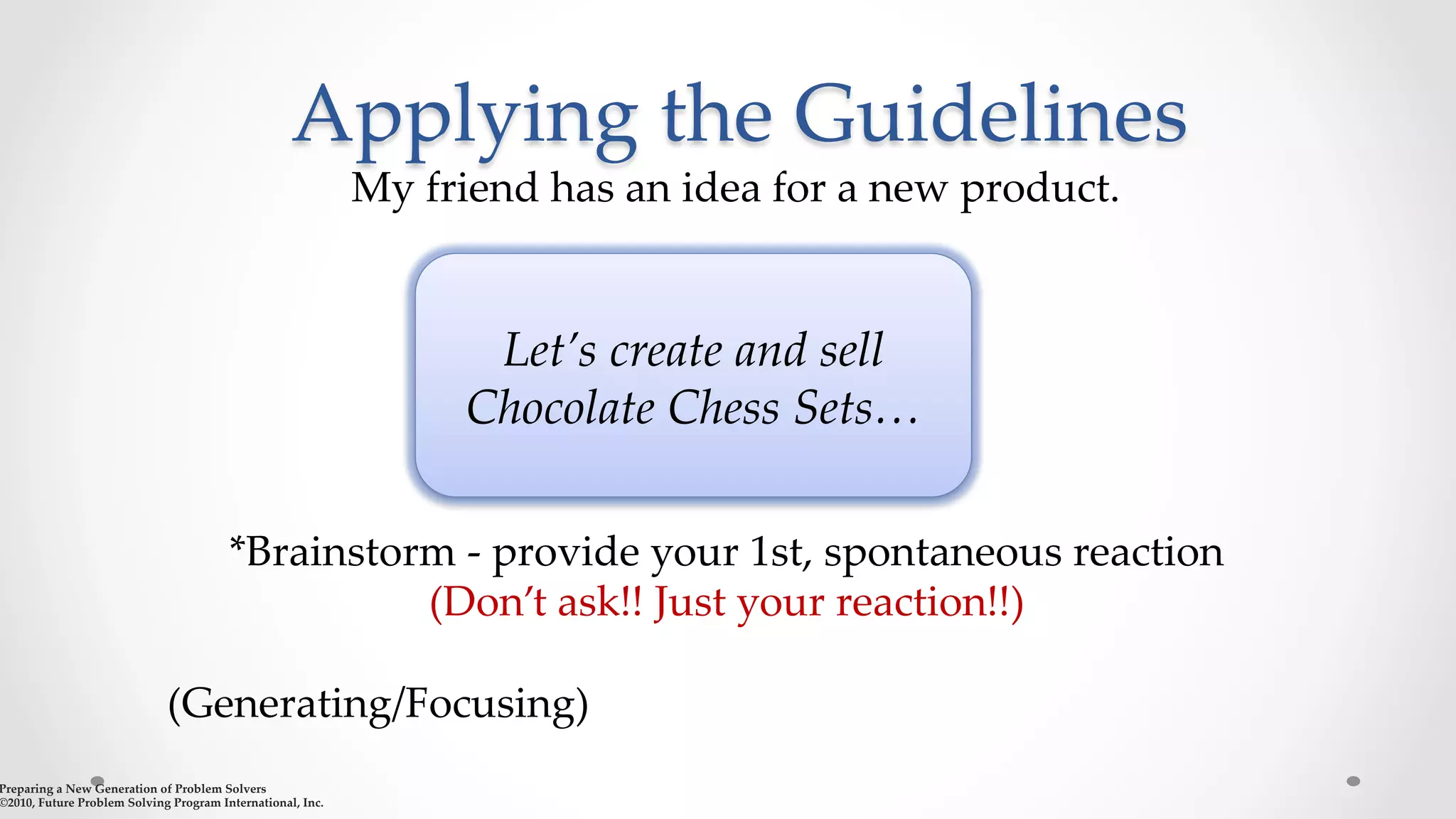
Applying  the  Guidelines	
My  friend  has  an  idea  for  a  new  product.      
	
Preparing  a  New  Generation  of  Problem  Solvers  	
©2010,  Future  Problem  Solving  Program  International,  Inc.	
*Brainstorm  -­‐‑  provide  your  1st,  spontaneous  reaction    	
(Don’t  ask!!  Just  your  reaction!!)	
	
(Generating/Focusing)	
	
Let’s  create  and  sell  
Chocolate  Chess  Sets…
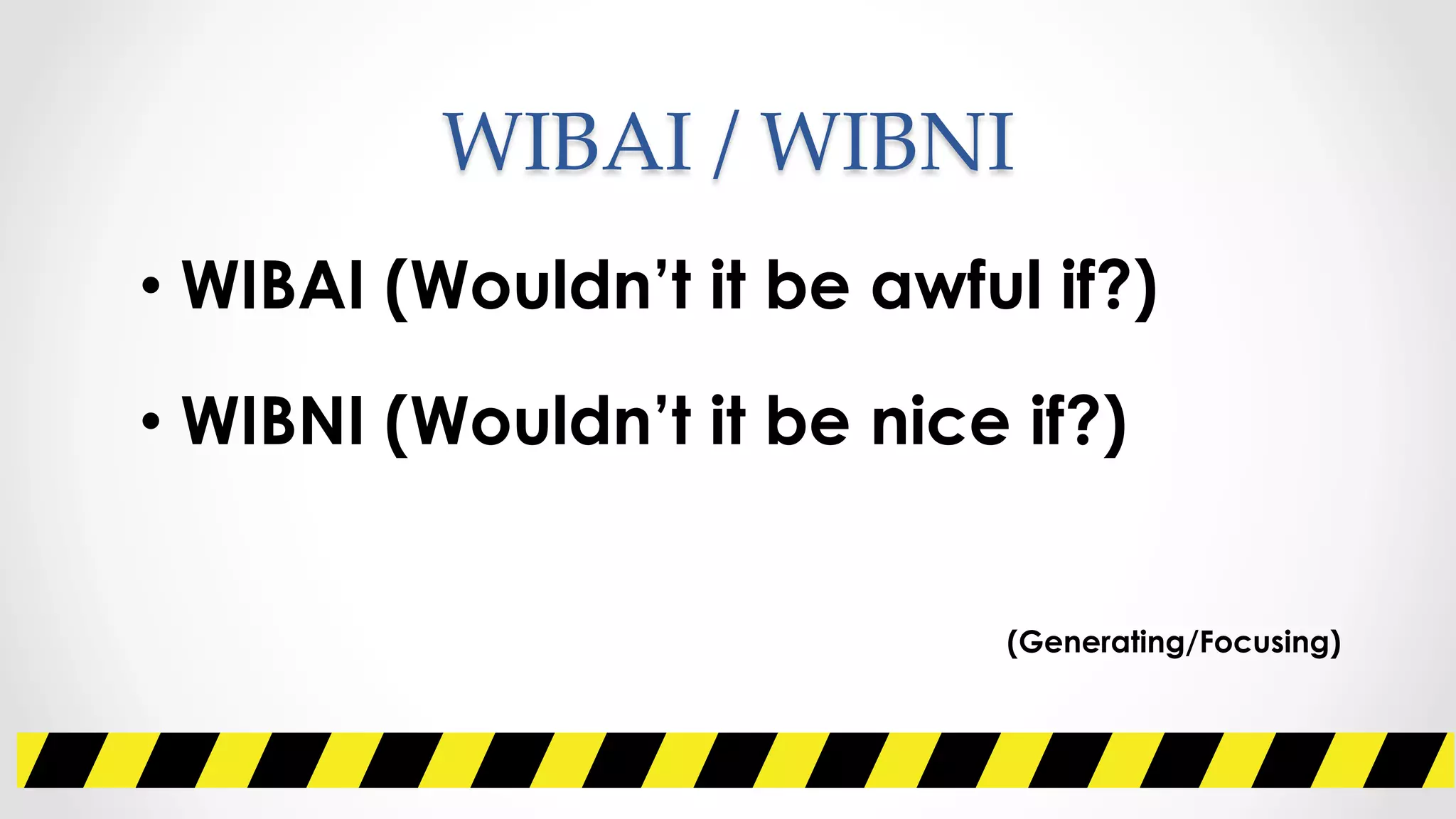
WIBAI  /  WIBNI	
• WIBAI (Wouldn’t it be awful if?)
• WIBNI (Wouldn’t it be nice if?)
(Generating/Focusing)
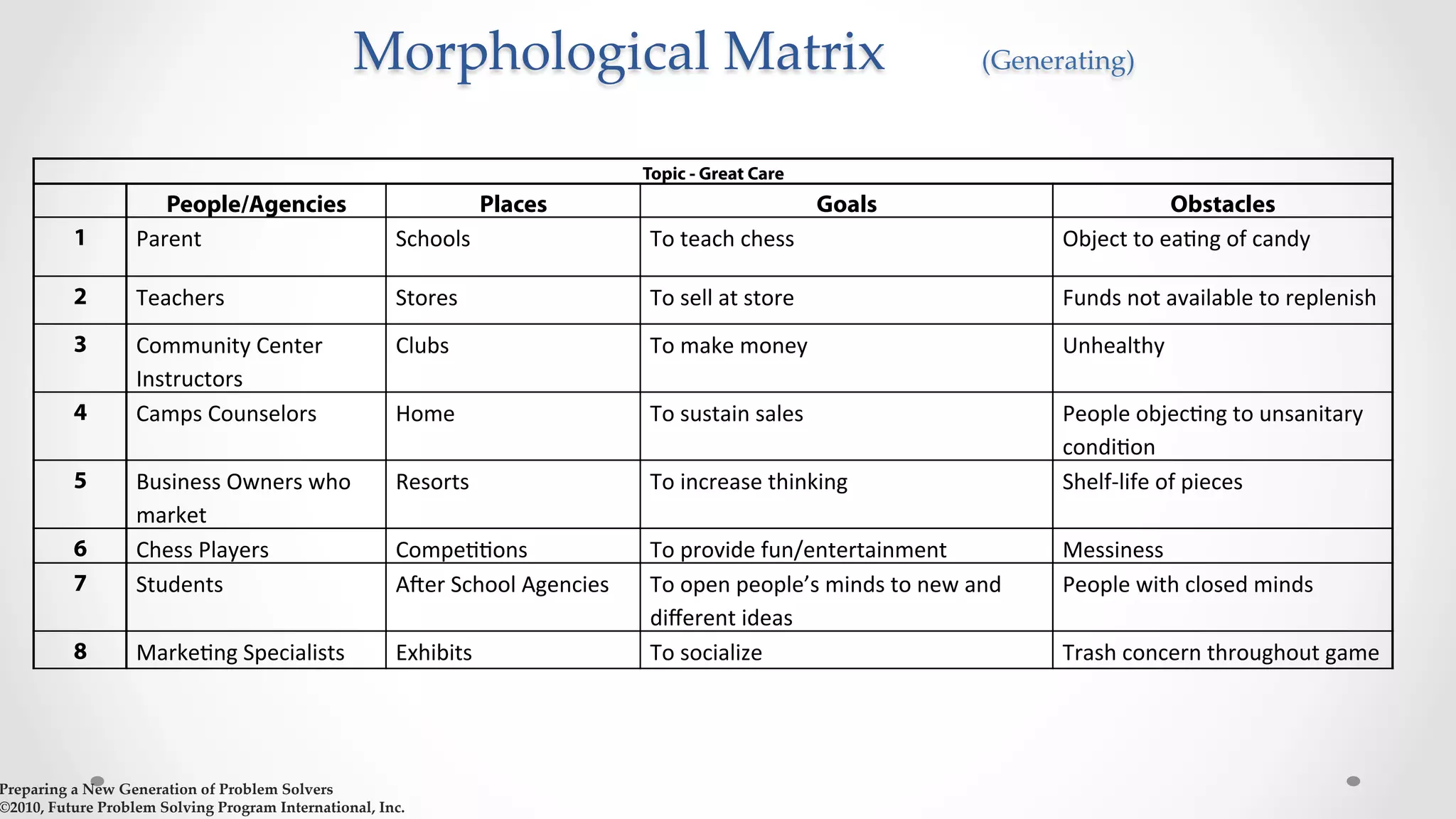
Morphological  Matrix              (Generating)	
Preparing  a  New  Generation  of  Problem  Solvers  	
©2010,  Future  Problem  Solving  Program  International,  Inc.	
Topic - Great Care	
  
People/Agencies Places Goals Obstacles
1	
   Parent	
   Schools	
   To	
  teach	
  chess	
   Object	
  to	
  eaEng	
  of	
  candy	
  
2	
   Teachers	
   Stores	
   To	
  sell	
  at	
  store	
   Funds	
  not	
  available	
  to	
  replenish	
  
3	
   Community	
  Center	
  
Instructors	
  
Clubs	
   To	
  make	
  money	
   Unhealthy	
  	
  
4	
   Camps	
  Counselors	
   Home	
   To	
  sustain	
  sales	
   People	
  objecEng	
  to	
  unsanitary	
  
condiEon	
  
5	
   Business	
  Owners	
  who	
  
market	
  
Resorts	
   To	
  increase	
  thinking	
   Shelf-­‐life	
  of	
  pieces	
  
6	
   Chess	
  Players	
   CompeEEons	
   To	
  provide	
  fun/entertainment	
   Messiness	
  
7	
   Students	
   ARer	
  School	
  Agencies	
   To	
  open	
  people’s	
  minds	
  to	
  new	
  and	
  
different	
  ideas	
  
People	
  with	
  closed	
  minds	
  
8	
   MarkeEng	
  Specialists	
   Exhibits	
   To	
  socialize	
   Trash	
  concern	
  throughout	
  game	
  
 
And  Now  Your  Solutions:  
  
*Hits  &  Hot  Spots  within  your  team  
  to  determine  the  best  solutions  
  
(Focusing)  
  
	
Preparing  a  New  Generation  of  Problem  Solvers    -­‐‑  Practice  Session	
©2010,  Future  Problem  Solving  Program  International,  Inc.    All  rights  reserved.
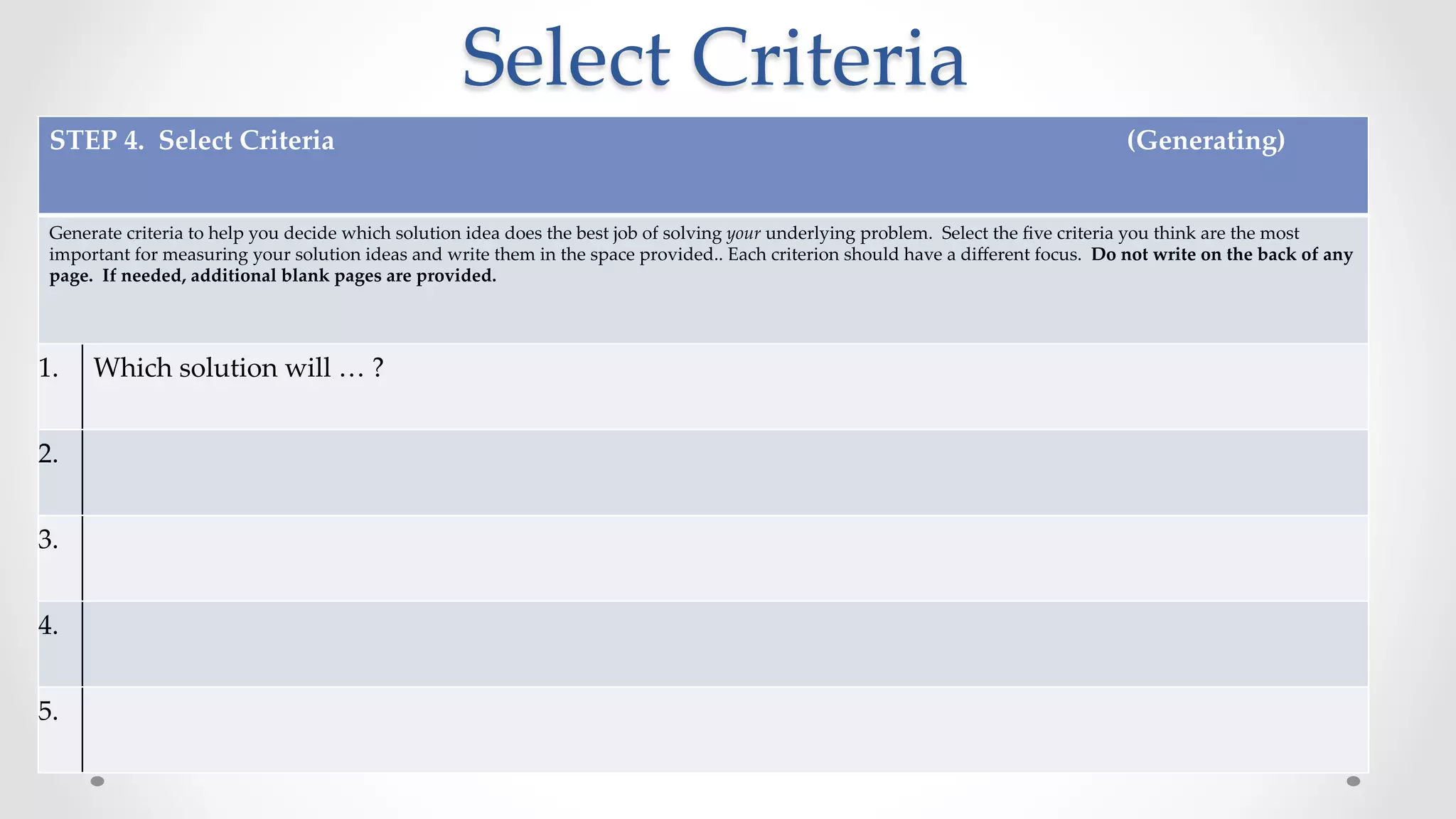
Select  Criteria	
STEP  4.    Select  Criteria                                                                                                                                                                                                                                        (Generating)	
	
Generate  criteria  to  help  you  decide  which  solution  idea  does  the  best  job  of  solving  your  underlying  problem.    Select  the  five  criteria  you  think  are  the  most  
important  for  measuring  your  solution  ideas  and  write  them  in  the  space  provided..  Each  criterion  should  have  a  different  focus.    Do  not  write  on  the  back  of  any  
page.    If  needed,  additional  blank  pages  are  provided.	
	
1.	
 Which  solution  will  …  ?	
2.	
3.	
4.	
5.
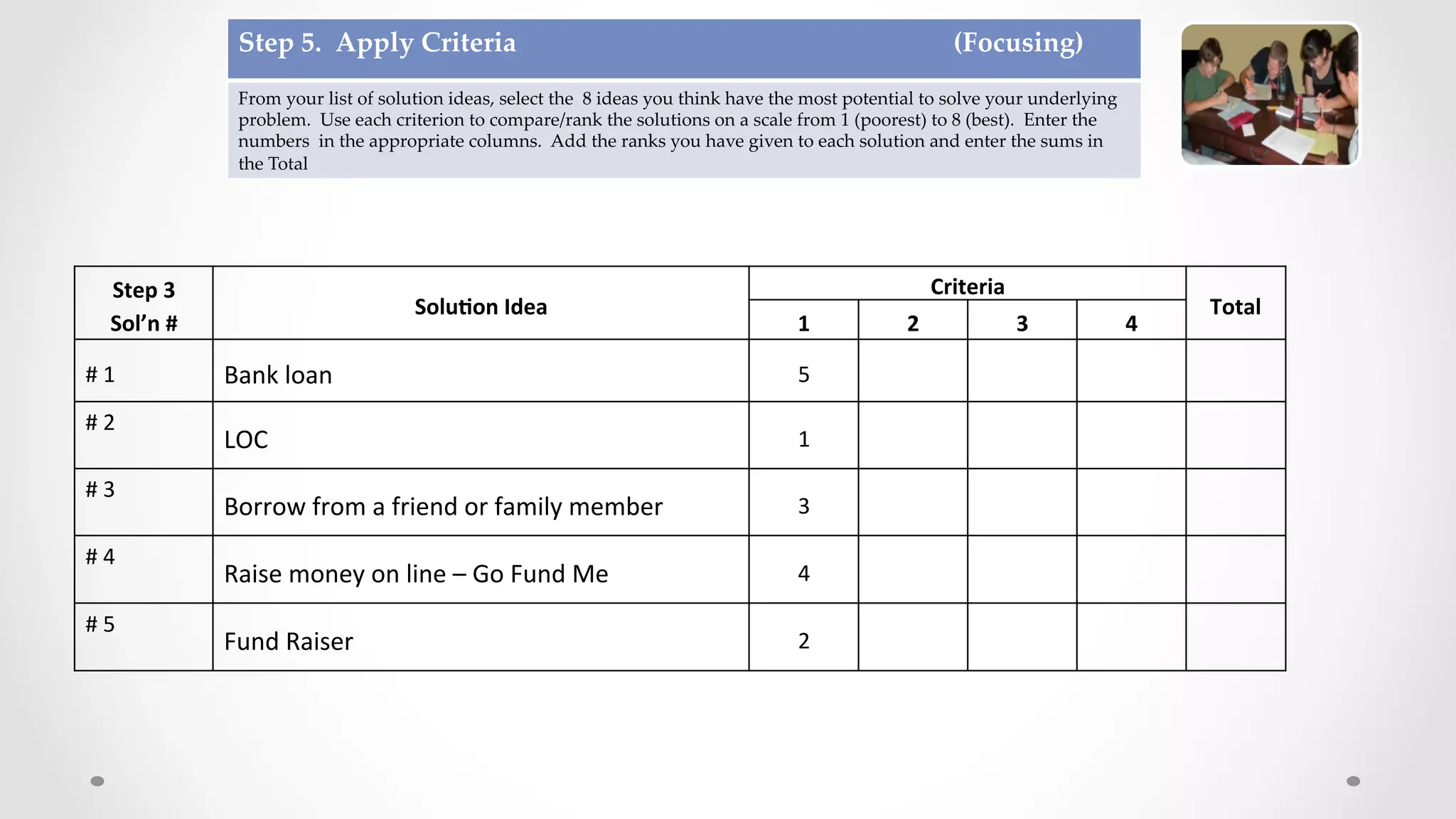
Step  5.    Apply  Criteria                                                                                                                                (Focusing)	
From  your  list  of  solution  ideas,  select  the    8  ideas  you  think  have  the  most  potential  to  solve  your  underlying  
problem.    Use  each  criterion  to  compare/rank  the  solutions  on  a  scale  from  1  (poorest)  to  8  (best).    Enter  the  
numbers    in  the  appropriate  columns.    Add  the  ranks  you  have  given  to  each  solution  and  enter  the  sums  in  
the  Total	
Step	
  3	
  
Sol’n	
  #	
  
Solu-on	
  Idea	
  
Criteria	
  
Total	
  
1	
   2	
   3	
   4	
  
#	
  1	
   Bank	
  loan	
   5	
  
#	
  2	


LOC	
   1	
  
#	
  3	


Borrow	
  from	
  a	
  friend	
  or	
  family	
  member	
   3	
  
#	
  4	


Raise	
  money	
  on	
  line	
  –	
  Go	
  Fund	
  Me	
   4	
  
#	
  5	


Fund	
  Raiser	
   2	
  
ALoU	
*ALoU  –  show  the  Advantages,  
Limitations/means  to  Overcome,  
and  Unique  possibilities	
  	
(Focusing)
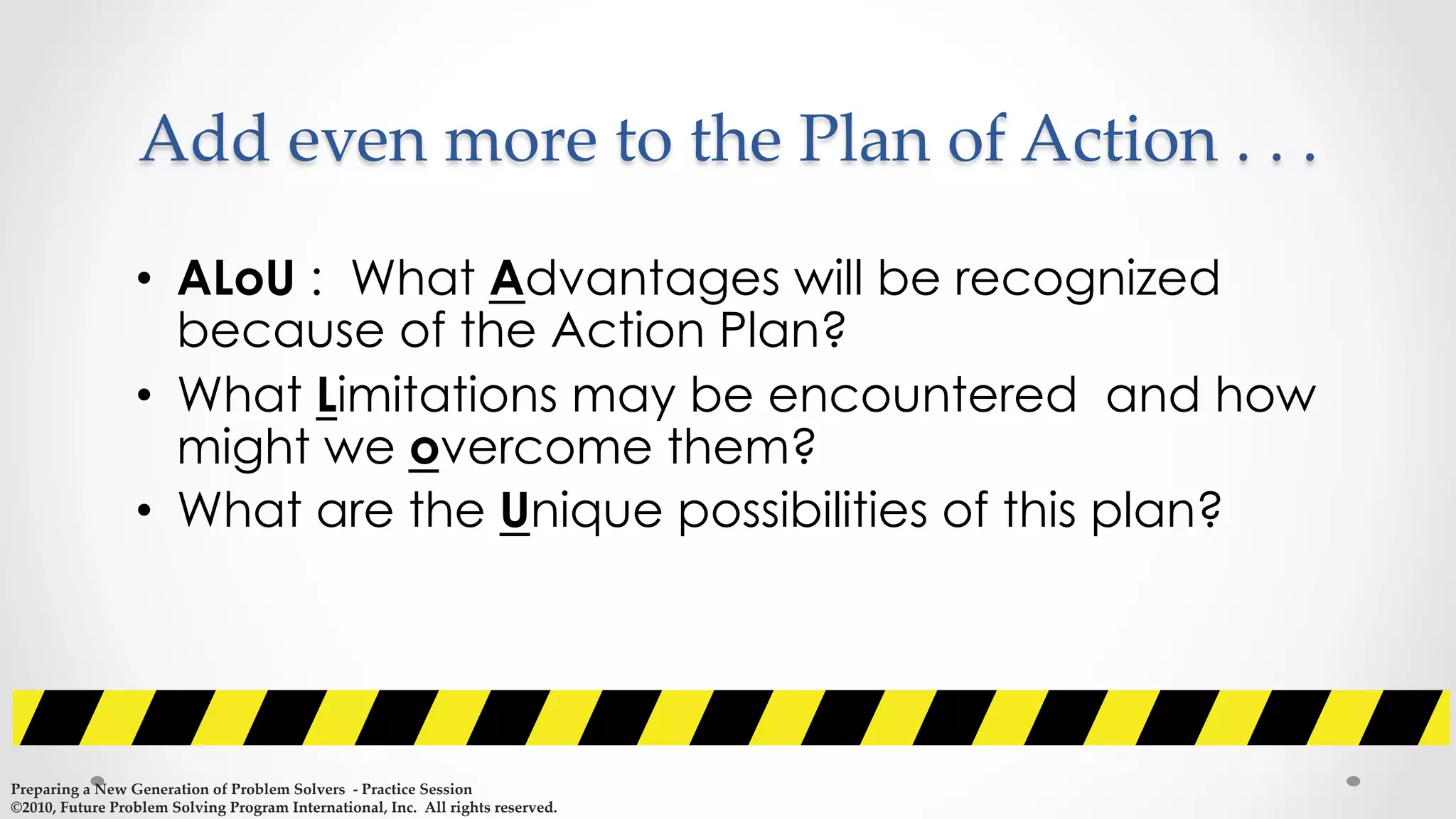
•  ALoU : What Advantages will be recognized
because of the Action Plan?
•  What Limitations may be encountered and how
might we overcome them?
•  What are the Unique possibilities of this plan?
Add  even  more  to  the  Plan  of  Action  .  .  .	
Preparing  a  New  Generation  of  Problem  Solvers    -­‐‑  Practice  Session	
©2010,  Future  Problem  Solving  Program  International,  Inc.    All  rights  reserved.
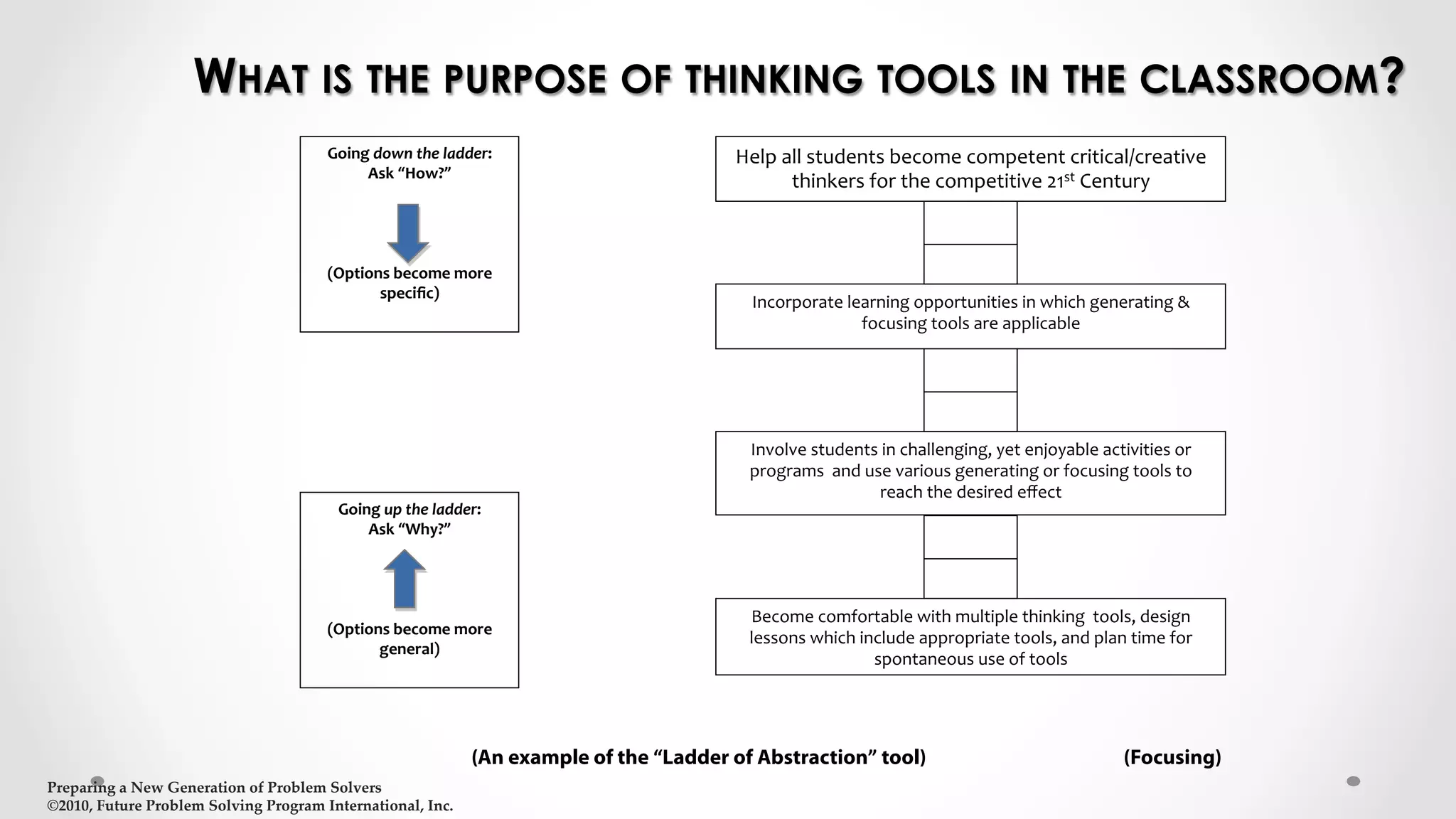
Going	
  down	
  the	
  ladder:	
Ask	
  “How?”	


(Options	
  become	
  more	
  
specific)	
Going	
  up	
  the	
  ladder:	
Ask	
  “Why?”	


(Options	
  become	
  more	
  
general)	
Help	
  all	
  students	
  become	
  competent	
  critical/creative	
  
thinkers	
  for	
  the	
  competitive	
  21st	
  Century	
Incorporate	
  learning	
  opportunities	
  in	
  which	
  generating	
  &	
  
focusing	
  tools	
  are	
  applicable	
Involve	
  students	
  in	
  challenging,	
  yet	
  enjoyable	
  activities	
  or	
  
programs	
  	
  and	
  use	
  various	
  generating	
  or	
  focusing	
  tools	
  to	
  
reach	
  the	
  desired	
  effect	
Become	
  comfortable	
  with	
  multiple	
  thinking	
  	
  tools,	
  design	
  
lessons	
  which	
  include	
  appropriate	
  tools,	
  and	
  plan	
  time	
  for	
  
spontaneous	
  use	
  of	
  tools	
  
WHAT IS THE PURPOSE OF THINKING TOOLS IN THE CLASSROOM?
(An example of the “Ladder of Abstraction” tool) (Focusing)	
Preparing  a  New  Generation  of  Problem  Solvers  	
©2010,  Future  Problem  Solving  Program  International,  Inc.
Applying  the  Tools  Effectively    
Tools  for  Problem  Solvers  -­‐‑  Chapter  5  	
©  1996,  Center  for  Creative  Learning;  reproduced  by  permission	
•  Set  time  aside  to  work  deliberately  on  learning  &  
practicing  these  tools.	
•  Learn  &  use  the  tools  by  name.	
•  Review  regularly  both  the  Tools  &  the  Guidelines  
for  Generating  &  Focusing.	
•  Recognize  the  role  &  importance  of  style  differences.	
•  Provide  familiar  tasks  for  learning  &  practicing  new  
tools,  and  use  familiar  tools  when  beginning  new  
tasks.  	
Preparing  a  New  Generation  of  Problem  Solvers  	
©2010,  Future  Problem  Solving  Program  International,  Inc.
Applying  the  Tools  Effectively    
Tools  for  Problem  Solvers    -­‐‑  Chapter  5	
©  1996,  Center  for  Creative  Learning;  reproduced  by  permission	
•  Plan  deliberately  when  selecting  tools;  be  certain  you  know  
what  you  want  to  accomplish  &  why  you’re  choosing  a  certain  
tool.	
•  Discuss  &  debrief  the  tools  &  the  results.	
•  Encourage  participants  to  apply  tools  in  other  seZings  and  to  
share  their  personal  applications  of  any  of  the  tools.	
•  Model  using  the  tools.	
•  Seek  ways  to  use  the  tools  in    combination.	
•  If  what  you’re  doing  isn’t  working,  try  something  else.	
•    	
Preparing  a  New  Generation  of  Problem  Solvers  	
©2010,  Future  Problem  Solving  Program  International,  Inc.
The  tools  won’t  break.    	
You  might  discover  a  great  new  
way  to  apply  it  successfully.    	
	
Feel  free  to  be  creative  about  
being  creative!

Thinking Tools - Empowering Students to Get the Job Done

  • 1.
    THINKING  TOOLS  -­‐‑  EMPOWERING  STUDENTS  TO  GET  THE  JOB  DONE
  • 2.
    UNDERSTANDING THE CHALLENGE Constructing Opportunities Framing Problems Exploring Data PREPARING FOR ACTION Developing Solutions Building Acceptance GENERATING IDEASGenerating Ideas Designing Process PLANNING YOURAPPROACH Appraising Tasks CREATIVE  PROBLEM  SOLVING—   CPS  Version  6.1™ Clarity Options Action © 2013 Future Problem Solving Program International, Inc.
  • 3.
    Self  Assessment ©  1996, Center  for  Creative  Learning;  reproduced  by  permission Let’s  find  out  where  you  stand  now  as  a  creative  problem  solver?! 4=  Familiar  and  could  teach  to  others 3=  Have  seen  and  used  some 2=  Have  heard  of  or  seen,  have  never  used 1=  Unfamiliar  to  me     Preparing  a  New  Generation  of  Problem  Solvers   ©2010,  Future  Problem  Solving  Program  International,  Inc.
  • 4.
    List  any  generating or  focusing  tools   you  know  well  and  have  used: Brainstorming Brainstorming  with  Post-­‐‑itsTM Brainwriting Force-­‐‑FiZing Hot  spots,  Highlighting Identifying  Hits Sequencing:  SML Evaluation  Matrix  (variations) Paired  Comparison  Analysis ALoU SCAMPER Morphological  Matrix Ladder  of  Abstraction WIBAI  /  WIBNI
  • 5.
    EFFECTIVE  PROBLEM  SOLVING RELIES  UPON…   Creative  Thinking  (divergent) Generating  new  &  many  ideas Principle  of  Deferred  Judgment Adapted  from:  Treffinger,  D.  J.,  Isaksen,  S.  G.,  &  Dorval,  K.  B.  (2006).  Creative  problem solving:  An  introduction.  (4th  Ed.).  Waco,  TX:  Prufrock  Press.
  • 6.
    Preparing  a  New Generation  of  Problem  Solvers   ©2010,  Future  Problem  Solving  Program  International,  Inc. Guidelines  for  Generating  .  .  .   Use  Deferred  Judgment 1.     No  Criticism  or  Praise…   2.  Quantity       3.  Combinations  and  improvements   (hitchhiking  or  piggybacking)       4.  Freewheeling   (Wild  and  crazy  ideas  are  allowed!)      
  • 7.
    Category  List  for Generating  Ideas •  Arts  &  Aesthetics   •  Basic  Needs   •  Business  &  Commerce   •  Communication   •  Defense   •  Economics   •  Education   •  Environment   •  Ethics  &  Religion •  Government  &  Politics   •  Law  &  Justice •  Miscellaneous •  Physical  Health •  Psychological  Health •  Recreation •  Social  Relationships •  Technology •  Transportation   (Used  in  both  Steps  1  &  3) Preparing  a  New  Generation  of  Problem  Solvers   ©2010,  Future  Problem  Solving  Program  International,  Inc.
  • 8.
       Brainwriting  Directions  There  should  be  enough  sheets  for  everyone  in  the  group,   Identify  the  question  or  problem  on  which  the  group  will   be  working.  Write  your  name  on  the  top  of  this  sheet.   Next:   1.  Take  a  blank  brainwriting  sheet  and  write  three  ideas   for  dealing  with  the  problem,  entering  one  idea  in  boxes  1,   1,  and  1.   2.  Pass  your  sheet  to  the  right  when  finished  and  take  the   one  passed  to  you  from  your  left.   3.  You  should  always  have  a  new  sheet,  not  the  one  you   just  wrote  on.   4.  Read  the  ideas  on  the  sheet  you  received  and  use  the   ideas  to  make  new  connections.   5.  Add  three  more  ideas  to  the  new  sheet,  and  then  repeat   steps  1-­‐‑4.  (write  in  boxes  2,2,2;  then  3,3,3;  and  finally  4,4,4)   6.  Continue  until  all  the  sheets  have  been  filled  with  ideas!   7.  Duplicate  ideas  should  not  be  wriZen  on  any  sheet;   however,  if  one  of  your  ideas  is  not  on  the  sheet  you   receive  and  you  cannot  think  of  a  novel  idea,  you  may   repeat  it.  
  • 9.
    1. 1. 1. 2. 2. 2. 3. 3.   3. 4. 4. 4.
  • 10.
    EFFECTIVE  PROBLEM  SOLVING RELIES  UPON…   Critical  Thinking  (convergent) Focusing  on  the  best  idea(s) Principle  of  Affirmative  Judgment     Adapted  from:  Treffinger,  D.  J.,  Isaksen,  S.  G.,  &  Dorval,  K.  B.  (2006).  Creative  problem solving:  An  introduction.  (4th  Ed.).  Waco,  TX:  Prufrock  Press.
  • 11.
    Preparing  a  New Generation  of  Problem  Solvers   ©2010,  Future  Problem  Solving  Program  International,  Inc. Guidelines  for  Focusing  …   Use  Affirmative  Judgment   1.    Be  thorough,  but  positive.     2.    Follow  a  plan  using  focusing  tools.   3.    Keep  eyes  on  the  goal.     4.    Stay  open  to  all  ideas  -­‐‑  looking  for  new  &  unusual   possibilities. These  guidelines  are  adapted  from  Treffinger,  Isaksen,  and  Dorval  (1994).  
  • 12.
    EFFECTIVE  PROBLEM  SOLVING RELIES  UPON…     Creative  Thinking Critical  Thinking                 Adapted  from:  Treffinger,  D.  J.,  Isaksen,  S.  G.,  &  Dorval,  K.  B.  (2006).  Creative  problem solving:  An  introduction.  (4th  Ed.).  Waco,  TX:  Prufrock  Press.
  • 13.
    CHESS     *A]ribute Listing  -­‐‑   What parts or game pieces are needed? (Generating/Focusing)
  • 14.
    *SCAMPER How  might  we improve  young  peoples’  enjoyment  of  chess?     S  -­‐‑  Substitute   C  -­‐‑  Combine A  -­‐‑  Adapt M  -­‐‑  Modify/Magnify/Minimize P  -­‐‑  put  to  other  uses   E  -­‐‑  Eliminate R  -­‐‑  Rearrange  or  reverse  (SCAMPER) (Generating)
  • 15.
    Applying  the  Guidelines My friend  has  an  idea  for  a  new  product.       Preparing  a  New  Generation  of  Problem  Solvers   ©2010,  Future  Problem  Solving  Program  International,  Inc. *Brainstorm  -­‐‑  provide  your  1st,  spontaneous  reaction     (Don’t  ask!!  Just  your  reaction!!) (Generating/Focusing) Let’s  create  and  sell   Chocolate  Chess  Sets…
  • 16.
    WIBAI  /  WIBNI • WIBAI(Wouldn’t it be awful if?) • WIBNI (Wouldn’t it be nice if?) (Generating/Focusing)
  • 17.
    Morphological  Matrix             (Generating) Preparing  a  New  Generation  of  Problem  Solvers   ©2010,  Future  Problem  Solving  Program  International,  Inc. Topic - Great Care   People/Agencies Places Goals Obstacles 1   Parent   Schools   To  teach  chess   Object  to  eaEng  of  candy   2   Teachers   Stores   To  sell  at  store   Funds  not  available  to  replenish   3   Community  Center   Instructors   Clubs   To  make  money   Unhealthy     4   Camps  Counselors   Home   To  sustain  sales   People  objecEng  to  unsanitary   condiEon   5   Business  Owners  who   market   Resorts   To  increase  thinking   Shelf-­‐life  of  pieces   6   Chess  Players   CompeEEons   To  provide  fun/entertainment   Messiness   7   Students   ARer  School  Agencies   To  open  people’s  minds  to  new  and   different  ideas   People  with  closed  minds   8   MarkeEng  Specialists   Exhibits   To  socialize   Trash  concern  throughout  game  
  • 18.
      And  Now  Your Solutions:     *Hits  &  Hot  Spots  within  your  team    to  determine  the  best  solutions     (Focusing)     Preparing  a  New  Generation  of  Problem  Solvers    -­‐‑  Practice  Session ©2010,  Future  Problem  Solving  Program  International,  Inc.    All  rights  reserved.
  • 19.
    Select  Criteria STEP  4.   Select  Criteria                                                                                                                                                                                                                                        (Generating) Generate  criteria  to  help  you  decide  which  solution  idea  does  the  best  job  of  solving  your  underlying  problem.    Select  the  five  criteria  you  think  are  the  most   important  for  measuring  your  solution  ideas  and  write  them  in  the  space  provided..  Each  criterion  should  have  a  different  focus.    Do  not  write  on  the  back  of  any   page.    If  needed,  additional  blank  pages  are  provided. 1. Which  solution  will  …  ? 2. 3. 4. 5.
  • 20.
    Step  5.   Apply  Criteria                                                                                                                                (Focusing) From  your  list  of  solution  ideas,  select  the    8  ideas  you  think  have  the  most  potential  to  solve  your  underlying   problem.    Use  each  criterion  to  compare/rank  the  solutions  on  a  scale  from  1  (poorest)  to  8  (best).    Enter  the   numbers    in  the  appropriate  columns.    Add  the  ranks  you  have  given  to  each  solution  and  enter  the  sums  in   the  Total Step  3   Sol’n  #   Solu-on  Idea   Criteria   Total   1   2   3   4   #  1   Bank  loan   5   #  2     LOC   1   #  3     Borrow  from  a  friend  or  family  member   3   #  4     Raise  money  on  line  –  Go  Fund  Me   4   #  5     Fund  Raiser   2  
  • 21.
    ALoU *ALoU  –  show the  Advantages,   Limitations/means  to  Overcome,   and  Unique  possibilities   (Focusing)
  • 22.
    •  ALoU :What Advantages will be recognized because of the Action Plan? •  What Limitations may be encountered and how might we overcome them? •  What are the Unique possibilities of this plan? Add  even  more  to  the  Plan  of  Action  .  .  . Preparing  a  New  Generation  of  Problem  Solvers    -­‐‑  Practice  Session ©2010,  Future  Problem  Solving  Program  International,  Inc.    All  rights  reserved.
  • 23.
    Going  down  the  ladder: Ask  “How?”         (Options  become  more   specific) Going  up  the  ladder: Ask  “Why?”         (Options  become  more   general) Help  all  students  become  competent  critical/creative   thinkers  for  the  competitive  21st  Century Incorporate  learning  opportunities  in  which  generating  &   focusing  tools  are  applicable Involve  students  in  challenging,  yet  enjoyable  activities  or   programs    and  use  various  generating  or  focusing  tools  to   reach  the  desired  effect Become  comfortable  with  multiple  thinking    tools,  design   lessons  which  include  appropriate  tools,  and  plan  time  for   spontaneous  use  of  tools   WHAT IS THE PURPOSE OF THINKING TOOLS IN THE CLASSROOM? (An example of the “Ladder of Abstraction” tool) (Focusing) Preparing  a  New  Generation  of  Problem  Solvers   ©2010,  Future  Problem  Solving  Program  International,  Inc.
  • 24.
    Applying  the  Tools Effectively     Tools  for  Problem  Solvers  -­‐‑  Chapter  5   ©  1996,  Center  for  Creative  Learning;  reproduced  by  permission •  Set  time  aside  to  work  deliberately  on  learning  &   practicing  these  tools. •  Learn  &  use  the  tools  by  name. •  Review  regularly  both  the  Tools  &  the  Guidelines   for  Generating  &  Focusing. •  Recognize  the  role  &  importance  of  style  differences. •  Provide  familiar  tasks  for  learning  &  practicing  new   tools,  and  use  familiar  tools  when  beginning  new   tasks.   Preparing  a  New  Generation  of  Problem  Solvers   ©2010,  Future  Problem  Solving  Program  International,  Inc.
  • 25.
    Applying  the  Tools Effectively     Tools  for  Problem  Solvers    -­‐‑  Chapter  5 ©  1996,  Center  for  Creative  Learning;  reproduced  by  permission •  Plan  deliberately  when  selecting  tools;  be  certain  you  know   what  you  want  to  accomplish  &  why  you’re  choosing  a  certain   tool. •  Discuss  &  debrief  the  tools  &  the  results. •  Encourage  participants  to  apply  tools  in  other  seZings  and  to   share  their  personal  applications  of  any  of  the  tools. •  Model  using  the  tools. •  Seek  ways  to  use  the  tools  in    combination. •  If  what  you’re  doing  isn’t  working,  try  something  else. •    Preparing  a  New  Generation  of  Problem  Solvers   ©2010,  Future  Problem  Solving  Program  International,  Inc.
  • 26.
    The  tools  won’t break.     You  might  discover  a  great  new   way  to  apply  it  successfully.     Feel  free  to  be  creative  about   being  creative!