Solution Thinking
The Development of a Thoughtful Design
The development of a thoughtful design
• Complex situations are different from complicated ones in a particular way.
• Both involve multiple elements interacting, and both can be “net positive” or “net negative”. But complexity ideally features a
success from difficult relationships, whereas complication features a lack of success due to the difficulty of the relationships.
• Successful complexity is most valuable when the complexity allows a needed outcome not available from simplicity. But
complexity also presents higher degrees of difficulty when it must be changed to allow or provide different outcomes.
• Professionals working on changing complex situations increasingly talk about the need to solve problems that have low or
uncertain definition. The challenge is similar to confronting a highly out-of-focus image where the picture at hand needs far higher
resolution before we can tell what it intends to communicate. Part of the challenge is also to determine what the framing of the
image actually includes or omits, and how that affects the way details are connected and organized within.
• Higher resolution creates the opportunity to examine and decide on what evident meaning can and should be addressed.
Techniques for increasing the resolution include analysis, pattern recognition, and trial-and-error distillation among others that
may “enhance” and “clarify” available information about details and relationships.
• The techniques themselves may be simple or complex, and their use comes with a risk of creating images that are not factual
representations of the underlying situation being resolved. They need not be mutually exclusive, and they may themselves evolve.
• This risk points out, however, that the desired initial impact of the resolution is not about the output being “truth” but instead
about being actionable; and the essential goal is not about the completeness of the technique but instead about the maturation of
the incremental outcomes towards having a desirable impact.
• In effect, the overall resolution effort is a form of development aimed at producing utility of desirable known value. If the effort
also becomes sustainable, then it is a way for development to continue adding to a progression of benefits over time. It is also
important to acknowledge that the “developer” may also be the target beneficiary, as well as that competency can vary from one
developer or situation to another.
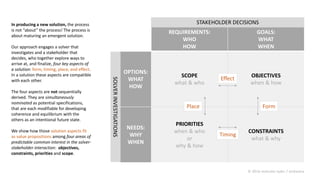
REQUIREMENTS:
WHO
HOW
GOALS:
WHAT
WHEN
OPTIONS:
WHAT
HOW
SCOPE
what & who
OBJECTIVES
when & how
NEEDS:
WHY
WHEN
PRIORITIES
when & who
or
why & how
CONSTRAINTS
what & why
FormPlace
Timing
Effect
In producing a new solution, the process
is not “about” the process! The process is
about maturing an emergent solution.
Our approach engages a solver that
investigates and a stakeholder that
decides, who together explore ways to
arrive at, and finalize, four key aspects of
a solution: form, timing, place, and effect.
In a solution these aspects are compatible
with each other.
The four aspects are not sequentially
derived. They are simultaneously
nominated as potential specifications,
that are each modifiable for developing
coherence and equilibrium with the
others as an intentional future state.
We show how those solution aspects fit
as value propositions among four areas of
predictable common interest in the solver-
stakeholder interaction: objectives,
constraints, priorities and scope.
STAKEHOLDER DECISIONS
SOLVERINVESTIGATIONS
© 2016 malcolm ryder / archestra
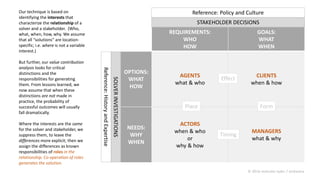
REQUIREMENTS:
WHO
HOW
GOALS:
WHAT
WHEN
OPTIONS:
WHAT
HOW
AGENTS
what & who
CLIENTS
when & how
NEEDS:
WHY
WHEN
ACTORS
when & who
or
why & how
MANAGERS
what & why
FormPlace
Timing
Effect
STAKEHOLDER DECISIONS
SOLVERINVESTIGATIONS
Reference: Policy and Culture
Reference:HistoryandExpertise
Our technique is based on
identifying the interests that
characterize the relationship of a
solver and a stakeholder. (Who,
what, when, how, why. We assume
that all “solutions” are location-
specific; i.e. where is not a variable
interest.)
But further, our value contribution
analysis looks for critical
distinctions and the
responsibilities for generating
them. From lessons learned, we
now assume that when these
distinctions are not made in
practice, the probability of
successful outcomes will usually
fall dramatically.
Where the interests are the same
for the solver and stakeholder, we
suppress them, to leave the
differences more explicit; then we
assign the differences as known
responsibilities of roles in the
relationship. Co-operation of roles
generates the solution.
© 2016 malcolm ryder / archestra
Solution maturation as progress
The various participants and their inputs are orchestrated to achieve “realizations”
and “acceptance” of definable options.
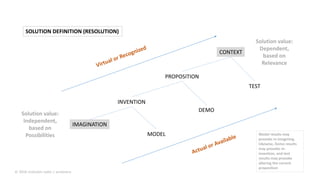
MODEL
IMAGINATION
PROPOSITION
INVENTION
TEST
CONTEXT
Solution value:
Independent,
based on
Possibilities
Solution value:
Dependent,
based on
Relevance
DEMO
SOLUTION DEFINITION (RESOLUTION)
Model results may
provoke re-imagining.
Likewise, Demo results
may provoke re-
invention, and test
results may provoke
altering the current
proposition
© 2016 malcolm ryder / archestra
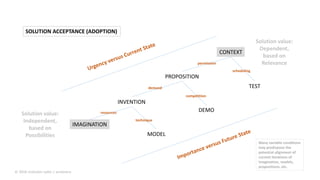
MODEL
IMAGINATION
PROPOSITION
INVENTION
TEST
CONTEXT
Solution value:
Independent,
based on
Possibilities
Solution value:
Dependent,
based on
Relevance
DEMO
competition
scheduling
resources
demand
technique
permission
SOLUTION ACCEPTANCE (ADOPTION)
Many variable conditions
may predispose the
potential alignment of
current iterations of
imagination, models,
propositions, etc.
© 2016 malcolm ryder / archestra
MODEL
IMAGINATION
PROPOSITION
INVENTION
TEST
CONTEXT
Solution value:
Independent,
based on
Possibilities
Solution value:
Dependent,
based on
Relevance
DEMO
competition
scheduling
resources
demand
technique
permission
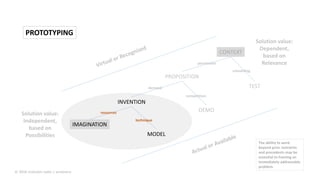
PROTOTYPING
The ability to work
beyond prior restraints
and precedents may be
essential to framing an
immediately addressable
problem.
© 2016 malcolm ryder / archestra
MODEL
IMAGINATION
PROPOSITION
INVENTION
TEST
CONTEXT
Solution value:
Independent,
based on
Possibilities
Solution value:
Dependent,
based on
Relevance
DEMO
competition
scheduling
resources
demand
technique
permission
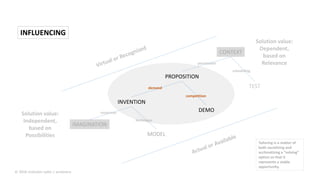
INFLUENCING
Tailoring is a matter of
both socializing and
acclimatizing a “solving”
option so that it
represents a viable
opportunity.
© 2016 malcolm ryder / archestra
MODEL
IMAGINATION
PROPOSITION
INVENTION
TEST
CONTEXT
Solution value:
Independent,
based on
Possibilities
Solution value:
Dependent,
based on
Relevance
DEMO
competition
scheduling
resources
demand
technique
permission
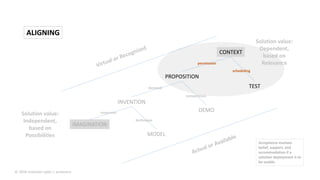
ALIGNING
Acceptance involves
belief, support, and
accommodation if a
solution deployment is to
be usable.
© 2016 malcolm ryder / archestra
Archestra notebooks compile and organize decades of in-the-field empirical findings. The notes offer explanations of why
things did happen or can happen in certain ways or to certain effects. The descriptions are determined mainly from the
perspective of strategy and architecture. They comment on, and navigate between, the motives and potentials that
predetermine the decisions and shapes of activity as discussed in the notes. All notebooks are subject to change.
©2016 Malcolm Ryder / Archestra Research
www.archestra.com
mryder@archestra.com

Solution Thinking

  • 1.
    Solution Thinking The Developmentof a Thoughtful Design
  • 2.
    The development ofa thoughtful design • Complex situations are different from complicated ones in a particular way. • Both involve multiple elements interacting, and both can be “net positive” or “net negative”. But complexity ideally features a success from difficult relationships, whereas complication features a lack of success due to the difficulty of the relationships. • Successful complexity is most valuable when the complexity allows a needed outcome not available from simplicity. But complexity also presents higher degrees of difficulty when it must be changed to allow or provide different outcomes. • Professionals working on changing complex situations increasingly talk about the need to solve problems that have low or uncertain definition. The challenge is similar to confronting a highly out-of-focus image where the picture at hand needs far higher resolution before we can tell what it intends to communicate. Part of the challenge is also to determine what the framing of the image actually includes or omits, and how that affects the way details are connected and organized within. • Higher resolution creates the opportunity to examine and decide on what evident meaning can and should be addressed. Techniques for increasing the resolution include analysis, pattern recognition, and trial-and-error distillation among others that may “enhance” and “clarify” available information about details and relationships. • The techniques themselves may be simple or complex, and their use comes with a risk of creating images that are not factual representations of the underlying situation being resolved. They need not be mutually exclusive, and they may themselves evolve. • This risk points out, however, that the desired initial impact of the resolution is not about the output being “truth” but instead about being actionable; and the essential goal is not about the completeness of the technique but instead about the maturation of the incremental outcomes towards having a desirable impact. • In effect, the overall resolution effort is a form of development aimed at producing utility of desirable known value. If the effort also becomes sustainable, then it is a way for development to continue adding to a progression of benefits over time. It is also important to acknowledge that the “developer” may also be the target beneficiary, as well as that competency can vary from one developer or situation to another.
  • 3.
    REQUIREMENTS: WHO HOW GOALS: WHAT WHEN OPTIONS: WHAT HOW SCOPE what & who OBJECTIVES when& how NEEDS: WHY WHEN PRIORITIES when & who or why & how CONSTRAINTS what & why FormPlace Timing Effect In producing a new solution, the process is not “about” the process! The process is about maturing an emergent solution. Our approach engages a solver that investigates and a stakeholder that decides, who together explore ways to arrive at, and finalize, four key aspects of a solution: form, timing, place, and effect. In a solution these aspects are compatible with each other. The four aspects are not sequentially derived. They are simultaneously nominated as potential specifications, that are each modifiable for developing coherence and equilibrium with the others as an intentional future state. We show how those solution aspects fit as value propositions among four areas of predictable common interest in the solver- stakeholder interaction: objectives, constraints, priorities and scope. STAKEHOLDER DECISIONS SOLVERINVESTIGATIONS © 2016 malcolm ryder / archestra
  • 4.
    REQUIREMENTS: WHO HOW GOALS: WHAT WHEN OPTIONS: WHAT HOW AGENTS what & who CLIENTS when& how NEEDS: WHY WHEN ACTORS when & who or why & how MANAGERS what & why FormPlace Timing Effect STAKEHOLDER DECISIONS SOLVERINVESTIGATIONS Reference: Policy and Culture Reference:HistoryandExpertise Our technique is based on identifying the interests that characterize the relationship of a solver and a stakeholder. (Who, what, when, how, why. We assume that all “solutions” are location- specific; i.e. where is not a variable interest.) But further, our value contribution analysis looks for critical distinctions and the responsibilities for generating them. From lessons learned, we now assume that when these distinctions are not made in practice, the probability of successful outcomes will usually fall dramatically. Where the interests are the same for the solver and stakeholder, we suppress them, to leave the differences more explicit; then we assign the differences as known responsibilities of roles in the relationship. Co-operation of roles generates the solution. © 2016 malcolm ryder / archestra
  • 5.
    Solution maturation asprogress The various participants and their inputs are orchestrated to achieve “realizations” and “acceptance” of definable options.
  • 6.
    MODEL IMAGINATION PROPOSITION INVENTION TEST CONTEXT Solution value: Independent, based on Possibilities Solutionvalue: Dependent, based on Relevance DEMO SOLUTION DEFINITION (RESOLUTION) Model results may provoke re-imagining. Likewise, Demo results may provoke re- invention, and test results may provoke altering the current proposition © 2016 malcolm ryder / archestra
  • 7.
    MODEL IMAGINATION PROPOSITION INVENTION TEST CONTEXT Solution value: Independent, based on Possibilities Solutionvalue: Dependent, based on Relevance DEMO competition scheduling resources demand technique permission SOLUTION ACCEPTANCE (ADOPTION) Many variable conditions may predispose the potential alignment of current iterations of imagination, models, propositions, etc. © 2016 malcolm ryder / archestra
  • 8.
    MODEL IMAGINATION PROPOSITION INVENTION TEST CONTEXT Solution value: Independent, based on Possibilities Solutionvalue: Dependent, based on Relevance DEMO competition scheduling resources demand technique permission PROTOTYPING The ability to work beyond prior restraints and precedents may be essential to framing an immediately addressable problem. © 2016 malcolm ryder / archestra
  • 9.
    MODEL IMAGINATION PROPOSITION INVENTION TEST CONTEXT Solution value: Independent, based on Possibilities Solutionvalue: Dependent, based on Relevance DEMO competition scheduling resources demand technique permission INFLUENCING Tailoring is a matter of both socializing and acclimatizing a “solving” option so that it represents a viable opportunity. © 2016 malcolm ryder / archestra
  • 10.
    MODEL IMAGINATION PROPOSITION INVENTION TEST CONTEXT Solution value: Independent, based on Possibilities Solutionvalue: Dependent, based on Relevance DEMO competition scheduling resources demand technique permission ALIGNING Acceptance involves belief, support, and accommodation if a solution deployment is to be usable. © 2016 malcolm ryder / archestra
  • 11.
    Archestra notebooks compileand organize decades of in-the-field empirical findings. The notes offer explanations of why things did happen or can happen in certain ways or to certain effects. The descriptions are determined mainly from the perspective of strategy and architecture. They comment on, and navigate between, the motives and potentials that predetermine the decisions and shapes of activity as discussed in the notes. All notebooks are subject to change. ©2016 Malcolm Ryder / Archestra Research
  • 12.
    ©2016 Malcolm Ryder/ Archestra Research www.archestra.com mryder@archestra.com