THE MINTO PYRAMID
PRINCIPLE
1.
2.
3.
4.

LOGIC IN WRITING
LOGIC IN THINKING
LOGIC IN PROBLEM SOLVING
LOGIC IN PRESENTATION

-SHACHI H PARIKH
OBJECTIVE
• The main objective for having logic in writing, thinking, problem
solving and presentation is to enhance clear communication to
facilitate easy and correct flow of information.

• Logic in writing helps the reader get the clear picture about
what he/she should expect from the content and get an idea
about what the writer wants to convey.

• Logic in thinking trains our mind to think in a manner that is now
easy to put on paper logically. Logic in thinking trains the mind
to write logically.
• Logic in problem solving, helps us find the optimum solution
for a given problem and helps us facilitate our capability to
think logically.

• Finally logic in presentation is the amalgamation of logic in
writing, thinking and problem solving that help in clearer
thinking and rich information exchange.
1. LOGIC IN WRITING
• Phrase coined by George A. Miller in his treatise, “The magical
number seven, plus or minus two” is a pattern governing the process
of our mind.

• Whenever we encounter a number of items the mind begins to group
them into logical categories so they can be retained. The mind will
automatically impose order on everything around it. This tendency of
the mind is nicely illustrated by the Greeks who grouped stars into
figures instead of pinpoints of lights.
1.1 WHY A PYRAMID STRUCTURE
•
•

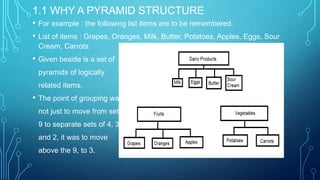
For example : the following list items are to be remembered.

•

Given beside is a set of

List of items : Grapes, Oranges, Milk, Butter, Potatoes, Apples, Eggs, Sour
Cream, Carrots.

pyramids of logically
related items.

•

The point of grouping was
not just to move from set of
9 to separate sets of 4, 3

and 2, it was to move
above the 9, to 3.
1.2 THINKING FROM BOTTOM UP
• Ideas at any level in the pyramid must always be summaries of the
ideas grouped below them.

• Ideas in each grouping must always be the same kind of idea.
which means that the ideas in grouping must fall in the same
category.

• Ideas in each grouping must always be logically ordered.
1.3 VERTICAL AND HORIZONTAL RELATIONSHIP
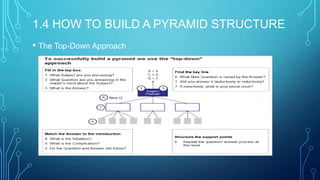
1.4 HOW TO BUILD A PYRAMID STRUCTURE
• The Top-Down Approach :
1.5 DEDUCTION AND INDUCTION : THE
DIFFERENCE
•

Deduction and induction, these two forms of reasoning are the only patterns
available for establishing logical relationships between ideas.

1. Deduction presents a line of

Induction define group of ideas

reasoning that leads to a
and

or facts to be same kind of thing

“therefore” conclusion,

and the then makes a statement(or

point above is a summary of that

inference) about the sameness.

line of reasoning, resting heavily
on the final point.
2. Deductive points arrive from each
each

other.

Inductive points do not arrive from

other.
2. LOGIC IN THINKING
2.1 ANALYTICAL ACTIVITIES PERFORMED BY THE
MIND
• Second rule of Minto Pyramid Principle is that, “ideas in any grouping
must be in logical order”.

• This makes sure that ideas brought together truly belong together and
none has been left out.

• Mind can perform only 3 analytical activities :
• 1. Determine the cause of an effect :
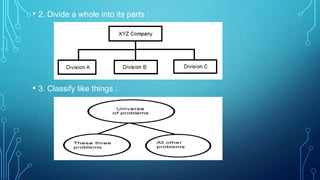
• 2. Divide a whole into its parts :

• 3. Classify like things :
2.2 IMPOSING LOGICAL ORDER
• Orders can be applied singly or in combination, but one of them must
always be present in a grouping to justify its existence.

• Different types of order :
1. TIME ORDER :
It would seem to be the simplest order of all to understand, for it is
certainly the most pervasively used as the basis of grouping of ideas.
Time-ordered grouping reflects the steps a person must take to
achieve a particular effect, in the order in which he must take them1,2,3.
2. STRUCTURAL ORDER :
It is the order which reflects what you see once you have visualized
something – either by diagram or by map, by drawing or photograph.
While creating a structure following things should be taken care of :
1. Mutually exclusive pieces (No Overlaps).
2. Collectively exhaustive in terms of the whole (Nothing Left
Out).
3. DEGREE ORDER :
This order is imposed on a grouping when it brings together a set of
things that have been classified as being alike because they possess a
characteristic in common, it is also the most commonly called order of
importance.
2.3 SUMMARIZING GROUPED IDEAS
• Act of summarizing = Act of completing the thinking.
• Avoid intellectually blank assertions :
They are deadly for the reader because they do not anchor his mind,
they are not stimulating to read and they present the very real danger
that he will not grasp what you are trying to say.

• State the effect of actions.
• Look for the similarity in conclusions.
3. LOGIC IN PROBLEM SOLVING
3.1 THE MAIN SEQUENCE
• Define
the problem

Structure

Conduct the

Form the

the analysis

analysis/find

pyramid to

the solution

communicate
the ideas
3.1 DEFINING THE PROBLEM
• Defining a problem begins the process of Sequential Analysis, a
particularly efficient problem solving technique that involves finding
the answers to a series of questions in logical sequence.

•

1. Is there/is likely to be a problem?

Define the

2. Where does it exist?

problem

3. Why does it exist?

Structure the

4. What could we do about it?

Find the solution

analysis

5. What should we do about it?
• Laying out the Elements.
• Converting to an Introduction.
• The Starting Point/Opening Scene.
• The Disturbing Event.
-The Disturbing Event is what happens – or what could happen or
would likely to happen in the near future – to threaten the relatively
stable situation described in the opening scene.
3.2 STRUCTURING THE ANALYSIS OF THE
PROBLEM
• Problem analysis generally proceed in a standard way :
Gather

State

Draw

Data

Findings

Conclusions

Recommend

Actions

• Devising Diagnostic Framework :
Physical

External

Head

bruised head
allergies, bad weather

Hurts

Internal
Mental
stress,
tension

Hypochondria

flu, cold
brain tumor
water on the brain
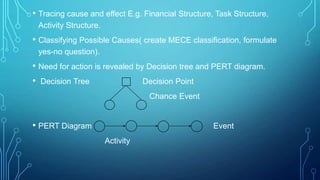
• Tracing cause and effect E.g. Financial Structure, Task Structure,
Activity Structure.

• Classifying Possible Causes( create MECE classification, formulate
yes-no question).

• Need for action is revealed by Decision tree and PERT diagram.
• Decision Tree
Decision Point
Chance Event

• PERT Diagram

Event

Activity
LOGIC IN PRESENTATION
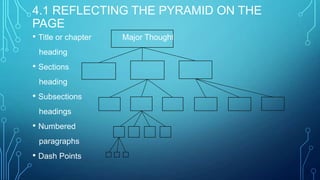
4.1 REFLECTING THE PYRAMID ON THE
PAGE
• Title or chapter
heading

• Sections
heading

• Subsections
headings

• Numbered
paragraphs

• Dash Points

Major Thought
• Hierarchical headings
• Underlined points
• Decimal numbering
• Indented display
• Dot-Dash outlines
• Summarizing sections
• Making full conclusions
• Stating next steps
4.2 PROBLEM SOLVING IN STRUCTURE-LESS
SITUATIONS
• DEDUCTION

INDUCTION

Case
Rule

Result
Case

Result

ABDUCTION
Rule
Result

Rule

Case

• Where you start determines the form of thinking you will see.
• Deductive arguments are needed when the reader is incapable of
understanding the action without prior explanation.

• Inductive reasoning is used when hypothesis or ideas already exist
and we just establishing probabilistic grounds for them.

• Abductive reasoning is used to generate inference networks : the
skillful combination of relevance and credibility characteristics of
evidence. Example : medical diagnosis.
THANK YOU

Minto pyramid

  • 1.
    THE MINTO PYRAMID PRINCIPLE 1. 2. 3. 4. LOGICIN WRITING LOGIC IN THINKING LOGIC IN PROBLEM SOLVING LOGIC IN PRESENTATION -SHACHI H PARIKH
  • 2.
    OBJECTIVE • The mainobjective for having logic in writing, thinking, problem solving and presentation is to enhance clear communication to facilitate easy and correct flow of information. • Logic in writing helps the reader get the clear picture about what he/she should expect from the content and get an idea about what the writer wants to convey. • Logic in thinking trains our mind to think in a manner that is now easy to put on paper logically. Logic in thinking trains the mind to write logically.
  • 3.
    • Logic inproblem solving, helps us find the optimum solution for a given problem and helps us facilitate our capability to think logically. • Finally logic in presentation is the amalgamation of logic in writing, thinking and problem solving that help in clearer thinking and rich information exchange.
  • 4.
    1. LOGIC INWRITING
  • 5.
    • Phrase coinedby George A. Miller in his treatise, “The magical number seven, plus or minus two” is a pattern governing the process of our mind. • Whenever we encounter a number of items the mind begins to group them into logical categories so they can be retained. The mind will automatically impose order on everything around it. This tendency of the mind is nicely illustrated by the Greeks who grouped stars into figures instead of pinpoints of lights.
  • 6.
    1.1 WHY APYRAMID STRUCTURE • • For example : the following list items are to be remembered. • Given beside is a set of List of items : Grapes, Oranges, Milk, Butter, Potatoes, Apples, Eggs, Sour Cream, Carrots. pyramids of logically related items. • The point of grouping was not just to move from set of 9 to separate sets of 4, 3 and 2, it was to move above the 9, to 3.
  • 7.
    1.2 THINKING FROMBOTTOM UP • Ideas at any level in the pyramid must always be summaries of the ideas grouped below them. • Ideas in each grouping must always be the same kind of idea. which means that the ideas in grouping must fall in the same category. • Ideas in each grouping must always be logically ordered.
  • 8.
    1.3 VERTICAL ANDHORIZONTAL RELATIONSHIP
  • 9.
    1.4 HOW TOBUILD A PYRAMID STRUCTURE • The Top-Down Approach :
  • 10.
    1.5 DEDUCTION ANDINDUCTION : THE DIFFERENCE • Deduction and induction, these two forms of reasoning are the only patterns available for establishing logical relationships between ideas. 1. Deduction presents a line of Induction define group of ideas reasoning that leads to a and or facts to be same kind of thing “therefore” conclusion, and the then makes a statement(or point above is a summary of that inference) about the sameness. line of reasoning, resting heavily on the final point. 2. Deductive points arrive from each each other. Inductive points do not arrive from other.
  • 12.
    2. LOGIC INTHINKING
  • 13.
    2.1 ANALYTICAL ACTIVITIESPERFORMED BY THE MIND • Second rule of Minto Pyramid Principle is that, “ideas in any grouping must be in logical order”. • This makes sure that ideas brought together truly belong together and none has been left out. • Mind can perform only 3 analytical activities : • 1. Determine the cause of an effect :
  • 14.
    • 2. Dividea whole into its parts : • 3. Classify like things :
  • 15.
    2.2 IMPOSING LOGICALORDER • Orders can be applied singly or in combination, but one of them must always be present in a grouping to justify its existence. • Different types of order : 1. TIME ORDER : It would seem to be the simplest order of all to understand, for it is certainly the most pervasively used as the basis of grouping of ideas. Time-ordered grouping reflects the steps a person must take to achieve a particular effect, in the order in which he must take them1,2,3.
  • 16.
    2. STRUCTURAL ORDER: It is the order which reflects what you see once you have visualized something – either by diagram or by map, by drawing or photograph. While creating a structure following things should be taken care of : 1. Mutually exclusive pieces (No Overlaps). 2. Collectively exhaustive in terms of the whole (Nothing Left Out). 3. DEGREE ORDER : This order is imposed on a grouping when it brings together a set of things that have been classified as being alike because they possess a characteristic in common, it is also the most commonly called order of importance.
  • 17.
    2.3 SUMMARIZING GROUPEDIDEAS • Act of summarizing = Act of completing the thinking. • Avoid intellectually blank assertions : They are deadly for the reader because they do not anchor his mind, they are not stimulating to read and they present the very real danger that he will not grasp what you are trying to say. • State the effect of actions. • Look for the similarity in conclusions.
  • 18.
    3. LOGIC INPROBLEM SOLVING
  • 19.
    3.1 THE MAINSEQUENCE • Define the problem Structure Conduct the Form the the analysis analysis/find pyramid to the solution communicate the ideas
  • 20.
    3.1 DEFINING THEPROBLEM • Defining a problem begins the process of Sequential Analysis, a particularly efficient problem solving technique that involves finding the answers to a series of questions in logical sequence. • 1. Is there/is likely to be a problem? Define the 2. Where does it exist? problem 3. Why does it exist? Structure the 4. What could we do about it? Find the solution analysis 5. What should we do about it?
  • 21.
    • Laying outthe Elements. • Converting to an Introduction. • The Starting Point/Opening Scene. • The Disturbing Event. -The Disturbing Event is what happens – or what could happen or would likely to happen in the near future – to threaten the relatively stable situation described in the opening scene.
  • 22.
    3.2 STRUCTURING THEANALYSIS OF THE PROBLEM • Problem analysis generally proceed in a standard way : Gather State Draw Data Findings Conclusions Recommend Actions • Devising Diagnostic Framework : Physical External Head bruised head allergies, bad weather Hurts Internal Mental stress, tension Hypochondria flu, cold brain tumor water on the brain
  • 23.
    • Tracing causeand effect E.g. Financial Structure, Task Structure, Activity Structure. • Classifying Possible Causes( create MECE classification, formulate yes-no question). • Need for action is revealed by Decision tree and PERT diagram. • Decision Tree Decision Point Chance Event • PERT Diagram Event Activity
  • 24.
  • 25.
    4.1 REFLECTING THEPYRAMID ON THE PAGE • Title or chapter heading • Sections heading • Subsections headings • Numbered paragraphs • Dash Points Major Thought
  • 26.
    • Hierarchical headings •Underlined points • Decimal numbering • Indented display • Dot-Dash outlines • Summarizing sections • Making full conclusions • Stating next steps
  • 27.
    4.2 PROBLEM SOLVINGIN STRUCTURE-LESS SITUATIONS • DEDUCTION INDUCTION Case Rule Result Case Result ABDUCTION Rule Result Rule Case • Where you start determines the form of thinking you will see. • Deductive arguments are needed when the reader is incapable of understanding the action without prior explanation. • Inductive reasoning is used when hypothesis or ideas already exist and we just establishing probabilistic grounds for them. • Abductive reasoning is used to generate inference networks : the skillful combination of relevance and credibility characteristics of evidence. Example : medical diagnosis.
  • 28.