
Solution Logic
Modeling the change called Progress
Solutions always address a “need” for Change
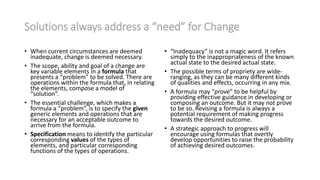
• When current circumstances are deemed
inadequate, change is deemed necessary.
• The scope, ability and goal of a change are
key variable elements in a formula that
presents a “problem” to be solved. There are
operations within the formula that, in relating
the elements, compose a model of
“solution”.
• The essential challenge, which makes a
formula a “problem”, is to specify the given
generic elements and operations that are
necessary for an acceptable outcome to
arrive from the formula.
• Specification means to identify the particular
corresponding values of the types of
elements, and particular corresponding
functions of the types of operations.
• “Inadequacy” is not a magic word. It refers
simply to the inappropriateness of the known
actual state to the desired actual state.
• The possible terms of propriety are wide-
ranging, as they can be many different kinds
of qualities and effects, occurring in any mix.
• A formula may “prove” to be helpful by
providing effective guidance in developing or
composing an outcome. But it may not prove
to be so. Revising a formula is always a
potential requirement of making progress
towards the desired outcome.
• A strategic approach to progress will
encourage using formulas that overtly
develop opportunities to raise the probability
of achieving desired outcomes.
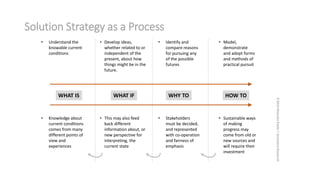
Solution Strategy as a Process
• Understand the
knowable current
conditions
• Develop ideas,
whether related to or
independent of the
present, about how
things might be in the
future.
• Identify and
compare reasons
for pursuing any
of the possible
futures
• Model,
demonstrate
and adopt forms
and methods of
practical pursuit
WHAT IS WHAT IF WHY TO HOW TO
• Knowledge about
current conditions
comes from many
different points of
view and
experiences
• This may also feed
back different
information about, or
new perspective for
interpreting, the
current state
• Stakeholders
must be decided,
and represented
with co-operation
and fairness of
emphasis
• Sustainable ways
of making
progress may
come from old or
new sources and
will require their
investment
©2016MalcolmRyder/ArchestraResearch
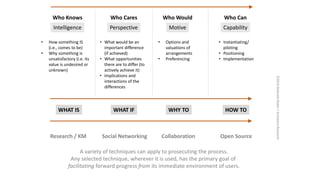
Intelligence Perspective Motive Capability
Who Knows Who Cares Who Would Who Can
• How something IS
(i.e., comes to be)
• Why something is
unsatisfactory (i.e. its
value is undesired or
unknown)
• What would be an
important difference
(if achieved)
• What opportunities
there are to differ (to
actively achieve it)
• Implications and
interactions of the
differences
• Options and
valuations of
arrangements
• Preferencing
• Instantiating/
piloting
• Positioning
• Implementation
WHAT IS WHAT IF WHY TO HOW TO
Research / KM Social Networking Collaboration Open Source
A variety of techniques can apply to prosecuting the process.
Any selected technique, wherever it is used, has the primary goal of
facilitating forward progress from its immediate environment of users.
©2016MalcolmRyder/ArchestraResearch
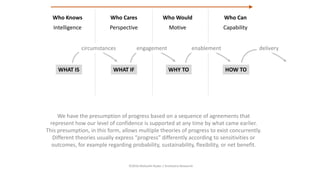
WHAT IS WHAT IF WHY TO HOW TO
Intelligence Perspective Motive Capability
Who Knows Who Cares Who Would Who Can
delivery
We have the presumption of progress based on a sequence of agreements that
represent how our level of confidence is supported at any time by what came earlier.
This presumption, in this form, allows multiple theories of progress to exist concurrently.
Different theories usually express “progress” differently according to sensitivities or
outcomes, for example regarding probability, sustainability, flexibility, or net benefit.
circumstances engagement enablement
©2016 Malcolm Ryder / Archestra Research
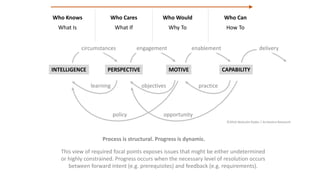
INTELLIGENCE PERSPECTIVE MOTIVE CAPABILITY
What Is What If Why To How To
Who Knows Who Cares Who Would Who Can
circumstances engagement enablement
learning objectives practice
policy opportunity
delivery
Process is structural. Progress is dynamic.
This view of required focal points exposes issues that might be either undetermined
or highly constrained. Progress occurs when the necessary level of resolution occurs
between forward intent (e.g. prerequisites) and feedback (e.g. requirements).
©2016 Malcolm Ryder / Archestra Research
Ability to Change
• Producing a desired actual state from a known
actual state also appears to require a significant
expenditure of time between the present and
the future.
• However, that presumption is not necessarily
true. A current state is already in a condition of
more equilibrium or less equilibrium as a result
of its current resolution of the issues seen in the
change ability model of progress.
• Increasing equilibrium can be instantaneous if
the “right” issue in the model is modified. Time
is not the major factor; complexity is.
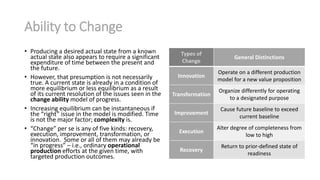
• “Change” per se is any of five kinds: recovery,
execution, improvement, transformation, or
innovation. Some or all of them may already be
“in progress” – i.e., ordinary operational
production efforts at the given time, with
targeted production outcomes.
Types of
Change
General Distinctions
Innovation
Operate on a different production
model for a new value proposition
Transformation
Organize differently for operating
to a designated purpose
Improvement
Cause future baseline to exceed
current baseline
Execution
Alter degree of completeness from
low to high
Recovery
Return to prior-defined state of
readiness
WHAT IS WHAT IF WHY TO HOW TO
circumstances engagement enablement
learning objectives practice
policy options
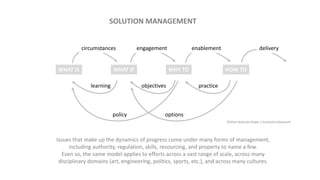
Issues that make up the dynamics of progress come under many forms of management,
including authority, regulation, skills, resourcing, and property to name a few.
Even so, the same model applies to efforts across a vast range of scale, across many
disciplinary domains (art, engineering, politics, sports, etc.), and across many cultures.
delivery
SOLUTION MANAGEMENT
©2016 Malcolm Ryder / Archestra Research
Solution Factors
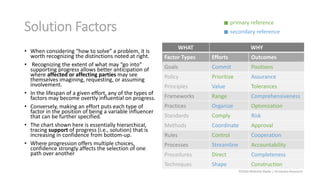
• When considering “how to solve” a problem, it is
worth recognizing the distinctions noted at right.
• Recognizing the extent of what may “go into”
supporting progress allows better anticipation of
where affected or affecting parties may see
themselves imagining, requesting, or assuming
involvement.
• In the lifespan of a given effort, any of the types of
factors may become overtly influential on progress.
• Conversely, making an effort puts each type of
factor in the position of being a variable influencer
that can be further specified.
• The chart shown here is essentially hierarchical,
tracing support of progress (i.e., solution) that is
increasing in confidence from bottom-up.
• Where progression offers multiple choices,
confidence strongly affects the selection of one
path over another
WHAT WHY
Factor Types Efforts Outcomes
Goals Commit Positions
Policy Prioritize Assurance
Principles Value Tolerances
Frameworks Range Comprehensiveness
Practices Organize Optimization
Standards Comply Risk
Methods Coordinate Approval
Rules Control Cooperation
Processes Streamline Accountability
Procedures Direct Completeness
Techniques Shape Construction
primary reference
secondary reference
©2016 Malcolm Ryder / Archestra Research
Variations on a Theme
• A discipline gains attention or acceptance based on
its “value proposition” (the benefit delivered by its
difference).
• Progress is usually “about” emerging proof of its
value proposition during execution.
• Any given discipline may have a history,
responsibility, or ambition that fosters emphasis on
some factors of progress more than others.
• The emphasis can reflect the determination to assure
sufficient attention to what the discipline has found
either most often critically lacking or most
consistently effective – in defending its responsibility
or in creating opportunity for its ambition.
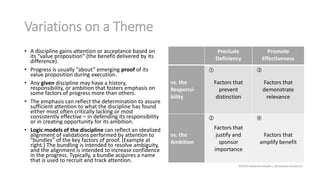
• Logic models of the discipline can reflect an idealized
alignment of validations performed by attention to
“bundles” of the key factors of proof. (Example at
right.) The bundling is intended to resolve ambiguity,
and the alignment is intended to increase confidence
in the progress. Typically, a bundle acquires a name
that is used to recruit and track attention.
Preclude
Deficiency
Promote
Effectiveness
vs. the
Responsi-
bility
Factors that
prevent
distinction
Factors that
demonstrate
relevance
vs. the
Ambition
Factors that
justify and
sponsor
importance
Factors that
amplify benefit




©2016 Malcolm Ryder / Archestra Research
Wrap up
• Superficially, but importantly, the
preceding observations explain why
pervasively embraced “models” such as
ITIL, Design Thinking, or Agile remain
persistently in debate among
practitioners.
• Such “best practice” models can be
simultaneously distinctive at a generic
(abstract) level and famously
indeterminate at a particular level.
• Years and years of “field practice” winds
up fostering continuing uncertainty, or
diversity of opinion, about the exclusivity,
the boundary, the necessity, and the
regularity of the model’s implementation
that warrants being called its “definition”
and giving it the model’s brand name.
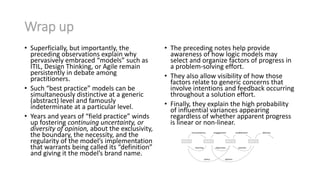
• The preceding notes help provide
awareness of how logic models may
select and organize factors of progress in
a problem-solving effort.
• They also allow visibility of how those
factors relate to generic concerns that
involve intentions and feedback occurring
throughout a solution effort.
• Finally, they explain the high probability
of influential variances appearing
regardless of whether apparent progress
is linear or non-linear.
©2016 Malcolm Ryder / Archestra Research
www.archestra.com
mryder@archestra.com

Solution Logic - Change as Progress

  • 1.
    Solution Logic Modeling thechange called Progress
  • 2.
    Solutions always addressa “need” for Change • When current circumstances are deemed inadequate, change is deemed necessary. • The scope, ability and goal of a change are key variable elements in a formula that presents a “problem” to be solved. There are operations within the formula that, in relating the elements, compose a model of “solution”. • The essential challenge, which makes a formula a “problem”, is to specify the given generic elements and operations that are necessary for an acceptable outcome to arrive from the formula. • Specification means to identify the particular corresponding values of the types of elements, and particular corresponding functions of the types of operations. • “Inadequacy” is not a magic word. It refers simply to the inappropriateness of the known actual state to the desired actual state. • The possible terms of propriety are wide- ranging, as they can be many different kinds of qualities and effects, occurring in any mix. • A formula may “prove” to be helpful by providing effective guidance in developing or composing an outcome. But it may not prove to be so. Revising a formula is always a potential requirement of making progress towards the desired outcome. • A strategic approach to progress will encourage using formulas that overtly develop opportunities to raise the probability of achieving desired outcomes.
  • 3.
    Solution Strategy asa Process • Understand the knowable current conditions • Develop ideas, whether related to or independent of the present, about how things might be in the future. • Identify and compare reasons for pursuing any of the possible futures • Model, demonstrate and adopt forms and methods of practical pursuit WHAT IS WHAT IF WHY TO HOW TO • Knowledge about current conditions comes from many different points of view and experiences • This may also feed back different information about, or new perspective for interpreting, the current state • Stakeholders must be decided, and represented with co-operation and fairness of emphasis • Sustainable ways of making progress may come from old or new sources and will require their investment ©2016MalcolmRyder/ArchestraResearch
  • 4.
    Intelligence Perspective MotiveCapability Who Knows Who Cares Who Would Who Can • How something IS (i.e., comes to be) • Why something is unsatisfactory (i.e. its value is undesired or unknown) • What would be an important difference (if achieved) • What opportunities there are to differ (to actively achieve it) • Implications and interactions of the differences • Options and valuations of arrangements • Preferencing • Instantiating/ piloting • Positioning • Implementation WHAT IS WHAT IF WHY TO HOW TO Research / KM Social Networking Collaboration Open Source A variety of techniques can apply to prosecuting the process. Any selected technique, wherever it is used, has the primary goal of facilitating forward progress from its immediate environment of users. ©2016MalcolmRyder/ArchestraResearch
  • 5.
    WHAT IS WHATIF WHY TO HOW TO Intelligence Perspective Motive Capability Who Knows Who Cares Who Would Who Can delivery We have the presumption of progress based on a sequence of agreements that represent how our level of confidence is supported at any time by what came earlier. This presumption, in this form, allows multiple theories of progress to exist concurrently. Different theories usually express “progress” differently according to sensitivities or outcomes, for example regarding probability, sustainability, flexibility, or net benefit. circumstances engagement enablement ©2016 Malcolm Ryder / Archestra Research
  • 6.
    INTELLIGENCE PERSPECTIVE MOTIVECAPABILITY What Is What If Why To How To Who Knows Who Cares Who Would Who Can circumstances engagement enablement learning objectives practice policy opportunity delivery Process is structural. Progress is dynamic. This view of required focal points exposes issues that might be either undetermined or highly constrained. Progress occurs when the necessary level of resolution occurs between forward intent (e.g. prerequisites) and feedback (e.g. requirements). ©2016 Malcolm Ryder / Archestra Research
  • 7.
    Ability to Change •Producing a desired actual state from a known actual state also appears to require a significant expenditure of time between the present and the future. • However, that presumption is not necessarily true. A current state is already in a condition of more equilibrium or less equilibrium as a result of its current resolution of the issues seen in the change ability model of progress. • Increasing equilibrium can be instantaneous if the “right” issue in the model is modified. Time is not the major factor; complexity is. • “Change” per se is any of five kinds: recovery, execution, improvement, transformation, or innovation. Some or all of them may already be “in progress” – i.e., ordinary operational production efforts at the given time, with targeted production outcomes. Types of Change General Distinctions Innovation Operate on a different production model for a new value proposition Transformation Organize differently for operating to a designated purpose Improvement Cause future baseline to exceed current baseline Execution Alter degree of completeness from low to high Recovery Return to prior-defined state of readiness
  • 8.
    WHAT IS WHATIF WHY TO HOW TO circumstances engagement enablement learning objectives practice policy options Issues that make up the dynamics of progress come under many forms of management, including authority, regulation, skills, resourcing, and property to name a few. Even so, the same model applies to efforts across a vast range of scale, across many disciplinary domains (art, engineering, politics, sports, etc.), and across many cultures. delivery SOLUTION MANAGEMENT ©2016 Malcolm Ryder / Archestra Research
  • 9.
    Solution Factors • Whenconsidering “how to solve” a problem, it is worth recognizing the distinctions noted at right. • Recognizing the extent of what may “go into” supporting progress allows better anticipation of where affected or affecting parties may see themselves imagining, requesting, or assuming involvement. • In the lifespan of a given effort, any of the types of factors may become overtly influential on progress. • Conversely, making an effort puts each type of factor in the position of being a variable influencer that can be further specified. • The chart shown here is essentially hierarchical, tracing support of progress (i.e., solution) that is increasing in confidence from bottom-up. • Where progression offers multiple choices, confidence strongly affects the selection of one path over another WHAT WHY Factor Types Efforts Outcomes Goals Commit Positions Policy Prioritize Assurance Principles Value Tolerances Frameworks Range Comprehensiveness Practices Organize Optimization Standards Comply Risk Methods Coordinate Approval Rules Control Cooperation Processes Streamline Accountability Procedures Direct Completeness Techniques Shape Construction primary reference secondary reference ©2016 Malcolm Ryder / Archestra Research
  • 10.
    Variations on aTheme • A discipline gains attention or acceptance based on its “value proposition” (the benefit delivered by its difference). • Progress is usually “about” emerging proof of its value proposition during execution. • Any given discipline may have a history, responsibility, or ambition that fosters emphasis on some factors of progress more than others. • The emphasis can reflect the determination to assure sufficient attention to what the discipline has found either most often critically lacking or most consistently effective – in defending its responsibility or in creating opportunity for its ambition. • Logic models of the discipline can reflect an idealized alignment of validations performed by attention to “bundles” of the key factors of proof. (Example at right.) The bundling is intended to resolve ambiguity, and the alignment is intended to increase confidence in the progress. Typically, a bundle acquires a name that is used to recruit and track attention. Preclude Deficiency Promote Effectiveness vs. the Responsi- bility Factors that prevent distinction Factors that demonstrate relevance vs. the Ambition Factors that justify and sponsor importance Factors that amplify benefit     ©2016 Malcolm Ryder / Archestra Research
  • 11.
    Wrap up • Superficially,but importantly, the preceding observations explain why pervasively embraced “models” such as ITIL, Design Thinking, or Agile remain persistently in debate among practitioners. • Such “best practice” models can be simultaneously distinctive at a generic (abstract) level and famously indeterminate at a particular level. • Years and years of “field practice” winds up fostering continuing uncertainty, or diversity of opinion, about the exclusivity, the boundary, the necessity, and the regularity of the model’s implementation that warrants being called its “definition” and giving it the model’s brand name. • The preceding notes help provide awareness of how logic models may select and organize factors of progress in a problem-solving effort. • They also allow visibility of how those factors relate to generic concerns that involve intentions and feedback occurring throughout a solution effort. • Finally, they explain the high probability of influential variances appearing regardless of whether apparent progress is linear or non-linear.
  • 12.
    ©2016 Malcolm Ryder/ Archestra Research www.archestra.com mryder@archestra.com