PAIN CONSULT Concept design workshop Tom Flanagan Chair, Board of Directors Institute for 21 st  Century Agoras We must learn to work together in large groups So that we can begin solving large problems Structured Dialogic Design  SM January 1, 2010
Recall you experiences within large groups The more essential it is for a group to share significant resources and work together,  the harder it is to get the group to agree upon a joint action plan. We work together  in large groups only  when we must.
Drivers of Large Group Collaborative Planning Businesses No Longer Compete:  Business strategists argue that with the decentralization of business structures and with the emergence of complex supply and distribution networks, individual businesses are not the unit of competition.  Competition is now among entire supply and distribution webs.  Without our business partners, we cannot sustain our competitive position within our markets. Business Cultures Converge :  Many service industries are experiencing consolidation (e.g., healthcare, banking, retail, etc.).  When two or more independent business cultures come together, the forced collaboration either leads to success or to failure. Innovation Occurs at the Margins :  It is often the capacity to see our situation differently that leads to new ways of thinking through our barriers.  Sharing different perspectives leads to creative breakthroughs.  Finding the root causes of complex civic problems requires reaching across silos. No Individual Can See the Big Picture :  With truly complex problems, we cannot see enough to plan with confidence and inspire confidence in others because we cannot see into the intentions of others who will be responding even as we seek to implement our response.
When we think of groups we first think of leadership Delegate  when you know the problem and are sure of the solution Direct  when you know the problem but need to discover the solution Support  “testing” solutions in hopes of discovering problem after the fact ( i.e., some antibiotic treatments ) Coach  a group to discover its situation and then to devise preferred solutions when the problem and probable solutions are both unclear As group size, diversity and unfamiliarly increases,  the leadership challenge scales exponentially.
Source: Max Hardy, Twyford Consulting Leaders and large groups frequently distrust each other
" I would not give a whit for the simplicity  this side of complexity ( a simple approach ),  but I would give my life for the simplicity  on the far side of complexity ( a simple resolution )."     O. W. Holmes   Large groups are OK for broadcasting. Explaining, training, motivating, and idea harvesting Large groups do not resolve complexity well. Design and decision making Leaders frequently lack skills for coaching large groups
“ Complexity” hinders democratic process Wicked complexity  is characterized by large numbers of issues,  large numbers of interconnections among issues,  evolving issues and connections in the system, and  limited transparency of both the issues and the connections The Situational Complexity Index is defined as DK (N-7) / R (R-1)  where D = (V-5) / (N-5) N =  Number of total observations by all observers  R =  Number of observations identified assembled into a map V =  Number of observations with 1 or more votes K =  Number of DISTINCT links among observations  D =  Divergence or “spread think” of importance votes _________________________________ 7 is the “Miller number” (7 ± 2)  and  5 is the “Warfield  spread think number” Average Complexity of  Unassisted Democracy  (conjectured) =  3 Average Complexity in  Wicked Problems  =  30 Greatest Level of Complexity Resolved  Using SDD at this time =  55
Complexity = pieces x time x boundaries Complexity leads to “ under-conceptualization ” which puts programs and projects at risk Multiple Moving Parts … 60 to 75 issues ( numerical complexity ) Very Long Time Frames … 5 to 25 years ( temporal complexity ) Many Boundaries Spanned … 10 to 30 perspectives ( dimensional complexity ) Distinct Perspectives Missing Voices Overpowering Self-Confidence of Some Individuals
“ Sponsors are rarely willing to invest  adequate time in building  firm foundations   for their teams at the start of a project.  But they are often willing to start over  when the project fails .”  Unknown Author How Do Groups Handle Complexity ?  POORLY
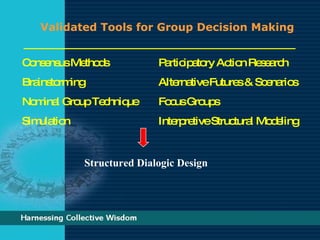
Ways to Make Decisions from within Large Groups Consensus Methods Brainstorming Nominal Group Technique Trade Off Analysis Participatory Action Research Alternative Futures & Scenarios Focus Groups Structured Dialogic Design Group Methods Design Methodology
5 Axioms that require the SDD methodology COMPLEXITY:   We live in a world that is very complex.  Most observers are confused.  Social  systems design issues are strongly   interconnected  (Warfield). ENGAGEMENT:   Disregarding the  participation of the full range of stakeholders  in designing social systems is unethical, and the resulting human system designs are bound to fail (Ozbekhan). SALIENCY:   Because the  field of options  in designing social systems is  multidimensional , salient synthesis is difficult (Boulding). PARSIMONY:   Human cognition & attention is limited.  Human beings are usually overloaded  in group design work leading to bad designs (Simon). CONTINUITY OF MEANING:   Group action requires respect of authorship of ideas by stakeholders.  When  Stakeholders’ ideas become distorted and misattributed  in group design work stakeholders lose their individual commitment to implementing the plan ().
7 empirical laws governing richness of group learning Requisite VARIETY (Ashby) Requisite PARSIMONY (Miller, Warfield) Requisite SALIENCY (Boulding) Requisite AUTHENTICITY & AUTONOMY (Tsivacou) Requisite MEANING & WISDOM (Peirce) Requisite EVOLUTIONARY LEARNING (Dye) Requisite ACTION (Laouris)
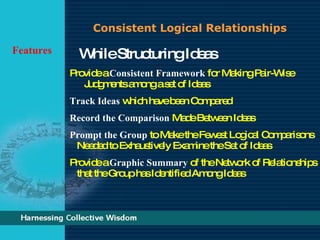
“  Suppose we were able to make progress in  addressing  Factor  X   ,  will this SIGNIFICANTLY enhance our capacity to  address  Factor  Y   ?  ” Software exists to support group work based on this simple structuring algorithm to generate a  directional   map of influence propagated across the entire SYSTEM of issues  ( Efficiency gains of a factor of 4 or more ) Interpretative Structural Modeling:  the Systems View in SDD Collectively “ vote ” on the significance of  a specified logical linkage  between each pair of issues
Example of part of an ISM map
A 30 person SDD session
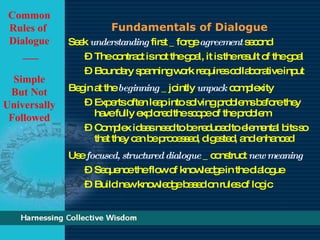
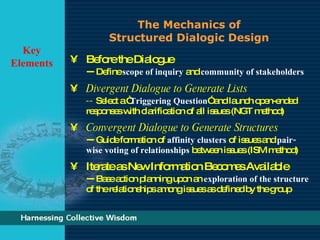
Commit time to fully discuss a well-selected question – 1 to 2 days ( Focus on the   Trigger Question ) Jointly name observations that need to be collectively understood  ( Nominal Group Technique ) Listen and ask questions as individuals explain their observations  ( Clarification ) Identify systemic connections among observations  ( Clustering: ISM ) Reflect on their shared systemic understanding  ( Pathway Narration ) Nominate actions for inclusion into an action plan  ( Action Planning ) What groups must agree to do to use SDD Begin at the  beginning   and  unpack   complexity.  Stakeholders often leap into solving problems  before they have fully defined the problem to be resolved. A. Christakis
The Talking Point: Creating Environments for  Exploring Complex Meaning Thomas R. Flanagan & Alexander N. Christakis  Information Age / January 2010   The Talking Point
How People Harness their  Collective Wisdom & Power  to Construct the Future  in Co-Laboratories of Democracy Alexander N. Christakis  &  Kenneth C Bausch  Information Age / February 2006   Co-Laboratories of Democracy
Graphic by  KMC Dye Global sites where SDD has been used
The Graphic Language of SDD Challenges & Trees Clusters & Votes Action Options & Trees Scenarios & Superposition Criteria & Trade-off Implementation Plan   Groups must  learn  and  agree to use  a graphic language to deal with complex nonlinear systems Type A Type C Type B Type A Type C Type B Type A Type C Type B Type A Type C Type B Criteria ( 1) ( 2) ( 3)
Level I Level II Level III Level IV Deep Driver Trend No-influence Trend The example shown above is an INFLUENCE structure demonstrates the direction of plausible influence demonstrates a contingent pathway Trends & Contingencies (red) Contingency An SDD Influence Map
Complex  Situation Articulate Observations Cluster Inductively Frame and Focus on a Triggering Question ? Develop  Shared  Language Vote &  Rank Structure Abductively Evaluate Cross-Impact Interpret Learning Class Label Type A Type C Type B Influence Steps in Each Stage of SDD Inquiry Clarify Meaning
AN EXAMPLE __ Participation in the Broadband Society A systemic evaluation of  obstacles preventing the wider public benefiting from and participating in the broadband society   Yiannis LAOURIS 1 , Marios MICHAELIDES 2 , Bartolomeo SAPIO 3   1  Cyprus Neuroscience & Technology Institute, Cyprus [email_address] 2  Cyprus Intercultural Training Initiative, Cyprus [email_address] 3   Fondazione Ugo Bordoni , Italy [email_address]   THE GOOD, THE BAD AND THE UNEXPECTED The user and the future of information and communication technologies A trans-disciplinary conference organised by COST Action 298 Moscow, Russian Federation 23 rd -25 th  May 2007
Larnaca, Cyprus September 29-30, 2006 26 expert participants  of  the Cost298 community
“  What are the obstacles  to the wider public  benefiting from and participating in the broadband society ?  ” Triggering Question AN EXAMPLE __ Participation in the Broadband Society
# Factor 1 INADEQUATE DEFINITION OF UNIVERSAL SERVICE 2 LACK OF INFRASTRUCTURE 3 LACK OF CONSISTENT BROAD BAND KNOWLEDGE 4 LOW LEVEL OF DIGITAL LITERACY 5 NO ATTENTION ON MICROBARRIERS 6 LACK OF EASE TO USE 7 ABSENCE OF SPECIFIC SERVICES ORIENTED TO USER NEEDS 8 LACK OF TIME TO ADOPT NEW TECHNOLOGIES 9 EXISTENCE OF SOCIAL INEQUALITIES 10 LOW EDUCATIONAL LEVEL 11 HIGH COST OF SERVICE 12 LACK OF DIGITAL CONTENT IN THE MOTHER LANGUAGE 13 GENERAL NEGATIVE ATTITUTE AGAINST COMPUTERS 14 LACK OF ACCESS IN THE PERSONAL FORMATION PROCESS 15 LACK OF COMPETENCE TOWARDS ICT 16 SOCIAL RESISTANCE TO PAY THE COSTS OF BROADBAND TECHNOLOGY THE OBSTACLES FOR THE NEW EASTERN AND CENTRAL EU MEMBERS ARE DIFFERENT FROM THOSE OF  THE OLD MEMBERS  18 LACK OF INTEREST 19 FEAR OF INTRUSION AND RISK OF FALSIFICATION OF PERSONAL DATA 20 LACK OF AWARENESS AMONG POLITICIANS 21 SLOW UBIQUITOUS ADOPTION ON MOBILE PHONES 22 UNDERDEVOLPMENT OF THE ISP MARKET IN EASTERN AND CENTRAL EUROPEAN COUNTRIES  23 FLAWS OF TECHNOLOGY IN TERMS OF HARDWARE, SOFTWARE AND CONTENT 24 LACK OF USER PARTICIPATION IN ICT DESIGN 25 LACK OF CONFIDENCE IN DATA SECURITY 26 FEAR OF NEW TECHNOLOGIES 27 BADLY DESIGNED INTELLECTUAL PROPERTY SYSTEMS 28 LOW PERCEPTION OF USER RELEVANCE 29 INABILITY TO PREDICT BENEFITS FOR INDIVIDUALS 30 INADEQUATE PUBLIC PROMOTION OF ITS IMPORTANCE 31 WEAKNESS OF EUROPEAN COORDINATION  32 LACK OF LEGAL FRAMEWORK ON BROADBAND ISSUES 33 WEAKNESS OF REGULATORY IMPLEMENTATION OF THE LEGAL FRAMEWORK 34 OVERESTIMATION OF THE POTENTIAL RISKS OF THE INTERNET 35 INADEQUATE GOVERNMENT POLICIES ON SERVICES TO THE PUBLIC 36 LOW INDIVIDUAL INTEREST ABOUT THE CONTENT AVAILABLE ON BROADBAND 37 BAD PRIORITISATION: FIRST TECHNOLOGY, THEN CONTENT  38 LACK OF POLITICAL ORGANIZATION OF USERS AND NON USERS  39 RESISTANCE TO LEARN NEW PRACTICES 40 TECHNOPHOBIA, THE FEAR OF  TECHNOLOGY 41 THE TOO BIG POWER OF TECHNOLOGISTS 
# Factor 42 POVERTY IN THE NEW CENTRAL AND EASTERN EU COUNTRIES 43 LACK OF SELF CONFIDENCE IN MASTERING THE TECHNOLOGY 44 TOO MUCH TIME CONSUMING AND RISK OF ADDICTION 45 MORAL PANIC REGARDING THE INTERNET 46 INERTIA 47 LACK OF USER FRIENDLINESS 48 POOR INTERFACE DESIGN 49 FEAR OF TECHNOMAFIA 50 LACK OF SOFTWARE DESIGN CAPACITY 51 DIFICULTIES TO CHOOSE BETWEEN SERVICE PACKAGES 52 FEAR OF BEING WATCHED BY THE BIG EYE 53 SHORTERM NATIONAL POLITICAL DECISIONS 54 FRUSTRATION BECAUSE OF THE LACK OF RELIABILITY OF THE CONTENT 55 SNOBISM 56 NOT HAVING A COMPUTER 57 TELECOM FOCUSING ON 3G, WHEREAS PEOPLE ON WIFI  58 NON USE AS A DELIBERATE LIFESTYLE 59 AGE 60  LACK OF UNDERSTANDING OF ADVANTAGES 61 PREDICTABLE MALE DOMINATION AMONG USERS 62 FRAGILITY OF IT SYSTEMS 63 TECHNOLOGICAL DETERMINISM 64 LACK OF CONSENSUS TO FIGHT AGAINST TECHNOLOGICAL DOMINATION 65 BAD SOFTWARE DESIGN 66 LACK OF ORGANIZATION OF PROMOTION ACTIVITIES 67 SPAM 68 TECHNOLOGY PUSHED SERVICES 69 SLOW ABSORBTION OF NEW TECHNOLOGIES WITHIN ORGANIZATIONS 70 VIRUSES 71 INTERFERENCE OF HEALTH AND SAFETY REGULATIONS 72 LACK OF UNDERSTANDING OF THE NEED TO DEFINE THE DIGITAL CITIZENS RIGHTS 73 VIABILITY OF EXISTING TECHNOLOGIES 74 LACK OF STANDARTIZATION OF QUALITY ISSUES 75 IVORY TOWER OF HUMANIST SOCIOLOGISTS 76 LACK OF INTEROPERABILITY BETWEEN SYSTEMS 77 OTHER PREFERENCES EG. SPORTS, TV, ETC 78 LACK OF OPEN DESIGN INTERFACES 79 NEOPHOBIA, THE FEAR OF THE NEW 80 BAD SPAM FILTERS 81 FEAR OF GLOBALIZATION 82 ETHICS
Clustering of the 82 factors in 11 categories  AN EXAMPLE __ Participation in the Broadband Society
5 votes per participant: 5x26 for 82 factors AN EXAMPLE __ Participation in the Broadband Society
11 highly preferred factors were structured AN EXAMPLE __ Participation  in the Broadband Society
Factors 30:  The inadequate public promotion of its importance Factor 47:  The lack of user friendliness  These are the obstacles, which must be addressed with priority. Their resolution will significantly help address all other obstacles. The group focused efforts on the 2 deepest drivers AN EXAMPLE __ Participation in the Broadband Society
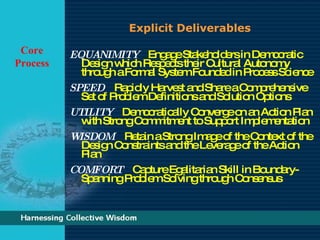
EQUANIMITY:   Engage Stakeholders in Democratic Design which Respects their Cultural Autonomy through a Formal System Founded in Process Science SPEED:   Rapidly Harvest and Share a Comprehensive Set of Problem Definitions and Solution Options UTILITY:   Democratically Converge on an Action Plan with Strong Commitment to Support Implementation WISDOM:   Harness Collective Wisdom by retaining a Strong Image of the Context of the Design Situation and the Leverage of the Action Plan COMFORT:   Capture Egalitarian Skill in Boundary-Spanning Dialogue for Problem Solving and Design What does SDD Guarantee
SDD is not “just” for large groups Keep meetings focused Stop recycling issues Clearly identify objectives Confidently explain our decisions Quantify risk Prioritize objectives Encourage consensus Collect and organize ideas Collaborate effectively Hold fewer meetings Capture our knowledge Slide from Steve Mack, Decision Management Group
To get more information on this topic http://www.globalagoras.com/
Tom Flanagan, Ph.D., MBA Director, South Coast Community Collaborative Design Studio ><((((º>·..¸¸·´¯`·.><(((º>`·.¸¸.·´¯`·..¸¸><((((º> .·´¯`·..><(((º>.·´¯`·..><(((º> &quot;Discussions as usual can lead to no more than business as usual&quot; South Coast Community Collaborative Design Studio is a project of the Community Foundation of Southeastern Massachusetts.  Our mission is to build community capacity through the use of advanced collaborative design practices.  We are a resource for multi-organization planning and not a direct source of funds. VOICE: 508-264-0066 EMAIL: TRFlanagan@aol.com WEBSITE:  http://socodesign.wetpaint.com/ SKYPE: SoCoDesign THE TALKING POINT http://www.infoagepub.com/products/The-Talking-Point  Thank  You !!

Structured Dialogic Design

  • 1.
    PAIN CONSULT Conceptdesign workshop Tom Flanagan Chair, Board of Directors Institute for 21 st Century Agoras We must learn to work together in large groups So that we can begin solving large problems Structured Dialogic Design SM January 1, 2010
  • 2.
    Recall you experienceswithin large groups The more essential it is for a group to share significant resources and work together, the harder it is to get the group to agree upon a joint action plan. We work together in large groups only when we must.
  • 3.
    Drivers of LargeGroup Collaborative Planning Businesses No Longer Compete: Business strategists argue that with the decentralization of business structures and with the emergence of complex supply and distribution networks, individual businesses are not the unit of competition. Competition is now among entire supply and distribution webs. Without our business partners, we cannot sustain our competitive position within our markets. Business Cultures Converge : Many service industries are experiencing consolidation (e.g., healthcare, banking, retail, etc.). When two or more independent business cultures come together, the forced collaboration either leads to success or to failure. Innovation Occurs at the Margins : It is often the capacity to see our situation differently that leads to new ways of thinking through our barriers. Sharing different perspectives leads to creative breakthroughs. Finding the root causes of complex civic problems requires reaching across silos. No Individual Can See the Big Picture : With truly complex problems, we cannot see enough to plan with confidence and inspire confidence in others because we cannot see into the intentions of others who will be responding even as we seek to implement our response.
  • 4.
    When we thinkof groups we first think of leadership Delegate when you know the problem and are sure of the solution Direct when you know the problem but need to discover the solution Support “testing” solutions in hopes of discovering problem after the fact ( i.e., some antibiotic treatments ) Coach a group to discover its situation and then to devise preferred solutions when the problem and probable solutions are both unclear As group size, diversity and unfamiliarly increases, the leadership challenge scales exponentially.
  • 5.
    Source: Max Hardy,Twyford Consulting Leaders and large groups frequently distrust each other
  • 6.
    &quot; I wouldnot give a whit for the simplicity this side of complexity ( a simple approach ), but I would give my life for the simplicity on the far side of complexity ( a simple resolution ).&quot;   O. W. Holmes Large groups are OK for broadcasting. Explaining, training, motivating, and idea harvesting Large groups do not resolve complexity well. Design and decision making Leaders frequently lack skills for coaching large groups
  • 7.
    “ Complexity” hindersdemocratic process Wicked complexity is characterized by large numbers of issues, large numbers of interconnections among issues, evolving issues and connections in the system, and limited transparency of both the issues and the connections The Situational Complexity Index is defined as DK (N-7) / R (R-1) where D = (V-5) / (N-5) N = Number of total observations by all observers R = Number of observations identified assembled into a map V = Number of observations with 1 or more votes K = Number of DISTINCT links among observations D = Divergence or “spread think” of importance votes _________________________________ 7 is the “Miller number” (7 ± 2) and 5 is the “Warfield spread think number” Average Complexity of Unassisted Democracy (conjectured) = 3 Average Complexity in Wicked Problems = 30 Greatest Level of Complexity Resolved Using SDD at this time = 55
  • 8.
    Complexity = piecesx time x boundaries Complexity leads to “ under-conceptualization ” which puts programs and projects at risk Multiple Moving Parts … 60 to 75 issues ( numerical complexity ) Very Long Time Frames … 5 to 25 years ( temporal complexity ) Many Boundaries Spanned … 10 to 30 perspectives ( dimensional complexity ) Distinct Perspectives Missing Voices Overpowering Self-Confidence of Some Individuals
  • 9.
    “ Sponsors arerarely willing to invest adequate time in building firm foundations for their teams at the start of a project. But they are often willing to start over when the project fails .” Unknown Author How Do Groups Handle Complexity ? POORLY
  • 10.
    Ways to MakeDecisions from within Large Groups Consensus Methods Brainstorming Nominal Group Technique Trade Off Analysis Participatory Action Research Alternative Futures & Scenarios Focus Groups Structured Dialogic Design Group Methods Design Methodology
  • 11.
    5 Axioms thatrequire the SDD methodology COMPLEXITY: We live in a world that is very complex. Most observers are confused. Social systems design issues are strongly interconnected (Warfield). ENGAGEMENT: Disregarding the participation of the full range of stakeholders in designing social systems is unethical, and the resulting human system designs are bound to fail (Ozbekhan). SALIENCY: Because the field of options in designing social systems is multidimensional , salient synthesis is difficult (Boulding). PARSIMONY: Human cognition & attention is limited. Human beings are usually overloaded in group design work leading to bad designs (Simon). CONTINUITY OF MEANING: Group action requires respect of authorship of ideas by stakeholders. When Stakeholders’ ideas become distorted and misattributed in group design work stakeholders lose their individual commitment to implementing the plan ().
  • 12.
    7 empirical lawsgoverning richness of group learning Requisite VARIETY (Ashby) Requisite PARSIMONY (Miller, Warfield) Requisite SALIENCY (Boulding) Requisite AUTHENTICITY & AUTONOMY (Tsivacou) Requisite MEANING & WISDOM (Peirce) Requisite EVOLUTIONARY LEARNING (Dye) Requisite ACTION (Laouris)
  • 13.
    “ Supposewe were able to make progress in addressing Factor X , will this SIGNIFICANTLY enhance our capacity to address Factor Y ? ” Software exists to support group work based on this simple structuring algorithm to generate a directional map of influence propagated across the entire SYSTEM of issues ( Efficiency gains of a factor of 4 or more ) Interpretative Structural Modeling: the Systems View in SDD Collectively “ vote ” on the significance of a specified logical linkage between each pair of issues
  • 14.
    Example of partof an ISM map
  • 15.
    A 30 personSDD session
  • 16.
    Commit time tofully discuss a well-selected question – 1 to 2 days ( Focus on the Trigger Question ) Jointly name observations that need to be collectively understood ( Nominal Group Technique ) Listen and ask questions as individuals explain their observations ( Clarification ) Identify systemic connections among observations ( Clustering: ISM ) Reflect on their shared systemic understanding ( Pathway Narration ) Nominate actions for inclusion into an action plan ( Action Planning ) What groups must agree to do to use SDD Begin at the beginning and unpack complexity. Stakeholders often leap into solving problems before they have fully defined the problem to be resolved. A. Christakis
  • 17.
    The Talking Point:Creating Environments for Exploring Complex Meaning Thomas R. Flanagan & Alexander N. Christakis Information Age / January 2010 The Talking Point
  • 18.
    How People Harnesstheir Collective Wisdom & Power to Construct the Future in Co-Laboratories of Democracy Alexander N. Christakis & Kenneth C Bausch  Information Age / February 2006 Co-Laboratories of Democracy
  • 19.
    Graphic by KMC Dye Global sites where SDD has been used
  • 20.
    The Graphic Languageof SDD Challenges & Trees Clusters & Votes Action Options & Trees Scenarios & Superposition Criteria & Trade-off Implementation Plan   Groups must learn and agree to use a graphic language to deal with complex nonlinear systems Type A Type C Type B Type A Type C Type B Type A Type C Type B Type A Type C Type B Criteria ( 1) ( 2) ( 3)
  • 21.
    Level I LevelII Level III Level IV Deep Driver Trend No-influence Trend The example shown above is an INFLUENCE structure demonstrates the direction of plausible influence demonstrates a contingent pathway Trends & Contingencies (red) Contingency An SDD Influence Map
  • 22.
    Complex SituationArticulate Observations Cluster Inductively Frame and Focus on a Triggering Question ? Develop Shared Language Vote & Rank Structure Abductively Evaluate Cross-Impact Interpret Learning Class Label Type A Type C Type B Influence Steps in Each Stage of SDD Inquiry Clarify Meaning
  • 23.
    AN EXAMPLE __Participation in the Broadband Society A systemic evaluation of obstacles preventing the wider public benefiting from and participating in the broadband society   Yiannis LAOURIS 1 , Marios MICHAELIDES 2 , Bartolomeo SAPIO 3   1 Cyprus Neuroscience & Technology Institute, Cyprus [email_address] 2 Cyprus Intercultural Training Initiative, Cyprus [email_address] 3 Fondazione Ugo Bordoni , Italy [email_address] THE GOOD, THE BAD AND THE UNEXPECTED The user and the future of information and communication technologies A trans-disciplinary conference organised by COST Action 298 Moscow, Russian Federation 23 rd -25 th May 2007
  • 24.
    Larnaca, Cyprus September29-30, 2006 26 expert participants of the Cost298 community
  • 25.
    “ Whatare the obstacles to the wider public benefiting from and participating in the broadband society ? ” Triggering Question AN EXAMPLE __ Participation in the Broadband Society
  • 26.
    # Factor 1INADEQUATE DEFINITION OF UNIVERSAL SERVICE 2 LACK OF INFRASTRUCTURE 3 LACK OF CONSISTENT BROAD BAND KNOWLEDGE 4 LOW LEVEL OF DIGITAL LITERACY 5 NO ATTENTION ON MICROBARRIERS 6 LACK OF EASE TO USE 7 ABSENCE OF SPECIFIC SERVICES ORIENTED TO USER NEEDS 8 LACK OF TIME TO ADOPT NEW TECHNOLOGIES 9 EXISTENCE OF SOCIAL INEQUALITIES 10 LOW EDUCATIONAL LEVEL 11 HIGH COST OF SERVICE 12 LACK OF DIGITAL CONTENT IN THE MOTHER LANGUAGE 13 GENERAL NEGATIVE ATTITUTE AGAINST COMPUTERS 14 LACK OF ACCESS IN THE PERSONAL FORMATION PROCESS 15 LACK OF COMPETENCE TOWARDS ICT 16 SOCIAL RESISTANCE TO PAY THE COSTS OF BROADBAND TECHNOLOGY THE OBSTACLES FOR THE NEW EASTERN AND CENTRAL EU MEMBERS ARE DIFFERENT FROM THOSE OF THE OLD MEMBERS 18 LACK OF INTEREST 19 FEAR OF INTRUSION AND RISK OF FALSIFICATION OF PERSONAL DATA 20 LACK OF AWARENESS AMONG POLITICIANS 21 SLOW UBIQUITOUS ADOPTION ON MOBILE PHONES 22 UNDERDEVOLPMENT OF THE ISP MARKET IN EASTERN AND CENTRAL EUROPEAN COUNTRIES 23 FLAWS OF TECHNOLOGY IN TERMS OF HARDWARE, SOFTWARE AND CONTENT 24 LACK OF USER PARTICIPATION IN ICT DESIGN 25 LACK OF CONFIDENCE IN DATA SECURITY 26 FEAR OF NEW TECHNOLOGIES 27 BADLY DESIGNED INTELLECTUAL PROPERTY SYSTEMS 28 LOW PERCEPTION OF USER RELEVANCE 29 INABILITY TO PREDICT BENEFITS FOR INDIVIDUALS 30 INADEQUATE PUBLIC PROMOTION OF ITS IMPORTANCE 31 WEAKNESS OF EUROPEAN COORDINATION 32 LACK OF LEGAL FRAMEWORK ON BROADBAND ISSUES 33 WEAKNESS OF REGULATORY IMPLEMENTATION OF THE LEGAL FRAMEWORK 34 OVERESTIMATION OF THE POTENTIAL RISKS OF THE INTERNET 35 INADEQUATE GOVERNMENT POLICIES ON SERVICES TO THE PUBLIC 36 LOW INDIVIDUAL INTEREST ABOUT THE CONTENT AVAILABLE ON BROADBAND 37 BAD PRIORITISATION: FIRST TECHNOLOGY, THEN CONTENT 38 LACK OF POLITICAL ORGANIZATION OF USERS AND NON USERS 39 RESISTANCE TO LEARN NEW PRACTICES 40 TECHNOPHOBIA, THE FEAR OF TECHNOLOGY 41 THE TOO BIG POWER OF TECHNOLOGISTS 
  • 27.
    # Factor 42POVERTY IN THE NEW CENTRAL AND EASTERN EU COUNTRIES 43 LACK OF SELF CONFIDENCE IN MASTERING THE TECHNOLOGY 44 TOO MUCH TIME CONSUMING AND RISK OF ADDICTION 45 MORAL PANIC REGARDING THE INTERNET 46 INERTIA 47 LACK OF USER FRIENDLINESS 48 POOR INTERFACE DESIGN 49 FEAR OF TECHNOMAFIA 50 LACK OF SOFTWARE DESIGN CAPACITY 51 DIFICULTIES TO CHOOSE BETWEEN SERVICE PACKAGES 52 FEAR OF BEING WATCHED BY THE BIG EYE 53 SHORTERM NATIONAL POLITICAL DECISIONS 54 FRUSTRATION BECAUSE OF THE LACK OF RELIABILITY OF THE CONTENT 55 SNOBISM 56 NOT HAVING A COMPUTER 57 TELECOM FOCUSING ON 3G, WHEREAS PEOPLE ON WIFI 58 NON USE AS A DELIBERATE LIFESTYLE 59 AGE 60 LACK OF UNDERSTANDING OF ADVANTAGES 61 PREDICTABLE MALE DOMINATION AMONG USERS 62 FRAGILITY OF IT SYSTEMS 63 TECHNOLOGICAL DETERMINISM 64 LACK OF CONSENSUS TO FIGHT AGAINST TECHNOLOGICAL DOMINATION 65 BAD SOFTWARE DESIGN 66 LACK OF ORGANIZATION OF PROMOTION ACTIVITIES 67 SPAM 68 TECHNOLOGY PUSHED SERVICES 69 SLOW ABSORBTION OF NEW TECHNOLOGIES WITHIN ORGANIZATIONS 70 VIRUSES 71 INTERFERENCE OF HEALTH AND SAFETY REGULATIONS 72 LACK OF UNDERSTANDING OF THE NEED TO DEFINE THE DIGITAL CITIZENS RIGHTS 73 VIABILITY OF EXISTING TECHNOLOGIES 74 LACK OF STANDARTIZATION OF QUALITY ISSUES 75 IVORY TOWER OF HUMANIST SOCIOLOGISTS 76 LACK OF INTEROPERABILITY BETWEEN SYSTEMS 77 OTHER PREFERENCES EG. SPORTS, TV, ETC 78 LACK OF OPEN DESIGN INTERFACES 79 NEOPHOBIA, THE FEAR OF THE NEW 80 BAD SPAM FILTERS 81 FEAR OF GLOBALIZATION 82 ETHICS
  • 28.
    Clustering of the82 factors in 11 categories AN EXAMPLE __ Participation in the Broadband Society
  • 29.
    5 votes perparticipant: 5x26 for 82 factors AN EXAMPLE __ Participation in the Broadband Society
  • 30.
    11 highly preferredfactors were structured AN EXAMPLE __ Participation in the Broadband Society
  • 31.
    Factors 30: The inadequate public promotion of its importance Factor 47: The lack of user friendliness These are the obstacles, which must be addressed with priority. Their resolution will significantly help address all other obstacles. The group focused efforts on the 2 deepest drivers AN EXAMPLE __ Participation in the Broadband Society
  • 32.
    EQUANIMITY: Engage Stakeholders in Democratic Design which Respects their Cultural Autonomy through a Formal System Founded in Process Science SPEED: Rapidly Harvest and Share a Comprehensive Set of Problem Definitions and Solution Options UTILITY: Democratically Converge on an Action Plan with Strong Commitment to Support Implementation WISDOM: Harness Collective Wisdom by retaining a Strong Image of the Context of the Design Situation and the Leverage of the Action Plan COMFORT: Capture Egalitarian Skill in Boundary-Spanning Dialogue for Problem Solving and Design What does SDD Guarantee
  • 33.
    SDD is not“just” for large groups Keep meetings focused Stop recycling issues Clearly identify objectives Confidently explain our decisions Quantify risk Prioritize objectives Encourage consensus Collect and organize ideas Collaborate effectively Hold fewer meetings Capture our knowledge Slide from Steve Mack, Decision Management Group
  • 34.
    To get moreinformation on this topic http://www.globalagoras.com/
  • 35.
    Tom Flanagan, Ph.D.,MBA Director, South Coast Community Collaborative Design Studio ><((((º>·..¸¸·´¯`·.><(((º>`·.¸¸.·´¯`·..¸¸><((((º> .·´¯`·..><(((º>.·´¯`·..><(((º> &quot;Discussions as usual can lead to no more than business as usual&quot; South Coast Community Collaborative Design Studio is a project of the Community Foundation of Southeastern Massachusetts. Our mission is to build community capacity through the use of advanced collaborative design practices. We are a resource for multi-organization planning and not a direct source of funds. VOICE: 508-264-0066 EMAIL: TRFlanagan@aol.com WEBSITE: http://socodesign.wetpaint.com/ SKYPE: SoCoDesign THE TALKING POINT http://www.infoagepub.com/products/The-Talking-Point Thank You !!

Editor's Notes

  • #3 What usually happens? Even with facilitation … Group discussion wanders Those with power use it to settle differences Iterative discussions take hours, even weeks Group work products of uneven quality or usefulness; No standard meaningful output Not democratic : Experts settle the issues they “own,” relieving burden of learning Not participatory : True diverse stakeholder sessions are rare, “customers” have no say
  • #5 http://www.turningpointprogram.org/toolkit/pdf/Fund_Concepts_Slides.ppt http://www.collaborativejustice.org/how.htm The Relationship Between Collaboration and Teamwork The focus of this Web site is on working together. Too often the problems we face are not reflections of a lack of knowledge or skill, but rather, a lack of understanding of the true nature of the problem to be addressed, and the resources at our disposal. Sometimes the necessary knowledge or resources rests with another—perhaps an individual, agency, or even a community—that could be mobilized in an effective way. But generally we fall short of identifying our assets, and even when we do know what their potential is, we have difficulty marshalling them in an effective way. The information and tools that follow, therefore, are designed to help individuals and teams to understand clearly the work they are engaged in: the outcomes they seek, the values that guide them; the partnerships that will make success possible; the structures and methodologies that hold the greatest possibility for success; and the management of the relationships that are key to making the endeavor possible.
  • #6 THIS GRAPHIC IS FROM: Dr Lyn Carson Government &amp; International Relations University of Sydney May 2007 www.mfe.govt.nz/issues/.../exploring-powerful-engagement-methods.ppt
  • #13 During the 20th-century, systems scientists identified inherent human constraints to democratic dialogue Limited individual perspective within complex, multidimensional systems [ Ashby , 1958]. Ashby&apos;s Law of Requisite Variety. &amp;quot;The control variety available in a situation must equal or exceed the system-generated variety.&amp;quot; Each participant in a dialogue thinks and acts from a different perspective, within a multidimensional reality. Limited individual capacity for short-term processing of information [ Miller , 1956 ]. Individuals have an inherently limited short-term ability, in physiological and psychological terms, to process information. The unshakable cognitive burden imposed by human values of uneven quality that hinder human transformation [ Goudge on C.S. Peirce , 1969]. Each participant in a dialogue is often guided by conflicting values, which are deeply socialized during childhood or in the places they live and work.
  • #14 Structured dialogic design shares many of the benefits of more familiar processes and avoids one of their key shortfalls. Everyone works with groups to help groups construct lists and forge some agreement on what they feel is important. Our empirical research has shown that when groups are guided to a collective decision, they are almost universally wrong when they first set their priorities. We call this erroneous priorities . The reason that we are able to make this statement is because we have tested group preferences when they vote for priorities in an unstructured list, and then also when they have had the opportunity to build a structure from that list. Our breakthrough is that we provide a means for folks to connect the dots and capture new insights about what is really most important. Some are familiar with this as a systems view. Very few folks are currently even attempting to construct systems views with live audiences, and of those who are trying this far fewer can actually do this well. Our sweet spot is in guiding a discussion so that groups are prepared to co-create a systems view , and then allowing them to consider that view BEFORE they set priorities. We save time, resources, and group confidence by helping groups set their priorities with authentic systems thinking. We are unique in this way.
  • #15 Whenever stakeholder observations are interdependent , assigning priorities by aggregating individual “importance votes” leads to erroneous priorities &amp; ineffective actions.
  • #25 GOALS: To create a shared understanding regarding the obstacles that prevent the general public exploit. To build commitment within the COST 298 community to an action agenda for collaboratively addressing the ‘system of obstacles To serve as a model for other European networks working on complex problems
  • #26 Individuals think quickly. Groups think slowly. Special consideration is needed so that rapid-thinkers do not divide the group. A “triggering question” helps groups retain their focus during extended deliberation.
  • #34 Strategic Planning / Consensus Scenarios Managing Uncertainty Mapping Enterprise Transformation Democratic Resolution of Wicked Problems Coordinating Enterprise Intelligence