Developmental Evaluation: Tips, Tools,
& Lessons Learned
Diálogo Improbable
30 May 2019
Joshua Fisher
Our conversation
• What is Developmental Evaluation?
• Why do we need it?
• What are useful tools?
• What are good practices?
Our conversation
What is Developmental Evaluation?
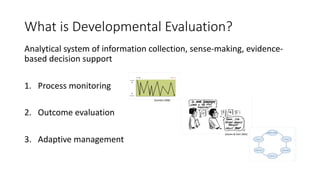
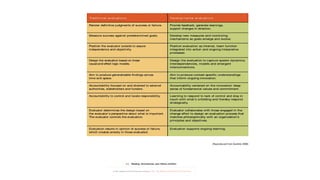
Analytical system of information collection, sense-making, evidence-
based decision support
1. Process monitoring
2. Outcome evaluation
3. Adaptive management
(Davies & Dart 2005)
(Gamble 2008)
(Reproduced from Gamble 2008)
Our conversation
Why do we need it?
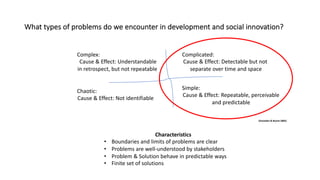
What types of problems do we encounter in development and social innovation?
Complex:
Cause & Effect: Understandable
in retrospect, but not repeatable
Complicated:
Cause & Effect: Detectable but not
separate over time and space
Chaotic:
Cause & Effect: Not identifiable
Simple:
Cause & Effect: Repeatable, perceivable
and predictable
(Snowden & Boone 2005)
Characteristics
• Boundaries and limits of problems are clear
• Problems are well-understood by stakeholders
• Problem & Solution behave in predictable ways
• Finite set of solutions
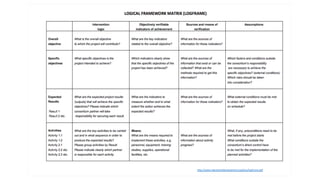
(Reproduced from Gamble 2008)
http://www.migration4development.org/docs/logframe.pdf
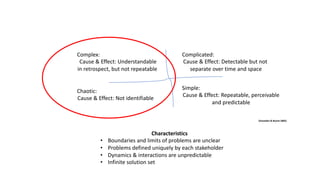
Complex:
Cause & Effect: Understandable
in retrospect, but not repeatable
Complicated:
Cause & Effect: Detectable but not
separate over time and space
Chaotic:
Cause & Effect: Not identifiable
Simple:
Cause & Effect: Repeatable, perceivable
and predictable
(Snowden & Boone 2005)
Characteristics
• Boundaries and limits of problems are unclear
• Problems defined uniquely by each stakeholder
• Dynamics & interactions are unpredictable
• Infinite solution set
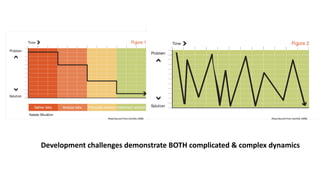
Development challenges demonstrate BOTH complicated & complex dynamics
(Reproduced from Gamble 2008)(Reproduced from Gamble 2008)
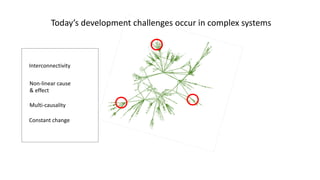
Today’s development challenges occur in complex systems
Interconnectivity
Non-linear cause
& effect
Multi-causality
Constant change
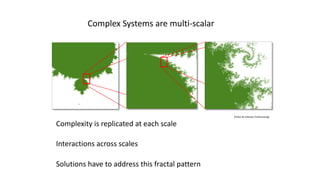
Complex Systems are multi-scalar
Complexity is replicated at each scale
Interactions across scales
Solutions have to address this fractal pattern
(Fisher & Coleman Forthcoming)
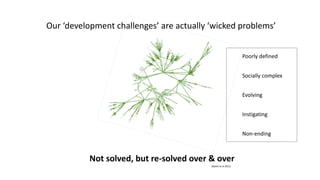
Not solved, but re-solved over & over
Poorly defined
Socially complex
Evolving
Instigating
Non-ending
(Balint et al 2011)
Our ‘development challenges’ are actually ‘wicked problems’
(Balint et al 2011 – Wicked Environmental Problems)
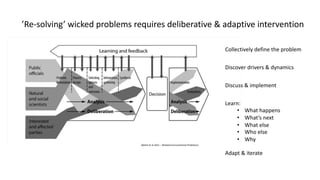
Collectively define the problem
Discover drivers & dynamics
Discuss & implement
Learn:
• What happens
• What’s next
• What else
• Who else
• Why
’Re-solving’ wicked problems requires deliberative & adaptive intervention
Adapt & iterate
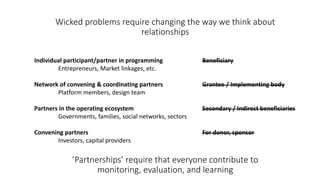
Wicked problems require changing the way we think about
relationships
Individual participant/partner in programming
Entrepreneurs, Market linkages, etc.
Network of convening & coordinating partners
Platform members, design team
Partners in the operating ecosystem
Governments, families, social networks, sectors
Convening partners
Investors, capital providers
Beneficiary
Grantee / Implementing body
Secondary / Indirect beneficiaries
For donor, sponsor
’Partnerships’ require that everyone contribute to
monitoring, evaluation, and learning
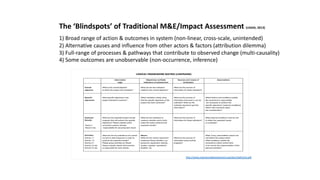
The ‘Blindspots’ of Traditional M&E/Impact Assessment (USAID, 2013)
1) Broad range of action & outcomes in system (non-linear, cross-scale, unintended)
2) Alternative causes and influence from other actors & factors (attribution dilemma)
3) Full-range of processes & pathways that contribute to observed change (multi-causality)
4) Some outcomes are unobservable (non-occurrence, inference)
http://www.migration4development.org/docs/logframe.pdf
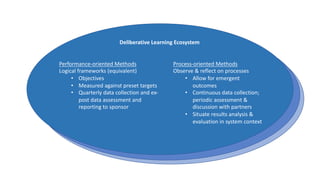
Performance-oriented Methods
Logical frameworks (equivalent)
• Objectives
• Measured against preset targets
• Quarterly data collection and ex-
post data assessment and
reporting to sponsor
Process-oriented Methods
Observe & reflect on processes
• Allow for emergent
outcomes
• Continuous data collection;
periodic assessment &
discussion with partners
• Situate results analysis &
evaluation in system context
Deliberative Learning Ecosystem
Our conversation
What are useful tools?
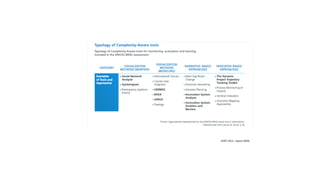
GOPC 2014 – Spaces MERL
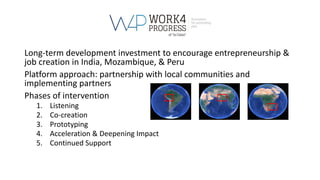
Long-term development investment to encourage entrepreneurship &
job creation in India, Mozambique, & Peru
Platform approach: partnership with local communities and
implementing partners
Phases of intervention
1. Listening
2. Co-creation
3. Prototyping
4. Acceleration & Deepening Impact
5. Continued Support
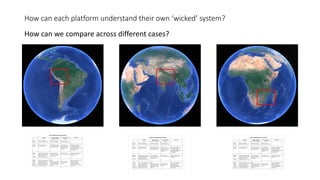
How can each platform understand their own ‘wicked’ system?
How can we compare across different cases?
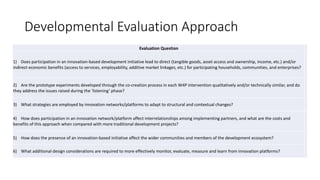
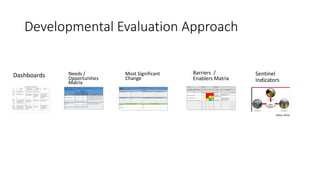
Developmental Evaluation Approach
Evaluation Question
1) Does participation in an innovation-based development initiative lead to direct (tangible goods, asset access and ownership, income, etc.) and/or
indirect economic benefits (access to services, employability, additive market linkages, etc.) for participating households, communities, and enterprises?
2) Are the prototype experiments developed through the co-creation process in each W4P intervention qualitatively and/or technically similar, and do
they address the issues raised during the ‘listening’ phase?
3) What strategies are employed by innovation networks/platforms to adapt to structural and contextual changes?
4) How does participation in an innovation network/platform affect interrelationships among implementing partners, and what are the costs and
benefits of this approach when compared with more traditional development projects?
5) How does the presence of an innovation-based initiative affect the wider communities and members of the development ecosystem?
6) What additional design considerations are required to more effectively monitor, evaluate, measure and learn from innovation platforms?
Dashboards
(Mayo 2016)
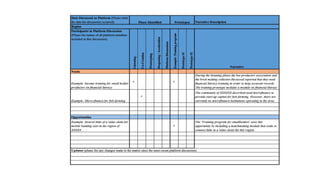
Needs /
Opportunities
Matrix
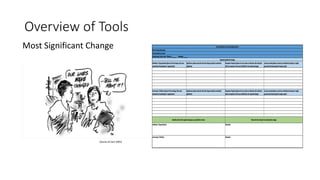
Most Significant
Change
Barriers /
Enablers Matrix
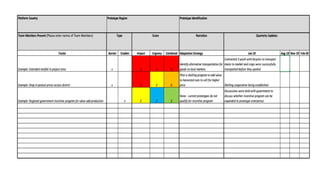
Sentinel
Indicators
Developmental Evaluation Approach
Overview of Tools
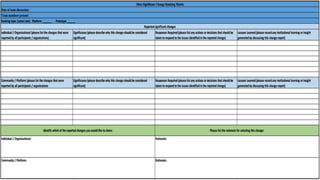
Most Significant Change
(Davies & Dart 2005)
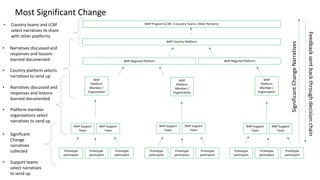
Most Significant Change
Prototype
participant
Prototype
participant
Prototype
participant
Prototype
participant
Prototype
participant
Prototype
participant
Prototype
participant
Prototype
participant
Prototype
participant
W4P Support
Team
W4P Support
Team
W4P Support
Team
W4P Support
Team
W4P Support
Team
W4P Support
Team
W4P
Platform
Member /
Organization
W4P
Platform
Member /
Organization
W4P
Platform
Member /
Organization
W4P Country Platform
W4P Regional Platform W4P Regional Platform
W4P Program (LCBF, 3 Country Teams, Other Partners)
SignificantChangeNarratives
Feedbacksentbackthroughdecisionchain
• Significant
Change
narratives
collected
• Support teams
select narratives
to send up
• Narratives discussed and
responses and lessons
learned documented
• Platform member
organizations select
narratives to send up
• Narratives discussed and
responses and lessons
learned documented
• Country platform selects
narratives to send up
• Country teams and LCBF
select narratives to share
with other platforms
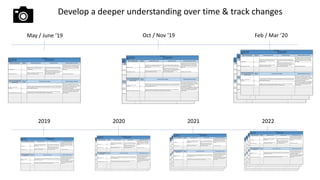
May / June ‘19 Oct / Nov ‘19 Feb / Mar ‘20
2019 2020 2021 2022
Develop a deeper understanding over time & track changes
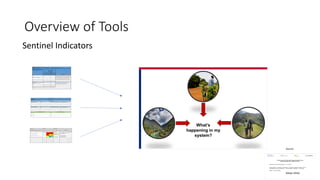
Overview of Tools
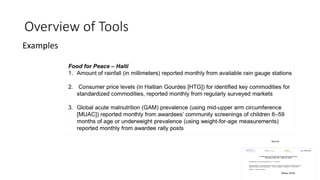
Sentinel Indicators
Source:
(Mayo 2016)
Overview of Tools
Examples
Source:
(Mayo 2016)
Our conversation
What are good practices?
Multiple methods, multiple scales, with intentional discussions to inform programming
Evaluation Partners need investment/ownership & distance/objectivity
Cost-efficient in terms of ALL partners’ time, energy, economies, incentives, ROI & SROI
Balance between scientific purity/rigor & useful data and information
Partnerships in learning & adaptation rather than transactional programs & evaluations
Good Practices
References
• Balint, P.J., R.E. Stewart, A. Desai, and L.C. Walters. 2011. Wicked Environmental Problems: Managing Uncertainty and Conflict. Washington, D.C.: Island Press.
• Davies, R., and J. Dart. (2005) The Most Significant Change (MSC) Technique. Available online at:
https://www.researchgate.net/publication/275409002_The_'Most_Significant_Change'_MSC_Technique_A_Guide_to_Its_Use/download
• Fisher, J., & Coleman, P. (Forthcoming). The fractal nature of intractable conflict: Implications for sustainable transformation. In L. Kriesberg (Ed.) Transforming
Intractable Conflicts. Rowman and Littlefield. Boulder.
• Gamble, J. (2008). A Developmental Evaluation Primer. Montreal. The J.W. McConnell Family Foundation.
• GOPC (2016) Spaces MERL – Systems and Complexity White Paper. Washington DC. USAID.
• Mayo, T. (2016) AEA 2015 - Sentinel Indicators: A Systems-Based Approach to Monitoring and Evaluation. USAID.
• Snowden, D. J. & M.E. Boone (2007). A Leaders Framework for Decision Making, Harvard Business Review
• USAID, 2013. Discussion Note: Complexity Aware Monitoring. V 2.0. Washington DC. Available online at:
http://www.dmeforpeace.org/sites/default/files/0107_Complexity%20Aware%20Monitoring%202013-12-11%20FINAL.pdf
• USAID, 2018. Discussion Note: Complexity Aware Monitoring. Washington DC. Available online at: http://usaidlearninglab.org/library/complexity-aware-
monitoring-discussion-note-brief
• http://www.migration4development.org/docs/logframe.pdf
Discussion

Developmental Evaluation: Tips, Tools, & Lessons Learned.

  • 1.
    Developmental Evaluation: Tips,Tools, & Lessons Learned Diálogo Improbable 30 May 2019 Joshua Fisher
  • 2.
    Our conversation • Whatis Developmental Evaluation? • Why do we need it? • What are useful tools? • What are good practices?
  • 3.
    Our conversation What isDevelopmental Evaluation?
  • 4.
    What is DevelopmentalEvaluation? Analytical system of information collection, sense-making, evidence- based decision support 1. Process monitoring 2. Outcome evaluation 3. Adaptive management (Davies & Dart 2005) (Gamble 2008)
  • 5.
  • 6.
  • 7.
    What types ofproblems do we encounter in development and social innovation? Complex: Cause & Effect: Understandable in retrospect, but not repeatable Complicated: Cause & Effect: Detectable but not separate over time and space Chaotic: Cause & Effect: Not identifiable Simple: Cause & Effect: Repeatable, perceivable and predictable (Snowden & Boone 2005) Characteristics • Boundaries and limits of problems are clear • Problems are well-understood by stakeholders • Problem & Solution behave in predictable ways • Finite set of solutions
  • 8.
    (Reproduced from Gamble2008) http://www.migration4development.org/docs/logframe.pdf
  • 9.
    Complex: Cause & Effect:Understandable in retrospect, but not repeatable Complicated: Cause & Effect: Detectable but not separate over time and space Chaotic: Cause & Effect: Not identifiable Simple: Cause & Effect: Repeatable, perceivable and predictable (Snowden & Boone 2005) Characteristics • Boundaries and limits of problems are unclear • Problems defined uniquely by each stakeholder • Dynamics & interactions are unpredictable • Infinite solution set
  • 10.
    Development challenges demonstrateBOTH complicated & complex dynamics (Reproduced from Gamble 2008)(Reproduced from Gamble 2008)
  • 11.
    Today’s development challengesoccur in complex systems Interconnectivity Non-linear cause & effect Multi-causality Constant change
  • 12.
    Complex Systems aremulti-scalar Complexity is replicated at each scale Interactions across scales Solutions have to address this fractal pattern (Fisher & Coleman Forthcoming)
  • 13.
    Not solved, butre-solved over & over Poorly defined Socially complex Evolving Instigating Non-ending (Balint et al 2011) Our ‘development challenges’ are actually ‘wicked problems’
  • 14.
    (Balint et al2011 – Wicked Environmental Problems) Collectively define the problem Discover drivers & dynamics Discuss & implement Learn: • What happens • What’s next • What else • Who else • Why ’Re-solving’ wicked problems requires deliberative & adaptive intervention Adapt & iterate
  • 15.
    Wicked problems requirechanging the way we think about relationships Individual participant/partner in programming Entrepreneurs, Market linkages, etc. Network of convening & coordinating partners Platform members, design team Partners in the operating ecosystem Governments, families, social networks, sectors Convening partners Investors, capital providers Beneficiary Grantee / Implementing body Secondary / Indirect beneficiaries For donor, sponsor ’Partnerships’ require that everyone contribute to monitoring, evaluation, and learning
  • 16.
    The ‘Blindspots’ ofTraditional M&E/Impact Assessment (USAID, 2013) 1) Broad range of action & outcomes in system (non-linear, cross-scale, unintended) 2) Alternative causes and influence from other actors & factors (attribution dilemma) 3) Full-range of processes & pathways that contribute to observed change (multi-causality) 4) Some outcomes are unobservable (non-occurrence, inference) http://www.migration4development.org/docs/logframe.pdf
  • 17.
    Performance-oriented Methods Logical frameworks(equivalent) • Objectives • Measured against preset targets • Quarterly data collection and ex- post data assessment and reporting to sponsor Process-oriented Methods Observe & reflect on processes • Allow for emergent outcomes • Continuous data collection; periodic assessment & discussion with partners • Situate results analysis & evaluation in system context Deliberative Learning Ecosystem
  • 18.
  • 19.
    GOPC 2014 –Spaces MERL
  • 20.
    Long-term development investmentto encourage entrepreneurship & job creation in India, Mozambique, & Peru Platform approach: partnership with local communities and implementing partners Phases of intervention 1. Listening 2. Co-creation 3. Prototyping 4. Acceleration & Deepening Impact 5. Continued Support
  • 21.
    How can eachplatform understand their own ‘wicked’ system? How can we compare across different cases?
  • 22.
    Developmental Evaluation Approach EvaluationQuestion 1) Does participation in an innovation-based development initiative lead to direct (tangible goods, asset access and ownership, income, etc.) and/or indirect economic benefits (access to services, employability, additive market linkages, etc.) for participating households, communities, and enterprises? 2) Are the prototype experiments developed through the co-creation process in each W4P intervention qualitatively and/or technically similar, and do they address the issues raised during the ‘listening’ phase? 3) What strategies are employed by innovation networks/platforms to adapt to structural and contextual changes? 4) How does participation in an innovation network/platform affect interrelationships among implementing partners, and what are the costs and benefits of this approach when compared with more traditional development projects? 5) How does the presence of an innovation-based initiative affect the wider communities and members of the development ecosystem? 6) What additional design considerations are required to more effectively monitor, evaluate, measure and learn from innovation platforms?
  • 23.
    Dashboards (Mayo 2016) Needs / Opportunities Matrix MostSignificant Change Barriers / Enablers Matrix Sentinel Indicators Developmental Evaluation Approach
  • 25.
    Overview of Tools MostSignificant Change (Davies & Dart 2005)
  • 26.
    Most Significant Change Prototype participant Prototype participant Prototype participant Prototype participant Prototype participant Prototype participant Prototype participant Prototype participant Prototype participant W4PSupport Team W4P Support Team W4P Support Team W4P Support Team W4P Support Team W4P Support Team W4P Platform Member / Organization W4P Platform Member / Organization W4P Platform Member / Organization W4P Country Platform W4P Regional Platform W4P Regional Platform W4P Program (LCBF, 3 Country Teams, Other Partners) SignificantChangeNarratives Feedbacksentbackthroughdecisionchain • Significant Change narratives collected • Support teams select narratives to send up • Narratives discussed and responses and lessons learned documented • Platform member organizations select narratives to send up • Narratives discussed and responses and lessons learned documented • Country platform selects narratives to send up • Country teams and LCBF select narratives to share with other platforms
  • 29.
    May / June‘19 Oct / Nov ‘19 Feb / Mar ‘20 2019 2020 2021 2022 Develop a deeper understanding over time & track changes
  • 30.
    Overview of Tools SentinelIndicators Source: (Mayo 2016)
  • 31.
  • 32.
  • 33.
    Multiple methods, multiplescales, with intentional discussions to inform programming Evaluation Partners need investment/ownership & distance/objectivity Cost-efficient in terms of ALL partners’ time, energy, economies, incentives, ROI & SROI Balance between scientific purity/rigor & useful data and information Partnerships in learning & adaptation rather than transactional programs & evaluations Good Practices
  • 34.
    References • Balint, P.J.,R.E. Stewart, A. Desai, and L.C. Walters. 2011. Wicked Environmental Problems: Managing Uncertainty and Conflict. Washington, D.C.: Island Press. • Davies, R., and J. Dart. (2005) The Most Significant Change (MSC) Technique. Available online at: https://www.researchgate.net/publication/275409002_The_'Most_Significant_Change'_MSC_Technique_A_Guide_to_Its_Use/download • Fisher, J., & Coleman, P. (Forthcoming). The fractal nature of intractable conflict: Implications for sustainable transformation. In L. Kriesberg (Ed.) Transforming Intractable Conflicts. Rowman and Littlefield. Boulder. • Gamble, J. (2008). A Developmental Evaluation Primer. Montreal. The J.W. McConnell Family Foundation. • GOPC (2016) Spaces MERL – Systems and Complexity White Paper. Washington DC. USAID. • Mayo, T. (2016) AEA 2015 - Sentinel Indicators: A Systems-Based Approach to Monitoring and Evaluation. USAID. • Snowden, D. J. & M.E. Boone (2007). A Leaders Framework for Decision Making, Harvard Business Review • USAID, 2013. Discussion Note: Complexity Aware Monitoring. V 2.0. Washington DC. Available online at: http://www.dmeforpeace.org/sites/default/files/0107_Complexity%20Aware%20Monitoring%202013-12-11%20FINAL.pdf • USAID, 2018. Discussion Note: Complexity Aware Monitoring. Washington DC. Available online at: http://usaidlearninglab.org/library/complexity-aware- monitoring-discussion-note-brief • http://www.migration4development.org/docs/logframe.pdf
  • 35.