
Solution Focussed
 Approaches to Helping
“The Solution Focused approach
 to coaching” Cavanagh & Grant
                        (2010)
Key Ideas
 Problem free talk
 Scaling
 Miracle question
 Client is expert
Problem Free Talk
   Note: The mentee must be ‘ready’ to engage in
    problem free talk. Attempts to rush into this can
    be perceived as insensitive (CF Person Centred)
   Many helping relationships centre around
    exploration of ‘the problem(s)’ as experienced by
    the mentee.
   Although this can be necessary and have its
    benefits in certain contexts, there are occasions
    of continually revisiting the problem might be
    counter-productive.
   Consider the following TA example:
The acronym ‘GEMS’ can serve to steer
the mentor away from problem based
talk:
   G - oals – what does the mentee want for themselves in
    the future
   E - xceptions – listen out for when the mentee is
    discussion an aspect of their life when the problem was
    not apparent.
   M - iracle question can be used creatively (yellow hat
    thinking) to divert the topic.
   S – caling can enable the mentee to refocus on the
    solutions. (Destination/vision etc).
   Employing Egan’s ‘active listening’ techniques can
    promote your sensory acuity towards opportunities to
    introduce GEMS.
Links with Transactional Analysis
   The first such game theorized was Why don't you/Yes,
    but in which one player (Julie) would pose a problem as
    if seeking help, and the other player(s) (Claire) would
    offer solutions (the "Why don't you?" suggestion). This
    game was noticed as many patients played it in therapy
    and psychiatry sessions, and inspired Berne to identify
    other interpersonal "games".
   Julie would point out a flaw in every Claire’s solution
    (the "Yes, but" response), until they all gave up in
    frustration. For example, if someone's life script was "to
    be hurt many times, and suffer and make others feel bad
    when I die" a game of "Why Don't You, Yes But" might
    proceed as follows:
Example:
    Julie: I wish I could lose some weight.
    Claire: Why don't you join a gym?
    Julie: Yes but, I can't afford the payments for a gym.
    Claire: Why don't you speed walk around your block after you
     get home from work?
    Julie: Yes but, I don't dare walk alone in my area after dark.
    Claire: Why don't you take the stairs at work instead of the
     elevator?
    Julie: Yes but, after my knee surgery, it hurts too much to walk
     that many flights of stairs.
    Claire: Why don't you change your diet?
    Julie: Yes but, my stomach is sensitive and I can tolerate only
     certain foods.
Founders
 (1934 – 2007) Co-Founder of SFBT
 Brief Family Therapy Center (BFTC) in
  Milwaukee
 Insoo Kim Berg - Family Therapy
 And, Steve DeShazer.
Scaling Questions
 Steve De Shazer (1940 -2005)
 Co-founder of the solution focussed
  approach with Insoo Kim Berg.
 After asking a client “what is better since
  last time?” The client said “I’m nearly a 10
  now”.
 Hence, numbers used to understand
  development
Benefits
 Easy to use
 Focus on change
 Focus on clients phenomenological
  existence (Like Person Centred)
 Broad application
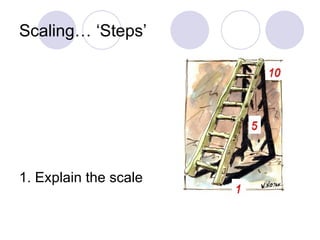
Scaling… ‘Steps’


1. Explain the scale
Alternative scales:
Where are we now?


                2. The current position
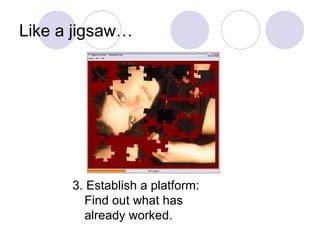
Like a jigsaw…


      3. Establish a platform:
        Find out what has
        already worked.
Vision
            Visualise a higher
             position; describe
             how things will look.
Success and Strengths

 5. Identify earlier
 success – what
 happened?
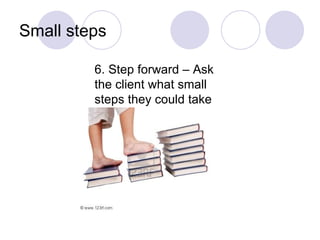
Small steps

         6. Step forward – Ask
         the client what small
         steps they could take
Types of Scale

 Success  scale
 Motivational scale
 Confidence scale
 Independence scale
Conclusion
   Being a cognitively flexible mentor might mean
    that at times you have cause to employ solution
    focussed techniques. This might be when:
   Discussions of the problem are creating
    stagnation and or frustration.
   The mentee is in a contemplative stage of
    considering the benefits of change.
   You are being motivational (interviewing).
   You are empowering the mentee to employ
    divergent thinking and offer their own solutions
    that are more likely to succeed than mentor led
    solutions.

Solution focussed approaches to helping

  • 1.
    Solution Focussed Approachesto Helping “The Solution Focused approach to coaching” Cavanagh & Grant (2010)
  • 2.
    Key Ideas  Problemfree talk  Scaling  Miracle question  Client is expert
  • 3.
    Problem Free Talk  Note: The mentee must be ‘ready’ to engage in problem free talk. Attempts to rush into this can be perceived as insensitive (CF Person Centred)  Many helping relationships centre around exploration of ‘the problem(s)’ as experienced by the mentee.  Although this can be necessary and have its benefits in certain contexts, there are occasions of continually revisiting the problem might be counter-productive.  Consider the following TA example:
  • 4.
    The acronym ‘GEMS’can serve to steer the mentor away from problem based talk:  G - oals – what does the mentee want for themselves in the future  E - xceptions – listen out for when the mentee is discussion an aspect of their life when the problem was not apparent.  M - iracle question can be used creatively (yellow hat thinking) to divert the topic.  S – caling can enable the mentee to refocus on the solutions. (Destination/vision etc).  Employing Egan’s ‘active listening’ techniques can promote your sensory acuity towards opportunities to introduce GEMS.
  • 5.
    Links with TransactionalAnalysis  The first such game theorized was Why don't you/Yes, but in which one player (Julie) would pose a problem as if seeking help, and the other player(s) (Claire) would offer solutions (the "Why don't you?" suggestion). This game was noticed as many patients played it in therapy and psychiatry sessions, and inspired Berne to identify other interpersonal "games".  Julie would point out a flaw in every Claire’s solution (the "Yes, but" response), until they all gave up in frustration. For example, if someone's life script was "to be hurt many times, and suffer and make others feel bad when I die" a game of "Why Don't You, Yes But" might proceed as follows:
  • 6.
    Example:  Julie: I wish I could lose some weight.  Claire: Why don't you join a gym?  Julie: Yes but, I can't afford the payments for a gym.  Claire: Why don't you speed walk around your block after you get home from work?  Julie: Yes but, I don't dare walk alone in my area after dark.  Claire: Why don't you take the stairs at work instead of the elevator?  Julie: Yes but, after my knee surgery, it hurts too much to walk that many flights of stairs.  Claire: Why don't you change your diet?  Julie: Yes but, my stomach is sensitive and I can tolerate only certain foods.
  • 7.
    Founders  (1934 –2007) Co-Founder of SFBT  Brief Family Therapy Center (BFTC) in Milwaukee  Insoo Kim Berg - Family Therapy  And, Steve DeShazer.
  • 8.
    Scaling Questions  SteveDe Shazer (1940 -2005)  Co-founder of the solution focussed approach with Insoo Kim Berg.  After asking a client “what is better since last time?” The client said “I’m nearly a 10 now”.  Hence, numbers used to understand development
  • 9.
    Benefits  Easy touse  Focus on change  Focus on clients phenomenological existence (Like Person Centred)  Broad application
  • 10.
  • 11.
  • 12.
    Where are wenow? 2. The current position
  • 13.
    Like a jigsaw… 3. Establish a platform: Find out what has already worked.
  • 14.
    Vision  Visualise a higher position; describe how things will look.
  • 15.
    Success and Strengths 5. Identify earlier success – what happened?
  • 16.
    Small steps 6. Step forward – Ask the client what small steps they could take
  • 17.
    Types of Scale Success scale  Motivational scale  Confidence scale  Independence scale
  • 18.
    Conclusion  Being a cognitively flexible mentor might mean that at times you have cause to employ solution focussed techniques. This might be when:  Discussions of the problem are creating stagnation and or frustration.  The mentee is in a contemplative stage of considering the benefits of change.  You are being motivational (interviewing).  You are empowering the mentee to employ divergent thinking and offer their own solutions that are more likely to succeed than mentor led solutions.