8. Knives, gangs & guns 16 slides
John Clark
Bob Bowman
General essay guidance
 Ensure you have a clear structure but that doesn’t mean
use of sub-headings
 Harvard referencing
 Bibliography
 Don’t just describe
 Adopt a critical approach, use a variety of sources &
analyse your subject
 Provide evidence from your reading & research to support
your arguments
 Aim to be as close as possible to the word count
Violence & weapons
 This session consists of:
 Weapons awareness session
 Knife crime survey
Knife Crime Survey 2008 – Analysis
 The following report relates to the Knife Crime Survey
completed in the Autumn Term of the 2008/09 academic
year. The survey was completed by students ranging from
10 years old to 19 years old at both schools and colleges
across West Yorkshire. In total, 5505 responses were
received back from the participating schools and colleges.
 Following the period of data input, it was found that 5103 of
the responses contained information and 402 responses
contained no data at all. The analysis is therefore based on
a sample size of 5103. It should be noted that not all
students completed each question and there are therefore
some gaps in the data, however the vast majority of
students gave responses to each question.
Q. 1. Do you think the media present an
accurate picture of knife crime?
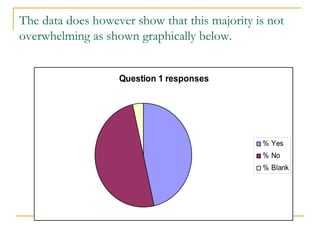
 The responses to question 1 gave the following
breakdown:
 Yes: 2368
 No: 2556
 Blank: 179 Yes: 46.4% No: 50.1% Blank: 3.5%
 The data shows marginally more respondents
answered “no” than answered “yes” to this question.
 This implies a small majority of the respondents
believe the media do not present an accurate
picture of knife crime. Of the 5103 respondents,
2556 believe this to be the case.
The data does however show that this majority is not
overwhelming as shown graphically below.
Question 1 responses
% Yes
% No
% Blank
Q. 2. Does this media coverage affect you in
any way?
 The responses to question 2 gave the following
breakdown:
 Yes; 2099. No; 2748. Blank; 256 % Yes;
41.1%. No; 53.9%. Blank; 5.0%
 The data shows more respondents answered
“no” than answered “yes” to this question. This
implies that more of the respondents believe
media coverage does not affect them in any
way. Of the 5103 respondents, 2748 believe
this to be the case.
The data shows that this majority is more noticeable than the
majority for question 1 as shown graphically below.
 It should also be noted there were a greater number of
blank responses to this question, with 1 in 20 students
choosing not to answer this question.
Question 2 responses
% Yes
% No
% Blank
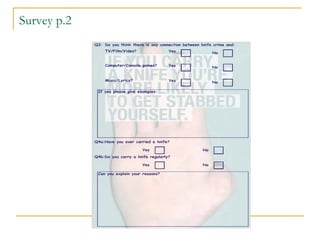
Question 3. Do you think there is any connection between
knife crime and:
1. TV/Film/Video?
2. Computer/Console Games?
3. Music/Lyrics?
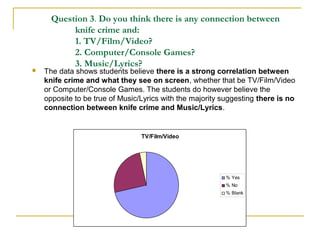
 The data shows students believe there is a strong correlation between
knife crime and what they see on screen, whether that be TV/Film/Video
or Computer/Console Games. The students do however believe the
opposite to be true of Music/Lyrics with the majority suggesting there is no
connection between knife crime and Music/Lyrics.
TV/Film/Video
% Yes
% No
% Blank
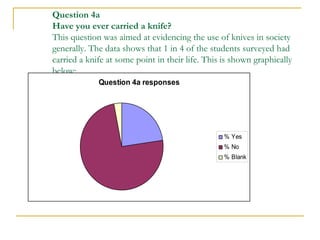
Question 4a
Have you ever carried a knife?
This question was aimed at evidencing the use of knives in society
generally. The data shows that 1 in 4 of the students surveyed had
carried a knife at some point in their life. This is shown graphically
below:
Question 4a responses
% Yes
% No
% Blank
Question 4a ctd.
 It should be noted, however that although this 1 in 4 figure appears to
be very high, the data showed a different picture. When analysing the
data further, it was clear that the vast majority of the students surveyed
who had answered “yes” to this question were for reasons such as food
preparation.
 185 respondents who had answered “yes” to this question cited the
reason as being “Food Preparation/Cooking”, and a further 110
respondents stated they had carried a knife “in the Kitchen”. 112 of the
respondents gave the reason for carrying as “Outdoor Pursuits” such as
Scouting, Cadets, Camping or Fishing. These reasons for carrying a
knife were seen as “legitimate” and will be further analysed on the next
question.
Question 4b. Do you carry a knife regularly?
This question was aimed at evidencing whether a teenage knife carrying culture exists in
the West Yorkshire Police area. The responses to question 4b gave the following
breakdown:
 The data shows nearly 1 in 23 of the students surveyed had carried
a knife regularly. This is shown graphically below:
Question 4b responses
% Yes
% No
% Blank
It should be noted, however that
 although this 1 in 23 figure appears to be high once again, the data was
further analysed to show a more realistic picture. It was clear that many
students surveyed who answered “yes” to this question were for
reasons such as eating or food preparation.
 As with the previous question, the majority of respondents who
answered “yes” to this question cited the reason as being “Food
Preparation/Cooking” (43), and a further 24 respondents stated they
had carried a knife “in the Kitchen”. Further “legitimate” reasons given
showed that 18 respondents suggested the reason for carrying as
“eating” and a further 18 of the respondents gave the reason for
carrying as “Outdoor Pursuits” such as Scouting, Cadets, Camping or
Fishing.
Once the “legitimate” reasons were taken from the total,
the data for those who answered “yes” showed the
following:
 1122.19%
 This figure shows a different picture in that only 1 in 46 students carried a knife
regularly. The analysis was then taken one step further to look at those who had
answered “yes” to the question and then given no explanation in the free text box. An
assumption was made that the reasons for carrying would be comparable to the rest
of the dataset. When this was taken into account, the data for the “yes” responses
showed the following:
 881.72%
 This figure shows that only 1 in 58 students carried a knife regularly.
 This “1 in 58” figure can be broken down further to assess the main reasons for
carrying a knife. The overwhelming majority of the reasons for carrying regularly again
revolve around protection and safety. 22 respondents carry a knife for “protection” and
a further 16 carried one for “safety”. Another key reason for carrying a knife was in
case they were “threatened” (7).
 As a footnote to this dataset, it is necessary to consider the wording of the question.
The word “regularly” is not defined and could therefore be viewed differently by each
of the respondents.
Question 5
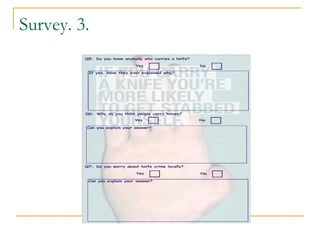
Do you know anybody who carries a knife?
 1 in 4 of the students surveyed know somebody who carries a
knife
Question 5 responses
% Yes
% No
% Blank
This figure of 1 in 4 seems high, but a few other
considerations need to be taken into account.
 Firstly, a number of respondents may know the
same person who carries a knife, therefore skewing
the dataset. This is highly likely as a number of the
respondents surveyed were in the same peer
groups.
 There could also be respondents who answered
“yes” for the same reasons as in question 4 (for
example eating and food preparation). Further
analysis of this question would not give definitive
answers as we would not be able to establish the
individuals known for carrying knives from the
responses given.
Question 6
Why do you think people carry knives?
 Unfortunately the wording of this question did not
match the potential answers offered. Many of the
respondents left this question blank. No further
analysis of this question was completed due to lack of
meaningful data.
 It is felt that the free text answers given in question 4
will provide the reasons that people carry knives.
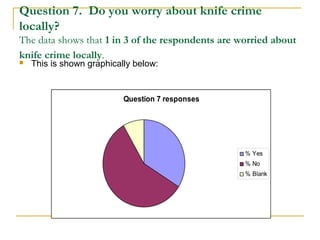
Question 7. Do you worry about knife crime
locally?
The data shows that 1 in 3 of the respondents are worried about
knife crime locally.
 This is shown graphically below:
Question 7 responses
% Yes
% No
% Blank
This figure of 1 in 3 seems to be a high figure and
indicates that there are a vast number of the younger
generation who worry about knife crime.
 Further analysis of the data shows the vast majority of these respondents
have a fear that they may become the victim of knife crime. Phrases such
as “could get stabbed”, “could happen to me”, “could be me next” and
“could happen anywhere and to anyone at any time” show the fears that
these respondents have. This fear of the respondents goes further to
suggest that “a lot of people carry” knives and you “don’t know who is
carrying”.
 A large proportion of the respondents appear to be generally “scared” and
many of them perceive that they live in a “rough area”. Within these “rough
areas”, a small minority of the respondents highlighted the presence of
gangs as being a reason for their fear although this was less than 1% of
the total respondents.
 It should also be noted a small proportion of the respondents who are
worried about knife crime locally cite the reason as being the “TV/News”.
This implies that coverage of knife crime does actually affect the younger
generation, even though questions 1 and 2 of the survey suggest the
majority are not influenced by the media.
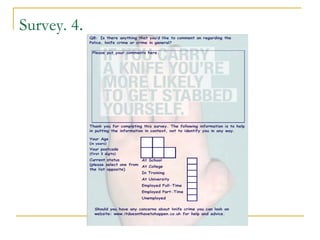
Question 8. Is there anything that you’d like to comment on
regarding the Police, knife crime or crime in general?
 For this question, there was no quantitative data to analyse as there was only a free
text box for the respondents to complete. Many of the respondents chose not to
provide any additional comments, but there were some interesting points raised by
those who did.
 A number of the additional comments given stated “knife crime is bad” and “should
be stopped” in a number of different phrases, but there was also differences in
opinion for other areas of comment.
 It was clear when looking at the differences in opinion that the view was dependent
on whether the respondent carried a knife or not. Those who did not carry knives had
one view and those who did seemed to have the opposite view.
 The following paragraphs are taken from the view of the majority (those who do not
carry), but it should be noted that some of the comments given were in direct
opposition to these points.
 Many comments suggested there should be “stricter” policies on knife crime with long
custodial sentences and harsher treatment by the authorities. Comments also
suggested the Police should stop and search more people.
 There were a large proportion who wanted to see a greater police presence out on
the streets and many suggested they felt the police already did a good job.
 The use of technology to assist in the process was also highlighted with suggestions
such as “more CCTV” and “metal detectors in schools” occurring frequently in the
responses.
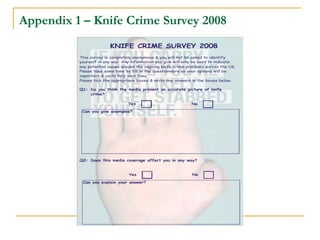
Appendix 1 – Knife Crime Survey 2008
Survey p.2
Survey. 3.
Survey. 4.

Session 8. knives gangs guns.2016

  • 1.
    8. Knives, gangs& guns 16 slides John Clark Bob Bowman
  • 2.
    General essay guidance Ensure you have a clear structure but that doesn’t mean use of sub-headings  Harvard referencing  Bibliography  Don’t just describe  Adopt a critical approach, use a variety of sources & analyse your subject  Provide evidence from your reading & research to support your arguments  Aim to be as close as possible to the word count
  • 3.
    Violence & weapons This session consists of:  Weapons awareness session  Knife crime survey
  • 4.
    Knife Crime Survey2008 – Analysis  The following report relates to the Knife Crime Survey completed in the Autumn Term of the 2008/09 academic year. The survey was completed by students ranging from 10 years old to 19 years old at both schools and colleges across West Yorkshire. In total, 5505 responses were received back from the participating schools and colleges.  Following the period of data input, it was found that 5103 of the responses contained information and 402 responses contained no data at all. The analysis is therefore based on a sample size of 5103. It should be noted that not all students completed each question and there are therefore some gaps in the data, however the vast majority of students gave responses to each question.
  • 5.
    Q. 1. Doyou think the media present an accurate picture of knife crime?  The responses to question 1 gave the following breakdown:  Yes: 2368  No: 2556  Blank: 179 Yes: 46.4% No: 50.1% Blank: 3.5%  The data shows marginally more respondents answered “no” than answered “yes” to this question.  This implies a small majority of the respondents believe the media do not present an accurate picture of knife crime. Of the 5103 respondents, 2556 believe this to be the case.
  • 6.
    The data doeshowever show that this majority is not overwhelming as shown graphically below. Question 1 responses % Yes % No % Blank
  • 7.
    Q. 2. Doesthis media coverage affect you in any way?  The responses to question 2 gave the following breakdown:  Yes; 2099. No; 2748. Blank; 256 % Yes; 41.1%. No; 53.9%. Blank; 5.0%  The data shows more respondents answered “no” than answered “yes” to this question. This implies that more of the respondents believe media coverage does not affect them in any way. Of the 5103 respondents, 2748 believe this to be the case.
  • 8.
    The data showsthat this majority is more noticeable than the majority for question 1 as shown graphically below.  It should also be noted there were a greater number of blank responses to this question, with 1 in 20 students choosing not to answer this question. Question 2 responses % Yes % No % Blank
  • 9.
    Question 3. Doyou think there is any connection between knife crime and: 1. TV/Film/Video? 2. Computer/Console Games? 3. Music/Lyrics?  The data shows students believe there is a strong correlation between knife crime and what they see on screen, whether that be TV/Film/Video or Computer/Console Games. The students do however believe the opposite to be true of Music/Lyrics with the majority suggesting there is no connection between knife crime and Music/Lyrics. TV/Film/Video % Yes % No % Blank
  • 10.
    Question 4a Have youever carried a knife? This question was aimed at evidencing the use of knives in society generally. The data shows that 1 in 4 of the students surveyed had carried a knife at some point in their life. This is shown graphically below: Question 4a responses % Yes % No % Blank
  • 11.
    Question 4a ctd. It should be noted, however that although this 1 in 4 figure appears to be very high, the data showed a different picture. When analysing the data further, it was clear that the vast majority of the students surveyed who had answered “yes” to this question were for reasons such as food preparation.  185 respondents who had answered “yes” to this question cited the reason as being “Food Preparation/Cooking”, and a further 110 respondents stated they had carried a knife “in the Kitchen”. 112 of the respondents gave the reason for carrying as “Outdoor Pursuits” such as Scouting, Cadets, Camping or Fishing. These reasons for carrying a knife were seen as “legitimate” and will be further analysed on the next question.
  • 12.
    Question 4b. Doyou carry a knife regularly? This question was aimed at evidencing whether a teenage knife carrying culture exists in the West Yorkshire Police area. The responses to question 4b gave the following breakdown:  The data shows nearly 1 in 23 of the students surveyed had carried a knife regularly. This is shown graphically below: Question 4b responses % Yes % No % Blank
  • 13.
    It should benoted, however that  although this 1 in 23 figure appears to be high once again, the data was further analysed to show a more realistic picture. It was clear that many students surveyed who answered “yes” to this question were for reasons such as eating or food preparation.  As with the previous question, the majority of respondents who answered “yes” to this question cited the reason as being “Food Preparation/Cooking” (43), and a further 24 respondents stated they had carried a knife “in the Kitchen”. Further “legitimate” reasons given showed that 18 respondents suggested the reason for carrying as “eating” and a further 18 of the respondents gave the reason for carrying as “Outdoor Pursuits” such as Scouting, Cadets, Camping or Fishing.
  • 14.
    Once the “legitimate”reasons were taken from the total, the data for those who answered “yes” showed the following:  1122.19%  This figure shows a different picture in that only 1 in 46 students carried a knife regularly. The analysis was then taken one step further to look at those who had answered “yes” to the question and then given no explanation in the free text box. An assumption was made that the reasons for carrying would be comparable to the rest of the dataset. When this was taken into account, the data for the “yes” responses showed the following:  881.72%  This figure shows that only 1 in 58 students carried a knife regularly.  This “1 in 58” figure can be broken down further to assess the main reasons for carrying a knife. The overwhelming majority of the reasons for carrying regularly again revolve around protection and safety. 22 respondents carry a knife for “protection” and a further 16 carried one for “safety”. Another key reason for carrying a knife was in case they were “threatened” (7).  As a footnote to this dataset, it is necessary to consider the wording of the question. The word “regularly” is not defined and could therefore be viewed differently by each of the respondents.
  • 15.
    Question 5 Do youknow anybody who carries a knife?  1 in 4 of the students surveyed know somebody who carries a knife Question 5 responses % Yes % No % Blank
  • 16.
    This figure of1 in 4 seems high, but a few other considerations need to be taken into account.  Firstly, a number of respondents may know the same person who carries a knife, therefore skewing the dataset. This is highly likely as a number of the respondents surveyed were in the same peer groups.  There could also be respondents who answered “yes” for the same reasons as in question 4 (for example eating and food preparation). Further analysis of this question would not give definitive answers as we would not be able to establish the individuals known for carrying knives from the responses given.
  • 17.
    Question 6 Why doyou think people carry knives?  Unfortunately the wording of this question did not match the potential answers offered. Many of the respondents left this question blank. No further analysis of this question was completed due to lack of meaningful data.  It is felt that the free text answers given in question 4 will provide the reasons that people carry knives.
  • 18.
    Question 7. Doyou worry about knife crime locally? The data shows that 1 in 3 of the respondents are worried about knife crime locally.  This is shown graphically below: Question 7 responses % Yes % No % Blank
  • 19.
    This figure of1 in 3 seems to be a high figure and indicates that there are a vast number of the younger generation who worry about knife crime.  Further analysis of the data shows the vast majority of these respondents have a fear that they may become the victim of knife crime. Phrases such as “could get stabbed”, “could happen to me”, “could be me next” and “could happen anywhere and to anyone at any time” show the fears that these respondents have. This fear of the respondents goes further to suggest that “a lot of people carry” knives and you “don’t know who is carrying”.  A large proportion of the respondents appear to be generally “scared” and many of them perceive that they live in a “rough area”. Within these “rough areas”, a small minority of the respondents highlighted the presence of gangs as being a reason for their fear although this was less than 1% of the total respondents.  It should also be noted a small proportion of the respondents who are worried about knife crime locally cite the reason as being the “TV/News”. This implies that coverage of knife crime does actually affect the younger generation, even though questions 1 and 2 of the survey suggest the majority are not influenced by the media.
  • 20.
    Question 8. Isthere anything that you’d like to comment on regarding the Police, knife crime or crime in general?  For this question, there was no quantitative data to analyse as there was only a free text box for the respondents to complete. Many of the respondents chose not to provide any additional comments, but there were some interesting points raised by those who did.  A number of the additional comments given stated “knife crime is bad” and “should be stopped” in a number of different phrases, but there was also differences in opinion for other areas of comment.  It was clear when looking at the differences in opinion that the view was dependent on whether the respondent carried a knife or not. Those who did not carry knives had one view and those who did seemed to have the opposite view.  The following paragraphs are taken from the view of the majority (those who do not carry), but it should be noted that some of the comments given were in direct opposition to these points.  Many comments suggested there should be “stricter” policies on knife crime with long custodial sentences and harsher treatment by the authorities. Comments also suggested the Police should stop and search more people.  There were a large proportion who wanted to see a greater police presence out on the streets and many suggested they felt the police already did a good job.  The use of technology to assist in the process was also highlighted with suggestions such as “more CCTV” and “metal detectors in schools” occurring frequently in the responses.
  • 21.
    Appendix 1 –Knife Crime Survey 2008
  • 22.
  • 23.
  • 24.