


Goal Setting
Dr. Dawn-Elise Snipes PhD, LPC-MHSP, LMHC, NCC
Executive Director, AllCEUs
AllCEUs.com Unlimited CEUs $59 | Specialty Certificates $89 | Live Webinars $5
Objectives
 Identify the purpose of setting goals
 Learn about SMART goals and how to set them
 Explore ways to help clients identify their goals
 Learn how to help clients increase and maintain
motivation
 Identify the 6 most common pitfalls in goal
setting, and how to prevent them
AllCEUs.com Unlimited CEUs $59 | Specialty Certificates $89 | Live Webinars $5
Why Do I Care
 Goal setting is an integral part of treatment
 Goal setting is something everyone does every day
 Ineffective goals can have a negative impact on
self esteem
 Ineffective goals can make people mistakenly
think they are helpless to change anything.
AllCEUs.com Unlimited CEUs $59 | Specialty Certificates $89 | Live Webinars $5
Specific
Measurable
Achievable
Realistic
Time Limited
Think about the last goal you set that was successful…
Think about the last goal you set that was unsuccessful.
What is the difference between the two?
SMART?
Motivation?
SMART Goals
 Goals (WHY)
 Goals are the overarching reason a person begins to do
something.
 Often goals are broad and abstract. “I want to be
healthier.” “I want to be happy.”
 Goals need to be broken down into manageable,
meaningful, observable objectives.
 Phrase goals as adding a positive instead of removing a
negative.
Goals—The Beginning
 One way to elicit goals is through the miracle
question:
 If you woke up tomorrow and you were _____ (i.e. your
problem was resolved/goal was achieved) what would be
different?
 This gives you insight into the foundations of this
particular persons symptoms/definition of the
problem.
Miracle Question
Specific
 Overall Goal for Treatment
 What is the problem?
Example: Depression
 How will you know when the problem is resolved?
Emotionally, I won’t feel as hopeless and helpless. I wont
dread getting out of bed.
Mentally, I won’t be so foggy headed and will be able to
concentrate
Physically, I will have more energy and lose some weight
Socially, I will enjoy spending time with friends
AllCEUs.com Unlimited CEUs $59 | Specialty Certificates $89 | Live Webinars $5
Specific
 Subgoals
 Main Issue
Learn about the overall problem (Depression)
Learn about your symptoms/causes/triggers of the problem
Identify ways to address your specific
symptoms/causes/triggers
 I won’t dread getting out of bed each day
Reframed– I will be happy to wake up and face the day
Identify causes of dread for you and interventions
 I will have more energy
Learn about causes of fatigue and low energy
Identify potential causes of your fatigue and low energy
AllCEUs.com Unlimited CEUs $59 | Specialty Certificates $89 | Live Webinars $5
Measurable
 Frequency (#/time)
 Number of times per day or week
 i.e. Number of crying episodes
 i.e. Number of eating episodes NOT due to hunger
 i.e. Number of glasses of water consumed/day
 i.e. Number of wake-ups during the night
 Duration (How long)
 Sleep
 Exercise
 Crying episodes
 Intensity
 Likert (1-mild; 2-moderate; 3-intense; 4-excruciating)
 Number of calories per binge
Copyright 2008-2012 AllCEUs, a subsidiary of CDS Ventures, LLC
Measurable
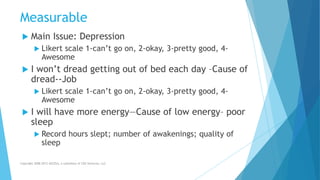
 Main Issue: Depression
 Likert scale 1-can’t go on, 2-okay, 3-pretty good, 4-
Awesome
 I won’t dread getting out of bed each day –Cause of
dread--Job
 Likert scale 1-can’t go on, 2-okay, 3-pretty good, 4-
Awesome
 I will have more energy—Cause of low energy– poor
sleep
 Record hours slept; number of awakenings; quality of
sleep
Copyright 2008-2012 AllCEUs, a subsidiary of CDS Ventures, LLC
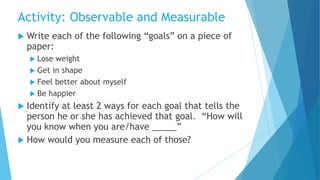
 Write each of the following “goals” on a piece of
paper:
 Lose weight
 Get in shape
 Feel better about myself
 Be happier
 Identify at least 2 ways for each goal that tells the
person he or she has achieved that goal. “How will
you know when you are/have _____”
 How would you measure each of those?
Activity: Observable and Measurable
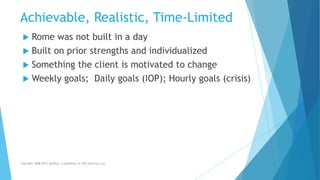
Achievable, Realistic, Time-Limited
 Rome was not built in a day
 Built on prior strengths and individualized
 Something the client is motivated to change
 Weekly goals; Daily goals (IOP); Hourly goals (crisis)
Copyright 2008-2012 AllCEUs, a subsidiary of CDS Ventures, LLC
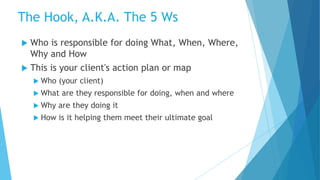
 Who is responsible for doing What, When, Where,
Why and How
 This is your client's action plan or map
 Who (your client)
 What are they responsible for doing, when and where
 Why are they doing it
 How is it helping them meet their ultimate goal
The Hook, A.K.A. The 5 Ws
Example
 Main Issue (8/1/2016-9/5/2016)
 Sally will learn about the overall problem (Depression) by
reading one chapter of XYZ Book and the handouts provided by
Dr. Snipes each week for 5 weeks.
 Sally will learn about her symptoms/causes/triggers of the
problem by taking notes on what sounds like her as she reads
the book and handouts about depression. She will process
those notes in counseling with Dr. Snipes each week.
 Sally will identify ways to address her specific
symptoms/causes/triggers by completing the My Symptoms and
My Triggers worksheets provided by Dr. Snipes
 Each morning and evening, Sally will rate, on a scale from 1-4
her happiness and explain her response. These logs will be
discussed with Dr. Snipes each session.
AllCEUs.com Unlimited CEUs $59 | Specialty Certificates $89 | Live Webinars $5
Learning
 Goal setting means changing a behavior
 Change usually involves learning something
 Part of the learning process involves improving
motivation
 Effective change means presenting the information in a
form in which the person most easily learns.
Copyright 2008-2012 AllCEUs, a subsidiary of CDS Ventures, LLC
Learning
3 parts to the learning process:
 Cognition
How people acquire knowledge: Seeing, hearing or doing
 Conceptualization
How people process information: Abstract, specific, memory
pathways
 Affective
People’s motivation, decision-making styles, values and
emotional preferences: How much does this information matter
Copyright 2008-2012 AllCEUs, a subsidiary of CDS Ventures, LLC
Learning Styles and Goal Setting
 Active/Reflective
 When you process information
 Auditory/hearing, visual/seeing, or kinesthetic/doing
 Methods for receiving information
 Factual or Emotional
 How you conceptualize information
 Sensing vs. Intuitive
 What you pay attention to
 Global vs. Specific
 Parts to whole or vice versa
Copyright 2008-2012 AllCEUs, a subsidiary of CDS Ventures, LLC
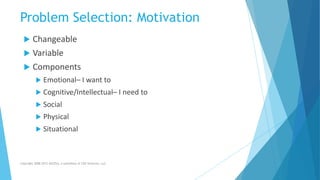
Problem Selection: Motivation
 Changeable
 Variable
 Components
 Emotional– I want to
 Cognitive/Intellectual– I need to
 Social
 Physical
 Situational
Copyright 2008-2012 AllCEUs, a subsidiary of CDS Ventures, LLC
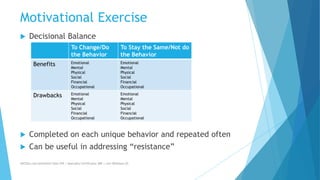
Motivational Exercise
 Decisional Balance
 Completed on each unique behavior and repeated often
 Can be useful in addressing “resistance”
AllCEUs.com Unlimited CEUs $59 | Specialty Certificates $89 | Live Webinars $5
To Change/Do
the Behavior
To Stay the Same/Not do
the Behavior
Benefits Emotional
Mental
Physical
Social
Financial
Occupational
Emotional
Mental
Physical
Social
Financial
Occupational
Drawbacks Emotional
Mental
Physical
Social
Financial
Occupational
Emotional
Mental
Physical
Social
Financial
Occupational
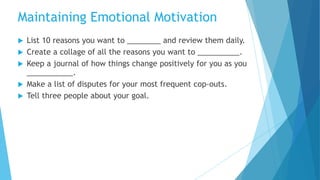
 List 10 reasons you want to ________ and review them daily.
 Create a collage of all the reasons you want to __________.
 Keep a journal of how things change positively for you as you
___________.
 Make a list of disputes for your most frequent cop-outs.
 Tell three people about your goal.
Maintaining Emotional Motivation
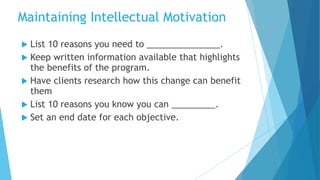
 List 10 reasons you need to _______________.
 Keep written information available that highlights
the benefits of the program.
 Have clients research how this change can benefit
them
 List 10 reasons you know you can _________.
 Set an end date for each objective.
Maintaining Intellectual Motivation
 Identify 3 social supports that understand (or are
willing to learn about) addiction and co-occurring
disorders recovery
 Buddy-Up-- Encourage people with similar goals to
support each other in and out of group/class.
 Plan weekly fun social activities with friends,
children, pets
Maintaining Social Motivation
 Create a positive environment
 The way things look on the outside often reflect how
you feel on the inside
 Eliminate sensory (visual, auditory, olfactory)
stimuli –i.e. Bob Marley has to go.
Maintaining Environmental Motivation
 Keep a daily check-in sheet of how you feel
physically (pain, lethargy, fatigue, irritability)
 Use money you would have spent on your addiction
to take care of yourself
 Fitness center membership
 Massage
 Hot-tub
 Spa day
Maintaining Physical Motivation
 Identify 5 obstacles to accomplishing your goal,
what motivations they are related to, and 3
solutions for each
 Identify 5 reasons for prior relapses, motivations
for each and alternative behaviours
Maintaining Motivation--General
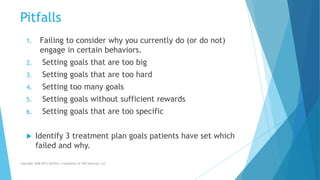
Pitfalls
1. Failing to consider why you currently do (or do not)
engage in certain behaviors.
2. Setting goals that are too big
3. Setting goals that are too hard
4. Setting too many goals
5. Setting goals without sufficient rewards
6. Setting goals that are too specific
 Identify 3 treatment plan goals patients have set which
failed and why.
Copyright 2008-2012 AllCEUs, a subsidiary of CDS Ventures, LLC
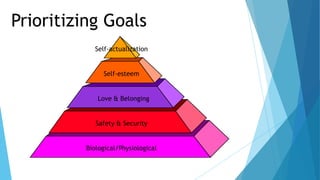
Prioritizing Goals
Biological/Physiological
Safety & Security
Love & Belonging
Self-esteem
Self-actualization
Summary
 Good Goals
 Use positive language
 Address the reasons for not changing as well as changing
 Are meaningful to the patient
 SMART
 Use the KSA progression
Knowledge in general
Knowledge specific to the patient
Skills in general
Skills specific to the patient
Copyright 2008-2012 AllCEUs, a subsidiary of CDS Ventures, LLC
Summary
 Well formed goals guide effective treatment
 Making goals SMART helps clients
 Improve self-esteem and self-efficacy
 See incremental improvements
AllCEUs.com Unlimited CEUs $59 | Specialty Certificates $89 | Live Webinars $5

Goal Setting for Behavior Change

  • 1.
    Goal Setting Dr. Dawn-EliseSnipes PhD, LPC-MHSP, LMHC, NCC Executive Director, AllCEUs AllCEUs.com Unlimited CEUs $59 | Specialty Certificates $89 | Live Webinars $5
  • 2.
    Objectives  Identify thepurpose of setting goals  Learn about SMART goals and how to set them  Explore ways to help clients identify their goals  Learn how to help clients increase and maintain motivation  Identify the 6 most common pitfalls in goal setting, and how to prevent them AllCEUs.com Unlimited CEUs $59 | Specialty Certificates $89 | Live Webinars $5
  • 3.
    Why Do ICare  Goal setting is an integral part of treatment  Goal setting is something everyone does every day  Ineffective goals can have a negative impact on self esteem  Ineffective goals can make people mistakenly think they are helpless to change anything. AllCEUs.com Unlimited CEUs $59 | Specialty Certificates $89 | Live Webinars $5
  • 4.
    Specific Measurable Achievable Realistic Time Limited Think aboutthe last goal you set that was successful… Think about the last goal you set that was unsuccessful. What is the difference between the two? SMART? Motivation? SMART Goals
  • 5.
     Goals (WHY) Goals are the overarching reason a person begins to do something.  Often goals are broad and abstract. “I want to be healthier.” “I want to be happy.”  Goals need to be broken down into manageable, meaningful, observable objectives.  Phrase goals as adding a positive instead of removing a negative. Goals—The Beginning
  • 6.
     One wayto elicit goals is through the miracle question:  If you woke up tomorrow and you were _____ (i.e. your problem was resolved/goal was achieved) what would be different?  This gives you insight into the foundations of this particular persons symptoms/definition of the problem. Miracle Question
  • 7.
    Specific  Overall Goalfor Treatment  What is the problem? Example: Depression  How will you know when the problem is resolved? Emotionally, I won’t feel as hopeless and helpless. I wont dread getting out of bed. Mentally, I won’t be so foggy headed and will be able to concentrate Physically, I will have more energy and lose some weight Socially, I will enjoy spending time with friends AllCEUs.com Unlimited CEUs $59 | Specialty Certificates $89 | Live Webinars $5
  • 8.
    Specific  Subgoals  MainIssue Learn about the overall problem (Depression) Learn about your symptoms/causes/triggers of the problem Identify ways to address your specific symptoms/causes/triggers  I won’t dread getting out of bed each day Reframed– I will be happy to wake up and face the day Identify causes of dread for you and interventions  I will have more energy Learn about causes of fatigue and low energy Identify potential causes of your fatigue and low energy AllCEUs.com Unlimited CEUs $59 | Specialty Certificates $89 | Live Webinars $5
  • 9.
    Measurable  Frequency (#/time) Number of times per day or week  i.e. Number of crying episodes  i.e. Number of eating episodes NOT due to hunger  i.e. Number of glasses of water consumed/day  i.e. Number of wake-ups during the night  Duration (How long)  Sleep  Exercise  Crying episodes  Intensity  Likert (1-mild; 2-moderate; 3-intense; 4-excruciating)  Number of calories per binge Copyright 2008-2012 AllCEUs, a subsidiary of CDS Ventures, LLC
  • 10.
    Measurable  Main Issue:Depression  Likert scale 1-can’t go on, 2-okay, 3-pretty good, 4- Awesome  I won’t dread getting out of bed each day –Cause of dread--Job  Likert scale 1-can’t go on, 2-okay, 3-pretty good, 4- Awesome  I will have more energy—Cause of low energy– poor sleep  Record hours slept; number of awakenings; quality of sleep Copyright 2008-2012 AllCEUs, a subsidiary of CDS Ventures, LLC
  • 11.
     Write eachof the following “goals” on a piece of paper:  Lose weight  Get in shape  Feel better about myself  Be happier  Identify at least 2 ways for each goal that tells the person he or she has achieved that goal. “How will you know when you are/have _____”  How would you measure each of those? Activity: Observable and Measurable
  • 12.
    Achievable, Realistic, Time-Limited Rome was not built in a day  Built on prior strengths and individualized  Something the client is motivated to change  Weekly goals; Daily goals (IOP); Hourly goals (crisis) Copyright 2008-2012 AllCEUs, a subsidiary of CDS Ventures, LLC
  • 13.
     Who isresponsible for doing What, When, Where, Why and How  This is your client's action plan or map  Who (your client)  What are they responsible for doing, when and where  Why are they doing it  How is it helping them meet their ultimate goal The Hook, A.K.A. The 5 Ws
  • 14.
    Example  Main Issue(8/1/2016-9/5/2016)  Sally will learn about the overall problem (Depression) by reading one chapter of XYZ Book and the handouts provided by Dr. Snipes each week for 5 weeks.  Sally will learn about her symptoms/causes/triggers of the problem by taking notes on what sounds like her as she reads the book and handouts about depression. She will process those notes in counseling with Dr. Snipes each week.  Sally will identify ways to address her specific symptoms/causes/triggers by completing the My Symptoms and My Triggers worksheets provided by Dr. Snipes  Each morning and evening, Sally will rate, on a scale from 1-4 her happiness and explain her response. These logs will be discussed with Dr. Snipes each session. AllCEUs.com Unlimited CEUs $59 | Specialty Certificates $89 | Live Webinars $5
  • 15.
    Learning  Goal settingmeans changing a behavior  Change usually involves learning something  Part of the learning process involves improving motivation  Effective change means presenting the information in a form in which the person most easily learns. Copyright 2008-2012 AllCEUs, a subsidiary of CDS Ventures, LLC
  • 16.
    Learning 3 parts tothe learning process:  Cognition How people acquire knowledge: Seeing, hearing or doing  Conceptualization How people process information: Abstract, specific, memory pathways  Affective People’s motivation, decision-making styles, values and emotional preferences: How much does this information matter Copyright 2008-2012 AllCEUs, a subsidiary of CDS Ventures, LLC
  • 17.
    Learning Styles andGoal Setting  Active/Reflective  When you process information  Auditory/hearing, visual/seeing, or kinesthetic/doing  Methods for receiving information  Factual or Emotional  How you conceptualize information  Sensing vs. Intuitive  What you pay attention to  Global vs. Specific  Parts to whole or vice versa Copyright 2008-2012 AllCEUs, a subsidiary of CDS Ventures, LLC
  • 18.
    Problem Selection: Motivation Changeable  Variable  Components  Emotional– I want to  Cognitive/Intellectual– I need to  Social  Physical  Situational Copyright 2008-2012 AllCEUs, a subsidiary of CDS Ventures, LLC
  • 19.
    Motivational Exercise  DecisionalBalance  Completed on each unique behavior and repeated often  Can be useful in addressing “resistance” AllCEUs.com Unlimited CEUs $59 | Specialty Certificates $89 | Live Webinars $5 To Change/Do the Behavior To Stay the Same/Not do the Behavior Benefits Emotional Mental Physical Social Financial Occupational Emotional Mental Physical Social Financial Occupational Drawbacks Emotional Mental Physical Social Financial Occupational Emotional Mental Physical Social Financial Occupational
  • 20.
     List 10reasons you want to ________ and review them daily.  Create a collage of all the reasons you want to __________.  Keep a journal of how things change positively for you as you ___________.  Make a list of disputes for your most frequent cop-outs.  Tell three people about your goal. Maintaining Emotional Motivation
  • 21.
     List 10reasons you need to _______________.  Keep written information available that highlights the benefits of the program.  Have clients research how this change can benefit them  List 10 reasons you know you can _________.  Set an end date for each objective. Maintaining Intellectual Motivation
  • 22.
     Identify 3social supports that understand (or are willing to learn about) addiction and co-occurring disorders recovery  Buddy-Up-- Encourage people with similar goals to support each other in and out of group/class.  Plan weekly fun social activities with friends, children, pets Maintaining Social Motivation
  • 23.
     Create apositive environment  The way things look on the outside often reflect how you feel on the inside  Eliminate sensory (visual, auditory, olfactory) stimuli –i.e. Bob Marley has to go. Maintaining Environmental Motivation
  • 24.
     Keep adaily check-in sheet of how you feel physically (pain, lethargy, fatigue, irritability)  Use money you would have spent on your addiction to take care of yourself  Fitness center membership  Massage  Hot-tub  Spa day Maintaining Physical Motivation
  • 25.
     Identify 5obstacles to accomplishing your goal, what motivations they are related to, and 3 solutions for each  Identify 5 reasons for prior relapses, motivations for each and alternative behaviours Maintaining Motivation--General
  • 26.
    Pitfalls 1. Failing toconsider why you currently do (or do not) engage in certain behaviors. 2. Setting goals that are too big 3. Setting goals that are too hard 4. Setting too many goals 5. Setting goals without sufficient rewards 6. Setting goals that are too specific  Identify 3 treatment plan goals patients have set which failed and why. Copyright 2008-2012 AllCEUs, a subsidiary of CDS Ventures, LLC
  • 27.
    Prioritizing Goals Biological/Physiological Safety &Security Love & Belonging Self-esteem Self-actualization
  • 28.
    Summary  Good Goals Use positive language  Address the reasons for not changing as well as changing  Are meaningful to the patient  SMART  Use the KSA progression Knowledge in general Knowledge specific to the patient Skills in general Skills specific to the patient Copyright 2008-2012 AllCEUs, a subsidiary of CDS Ventures, LLC
  • 29.
    Summary  Well formedgoals guide effective treatment  Making goals SMART helps clients  Improve self-esteem and self-efficacy  See incremental improvements AllCEUs.com Unlimited CEUs $59 | Specialty Certificates $89 | Live Webinars $5