Final Course summary
week 10
John Clark
Violent & sexually offending young people
 Essay process.
1. Initial marking
2. Moderated
3. Exam Board – June
4. July - pick up scripts from LLC
What do we mean by Youth Crime?
Issues in respect of:
 Age; gender; class etc
 Age of criminal responsibility
 Doli Incapax
 Justice / Welfare pendulum
 Key Moments
 Romanticisation of crime
 Demonisation & Moral Panics
Social construction
 A perspective that begins with exploring
assumptions associated with the labelling of
things & emphasizes the importance of social
expectations in the analysis of taken for
granted & apparently natural social
circumstances. (Clarke & Cochrane 1998)
How prevalent is crime?
 Is crime limited to a minority ‘hard core’ of the
population?
 Is crime an activity engaged in by the majority
of the population?
 How can we ‘know’ the extent of crime in a
population
The Youth Justice System 10-18
 Pre-court diversions
Community or restorative resolution, Reprimands, Final Warnings
 Court stage (pre-conviction)
Remand & bail with or without conditions, remand in custody, plea stage,
conviction, acquittal, reports
 Court ordered interventions
Common law bindover, Fines & discharges, Referral Orders, Reparation
Orders, Youth Rehabilitation Orders, Custody
The murder of Jamie Bulger
 This event created a new anxiety about the
state of youth & offending in the UK
 Led to the Misspent Youth report (1996) and
the Crime and Disorder Act 1998
 Raised debates about:
 What should be done with violent young offenders
 The age of criminal responsibility
 Was trying two 10 year olds in an adult court
appropriate – what are the alternatives
 Contrast with Norway
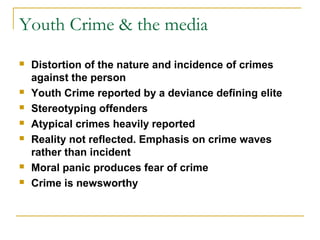
Youth Crime & the media
 Distortion of the nature and incidence of crimes
against the person
 Youth Crime reported by a deviance defining elite
 Stereotyping offenders
 Atypical crimes heavily reported
 Reality not reflected. Emphasis on crime waves
rather than incident
 Moral panic produces fear of crime
 Crime is newsworthy
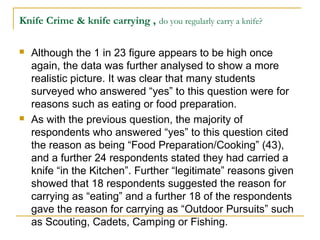
Knife Crime & knife carrying , do you regularly carry a knife?
 Although the 1 in 23 figure appears to be high once
again, the data was further analysed to show a more
realistic picture. It was clear that many students
surveyed who answered “yes” to this question were for
reasons such as eating or food preparation.
 As with the previous question, the majority of
respondents who answered “yes” to this question cited
the reason as being “Food Preparation/Cooking” (43),
and a further 24 respondents stated they had carried a
knife “in the Kitchen”. Further “legitimate” reasons given
showed that 18 respondents suggested the reason for
carrying as “eating” and a further 18 of the respondents
gave the reason for carrying as “Outdoor Pursuits” such
as Scouting, Cadets, Camping or Fishing.
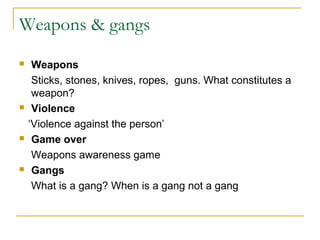
Weapons & gangs
 Weapons
Sticks, stones, knives, ropes, guns. What constitutes a
weapon?
 Violence
‘Violence against the person’
 Game over
Weapons awareness game
 Gangs
What is a gang? When is a gang not a gang
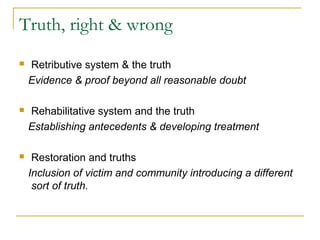
Truth, right & wrong
 Retributive system & the truth
Evidence & proof beyond all reasonable doubt
 Rehabilitative system and the truth
Establishing antecedents & developing treatment
 Restoration and truths
Inclusion of victim and community introducing a different
sort of truth.
Dealing with offending
 Retributive systems seek public accountability
with a focus on punishment as a method
demonstrating societal disapproval and of
deterring the offender
 Welfare systems emphasis on antecedents
concentrate on education, rehabilitation &
treatment of the offender
 Restorative systems, re-integrative shaming,
focus on re-empowering the person harmed &
enabling the harm causer to accept personal
responsibility
 John Clark 2010
Cycles of abuse, how is work with
adolescent sex offenders undertaken?
 Sex education
 Challenge denial
 Abuse of trust and power
 Joint work & relapse prevention
 Victims or perpetrators?
Summary
 Most young people offend at some point in their lives
 Only a relatively small proportion of offending is of a
serious sexual or violent nature
 The ability to be violent is a survival mechanism
 Most of us are socialised out of violence
 Many ordinary items can be used as weapons
 Weapons are generally carried for self defence but are
turned on the person carrying them
 Most offending by youth is grown out of but a small
number of adolescents offend sexually & this can be
grown into
Violent & sexually offending young people
 Violent & sexual offending covers a wide
range of behaviours and of seriousness
 The least serious can manifest ‘normal’
boundary challenging as part of emerging
adolescence
 The most serious will require assessment &
intervention
 Does the intervention need to be mandated
by a criminal court order?
 Consider how other European country’s
manage? John Clark 2011
Violent & sexually offending young people
 Evaluation forms
 Thank you for your participation
 Finish

Session 10. final course summary[ 2016

  • 1.
  • 2.
    Violent & sexuallyoffending young people  Essay process. 1. Initial marking 2. Moderated 3. Exam Board – June 4. July - pick up scripts from LLC
  • 3.
    What do wemean by Youth Crime? Issues in respect of:  Age; gender; class etc  Age of criminal responsibility  Doli Incapax  Justice / Welfare pendulum  Key Moments  Romanticisation of crime  Demonisation & Moral Panics
  • 4.
    Social construction  Aperspective that begins with exploring assumptions associated with the labelling of things & emphasizes the importance of social expectations in the analysis of taken for granted & apparently natural social circumstances. (Clarke & Cochrane 1998)
  • 5.
    How prevalent iscrime?  Is crime limited to a minority ‘hard core’ of the population?  Is crime an activity engaged in by the majority of the population?  How can we ‘know’ the extent of crime in a population
  • 6.
    The Youth JusticeSystem 10-18  Pre-court diversions Community or restorative resolution, Reprimands, Final Warnings  Court stage (pre-conviction) Remand & bail with or without conditions, remand in custody, plea stage, conviction, acquittal, reports  Court ordered interventions Common law bindover, Fines & discharges, Referral Orders, Reparation Orders, Youth Rehabilitation Orders, Custody
  • 7.
    The murder ofJamie Bulger  This event created a new anxiety about the state of youth & offending in the UK  Led to the Misspent Youth report (1996) and the Crime and Disorder Act 1998  Raised debates about:  What should be done with violent young offenders  The age of criminal responsibility  Was trying two 10 year olds in an adult court appropriate – what are the alternatives  Contrast with Norway
  • 8.
    Youth Crime &the media  Distortion of the nature and incidence of crimes against the person  Youth Crime reported by a deviance defining elite  Stereotyping offenders  Atypical crimes heavily reported  Reality not reflected. Emphasis on crime waves rather than incident  Moral panic produces fear of crime  Crime is newsworthy
  • 9.
    Knife Crime &knife carrying , do you regularly carry a knife?  Although the 1 in 23 figure appears to be high once again, the data was further analysed to show a more realistic picture. It was clear that many students surveyed who answered “yes” to this question were for reasons such as eating or food preparation.  As with the previous question, the majority of respondents who answered “yes” to this question cited the reason as being “Food Preparation/Cooking” (43), and a further 24 respondents stated they had carried a knife “in the Kitchen”. Further “legitimate” reasons given showed that 18 respondents suggested the reason for carrying as “eating” and a further 18 of the respondents gave the reason for carrying as “Outdoor Pursuits” such as Scouting, Cadets, Camping or Fishing.
  • 10.
    Weapons & gangs Weapons Sticks, stones, knives, ropes, guns. What constitutes a weapon?  Violence ‘Violence against the person’  Game over Weapons awareness game  Gangs What is a gang? When is a gang not a gang
  • 11.
    Truth, right &wrong  Retributive system & the truth Evidence & proof beyond all reasonable doubt  Rehabilitative system and the truth Establishing antecedents & developing treatment  Restoration and truths Inclusion of victim and community introducing a different sort of truth.
  • 12.
    Dealing with offending Retributive systems seek public accountability with a focus on punishment as a method demonstrating societal disapproval and of deterring the offender  Welfare systems emphasis on antecedents concentrate on education, rehabilitation & treatment of the offender  Restorative systems, re-integrative shaming, focus on re-empowering the person harmed & enabling the harm causer to accept personal responsibility  John Clark 2010
  • 13.
    Cycles of abuse,how is work with adolescent sex offenders undertaken?  Sex education  Challenge denial  Abuse of trust and power  Joint work & relapse prevention  Victims or perpetrators?
  • 14.
    Summary  Most youngpeople offend at some point in their lives  Only a relatively small proportion of offending is of a serious sexual or violent nature  The ability to be violent is a survival mechanism  Most of us are socialised out of violence  Many ordinary items can be used as weapons  Weapons are generally carried for self defence but are turned on the person carrying them  Most offending by youth is grown out of but a small number of adolescents offend sexually & this can be grown into
  • 15.
    Violent & sexuallyoffending young people  Violent & sexual offending covers a wide range of behaviours and of seriousness  The least serious can manifest ‘normal’ boundary challenging as part of emerging adolescence  The most serious will require assessment & intervention  Does the intervention need to be mandated by a criminal court order?  Consider how other European country’s manage? John Clark 2011
  • 16.
    Violent & sexuallyoffending young people  Evaluation forms  Thank you for your participation  Finish