
1
Violently & sexually offending
young people
Session 1. An Introduction to
Youth Crime and Youth Justice
22 slides
John Clark
2
Course handbook - Read it!
 Timetable & dates
 Assignment timetable
 Hand in date
 Guidance, referencing etc
3
Contacting John
John is a part-time tutor & only on
campus at times of teaching.
Use this e-mail address:
 John.clark@leeds.gov.uk
4
Did you ever …
 Steal from a shop?
 Get involved in a fight?
 Buy alcohol underage?
 Tell your parents you would be staying in one place … and then stay
somewhere else?
 Hit someone?
 Use a telephone without permission?
 Use a television without a licence?
 Drive faster than the speed limit?
 Start a fire
 Damage someone else’s property?
 Catch a train or bus without paying?
 Hang around in a group on the streets?
 Get drunk and rowdy in public?
 Try to get money back on something having used it?
55
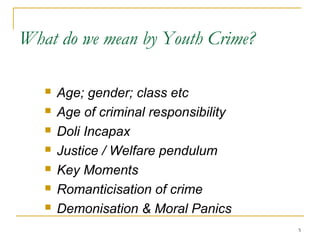
What do we mean by Youth Crime?
 Age; gender; class etc
 Age of criminal responsibility
 Doli Incapax
 Justice / Welfare pendulum
 Key Moments
 Romanticisation of crime
 Demonisation & Moral Panics
6
15Iceland
14Hungary
12Greece
14Germany
13France
15Finland
15Denmark
14Cyprus
14Bulgaria
18Belgium
14Austria
16Andorra
10
England, Wales,
N. Ireland
12Turkey
8 (12)Scotland
7Switzerland
15Sweden
16Spain
16Portugal
16Poland
15Norway
12Netherlands
18Luxembourg
14Italy
12Ireland
Civil regulation, rights & responsibilities
Age 5 Drink alcohol in private
Age 8 Be held responsible for a crime in Scotland
Age 10 Be held responsible for a crime in England, Wales & N.I.
Taken into protective custody of intensive fostering
Be sent to a secure unit for grave/serious crimes
Age 12 Be held in a Secure Training Centre or Own a pet
Age 13 Have a part time job (with conditions)
Age 15 Be sent to a YOI
Age 16 Pay taxes / Consent to sexual intercourse
Engage in a homosexual relationship / Leave home/Marry
Leave school / Get full time job / Join army / Buy a lottery ticket
Buy aerosol paint
Age 17 Drive a car / Pilot a plane / Emigrate
Age 18 Vote / Serve on a jury / Buy alcohol / Buy tobacco / Buy a knife
Marry without consent / Be tried in a magistrates court
Get a tattoo / Place a Bet /Buy fireworks / Be entitled to the lower rate of the
national minimum wage /Buy an airgun or replica
Age 21 Adopt a child / become an MP
Age 22 Entitled to adult rate of national minimum wage
From John Muncie, Youth & Crime 2009
7
88
Age; gender; class etc
 Age of criminal responsibility is 10 & can
be tried in an adult Court
 Become an adult in the eyes of the court
at 18 (or 17 for bail & remand purposes)
 More boys than girls … why??
 Need to consider social class in terms of
crime
99
Age of criminal responsibility
 In England and Wales the ACR is 10
 One of the lowest in Europe
 Strong negative public reaction to
suggestions of increasing age
1010
Doli Incapax
 The assumption that a child below the age
of 14 could not form the “mens rea”
(criminal intent) to commit a crime
 The burden was on the prosecution to
prove intent
 Presumption was reversed in the Crime
and Disorder Act 1998
Youth Justice System 10-18 Years
Youth Justice System (10 – 18 ) Flowchart (summary
Please note that offences of assault against or between children must be
disclosed on a CRB/DBS application, always have to be declared subsequently and
& can result in being unable to embark on courses or take up work with children or
other vulnerable groups
Incident/ Offence if fully admitted (& not so serious as to warrant prosecution)
can result in:
A Community (restorative) resolution which can be administered pre or post arrest at Police
discretion.
A further offence of sufficient seriousness to warrant formal processing can result in a:
CAUTION administered by Police & recorded.
Any further offence or 1st
offence if serious (if fully admitted & not so serious etc) will result in:
CONDITIONAL CAUTION (Police decision, recorded & citable in Court on future occasions +
referral to YOS for assessment & action)

Further offending will result in:
PROSECUTION IN COURT (This will lead to one of the following court orders or interventions)
Referral Order (between 3 and 12 months for first offence in Court if admitted & not serious enough
to merit Custody, can be extended but not repeated unless exceptional circumstances)
Reparation Order (max 24hrs within 3 months)
Fines, Discharges, Compensation Order & Deferred Sentence for less serious offences
12
 Subsequent offending is likely to result in a Youth Rehabilitation Order (no
minimum period and up to 36 months. Can be used more than once and based on
seriousness of offence & risk)
 And which could contain:
 Reparation, attendance centre, supervision, unpaid work (for 16 & 17 only),
mentoring, education, family intervention.
 Other control elements could include:
 Prohibited activity, curfew, exclusion, drug testing/treatment, residence and
electronic monitoring, Intensive fostering & intensive supervision &
surveillance.
 Serious & repeat offending can result in custody
 Detention & Training Order (Custody for up to two years for 12-17 yr olds)
 Intermediate and extended public protection
 Section 90/91 ( Crown Court custody & only for the most serious offences)
 Civil Anti-social behaviour measures include Acceptable Behaviour Contracts,
Individual Support Orders & Anti-Social Behaviour Orders. Breach of ASBOs can
result in Custody
John Clark RJ/YOS 2013
  13
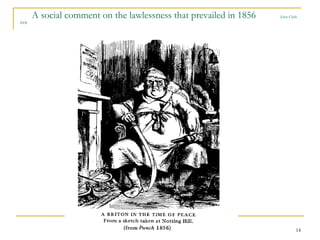
A social comment on the lawlessness that prevailed in 1856 John Clark
2008
14
1515
The Welfare / Justice Pendulum
Restoration
Justice Welfare
1616
Justice model
 You make a choice to offend
 Antecedents are irrelevant
 A retributive system, “do the crime … do 
the time” “just desserts”
 Punishment needs to act as a deterrent to 
others
1717
Welfare & rehabilitation model
 Antecedents are all important
 Crime is a symptom of an illness – in 
either an individual or society as a whole 
 Criminal behaviour needs to be 
understood and treated
1818
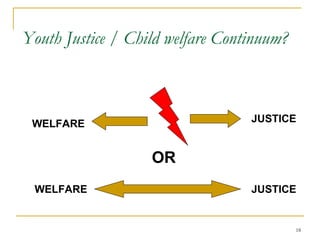
Youth Justice / Child welfare Continuum?
WELFARE JUSTICE
WELFARE JUSTICE
OR
19
Restorative model
 Views an ‘offence’ as an incident, a violation
of social bonds
 Is inclusive
 Seeks to repair harm & restore balance
2020
Key Moments
 1993 – Murder of James Bulger in
Liverpool
 1996 – Misspent Youth report
 1997 – New Labour elected
 1998 – Crime and Disorder Act
 The “growth” in antisocial behaviour
 The increased politicisation of Youth
Crime
2121
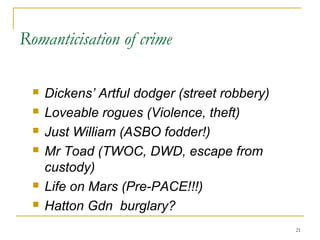
Romanticisation of crime
 Dickens’ Artful dodger (street robbery)
 Loveable rogues (Violence, theft)
 Just William (ASBO fodder!)
 Mr Toad (TWOC, DWD, escape from
custody)
 Life on Mars (Pre-PACE!!!)
 Hatton Gdn burglary?
2222
Demonisation and Moral Panics
 Youth culture – “normal” behaviour?
 Historical issue – ‘twas ever thus?
 Demonisation of Young People
 Children learn from adults?
 Moral Panics
 Adults vs. Children
 Provision for Young People

Session 1 lllc 2222 2016

  • 1.
    1 Violently & sexuallyoffending young people Session 1. An Introduction to Youth Crime and Youth Justice 22 slides John Clark
  • 2.
    2 Course handbook -Read it!  Timetable & dates  Assignment timetable  Hand in date  Guidance, referencing etc
  • 3.
    3 Contacting John John isa part-time tutor & only on campus at times of teaching. Use this e-mail address:  John.clark@leeds.gov.uk
  • 4.
    4 Did you ever…  Steal from a shop?  Get involved in a fight?  Buy alcohol underage?  Tell your parents you would be staying in one place … and then stay somewhere else?  Hit someone?  Use a telephone without permission?  Use a television without a licence?  Drive faster than the speed limit?  Start a fire  Damage someone else’s property?  Catch a train or bus without paying?  Hang around in a group on the streets?  Get drunk and rowdy in public?  Try to get money back on something having used it?
  • 5.
    55 What do wemean by Youth Crime?  Age; gender; class etc  Age of criminal responsibility  Doli Incapax  Justice / Welfare pendulum  Key Moments  Romanticisation of crime  Demonisation & Moral Panics
  • 6.
    6 15Iceland 14Hungary 12Greece 14Germany 13France 15Finland 15Denmark 14Cyprus 14Bulgaria 18Belgium 14Austria 16Andorra 10 England, Wales, N. Ireland 12Turkey 8(12)Scotland 7Switzerland 15Sweden 16Spain 16Portugal 16Poland 15Norway 12Netherlands 18Luxembourg 14Italy 12Ireland
  • 7.
    Civil regulation, rights& responsibilities Age 5 Drink alcohol in private Age 8 Be held responsible for a crime in Scotland Age 10 Be held responsible for a crime in England, Wales & N.I. Taken into protective custody of intensive fostering Be sent to a secure unit for grave/serious crimes Age 12 Be held in a Secure Training Centre or Own a pet Age 13 Have a part time job (with conditions) Age 15 Be sent to a YOI Age 16 Pay taxes / Consent to sexual intercourse Engage in a homosexual relationship / Leave home/Marry Leave school / Get full time job / Join army / Buy a lottery ticket Buy aerosol paint Age 17 Drive a car / Pilot a plane / Emigrate Age 18 Vote / Serve on a jury / Buy alcohol / Buy tobacco / Buy a knife Marry without consent / Be tried in a magistrates court Get a tattoo / Place a Bet /Buy fireworks / Be entitled to the lower rate of the national minimum wage /Buy an airgun or replica Age 21 Adopt a child / become an MP Age 22 Entitled to adult rate of national minimum wage From John Muncie, Youth & Crime 2009 7
  • 8.
    88 Age; gender; classetc  Age of criminal responsibility is 10 & can be tried in an adult Court  Become an adult in the eyes of the court at 18 (or 17 for bail & remand purposes)  More boys than girls … why??  Need to consider social class in terms of crime
  • 9.
    99 Age of criminalresponsibility  In England and Wales the ACR is 10  One of the lowest in Europe  Strong negative public reaction to suggestions of increasing age
  • 10.
    1010 Doli Incapax  Theassumption that a child below the age of 14 could not form the “mens rea” (criminal intent) to commit a crime  The burden was on the prosecution to prove intent  Presumption was reversed in the Crime and Disorder Act 1998
  • 11.
  • 12.
    Youth Justice System(10 – 18 ) Flowchart (summary Please note that offences of assault against or between children must be disclosed on a CRB/DBS application, always have to be declared subsequently and & can result in being unable to embark on courses or take up work with children or other vulnerable groups Incident/ Offence if fully admitted (& not so serious as to warrant prosecution) can result in: A Community (restorative) resolution which can be administered pre or post arrest at Police discretion. A further offence of sufficient seriousness to warrant formal processing can result in a: CAUTION administered by Police & recorded. Any further offence or 1st offence if serious (if fully admitted & not so serious etc) will result in: CONDITIONAL CAUTION (Police decision, recorded & citable in Court on future occasions + referral to YOS for assessment & action)  Further offending will result in: PROSECUTION IN COURT (This will lead to one of the following court orders or interventions) Referral Order (between 3 and 12 months for first offence in Court if admitted & not serious enough to merit Custody, can be extended but not repeated unless exceptional circumstances) Reparation Order (max 24hrs within 3 months) Fines, Discharges, Compensation Order & Deferred Sentence for less serious offences 12
  • 13.
     Subsequent offendingis likely to result in a Youth Rehabilitation Order (no minimum period and up to 36 months. Can be used more than once and based on seriousness of offence & risk)  And which could contain:  Reparation, attendance centre, supervision, unpaid work (for 16 & 17 only), mentoring, education, family intervention.  Other control elements could include:  Prohibited activity, curfew, exclusion, drug testing/treatment, residence and electronic monitoring, Intensive fostering & intensive supervision & surveillance.  Serious & repeat offending can result in custody  Detention & Training Order (Custody for up to two years for 12-17 yr olds)  Intermediate and extended public protection  Section 90/91 ( Crown Court custody & only for the most serious offences)  Civil Anti-social behaviour measures include Acceptable Behaviour Contracts, Individual Support Orders & Anti-Social Behaviour Orders. Breach of ASBOs can result in Custody John Clark RJ/YOS 2013   13
  • 14.
    A social commenton the lawlessness that prevailed in 1856 John Clark 2008 14
  • 15.
    1515 The Welfare /Justice Pendulum Restoration Justice Welfare
  • 16.
    1616 Justice model  You make a choice to offend Antecedents are irrelevant  A retributive system, “do the crime … do  the time” “just desserts”  Punishment needs to act as a deterrent to  others
  • 17.
    1717 Welfare & rehabilitationmodel  Antecedents are all important  Crime is a symptom of an illness – in  either an individual or society as a whole   Criminal behaviour needs to be  understood and treated
  • 18.
    1818 Youth Justice /Child welfare Continuum? WELFARE JUSTICE WELFARE JUSTICE OR
  • 19.
    19 Restorative model  Viewsan ‘offence’ as an incident, a violation of social bonds  Is inclusive  Seeks to repair harm & restore balance
  • 20.
    2020 Key Moments  1993– Murder of James Bulger in Liverpool  1996 – Misspent Youth report  1997 – New Labour elected  1998 – Crime and Disorder Act  The “growth” in antisocial behaviour  The increased politicisation of Youth Crime
  • 21.
    2121 Romanticisation of crime Dickens’ Artful dodger (street robbery)  Loveable rogues (Violence, theft)  Just William (ASBO fodder!)  Mr Toad (TWOC, DWD, escape from custody)  Life on Mars (Pre-PACE!!!)  Hatton Gdn burglary?
  • 22.
    2222 Demonisation and MoralPanics  Youth culture – “normal” behaviour?  Historical issue – ‘twas ever thus?  Demonisation of Young People  Children learn from adults?  Moral Panics  Adults vs. Children  Provision for Young People

Editor's Notes

  • #8 SLIDE 7 10 minutes Explore civil rights etc Discuss maturity & contrast between civil & criminal ages. Refer to Doli-incapax
  • #15 SLIDE 8 1. Reference public perceptions of youth & crime by drawing attention to myths