1
7. Restoration (Restorative Justice)(
28 slides)
John Clark
2
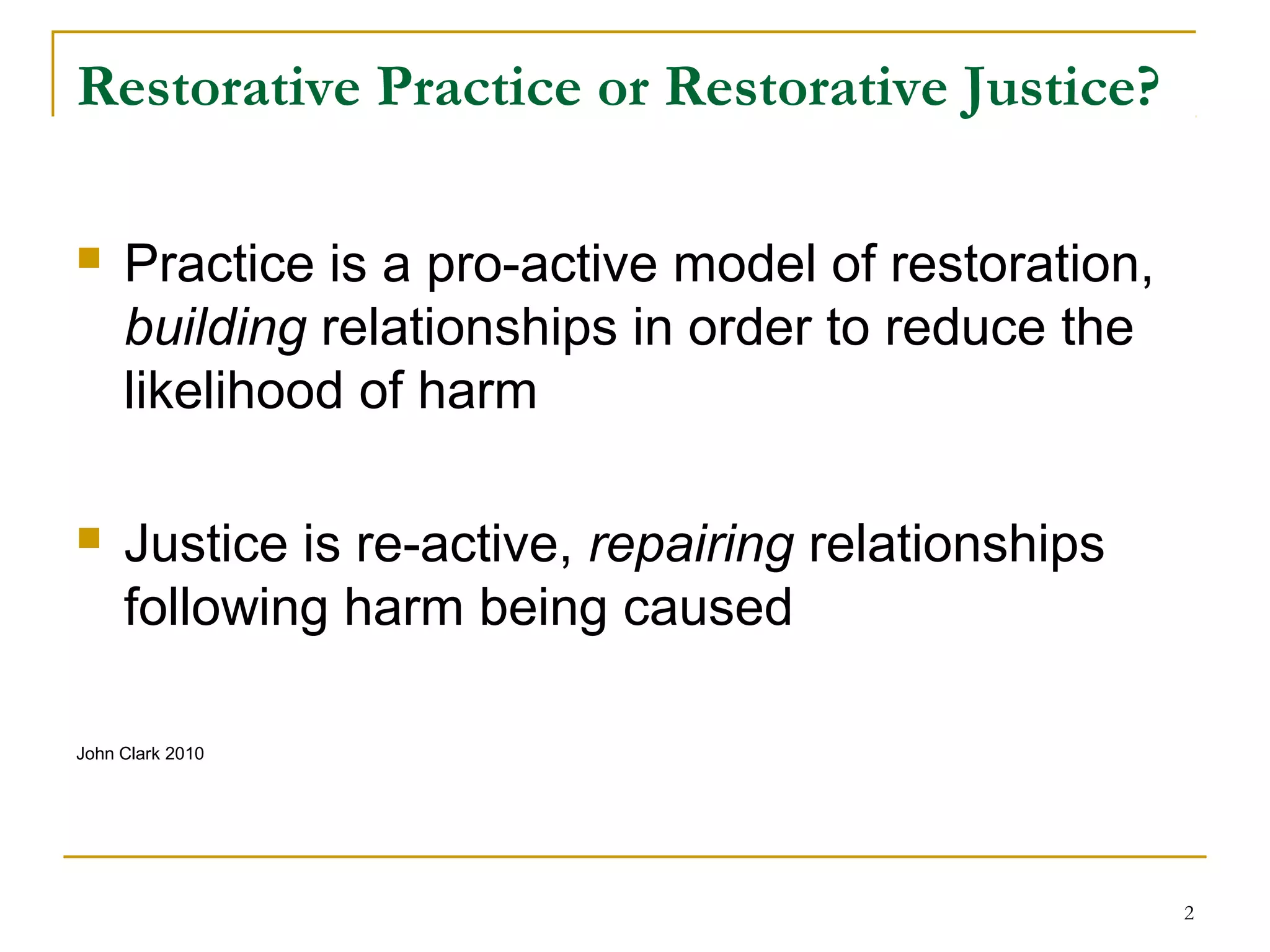
Restorative Practice or Restorative Justice?
 Practice is a pro-active model of restoration,
building relationships in order to reduce the
likelihood of harm
 Justice is re-active, repairing relationships
following harm being caused
John Clark 2010
A range of restorative practices
 Proactive and Reactive Circles
 Restorative language
 Restorative questions & conversations
 Restorative Conferences including mediation
& FGC’s
3
4
Truth, right & wrong
 Retributive system & the truth
Evidence & proof beyond all reasonable doubt
 Rehabilitative system and the truth
Establishing antecedents & developing treatment
 Restoration and truths
The Six Blind Men & the Elephant.
John Godfrey Saxe (1816-1887)
5
A BRIEF SUMMARY & BACKGROUND TO
RESTORATIVE JUSTICE
 A brief summary & background to Restorative Justice
 Western legal tradition since the 11th century has increasingly viewed crime as an offence
against the public at large and against society rather than against the individual victim.
 The obvious response resulting from this is state prosecution, punishment and the
development of a system of justice, which is both retributive and adversarial. One of the
results being that the individual victim is marginalised in the process.
 A number of western cultures prior to the eleventh century and many non-western cultures
today view an offence as a violation of social bonds and respond to it through a process
of negotiation, restitution and reconciliation.
 In the UK recently rediscovered restorative practices among Quaker and Mennonite
communities and indigenous communities in North America / Canada, New Zealand,
Australia and South Africa have been incorporated into the Youth Justice System
 The law becomes a mediating process designed to reconcile not a process to allocate
blame and punishment.
 Developing practices include Victim Offender Mediation, Restorative Conferences, Family
Group Conferences, Scottish Hearing Panels and Referral Order Panels. These and other
interventions have come to be known as Restorative Justice and or Restorative
Approaches.
 Restorative approaches are also used outside the justice systems to resolve conflicts in
schools, in the community, neighbour conflicts, in the workplace and also in family
disputes.
John Clark 2010
Theory
 While there is a body of theory which describes restorative
behaviours, there is not a single Restorative Practice
“theory”.
 Instead it is a WAY OF BEING … it describes ways of
communicating, developing relationships and resolving
difficulties.
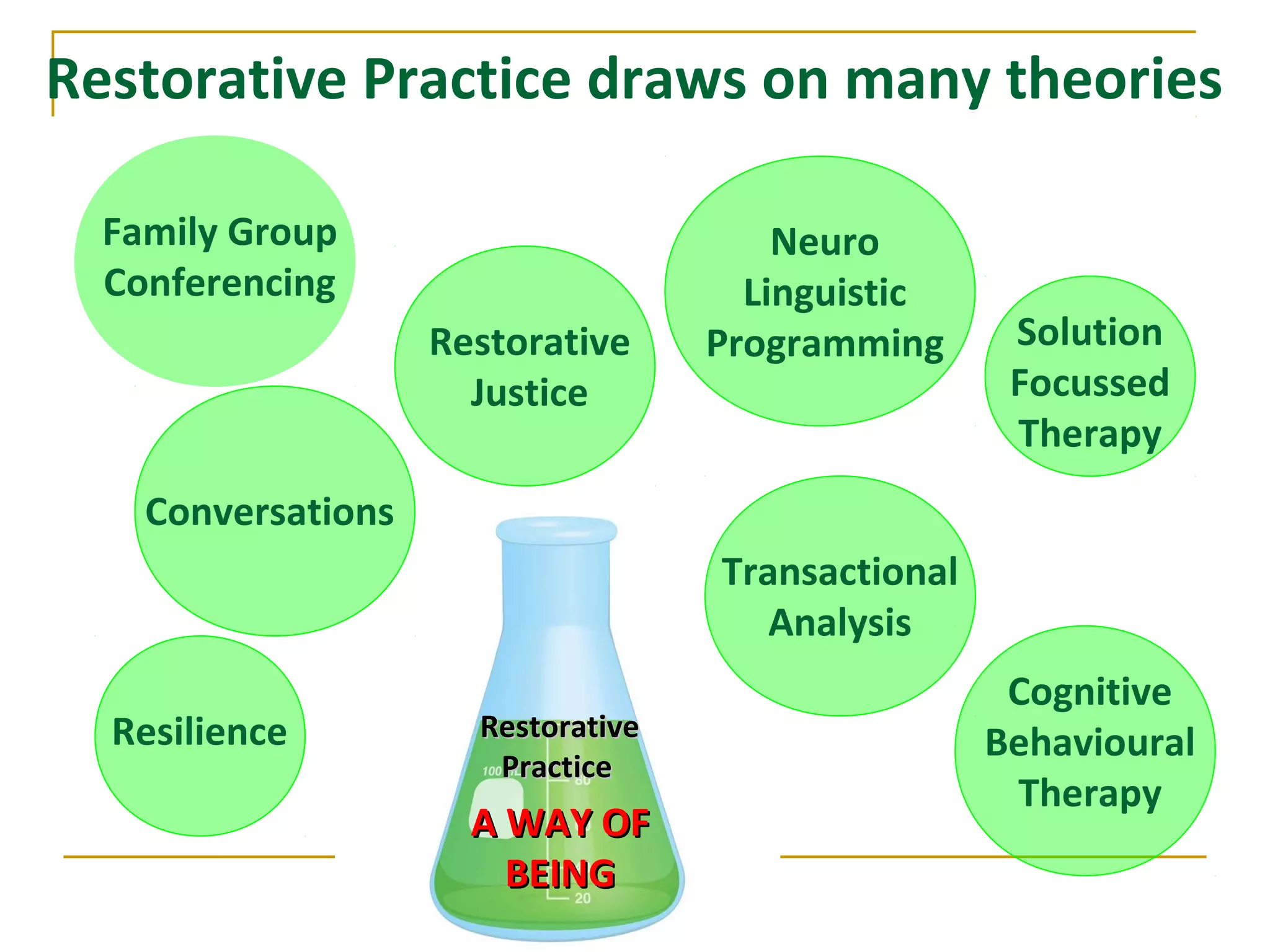
Restorative Practice draws on many theories
RestorativeRestorative
PracticePractice
A WAY OFA WAY OF
BEINGBEING
Resilience
Conversations
Family Group
Conferencing
Solution
Focussed
Therapy
Restorative
Justice
Cognitive
Behavioural
Therapy
Transactional
Analysis
Neuro
Linguistic
Programming
Some characteristics of Restorative Practice
 Being explicit in your practice
 Working with people
 Ensuring the process is fair
 Applying the above to your language &
behaviours
John Clark 2013
8
9
Restorative system
 In Restorative Justice the process through which
decisions are made and the future planned is
essential.
 A restorative processA restorative process seeks to include all the
people effected by an incident
 It encourages and facilitates opportunities for
communication
 RJ Seeks to agree mutually acceptable
outcomes
 It is respectful and attempts to strengthen all
participants
 John Clark 2010
10
Restorative Justice is:
 An inclusive process for those who are victims and those
who have offended
 Provides an expanded role for victims to be able to
regain personal power, speak about feelings and to be
involved and make decisions about how their needs can
be met.
 The person who has offended is enabled to take
personal responsibility for their actions, actively work to
repair harm caused to victims, learn about personal
harm caused to victims and work to make amends to the
victim and to the community
11
RJ is inclusive and should always includes
those who have been harmed (victims)
 People who have been victims of crime or of
harmful behaviours can display a variety of
needs
 Providers of services or interventions need to be
aware of those needs in order to ensure
inclusion and avoid re-victimising
John Clark 2009
12
“Traditional”
“What happened?”,
“Who’s to blame?”
“What rule has been
broken”?
“What punishment is
appropriate to the rule
that has been broken?”
.
Restorative
“What happened?”,
“What harm has resulted?”
“Who has been affected”?
“What needs to happen next?”
What support do you need for this to
happen?
What will it look like when it improves?
13
14
Victims & loss, common reactions
4 Stage Model
1) Initial Reaction –
Shock / Denial
4) Adjustment
3) Reconstruction
Acceptance
2) Disorganisation
Depression
ESTEEM TIME
15
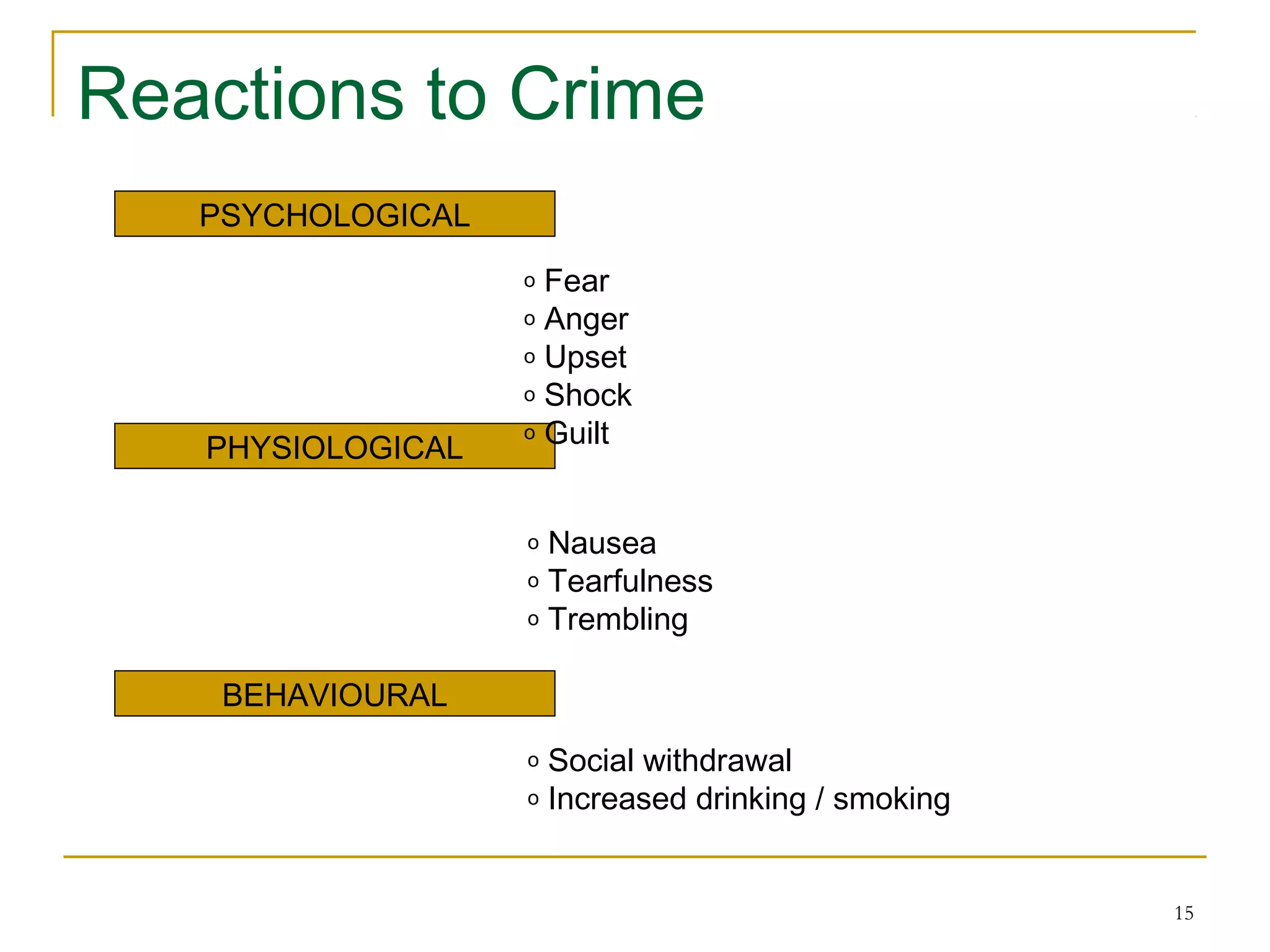
Reactions to Crime
PSYCHOLOGICAL
PHYSIOLOGICAL
BEHAVIOURAL
o Fear
o Anger
o Upset
o Shock
o Guilt
o Nausea
o Tearfulness
o Trembling
o Social withdrawal
o Increased drinking / smoking
16
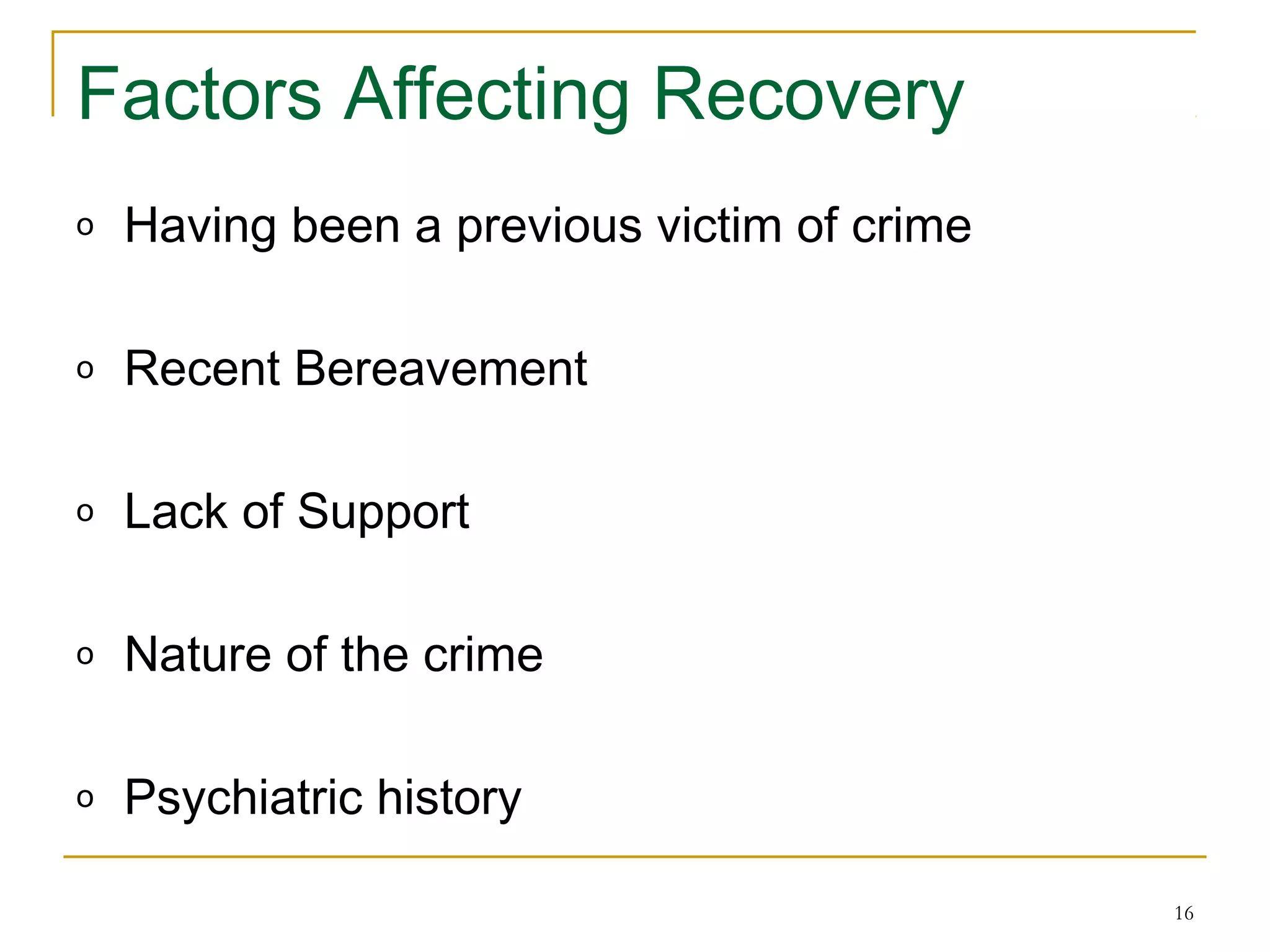
Factors Affecting Recovery
o Having been a previous victim of crime
o Recent Bereavement
o Lack of Support
o Nature of the crime
o Psychiatric history
17
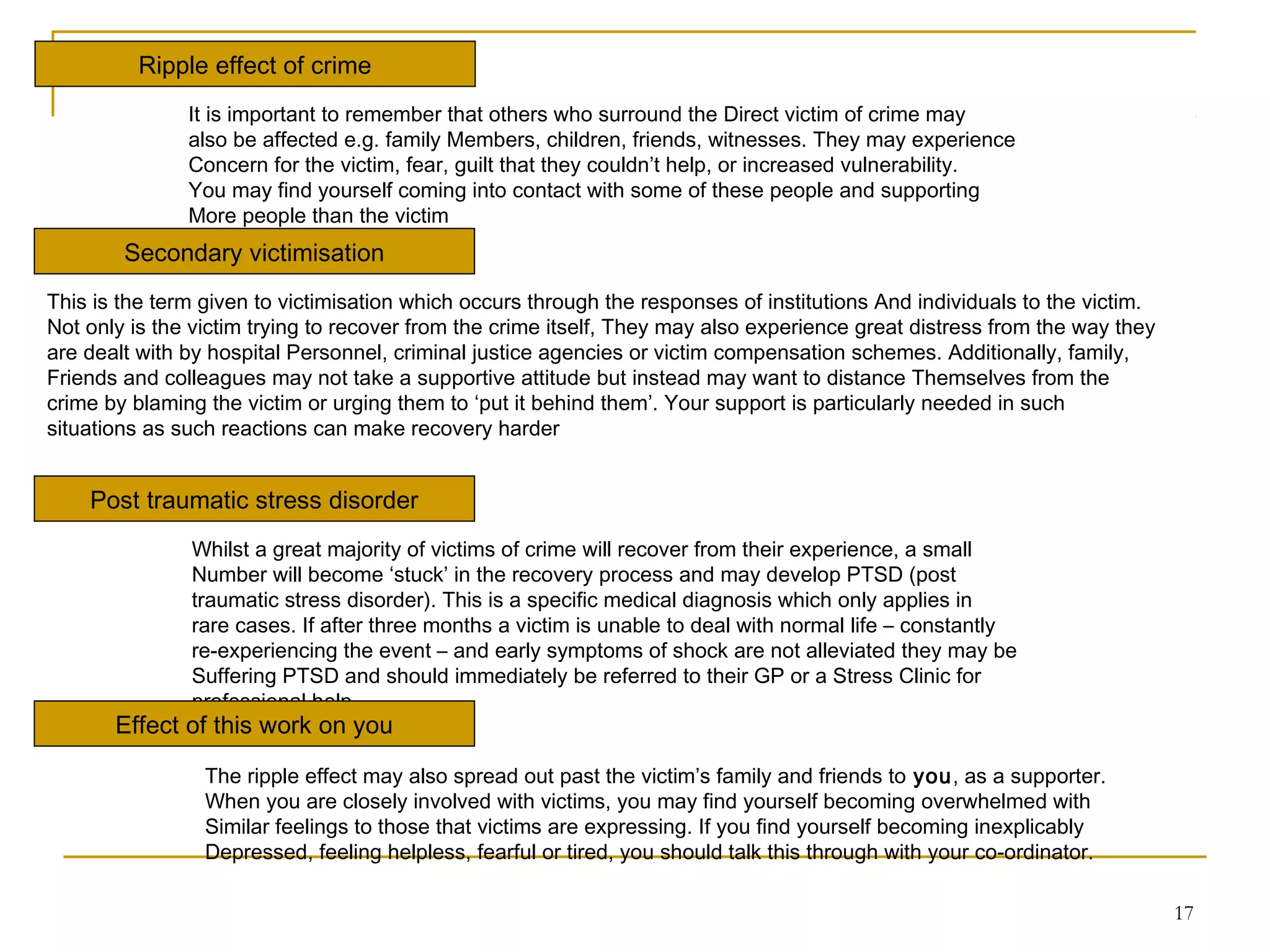
Ripple effect of crime
It is important to remember that others who surround the Direct victim of crime may
also be affected e.g. family Members, children, friends, witnesses. They may experience
Concern for the victim, fear, guilt that they couldn’t help, or increased vulnerability.
You may find yourself coming into contact with some of these people and supporting
More people than the victim
Secondary victimisation
This is the term given to victimisation which occurs through the responses of institutions And individuals to the victim.
Not only is the victim trying to recover from the crime itself, They may also experience great distress from the way they
are dealt with by hospital Personnel, criminal justice agencies or victim compensation schemes. Additionally, family,
Friends and colleagues may not take a supportive attitude but instead may want to distance Themselves from the
crime by blaming the victim or urging them to ‘put it behind them’. Your support is particularly needed in such
situations as such reactions can make recovery harder
Post traumatic stress disorder
Whilst a great majority of victims of crime will recover from their experience, a small
Number will become ‘stuck’ in the recovery process and may develop PTSD (post
traumatic stress disorder). This is a specific medical diagnosis which only applies in
rare cases. If after three months a victim is unable to deal with normal life – constantly
re-experiencing the event – and early symptoms of shock are not alleviated they may be
Suffering PTSD and should immediately be referred to their GP or a Stress Clinic for
professional help
Effect of this work on you
The ripple effect may also spread out past the victim’s family and friends to you, as a supporter.
When you are closely involved with victims, you may find yourself becoming overwhelmed with
Similar feelings to those that victims are expressing. If you find yourself becoming inexplicably
Depressed, feeling helpless, fearful or tired, you should talk this through with your co-ordinator.
ChallengeChallenge
ToTo WithWith
NotNot ForFor
Adapted from: Wachtel T & McCold P in Strang H & Braithwaite J (eds), (2001),
Restorative Justice and Civil Society, Cambridge University Press, Cambridge
SupportSupport
Four ways…
19
SOCIAL DISCIPLINE WINDOW
LOW HIGH
HIGH
Care / support (Encouragement, nurture)
Challenge/control(limitsetting,discipline)
TO
punitive
NOT
neglectful
WITH
restorative
FOR
permissive
Adapted from IIRP 2011
20
 Engaging participants in the process
 Explaining & building a shared understanding
 Building a clarity of expectation and vision for
change
20
Fairness of process
21
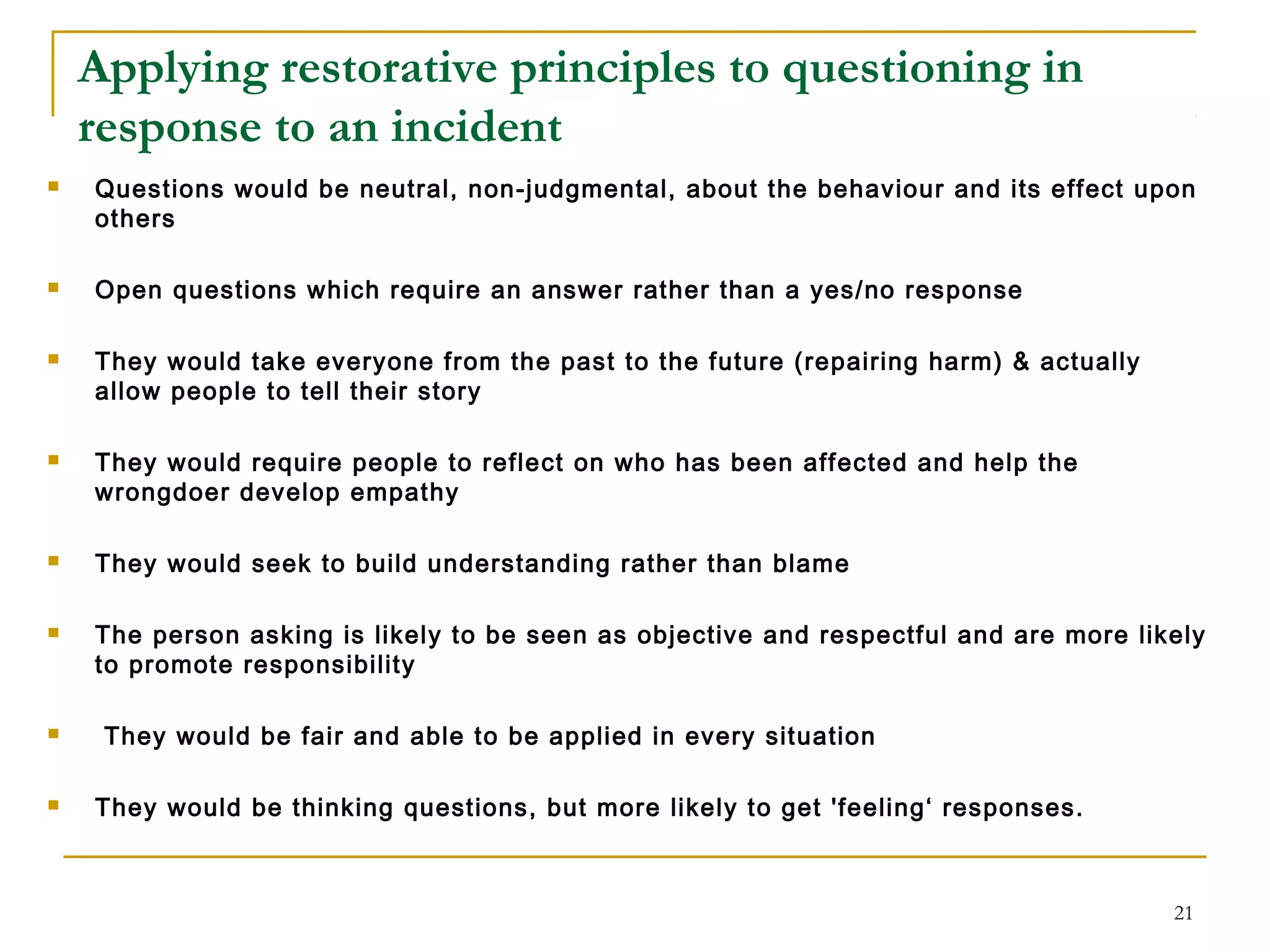
Applying restorative principles to questioning in
response to an incident
 Questions would be neutral, non-judgmental, about the behaviour and its effect upon
others
 Open questions which require an answer rather than a yes/no response
 They would take everyone from the past to the future (repairing harm) & actually
allow people to tell their story
 They would require people to reflect on who has been affected and help the
wrongdoer develop empathy
 They would seek to build understanding rather than blame
 The person asking is likely to be seen as objective and respectful and are more likely
to promote responsibility
 They would be fair and able to be applied in every situation
 They would be thinking questions, but more likely to get 'feeling‘ responses.
22
 What happened?
 What were you thinking about at the time?
 What have your thoughts been since?
 Who has been affected by what you did?
 In what way have they been affected?
 What do you think needs to happen next?
Thames Valley Police 2000
22
Restorative Questions
23
 What happened?
 What were your thoughts at the time?
 What have your thoughts been since?
 How has this affected you and others?
 What has been the hardest thing for you?
 What do you think needs to happen next?
Thames Valley Police 2000
23
Restorative Questions
24
SOME UNDERLYING PRINCIPLES FOR
RESTORATIVE INTERVENTIONS
 Restoration rather than retribution as a method of resolving conflict
 Voluntarism so that participation is not the result of duress
 Self-determination so that participants resolve their own conflict
 Openness regarding feelings and opinions
 Collaboration so that people work with rather than against each other
 Flexibility in seeking creative solutions
 Equality& inclusion in terms of access and power ensuring that the
particular needs of different interests are properly addressed to avoid
oppressive practices
John Clark 2008
25
SCALE OF INTERVENTION
 LEAST INTERVENTIONIST
 Avoidance
 Negotiation
 Mediation
 Arbitration
 Litigation
 Aggression
 MOST INTERVENTIONIST
John clark 2008
26
DEFINITIONS
 NEGOTIATION is a general term for the process of disputants working
out an agreement between themselves.
 MEDIATION is a process by which an impartial third party helps two or
more disputants work out how to resolve a conflict. The disputants, not
the mediators, decide the terms of any agreement reached.Mediation
usually focuses on future rather than past behaviour.
 ARBITRATION is a process in which an impartial third party (after
hearing from both sides) makes a final, usually binding decision.The
discussion and decision, while structured, may not be as regulated as
formal procedures and rules of evidence as is courtroom procedure.
 LITIGATION is the process of settling a dispute in court according to
legal statutes, with advocates presenting evidence on behalf of the
parties. Litigation is an adversarial process, in which a judge (or jury)
adjudicates in favour of one party after hearing both sides
John Clark 2008
27
Skills
 Being able to allow uninterrupted time
 To be encouraging & prompting without
dominating the process
 Listening skills, hearing as well as listening
 Making use of silence
 Being able to sum up
 Knowing when to take time out
 Taking cognisance of safety of participants
 Ensuring that (in a Conference) the script follows
the process rather than the process following the
script
John Clark 2010
28
Restorative Justice interventions
 Mediation
A process in which an impartial third party helps two (or more)
disputants to reach an agreement. The disputants, not the mediator,
work out the terms of the agreement.
 Victim-offender mediation
In which an impartial third party helps the victim(s) and offender(s) to
communicate either directly or indirectly. The process can lead to a
greater understanding for both parties and sometimes to reparation
 Reparation
Action taken by the offender (or person causing harm) to put right the
harm caused (in response to victim’s wishes.
 JC/08
29
RJ interventions 2
 Restorative Conferencing
Similar in principle to V/O mediation but follows a script and can include
family members. Focus on outcome
 Family Group Conference
Similar to above but includes private time for the ‘offenders’ family to
come up with a viable plan for repairing harm & for the future. Also used
in welfare/child protection
 Referral Order Panel
Youth Court Order which mandates a panel including victim, offender,
volunteers and staff to agree a contract of work to repair harm
JC.08
30
The Woolf Within
Circles
 Circles can build equality, trust
& responsibility
31
32
Navajo restorative justice: the law of
equality & justice - peacemaking
 Navajo justice has a healing component
 State justice appoints judges on the basis of education to
hear facts, apply the law and make decisions
 The above is alien to Navajo concepts of freedom &
individuality, where one person cannot impose a
decision on another
 Navajos are their own judges in an egalitarian process
 A wronged person demands that of the perpetrator that
things be put right, a demand to readjust the relationship
that the proper thing be done
 Relatives can act on the wronged persons behalf
33
Cree justice as healing
 “………………in the non-Indian community, a
crime seems to mean that the individual is a
bad person and therefore must be
punished……………..”
 “The Indian communities view a wrongdoing
as a misbehaviour which requires teaching or
an illness which requires healing”
34
Maori restorative tradition
 Lost or parallel system
 Maori justice – healing for all
 Set up to meet the victims needs, not about
humiliating the offender
 Recognition that it is an individual who is hurt
not society
 Hearing and helping the victim, helping &
healing the perpetrator, healing the
families/community and restoring balance
Types of circle
 Sequential
Specific question
Done in order
Participation expected
 Non Sequential, can be:
Structured
Loosely Structured
No order
Participation voluntary
 Fishbowl
Sequential or non-sequential
Empty chair
Feedback 35
Uses for circles
 Go around
 Check in /check outs
 Problem solving
 Dealing with conflict
 Teaching and learning
 Staff meetings
 Decision making
 Staff handovers
 Just about anything!
36
37
Canadian & European RJ
 VORP.
Victim offender reconciliation programme in Kitchener,
Ontario (1974)
 Spread to other parts of Canada & North America
 England in1985 Home office projects set up in Cumbria,
West Midlands (2), West Yorkshire
 Austria 1989 Juvenile Justice legislation provides for
referral to mediation
 Mediation used in Balkan wars and incorporated as
domestic practice in Croatia
 European Union encourages RJ as a recommended
form of Justice
38
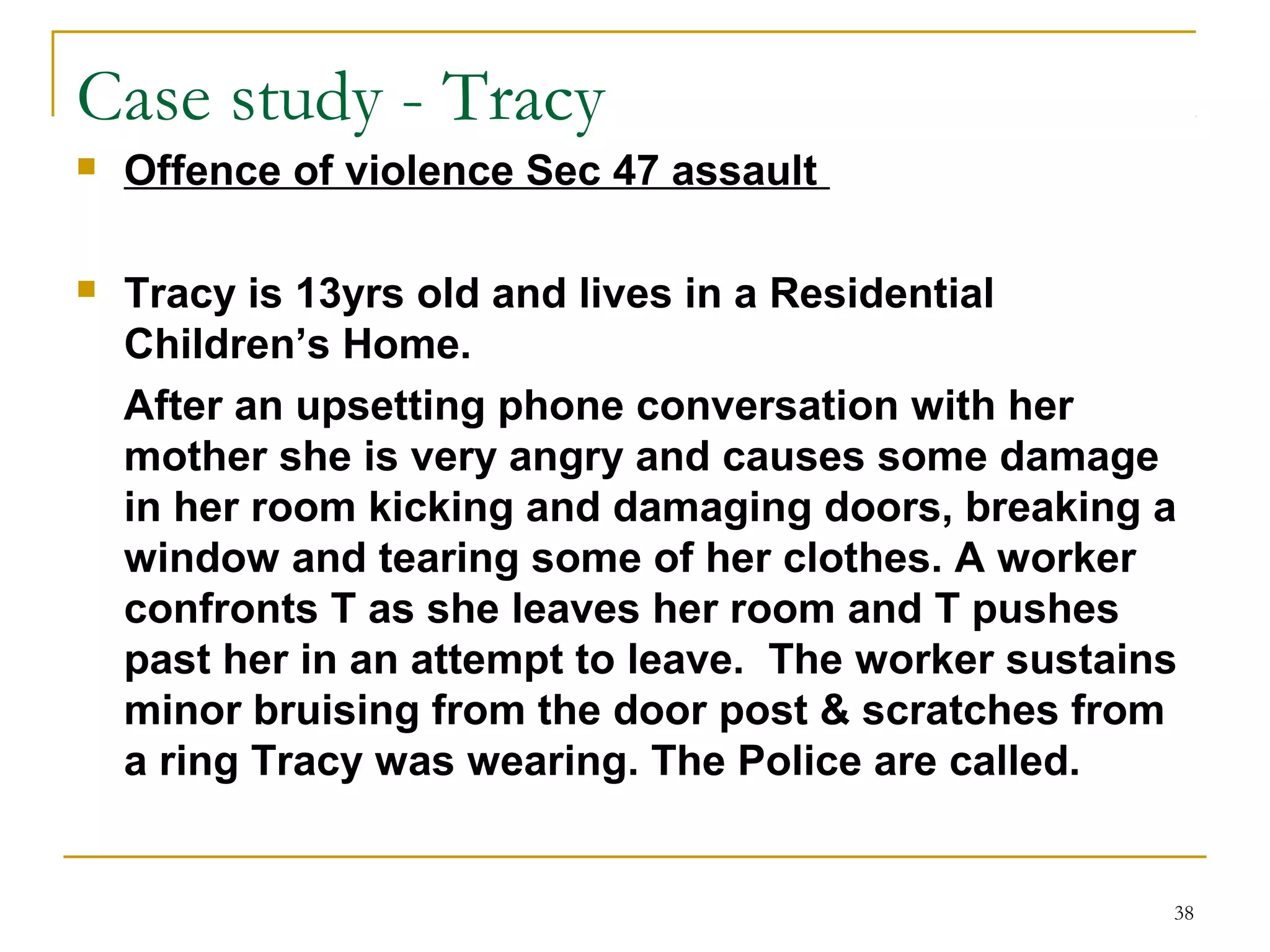
Case study - Tracy
 Offence of violence Sec 47 assault
 Tracy is 13yrs old and lives in a Residential
Children’s Home.
After an upsetting phone conversation with her
mother she is very angry and causes some damage
in her room kicking and damaging doors, breaking a
window and tearing some of her clothes. A worker
confronts T as she leaves her room and T pushes
past her in an attempt to leave. The worker sustains
minor bruising from the door post & scratches from
a ring Tracy was wearing. The Police are called.
39
Case study - Tracy
 What do you think would happen to Tracy
employing the following processes?
1. Retributive justice process
2. Rehabilitative or welfare system
3. Restorative approach to justice
40
Resolving serious harm in the international
arena
 Rwanda
 Bosnia
 South Africa
The Truth & Reconciliation Committee.
41
Measuring results
 How do we evaluate conventional methods
of justice administration?
 British Crime Survey
 Police & Home Office statistics & reports
 Public opinion as reflected by politicians
 Media reports
 Letters/opinion from public as selected &
reported by the press
 Complaints to criminal justice agencies
42
Measuring results 2
 Measuring restorative approaches to justice
 Home Office/Youth Justice Board measures
 Professional organisations
 Academic research
 International studies
 Customer satisfaction surveys
John Clark/RJ/07
43
 Behaving in ways which are consistent with
what you say
 If you are not modeling what you are
teaching, then you are teaching something
different
Restorative behaviours
44
If you always do what you’ve always done then
you’ll always get what you’ve always got
Change require energy-
45
Some Restorative Justice research
findings
 Government research: A Gov’t Crime Reduction Programme –
What works in reducing crime
Four reports:
 RJ: the views of victims & offenders (2007)
http://www.justice.gov.uk/docs/Restorative-Justice.pdf
 Restorative Justice in Practice, Findings from the second
phase of the 3 scheme evaluation (2006)
http://www.homeoffice.gov.uk/rds/pdfs06/r274.pdf
 Implementing RJ schemes, a report on the first year(2004)
http://www.homeoffice.gov.uk/rds/pdfs04/rdsolr3204.pdf
 Restorative Justice: The Evidence 2007
Lawrence W Sherman and Heather Strang
http:/www.smith-institute.org.uk
46
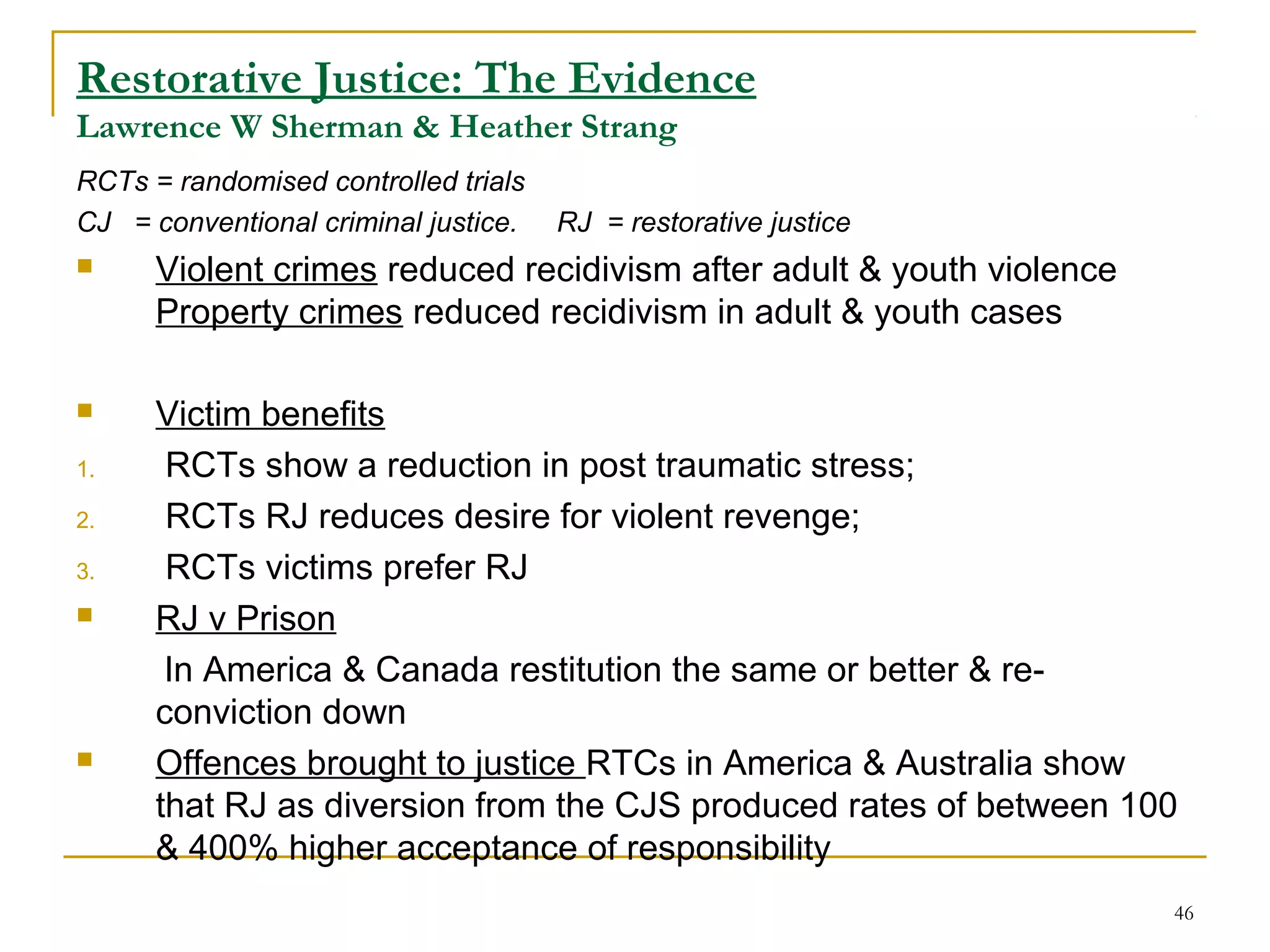
Restorative Justice: The Evidence
Lawrence W Sherman & Heather Strang
RCTs = randomised controlled trials
CJ = conventional criminal justice. RJ = restorative justice
 Violent crimes reduced recidivism after adult & youth violence
Property crimes reduced recidivism in adult & youth cases
 Victim benefits
1. RCTs show a reduction in post traumatic stress;
2. RCTs RJ reduces desire for violent revenge;
3. RCTs victims prefer RJ
 RJ v Prison
In America & Canada restitution the same or better & re-
conviction down
 Offences brought to justice RTCs in America & Australia show
that RJ as diversion from the CJS produced rates of between 100
& 400% higher acceptance of responsibility
47
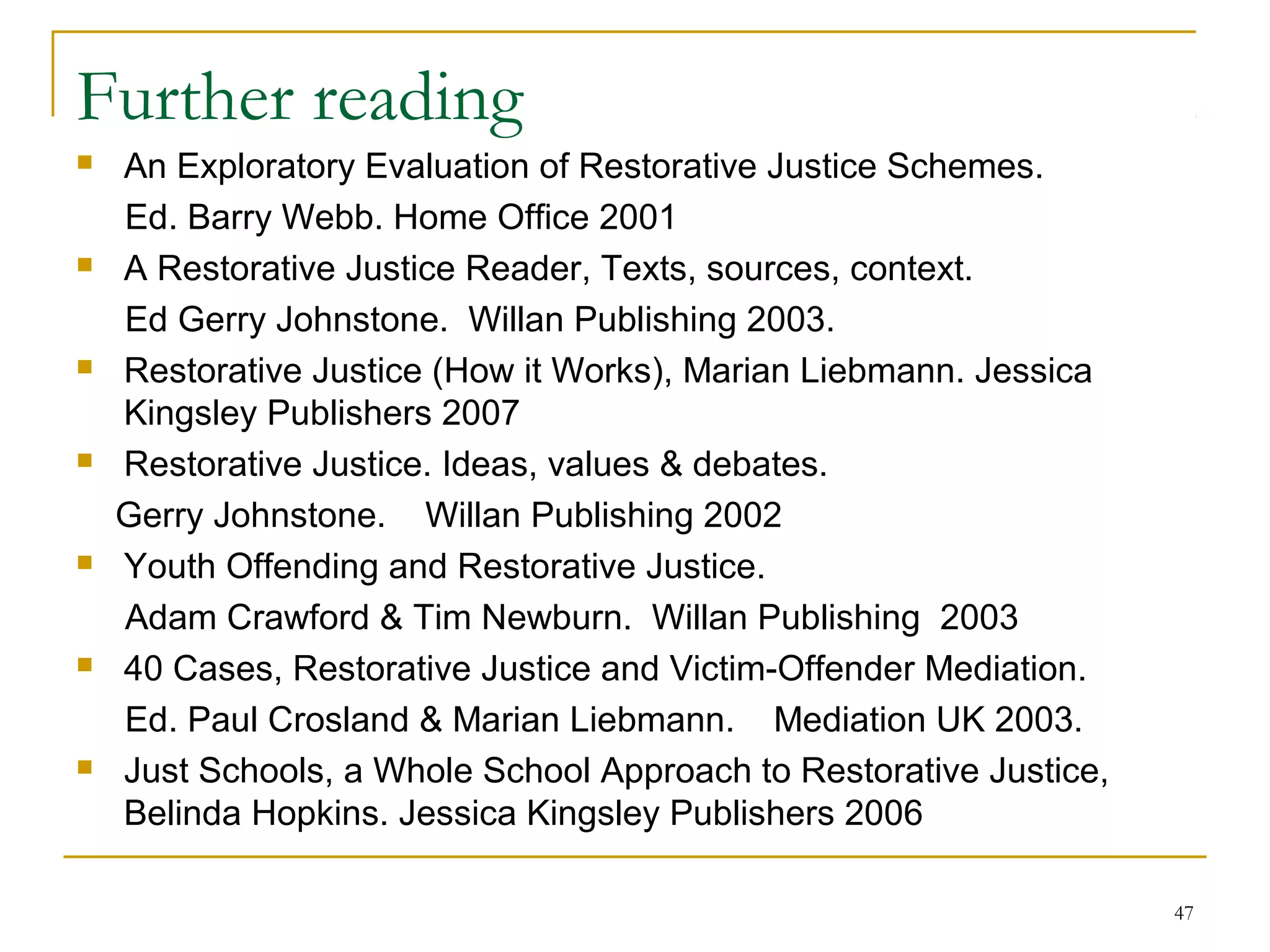
Further reading
 An Exploratory Evaluation of Restorative Justice Schemes.
Ed. Barry Webb. Home Office 2001
 A Restorative Justice Reader, Texts, sources, context.
Ed Gerry Johnstone. Willan Publishing 2003.
 Restorative Justice (How it Works), Marian Liebmann. Jessica
Kingsley Publishers 2007
 Restorative Justice. Ideas, values & debates.
Gerry Johnstone. Willan Publishing 2002
 Youth Offending and Restorative Justice.
Adam Crawford & Tim Newburn. Willan Publishing 2003
 40 Cases, Restorative Justice and Victim-Offender Mediation.
Ed. Paul Crosland & Marian Liebmann. Mediation UK 2003.
 Just Schools, a Whole School Approach to Restorative Justice,
Belinda Hopkins. Jessica Kingsley Publishers 2006

Session 7 restoration ppt.2016

  • 1.
    1 7. Restoration (RestorativeJustice)( 28 slides) John Clark
  • 2.
    2 Restorative Practice orRestorative Justice?  Practice is a pro-active model of restoration, building relationships in order to reduce the likelihood of harm  Justice is re-active, repairing relationships following harm being caused John Clark 2010
  • 3.
    A range ofrestorative practices  Proactive and Reactive Circles  Restorative language  Restorative questions & conversations  Restorative Conferences including mediation & FGC’s 3
  • 4.
    4 Truth, right &wrong  Retributive system & the truth Evidence & proof beyond all reasonable doubt  Rehabilitative system and the truth Establishing antecedents & developing treatment  Restoration and truths The Six Blind Men & the Elephant. John Godfrey Saxe (1816-1887)
  • 5.
    5 A BRIEF SUMMARY& BACKGROUND TO RESTORATIVE JUSTICE  A brief summary & background to Restorative Justice  Western legal tradition since the 11th century has increasingly viewed crime as an offence against the public at large and against society rather than against the individual victim.  The obvious response resulting from this is state prosecution, punishment and the development of a system of justice, which is both retributive and adversarial. One of the results being that the individual victim is marginalised in the process.  A number of western cultures prior to the eleventh century and many non-western cultures today view an offence as a violation of social bonds and respond to it through a process of negotiation, restitution and reconciliation.  In the UK recently rediscovered restorative practices among Quaker and Mennonite communities and indigenous communities in North America / Canada, New Zealand, Australia and South Africa have been incorporated into the Youth Justice System  The law becomes a mediating process designed to reconcile not a process to allocate blame and punishment.  Developing practices include Victim Offender Mediation, Restorative Conferences, Family Group Conferences, Scottish Hearing Panels and Referral Order Panels. These and other interventions have come to be known as Restorative Justice and or Restorative Approaches.  Restorative approaches are also used outside the justice systems to resolve conflicts in schools, in the community, neighbour conflicts, in the workplace and also in family disputes. John Clark 2010
  • 6.
    Theory  While thereis a body of theory which describes restorative behaviours, there is not a single Restorative Practice “theory”.  Instead it is a WAY OF BEING … it describes ways of communicating, developing relationships and resolving difficulties.
  • 7.
    Restorative Practice drawson many theories RestorativeRestorative PracticePractice A WAY OFA WAY OF BEINGBEING Resilience Conversations Family Group Conferencing Solution Focussed Therapy Restorative Justice Cognitive Behavioural Therapy Transactional Analysis Neuro Linguistic Programming
  • 8.
    Some characteristics ofRestorative Practice  Being explicit in your practice  Working with people  Ensuring the process is fair  Applying the above to your language & behaviours John Clark 2013 8
  • 9.
    9 Restorative system  InRestorative Justice the process through which decisions are made and the future planned is essential.  A restorative processA restorative process seeks to include all the people effected by an incident  It encourages and facilitates opportunities for communication  RJ Seeks to agree mutually acceptable outcomes  It is respectful and attempts to strengthen all participants  John Clark 2010
  • 10.
    10 Restorative Justice is: An inclusive process for those who are victims and those who have offended  Provides an expanded role for victims to be able to regain personal power, speak about feelings and to be involved and make decisions about how their needs can be met.  The person who has offended is enabled to take personal responsibility for their actions, actively work to repair harm caused to victims, learn about personal harm caused to victims and work to make amends to the victim and to the community
  • 11.
    11 RJ is inclusiveand should always includes those who have been harmed (victims)  People who have been victims of crime or of harmful behaviours can display a variety of needs  Providers of services or interventions need to be aware of those needs in order to ensure inclusion and avoid re-victimising John Clark 2009
  • 12.
    12 “Traditional” “What happened?”, “Who’s toblame?” “What rule has been broken”? “What punishment is appropriate to the rule that has been broken?” .
  • 13.
    Restorative “What happened?”, “What harmhas resulted?” “Who has been affected”? “What needs to happen next?” What support do you need for this to happen? What will it look like when it improves? 13
  • 14.
    14 Victims & loss,common reactions 4 Stage Model 1) Initial Reaction – Shock / Denial 4) Adjustment 3) Reconstruction Acceptance 2) Disorganisation Depression ESTEEM TIME
  • 15.
    15 Reactions to Crime PSYCHOLOGICAL PHYSIOLOGICAL BEHAVIOURAL oFear o Anger o Upset o Shock o Guilt o Nausea o Tearfulness o Trembling o Social withdrawal o Increased drinking / smoking
  • 16.
    16 Factors Affecting Recovery oHaving been a previous victim of crime o Recent Bereavement o Lack of Support o Nature of the crime o Psychiatric history
  • 17.
    17 Ripple effect ofcrime It is important to remember that others who surround the Direct victim of crime may also be affected e.g. family Members, children, friends, witnesses. They may experience Concern for the victim, fear, guilt that they couldn’t help, or increased vulnerability. You may find yourself coming into contact with some of these people and supporting More people than the victim Secondary victimisation This is the term given to victimisation which occurs through the responses of institutions And individuals to the victim. Not only is the victim trying to recover from the crime itself, They may also experience great distress from the way they are dealt with by hospital Personnel, criminal justice agencies or victim compensation schemes. Additionally, family, Friends and colleagues may not take a supportive attitude but instead may want to distance Themselves from the crime by blaming the victim or urging them to ‘put it behind them’. Your support is particularly needed in such situations as such reactions can make recovery harder Post traumatic stress disorder Whilst a great majority of victims of crime will recover from their experience, a small Number will become ‘stuck’ in the recovery process and may develop PTSD (post traumatic stress disorder). This is a specific medical diagnosis which only applies in rare cases. If after three months a victim is unable to deal with normal life – constantly re-experiencing the event – and early symptoms of shock are not alleviated they may be Suffering PTSD and should immediately be referred to their GP or a Stress Clinic for professional help Effect of this work on you The ripple effect may also spread out past the victim’s family and friends to you, as a supporter. When you are closely involved with victims, you may find yourself becoming overwhelmed with Similar feelings to those that victims are expressing. If you find yourself becoming inexplicably Depressed, feeling helpless, fearful or tired, you should talk this through with your co-ordinator.
  • 18.
    ChallengeChallenge ToTo WithWith NotNot ForFor Adaptedfrom: Wachtel T & McCold P in Strang H & Braithwaite J (eds), (2001), Restorative Justice and Civil Society, Cambridge University Press, Cambridge SupportSupport Four ways…
  • 19.
    19 SOCIAL DISCIPLINE WINDOW LOWHIGH HIGH Care / support (Encouragement, nurture) Challenge/control(limitsetting,discipline) TO punitive NOT neglectful WITH restorative FOR permissive Adapted from IIRP 2011
  • 20.
    20  Engaging participantsin the process  Explaining & building a shared understanding  Building a clarity of expectation and vision for change 20 Fairness of process
  • 21.
    21 Applying restorative principlesto questioning in response to an incident  Questions would be neutral, non-judgmental, about the behaviour and its effect upon others  Open questions which require an answer rather than a yes/no response  They would take everyone from the past to the future (repairing harm) & actually allow people to tell their story  They would require people to reflect on who has been affected and help the wrongdoer develop empathy  They would seek to build understanding rather than blame  The person asking is likely to be seen as objective and respectful and are more likely to promote responsibility  They would be fair and able to be applied in every situation  They would be thinking questions, but more likely to get 'feeling‘ responses.
  • 22.
    22  What happened? What were you thinking about at the time?  What have your thoughts been since?  Who has been affected by what you did?  In what way have they been affected?  What do you think needs to happen next? Thames Valley Police 2000 22 Restorative Questions
  • 23.
    23  What happened? What were your thoughts at the time?  What have your thoughts been since?  How has this affected you and others?  What has been the hardest thing for you?  What do you think needs to happen next? Thames Valley Police 2000 23 Restorative Questions
  • 24.
    24 SOME UNDERLYING PRINCIPLESFOR RESTORATIVE INTERVENTIONS  Restoration rather than retribution as a method of resolving conflict  Voluntarism so that participation is not the result of duress  Self-determination so that participants resolve their own conflict  Openness regarding feelings and opinions  Collaboration so that people work with rather than against each other  Flexibility in seeking creative solutions  Equality& inclusion in terms of access and power ensuring that the particular needs of different interests are properly addressed to avoid oppressive practices John Clark 2008
  • 25.
    25 SCALE OF INTERVENTION LEAST INTERVENTIONIST  Avoidance  Negotiation  Mediation  Arbitration  Litigation  Aggression  MOST INTERVENTIONIST John clark 2008
  • 26.
    26 DEFINITIONS  NEGOTIATION isa general term for the process of disputants working out an agreement between themselves.  MEDIATION is a process by which an impartial third party helps two or more disputants work out how to resolve a conflict. The disputants, not the mediators, decide the terms of any agreement reached.Mediation usually focuses on future rather than past behaviour.  ARBITRATION is a process in which an impartial third party (after hearing from both sides) makes a final, usually binding decision.The discussion and decision, while structured, may not be as regulated as formal procedures and rules of evidence as is courtroom procedure.  LITIGATION is the process of settling a dispute in court according to legal statutes, with advocates presenting evidence on behalf of the parties. Litigation is an adversarial process, in which a judge (or jury) adjudicates in favour of one party after hearing both sides John Clark 2008
  • 27.
    27 Skills  Being ableto allow uninterrupted time  To be encouraging & prompting without dominating the process  Listening skills, hearing as well as listening  Making use of silence  Being able to sum up  Knowing when to take time out  Taking cognisance of safety of participants  Ensuring that (in a Conference) the script follows the process rather than the process following the script John Clark 2010
  • 28.
    28 Restorative Justice interventions Mediation A process in which an impartial third party helps two (or more) disputants to reach an agreement. The disputants, not the mediator, work out the terms of the agreement.  Victim-offender mediation In which an impartial third party helps the victim(s) and offender(s) to communicate either directly or indirectly. The process can lead to a greater understanding for both parties and sometimes to reparation  Reparation Action taken by the offender (or person causing harm) to put right the harm caused (in response to victim’s wishes.  JC/08
  • 29.
    29 RJ interventions 2 Restorative Conferencing Similar in principle to V/O mediation but follows a script and can include family members. Focus on outcome  Family Group Conference Similar to above but includes private time for the ‘offenders’ family to come up with a viable plan for repairing harm & for the future. Also used in welfare/child protection  Referral Order Panel Youth Court Order which mandates a panel including victim, offender, volunteers and staff to agree a contract of work to repair harm JC.08
  • 30.
  • 31.
    Circles  Circles canbuild equality, trust & responsibility 31
  • 32.
    32 Navajo restorative justice:the law of equality & justice - peacemaking  Navajo justice has a healing component  State justice appoints judges on the basis of education to hear facts, apply the law and make decisions  The above is alien to Navajo concepts of freedom & individuality, where one person cannot impose a decision on another  Navajos are their own judges in an egalitarian process  A wronged person demands that of the perpetrator that things be put right, a demand to readjust the relationship that the proper thing be done  Relatives can act on the wronged persons behalf
  • 33.
    33 Cree justice ashealing  “………………in the non-Indian community, a crime seems to mean that the individual is a bad person and therefore must be punished……………..”  “The Indian communities view a wrongdoing as a misbehaviour which requires teaching or an illness which requires healing”
  • 34.
    34 Maori restorative tradition Lost or parallel system  Maori justice – healing for all  Set up to meet the victims needs, not about humiliating the offender  Recognition that it is an individual who is hurt not society  Hearing and helping the victim, helping & healing the perpetrator, healing the families/community and restoring balance
  • 35.
    Types of circle Sequential Specific question Done in order Participation expected  Non Sequential, can be: Structured Loosely Structured No order Participation voluntary  Fishbowl Sequential or non-sequential Empty chair Feedback 35
  • 36.
    Uses for circles Go around  Check in /check outs  Problem solving  Dealing with conflict  Teaching and learning  Staff meetings  Decision making  Staff handovers  Just about anything! 36
  • 37.
    37 Canadian & EuropeanRJ  VORP. Victim offender reconciliation programme in Kitchener, Ontario (1974)  Spread to other parts of Canada & North America  England in1985 Home office projects set up in Cumbria, West Midlands (2), West Yorkshire  Austria 1989 Juvenile Justice legislation provides for referral to mediation  Mediation used in Balkan wars and incorporated as domestic practice in Croatia  European Union encourages RJ as a recommended form of Justice
  • 38.
    38 Case study -Tracy  Offence of violence Sec 47 assault  Tracy is 13yrs old and lives in a Residential Children’s Home. After an upsetting phone conversation with her mother she is very angry and causes some damage in her room kicking and damaging doors, breaking a window and tearing some of her clothes. A worker confronts T as she leaves her room and T pushes past her in an attempt to leave. The worker sustains minor bruising from the door post & scratches from a ring Tracy was wearing. The Police are called.
  • 39.
    39 Case study -Tracy  What do you think would happen to Tracy employing the following processes? 1. Retributive justice process 2. Rehabilitative or welfare system 3. Restorative approach to justice
  • 40.
    40 Resolving serious harmin the international arena  Rwanda  Bosnia  South Africa The Truth & Reconciliation Committee.
  • 41.
    41 Measuring results  Howdo we evaluate conventional methods of justice administration?  British Crime Survey  Police & Home Office statistics & reports  Public opinion as reflected by politicians  Media reports  Letters/opinion from public as selected & reported by the press  Complaints to criminal justice agencies
  • 42.
    42 Measuring results 2 Measuring restorative approaches to justice  Home Office/Youth Justice Board measures  Professional organisations  Academic research  International studies  Customer satisfaction surveys John Clark/RJ/07
  • 43.
    43  Behaving inways which are consistent with what you say  If you are not modeling what you are teaching, then you are teaching something different Restorative behaviours
  • 44.
    44 If you alwaysdo what you’ve always done then you’ll always get what you’ve always got Change require energy-
  • 45.
    45 Some Restorative Justiceresearch findings  Government research: A Gov’t Crime Reduction Programme – What works in reducing crime Four reports:  RJ: the views of victims & offenders (2007) http://www.justice.gov.uk/docs/Restorative-Justice.pdf  Restorative Justice in Practice, Findings from the second phase of the 3 scheme evaluation (2006) http://www.homeoffice.gov.uk/rds/pdfs06/r274.pdf  Implementing RJ schemes, a report on the first year(2004) http://www.homeoffice.gov.uk/rds/pdfs04/rdsolr3204.pdf  Restorative Justice: The Evidence 2007 Lawrence W Sherman and Heather Strang http:/www.smith-institute.org.uk
  • 46.
    46 Restorative Justice: TheEvidence Lawrence W Sherman & Heather Strang RCTs = randomised controlled trials CJ = conventional criminal justice. RJ = restorative justice  Violent crimes reduced recidivism after adult & youth violence Property crimes reduced recidivism in adult & youth cases  Victim benefits 1. RCTs show a reduction in post traumatic stress; 2. RCTs RJ reduces desire for violent revenge; 3. RCTs victims prefer RJ  RJ v Prison In America & Canada restitution the same or better & re- conviction down  Offences brought to justice RTCs in America & Australia show that RJ as diversion from the CJS produced rates of between 100 & 400% higher acceptance of responsibility
  • 47.
    47 Further reading  AnExploratory Evaluation of Restorative Justice Schemes. Ed. Barry Webb. Home Office 2001  A Restorative Justice Reader, Texts, sources, context. Ed Gerry Johnstone. Willan Publishing 2003.  Restorative Justice (How it Works), Marian Liebmann. Jessica Kingsley Publishers 2007  Restorative Justice. Ideas, values & debates. Gerry Johnstone. Willan Publishing 2002  Youth Offending and Restorative Justice. Adam Crawford & Tim Newburn. Willan Publishing 2003  40 Cases, Restorative Justice and Victim-Offender Mediation. Ed. Paul Crosland & Marian Liebmann. Mediation UK 2003.  Just Schools, a Whole School Approach to Restorative Justice, Belinda Hopkins. Jessica Kingsley Publishers 2006

Editor's Notes

  • #7 SLIDE 5 TIMING: 3 MINUTES Trainers Notes 5.1Restorative Practice draws on a lot of different theories 5.2 Restorative practice is not a tool, not something you do for an hour a day. 5.3RP is something you should do all the time, it is a way of being.
  • #8 SLIDE 6 TIMING: 3 MINUTES Trainers Notes 6.1No need to go over all the above theories just pick one or two from below (ones you feel comfortable talking about) and briefly explain how they relate to RP. 6.2Resilience: is an individual's tendency to cope with stress and adversity 6.3Conversations: is a form of interactive, spontaneous communication between two or more people who are following rules of etiquette. It is polite give and take of subjects thought of by people talking with each other for company. 6.4Restorative Justice: is an approach to justice that focuses on the needs of the victims and the offenders, as well as the involved community, instead of satisfying abstract legal principles or punishing the offender. 6.5Family Group Conferencing:  is a family led, decision making  process that brings together formal and informal networks around a child for whom there are concerns.   Based on an empowerment, strengths based model, family group conferences involve families, friends and professionals to make plans and decisions to promote a  child’s safety and welfare .  Children and young people are normally involved in their meetings, with the support of advocates if required.  It is a voluntary process that is facilitated by an independent co-ordinator.6.6Transactional Analysis: is an integrative approach to the theory of psychology and psychotherapy. It is described as integrative because it has elements of psychoanalytic, humanist and cognitive approaches. TA was first developed by Canadian-born US psychiatrist Eric Berne, starting in the late 1950s. 6.7Solution Focussed Therapy: is a type of talking therapy that is based upon social constructionist philosophy. It focuses on what clients want to achieve through therapy rather than on the problem(s) that made them seek help. The approach does not focus on the past, but instead, focuses on the present and future. 6.8Cognitive Behaviour Therapy: approach that addresses dysfunctional emotions, maladaptive behaviors and cognitive processes and contents through a number of goal-oriented, explicit systematic procedures. The name refers to behavior therapy. cognitive therapy, and to therapy based upon a combination of basic behavioral and cognitive principles and research. 6.9Neuro Linguistic Programming: is an approach to communication, personal development and psychotherapy created by Richard Bandler and John Grinder in California, USA in the 1970s. The title asserts a connection between the neurological processes ("neuro"), language ("linguistic"), and behavioural patterns learned through experience ("programming") that proponents speculate can be changed to achieve specific goals in life.
  • #19 SLIDE 11