NEXT TOOL 
When to use it 
• You have a clear, customer-backed vision. 
• You want to experiment with different ideas that ladder up to 
an established vision. 
Time 
Iterative process. 
Why use it 
• To be more intentional about how you set up rapid 
experiments with customers. 
• To make more informed decisions based on how 
people actually behave in the real world. 
How to use it 
1. Our Insights 
What is the big unmet problem? What was the compelling 
a-ha that is driving your vision? 
2. Our Vision 
Inspire your team with a grand challenge. Focus on the 
customer and ensure solutions are not included in the vision. 
3. Our Idea 
Make it tangible and specific, while highlighting the customer. 
4. Leap Of Faith Assumption 
Focus on the customer behaviors that must take place, and 
the most “unknown” assumptions. 
5. Our Hypotheses 
Ensure alignment with your Leap of Faith. Choose numeric 
targets that inspire your team, and behaviors that are 
measurable. 
DESIGN FOR DELIGHT 
Rapid experiments 
with customers 
IntuitLabs.com | @Intuit 1 © Intuit
6. Our Experiments 
Test important behaviors that align with your hypothesis. 
Collect “currency” from customers as a way to measure real 
interest, and encourage teams to be open to surprises as 
well as collect metrics. Make sure the experiment will test 
your Leap of Faith. 
7. Our Decision 
A team’s default decision is often to persevere, so push 
teams to make a strong case if that’s the way they decide 
to go. 
Tips 
• Embrace failure. Seek surprises and new insights. 
• Run experiments, don’t debate. 
• Make sure that your team is aligned on the customer 
behaviors you’re trying to test, and why. 
Use with 
Brainstorming 
2x2 
At Intuit, we believe our Design for Delight (D4D) 
approach can make innovators 20x more effective. 
Three key principles make up D4D: deep customer 
empathy, going broad to go narrow, and rapid 
experiments with customers. Now go and create some 
awesome experiences that delight your customers. 
© Intuit 2 IntuitLabs.com | @Intuit
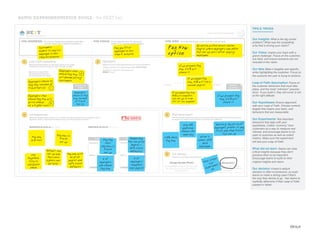
TIPS & TRICKS 
Our Insights What is the big unmet 
problem? What was the compelling 
a-ha that is driving your vision? 
Our Vision Inspire your team with a 
grand challenge. Focus on the customer, 
not Intuit, and ensure solutions are not 
included in the vision. 
Our Idea Make it tangible and specific, 
while highlighting the customer. Focus on 
the outcome the user is trying to achieve. 
Leap of Faith Assumption Focus on 
the customer behaviors that must take 
place, and the most “unknown” assump-tions. 
‘If you build it, they will come’ is not 
at the right altitude. 
Our Hypotheses Ensure alignment 
with your Leap of Faith. Choose numeric 
targets that inspire your team, and 
behaviors that are measurable. 
Our Experiments Test important 
behaviors that align with your 
hypothesis. Collect “currency” from 
customers as a way to measure real 
interest, and encourage teams to be 
open to surprises as well as collect 
metrics. Make sure the experiment 
will test your Leap of Faith. 
What did we learn Teams can miss 
critical insights because they don’t 
perceive them to be important. 
Encourage teams to build on their 
original insights and vision. 
Our decision A team’s default 
decision is often to persevere, so push 
teams to make a strong case if that’s 
the way they decide to go. Ask teams to 
explicitly determine if their Leap of Faith 
passed or failed. 
RAPID EXPERIMENTATION TOOLS - the NEXT tool 
OUR VISION - A bold statement about the opportunity 
based on our customer-backed insight(s) 
Hypotheses - 
Intuit | D4D Rapid Experimentation 
OUR IDEA - A concept that delivers on our vision and customer needs 
2 
Hypothesis = “If we do X, Y% of people will 
behave in way Z” 
NEXT 
Our Experiments - 
Brainstorm potential experiments we can run quickly (starting today/tomorrow for example) to test our 
hypothesis. Select 2 experiments, build them and go out in the real world to test them. 
? 
Most important 
If we present Pay 
Now, 55% will 
choose it 
If we enable Pay 
Now, 40% will run a 
second payroll 
Not as important 
? 
What did we learn? - 
What did our experiments reveal about our hypothesis. What did we learn? What surprised us? Did 
we uncover any insights? How would we run the experiment differently? 
Our decision - 
Based on our learnings, what would we do next? 
Experiments we will run (narrow to 2) 
Experiment 1 Experiment 2 
Description: 
Metrics: 
Description: 
Metrics: 
4 
We invalidated our leap of faith assumption. 
We need to pivot our idea and go back to 
the drawing board. 
We did NOT invalidate our leap of faith assumption. 
We need to run more experiments or start testing our 
next leap of faith assumption. 
Experiments we could run (go broad) 
Change the idea (Pivot)? Keep going (Persevere)? 
3 
5 
The next decision tool 
OUR INSIGHT(S) - An a-ha that changes your perspective and makes 
you think beyond your customer’s expectations. 
1 Leap of faith assumptions - 
Riskiest assumptions about our idea that’s keeping us up at night 
(if people don’t behave this way, we need to change our idea). 
Sequence your leap of faith 
assumptions and tackle them 
one at a time (start with riskiest) 
- 
- 
- 
- 
- 
Brainstorm a list of solutions/features that could prompt the behavior 
change underlined in the selected leap of faith assumption 
Selected leap 
of faith 
Selected 
hypothesis 
Description: 
Metrics: 
Description: 
Metrics: 
known unknown 
Customers 
expect to pay 1st 
employee in less 
than 20 minutes 
Pay you first 
employee in less 
than 5 minutes 
Employers choose to 
Pay Now instead of 
Finish Set Up 
Employers that 
choose Pay Now will 
write checks 
at a higher rate 
Employers that 
choose Pay Now 
will become billing 
customers 
1 
2 
3 
Employers 
choose to Pay 
Now instead 
of Finish 
Set Up 
If we enable Pay Now, 
80% will complete 
tax set up in time 
for 1st tax payment 
Pay Now 
test: 
pay now vs. 
finish 
set up 
Pay now 
A/B test 
Pay now vs. 
finish 
set up 
# of 
employers 
who choose 
Pay Now 
Pay Now 
option 
An option within Intuit Online 
Payroll where employers can defer 
full set up until after paying 
employees 
If we present Pay 
Now, 55% will 
choose it 
learning: Majority of 
employers prefer to pay 
first and then finish 
full set up 
58% chose 
Pay Now 
only 18% 
approved 
checks the 
same day 
after 2 
weeks, 32% 
paid 
employees 
Next steps: 
run 
experiment 
#2 
Use 
Paycheck 
City to 
calculate 
check 
Default tax 
set up and 
have care 
agents set 
up later 
Pay now with 
no prior 
payroll and 
safe state 
defaults 
Enable Pay 
Now (no prior 
payroll + 
safe state 
defaults) 
# of 
employers 
complete 
2nd payroll 
©Intuit
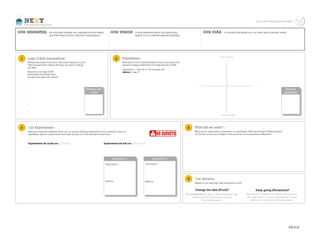
OUR VISION - A bold statement about the opportunity 
based on our customer-backed insight(s) 
Hypotheses - 
Intuit | D4D Rapid Experimentation 
OUR IDEA - A concept that delivers on our vision and customer needs 
2 
Hypothesis = “If we do X, Y% of people will 
behave in way Z” 
NEXT 
Our Experiments - 
Brainstorm potential experiments we can run quickly (starting today/tomorrow for example) to test our 
hypothesis. Select 2 experiments, build them and go out in the real world to test them. 
? 
Most important 
Not as important 
? 
What did we learn? - 
What did our experiments reveal about our hypothesis. What did we learn? What surprised 
us? Did we uncover any insights? How would we run the experiment differently? 
Our decision - 
Based on our learnings, what would we do next? 
Experiments we will run (narrow to 2) 
Experiment 1 Experiment 2 
Description: 
Metrics: 
Description: 
Metrics: 
4 
We invalidated our leap of faith assumption. We 
need to pivot our idea and go back to 
the drawing board. 
We did NOT invalidate our leap of faith assump-tion. 
We need to run more experiments or start 
testing our next leap of faith assumption. 
Experiments we could run (go broad) 
Change the idea (Pivot)? Keep going (Persevere)? 
3 
5 
The next decision tool 
OUR INSIGHT(S) - An a-ha that changes your perspective and makes 
you think beyond your customers expectations. 
1 Leap of faith assumptions - 
iskiest assumptions about our idea thats keeping us up at 
night (if people dont behave this way, we need to change 
our idea). 
	eene yo leap of faith 
assptions and tale the 
one at a tie stat with isiest 
- 
- 
- 
- 
- 
Brainstorm a list of solutions/features that could prompt the 
behavior change underlined in the selected leap of faith 
Selected leap 
of faith 
Selected 
hypothesis 
Description
 
etrics
 
Description
 
etrics
 
©Intuit

D4D Tools - The NEXT Tool

  • 1.
    NEXT TOOL Whento use it • You have a clear, customer-backed vision. • You want to experiment with different ideas that ladder up to an established vision. Time Iterative process. Why use it • To be more intentional about how you set up rapid experiments with customers. • To make more informed decisions based on how people actually behave in the real world. How to use it 1. Our Insights What is the big unmet problem? What was the compelling a-ha that is driving your vision? 2. Our Vision Inspire your team with a grand challenge. Focus on the customer and ensure solutions are not included in the vision. 3. Our Idea Make it tangible and specific, while highlighting the customer. 4. Leap Of Faith Assumption Focus on the customer behaviors that must take place, and the most “unknown” assumptions. 5. Our Hypotheses Ensure alignment with your Leap of Faith. Choose numeric targets that inspire your team, and behaviors that are measurable. DESIGN FOR DELIGHT Rapid experiments with customers IntuitLabs.com | @Intuit 1 © Intuit
  • 2.
    6. Our Experiments Test important behaviors that align with your hypothesis. Collect “currency” from customers as a way to measure real interest, and encourage teams to be open to surprises as well as collect metrics. Make sure the experiment will test your Leap of Faith. 7. Our Decision A team’s default decision is often to persevere, so push teams to make a strong case if that’s the way they decide to go. Tips • Embrace failure. Seek surprises and new insights. • Run experiments, don’t debate. • Make sure that your team is aligned on the customer behaviors you’re trying to test, and why. Use with Brainstorming 2x2 At Intuit, we believe our Design for Delight (D4D) approach can make innovators 20x more effective. Three key principles make up D4D: deep customer empathy, going broad to go narrow, and rapid experiments with customers. Now go and create some awesome experiences that delight your customers. © Intuit 2 IntuitLabs.com | @Intuit
  • 3.
    TIPS & TRICKS Our Insights What is the big unmet problem? What was the compelling a-ha that is driving your vision? Our Vision Inspire your team with a grand challenge. Focus on the customer, not Intuit, and ensure solutions are not included in the vision. Our Idea Make it tangible and specific, while highlighting the customer. Focus on the outcome the user is trying to achieve. Leap of Faith Assumption Focus on the customer behaviors that must take place, and the most “unknown” assump-tions. ‘If you build it, they will come’ is not at the right altitude. Our Hypotheses Ensure alignment with your Leap of Faith. Choose numeric targets that inspire your team, and behaviors that are measurable. Our Experiments Test important behaviors that align with your hypothesis. Collect “currency” from customers as a way to measure real interest, and encourage teams to be open to surprises as well as collect metrics. Make sure the experiment will test your Leap of Faith. What did we learn Teams can miss critical insights because they don’t perceive them to be important. Encourage teams to build on their original insights and vision. Our decision A team’s default decision is often to persevere, so push teams to make a strong case if that’s the way they decide to go. Ask teams to explicitly determine if their Leap of Faith passed or failed. RAPID EXPERIMENTATION TOOLS - the NEXT tool OUR VISION - A bold statement about the opportunity based on our customer-backed insight(s) Hypotheses - Intuit | D4D Rapid Experimentation OUR IDEA - A concept that delivers on our vision and customer needs 2 Hypothesis = “If we do X, Y% of people will behave in way Z” NEXT Our Experiments - Brainstorm potential experiments we can run quickly (starting today/tomorrow for example) to test our hypothesis. Select 2 experiments, build them and go out in the real world to test them. ? Most important If we present Pay Now, 55% will choose it If we enable Pay Now, 40% will run a second payroll Not as important ? What did we learn? - What did our experiments reveal about our hypothesis. What did we learn? What surprised us? Did we uncover any insights? How would we run the experiment differently? Our decision - Based on our learnings, what would we do next? Experiments we will run (narrow to 2) Experiment 1 Experiment 2 Description: Metrics: Description: Metrics: 4 We invalidated our leap of faith assumption. We need to pivot our idea and go back to the drawing board. We did NOT invalidate our leap of faith assumption. We need to run more experiments or start testing our next leap of faith assumption. Experiments we could run (go broad) Change the idea (Pivot)? Keep going (Persevere)? 3 5 The next decision tool OUR INSIGHT(S) - An a-ha that changes your perspective and makes you think beyond your customer’s expectations. 1 Leap of faith assumptions - Riskiest assumptions about our idea that’s keeping us up at night (if people don’t behave this way, we need to change our idea). Sequence your leap of faith assumptions and tackle them one at a time (start with riskiest) - - - - - Brainstorm a list of solutions/features that could prompt the behavior change underlined in the selected leap of faith assumption Selected leap of faith Selected hypothesis Description: Metrics: Description: Metrics: known unknown Customers expect to pay 1st employee in less than 20 minutes Pay you first employee in less than 5 minutes Employers choose to Pay Now instead of Finish Set Up Employers that choose Pay Now will write checks at a higher rate Employers that choose Pay Now will become billing customers 1 2 3 Employers choose to Pay Now instead of Finish Set Up If we enable Pay Now, 80% will complete tax set up in time for 1st tax payment Pay Now test: pay now vs. finish set up Pay now A/B test Pay now vs. finish set up # of employers who choose Pay Now Pay Now option An option within Intuit Online Payroll where employers can defer full set up until after paying employees If we present Pay Now, 55% will choose it learning: Majority of employers prefer to pay first and then finish full set up 58% chose Pay Now only 18% approved checks the same day after 2 weeks, 32% paid employees Next steps: run experiment #2 Use Paycheck City to calculate check Default tax set up and have care agents set up later Pay now with no prior payroll and safe state defaults Enable Pay Now (no prior payroll + safe state defaults) # of employers complete 2nd payroll ©Intuit
  • 4.
    OUR VISION -A bold statement about the opportunity based on our customer-backed insight(s) Hypotheses - Intuit | D4D Rapid Experimentation OUR IDEA - A concept that delivers on our vision and customer needs 2 Hypothesis = “If we do X, Y% of people will behave in way Z” NEXT Our Experiments - Brainstorm potential experiments we can run quickly (starting today/tomorrow for example) to test our hypothesis. Select 2 experiments, build them and go out in the real world to test them. ? Most important Not as important ? What did we learn? - What did our experiments reveal about our hypothesis. What did we learn? What surprised us? Did we uncover any insights? How would we run the experiment differently? Our decision - Based on our learnings, what would we do next? Experiments we will run (narrow to 2) Experiment 1 Experiment 2 Description: Metrics: Description: Metrics: 4 We invalidated our leap of faith assumption. We need to pivot our idea and go back to the drawing board. We did NOT invalidate our leap of faith assump-tion. We need to run more experiments or start testing our next leap of faith assumption. Experiments we could run (go broad) Change the idea (Pivot)? Keep going (Persevere)? 3 5 The next decision tool OUR INSIGHT(S) - An a-ha that changes your perspective and makes you think beyond your customers expectations. 1 Leap of faith assumptions - iskiest assumptions about our idea thats keeping us up at night (if people dont behave this way, we need to change our idea). eene yo leap of faith assptions and tale the one at a tie stat with isiest - - - - - Brainstorm a list of solutions/features that could prompt the behavior change underlined in the selected leap of faith Selected leap of faith Selected hypothesis Description etrics Description etrics ©Intuit