Chapter 12
Solid and Liquid Wastes
Learning Objectives
By the end of this chapter the reader will be able to:
• Describe trends in the production of solid waste
• Discuss methods for source reduction of solid waste
• Discuss the role of landfills for disposing of solid
waste
• Describe methods for primary, secondary, and
tertiary sewage treatment
• Discuss hazards of poorly designed solid waste
disposal sites and improperly processed sewage
Introduction
• Ecosystems produce waste, and that waste needs to be
appropriately disposed of or it would eventually destroy
the ecosystem
• Problems arise when the waste is not organically based
and the number of single use items increases
o Decomposition is reduced and wastes build up
• The issues are:
o Incinerators of the past are not ideal
o Increases in pollution of aquatic environments
o We are slowly running out of space for this waste so as a society
we need to take a serious look at how we use, re-use, and
dispose of waste
Municipal Solid Waste (MSW)
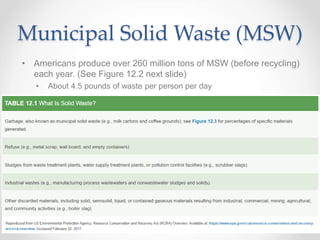
• Americans produce over 260 million tons of MSW (before recycling)
each year. (See Figure 12.2 next slide)
• About 4.5 pounds of waste per person per day
Figure 12.2 Municipal solid waste generation rates, 1960 to 2018.
Storage of MSW
• Most homes use various receptacles to accumulate waste
until it can be removed
o Long term receptacles should be “fly-tight” and non-corrosive
o Can be lined with bags for easy disposal or cleaned after they
are emptied
• Large-volume receptacles are used at businesses or multi-
housing areas
• Should be collected at least once per week (most areas it is
twice)
o Schedule is suggested based on the life cycle of the house fly
(eggs mature into adults in about 8 days)
o Collecting refuse weekly controls the fly population
• Collection is through a private or government operation
• Trucks must meet certain specifications for transporting and
compacting refuse
Components of the MSW Stream
• Food waste
• Papers
• Batteries
• Organic materials
• Packaging
• Furniture
• Clothing
• Bottles
MSW Disposal
• Formerly completed through open-dumping and
incineration which of course is not ideal
• The EPA recommends that wastes are handled in other
manners because of disease and other hazards to the
environment
• The hierarchy of management:
o Source Reduction and reuse
o Recycle-Composting
o Waste to Energy (WTE)
o Treatment and disposal
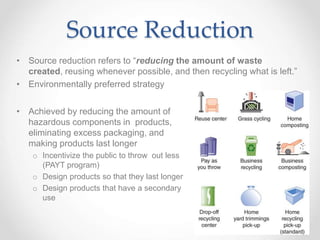
Source Reduction
• Source reduction refers to “reducing the amount of waste
created, reusing whenever possible, and then recycling what is left.”
• Environmentally preferred strategy
• Achieved by reducing the amount of
hazardous components in products,
eliminating excess packaging, and
making products last longer
o Incentivize the public to throw out less
(PAYT program)
o Design products so that they last longer
o Design products that have a secondary
use
Recycling
• The EPA defines recycling (reuse) as the process of
“Minimizing waste generation by recovering and
reprocessing usable products that might otherwise
become waste.” (i.e., recycling of aluminum cans, paper,
and bottles, etc.)
• Collection of materials to be used to make new products
• Reduces the need for virgin sources, saves energy, and
creates jobs
• Still don’t or can’t recycle as much as we should
• Click here to go to Harford County’s site about recycling
Recycling
• We all need to
recycle like this
guy…
Recycling
Click on box below to view a video on bottle recycling.
(Click again to pause. Click outside of box to advance slide)
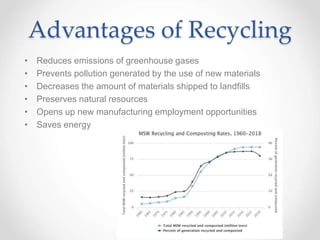
Advantages of Recycling
• Reduces emissions of greenhouse gases
• Prevents pollution generated by the use of new materials
• Decreases the amount of materials shipped to landfills
• Preserves natural resources
• Opens up new manufacturing employment opportunities
• Saves energy
Composting
• “the aerobic biological decomposition of organic
materials [e.g., leaves, grass, and food scraps] to
produce a stable humus-like product…. Biodegradation
is a natural, ongoing biological process that is a common
occurrence in both human-made and natural
environments.”
• Materials must be separated and non biodegradable
materials disposed of in some other manner
o See Table 12.2 in the text for materials to include or exclude
• Produces a useful material that resembles soil and that
can be used in gardening.
• Most modern composting uses aerobic methods to
reduce odor.
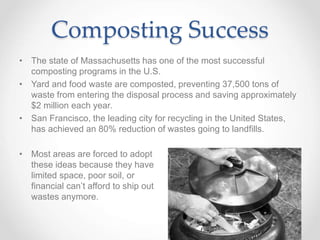
Composting Success
• The state of Massachusetts has one of the most successful
composting programs in the U.S.
• Yard and food waste are composted, preventing 37,500 tons of
waste from entering the disposal process and saving approximately
$2 million each year.
• San Francisco, the leading city for recycling in the United States,
has achieved an 80% reduction of wastes going to landfills.
• Most areas are forced to adopt
these ideas because they have
limited space, poor soil, or
financial can’t afford to ship out
wastes anymore.
Landfill Design
• Solid waste buried in sections and covered with soil
• Class I facilities serve municipal, institutional, residential
and rural populations
• Constructed to prevent any leaching of waste into
ground or surface water
o Water that collects contaminants as it trickles through wastes, pesticides or
fertilizers. Leaching may occur in farming areas, feedlots, and landfills, and may
result in hazardous substances entering surface water, ground water, or soil.
• A landfill is composed of four major parts:
o a bottom liner
o a system for collecting leachates
o a cover
o an appropriate location that minimizes the leaching of waste into groundwater
How a Landfill Works
• The bottom is lined with a dense layer of clay and sealed
with thick plastic sheeting to contain leaks of hazardous
materials.
• A flexible membrane liner holds in toxic chemicals that
might contaminate groundwater.
• A leachate sump collects leachates, which then can be
subjected to further treatment.
• Garbage is piled up in rows; bulldozers and rollers compact
the garbage; at the end of the day, the newly added
garbage is covered with soil and other materials.
• After the garbage is covered, anaerobic bacteria aid in the
decomposition of organic materials and produce methane
gas.
Side View of a Landfill
Dangers Associated with Landfills
• Air pollution and groundwater contamination
• Leachates, which may include:
o Toxic heavy metals
o Solvents and cleaning agents.
• Methane, volatile organic compounds (VOCs), and other
gases
o Methane vented from landfills poses a fire hazard and is a
greenhouse gas.
• VOC emissions
o Potentially carcinogenic
o May cause complaints about odors and symptoms of respiratory
irritation
Megafills
• Newer designs for landfills were adopted in 1988
which took 10,000 smaller sites and combined them
to 3500 larger (megafills) sites.
• These take in 5,000–10,000 tons of trash per day
and serve regional needs for waste disposal
• Tend to be more cost effective than incinerators for
disposal of solid waste
• The new standards are on the following slide, but
the details can be found in the text
Federal Landfill Standards
(In effect since 1988)
1. Location restrictions
2. Composite liners
requirements
3. Leachate collection
and removal systems
4. Groundwater
monitoring
requirements
5. Closure and
postclosure care
requirements
6. Corrective action
provisions
7. Financial assurance
Source: Adapted and reprinted from US Environmental Protection Agency. Municipal Solid Waste:
Landfills. Available at: http://www.epa.gov/osw/nonhaz/minicipal/landfill.htm. Accessed March 25. 2010.
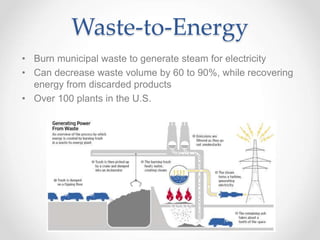
Waste-to-Energy
• Burn municipal waste to generate steam for electricity
• Can decrease waste volume by 60 to 90%, while recovering
energy from discarded products
• Over 100 plants in the U.S.
Incineration
• Can be used to generate energy while at the same time
reducing the volume and weight of waste.
• No attempt is made to separate the trash into
components; at the high temperatures of incinerating
plants, glass and aluminum in the trash melt.
• Metals from the residues of combustion can be recycled
into scrap metal; remaining ash is deposited in landfills.
• Wheelabrator Technologies in Baltimore (Fig 12-10)
o Produces about 60,000 KW which can power about 40,000 homes
Disadvantages of Incineration
• Emissions may be potentially hazardous to human
health and the environment.
• Toxic materials emitted may cause air pollution or be
deposited on the land.
o polychlorinated biphenyls (PCBs), cadmium, and heavy metals, as well as
other potentially carcinogenic substances.
Hazardous Materials and Wastes
• What is a hazardous waste?
• Hazardous wastes are disposed of legally in the U.S. by:
o Discarding them on the surface of the land
o Storing them in slurry ponds
o Dumping them into landfills or into the ocean
o Incineration
Hazardous Materials and Wastes
Characteristics…
• Corrosive
o Chemically wearing away substances
o pH below 2 or above 12.5
• Toxic
o Poisonous to people and other organisms
• Ignitable
o Capable of bursting into flames
• Reactive
o Capable of exploding or releasing poisonous gas
when mixed with another substance or chemical
Sources of Hazardous Wastes
Americans produce about 1.6 million tons of hazardous waste
per year…
Hazardous materials used in the home
• Pesticides, cleaning products, automotive products, painting
supplies, and other flammable and nonflammable products
Medical waste
• Chemicals, infectious agents, and radioactive materials
Industrial hazardous waste
• Heavy metals from plating operations, toxic chemicals,
solvents, and residues from the manufacture of pesticides
Sources of Hazardous Wastes
(continued)
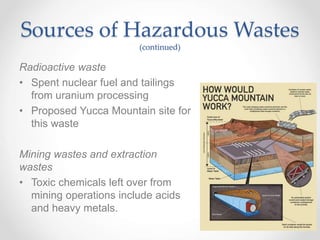
Radioactive waste
• Spent nuclear fuel and tailings
from uranium processing
• Proposed Yucca Mountain site for
this waste
Mining wastes and extraction
wastes
• Toxic chemicals left over from
mining operations include acids
and heavy metals.
Hazardous Waste Problem
• More than 400 million tons are generated worldwide on
an annual basis.
• Developed world generates most of the toxic wastes.
• Some developing nations will take hazardous wastes for
cash payments; this practice may endanger the health of
the local population.
o In 1989, the U.N. enacted a treaty to regulate the transport and disposal of
hazardous waste in a safe manner, after a vessel from the U.S. dumped leftover
hazardous cargo off the coast of Africa.
Hazardous Waste Problem
• How hazardous waste released into the environment can
affect plants (flora) or animals (fauna) in an ecosystem.
o Gaps in vital food chains or nutrient cycles
o Reproductive problems
o Developmental effects
o Tumors
o Critical organ damage
o Immune system dysfunction
o Altered individual or population growth rates
o Changes in population and community organization
o Loss of total biomass
o Relative loss of taxa or species abundance in defined areas
o Loss of species diversity.
Uncontrolled Hazardous Waste
Sites in the U.S.
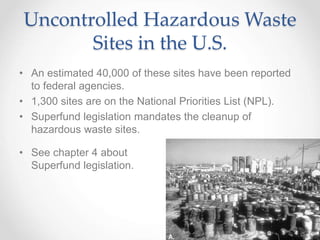
• An estimated 40,000 of these sites have been reported
to federal agencies.
• 1,300 sites are on the National Priorities List (NPL).
• Superfund legislation mandates the cleanup of
hazardous waste sites.
• See chapter 4 about
Superfund legislation.
Impacts of Uncontrolled Sites
• Potential adverse human health effects
• High costs of cleanup
• Reductions in property
values
• Potential ecological
damage
• Example next slide…
Love Canal
• Was the former site for disposal of toxic wastes
• Later used for residential construction
• Became identified with hazardous chemical exposures
and their possible harmful influences on human health
• Led to the creation of
the EPA’s Superfund
Program
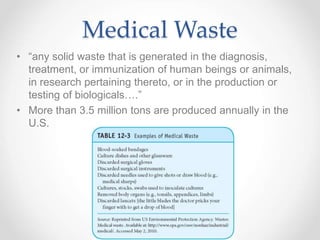
Medical Waste
• “any solid waste that is generated in the diagnosis,
treatment, or immunization of human beings or animals,
in research pertaining thereto, or in the production or
testing of biologicals….”
• More than 3.5 million tons are produced annually in the
U.S.
Medical Waste
Medical waste disposal methods
• Shredding and Chlorinating
o Reduces volume but comes with high costs and potential slurry
contamination
• Incinerator Technology
o High temperature combustion to destroy organics in waste
materials
o Multiple chamber incinerators, Rotary kiln incinerators, and
Controlled air incinerators
• Use of land disposal units is the most frequently
employed method for disposal of hazardous wastes
o Congress has mandated the treatment of hazardous wastes in an acceptable
manner prior to their disposal; uncontrolled disposal of untreated hazardous
wastes is forbidden because of potential hazards to our health and environment.
Sewage
• “The waste and wastewater produced by residential and
commercial sources and discharged into sewers.”
• Water containing human waste is known as sewage
o Usually about 1% of the content
o U.S. law requires the removal of human excrement in a sanitary
manner
• Prevents the pollution of ground and surface water, and
prevents insects (vectors) from picking up diseases to spread
• Treatment of human waste is divided into two main types:
o Non-water-carried
o Water-carried
Wastewater Treatment
• Non-water-carried systems
o Pit privy (pit latrine or outhouse)
• No water is available to flush waste away to a treatment plant
• Once full, hole is covered, and the structure is moved to a
new location
o Box and can
• Waste is contained until it can be removed and treated
• Used in “port-a-pots”, on buses, campers, planes, etc
Wastewater Treatment
• Individual water-carried systems
o Septic Tank System
• Waste water initially passes through a trap under the sink or
toilet before it continues through the pipes out the house
• The pipe then enters the septic tank
o Goal of a septic tank and drainfield system is to filter out as
much solid as possible then allow plants to draw the waste water
from the soil (transpiration)
• Evapotranspiration
o Roots of plants pull water from the soil to the surface
where it can evaporate
o This process creates clean water vapor
Wastewater Treatment
• Individual water-carried systems
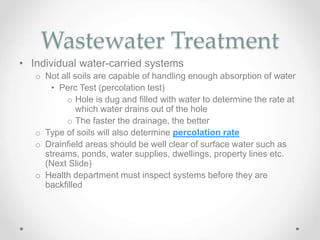
o Not all soils are capable of handling enough absorption of water
• Perc Test (percolation test)
o Hole is dug and filled with water to determine the rate at
which water drains out of the hole
o The faster the drainage, the better
o Type of soils will also determine percolation rate
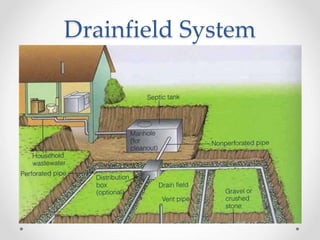
o Drainfield areas should be well clear of surface water such as
streams, ponds, water supplies, dwellings, property lines etc.
(Next Slide)
o Health department must inspect systems before they are
backfilled
Drainfield System
Wastewater Treatment
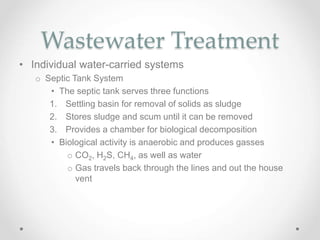
• Individual water-carried systems
o Septic Tank System
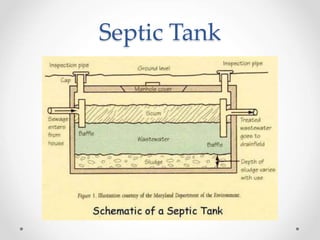
• The septic tank serves three functions
1. Settling basin for removal of solids as sludge
2. Stores sludge and scum until it can be removed
3. Provides a chamber for biological decomposition
• Biological activity is anaerobic and produces gasses
o CO2, H2S, CH4, as well as water
o Gas travels back through the lines and out the house
vent
Septic Tank
Municipal Wastewater
Treatment
• Modern technology involves :
o Removing solids
o Deactivating microbes
o Producing wastewater that can be returned safely to waterways
or in some cases can be reused or recycled.
• Wastewater exits a dwelling through the same pipes as it
would for a septic system
o Flows into a sanitary sewer to be transported to a treatment
facility
• Storm sewers however do not use the same pipes and do
not go to a treatment facility
o Wastewater that enters a treatment facility flows first through a
bar screen and grit chamber
Municipal Wastewater
Treatment
• Typically, sewage treatment involves three stages, called
primary, secondary and tertiary treatment.
• The primary stage aims to remove large materials, which
can be composted or shipped to landfills.
• Secondary processing promotes microbial digestion of
organic material that remains in the sewage.
o Microorganisms that are present naturally in sewage or that may be added to
enhance microbial action aid in the digestion of the liquor during aeration.
• Tertiary (high-level) processing is directed at removal of
remaining solids and microorganisms from the liquid
portion of sewage.
• Click here to view a video on this process
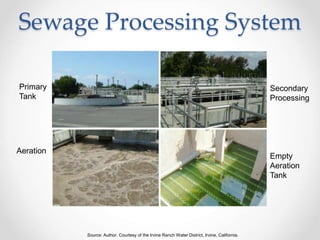
Sewage Processing System
Primary
Tank
Secondary
Processing
Aeration
Empty
Aeration
Tank
Source: Author. Courtesy of the Irvine Ranch Water District, Irvine, California.
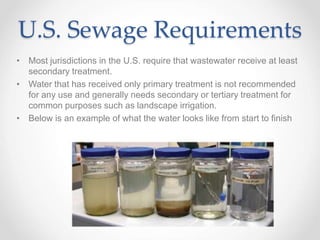
U.S. Sewage Requirements
• Most jurisdictions in the U.S. require that wastewater receive at least
secondary treatment.
• Water that has received only primary treatment is not recommended
for any use and generally needs secondary or tertiary treatment for
common purposes such as landscape irrigation.
• Below is an example of what the water looks like from start to finish
Composting toilets
Convert human excrement into a soil-like material that
must be buried or hauled away for disposal.
• They require little water to operate and contain and deactivate
pathogens in human wastes through aerobic bacterial action
Click to watch a video on how SOIL is changing sanitation
in developing countries
We all have to think about doing it differently to save water
and reduce water pollution which causes disease and
even death.
Wastewater stabilization ponds
• Used when treatment volume is low or areas cannot afford
treatment plants
• Uses large ponds with a depth of about 4 feet
• Uses biological decomposition to dispose of wastes
• Anaerobic process at the bottom creates gasses that
accelerates the aerobic activity towards the top
• The stabilization pond is designed to receive no more than 50
pounds of BOD 5 per day per acre.
o The biochemical oxygen demand , or BOD 5 , is the amount of
organic matter which can be biologically oxidized in 5 days at
20°C in the dark. This is a way of measuring how much organic
matter is in the water
• The effluent is chlorinated as it flows out of the pond into a
surface water supply
Wastewater stabilization ponds
Water Pollution
 According to the American College Dictionary, pollution is
defined as: “to make foul or unclean; dirty.”
 Two types of water pollutants exist - point source and
nonpoint source.
 Point sources of pollution occur when harmful substances are
emitted directly into a body of water.
The technology exists for point sources of pollution to be
monitored and regulated
 A nonpoint source delivers pollutants indirectly through
environmental changes.
Nonpoint sources are much more difficult to control.
Pollution arising from nonpoint sources accounts for a majority
of the contaminants in streams and lakes
Hazards Posed by Animal
Wastes
• Contamination from nutrients, organic materials,
microorganisms, residues of medicines, and potentially
toxic gases
• Workers in contact with livestock exposed to pathogenic
microorganisms
• Creation of antibiotic-resistant bacteria that may
endanger human health
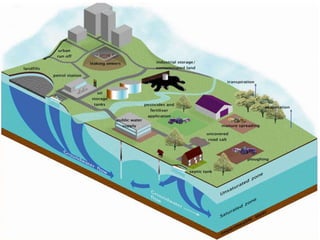
Groundwater Contamination
• Once dissolved, pollutants can move along with water to
holding areas
o Plume
• Area of contaminated ground water
• May be several miles long
o Light non-aqueous phase liquids
• Liquid contaminants that are lighter than water witch will then
float towards the top
o Dense non-aqueous phase liquids
• Dense contaminant that forms pools at the bottom of an
aquifer
Conclusion
• Before the 20th century, solid waste was dumped onto the land, and liquid
waste from human and animal excrement flowed through open sewers
without much regard for the environmental consequences of such disposal
methods.
• With increasing industrialization and growing populations worldwide, solid
and liquid wastes threaten the environment and require safe methods for
their disposal.
• Progress has been made in source reduction and recycling municipal solid
waste and industrial waste.
• Incineration and use of specially designed land disposal units that prevent
toxic chemicals from reaching groundwater are two common methods for
solid waste disposal.
• Through high-level processing, wastewater can be made suitable for
recycling.
• We must all do our part to reduce pollution by reducing toxic materials we
are flushing, pouring down our drains, or discarding into the storm drains.

HLTH 104 Chapter 12 1

  • 1.
    Chapter 12 Solid andLiquid Wastes
  • 2.
    Learning Objectives By theend of this chapter the reader will be able to: • Describe trends in the production of solid waste • Discuss methods for source reduction of solid waste • Discuss the role of landfills for disposing of solid waste • Describe methods for primary, secondary, and tertiary sewage treatment • Discuss hazards of poorly designed solid waste disposal sites and improperly processed sewage
  • 3.
    Introduction • Ecosystems producewaste, and that waste needs to be appropriately disposed of or it would eventually destroy the ecosystem • Problems arise when the waste is not organically based and the number of single use items increases o Decomposition is reduced and wastes build up • The issues are: o Incinerators of the past are not ideal o Increases in pollution of aquatic environments o We are slowly running out of space for this waste so as a society we need to take a serious look at how we use, re-use, and dispose of waste
  • 4.
    Municipal Solid Waste(MSW) • Americans produce over 260 million tons of MSW (before recycling) each year. (See Figure 12.2 next slide) • About 4.5 pounds of waste per person per day
  • 5.
    Figure 12.2 Municipalsolid waste generation rates, 1960 to 2018.
  • 6.
    Storage of MSW •Most homes use various receptacles to accumulate waste until it can be removed o Long term receptacles should be “fly-tight” and non-corrosive o Can be lined with bags for easy disposal or cleaned after they are emptied • Large-volume receptacles are used at businesses or multi- housing areas • Should be collected at least once per week (most areas it is twice) o Schedule is suggested based on the life cycle of the house fly (eggs mature into adults in about 8 days) o Collecting refuse weekly controls the fly population • Collection is through a private or government operation • Trucks must meet certain specifications for transporting and compacting refuse
  • 7.
    Components of theMSW Stream • Food waste • Papers • Batteries • Organic materials • Packaging • Furniture • Clothing • Bottles
  • 8.
    MSW Disposal • Formerlycompleted through open-dumping and incineration which of course is not ideal • The EPA recommends that wastes are handled in other manners because of disease and other hazards to the environment • The hierarchy of management: o Source Reduction and reuse o Recycle-Composting o Waste to Energy (WTE) o Treatment and disposal
  • 9.
    Source Reduction • Sourcereduction refers to “reducing the amount of waste created, reusing whenever possible, and then recycling what is left.” • Environmentally preferred strategy • Achieved by reducing the amount of hazardous components in products, eliminating excess packaging, and making products last longer o Incentivize the public to throw out less (PAYT program) o Design products so that they last longer o Design products that have a secondary use
  • 10.
    Recycling • The EPAdefines recycling (reuse) as the process of “Minimizing waste generation by recovering and reprocessing usable products that might otherwise become waste.” (i.e., recycling of aluminum cans, paper, and bottles, etc.) • Collection of materials to be used to make new products • Reduces the need for virgin sources, saves energy, and creates jobs • Still don’t or can’t recycle as much as we should • Click here to go to Harford County’s site about recycling
  • 11.
    Recycling • We allneed to recycle like this guy…
  • 12.
  • 13.
    Click on boxbelow to view a video on bottle recycling. (Click again to pause. Click outside of box to advance slide)
  • 14.
    Advantages of Recycling •Reduces emissions of greenhouse gases • Prevents pollution generated by the use of new materials • Decreases the amount of materials shipped to landfills • Preserves natural resources • Opens up new manufacturing employment opportunities • Saves energy
  • 15.
    Composting • “the aerobicbiological decomposition of organic materials [e.g., leaves, grass, and food scraps] to produce a stable humus-like product…. Biodegradation is a natural, ongoing biological process that is a common occurrence in both human-made and natural environments.” • Materials must be separated and non biodegradable materials disposed of in some other manner o See Table 12.2 in the text for materials to include or exclude • Produces a useful material that resembles soil and that can be used in gardening. • Most modern composting uses aerobic methods to reduce odor.
  • 16.
    Composting Success • Thestate of Massachusetts has one of the most successful composting programs in the U.S. • Yard and food waste are composted, preventing 37,500 tons of waste from entering the disposal process and saving approximately $2 million each year. • San Francisco, the leading city for recycling in the United States, has achieved an 80% reduction of wastes going to landfills. • Most areas are forced to adopt these ideas because they have limited space, poor soil, or financial can’t afford to ship out wastes anymore.
  • 17.
    Landfill Design • Solidwaste buried in sections and covered with soil • Class I facilities serve municipal, institutional, residential and rural populations • Constructed to prevent any leaching of waste into ground or surface water o Water that collects contaminants as it trickles through wastes, pesticides or fertilizers. Leaching may occur in farming areas, feedlots, and landfills, and may result in hazardous substances entering surface water, ground water, or soil. • A landfill is composed of four major parts: o a bottom liner o a system for collecting leachates o a cover o an appropriate location that minimizes the leaching of waste into groundwater
  • 18.
    How a LandfillWorks • The bottom is lined with a dense layer of clay and sealed with thick plastic sheeting to contain leaks of hazardous materials. • A flexible membrane liner holds in toxic chemicals that might contaminate groundwater. • A leachate sump collects leachates, which then can be subjected to further treatment. • Garbage is piled up in rows; bulldozers and rollers compact the garbage; at the end of the day, the newly added garbage is covered with soil and other materials. • After the garbage is covered, anaerobic bacteria aid in the decomposition of organic materials and produce methane gas.
  • 19.
    Side View ofa Landfill
  • 20.
    Dangers Associated withLandfills • Air pollution and groundwater contamination • Leachates, which may include: o Toxic heavy metals o Solvents and cleaning agents. • Methane, volatile organic compounds (VOCs), and other gases o Methane vented from landfills poses a fire hazard and is a greenhouse gas. • VOC emissions o Potentially carcinogenic o May cause complaints about odors and symptoms of respiratory irritation
  • 21.
    Megafills • Newer designsfor landfills were adopted in 1988 which took 10,000 smaller sites and combined them to 3500 larger (megafills) sites. • These take in 5,000–10,000 tons of trash per day and serve regional needs for waste disposal • Tend to be more cost effective than incinerators for disposal of solid waste • The new standards are on the following slide, but the details can be found in the text
  • 22.
    Federal Landfill Standards (Ineffect since 1988) 1. Location restrictions 2. Composite liners requirements 3. Leachate collection and removal systems 4. Groundwater monitoring requirements 5. Closure and postclosure care requirements 6. Corrective action provisions 7. Financial assurance Source: Adapted and reprinted from US Environmental Protection Agency. Municipal Solid Waste: Landfills. Available at: http://www.epa.gov/osw/nonhaz/minicipal/landfill.htm. Accessed March 25. 2010.
  • 23.
    Waste-to-Energy • Burn municipalwaste to generate steam for electricity • Can decrease waste volume by 60 to 90%, while recovering energy from discarded products • Over 100 plants in the U.S.
  • 24.
    Incineration • Can beused to generate energy while at the same time reducing the volume and weight of waste. • No attempt is made to separate the trash into components; at the high temperatures of incinerating plants, glass and aluminum in the trash melt. • Metals from the residues of combustion can be recycled into scrap metal; remaining ash is deposited in landfills. • Wheelabrator Technologies in Baltimore (Fig 12-10) o Produces about 60,000 KW which can power about 40,000 homes
  • 25.
    Disadvantages of Incineration •Emissions may be potentially hazardous to human health and the environment. • Toxic materials emitted may cause air pollution or be deposited on the land. o polychlorinated biphenyls (PCBs), cadmium, and heavy metals, as well as other potentially carcinogenic substances.
  • 26.
    Hazardous Materials andWastes • What is a hazardous waste? • Hazardous wastes are disposed of legally in the U.S. by: o Discarding them on the surface of the land o Storing them in slurry ponds o Dumping them into landfills or into the ocean o Incineration
  • 27.
    Hazardous Materials andWastes Characteristics… • Corrosive o Chemically wearing away substances o pH below 2 or above 12.5 • Toxic o Poisonous to people and other organisms • Ignitable o Capable of bursting into flames • Reactive o Capable of exploding or releasing poisonous gas when mixed with another substance or chemical
  • 28.
    Sources of HazardousWastes Americans produce about 1.6 million tons of hazardous waste per year… Hazardous materials used in the home • Pesticides, cleaning products, automotive products, painting supplies, and other flammable and nonflammable products Medical waste • Chemicals, infectious agents, and radioactive materials Industrial hazardous waste • Heavy metals from plating operations, toxic chemicals, solvents, and residues from the manufacture of pesticides
  • 29.
    Sources of HazardousWastes (continued) Radioactive waste • Spent nuclear fuel and tailings from uranium processing • Proposed Yucca Mountain site for this waste Mining wastes and extraction wastes • Toxic chemicals left over from mining operations include acids and heavy metals.
  • 30.
    Hazardous Waste Problem •More than 400 million tons are generated worldwide on an annual basis. • Developed world generates most of the toxic wastes. • Some developing nations will take hazardous wastes for cash payments; this practice may endanger the health of the local population. o In 1989, the U.N. enacted a treaty to regulate the transport and disposal of hazardous waste in a safe manner, after a vessel from the U.S. dumped leftover hazardous cargo off the coast of Africa.
  • 31.
    Hazardous Waste Problem •How hazardous waste released into the environment can affect plants (flora) or animals (fauna) in an ecosystem. o Gaps in vital food chains or nutrient cycles o Reproductive problems o Developmental effects o Tumors o Critical organ damage o Immune system dysfunction o Altered individual or population growth rates o Changes in population and community organization o Loss of total biomass o Relative loss of taxa or species abundance in defined areas o Loss of species diversity.
  • 32.
    Uncontrolled Hazardous Waste Sitesin the U.S. • An estimated 40,000 of these sites have been reported to federal agencies. • 1,300 sites are on the National Priorities List (NPL). • Superfund legislation mandates the cleanup of hazardous waste sites. • See chapter 4 about Superfund legislation.
  • 33.
    Impacts of UncontrolledSites • Potential adverse human health effects • High costs of cleanup • Reductions in property values • Potential ecological damage • Example next slide…
  • 34.
    Love Canal • Wasthe former site for disposal of toxic wastes • Later used for residential construction • Became identified with hazardous chemical exposures and their possible harmful influences on human health • Led to the creation of the EPA’s Superfund Program
  • 35.
    Medical Waste • “anysolid waste that is generated in the diagnosis, treatment, or immunization of human beings or animals, in research pertaining thereto, or in the production or testing of biologicals….” • More than 3.5 million tons are produced annually in the U.S.
  • 36.
    Medical Waste Medical wastedisposal methods • Shredding and Chlorinating o Reduces volume but comes with high costs and potential slurry contamination • Incinerator Technology o High temperature combustion to destroy organics in waste materials o Multiple chamber incinerators, Rotary kiln incinerators, and Controlled air incinerators • Use of land disposal units is the most frequently employed method for disposal of hazardous wastes o Congress has mandated the treatment of hazardous wastes in an acceptable manner prior to their disposal; uncontrolled disposal of untreated hazardous wastes is forbidden because of potential hazards to our health and environment.
  • 37.
    Sewage • “The wasteand wastewater produced by residential and commercial sources and discharged into sewers.” • Water containing human waste is known as sewage o Usually about 1% of the content o U.S. law requires the removal of human excrement in a sanitary manner • Prevents the pollution of ground and surface water, and prevents insects (vectors) from picking up diseases to spread • Treatment of human waste is divided into two main types: o Non-water-carried o Water-carried
  • 38.
    Wastewater Treatment • Non-water-carriedsystems o Pit privy (pit latrine or outhouse) • No water is available to flush waste away to a treatment plant • Once full, hole is covered, and the structure is moved to a new location o Box and can • Waste is contained until it can be removed and treated • Used in “port-a-pots”, on buses, campers, planes, etc
  • 39.
    Wastewater Treatment • Individualwater-carried systems o Septic Tank System • Waste water initially passes through a trap under the sink or toilet before it continues through the pipes out the house • The pipe then enters the septic tank o Goal of a septic tank and drainfield system is to filter out as much solid as possible then allow plants to draw the waste water from the soil (transpiration) • Evapotranspiration o Roots of plants pull water from the soil to the surface where it can evaporate o This process creates clean water vapor
  • 40.
    Wastewater Treatment • Individualwater-carried systems o Not all soils are capable of handling enough absorption of water • Perc Test (percolation test) o Hole is dug and filled with water to determine the rate at which water drains out of the hole o The faster the drainage, the better o Type of soils will also determine percolation rate o Drainfield areas should be well clear of surface water such as streams, ponds, water supplies, dwellings, property lines etc. (Next Slide) o Health department must inspect systems before they are backfilled
  • 41.
  • 42.
    Wastewater Treatment • Individualwater-carried systems o Septic Tank System • The septic tank serves three functions 1. Settling basin for removal of solids as sludge 2. Stores sludge and scum until it can be removed 3. Provides a chamber for biological decomposition • Biological activity is anaerobic and produces gasses o CO2, H2S, CH4, as well as water o Gas travels back through the lines and out the house vent
  • 43.
  • 44.
    Municipal Wastewater Treatment • Moderntechnology involves : o Removing solids o Deactivating microbes o Producing wastewater that can be returned safely to waterways or in some cases can be reused or recycled. • Wastewater exits a dwelling through the same pipes as it would for a septic system o Flows into a sanitary sewer to be transported to a treatment facility • Storm sewers however do not use the same pipes and do not go to a treatment facility o Wastewater that enters a treatment facility flows first through a bar screen and grit chamber
  • 45.
    Municipal Wastewater Treatment • Typically,sewage treatment involves three stages, called primary, secondary and tertiary treatment. • The primary stage aims to remove large materials, which can be composted or shipped to landfills. • Secondary processing promotes microbial digestion of organic material that remains in the sewage. o Microorganisms that are present naturally in sewage or that may be added to enhance microbial action aid in the digestion of the liquor during aeration. • Tertiary (high-level) processing is directed at removal of remaining solids and microorganisms from the liquid portion of sewage. • Click here to view a video on this process
  • 46.
    Sewage Processing System Primary Tank Secondary Processing Aeration Empty Aeration Tank Source:Author. Courtesy of the Irvine Ranch Water District, Irvine, California.
  • 47.
    U.S. Sewage Requirements •Most jurisdictions in the U.S. require that wastewater receive at least secondary treatment. • Water that has received only primary treatment is not recommended for any use and generally needs secondary or tertiary treatment for common purposes such as landscape irrigation. • Below is an example of what the water looks like from start to finish
  • 48.
    Composting toilets Convert humanexcrement into a soil-like material that must be buried or hauled away for disposal. • They require little water to operate and contain and deactivate pathogens in human wastes through aerobic bacterial action Click to watch a video on how SOIL is changing sanitation in developing countries We all have to think about doing it differently to save water and reduce water pollution which causes disease and even death.
  • 49.
    Wastewater stabilization ponds •Used when treatment volume is low or areas cannot afford treatment plants • Uses large ponds with a depth of about 4 feet • Uses biological decomposition to dispose of wastes • Anaerobic process at the bottom creates gasses that accelerates the aerobic activity towards the top • The stabilization pond is designed to receive no more than 50 pounds of BOD 5 per day per acre. o The biochemical oxygen demand , or BOD 5 , is the amount of organic matter which can be biologically oxidized in 5 days at 20°C in the dark. This is a way of measuring how much organic matter is in the water • The effluent is chlorinated as it flows out of the pond into a surface water supply
  • 50.
  • 51.
    Water Pollution  Accordingto the American College Dictionary, pollution is defined as: “to make foul or unclean; dirty.”  Two types of water pollutants exist - point source and nonpoint source.  Point sources of pollution occur when harmful substances are emitted directly into a body of water. The technology exists for point sources of pollution to be monitored and regulated  A nonpoint source delivers pollutants indirectly through environmental changes. Nonpoint sources are much more difficult to control. Pollution arising from nonpoint sources accounts for a majority of the contaminants in streams and lakes
  • 52.
    Hazards Posed byAnimal Wastes • Contamination from nutrients, organic materials, microorganisms, residues of medicines, and potentially toxic gases • Workers in contact with livestock exposed to pathogenic microorganisms • Creation of antibiotic-resistant bacteria that may endanger human health
  • 53.
    Groundwater Contamination • Oncedissolved, pollutants can move along with water to holding areas o Plume • Area of contaminated ground water • May be several miles long o Light non-aqueous phase liquids • Liquid contaminants that are lighter than water witch will then float towards the top o Dense non-aqueous phase liquids • Dense contaminant that forms pools at the bottom of an aquifer
  • 55.
    Conclusion • Before the20th century, solid waste was dumped onto the land, and liquid waste from human and animal excrement flowed through open sewers without much regard for the environmental consequences of such disposal methods. • With increasing industrialization and growing populations worldwide, solid and liquid wastes threaten the environment and require safe methods for their disposal. • Progress has been made in source reduction and recycling municipal solid waste and industrial waste. • Incineration and use of specially designed land disposal units that prevent toxic chemicals from reaching groundwater are two common methods for solid waste disposal. • Through high-level processing, wastewater can be made suitable for recycling. • We must all do our part to reduce pollution by reducing toxic materials we are flushing, pouring down our drains, or discarding into the storm drains.