LANDFILL SYSTEM A.V.N.S.GUNASRI
Topics of discussion Introduction to landfill Types of landfills Methods of landfill Landfill operation Landfill gas Leachate Landfill liners Final and Post Closure
LANDFILL Landfill , is a site for the engineered disposal of waste materials by burial in the earth’s crust. Most common method. Energy efficient process. Cost effective process.
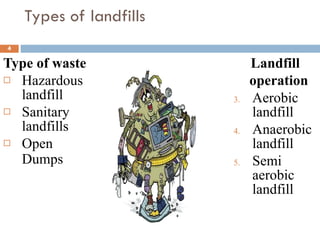
Types of landfills Type of waste Hazardous landfill  Sanitary landfills  Open Dumps   Landfill operation Aerobic landfill Anaerobic landfill Semi aerobic landfill
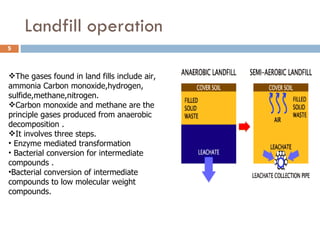
Landfill operation  The gases found in land fills include air, ammonia Carbon monoxide,hydrogen, sulfide,methane,nitrogen. Carbon monoxide and methane are the principle gases produced from anaerobic decomposition . It involves three steps. Enzyme mediated transformation Bacterial conversion for intermediate  compounds . Bacterial conversion of intermediate compounds to low molecular weight compounds.
Methods of landfill Area method Trench method  Open pit method Canyon method.
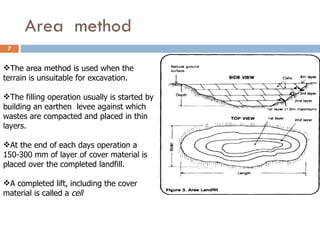
Area  method The area method is used when the terrain is unsuitable for excavation. The filling operation usually is started by building an earthen  levee against which wastes are compacted and placed in thin layers. At the end of each days operation a 150-300 mm of layer of cover material is placed over the completed landfill. A completed lift, including the cover material is called a  cell
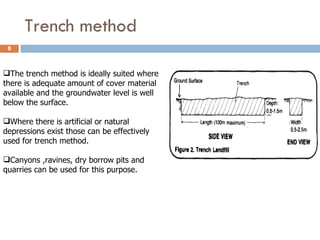
Trench method The trench method is ideally suited where there is adequate amount of cover material available and the groundwater level is well below the surface. Where there is artificial or natural depressions exist those can be effectively used for trench method. Canyons ,ravines, dry borrow pits and quarries can be used for this purpose.
Landfill Design & Operation Design Considerations Geometry of cell Support material Leachate collection LFG collection Final closure Liners
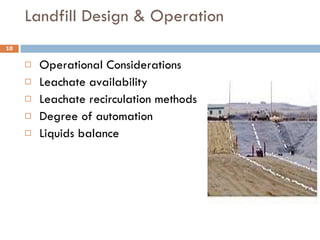
Landfill Design & Operation Operational Considerations Leachate availability Leachate recirculation methods Degree of automation Liquids balance
Steps to be followed for landfill design  Establish Design Criteria Obtain Data Necessary for Design Prepare Preliminary Layouts and Design Prepare Operations and Maintenance Plan
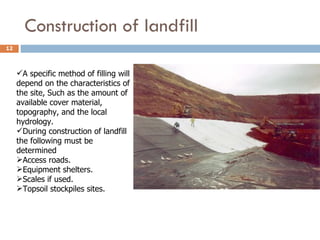
Construction of landfill A specific method of filling will  depend on the characteristics of the site, Such as the amount of available cover material, topography, and the local hydrology. During construction of landfill the following must be determined Access roads. Equipment shelters. Scales if used. Topsoil stockpiles sites.
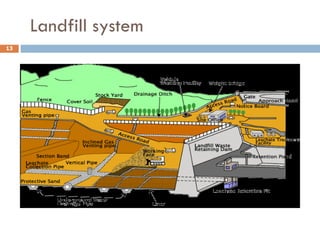
Landfill system
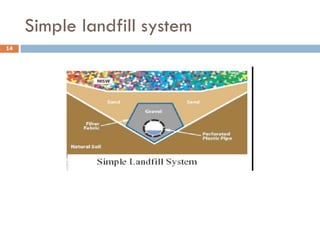
Simple landfill system
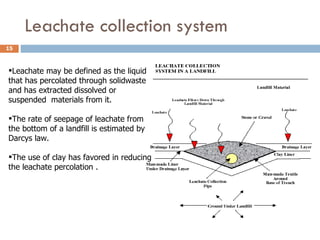
Leachate collection system Leachate may be defined as the liquid  that has percolated through solidwaste and has extracted dissolved or suspended  materials from it. The rate of seepage of leachate from the bottom of a landfill is estimated by Darcys law. The use of clay has favored in reducing the leachate percolation .
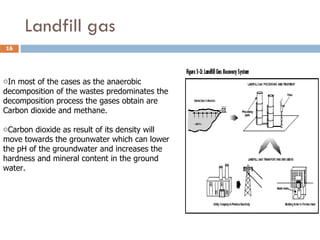
Landfill gas In most of the cases as the anaerobic decomposition of the wastes predominates the decomposition process the gases obtain are  Carbon dioxide and methane. Carbon dioxide as result of its density will move towards the grounwater which can lower the pH of the groundwater and increases the hardness and mineral content in the ground water.
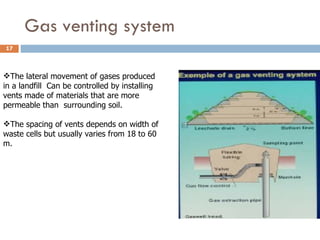
Gas venting system The lateral movement of gases produced in a landfill  Can be controlled by installing vents made of materials that are more permeable than  surrounding soil. The spacing of vents depends on width of waste cells but usually varies from 18 to 60 m.
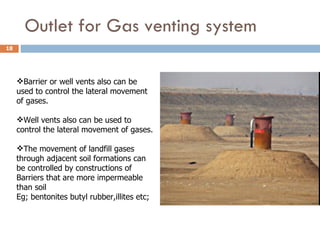
Outlet for Gas venting system Barrier or well vents also can be used to control the lateral movement of gases. Well vents also can be used to control the lateral movement of gases. The movement of landfill gases through adjacent soil formations can be controlled by constructions of  Barriers that are more impermeable than soil Eg; bentonites butyl rubber,illites etc;
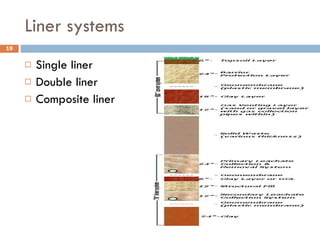
Liner systems Single liner Double liner Composite liner
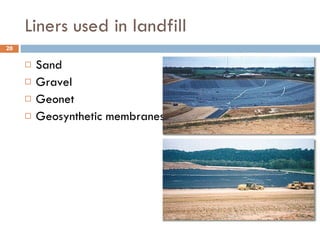
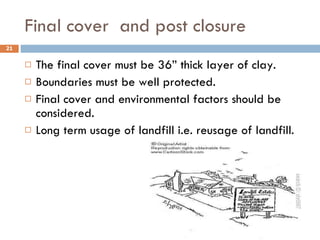
Liners used in landfill Sand  Gravel Geonet Geosynthetic membranes
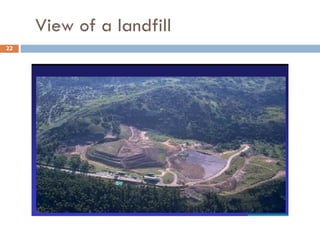
Final cover  and post closure The final cover must be 36” thick layer of clay. Boundaries must be well protected. Final cover and environmental factors should be considered. Long term usage of landfill i.e. reusage of landfill.
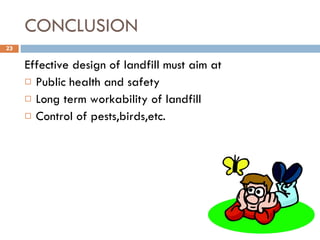
View of a landfill
CONCLUSION Effective design of landfill must aim at Public health and safety Long term workability of landfill Control of pests,birds,etc.
REFERENCES Environmental engineering- Peavy Urban environmental engineering and management- Dr. J.Trankler.
Landfill revised

Landfill revised

  • 1.
  • 2.
    Topics of discussionIntroduction to landfill Types of landfills Methods of landfill Landfill operation Landfill gas Leachate Landfill liners Final and Post Closure
  • 3.
    LANDFILL Landfill ,is a site for the engineered disposal of waste materials by burial in the earth’s crust. Most common method. Energy efficient process. Cost effective process.
  • 4.
    Types of landfillsType of waste Hazardous landfill Sanitary landfills Open Dumps Landfill operation Aerobic landfill Anaerobic landfill Semi aerobic landfill
  • 5.
    Landfill operation The gases found in land fills include air, ammonia Carbon monoxide,hydrogen, sulfide,methane,nitrogen. Carbon monoxide and methane are the principle gases produced from anaerobic decomposition . It involves three steps. Enzyme mediated transformation Bacterial conversion for intermediate compounds . Bacterial conversion of intermediate compounds to low molecular weight compounds.
  • 6.
    Methods of landfillArea method Trench method Open pit method Canyon method.
  • 7.
    Area methodThe area method is used when the terrain is unsuitable for excavation. The filling operation usually is started by building an earthen levee against which wastes are compacted and placed in thin layers. At the end of each days operation a 150-300 mm of layer of cover material is placed over the completed landfill. A completed lift, including the cover material is called a cell
  • 8.
    Trench method Thetrench method is ideally suited where there is adequate amount of cover material available and the groundwater level is well below the surface. Where there is artificial or natural depressions exist those can be effectively used for trench method. Canyons ,ravines, dry borrow pits and quarries can be used for this purpose.
  • 9.
    Landfill Design &Operation Design Considerations Geometry of cell Support material Leachate collection LFG collection Final closure Liners
  • 10.
    Landfill Design &Operation Operational Considerations Leachate availability Leachate recirculation methods Degree of automation Liquids balance
  • 11.
    Steps to befollowed for landfill design Establish Design Criteria Obtain Data Necessary for Design Prepare Preliminary Layouts and Design Prepare Operations and Maintenance Plan
  • 12.
    Construction of landfillA specific method of filling will depend on the characteristics of the site, Such as the amount of available cover material, topography, and the local hydrology. During construction of landfill the following must be determined Access roads. Equipment shelters. Scales if used. Topsoil stockpiles sites.
  • 13.
  • 14.
  • 15.
    Leachate collection systemLeachate may be defined as the liquid that has percolated through solidwaste and has extracted dissolved or suspended materials from it. The rate of seepage of leachate from the bottom of a landfill is estimated by Darcys law. The use of clay has favored in reducing the leachate percolation .
  • 16.
    Landfill gas Inmost of the cases as the anaerobic decomposition of the wastes predominates the decomposition process the gases obtain are Carbon dioxide and methane. Carbon dioxide as result of its density will move towards the grounwater which can lower the pH of the groundwater and increases the hardness and mineral content in the ground water.
  • 17.
    Gas venting systemThe lateral movement of gases produced in a landfill Can be controlled by installing vents made of materials that are more permeable than surrounding soil. The spacing of vents depends on width of waste cells but usually varies from 18 to 60 m.
  • 18.
    Outlet for Gasventing system Barrier or well vents also can be used to control the lateral movement of gases. Well vents also can be used to control the lateral movement of gases. The movement of landfill gases through adjacent soil formations can be controlled by constructions of Barriers that are more impermeable than soil Eg; bentonites butyl rubber,illites etc;
  • 19.
    Liner systems Singleliner Double liner Composite liner
  • 20.
    Liners used inlandfill Sand Gravel Geonet Geosynthetic membranes
  • 21.
    Final cover and post closure The final cover must be 36” thick layer of clay. Boundaries must be well protected. Final cover and environmental factors should be considered. Long term usage of landfill i.e. reusage of landfill.
  • 22.
    View of alandfill
  • 23.
    CONCLUSION Effective designof landfill must aim at Public health and safety Long term workability of landfill Control of pests,birds,etc.
  • 24.
    REFERENCES Environmental engineering-Peavy Urban environmental engineering and management- Dr. J.Trankler.