SOILD PHASE
SYNTHESIS
Dr.Gurumeet C Wadhawa ,Assistant Professor, Department
of Chemistry.
Rayat Shikshan sansthas Veer Wajekar ASC
College,Phunde,Uran
CONTENTS
INTRODUCTION
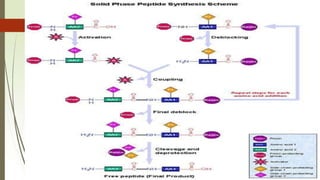
PLANING OF SOLID PHASE SYNTHESIS
EXAMPLE OF SOLID PHASE SYNTHESIS
ADVANTAGES
DISADVANTAGES
APPLICATION
INTRODUCTION
“Solid phase synthesis is heterogeneous reaction in which a
reagent is coupled to a solid support via chemical functionality
present on solid support. A multistep synthesis on solid phase then
transforms the bound intermediate into the target molecule but
eventually cleaved from support. This technique is called as solid
phase synthesis”
Solid phase synthesis was invented by Bruce Merrifield in
1963
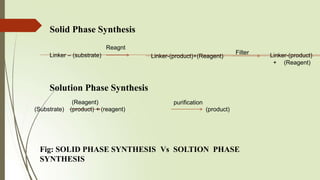
Linker – (substrate)
Reagnt
Linker-(product)+(Reagent)
Filter Linker-(product)
+ (Reagent)
(product)
purification
Fig: SOLID PHASE SYNTHESIS Vs SOLTION PHASE
SYNTHESIS
Solid Phase Synthesis
Solution Phase Synthesis
(Reagent)
(Substrate) (product) + (reagent)
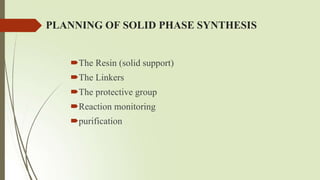
PLANNING OF SOLID PHASE SYNTHESIS
The Resin (solid support)
The Linkers
The protective group
Reaction monitoring
purification
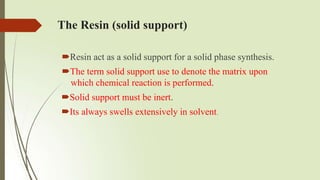
The Resin (solid support)
Resin act as a solid support for a solid phase synthesis.
The term solid support use to denote the matrix upon
which chemical reaction is performed.
Solid support must be inert.
Its always swells extensively in solvent.
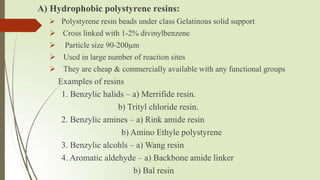
A) Hydrophobic polystyrene resins:
 Polystyrene resin beads under class Gelatinous solid support
 Cross linked with 1-2% divinylbenzene
 Particle size 90-200µm
 Used in large number of reaction sites
 They are cheap & commercially available with any functional groups
Examples of resins
1. Benzylic halids – a) Merrifide resin.
b) Trityl chloride resin.
2. Benzylic amines – a) Rink amide resin
b) Amino Ethyle polystyrene
3. Benzylic alcohls – a) Wang resin
4. Aromatic aldehyde – a) Backbone amide linker
b) Bal resin
B) Hybrite Hydrophilic Polystyrene Resin
(HHPSR):
A major drawback of hydrophilic PS resin is poor swelling in protic
solvent. Thus support is prepared by grafting hydrophilic mono-
functional or bi-functional polystyrene glycol (PEG).
Examples ChemMatriex
1 It has chemical and thermal stability
2 Compatible with microwave
3 High degree of swelling in acetonitrile, DMF, TFA
4 Used for synthesis of difficult and long peptides.
1 Hydrophobic polystyrene resins: 1.Benzylic Halide Type
a) Merrifie Resin
Attachment - Carboxylic acid, Alcohol, Phenol.
Cleavage – Strong acidic condition
Application - Peptide synthesis
b) Trityle chloride Resin
Attachment - Carboxylic acid, Alcohol, Amine. Cleavage
– Mild acidic condition
Application - Peptide synthesis, Alcohol & Amine synthsis.
2 Benzylic Amine Type resin
Attachment - Carboxylic acid , alcohol , Phenol.
Cleavage – Mild acidic condition.
Application - Peptide synthesis( Aryle & Alkyle carboxamide)
3 Benzylic alcohol Type Resin
Attachment - Carboxylic acid.
Cleavage – Acidic condition.
Application - Peptide synthesis.
4 Aromatic Aldehyde Type Resin Attachment – Primary Amine.
Cleavage – Mild acidic condition.
Application - Peptide synthesis.
The Linker
Linker referred as a handle to attach the small molecule onto
polymeric resin Linkers has many similarities to protecting
group in solid phase synthesis.
Properties of linkers which may assist Solid phase synthesis are:
 Stable to the reaction conditions
 Cleaved selectively at the end of synthesis
 Re-useable
 Facilitate reactions monitoring
 Sequential / Partial release
 Easy to prepared
 It should be highly selective to one or most small number of
specific cleavage reagents/ conditions.
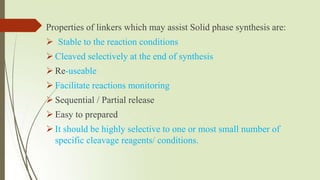
TYPES OF LINKERS
1 Acid-Cleavable Anchors and Linker:
SPS of peptides was developed using this type of linkers
Fig: Acid labile, commercialy available SP Linker
SPS
30°C RT
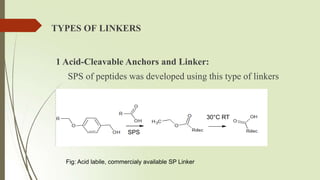
2) Base / Nucleophil-Laibale linkers:
The commonly used Fmoc peptide coupling protocols
required Fmoc deprotection under basic conditions during
synthesis.
R-COOR
SPS
20% DMF
2hr,RT
FIG : Base/ Nucleophilic Laibale Linker
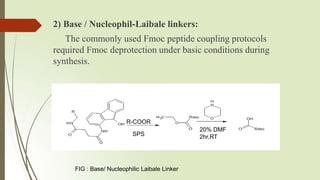
3) Photo Labile Linkers
The light is used to break the bond between the intermediate and the
linker and releases pure compound from the SPS into solution without
interference from side produced .
R-COOH
SPS
350nm HOOC-
Rdc
MeOH, 24 hr,RT
Fig : photo labile SP Linker
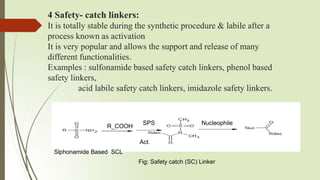
4 Safety- catch linkers:
It is totally stable during the synthetic procedure & labile after a
process known as activation
It is very popular and allows the support and release of many
different functionalities.
Examples : sulfonamide based safety catch linkers, phenol based
safety linkers,
acid labile safety catch linkers, imidazole safety linkers.
SPS
R_COOH
Nucleophile
Act.
Slphonamide Based SCL
Fig: Safety catch (SC) Linker
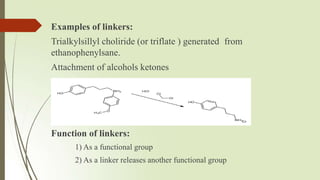
Examples of linkers:
Trialkylsillyl choliride (or triflate ) generated from
ethanophenylsane.
Attachment of alcohols ketones
Function of linkers:
1) As a functional group
2) As a linker releases another functional group
Procteive group
Due to amino acid excess used to ensure complete during each
synthesis step, polymerization of amino acids is common in reactions
where each amino acid is not protected. In order to prevent this
polymerization , protecting group are used.
Examples :
1) Fomac protective group
[ fomac (9 H- fluoren -9-ylmethoxycarbonyl)
it is currently widely useds group that removed the N- terminal of
peptide in synthesis of a peptide from amino acid terminal.
ACTUAL PROCESS IN SPS
1st Step: In this the stating molecule to an inert solid.
Typically inert polymers or resin are used. These are commercially available.
2nd Step: Here, Solid are deep into solution containing subsequent reagent next they
can be removed from the dip and placed into a ash solution.
3rd Step: After all reactions are don the product is still attached to the insoluble
bead Product Can be washed in a reaction well excess solvent is washed out finally
the product is cleaved from the bead and isolated.
Washing: After each synthetic step and prior to cleavage the solid support must be
exhaustically washed with large vol. of solvent.
Purifications: purification is done by semi preprative HPLC utilizing.
ADVANTAGES
 Over all process is quick
 Purification of each product can be achieved in one step. Only
purification technique is filtration.
 Purification in each step is possible.
 Synthetic intermediates don’t have to be isolated.
 Can be automated with Roberts.
 Use of solvent are minimized.
 Less health hazards and eco- friendly and hence follows the
principle of GREEN CHEMISTRY.
DISADVANTAGES
 High chemical consume.
 Expensive.
 Low reaction rates.
 Special substances needed.
 It produces very few molecules at a time for testing.
 Solid phase synthesis without using any solvents.
APPLICATION
Combinatorial synthesis f solid phase
Peptide synthesis
In DNA synthesis
In various reactions
Clainsan rearrangement
Beckmann rearrangement
Organic synthesis
27.18
Solid-Phase Peptide Synthesis:
The Merrifield Method
Solid-Phase Peptide Synthesis
In solid-phase synthesis, the starting material is bonded to an inert solid support.
Reactants are added in solution.
Reaction occurs at the interface between the solid and the solution. Because the starting material is bonded to
the solid, any product from the starting material remains bonded as well.
Purification involves simply washing the byproducts from the solid support.
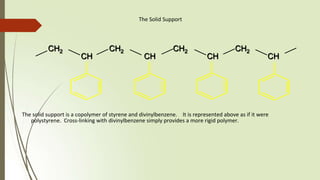
The Solid Support
The solid support is a copolymer of styrene and divinylbenzene. It is represented above as if it were
polystyrene. Cross-linking with divinylbenzene simply provides a more rigid polymer.
CH2 CH2 CH2 CH2
CH CH CH CH
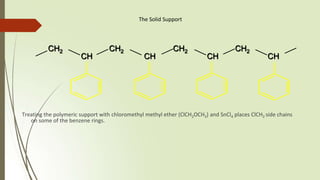
The Solid Support
Treating the polymeric support with chloromethyl methyl ether (ClCH2OCH3) and SnCl4 places ClCH2 side chains
on some of the benzene rings.
CH2 CH2 CH2 CH2
CH CH CH CH
The Solid Support
CH2 CH2 CH2 CH2
CH CH CH CH
CH2Cl
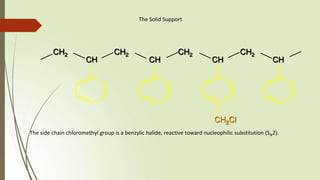
The side chain chloromethyl group is a benzylic halide, reactive toward nucleophilic substitution (SN2).
The Solid Support
CH2 CH2 CH2 CH2
CH CH CH CH
CH2Cl
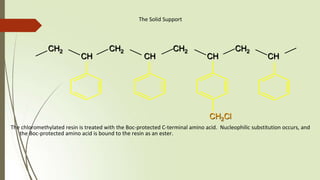
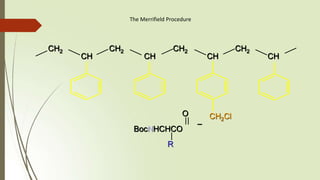
The chloromethylated resin is treated with the Boc-protected C-terminal amino acid. Nucleophilic substitution occurs, and
the Boc-protected amino acid is bound to the resin as an ester.
The Merrifield Procedure
CH2 CH2 CH2 CH2
CH CH CH CH
CH2Cl
BocNHCHCO
R
O
–
The Merrifield Procedure
BocNHCHCO
R
O
CH2 CH2 CH2 CH2
CH CH CH CH
CH2
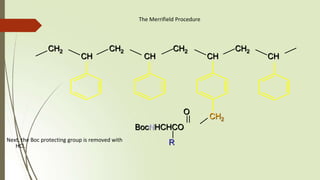
Next, the Boc protecting group is removed with
HCl.
The Merrifield Procedure
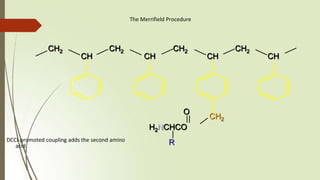
H2NCHCO
R
CH2 CH2 CH2 CH2
CH CH CH CH
CH2
O
DCCI-promoted coupling adds the second amino
acid
The Merrifield Procedure
NHCHCO
R
O
CH2 CH2 CH2 CH2
CH CH CH CH
CH2
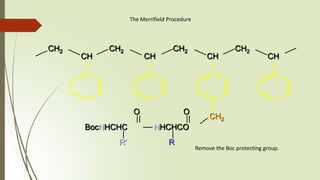
BocNHCHC
R'
O
Remove the Boc protecting group.
The Merrifield Procedure
CH2 CH2 CH2 CH2
CH CH CH CH
CH2
NHCHCO
R
O
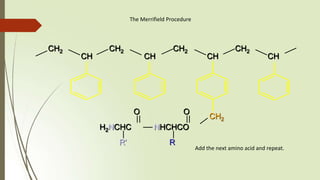
H2NCHC
R'
O
Add the next amino acid and repeat.
The Merrifield Procedure
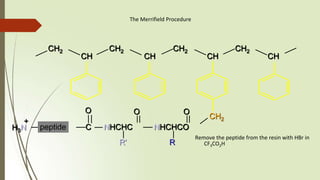
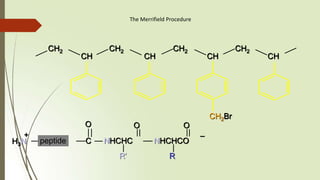
Remove the peptide from the resin with HBr in
CF3CO2H
CH2 CH2 CH2 CH2
CH CH CH CH
CH2
NHCHCO
R
O
NHCHC
R'
O
C
O
+
H3N peptide
The Merrifield Procedure
CH2 CH2 CH2 CH2
CH CH CH CH
CH2Br
NHCHCO
R
O
NHCHC
R'
O
C
O
+
H3N peptide
–
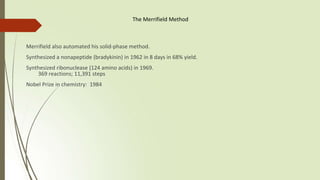
The Merrifield Method
Merrifield also automated his solid-phase method.
Synthesized a nonapeptide (bradykinin) in 1962 in 8 days in 68% yield.
Synthesized ribonuclease (124 amino acids) in 1969.
369 reactions; 11,391 steps
Nobel Prize in chemistry: 1984
References
 R.B. Merriffield , G. Barany, W.L. Cosand, M. Engelhard and S.
Mojsov, pept. Am pept. Symp. 5 th edittion 1997, page no 48-55.
 Multi-step organic synthesis using solid-supported reagents and
scavengers: a new paradigm in chemical library synthesis Ley et al.
J. Chem. Soc., Perkin Trans 1 2000, 3815-4195
 Preparation of polymer-supported ligands and metal complexes for
use in catalysis
 Leadbeater, Marco Chem. Rev. 2002, 102, 3217-3273
solid support.ppt

solid support.ppt

  • 1.
    SOILD PHASE SYNTHESIS Dr.Gurumeet CWadhawa ,Assistant Professor, Department of Chemistry. Rayat Shikshan sansthas Veer Wajekar ASC College,Phunde,Uran
  • 2.
    CONTENTS INTRODUCTION PLANING OF SOLIDPHASE SYNTHESIS EXAMPLE OF SOLID PHASE SYNTHESIS ADVANTAGES DISADVANTAGES APPLICATION
  • 3.
    INTRODUCTION “Solid phase synthesisis heterogeneous reaction in which a reagent is coupled to a solid support via chemical functionality present on solid support. A multistep synthesis on solid phase then transforms the bound intermediate into the target molecule but eventually cleaved from support. This technique is called as solid phase synthesis” Solid phase synthesis was invented by Bruce Merrifield in 1963
  • 4.
    Linker – (substrate) Reagnt Linker-(product)+(Reagent) FilterLinker-(product) + (Reagent) (product) purification Fig: SOLID PHASE SYNTHESIS Vs SOLTION PHASE SYNTHESIS Solid Phase Synthesis Solution Phase Synthesis (Reagent) (Substrate) (product) + (reagent)
  • 5.
    PLANNING OF SOLIDPHASE SYNTHESIS The Resin (solid support) The Linkers The protective group Reaction monitoring purification
  • 6.
    The Resin (solidsupport) Resin act as a solid support for a solid phase synthesis. The term solid support use to denote the matrix upon which chemical reaction is performed. Solid support must be inert. Its always swells extensively in solvent.
  • 7.
    A) Hydrophobic polystyreneresins:  Polystyrene resin beads under class Gelatinous solid support  Cross linked with 1-2% divinylbenzene  Particle size 90-200µm  Used in large number of reaction sites  They are cheap & commercially available with any functional groups Examples of resins 1. Benzylic halids – a) Merrifide resin. b) Trityl chloride resin. 2. Benzylic amines – a) Rink amide resin b) Amino Ethyle polystyrene 3. Benzylic alcohls – a) Wang resin 4. Aromatic aldehyde – a) Backbone amide linker b) Bal resin
  • 8.
    B) Hybrite HydrophilicPolystyrene Resin (HHPSR): A major drawback of hydrophilic PS resin is poor swelling in protic solvent. Thus support is prepared by grafting hydrophilic mono- functional or bi-functional polystyrene glycol (PEG). Examples ChemMatriex 1 It has chemical and thermal stability 2 Compatible with microwave 3 High degree of swelling in acetonitrile, DMF, TFA 4 Used for synthesis of difficult and long peptides.
  • 9.
    1 Hydrophobic polystyreneresins: 1.Benzylic Halide Type a) Merrifie Resin Attachment - Carboxylic acid, Alcohol, Phenol. Cleavage – Strong acidic condition Application - Peptide synthesis b) Trityle chloride Resin Attachment - Carboxylic acid, Alcohol, Amine. Cleavage – Mild acidic condition Application - Peptide synthesis, Alcohol & Amine synthsis.
  • 10.
    2 Benzylic AmineType resin Attachment - Carboxylic acid , alcohol , Phenol. Cleavage – Mild acidic condition. Application - Peptide synthesis( Aryle & Alkyle carboxamide) 3 Benzylic alcohol Type Resin Attachment - Carboxylic acid. Cleavage – Acidic condition. Application - Peptide synthesis. 4 Aromatic Aldehyde Type Resin Attachment – Primary Amine. Cleavage – Mild acidic condition. Application - Peptide synthesis.
  • 11.
    The Linker Linker referredas a handle to attach the small molecule onto polymeric resin Linkers has many similarities to protecting group in solid phase synthesis.
  • 12.
    Properties of linkerswhich may assist Solid phase synthesis are:  Stable to the reaction conditions  Cleaved selectively at the end of synthesis  Re-useable  Facilitate reactions monitoring  Sequential / Partial release  Easy to prepared  It should be highly selective to one or most small number of specific cleavage reagents/ conditions.
  • 13.
    TYPES OF LINKERS 1Acid-Cleavable Anchors and Linker: SPS of peptides was developed using this type of linkers Fig: Acid labile, commercialy available SP Linker SPS 30°C RT
  • 14.
    2) Base /Nucleophil-Laibale linkers: The commonly used Fmoc peptide coupling protocols required Fmoc deprotection under basic conditions during synthesis. R-COOR SPS 20% DMF 2hr,RT FIG : Base/ Nucleophilic Laibale Linker
  • 15.
    3) Photo LabileLinkers The light is used to break the bond between the intermediate and the linker and releases pure compound from the SPS into solution without interference from side produced . R-COOH SPS 350nm HOOC- Rdc MeOH, 24 hr,RT Fig : photo labile SP Linker
  • 16.
    4 Safety- catchlinkers: It is totally stable during the synthetic procedure & labile after a process known as activation It is very popular and allows the support and release of many different functionalities. Examples : sulfonamide based safety catch linkers, phenol based safety linkers, acid labile safety catch linkers, imidazole safety linkers. SPS R_COOH Nucleophile Act. Slphonamide Based SCL Fig: Safety catch (SC) Linker
  • 17.
    Examples of linkers: Trialkylsillylcholiride (or triflate ) generated from ethanophenylsane. Attachment of alcohols ketones Function of linkers: 1) As a functional group 2) As a linker releases another functional group
  • 18.
    Procteive group Due toamino acid excess used to ensure complete during each synthesis step, polymerization of amino acids is common in reactions where each amino acid is not protected. In order to prevent this polymerization , protecting group are used. Examples : 1) Fomac protective group [ fomac (9 H- fluoren -9-ylmethoxycarbonyl) it is currently widely useds group that removed the N- terminal of peptide in synthesis of a peptide from amino acid terminal.
  • 19.
    ACTUAL PROCESS INSPS 1st Step: In this the stating molecule to an inert solid. Typically inert polymers or resin are used. These are commercially available. 2nd Step: Here, Solid are deep into solution containing subsequent reagent next they can be removed from the dip and placed into a ash solution. 3rd Step: After all reactions are don the product is still attached to the insoluble bead Product Can be washed in a reaction well excess solvent is washed out finally the product is cleaved from the bead and isolated. Washing: After each synthetic step and prior to cleavage the solid support must be exhaustically washed with large vol. of solvent. Purifications: purification is done by semi preprative HPLC utilizing.
  • 21.
    ADVANTAGES  Over allprocess is quick  Purification of each product can be achieved in one step. Only purification technique is filtration.  Purification in each step is possible.  Synthetic intermediates don’t have to be isolated.  Can be automated with Roberts.  Use of solvent are minimized.  Less health hazards and eco- friendly and hence follows the principle of GREEN CHEMISTRY.
  • 22.
    DISADVANTAGES  High chemicalconsume.  Expensive.  Low reaction rates.  Special substances needed.  It produces very few molecules at a time for testing.  Solid phase synthesis without using any solvents.
  • 23.
    APPLICATION Combinatorial synthesis fsolid phase Peptide synthesis In DNA synthesis In various reactions Clainsan rearrangement Beckmann rearrangement Organic synthesis
  • 24.
  • 25.
    Solid-Phase Peptide Synthesis Insolid-phase synthesis, the starting material is bonded to an inert solid support. Reactants are added in solution. Reaction occurs at the interface between the solid and the solution. Because the starting material is bonded to the solid, any product from the starting material remains bonded as well. Purification involves simply washing the byproducts from the solid support.
  • 26.
    The Solid Support Thesolid support is a copolymer of styrene and divinylbenzene. It is represented above as if it were polystyrene. Cross-linking with divinylbenzene simply provides a more rigid polymer. CH2 CH2 CH2 CH2 CH CH CH CH
  • 27.
    The Solid Support Treatingthe polymeric support with chloromethyl methyl ether (ClCH2OCH3) and SnCl4 places ClCH2 side chains on some of the benzene rings. CH2 CH2 CH2 CH2 CH CH CH CH
  • 28.
    The Solid Support CH2CH2 CH2 CH2 CH CH CH CH CH2Cl The side chain chloromethyl group is a benzylic halide, reactive toward nucleophilic substitution (SN2).
  • 29.
    The Solid Support CH2CH2 CH2 CH2 CH CH CH CH CH2Cl The chloromethylated resin is treated with the Boc-protected C-terminal amino acid. Nucleophilic substitution occurs, and the Boc-protected amino acid is bound to the resin as an ester.
  • 30.
    The Merrifield Procedure CH2CH2 CH2 CH2 CH CH CH CH CH2Cl BocNHCHCO R O –
  • 31.
    The Merrifield Procedure BocNHCHCO R O CH2CH2 CH2 CH2 CH CH CH CH CH2 Next, the Boc protecting group is removed with HCl.
  • 32.
    The Merrifield Procedure H2NCHCO R CH2CH2 CH2 CH2 CH CH CH CH CH2 O DCCI-promoted coupling adds the second amino acid
  • 33.
    The Merrifield Procedure NHCHCO R O CH2CH2 CH2 CH2 CH CH CH CH CH2 BocNHCHC R' O Remove the Boc protecting group.
  • 34.
    The Merrifield Procedure CH2CH2 CH2 CH2 CH CH CH CH CH2 NHCHCO R O H2NCHC R' O Add the next amino acid and repeat.
  • 35.
    The Merrifield Procedure Removethe peptide from the resin with HBr in CF3CO2H CH2 CH2 CH2 CH2 CH CH CH CH CH2 NHCHCO R O NHCHC R' O C O + H3N peptide
  • 36.
    The Merrifield Procedure CH2CH2 CH2 CH2 CH CH CH CH CH2Br NHCHCO R O NHCHC R' O C O + H3N peptide –
  • 37.
    The Merrifield Method Merrifieldalso automated his solid-phase method. Synthesized a nonapeptide (bradykinin) in 1962 in 8 days in 68% yield. Synthesized ribonuclease (124 amino acids) in 1969. 369 reactions; 11,391 steps Nobel Prize in chemistry: 1984
  • 38.
    References  R.B. Merriffield, G. Barany, W.L. Cosand, M. Engelhard and S. Mojsov, pept. Am pept. Symp. 5 th edittion 1997, page no 48-55.  Multi-step organic synthesis using solid-supported reagents and scavengers: a new paradigm in chemical library synthesis Ley et al. J. Chem. Soc., Perkin Trans 1 2000, 3815-4195  Preparation of polymer-supported ligands and metal complexes for use in catalysis  Leadbeater, Marco Chem. Rev. 2002, 102, 3217-3273