HALOGENATION
PRESENTING BY:
Mr. PURUSHOTHAM K.N
ASSI.PROFESSOR
DEPT.OF.PH.CHEMISTRY
SACCP, B.G.NAGARA.
2022-2023
Contents
1.Halogenation
2. Types of halogenation
3.Kinetics of halogenation
HALOGENATION
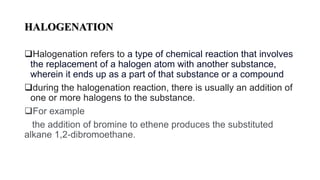
Halogenation refers to a type of chemical reaction that involves
the replacement of a halogen atom with another substance,
wherein it ends up as a part of that substance or a compound
during the halogenation reaction, there is usually an addition of
one or more halogens to the substance.
For example
the addition of bromine to ethene produces the substituted
alkane 1,2‐dibromoethane.
The preparation of organic compounds containing fluorine, chlorine,
bromine and iodine can be done by a variety of methods.
The conditions and procedures differ, not only for each member of the
halogen family but also with the type and structure of the compound
undergoing treatment.
The chlorine derivatives, because of the greater economy preparation,
are the most important compound
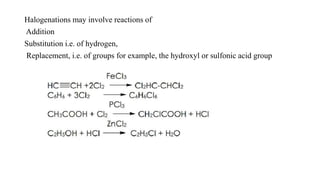
Halogenations may involve reactions of
Addition
Substitution i.e. of hydrogen,
Replacement, i.e. of groups for example, the hydroxyl or sulfonic acid group
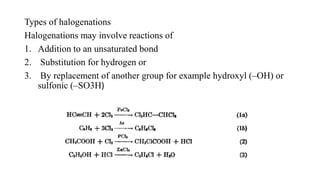
Types of halogenations
Halogenations may involve reactions of
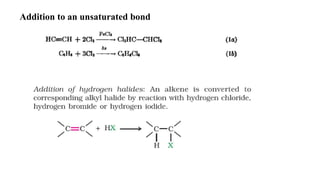
1. Addition to an unsaturated bond
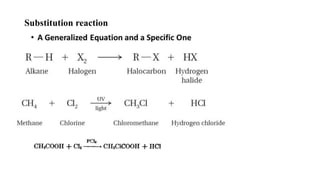
2. Substitution for hydrogen or
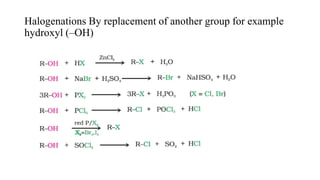
3. By replacement of another group for example hydroxyl (–OH) or
sulfonic (–SO3H)
Addition to an unsaturated bond
Substitution reaction
By Electrophilic substitution
Halogenations By replacement of another group for example
hydroxyl (–OH)
Halogenating agents
• Each type of reaction may involve not only a specific halogenating
agent but also a suitable catalyst or activator.
• Many of the catalysts are halogen carriers.
• Fe, antimony, and P, are exist in two valencies as halogen compounds,
are used, as they are less stable at the higher valence and give up part
of their halogen during the process
I2 , Br2 , and Cl2 are capable of forming mixed halogens are also
frequently employed as catalysts in halogenation processes.
• Activated carbon, clays, and other compounds also serve to catalyze
halogenation processes.
• Where the halogen is energized to an activated state by means of light,
heat, nuclear energy, or free radicals,
• It may then proceed to react by addition as in reaction (lb) or by
substitution without the need of a catalyst
Kinetics and the Rate Equation
• The study of reaction rates is called kinetics.
• The rate of a reaction is as important as the position of equilibrium.
• (Just because a reaction has a favorable DG°, does not mean the reaction
will spontaneously go).
• The rate of a reaction is how fast the products appear and how slow the
reactants disappear.
• These can be obtained experimentally by monitoring the concentrations of
either the products or reactants with respect to time.
• Reaction rates depend on the concentrations of reactants
• since at higher concentrations, collisions between reactants (leading to a
reaction) are more likely.
• The rate equation (rate law) relates the concentrations of the reactants to
the rate of reaction.
• Consider: A + B → C + D
• Rate = Kr [A]a [B]b
• The rate is proportional to the concentrations of A and B raised to some
power (a and b)
• Where kr is a rate constant, and a and b have to be determined
experimentally.
• Values a and b are usually whole numbers, and are called the order of
the reaction.
• (a+b) is the overall order of a reaction. Kinetics and the Rate Equation
• Consider the following reaction:
• CH3 -Br + -OH → CH3 -OH + Br-
• Experiments show that doubling the concentration of bromomethane,
doubles the rate of reaction. Also doubling the [- OH] doubles the rate.
• Therefore the rate is proportional to both [CH3Br] and [-OH], and the rate
equation would read:
• Rate = kr [CH3Br] [-OH]
• The rate is said to be first order w.r.t. bromomethane, and first order w.r.t.
hydroxide ion.
• The reaction is second order overall.
• However, similar reactions can have different kinetic orders. (CH3
)3C-Br + -OH → (CH3 )3C-OH + Br-
• For this reaction, doubling the [t-butylbromide] doubles the rate, but
doubling [-OH] has no effect on the rate.
• Rate = kr [(CH3 )3C-Br]
• First order w.r.t. t-butylbromide, but zeroth order w.r.t. hydroxide ion.
The order has to be obtained experimentally.
REFERENCE
• Pharmaceutical Engineering- C.V.S. Subrahmanyam. 293-381.
• https://www.slideshare.net/JoonJyotiSahariah/crystalli-zation-ppt
thank you

HALOGENATION.pptx

  • 1.
    HALOGENATION PRESENTING BY: Mr. PURUSHOTHAMK.N ASSI.PROFESSOR DEPT.OF.PH.CHEMISTRY SACCP, B.G.NAGARA. 2022-2023
  • 2.
    Contents 1.Halogenation 2. Types ofhalogenation 3.Kinetics of halogenation
  • 3.
    HALOGENATION Halogenation refers toa type of chemical reaction that involves the replacement of a halogen atom with another substance, wherein it ends up as a part of that substance or a compound during the halogenation reaction, there is usually an addition of one or more halogens to the substance. For example the addition of bromine to ethene produces the substituted alkane 1,2‐dibromoethane.
  • 4.
    The preparation oforganic compounds containing fluorine, chlorine, bromine and iodine can be done by a variety of methods. The conditions and procedures differ, not only for each member of the halogen family but also with the type and structure of the compound undergoing treatment. The chlorine derivatives, because of the greater economy preparation, are the most important compound
  • 5.
    Halogenations may involvereactions of Addition Substitution i.e. of hydrogen, Replacement, i.e. of groups for example, the hydroxyl or sulfonic acid group
  • 6.
    Types of halogenations Halogenationsmay involve reactions of 1. Addition to an unsaturated bond 2. Substitution for hydrogen or 3. By replacement of another group for example hydroxyl (–OH) or sulfonic (–SO3H)
  • 7.
    Addition to anunsaturated bond
  • 8.
  • 9.
  • 10.
    Halogenations By replacementof another group for example hydroxyl (–OH)
  • 11.
    Halogenating agents • Eachtype of reaction may involve not only a specific halogenating agent but also a suitable catalyst or activator. • Many of the catalysts are halogen carriers. • Fe, antimony, and P, are exist in two valencies as halogen compounds, are used, as they are less stable at the higher valence and give up part of their halogen during the process
  • 12.
    I2 , Br2, and Cl2 are capable of forming mixed halogens are also frequently employed as catalysts in halogenation processes. • Activated carbon, clays, and other compounds also serve to catalyze halogenation processes. • Where the halogen is energized to an activated state by means of light, heat, nuclear energy, or free radicals, • It may then proceed to react by addition as in reaction (lb) or by substitution without the need of a catalyst
  • 13.
    Kinetics and theRate Equation • The study of reaction rates is called kinetics. • The rate of a reaction is as important as the position of equilibrium. • (Just because a reaction has a favorable DG°, does not mean the reaction will spontaneously go). • The rate of a reaction is how fast the products appear and how slow the reactants disappear. • These can be obtained experimentally by monitoring the concentrations of either the products or reactants with respect to time. • Reaction rates depend on the concentrations of reactants • since at higher concentrations, collisions between reactants (leading to a reaction) are more likely.
  • 14.
    • The rateequation (rate law) relates the concentrations of the reactants to the rate of reaction. • Consider: A + B → C + D • Rate = Kr [A]a [B]b • The rate is proportional to the concentrations of A and B raised to some power (a and b) • Where kr is a rate constant, and a and b have to be determined experimentally. • Values a and b are usually whole numbers, and are called the order of the reaction. • (a+b) is the overall order of a reaction. Kinetics and the Rate Equation
  • 15.
    • Consider thefollowing reaction: • CH3 -Br + -OH → CH3 -OH + Br- • Experiments show that doubling the concentration of bromomethane, doubles the rate of reaction. Also doubling the [- OH] doubles the rate. • Therefore the rate is proportional to both [CH3Br] and [-OH], and the rate equation would read: • Rate = kr [CH3Br] [-OH] • The rate is said to be first order w.r.t. bromomethane, and first order w.r.t. hydroxide ion. • The reaction is second order overall.
  • 16.
    • However, similarreactions can have different kinetic orders. (CH3 )3C-Br + -OH → (CH3 )3C-OH + Br- • For this reaction, doubling the [t-butylbromide] doubles the rate, but doubling [-OH] has no effect on the rate. • Rate = kr [(CH3 )3C-Br] • First order w.r.t. t-butylbromide, but zeroth order w.r.t. hydroxide ion. The order has to be obtained experimentally.
  • 17.
    REFERENCE • Pharmaceutical Engineering-C.V.S. Subrahmanyam. 293-381. • https://www.slideshare.net/JoonJyotiSahariah/crystalli-zation-ppt
  • 18.