the process in which one or more halogen are into an organic reaction .
the halogens are non metals and have electronic configuration just one electron short from the nioble gases
UNIT PROCESSES :-HALOGENATION
Chhatrapati Shahu Ji Maharaj University, Kanpur
DEPARTMENT :- SCHOOL OF PHARMACEUTICAL SCIENCES
PRESENTED BY:-
POORNIMA PANDEY
M.PHARM CHEMISTRY
1ST YEAR
2ND SEM
03/19/2025
3
Introduction
The processin which one or more halogen are introduced into an
organic chemistry .
The Halogens comprises the group 17 of the periodic
table and include F , Cl , Br, I.
They are non-metals and have electronic configuration just one
electron short from the noble gases i.e they have 7 valence electron
in their outermost shell
03/19/2025
5
1.Free radical halogenation
The halogen of saturated hydrocarbons is a substitute reaction, halogen atom
replaces a hydrogen atom in an organic compound.
Free radicals , which are highly reactive species with unpaired electrons .
The reaction occur in the presence of a halogen ,chlorine, bromine and a source of
energy such as heat or light.
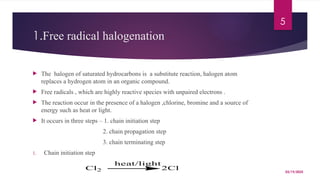
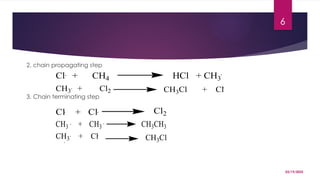
It occurs in three steps – 1. chain initiation step
2. chain propagation step
3. chain terminating step
1. Chain initiation step
Cl2 2Cl
heat/light
03/19/2025
7
2. Electrophilic aromaticsubstitution
halogenation
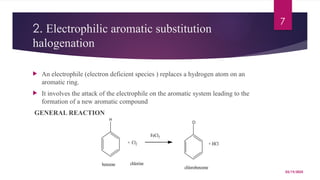
An electrophile (electron deficient species ) replaces a hydrogen atom on an
aromatic ring.
It involves the attack of the electrophile on the aromatic system leading to the
formation of a new aromatic compound
GENERAL REACTION
H
Cl
+ Cl2 + HCl
FeCl3
benzene chlorine
chlorobenzene
8.
03/19/2025
8
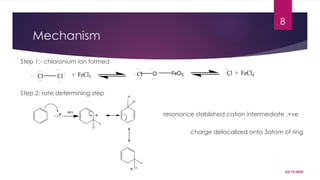
Mechanism
Step 1:- chloroniumion formed
Step 2: rate determining step
resonance stablished cation intermediate ,+ve
charge delocalized onto 3atom of ring
Cl + FeCl3
Cl FeCl3 Cl + FeCl4
Cl Cl
+ Cl
H
Cl
Cl
H
H
Cl
SRD
9.
03/19/2025
9
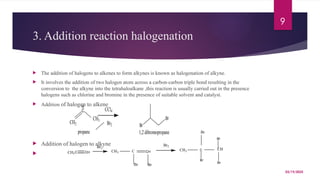
3. Addition reactionhalogenation
The addition of halogens to alkenes to form alkynes is known as halogenation of alkyne.
It involves the addition of two halogen atom across a carbon-carbon triple bond resulting in the
conversion to the alkyne into the tetrahaloalkane ,this reaction is usually carried out in the presence
halogens such as chlorine and bromine in the presence of suitable solvent and catalyst.
Addition of halogen to alkene
Addition of halogen to alkyne
H
C
propane
CH2
CH3
CCl4
Br
Br
1,2 dibromopropane
Br2
C CH
CH3
Br2
CH3 C CH
Br Br
Br2
CH3 C
Br
Br
Br
CH
Br
10.
03/19/2025
10
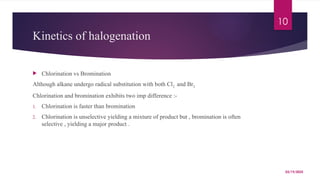
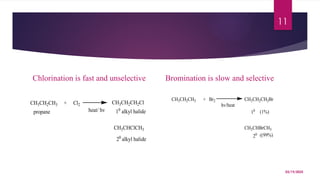
Kinetics of halogenation
Chlorination vs Bromination
Although alkane undergo radical substitution with both Cl2 and Br2
Chlorination and bromination exhibits two imp difference :-
1. Chlorination is faster than bromination
2. Chlorination is unselective yielding a mixture of product but , bromination is often
selective , yielding a major product .
03/19/2025
12
Catalytic halogenation
Mechanismfor activation of chlorine by AlCl3
and subsequent halogenation
.
Cl-Cl [ Cl-Cl-AlCl3 Cl-AlCl4]
AlCl3
Cl AlCl4
Cl
H
Cl-AlHCl3
Cl
attack by aromatic pi
bond at chlorine
deprotonation of addition product
to regenerate the aromatic ring
13.
03/19/2025
13
Case study
Halogenationis a chemical process where a halogen (F, Cl , Br, I ) is introduced into an organic compound .
It is widely used in the chemical industry to create a variety of useful products ,such as polymers ,
pharmaceuticals and agrochemicals .
Process description :-
1. Feed stock preparation :- the feedstock typically a hydrocarbon or other organic compound ,is prepared
and purified.
2. Halogenation reaction :- the feedstock is then reacted with a halogen such as chlorine or bromine in the
presence of a catalyst .
3. Product separation :- the resulting halogenated product is then separated from the reaction mixture through
various methods such as distillation or crystallization.
4. Purification :- the halogenated product is then purified through various methods such as recrystallisation or
chromatography
14.
03/19/2025
14
Process conditions:-
The industrial process of halogenation is typically carried out under the following
conditions
Temperature :- 100-3000
C
Pressure :-1-10 bar
Catalyst :- various catalyst such as Lewis acids or transitions metal complexes are used
to promote the reaction
Solvent :- various solvents such as water , organic solvents or ionic liquids are used to
facilitate the reaction
15.
03/19/2025
15
Safety considerations:-
The industrial process of halogenation involves several safety considerations
1. Corrosion :- halogens can be corrosive and require special materials of construction .
2. Explosion risk :- halogenation reaction can be highly exothermic and require a special
precaution to prevent explosions.
3. Toxicity :- halogens and halogenated compounds can be toxic and require special
handling and storage procedures.
16.
03/19/2025
16
Environmental considerations:-
The industrial process of halogenation involves several environmental considerations
1. Raw material costs :- the cost of raw materials such as halogens and feedstocks can vary depending on market
conditions.
2. Energy costs :- halogenation reactions can be energy intensive and require significant amounts of energy to
operate .
3. Labor costs :- halogenation reactions require skilled labor to operate and maintain the equipment .
Some case studies :-
1. Halogenation of methane :- in the industrial production of chloromethane methane is reacted with chlorine gas in
the presence of heat or light . This reaction is an example of a substitution reaction ,where a chlorine atom replaces
a hydrogen atom in the methane molecule .
the reaction is highly exothermic and requires careful control to avoid overheating and the formation of
unwanted byproducts .
17.
03/19/2025
17
Production ofpolyvinyl chloride (PVC) :-
PVC is a widely used plastic that is produced through the halogenation of ethylene .in this
process , ethylene is reacted with chlorine gas to form dichloroethane , which is then cracked to
form vinyl chloride monomer is then polymerized to form PVC.
Conclusion
The industrial process of halogenation is a complex process that requires carefull consideration
of safety , environment , and economic factors .
This process involves the reaction of a feedstock with a halogen in the presence a catalyst
followed by product separation , purification and analysis.
18.
03/19/2025
18
Applications
Synthesis ofhalogenated organic compounds :- this allows the selective introduction of
halogen at specific positions in the molecules .
Preparation of alkyl halides :- alkyl halides find applications as intermediates in the
synthesis of pharmaceuticals , agrochemicals, and other organic compounds.
Synthesis of tetrahaloalkanes :- compounds containing four halogen atoms intermediates in
the synthesis of various organic compounds including pharmaceuticals and agrochemicals.
Preparation organometallic compounds :- tetrahaloalkanes obtained from halogenation of
alkynes can be used as precursors form the synthesis of organometallic compound . By
reacting the tetrahaloalkanes with a metal such as ,magnesium or lithium organometallic
species like Grignard reagent or organolithium compound can be formed

![03/19/2025
12
Catalytic halogenation
Mechanism for activation of chlorine by AlCl3
and subsequent halogenation
.
Cl-Cl [ Cl-Cl-AlCl3 Cl-AlCl4]
AlCl3
Cl AlCl4
Cl
H
Cl-AlHCl3
Cl
attack by aromatic pi
bond at chlorine
deprotonation of addition product
to regenerate the aromatic ring](https://image.slidesharecdn.com/newpp-250319125914-7184ba5c/85/UNIT-3-CHEMISTRYUnit-process-Halogenations-12-320.jpg)


![OXIDATION [PHARMACEUTICAL PROCESS CHEMISTRY]](https://cdn.slidesharecdn.com/ss_thumbnails/65-191220062805-thumbnail.jpg?width=640&height=640&fit=bounds)


![CHEMISTRY OF PEPTIDES [M.PHARM, M.SC, BSC, B.PHARM]](https://cdn.slidesharecdn.com/ss_thumbnails/45-191219080659-thumbnail.jpg?width=640&height=640&fit=bounds)


