Asymmetric hydrogenation of
olefins
Presented by: Hadid Abdullah
Introduction
 Asymmetric hydrogenation is one of the most important catalytic
methods for the preparation of optically active compounds.
 It is a chemical reaction that adds two atoms of hydrogen to a target
(substrate) molecule with three-dimensional spatial selectivity.
Critically, this selectivity does not come from the target molecule itself,
but from other reagents or catalysts present in the reaction.
The creation of one or two chiral centers results in a
mixture of enantiomers (unless a meso compound is
produced)
If a chiral catalyst is used, it is possible to synthesize only one
enantiomer as the major product
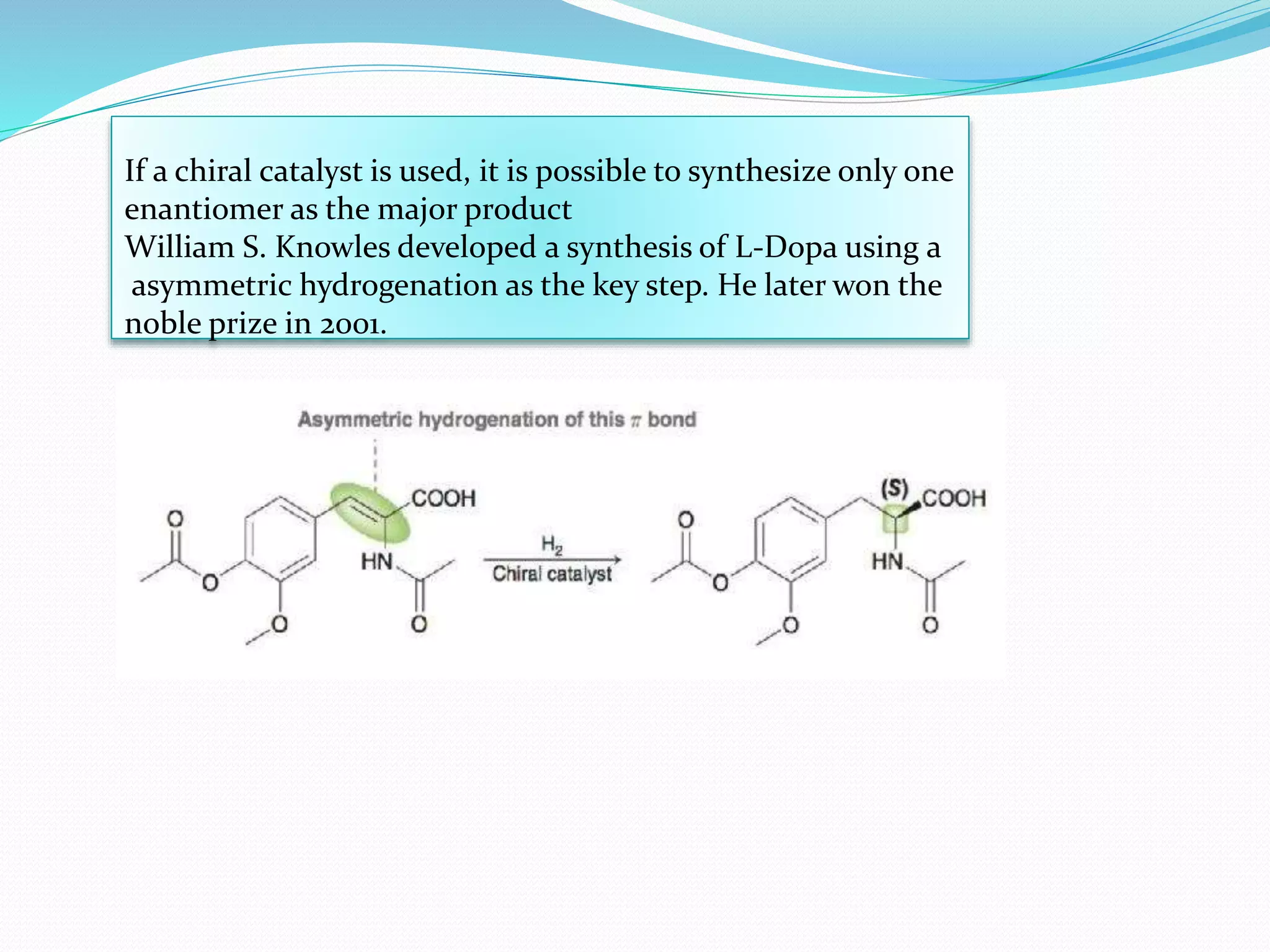
William S. Knowles developed a synthesis of L-Dopa using a
asymmetric hydrogenation as the key step. He later won the
noble prize in 2001.
If a chiral catalyst is used, it is possible to synthesize only one
enantiomer as the major product.
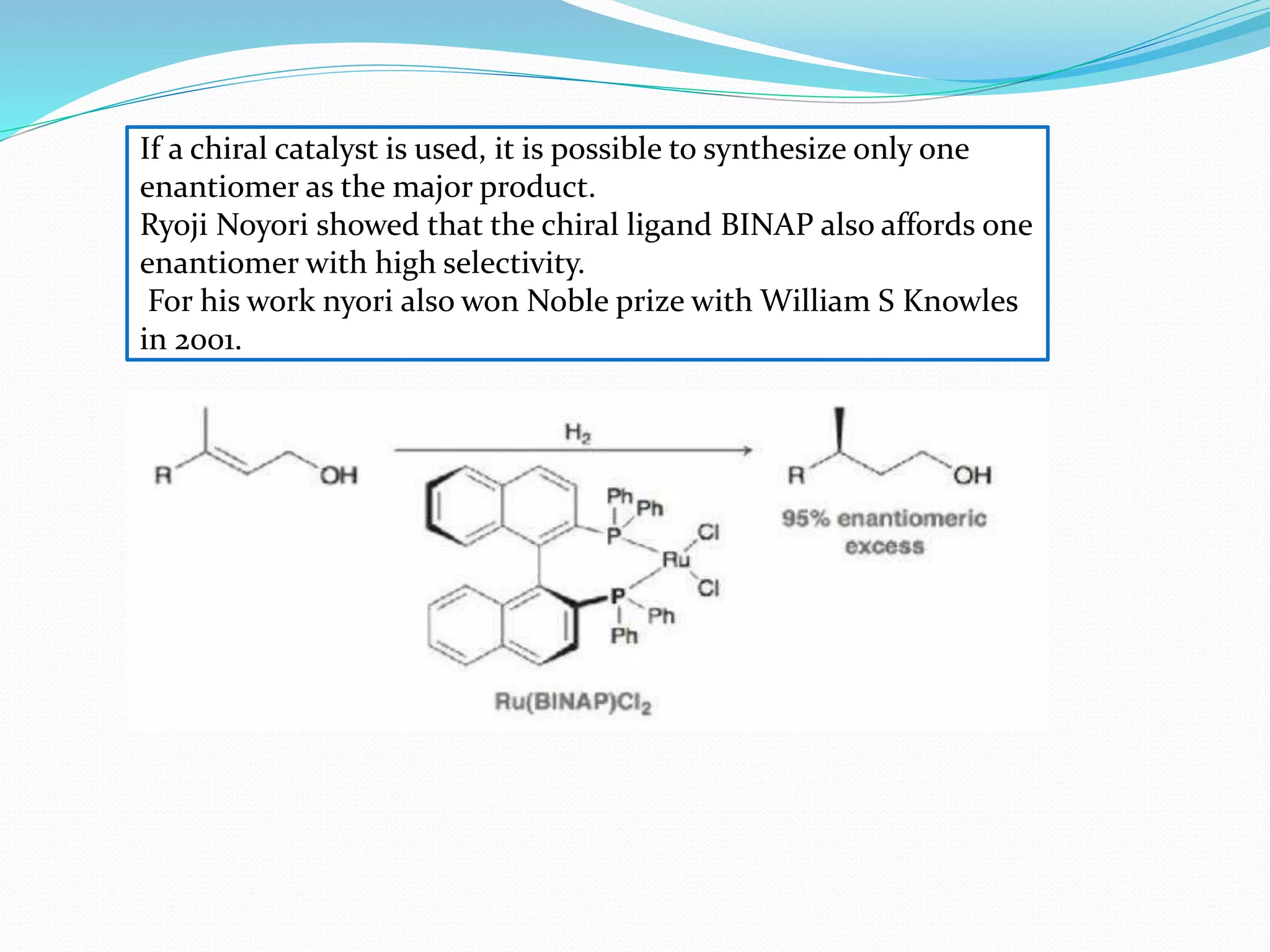
Ryoji Noyori showed that the chiral ligand BINAP also affords one
enantiomer with high selectivity.
For his work nyori also won Noble prize with William S Knowles
in 2001.
Asymmetric Alkene Hydrogenation
 The asymmetric hydrogenation of olefins is one of the most powerful
reactions for the synthesis of single enantiomer products. Carbon-
hydrogen bonds are most common constituent in chiral centers further
the power of asymmetric alkene hydrogenation to access single
enantiomer compounds. Asymmetric synthesis is enantioselective and
it’s efficiency can be judged from from the enantiomeric excess (ee) :
 % ee = (R-S/R+S) × 100
 where R and S = relative quantities of R and S enantiomers.
 In asymmetric catalysis, the catalyst is chiral.
 If catalyst is chiral it should favour the formation of one or other of the
R or S enantiomers, thereby making the Hydrogenation
enantioselective.
Asymmetric Hydrogenation by modifying Wikinson's
catalyst
 Asymmetric Hydrogenation can be carried out by modifying
Wilkinson’s catalyst introducing a chiral phosphane or chiral bidenate
bis-phosphane ,e.g.(R,R),DIOP by varying the chiral catalyst.
Hydrogenation of a given prochiral alkene proceeds with differing
enantiomeric selectivities.
(R,R)-DIOP
Recent advances in asymmetric
Hydrogenation of tetrasubstituted
olefins:
The asymmetric hydrogenation of tetrasubstituted olefins
provides direct access to very useful biological molecules and
intermediates. The development of the technology has been
slow, due in part to the synthetic challenges involved in
developing chiral catalysts for a successful asymmetric
induction
Asymmetric hydrogenation of alkenes lacking
coordinating groups
 Asymmetric hydrogenation of olefins is one of the most important
reactions for the synthesis of optically active compounds, especially in
industry.
 Chiral iridium catalysts based on P,N ligands have strongly expanded
their application range.
 In contrast to rhodium and ruthenium diphosphine complexes they do
not require the presence of a coordinating group near the C C bond
and, therefore, allow highly enantioselective hydrogenations of largely
unfunctionalized alkenes.
Applications of asymmetric hydrogenation of
olefins
An early triumph of application of asymmetric alkene
hydrogenation to drug manufacturer was the production
of alanine derivative L-DOPA which is used in the
treatment of Parkinson’s disease.
L-DOPA
The anti-inflammatory drug Naproxen (active in (S) form)is
prepared by chiral resolution or by asymmetric hydrogenation
of prochiral alkene,enantiopurity is essential,since the (R)-
enantiomer is liver toxin.
Asymmetric_Hydrogenation_.pptx

Asymmetric_Hydrogenation_.pptx

  • 1.
  • 2.
    Introduction  Asymmetric hydrogenationis one of the most important catalytic methods for the preparation of optically active compounds.  It is a chemical reaction that adds two atoms of hydrogen to a target (substrate) molecule with three-dimensional spatial selectivity. Critically, this selectivity does not come from the target molecule itself, but from other reagents or catalysts present in the reaction.
  • 3.
    The creation ofone or two chiral centers results in a mixture of enantiomers (unless a meso compound is produced)
  • 4.
    If a chiralcatalyst is used, it is possible to synthesize only one enantiomer as the major product William S. Knowles developed a synthesis of L-Dopa using a asymmetric hydrogenation as the key step. He later won the noble prize in 2001.
  • 5.
    If a chiralcatalyst is used, it is possible to synthesize only one enantiomer as the major product. Ryoji Noyori showed that the chiral ligand BINAP also affords one enantiomer with high selectivity. For his work nyori also won Noble prize with William S Knowles in 2001.
  • 6.
    Asymmetric Alkene Hydrogenation The asymmetric hydrogenation of olefins is one of the most powerful reactions for the synthesis of single enantiomer products. Carbon- hydrogen bonds are most common constituent in chiral centers further the power of asymmetric alkene hydrogenation to access single enantiomer compounds. Asymmetric synthesis is enantioselective and it’s efficiency can be judged from from the enantiomeric excess (ee) :  % ee = (R-S/R+S) × 100  where R and S = relative quantities of R and S enantiomers.  In asymmetric catalysis, the catalyst is chiral.  If catalyst is chiral it should favour the formation of one or other of the R or S enantiomers, thereby making the Hydrogenation enantioselective.
  • 7.
    Asymmetric Hydrogenation bymodifying Wikinson's catalyst  Asymmetric Hydrogenation can be carried out by modifying Wilkinson’s catalyst introducing a chiral phosphane or chiral bidenate bis-phosphane ,e.g.(R,R),DIOP by varying the chiral catalyst. Hydrogenation of a given prochiral alkene proceeds with differing enantiomeric selectivities. (R,R)-DIOP
  • 8.
    Recent advances inasymmetric Hydrogenation of tetrasubstituted olefins: The asymmetric hydrogenation of tetrasubstituted olefins provides direct access to very useful biological molecules and intermediates. The development of the technology has been slow, due in part to the synthetic challenges involved in developing chiral catalysts for a successful asymmetric induction
  • 9.
    Asymmetric hydrogenation ofalkenes lacking coordinating groups  Asymmetric hydrogenation of olefins is one of the most important reactions for the synthesis of optically active compounds, especially in industry.  Chiral iridium catalysts based on P,N ligands have strongly expanded their application range.  In contrast to rhodium and ruthenium diphosphine complexes they do not require the presence of a coordinating group near the C C bond and, therefore, allow highly enantioselective hydrogenations of largely unfunctionalized alkenes.
  • 10.
    Applications of asymmetrichydrogenation of olefins An early triumph of application of asymmetric alkene hydrogenation to drug manufacturer was the production of alanine derivative L-DOPA which is used in the treatment of Parkinson’s disease. L-DOPA
  • 11.
    The anti-inflammatory drugNaproxen (active in (S) form)is prepared by chiral resolution or by asymmetric hydrogenation of prochiral alkene,enantiopurity is essential,since the (R)- enantiomer is liver toxin.