SETH MOTILAL [P.G.] COLLEGE,
JHUNJHUNU
SEMINAR
M.Sc. FINAL CHEMISTRY
Submitted to:
Prof. Babita (H.O.D.)
Submitted by :
Ashish Kumar Sonkaria
Roll No. - 22335106
DEFECTS IN CRYSTALS
“Crystals are like people, it is the defects in them which
tend to make them interesting!” - Colin Humphreys
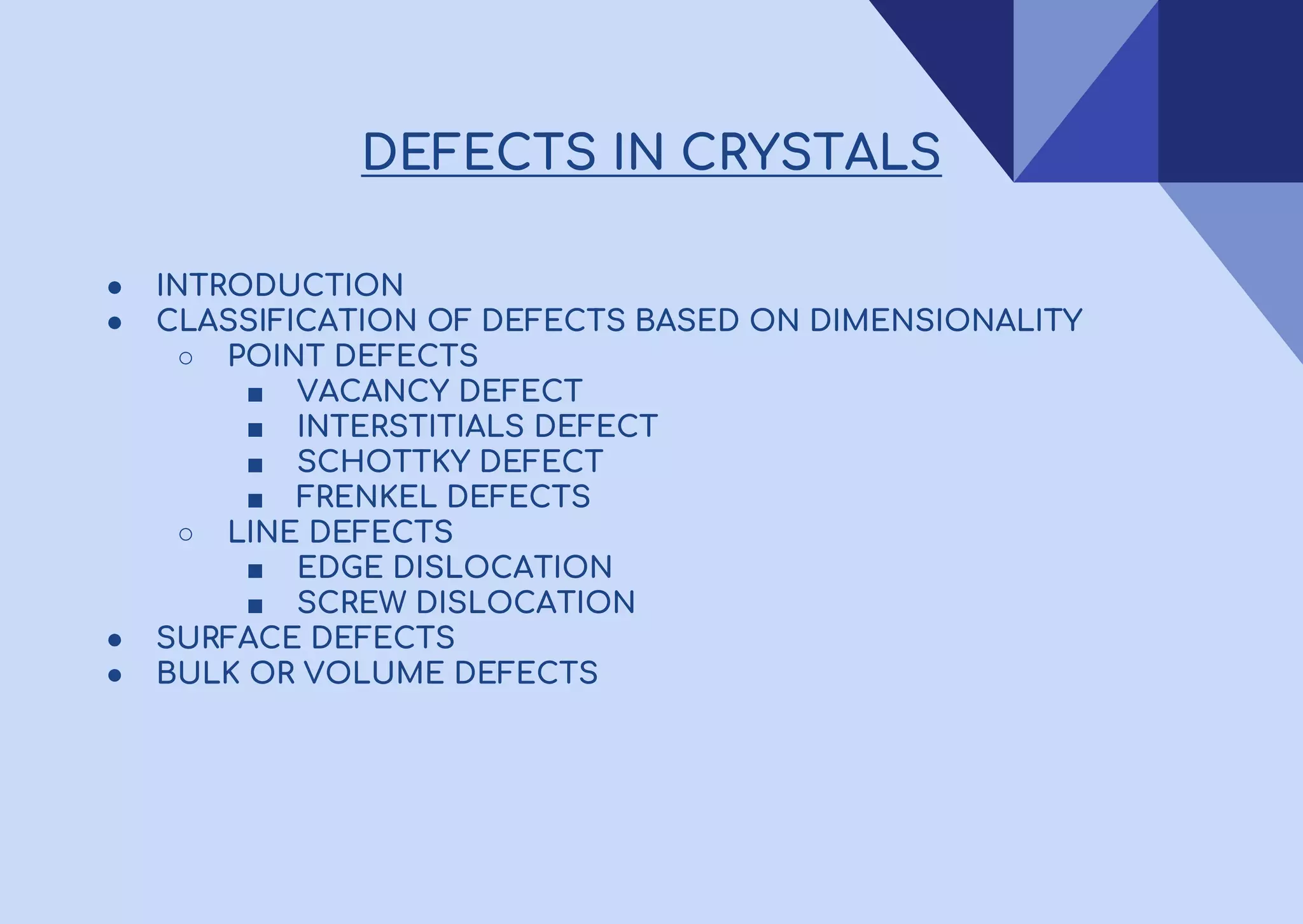
DEFECTS IN CRYSTALS
● INTRODUCTION
● CLASSIFICATION OF DEFECTS BASED ON DIMENSIONALITY
○ POINT DEFECTS
■ VACANCY DEFECT
■ INTERSTITIALS DEFECT
■ SCHOTTKY DEFECT
■ FRENKEL DEFECTS
○ LINE DEFECTS
■ EDGE DISLOCATION
■ SCREW DISLOCATION
● SURFACE DEFECTS
● BULK OR VOLUME DEFECTS
INTRODUCTION
● Crystalline material has a crystal structure
in which the atoms are positioned in perfect
ordered pattern which is repetitive over
large atomic distance.
● Defects have a profound impact on the
macroscopic properties of materials.
● Sometimes defects are deliberately created
to improve properties of crystal.
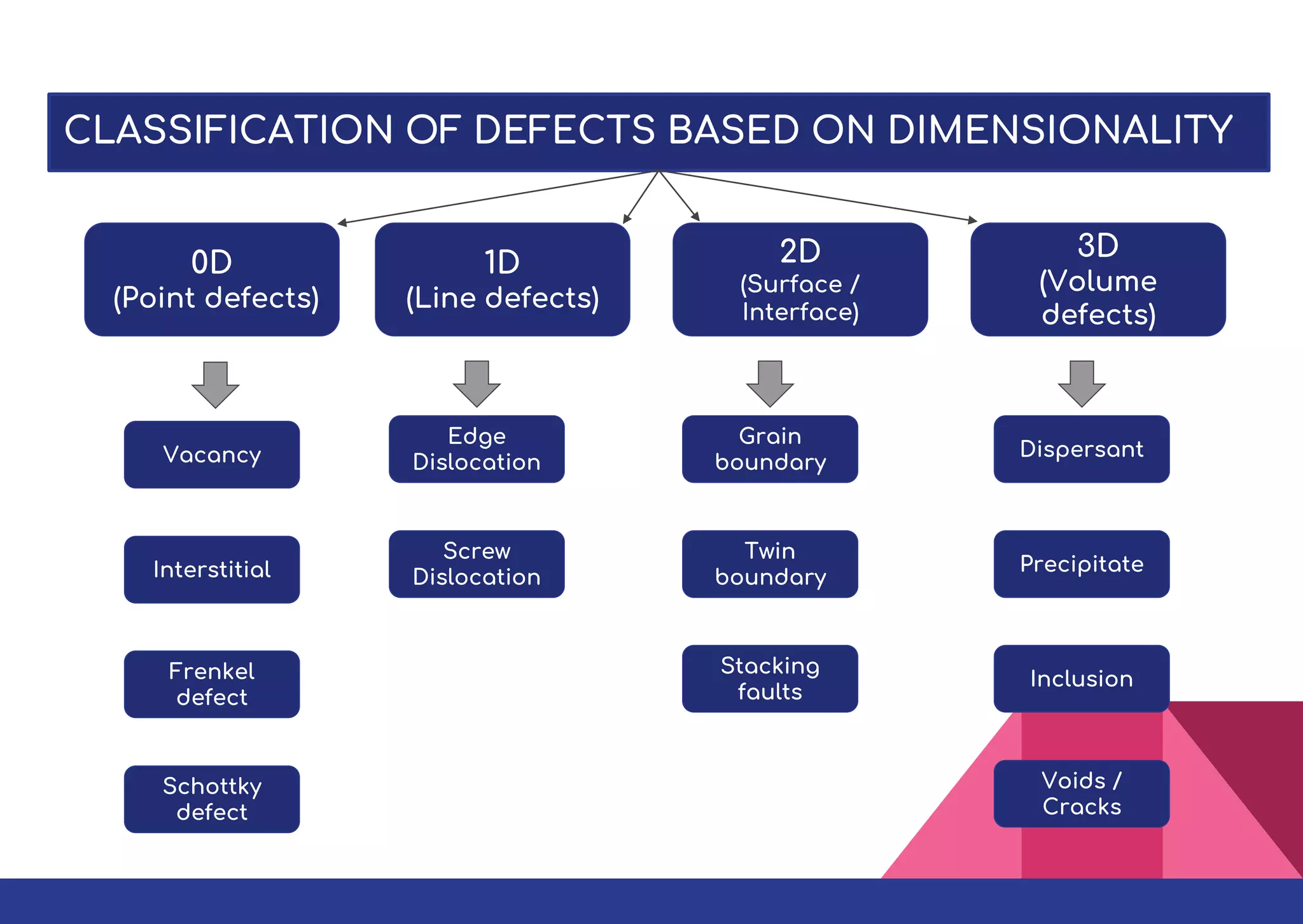
CLASSIFICATION OF DEFECTS BASED ON DIMENSIONALITY
Vacancy
Interstitial
Frenkel
defect
Schottky
defect
Edge
Dislocation
Screw
Dislocation
Grain
boundary
Twin
boundary
Stacking
faults
Dispersant
Precipitate
Inclusion
Voids /
Cracks
0D
(Point defects)
1D
(Line defects)
2D
(Surface /
Interface)
3D
(Volume
defects)
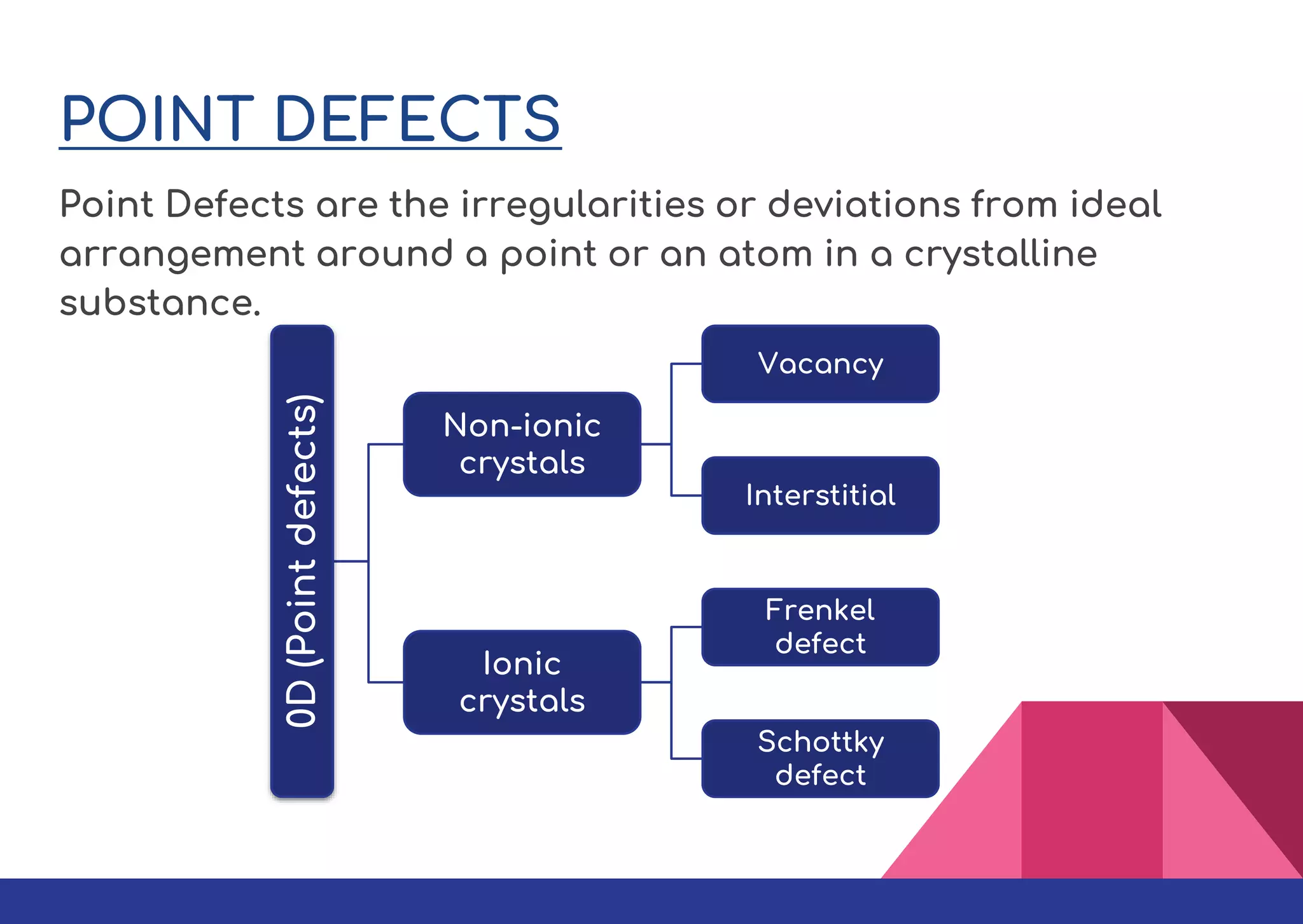
POINT DEFECTS
Point Defects are the irregularities or deviations from ideal
arrangement around a point or an atom in a crystalline
substance. 0D
(Point
defects)
Non-ionic
crystals
Ionic
crystals
Vacancy
Interstitial
Frenkel
defect
Schottky
defect
VACANCY DEFECT
➢ Atom missing from an atomic site
➢ Occur due to imperfect packing during crystallisation
➢ This results in decrease in density of the substance
➢ Number of vacancy defects depend on temperature
Vacancy Defect
POINT DEFECTS
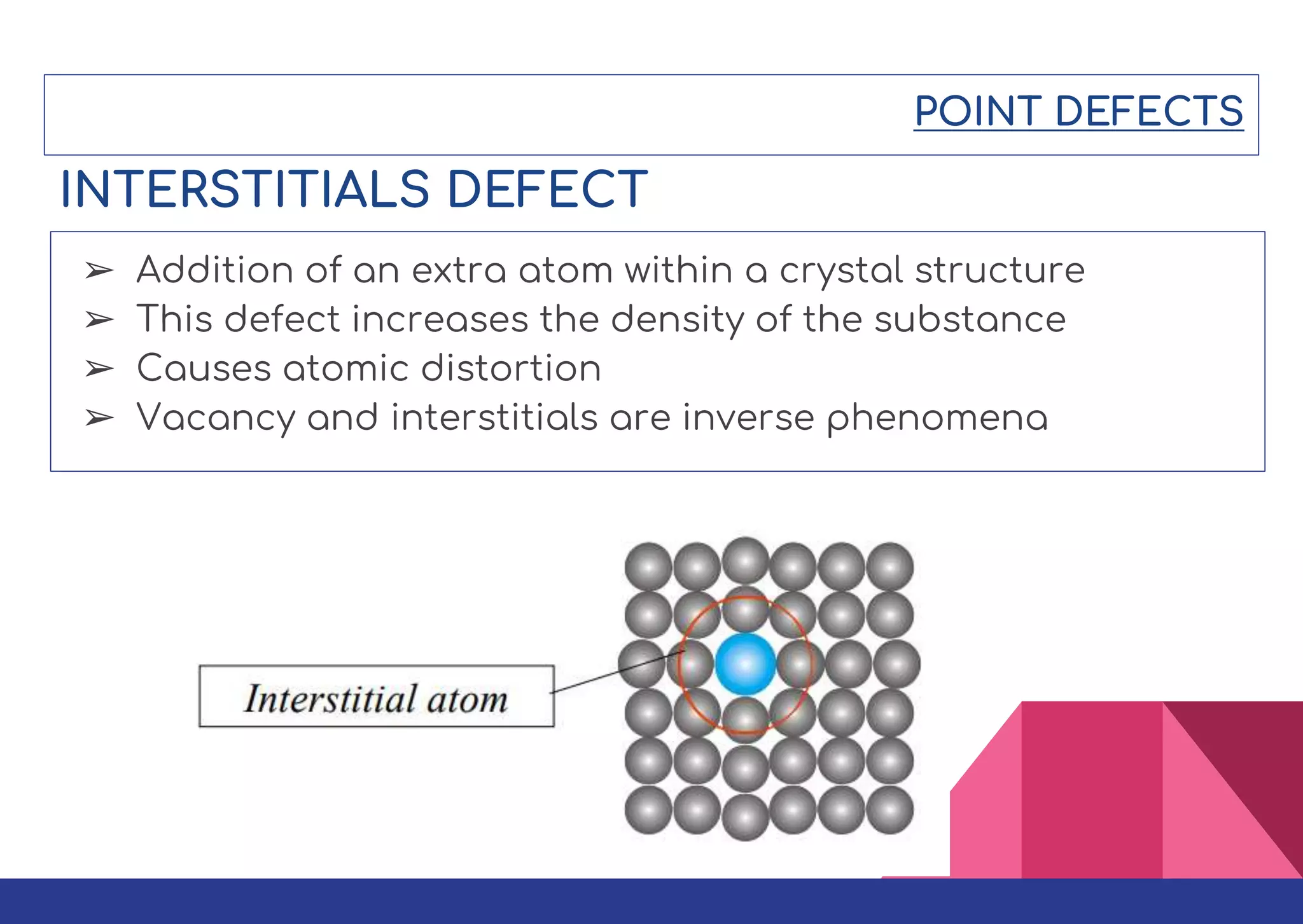
INTERSTITIALS DEFECT
➢ Addition of an extra atom within a crystal structure
➢ This defect increases the density of the substance
➢ Causes atomic distortion
➢ Vacancy and interstitials are inverse phenomena
POINT DEFECTS
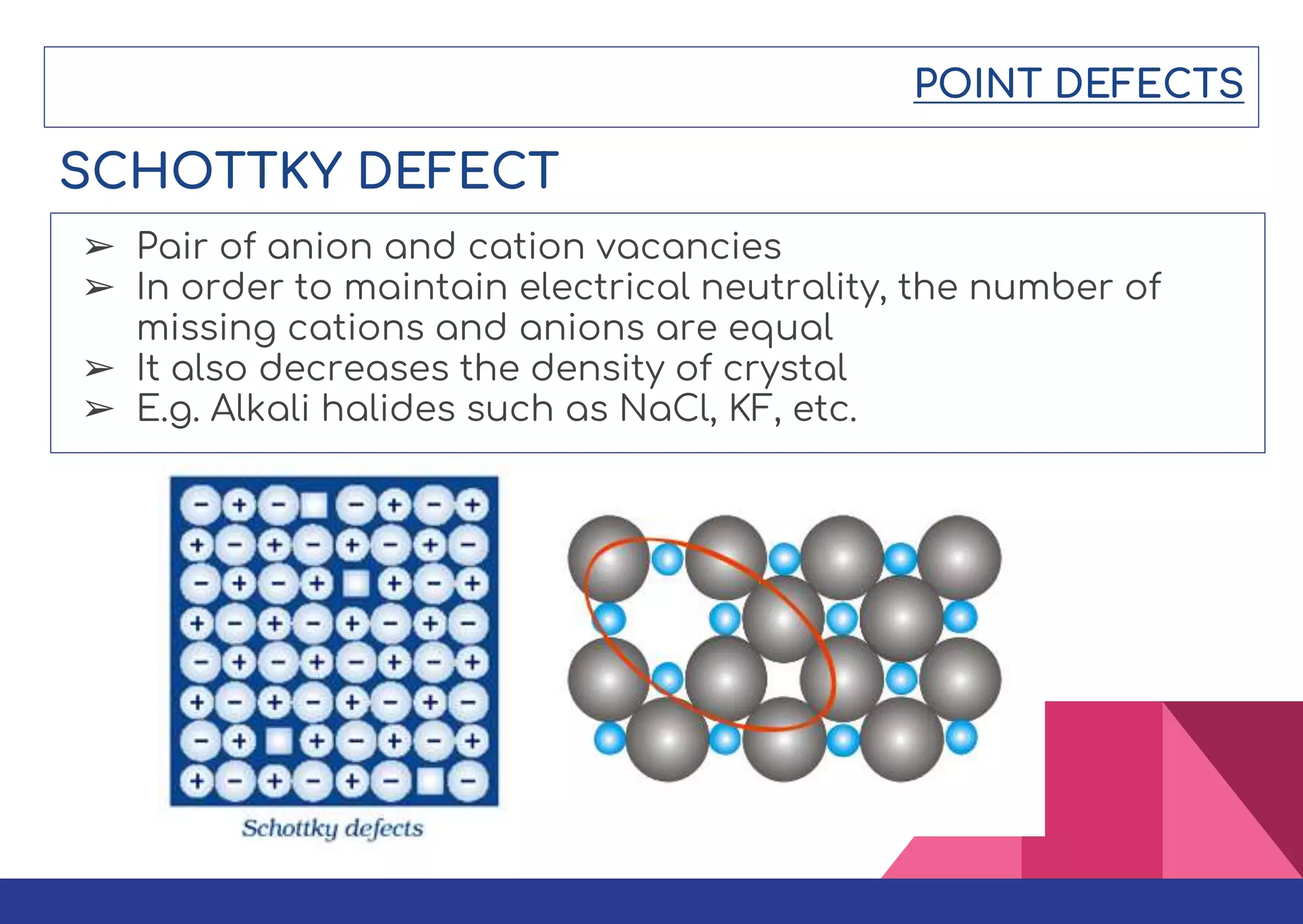
SCHOTTKY DEFECT
➢ Pair of anion and cation vacancies
➢ In order to maintain electrical neutrality, the number of
missing cations and anions are equal
➢ It also decreases the density of crystal
➢ E.g. Alkali halides such as NaCl, KF, etc.
POINT DEFECTS
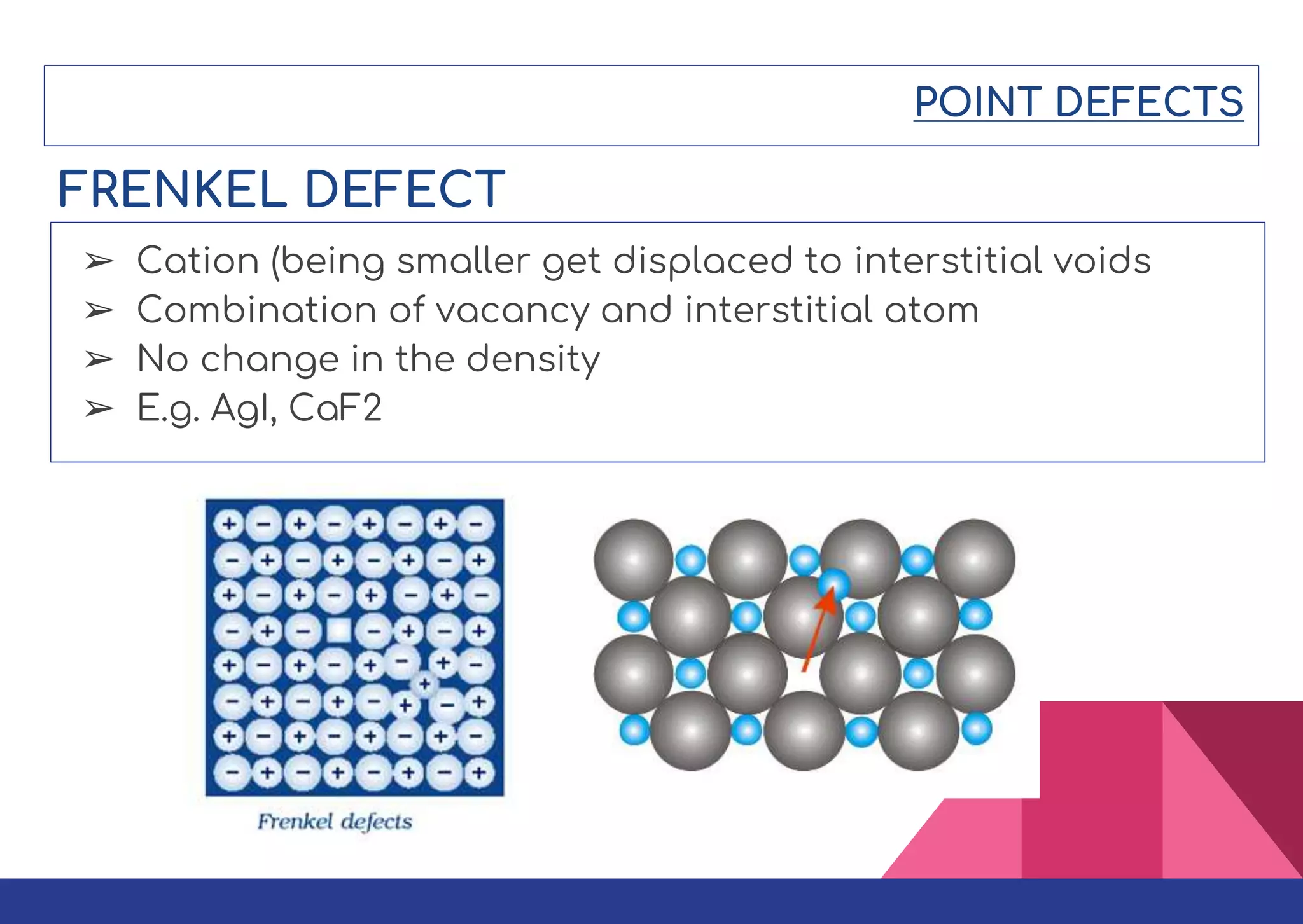
FRENKEL DEFECT
➢ Cation (being smaller get displaced to interstitial voids
➢ Combination of vacancy and interstitial atom
➢ No change in the density
➢ E.g. AgI, CaF2
POINT DEFECTS
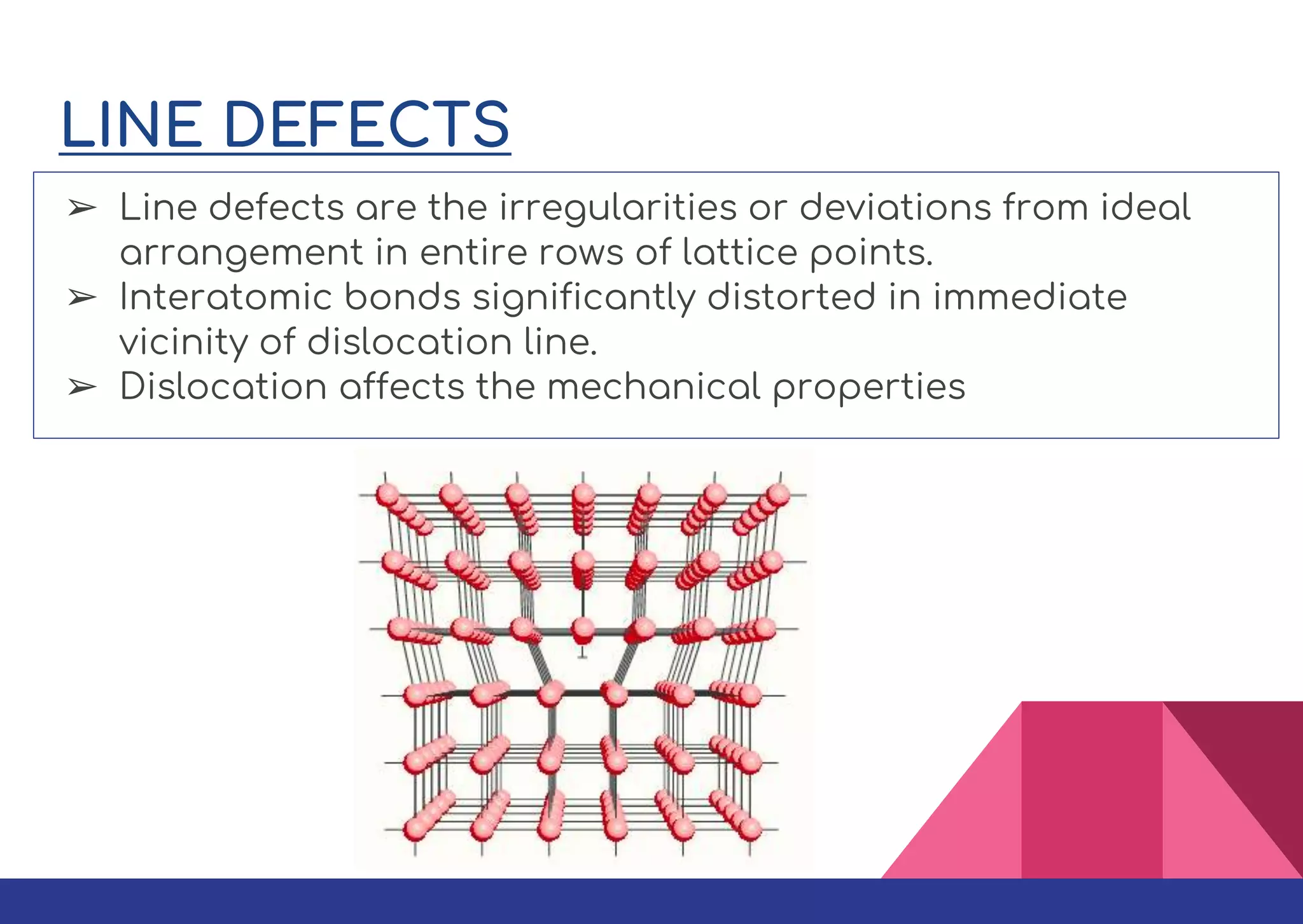
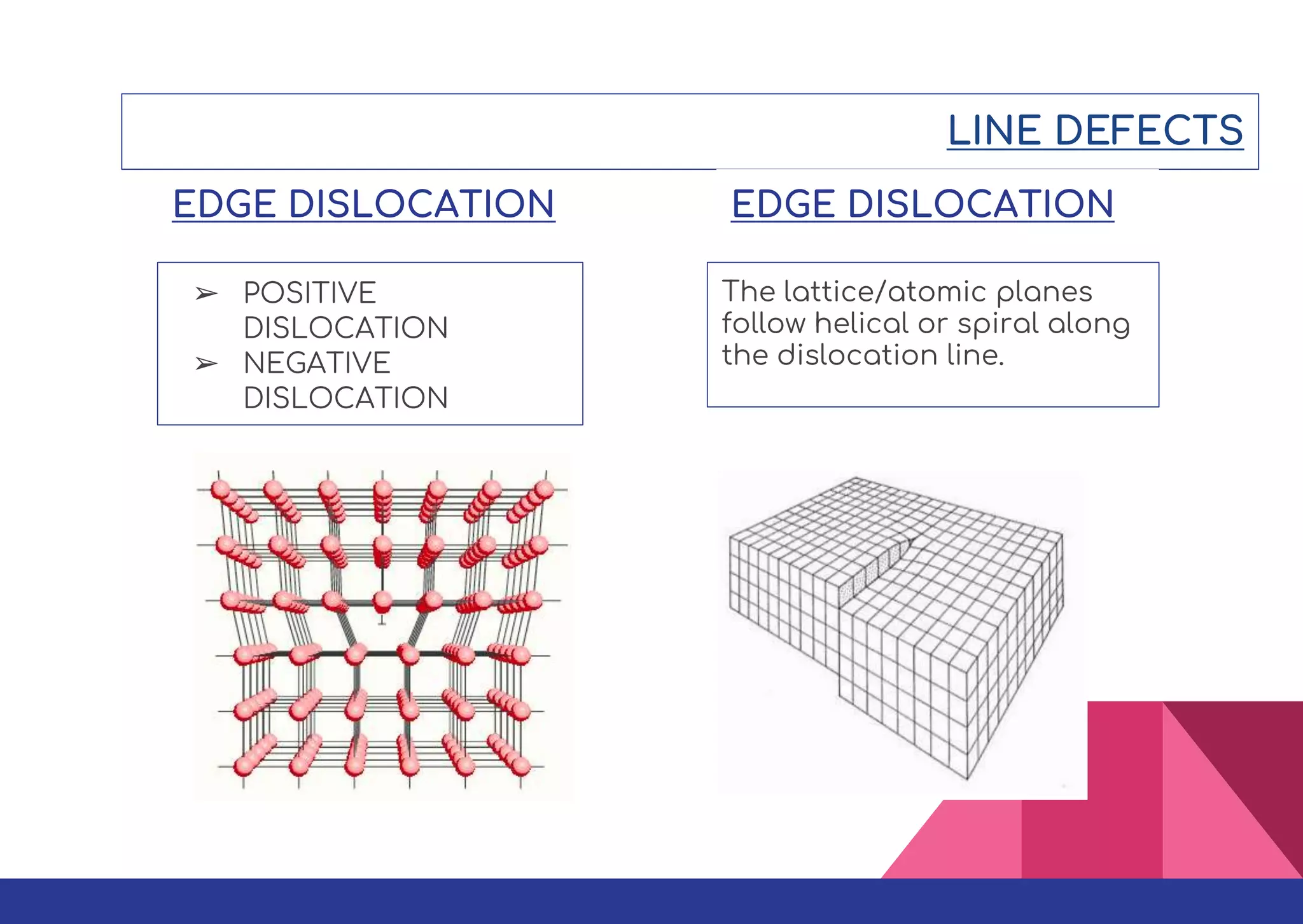
LINE DEFECTS
➢ Line defects are the irregularities or deviations from ideal
arrangement in entire rows of lattice points.
➢ Interatomic bonds significantly distorted in immediate
vicinity of dislocation line.
➢ Dislocation affects the mechanical properties
LINE DEFECTS
➢ POSITIVE
DISLOCATION
➢ NEGATIVE
DISLOCATION
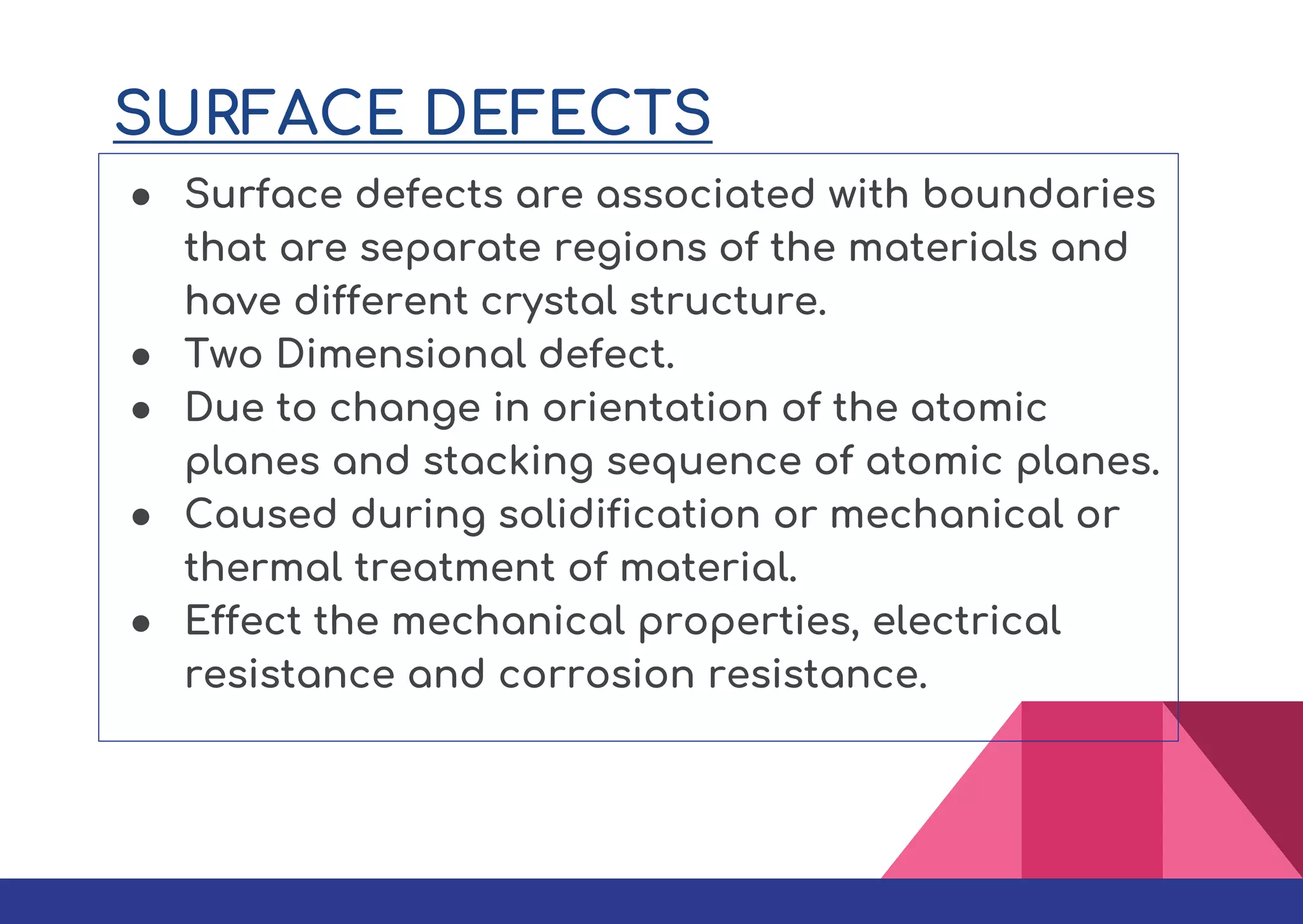
EDGE DISLOCATION EDGE DISLOCATION
The lattice/atomic planes
follow helical or spiral along
the dislocation line.
SURFACE DEFECTS
● Surface defects are associated with boundaries
that are separate regions of the materials and
have different crystal structure.
● Two Dimensional defect.
● Due to change in orientation of the atomic
planes and stacking sequence of atomic planes.
● Caused during solidification or mechanical or
thermal treatment of material.
● Effect the mechanical properties, electrical
resistance and corrosion resistance.
BULK OR VOLUME DEFECTS
➢ PERCIPITATES : Fraction of a micron in size
➢ DISPERSANTS : may be large precipitates, grains, or
polygranular particles distributed through
microstructure
➢ INCLUSIONS : foreign particles or large precipitate
particles ; undesirable ; harmful
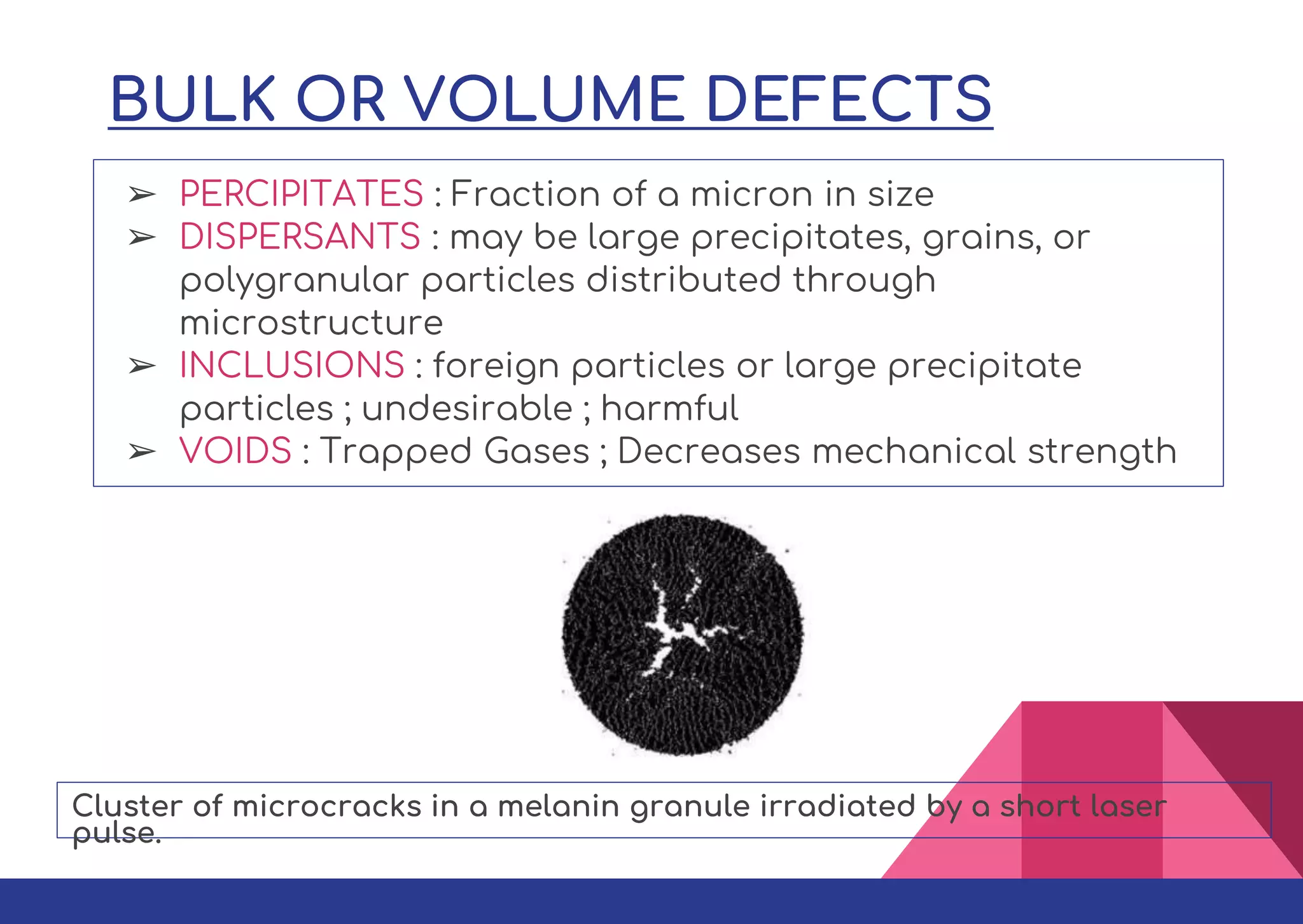
➢ VOIDS : Trapped Gases ; Decreases mechanical strength
Cluster of microcracks in a melanin granule irradiated by a short laser
pulse.
DEFECTS IN CRYSTALS.pptx

DEFECTS IN CRYSTALS.pptx

  • 1.
    SETH MOTILAL [P.G.]COLLEGE, JHUNJHUNU SEMINAR M.Sc. FINAL CHEMISTRY Submitted to: Prof. Babita (H.O.D.) Submitted by : Ashish Kumar Sonkaria Roll No. - 22335106
  • 2.
    DEFECTS IN CRYSTALS “Crystalsare like people, it is the defects in them which tend to make them interesting!” - Colin Humphreys
  • 3.
    DEFECTS IN CRYSTALS ●INTRODUCTION ● CLASSIFICATION OF DEFECTS BASED ON DIMENSIONALITY ○ POINT DEFECTS ■ VACANCY DEFECT ■ INTERSTITIALS DEFECT ■ SCHOTTKY DEFECT ■ FRENKEL DEFECTS ○ LINE DEFECTS ■ EDGE DISLOCATION ■ SCREW DISLOCATION ● SURFACE DEFECTS ● BULK OR VOLUME DEFECTS
  • 4.
    INTRODUCTION ● Crystalline materialhas a crystal structure in which the atoms are positioned in perfect ordered pattern which is repetitive over large atomic distance. ● Defects have a profound impact on the macroscopic properties of materials. ● Sometimes defects are deliberately created to improve properties of crystal.
  • 5.
    CLASSIFICATION OF DEFECTSBASED ON DIMENSIONALITY Vacancy Interstitial Frenkel defect Schottky defect Edge Dislocation Screw Dislocation Grain boundary Twin boundary Stacking faults Dispersant Precipitate Inclusion Voids / Cracks 0D (Point defects) 1D (Line defects) 2D (Surface / Interface) 3D (Volume defects)
  • 6.
    POINT DEFECTS Point Defectsare the irregularities or deviations from ideal arrangement around a point or an atom in a crystalline substance. 0D (Point defects) Non-ionic crystals Ionic crystals Vacancy Interstitial Frenkel defect Schottky defect
  • 7.
    VACANCY DEFECT ➢ Atommissing from an atomic site ➢ Occur due to imperfect packing during crystallisation ➢ This results in decrease in density of the substance ➢ Number of vacancy defects depend on temperature Vacancy Defect POINT DEFECTS
  • 8.
    INTERSTITIALS DEFECT ➢ Additionof an extra atom within a crystal structure ➢ This defect increases the density of the substance ➢ Causes atomic distortion ➢ Vacancy and interstitials are inverse phenomena POINT DEFECTS
  • 9.
    SCHOTTKY DEFECT ➢ Pairof anion and cation vacancies ➢ In order to maintain electrical neutrality, the number of missing cations and anions are equal ➢ It also decreases the density of crystal ➢ E.g. Alkali halides such as NaCl, KF, etc. POINT DEFECTS
  • 10.
    FRENKEL DEFECT ➢ Cation(being smaller get displaced to interstitial voids ➢ Combination of vacancy and interstitial atom ➢ No change in the density ➢ E.g. AgI, CaF2 POINT DEFECTS
  • 11.
    LINE DEFECTS ➢ Linedefects are the irregularities or deviations from ideal arrangement in entire rows of lattice points. ➢ Interatomic bonds significantly distorted in immediate vicinity of dislocation line. ➢ Dislocation affects the mechanical properties
  • 12.
    LINE DEFECTS ➢ POSITIVE DISLOCATION ➢NEGATIVE DISLOCATION EDGE DISLOCATION EDGE DISLOCATION The lattice/atomic planes follow helical or spiral along the dislocation line.
  • 13.
    SURFACE DEFECTS ● Surfacedefects are associated with boundaries that are separate regions of the materials and have different crystal structure. ● Two Dimensional defect. ● Due to change in orientation of the atomic planes and stacking sequence of atomic planes. ● Caused during solidification or mechanical or thermal treatment of material. ● Effect the mechanical properties, electrical resistance and corrosion resistance.
  • 14.
    BULK OR VOLUMEDEFECTS ➢ PERCIPITATES : Fraction of a micron in size ➢ DISPERSANTS : may be large precipitates, grains, or polygranular particles distributed through microstructure ➢ INCLUSIONS : foreign particles or large precipitate particles ; undesirable ; harmful ➢ VOIDS : Trapped Gases ; Decreases mechanical strength Cluster of microcracks in a melanin granule irradiated by a short laser pulse.