Government Vidharbha institute of Science
and Humanities , Amravati
Department of Physics and electronics
Seminar Presentation on
Imperfections In Solids
Presented By
Samiksha R. Deole
M.Sc. II year (Sem-III)
Contents
 Imperfection in crystal
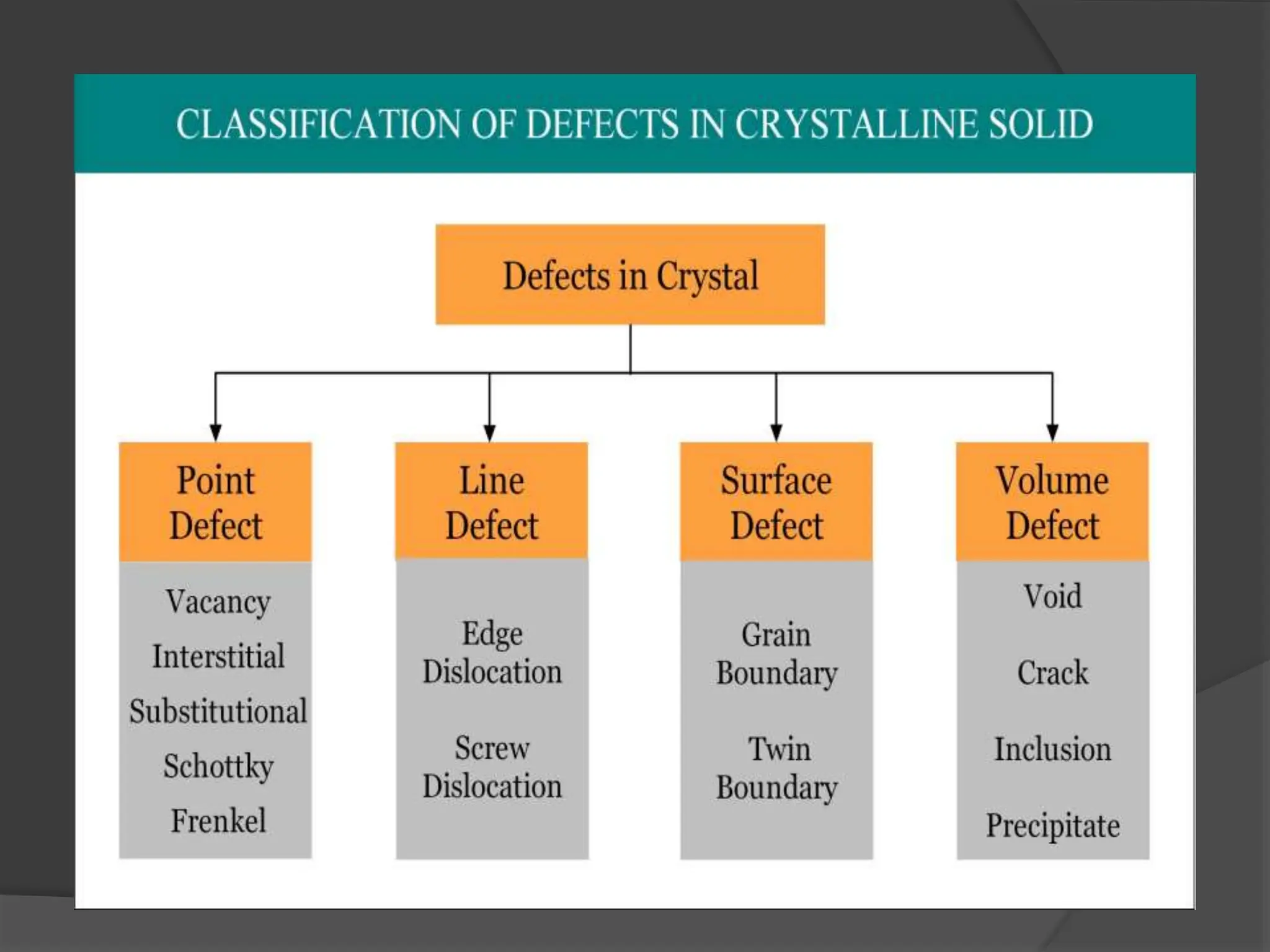
 Classification of defects in crystalline solids
 Point defects
 Vacancy defects
 Interstitial defects
 Schottky defect
 Frenkel defect
 Applications
Imperfection In Crystal
 An important feature of crystal is the
regular atomic arrangement but no crystal
is perfectly regular.
 Any deviation from this perfect atomic
periodicity is an imperfection which also
called as lattice defect.
 Lattice defect – a state in which the
atomic arrangement in smaller region of a
crystal has departed from regular crystal
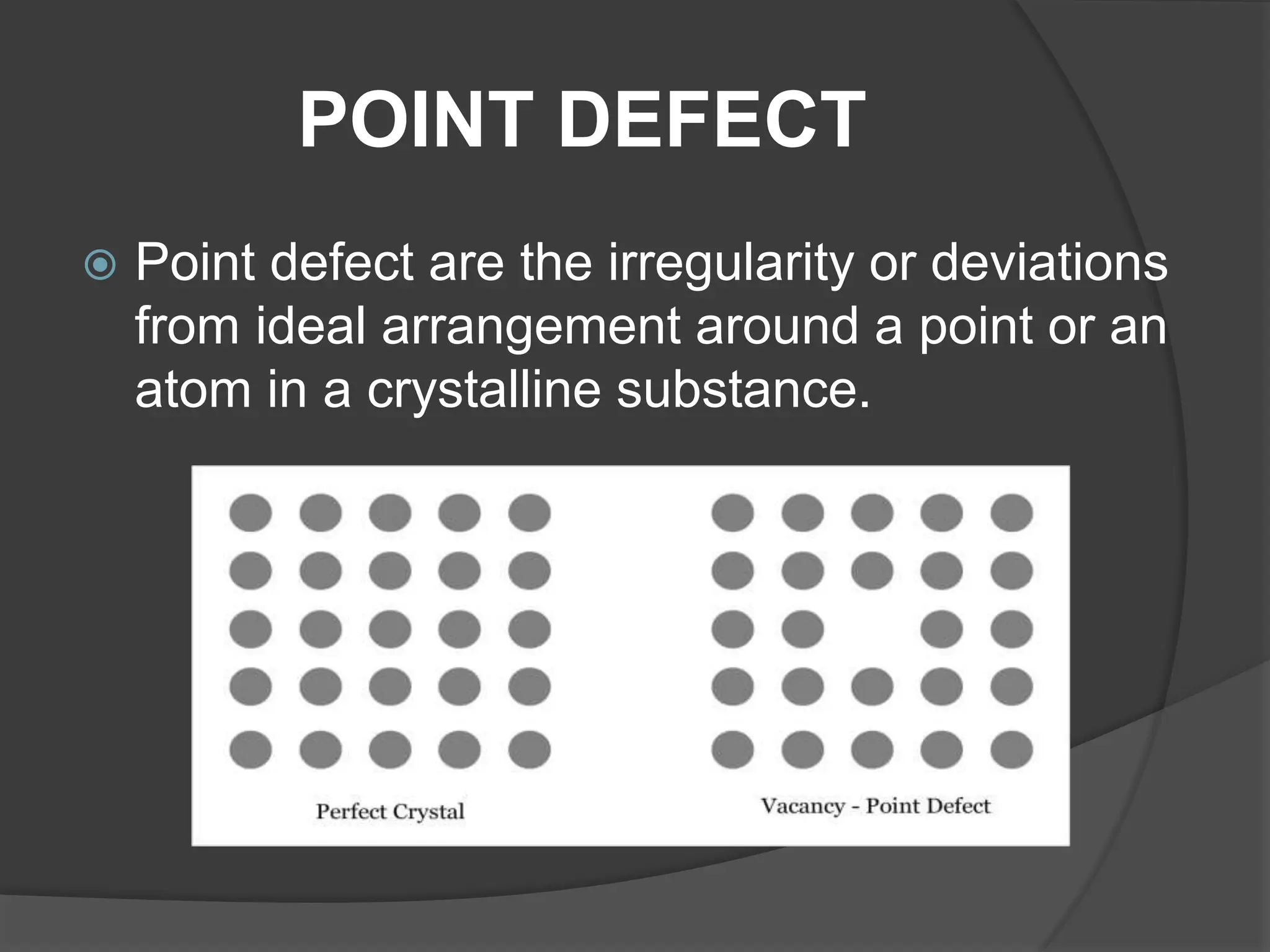
POINT DEFECT
 Point defect are the irregularity or deviations
from ideal arrangement around a point or an
atom in a crystalline substance.
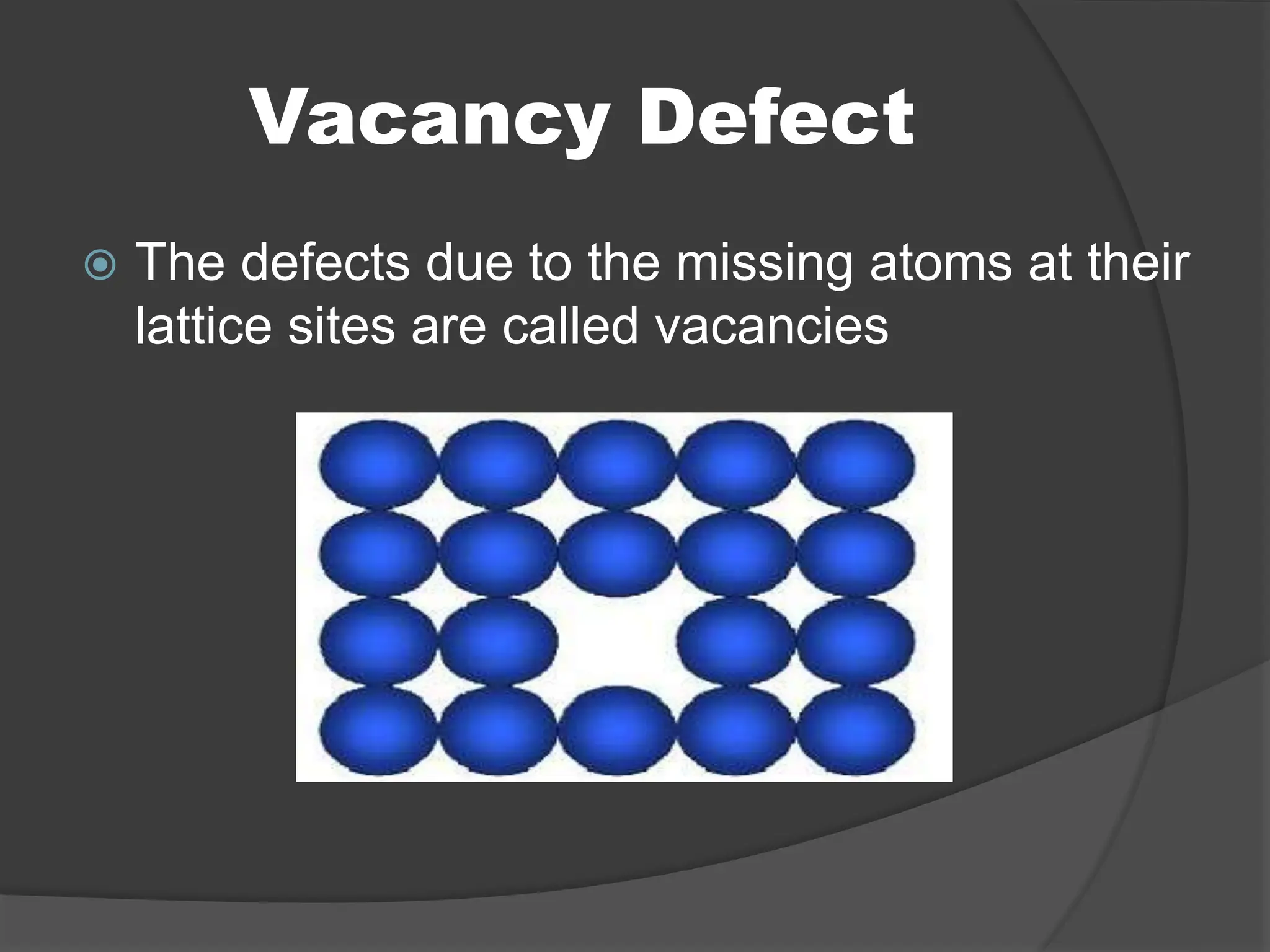
Vacancy Defect
 The defects due to the missing atoms at their
lattice sites are called vacancies
Interstitial defect
 When some constituent particals (atoms or
molecules) occupy an interstitial site, the
crystal is said to have interstitial defect
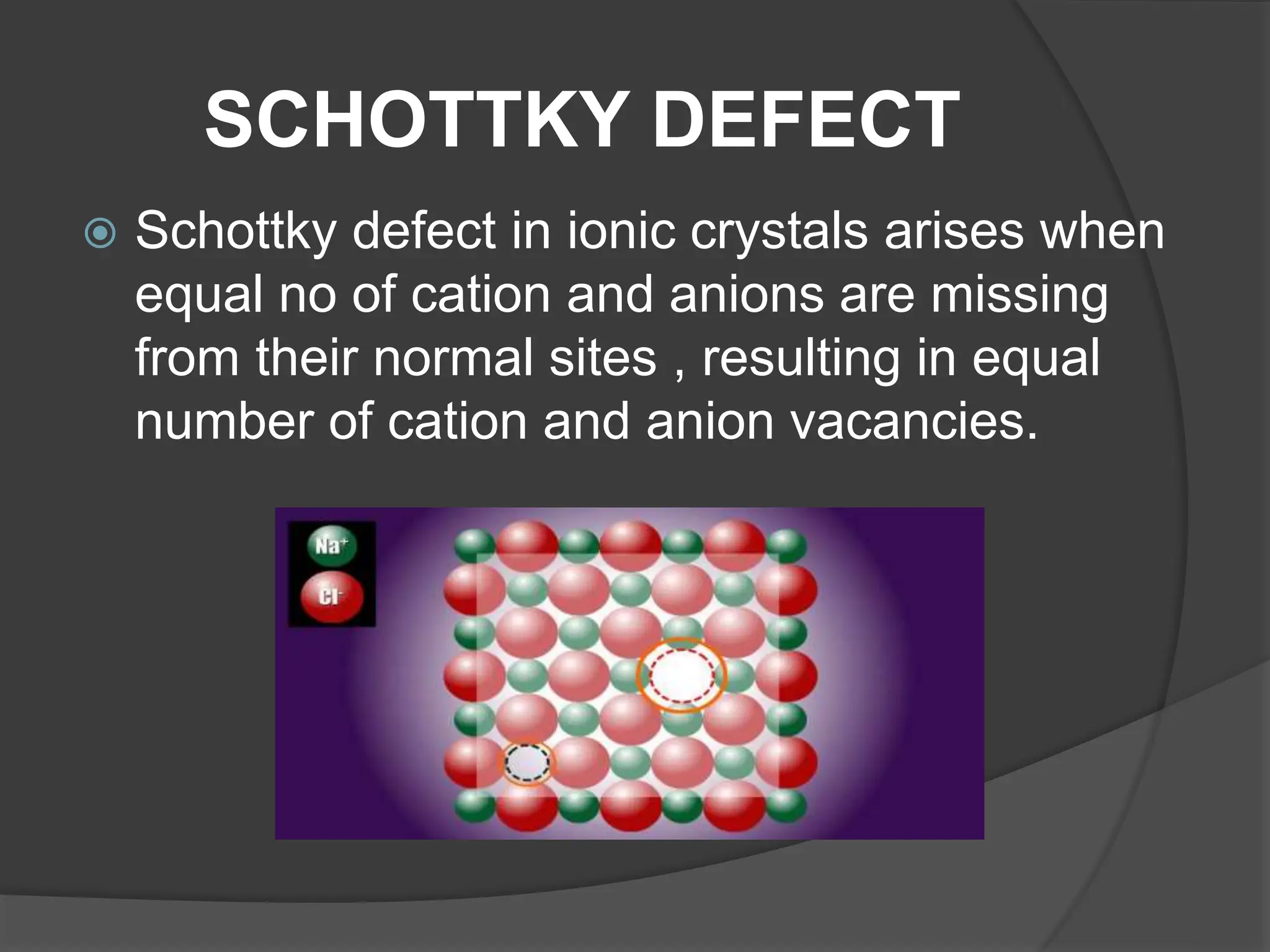
SCHOTTKY DEFECT
 Schottky defect in ionic crystals arises when
equal no of cation and anions are missing
from their normal sites , resulting in equal
number of cation and anion vacancies.
Consequences Of Schottky Defect
 In Schottky Defect the volume of the crystal
increases without any change in the mass
and therefore, the density of the crystal
decreases.
 The crystal begins to conduct electricity to a
small extent by ionic mechanism
 The presence of too many voids lowers
energy and the stability of the crystal.
Concentration of Schottky Defect
N: Total No of Ions
n: cation vacancies
Thermodynamic probability is given by
WA = N! / n! (N-n)! WC = N! / n! (N-n)!
Total Thermodynamic probability is
W = WA.WC = (N! / n!(N-n)!)2
Change in Entropy is given by,
ΔS= K ln W
ΔS= K ln (N! / n! (N-n)!)2
ΔS= 2K [ln N! - ln n! – ln(N-n)!]
By using stirlings Approximation formula
2K [ N ln N – n ln n- (N-n) ln (N-n) ]
Net Change in free energy
ΔG = n Δ H – TΔ S
Putting the value ΔS
ΔG = n Δ H – 2KT[N ln N – n ln n –(N-n) ln(N-n)]
We know that change in free energy is zero
d(ΔG) / ∂n = 0
ln (N-n) / n = ΔH / 2KT
As n << N , (N-n) = N
n/N = e(- ΔH / 2KT )
n= N exp (-ΔH / 2KT)
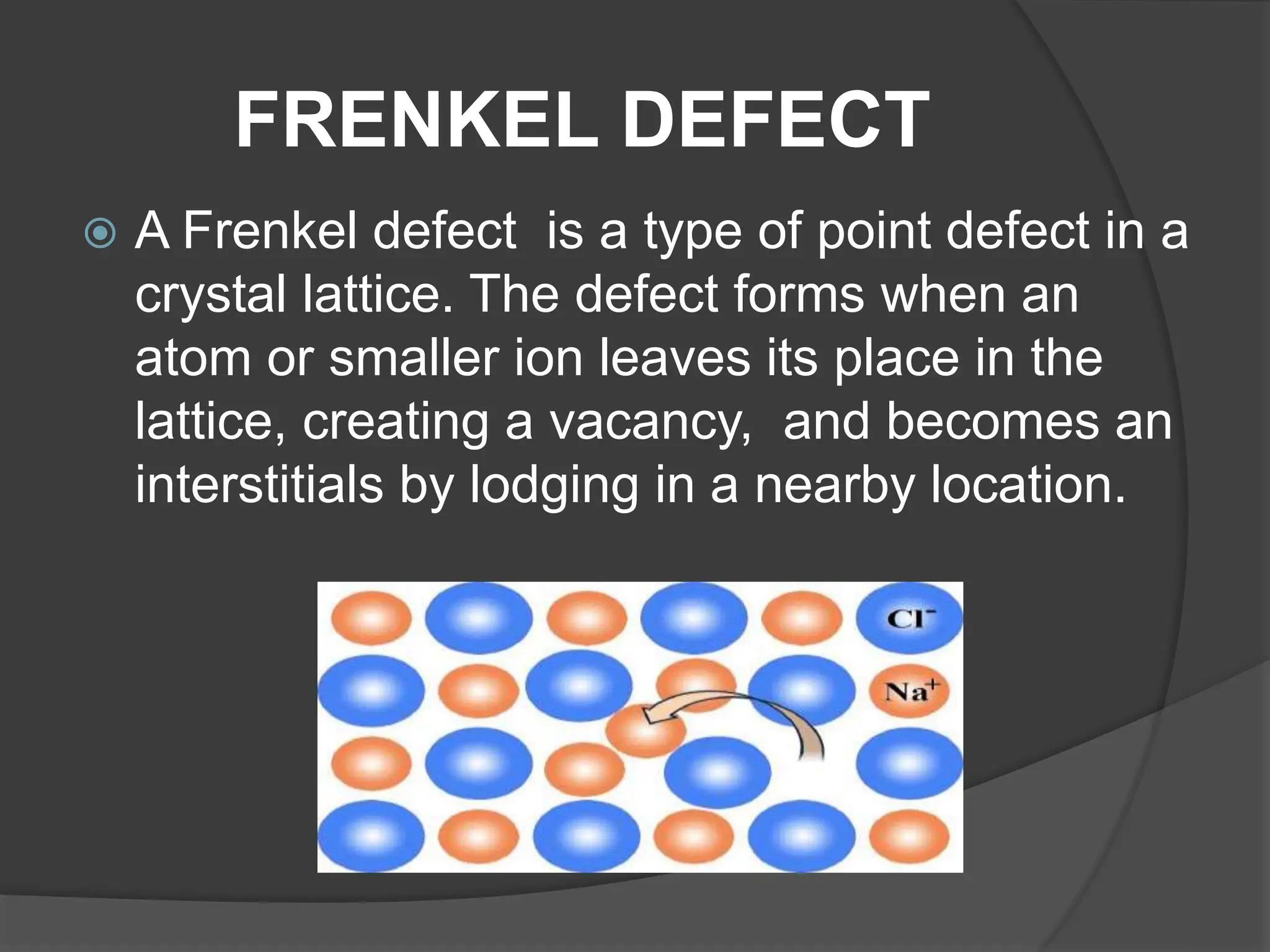
FRENKEL DEFECT
 A Frenkel defect is a type of point defect in a
crystal lattice. The defect forms when an
atom or smaller ion leaves its place in the
lattice, creating a vacancy, and becomes an
interstitials by lodging in a nearby location.
Concentration Of Frenkel
Defects
N : Total No of Ions
Ni : be the interstitial species
N : No of Frenkel Defects
Thermodynamic probability is given by
W = N! / (N-n)! n! . Ni ! / (Ni - n)! n!
Change in entropy
ΔS = K ln [ N! / (N-n)! n! . Ni ! / (Ni-n)! n!]
= k[ln N! + ln Ni ! – ln(N-n) ! –ln(Ni-n)-2 ln n!]
By solving the above equation , we get change in
free energy is
ΔG = n ΔH – T ΔS
Δ H –TK [ ln (N-n) + 1 + ln(Ni-n) + 1 -2ln n-2] = 0
Δ H –TK ln [ (N-n) (Ni-n) / n2 ] = 0
As n<< N , Ni
N-n = N
Ni – n = Ni
We get,
ஃ n = (N-Ni)1/2 exp (- Δ H / 2KT )
Application of point defects
 Point defects can influence the electrical
and magnetic properties of material
 Point defects can influence the optical
properties of materials.
 Colour Centres
Generations of colour centres
i. By the introduction of chemical impurities.
ii. By the introduction of excess of metal.
Samiksha Deole Defects Samiksha Deole Defects

Samiksha Deole Defects Samiksha Deole Defects

  • 1.
    Government Vidharbha instituteof Science and Humanities , Amravati Department of Physics and electronics Seminar Presentation on Imperfections In Solids Presented By Samiksha R. Deole M.Sc. II year (Sem-III)
  • 2.
    Contents  Imperfection incrystal  Classification of defects in crystalline solids  Point defects  Vacancy defects  Interstitial defects  Schottky defect  Frenkel defect  Applications
  • 3.
    Imperfection In Crystal An important feature of crystal is the regular atomic arrangement but no crystal is perfectly regular.  Any deviation from this perfect atomic periodicity is an imperfection which also called as lattice defect.  Lattice defect – a state in which the atomic arrangement in smaller region of a crystal has departed from regular crystal
  • 5.
    POINT DEFECT  Pointdefect are the irregularity or deviations from ideal arrangement around a point or an atom in a crystalline substance.
  • 6.
    Vacancy Defect  Thedefects due to the missing atoms at their lattice sites are called vacancies
  • 7.
    Interstitial defect  Whensome constituent particals (atoms or molecules) occupy an interstitial site, the crystal is said to have interstitial defect
  • 8.
    SCHOTTKY DEFECT  Schottkydefect in ionic crystals arises when equal no of cation and anions are missing from their normal sites , resulting in equal number of cation and anion vacancies.
  • 9.
    Consequences Of SchottkyDefect  In Schottky Defect the volume of the crystal increases without any change in the mass and therefore, the density of the crystal decreases.  The crystal begins to conduct electricity to a small extent by ionic mechanism  The presence of too many voids lowers energy and the stability of the crystal.
  • 10.
    Concentration of SchottkyDefect N: Total No of Ions n: cation vacancies Thermodynamic probability is given by WA = N! / n! (N-n)! WC = N! / n! (N-n)! Total Thermodynamic probability is W = WA.WC = (N! / n!(N-n)!)2 Change in Entropy is given by, ΔS= K ln W ΔS= K ln (N! / n! (N-n)!)2 ΔS= 2K [ln N! - ln n! – ln(N-n)!]
  • 11.
    By using stirlingsApproximation formula 2K [ N ln N – n ln n- (N-n) ln (N-n) ] Net Change in free energy ΔG = n Δ H – TΔ S Putting the value ΔS ΔG = n Δ H – 2KT[N ln N – n ln n –(N-n) ln(N-n)] We know that change in free energy is zero d(ΔG) / ∂n = 0 ln (N-n) / n = ΔH / 2KT As n << N , (N-n) = N n/N = e(- ΔH / 2KT ) n= N exp (-ΔH / 2KT)
  • 12.
    FRENKEL DEFECT  AFrenkel defect is a type of point defect in a crystal lattice. The defect forms when an atom or smaller ion leaves its place in the lattice, creating a vacancy, and becomes an interstitials by lodging in a nearby location.
  • 13.
    Concentration Of Frenkel Defects N: Total No of Ions Ni : be the interstitial species N : No of Frenkel Defects Thermodynamic probability is given by W = N! / (N-n)! n! . Ni ! / (Ni - n)! n! Change in entropy ΔS = K ln [ N! / (N-n)! n! . Ni ! / (Ni-n)! n!] = k[ln N! + ln Ni ! – ln(N-n) ! –ln(Ni-n)-2 ln n!]
  • 14.
    By solving theabove equation , we get change in free energy is ΔG = n ΔH – T ΔS Δ H –TK [ ln (N-n) + 1 + ln(Ni-n) + 1 -2ln n-2] = 0 Δ H –TK ln [ (N-n) (Ni-n) / n2 ] = 0 As n<< N , Ni N-n = N Ni – n = Ni We get, ஃ n = (N-Ni)1/2 exp (- Δ H / 2KT )
  • 15.
    Application of pointdefects  Point defects can influence the electrical and magnetic properties of material  Point defects can influence the optical properties of materials.  Colour Centres Generations of colour centres i. By the introduction of chemical impurities. ii. By the introduction of excess of metal.