Inorganic Solid State
Chemistry
4. Inorganic Solid State Chemistry (8 Hours)
• Defects in solids, Point defects; Schottky and Frenkel defects, Colour
center, Extended defects and Non-stoichiometry.
• Band Theory of solids: Band gaps, Metals, Insulators and Semi-conductors.
What is an Ideal Crystal?
• One which has the same unit cell dimensions and contains the same
lattice points throughout the crystal.
How are defects in Crystals formed?
• At absolute zero temperature, all ionic crystals show well-ordered
arrangements of ions and have no defects.
• With rise in temperature, there is a chance that one or more of the lattice
sites may remain unoccupied by the ions. This gives rise to a defect.
Defect/Disorder/Imperfection:
• Departure from perfectly ordered state of constituents of a crystal. It is an
imperfection of structure or composition.
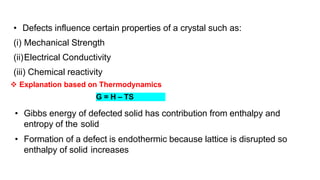
• Defects influence certain properties of a crystal such as:
(i) Mechanical Strength
(ii)Electrical Conductivity
(iii) Chemical reactivity
 Explanation based on Thermodynamics
G = H – TS
• Gibbs energy of defected solid has contribution from enthalpy and
entropy of the solid
• Formation of a defect is endothermic because lattice is disrupted so
enthalpy of solid increases
• -TS becomes more negative as defects are formed due to disorder. Thus, entropy
rises.
• G is minimum at non zero concentration of defects but as temperature of solid is
raised, minimum
G shifts to higher defect concentration.
• Thus, solids have greater no. of defects as their melting point is approached.
• No. ‘n’ of such defects per cm3 at a given temperature ‘T’ on absolute scale is
given by equation:
n= Ne-W/2RT
• N- total no. of sites per cm3 of crystal
• W- work (energy) required to produce a defect
• R- gas constant
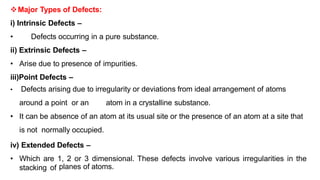
Major Types of Defects:
i) Intrinsic Defects –
• Defects occurring in a pure substance.
ii) Extrinsic Defects –
• Arise due to presence of impurities.
iii)Point Defects –
• Defects arising due to irregularity or deviations from ideal arrangement of atoms
around a point or an atom in a crystalline substance.
• It can be absence of an atom at its usual site or the presence of an atom at a site that
is not normally occupied.
iv) Extended Defects –
• Which are 1, 2 or 3 dimensional. These defects involve various irregularities in the
stacking of planes of atoms.
 Stoichiometric Crystals
• Crystals in which the no. of positive and negative ions are exactly in the ratios
indicated by their chemical formula.
• Consider crystals of type AB having equal no. of A+ and B- ions.
• Stoichiometric Defects are those which do not disturb the stoichiometry of the solids.
• They are also known as Daltonide compounds.
Classified into Ionic Solids
Non-ionic
solids
 Non-Ionic Solids:
a) Vacancy Defect –
• When some of the lattice sites are vacant, the crystal is said to have
vacancy defect.
• Unoccupied positions are called vacancies
• The density of substance decreases due to vacancy.
• When a substance is heated, vacancy defect may develop.
b) Interstitial Defect –
• When some constituent particles (atoms or molecules) occupy vacant interstitial
positions.
• Density of substance increases.
ii) Ionic Solids
• Ionic compounds must always maintain electrical
neutrality.
• They show vacancy and interstitial defects as:
Schottky
Defects
Frenkel
Defects
Schottky Defect (NaCl)
Schottky Defect
• German Scientist W. Schottky discovered this defect in 1930.
• It is a point defect in which a pair of atoms or ions are missing from their normal sites.
The unoccupied points are called lattice vacancies or holes.
• Overall stoichiometry of the solids are not affected to ensure electrical neutrality, the
defect occurs in pairs i.e. equal no. of cations and anions are missing.
• For eg. in compound with composition MX, both M and X are missing. In solids
with different
composition say MX2, defect must occur with balanced charges.
• Thus, 2 anion vacancies are created for each cation lost.
 Conditions for Schottky
• Strongly ionic compounds having coordination no. and radius ratio (r+/r-) almost unity i.e.
anion
and cation have similar sizes.
• Example: NaCl and CsCl with coordination no. 6 and 8 respectively. Also, KCl, KBr and
AgBr.
• At room temperature, Schottky defect is present for every 1016 ions.
• Due to Schottky defect, density of the substance decreases.
FRENKEL DEFECT
 Frenkel Defect
• Russian scientist Frenkel discovered this defect in 1926.
• It is a point defect in which an atom or ion has been displaced onto an interstitial position
located
between lattice points.
• In the fig, it is seen that one of the positive ions occupies a position in the interstitial
space rather than at its own original site in the lattice.
• A ‘hole’ is thus created in the lattice as shown.
• Therefore, in Frenkel defect, a vacancy defect is created at the original position and
an interstitial defect is created at the new location.
• Electrical neutrality is maintained.
• Metal cations are generally smaller than the anions .
• Therefore, it is easier to squeeze A+ into alternative interstitial positions and as a
result, it is more common to find positive ions occupying interstitial sites as
compared to anions.
Conditions for Frenkel
• Frenkel Defects are favoured in compounds in which negative ions are much larger than
positive ions. i.e. r+/r- is low.
• C.N. in such compounds is also low.
• Sincepositive ions are highly polarisingand large negativeions are readily polarised,
these
compounds have some covalent character.
• Examples include ZnS, AgCl ,AgBr and AgI
• In AgBr, some Ag+ ions are missing from their regular positions and occupy positions between other ions in
the lattice.
• Presence of Ag+ ions in interstitial spaces of AgBr are responsible for photographic images on exposure
of AgBr crystals
(photographic plate) to light.
• In ZnS, Zn2+ ions get entrapped in interstitial spaces leaving ‘holes’ in the lattice.
• No. of Frenkel defect formed per cm3 are:
N- No.of sites/cm3 that could be left vacant
N’- no. of alternative interstitial positions/cm3
wf-work necessary to form Frenkel Defect
R-gas constant
T-absolute temperature
1
8
Comparing Schottky And Frenkel Defects
• Schottky defect occurs more often than Frenkel because, the energy needed to
form Schotttky defect is much less than that needed to form a Frenkel defect.
• In Frenkel defect, oppositely charged ion forces have to be broken in causing
movement of a positive ion from its original site to the interstitial position. For eg. In
NaCl, energy needed to form a Schottky defect is 170kJ/mole. The lattice energy
of NaCl is -758.7kJ/mole, so the energy required for Frenkel defect i.e. to break the
NaCl lattice is 758.7 kJ/mole.
• No. of Schottky defects increases exponentially with rise in temperature. As
revealed by XRD, NaCl at RT has 1 Schottky Defect for 1015 lattice sites while the
no. of defects for same no. of lattice sites rises to 1016 at 500℃.
• Density also decreases in case of Schottky Defects. For eg. TiO with
145 vacant anion and cation has density 4.96g/cm which is much less
than 5.81g/cm for perfect TiO structure.
2
0
Consequences Of Stoichiometric Defects
• Closeness of similar charges brought about by Frenkel defect increases the
dielectric constant of crystals.
• As a consequence of both defects, a crystal is able to conduct electricity to
a small extent by ionic mechanism. For eg, as an electric field is applied,
a nearby ion moves from its lattice site to occupy a ‘hole.’ this creates a
new hole and another nearby ion moves into it and so on. This process
continues and a hole thereby migrates from one end to another. Thus,
electricity is conducted across the whole crystal. (This type of semi
conduction is responsible for unwanted background noise produced in
transistors.)
• The density of a defected lattice is different from a perfect lattice.
Presence of holes lowers density but too many holes may cause partial
collapse or distortion of the lattice in which case, change in density is
unpredictable.
• Presence of ions in interstitial positions (Frenkel Defect) may distort
(expand) the lattice and increase unit cell dimensions, thereby
lowering the stability of the crystal.
22
Non Stoichiometric Compounds
• Also known as the Berthollide compounds, exist over a range of chemical
composition and do not obey the law of constant proportions (same
chemical compound always contains the same elements in the same
composition by weight).
• The ratio of the no. of cations and anions in such compounds does not
correspond exactly to the ideal whole no.
ratio implied by the compound’s chemical formula.
• Examples of such compounds include oxides and sulphides of transition
elements. For eg: in FeO, FeS and CuS, the ratio of Fe:O, Fe:S or Cu:S differs
from the ideal chemical formula. If the ratio of the atoms is not exactly 1:1 in the
above cases, there must be either (i) an excess of positive charge (metal
ions) or (ii) deficiency of metal ions. For eg at 1000°C, the composition of
Wüstite Fe1-xO, varies from Fe0.89O-Fe0.96O.
• Electrical neutrality is maintained by having (i) extra electrons if the positive
charge is in excess and (ii) extra positive ions if negative charge is in excess.
• This leads to changes in unit cell composition arising either due to vacancies,
presence of interstitial atoms or the substitution of one atom by another.
24
Non stoichiometric defects
• The gradual change in the lattice parameter of a solid as a function of its
composition is known as ‘Vegard’s Rule. This irregularity in crystal structure
implies the presence of defects known as non- stoichiometric defects which may
exist in addition to thermodynamic defects.
• Non-stoichiometric defects are of two types, depending on whether positive ions are
in excess or negative ions are in excess. These are known as:
(1)Metal excess defects
(2)Metal deficiency defects
Metal Excess Defect due to extra
cation
25
26
Positive Ion In Interstitial Site
• Here, an extra positive ion occupies an interstitial site in the lattice and electrical
neutrality is maintained by inclusion of an interstitial electron.
• This defect is somewhat similar to Frenkel defect but there are no holes and there are
also interstitial electrons.
• This defect is common, and is formed in crystals that are expected to form Frenkel
defects i.e.
radius ratio is not unity, have low Coordination No. and are covalent.
• Examples include ZnO, CdO, Fe2O3 and Cr2O3.
• In this defect, oxide is heated in O2, then cooled to room temperature which shows a
decrease in conductivity. This is because O2 oxidises some of the interstitial ions and this
subsequently removes interstitial electrons, which reduces the conductivity.
27
Anionic Vacancy (F-centres)
28
29
Anionic Vacancy (F-centres)
• A negative ion is missing from its lattice site resulting in a ‘hole’ which is occupied
by an extra electron to maintain the electrical balance. Thus the crystal as a whole is
neutral.
• This type of defect is similar to Schottky Defect but has only ‘one hole’ and not a ‘pair of
holes.’ This defect is not common and is expected in compounds that would
generally exhibit Schottky defect.
• When compounds such as NaCl, KCl, LiH or δ-TiO are heated with excess of their
constituent metal vapours, or treated with high energy radiation, they become deficient in
the negative ions and their formula can be represented as AX1-δ where δ is a small
fraction.
• When NaCl is treated with Na vapour, a yellow non-stoichiometric form of
NaCl containing excess Na+ ions is obtained. Similarly, the non-
stoichiometric form of KCl is blue-lilac in colour due to presence of extra
K+ ions. (Note that flame colours of the above also have the same colour.)
31
• Hence, the crystal lattice has vacant anion sites, which are occupied by electrons.
These occupied
anionic sites are called ‘F centre.’ F is an abbreviation for farbe=colour in German.
• Thus, these F-centres impart colour to a compound and more the no. of F centres,
greater is the intensity of colouration.
• Solids containing F centres are paramagnetic as the electrons occupying the vacant sites
are unpaired.
• Materials with F centres when irradiated with light become photoconductors. When
electrons in the F-centres absorb sufficient light (or heat) energy, electron gets promoted
into a conduction band.
• This is called n-type semiconduction since conduction takes place by electrons.
32
Consequences Of Metal Excess Defects
• Both types of defects contain free electrons and if these electrons migrate, they can
conduct electricity. However since the no. of defects and therefore the no. of
electrons are few, these crystals can conduct only small amounts of current as
compared to metals or dissolved salts.
• These defected crystals are therefore also called semiconductors and since the
mechanism is normal electron conduction, these are called n-type
semiconductors.
• Crystals with metal excess defects are coloured, again due to presence
of free electrons.
• These electrons get excited easily to higher energy levels by
absorption of certain wavelength of
light from visible white light and hence the compounds appear
coloured.
• Hence, NaCl is yellow, KCl is lilac and ZnO is white when cold but
yellow when hot.
Metal Deficiency-a non stoichiometric
defect
• Metal deficiency compounds are represented by a general formula A1-∂X.
This can occur in two ways:
1) Positive ion vacancy
2) Negative ion in interstitial position
• Both ways require variable valency of the metal and hence, these defects are usually
seen in transition metals.
34
Positive Ion Vacancy
35
36
Positive Ion Vacancy
• Positive ion is missing from its original lattice site.
• The extra negative charge is balanced by some nearby metal ion (positive ion)
acquiring an additional positive charge. Hence the metal involved must be in a
position to have variable valency.
• Examples therefore include transition metals like FeO, NiO, ∂-TiO, FeS and CuI. If an
Fe2+ ion is missing from its lattice site in FeO, then there must be TWO Fe3+ ions
somewhere in the lattice to balance the electrical charges. Similar situation occurs in
the case of NiO.
• Crystals with metal deficiency defects are semiconductors.
37
Semiconduction
• Crystals with metal deficiency defect exhibit semiconduction.
• Imagine the lattice containing A+ and A2+ metal ions. If the electron ‘hops’ from A+ to A2+
( a positive centre), the original A+ becomes a new positive centre. Hence there has
been an apparent movement of A2+
• With a series of similar ‘hops’ an electron maybe transferred in one direction across
the structure and at the same time the positive hole migrates in the opposite direction
across the structure. This is called positive hole or p-type semiconduction.
• If defected oxide of this type is heated in dioxygen, its R.T conductivity increases
because the dioxygen oxidises some of the metal ions & this increases the no. of
positive centres.
Extra Negative Ion In Interstitial Site
38
39
Extra Negative Ion In Interstitial Site
• Here, an extra negative ion occupies an interstitial position.
• This extra negative charge is balanced by means of an extra charge on one of the
adjacent metal ions.
• Metals showing this defect must also be able to exhibit variable valency i.e. it should
be one of the transition metals.
• But, negative ions are large in size, therefore one cannot expect them to fit into the
interstitial positions.
• As a result, no crystal showing this type of metal deficiency defect exists. Therefore
there are no known examples of this type of defect.
Metal Deficiency Defects
40
41
Consequences Of Metal Deficiency Defects
• Crystals with metal deficiency defects can also be semiconductors.
• This property arises from the movement of an electron from one ion to another. This
means that an ion say A+, changes into A2+. Thus the movement of an electron from
A+ ion is an apparent movement of A2+ ion.
• This is called movement of positive hole and substances permitting this type of
movement is known as p-type semiconductors.
42
Extended Defects
• Defects may sometimes cluster together and form line or plane
defects.
Line Defects:
I) Dislocations – Edge and Screw
II)Wadsley Defects
43
Dislocations
• Dislocations are another type of defect in crystals. Dislocations are areas where the
atoms are out of position in the crystal structure.
• Dislocations are generated and move when stress is applied. The motion of
dislocation allows slip- plastic deformation to occur.
• Plastic deformation: a permanent deformation or change in shape or size of a
solid body without fracture under the action of a sustained stress(force), beyond the
elastic limit.
• Shear stress: force tending to cause deformation of a material by slippage along a
plane or planes parallel to the imposed stress.
• There are two basic types of dislocations: (i) Edge and (ii) Screw Dislocation.
Most dislocations are probably a hybrid of the edge and screw forms.
Edge
Dislocation
44
45
Edge Dislocation
• The edge defect can be easily visualized as an extra half-plane of atoms in a lattice.
• The dislocation is called a line defect because the locus of defective points
produced in the lattice by the dislocation lie along a line and is parallel to the line of
stress applied.
• This line runs along the top of the extra half plane.
• The inter atomic bonds are significantly distortedonly in the immediate vicinity of the
dislocation line.
46
Screw Dislocation
47
48
Screw Dislocation
• The screw dislocation is slightly more difficult to visualise.
• The motion of a screw dislocation is also a result of shear stress, but the defect line
movement is perpendicular to direction of the stress and the atom displacement,
rather than parallel.
• To visualise a screw dislocation, imagine a block of metal with a shear stress applied
across one end so that the metal begins to rip. If the shear force is increased, the
atoms will continue to slip to the right.
• The net plastic deformation of both edge and screw dislocations is however, the same.
49
50
51
52
Extended Defects or Wadsley Defects (Crystallographic Shear
Planes)
• Wadsley defects are shear planes that collect defects along certain
crystallographic directions.
• Such defects lead to a continuous range of compositions as in tungsten
oxide, which ranges from WO3 to WO2.93
.
• To picture the formation of the defect plane, we imagine the removal of
shared O atoms along a diagonal.
• The adjacent slabs slip past each other in a motion that results in the
completion of the vacant coordination sites around each W atom. This
shearing motion creates edge-shared octahedral along a diagonal.
• The resulting structure was named a crystallographic shear plane by
A.D. Wadsley, who first devised this way of describing extended planar
defects.
• Crystallographic shear planes randomly distributed in the solid are
called Wadsley defects.
• If, however, the crystallographic shear planes are distributed in a non-
random, periodic manner, so giving rise to a new unit cell, then we
should regard the material as a new stoichiometric phase.
• Thus, when even more O2- ions are removed from tungsten oxide, a
series of discrete phases having ordered crystallographic shear planes
and compositions WnO3n-2(n=20,24 and 40) are observed.
54
• In oxygen deficient rutile (TiO2), a homologous series of phases can be
prepared with a wide range of non-stoichiometric compoundTinO2n-
1(n=4….10).
• In these structures, regions of normal rutile structure occur which are
separated from each other by crystallographic shear planes which are
thin regions of different structure and composition. All of the oxygen
deficiency is concentrated within these crystallographic shear planes.
• With increased reduction, the variation in stoichiometry is
accommodated by increasing the no. of CS planes and decreasing the
block of rutile structure between adjacent CS planes.
Wadsley Defect OccurringSection
of Mineral
55
56
The Band Theory
• At T=0, electrons occupy the individual molecular orbitals of the bands in accordance
with the building up principle.
• If each atom supplies one s electron, then at T=0, the lowest n orbital is occupied.
• The highest occupied orbital at T=0 is called the Fermi level. It lies near the
centre of the band.
• When the band is not completely full, the electrons close to the fermi level can easily
be promoted to nearby empty levels.
• As a result, the electrons become mobile and can move freely throughout the solid
and the substance behaves like a conductor
57
• The molecular orbital theory of small molecules can be extended to account for
electrical properties in solids.
• The overlap of a large no. of atomic orbitals in a solid, leads to a large no. of molecular
orbitals that are closely spaced in energy and so form an almost continuous band of
energy levels.. Bands are separated by band gaps, which are values of the energy for
which there is no molecular orbital.
• Band built from ‘s’ orbitals is called ‘s band.’ Similarly, band built from ‘p’ orbital is
called ‘p band.’
• Because p orbitals lie higher in energy than s orbitals of the same valence shell, there is
often an energy gap between the s and p band. However, if the bands span a wide
range of energy and the atomic s and p energies are similar (which is mostly the case),
then the two bands overlap.
58
59
60
ThermalDefect
Intrinsic Conduction:
• Atoms of both Ge and Si have 4 electrons in the outer shell. Each atom therefore is
covalently bonded with 4 neighbouring atoms through sp3 hybrid bonds, giving rise
to a highly stable Td structure as in diamond.
• There are no free or conducting electrons as is seen in metals. The electrical
conductance therefore, is very low.
• Now suppose a sufficient amount of energy say in the form of heat is supplied to the
crystal as a result of which, one of the covalent bonds gets broken and the electrons
are released.
• The electrons thus released can migrate leaving behind a positive charge i.e. ‘a
positive hole,’ at the site of the missing bond.
• The crystal will now be able to conduct electricity because when electric field is
applied, the electrons migrate in one direction and the ‘positive holes’ in the other. (p-
type semiconduction)
• This type of conduction is known as intrinsic conduction as it can be produced
in the crystal
without adding an external substance.
61
62
63
Extrinsic/Impurity Defect –
Doping
• Certain defects in crystals arise from the presence of chemical impurities. These
are known as impurity defects.
n-Type Semiconduction
• Ge and Si belong to group 14 of the periodic table. These elements in their pure state
have very low electrical conductivity.
• However, on adding even traces of an element belonging to group 13 or group 15,
the electrical conductivity is greatly enhanced.
64
65
66
• Suppose a group 15 element like As is added to a Ge crystal i.e. a Ge atom will be
substituted by an atom of As.
• 4 of the electrons in As form covalent bonds with the surrounding Ge atoms
but the 5th electron remains free.
• In this way, an extra electron will be present in the crystal. This extra electron serves
to conduct electricity just like in the case of metals.
• Thus, Ge containing traces of As (known as As doped Ge) begins to exhibit fairly
high electrical conductivity.
• This type of conduction is known as extrinsic conduction which is much greater
than intrinsic conduction discussed earlier.
• Since in this type of conduction, current is carried by excess electrons, it is called the
n-type semiconductor.
• The donor As atoms lie at a higher energy than the valence electrons of the host
structure (Ge) and the filled dopant band (donor level) is commonly near the
empty conduction band.
• For T>0, some of the electrons will be thermally promoted into the empty conduction
band. This thermal excitation will lead to transfer of an electron from an As atom into
empty orbitals of neighbouring Ge atom.
• From there it will be able to migrate through the structure in the band formed by Ge-
Ge overlap giving rise to n-type semiconductivity.
67
68
69
p-Type Semiconduction
• An alternate substitutional method is one wherein suppose a group 13 element like In
having only 3 electrons in the outer shell is added in small traces to Ge.
• The atoms of In obviously are not able to complete Td covalent structures of group 14
elements because they are one electron short of the requirement. Hence some of
the sites normally occupied by electrons will be left empty. This gives rise to electron
vacancies.
• The electron vacant sites are known as ‘positive holes’ because the net charge at
these sites is positive.
• When electric field is applied, adjacent electrons move into the positive holes and in
this way other electron vacancies or positive holes are formed. The migration of
positive holes thus continues throughout the crystal.
• The dopant atoms form a very narrow, empty acceptor level that lies above the full
Ge band.
• At T=0, the acceptor band is empty but at higher temperatures, it can accept thermally
excited electrons from the Ge valence band. By doing so, it introduces holes into the
latter and allows mobility for remaining electrons in the band.
• Thus, doping of Ge with traces of In increases the electrical conductivity of Ge crystal.
Because the charge carriers are now positive holes in the lower band, this type
of conduction is called p-type semiconductivity.
70
71
72
73
• It is clear that while doping Ge or Si with a group 15 element like As, it will give rise to
n-type semiconduction.
• Doping the same elements with group 13 elements like In will give rise to p-type
semiconduction.
Effect of Temperature on Semiconductors:
• The conductivity of semiconductors, unlike metals increases with temperature.
• This is because extra electrons or positive holes are bound weakly to the crystal and
therefore if some energy such as heat is supplied, these electrons get freed from the
crystal lattice and aid in conduction of electricity.
74
Applications of The Band Theory
 n-p Junctions
• Combination of n and p-type semiconductors is known as n-p junctions.
• The device can conduct electric current more easily in one particular direction than in the reverse
direction and
therefore can be used as a rectifier for changing AC into DC current.
• The left side of each junction to be an n-type conductor, obtained by doping Si with As. Negative sign
represents extra electrons.
• On the right side is the p-type conductor obtained by doping Si with In. + sign represents positive
holes arising
from deficiency of electrons at the In impurity centres.
• When an external voltage is applied in such a way as to cause motion of electrons(n-current) from the left to
right and motion of positive holes (p-current) from right to left, current is readily conducted.
• If the direction of voltage is reversed, there is cancellation of n and p-currents and hence the conduction
stops. Thus the n-p junction permits the current from an outside source to flow in one direction only.
75
76
Fabrication of
Transistors
• Transistors are obtained either by putting:
• (i) A very thin layer of n-type semiconductors between two much thicker layers of p-type
semiconductors or (ii)By putting a very thin layer of p-type semiconductor between two much
thicker layers of n-type semiconductor.
• The first type is known as p-n-p transistor and the second type is known as n-p-n transistor.
Fabrication of n-p-n transistor involves the following steps:
1. Small chip of a single n-type Si crystal is oxidised in air or steam to produce a thin coating of SiO2
over its surface.
2. SiO2 film is then coated with a film of photosensitive material known as photo-resist.
3. A thin film of masking material is applied over that portion of ‘photo-resist’ which is required to be
protected. Crystal is then exposed to UV light which attacks only the unprotected i.e. unmasked
region. The exposed part of the photo-resist is removed by treatment with an acid.
77
4. Unprotected surface of crystal is then etched with HF to remove SiO2 layer and is
washed.
5. Etched surface is exposed to vapours of group 13 element so that its atoms diffuse
through the exposed Si surface to form p-type Si.
6. Steps 1-4 are repeated using a different mask to selectively expose desired new areas
of the crystal. These areas are then exposed to vapours of group 15 elements to
produce layers of n- type Si.
7. Resulting material is n-p-n transistor.
8. By applying a similar technique, we can fabricate p-n-p type transistor.
A transistor can act as a triode. Thus it can be used as an amplifier, oscillator and
as a rectifier.
Integrated Circuit (IC)
78
79

Solid state.pptx

  • 1.
    Inorganic Solid State Chemistry 4.Inorganic Solid State Chemistry (8 Hours) • Defects in solids, Point defects; Schottky and Frenkel defects, Colour center, Extended defects and Non-stoichiometry. • Band Theory of solids: Band gaps, Metals, Insulators and Semi-conductors.
  • 2.
    What is anIdeal Crystal? • One which has the same unit cell dimensions and contains the same lattice points throughout the crystal. How are defects in Crystals formed? • At absolute zero temperature, all ionic crystals show well-ordered arrangements of ions and have no defects. • With rise in temperature, there is a chance that one or more of the lattice sites may remain unoccupied by the ions. This gives rise to a defect. Defect/Disorder/Imperfection: • Departure from perfectly ordered state of constituents of a crystal. It is an imperfection of structure or composition.
  • 3.
    • Defects influencecertain properties of a crystal such as: (i) Mechanical Strength (ii)Electrical Conductivity (iii) Chemical reactivity  Explanation based on Thermodynamics G = H – TS • Gibbs energy of defected solid has contribution from enthalpy and entropy of the solid • Formation of a defect is endothermic because lattice is disrupted so enthalpy of solid increases
  • 4.
    • -TS becomesmore negative as defects are formed due to disorder. Thus, entropy rises. • G is minimum at non zero concentration of defects but as temperature of solid is raised, minimum G shifts to higher defect concentration. • Thus, solids have greater no. of defects as their melting point is approached. • No. ‘n’ of such defects per cm3 at a given temperature ‘T’ on absolute scale is given by equation: n= Ne-W/2RT • N- total no. of sites per cm3 of crystal • W- work (energy) required to produce a defect • R- gas constant
  • 5.
    Major Types ofDefects: i) Intrinsic Defects – • Defects occurring in a pure substance. ii) Extrinsic Defects – • Arise due to presence of impurities. iii)Point Defects – • Defects arising due to irregularity or deviations from ideal arrangement of atoms around a point or an atom in a crystalline substance. • It can be absence of an atom at its usual site or the presence of an atom at a site that is not normally occupied. iv) Extended Defects – • Which are 1, 2 or 3 dimensional. These defects involve various irregularities in the stacking of planes of atoms.
  • 6.
     Stoichiometric Crystals •Crystals in which the no. of positive and negative ions are exactly in the ratios indicated by their chemical formula. • Consider crystals of type AB having equal no. of A+ and B- ions. • Stoichiometric Defects are those which do not disturb the stoichiometry of the solids. • They are also known as Daltonide compounds. Classified into Ionic Solids Non-ionic solids
  • 7.
     Non-Ionic Solids: a)Vacancy Defect – • When some of the lattice sites are vacant, the crystal is said to have vacancy defect. • Unoccupied positions are called vacancies • The density of substance decreases due to vacancy. • When a substance is heated, vacancy defect may develop. b) Interstitial Defect – • When some constituent particles (atoms or molecules) occupy vacant interstitial positions. • Density of substance increases.
  • 8.
    ii) Ionic Solids •Ionic compounds must always maintain electrical neutrality. • They show vacancy and interstitial defects as: Schottky Defects Frenkel Defects
  • 9.
  • 10.
    Schottky Defect • GermanScientist W. Schottky discovered this defect in 1930. • It is a point defect in which a pair of atoms or ions are missing from their normal sites. The unoccupied points are called lattice vacancies or holes. • Overall stoichiometry of the solids are not affected to ensure electrical neutrality, the defect occurs in pairs i.e. equal no. of cations and anions are missing. • For eg. in compound with composition MX, both M and X are missing. In solids with different composition say MX2, defect must occur with balanced charges. • Thus, 2 anion vacancies are created for each cation lost.
  • 11.
     Conditions forSchottky • Strongly ionic compounds having coordination no. and radius ratio (r+/r-) almost unity i.e. anion and cation have similar sizes. • Example: NaCl and CsCl with coordination no. 6 and 8 respectively. Also, KCl, KBr and AgBr. • At room temperature, Schottky defect is present for every 1016 ions. • Due to Schottky defect, density of the substance decreases.
  • 12.
  • 13.
     Frenkel Defect •Russian scientist Frenkel discovered this defect in 1926. • It is a point defect in which an atom or ion has been displaced onto an interstitial position located between lattice points. • In the fig, it is seen that one of the positive ions occupies a position in the interstitial space rather than at its own original site in the lattice. • A ‘hole’ is thus created in the lattice as shown. • Therefore, in Frenkel defect, a vacancy defect is created at the original position and an interstitial defect is created at the new location. • Electrical neutrality is maintained.
  • 14.
    • Metal cationsare generally smaller than the anions . • Therefore, it is easier to squeeze A+ into alternative interstitial positions and as a result, it is more common to find positive ions occupying interstitial sites as compared to anions.
  • 15.
    Conditions for Frenkel •Frenkel Defects are favoured in compounds in which negative ions are much larger than positive ions. i.e. r+/r- is low. • C.N. in such compounds is also low. • Sincepositive ions are highly polarisingand large negativeions are readily polarised, these compounds have some covalent character.
  • 16.
    • Examples includeZnS, AgCl ,AgBr and AgI • In AgBr, some Ag+ ions are missing from their regular positions and occupy positions between other ions in the lattice. • Presence of Ag+ ions in interstitial spaces of AgBr are responsible for photographic images on exposure of AgBr crystals (photographic plate) to light. • In ZnS, Zn2+ ions get entrapped in interstitial spaces leaving ‘holes’ in the lattice. • No. of Frenkel defect formed per cm3 are: N- No.of sites/cm3 that could be left vacant N’- no. of alternative interstitial positions/cm3 wf-work necessary to form Frenkel Defect R-gas constant T-absolute temperature
  • 18.
    1 8 Comparing Schottky AndFrenkel Defects • Schottky defect occurs more often than Frenkel because, the energy needed to form Schotttky defect is much less than that needed to form a Frenkel defect. • In Frenkel defect, oppositely charged ion forces have to be broken in causing movement of a positive ion from its original site to the interstitial position. For eg. In NaCl, energy needed to form a Schottky defect is 170kJ/mole. The lattice energy of NaCl is -758.7kJ/mole, so the energy required for Frenkel defect i.e. to break the NaCl lattice is 758.7 kJ/mole. • No. of Schottky defects increases exponentially with rise in temperature. As revealed by XRD, NaCl at RT has 1 Schottky Defect for 1015 lattice sites while the no. of defects for same no. of lattice sites rises to 1016 at 500℃.
  • 19.
    • Density alsodecreases in case of Schottky Defects. For eg. TiO with 145 vacant anion and cation has density 4.96g/cm which is much less than 5.81g/cm for perfect TiO structure.
  • 20.
    2 0 Consequences Of StoichiometricDefects • Closeness of similar charges brought about by Frenkel defect increases the dielectric constant of crystals. • As a consequence of both defects, a crystal is able to conduct electricity to a small extent by ionic mechanism. For eg, as an electric field is applied, a nearby ion moves from its lattice site to occupy a ‘hole.’ this creates a new hole and another nearby ion moves into it and so on. This process continues and a hole thereby migrates from one end to another. Thus, electricity is conducted across the whole crystal. (This type of semi conduction is responsible for unwanted background noise produced in transistors.)
  • 21.
    • The densityof a defected lattice is different from a perfect lattice. Presence of holes lowers density but too many holes may cause partial collapse or distortion of the lattice in which case, change in density is unpredictable. • Presence of ions in interstitial positions (Frenkel Defect) may distort (expand) the lattice and increase unit cell dimensions, thereby lowering the stability of the crystal.
  • 22.
    22 Non Stoichiometric Compounds •Also known as the Berthollide compounds, exist over a range of chemical composition and do not obey the law of constant proportions (same chemical compound always contains the same elements in the same composition by weight). • The ratio of the no. of cations and anions in such compounds does not correspond exactly to the ideal whole no. ratio implied by the compound’s chemical formula.
  • 23.
    • Examples ofsuch compounds include oxides and sulphides of transition elements. For eg: in FeO, FeS and CuS, the ratio of Fe:O, Fe:S or Cu:S differs from the ideal chemical formula. If the ratio of the atoms is not exactly 1:1 in the above cases, there must be either (i) an excess of positive charge (metal ions) or (ii) deficiency of metal ions. For eg at 1000°C, the composition of Wüstite Fe1-xO, varies from Fe0.89O-Fe0.96O. • Electrical neutrality is maintained by having (i) extra electrons if the positive charge is in excess and (ii) extra positive ions if negative charge is in excess. • This leads to changes in unit cell composition arising either due to vacancies, presence of interstitial atoms or the substitution of one atom by another.
  • 24.
    24 Non stoichiometric defects •The gradual change in the lattice parameter of a solid as a function of its composition is known as ‘Vegard’s Rule. This irregularity in crystal structure implies the presence of defects known as non- stoichiometric defects which may exist in addition to thermodynamic defects. • Non-stoichiometric defects are of two types, depending on whether positive ions are in excess or negative ions are in excess. These are known as: (1)Metal excess defects (2)Metal deficiency defects
  • 25.
    Metal Excess Defectdue to extra cation 25
  • 26.
    26 Positive Ion InInterstitial Site • Here, an extra positive ion occupies an interstitial site in the lattice and electrical neutrality is maintained by inclusion of an interstitial electron. • This defect is somewhat similar to Frenkel defect but there are no holes and there are also interstitial electrons. • This defect is common, and is formed in crystals that are expected to form Frenkel defects i.e. radius ratio is not unity, have low Coordination No. and are covalent. • Examples include ZnO, CdO, Fe2O3 and Cr2O3. • In this defect, oxide is heated in O2, then cooled to room temperature which shows a decrease in conductivity. This is because O2 oxidises some of the interstitial ions and this subsequently removes interstitial electrons, which reduces the conductivity.
  • 27.
  • 28.
  • 29.
    29 Anionic Vacancy (F-centres) •A negative ion is missing from its lattice site resulting in a ‘hole’ which is occupied by an extra electron to maintain the electrical balance. Thus the crystal as a whole is neutral. • This type of defect is similar to Schottky Defect but has only ‘one hole’ and not a ‘pair of holes.’ This defect is not common and is expected in compounds that would generally exhibit Schottky defect. • When compounds such as NaCl, KCl, LiH or δ-TiO are heated with excess of their constituent metal vapours, or treated with high energy radiation, they become deficient in the negative ions and their formula can be represented as AX1-δ where δ is a small fraction.
  • 30.
    • When NaClis treated with Na vapour, a yellow non-stoichiometric form of NaCl containing excess Na+ ions is obtained. Similarly, the non- stoichiometric form of KCl is blue-lilac in colour due to presence of extra K+ ions. (Note that flame colours of the above also have the same colour.)
  • 31.
    31 • Hence, thecrystal lattice has vacant anion sites, which are occupied by electrons. These occupied anionic sites are called ‘F centre.’ F is an abbreviation for farbe=colour in German. • Thus, these F-centres impart colour to a compound and more the no. of F centres, greater is the intensity of colouration. • Solids containing F centres are paramagnetic as the electrons occupying the vacant sites are unpaired. • Materials with F centres when irradiated with light become photoconductors. When electrons in the F-centres absorb sufficient light (or heat) energy, electron gets promoted into a conduction band. • This is called n-type semiconduction since conduction takes place by electrons.
  • 32.
    32 Consequences Of MetalExcess Defects • Both types of defects contain free electrons and if these electrons migrate, they can conduct electricity. However since the no. of defects and therefore the no. of electrons are few, these crystals can conduct only small amounts of current as compared to metals or dissolved salts. • These defected crystals are therefore also called semiconductors and since the mechanism is normal electron conduction, these are called n-type semiconductors.
  • 33.
    • Crystals withmetal excess defects are coloured, again due to presence of free electrons. • These electrons get excited easily to higher energy levels by absorption of certain wavelength of light from visible white light and hence the compounds appear coloured. • Hence, NaCl is yellow, KCl is lilac and ZnO is white when cold but yellow when hot.
  • 34.
    Metal Deficiency-a nonstoichiometric defect • Metal deficiency compounds are represented by a general formula A1-∂X. This can occur in two ways: 1) Positive ion vacancy 2) Negative ion in interstitial position • Both ways require variable valency of the metal and hence, these defects are usually seen in transition metals. 34
  • 35.
  • 36.
    36 Positive Ion Vacancy •Positive ion is missing from its original lattice site. • The extra negative charge is balanced by some nearby metal ion (positive ion) acquiring an additional positive charge. Hence the metal involved must be in a position to have variable valency. • Examples therefore include transition metals like FeO, NiO, ∂-TiO, FeS and CuI. If an Fe2+ ion is missing from its lattice site in FeO, then there must be TWO Fe3+ ions somewhere in the lattice to balance the electrical charges. Similar situation occurs in the case of NiO. • Crystals with metal deficiency defects are semiconductors.
  • 37.
    37 Semiconduction • Crystals withmetal deficiency defect exhibit semiconduction. • Imagine the lattice containing A+ and A2+ metal ions. If the electron ‘hops’ from A+ to A2+ ( a positive centre), the original A+ becomes a new positive centre. Hence there has been an apparent movement of A2+ • With a series of similar ‘hops’ an electron maybe transferred in one direction across the structure and at the same time the positive hole migrates in the opposite direction across the structure. This is called positive hole or p-type semiconduction. • If defected oxide of this type is heated in dioxygen, its R.T conductivity increases because the dioxygen oxidises some of the metal ions & this increases the no. of positive centres.
  • 38.
    Extra Negative IonIn Interstitial Site 38
  • 39.
    39 Extra Negative IonIn Interstitial Site • Here, an extra negative ion occupies an interstitial position. • This extra negative charge is balanced by means of an extra charge on one of the adjacent metal ions. • Metals showing this defect must also be able to exhibit variable valency i.e. it should be one of the transition metals. • But, negative ions are large in size, therefore one cannot expect them to fit into the interstitial positions. • As a result, no crystal showing this type of metal deficiency defect exists. Therefore there are no known examples of this type of defect.
  • 40.
  • 41.
    41 Consequences Of MetalDeficiency Defects • Crystals with metal deficiency defects can also be semiconductors. • This property arises from the movement of an electron from one ion to another. This means that an ion say A+, changes into A2+. Thus the movement of an electron from A+ ion is an apparent movement of A2+ ion. • This is called movement of positive hole and substances permitting this type of movement is known as p-type semiconductors.
  • 42.
    42 Extended Defects • Defectsmay sometimes cluster together and form line or plane defects. Line Defects: I) Dislocations – Edge and Screw II)Wadsley Defects
  • 43.
    43 Dislocations • Dislocations areanother type of defect in crystals. Dislocations are areas where the atoms are out of position in the crystal structure. • Dislocations are generated and move when stress is applied. The motion of dislocation allows slip- plastic deformation to occur. • Plastic deformation: a permanent deformation or change in shape or size of a solid body without fracture under the action of a sustained stress(force), beyond the elastic limit. • Shear stress: force tending to cause deformation of a material by slippage along a plane or planes parallel to the imposed stress. • There are two basic types of dislocations: (i) Edge and (ii) Screw Dislocation. Most dislocations are probably a hybrid of the edge and screw forms.
  • 44.
  • 45.
    45 Edge Dislocation • Theedge defect can be easily visualized as an extra half-plane of atoms in a lattice. • The dislocation is called a line defect because the locus of defective points produced in the lattice by the dislocation lie along a line and is parallel to the line of stress applied. • This line runs along the top of the extra half plane. • The inter atomic bonds are significantly distortedonly in the immediate vicinity of the dislocation line.
  • 46.
  • 47.
  • 48.
    48 Screw Dislocation • Thescrew dislocation is slightly more difficult to visualise. • The motion of a screw dislocation is also a result of shear stress, but the defect line movement is perpendicular to direction of the stress and the atom displacement, rather than parallel. • To visualise a screw dislocation, imagine a block of metal with a shear stress applied across one end so that the metal begins to rip. If the shear force is increased, the atoms will continue to slip to the right. • The net plastic deformation of both edge and screw dislocations is however, the same.
  • 49.
  • 50.
  • 51.
  • 52.
    52 Extended Defects orWadsley Defects (Crystallographic Shear Planes) • Wadsley defects are shear planes that collect defects along certain crystallographic directions. • Such defects lead to a continuous range of compositions as in tungsten oxide, which ranges from WO3 to WO2.93 . • To picture the formation of the defect plane, we imagine the removal of shared O atoms along a diagonal. • The adjacent slabs slip past each other in a motion that results in the completion of the vacant coordination sites around each W atom. This shearing motion creates edge-shared octahedral along a diagonal.
  • 53.
    • The resultingstructure was named a crystallographic shear plane by A.D. Wadsley, who first devised this way of describing extended planar defects. • Crystallographic shear planes randomly distributed in the solid are called Wadsley defects. • If, however, the crystallographic shear planes are distributed in a non- random, periodic manner, so giving rise to a new unit cell, then we should regard the material as a new stoichiometric phase. • Thus, when even more O2- ions are removed from tungsten oxide, a series of discrete phases having ordered crystallographic shear planes and compositions WnO3n-2(n=20,24 and 40) are observed.
  • 54.
    54 • In oxygendeficient rutile (TiO2), a homologous series of phases can be prepared with a wide range of non-stoichiometric compoundTinO2n- 1(n=4….10). • In these structures, regions of normal rutile structure occur which are separated from each other by crystallographic shear planes which are thin regions of different structure and composition. All of the oxygen deficiency is concentrated within these crystallographic shear planes. • With increased reduction, the variation in stoichiometry is accommodated by increasing the no. of CS planes and decreasing the block of rutile structure between adjacent CS planes.
  • 55.
  • 56.
    56 The Band Theory •At T=0, electrons occupy the individual molecular orbitals of the bands in accordance with the building up principle. • If each atom supplies one s electron, then at T=0, the lowest n orbital is occupied. • The highest occupied orbital at T=0 is called the Fermi level. It lies near the centre of the band. • When the band is not completely full, the electrons close to the fermi level can easily be promoted to nearby empty levels. • As a result, the electrons become mobile and can move freely throughout the solid and the substance behaves like a conductor
  • 57.
    57 • The molecularorbital theory of small molecules can be extended to account for electrical properties in solids. • The overlap of a large no. of atomic orbitals in a solid, leads to a large no. of molecular orbitals that are closely spaced in energy and so form an almost continuous band of energy levels.. Bands are separated by band gaps, which are values of the energy for which there is no molecular orbital. • Band built from ‘s’ orbitals is called ‘s band.’ Similarly, band built from ‘p’ orbital is called ‘p band.’ • Because p orbitals lie higher in energy than s orbitals of the same valence shell, there is often an energy gap between the s and p band. However, if the bands span a wide range of energy and the atomic s and p energies are similar (which is mostly the case), then the two bands overlap.
  • 58.
  • 59.
  • 60.
    60 ThermalDefect Intrinsic Conduction: • Atomsof both Ge and Si have 4 electrons in the outer shell. Each atom therefore is covalently bonded with 4 neighbouring atoms through sp3 hybrid bonds, giving rise to a highly stable Td structure as in diamond. • There are no free or conducting electrons as is seen in metals. The electrical conductance therefore, is very low. • Now suppose a sufficient amount of energy say in the form of heat is supplied to the crystal as a result of which, one of the covalent bonds gets broken and the electrons are released. • The electrons thus released can migrate leaving behind a positive charge i.e. ‘a positive hole,’ at the site of the missing bond.
  • 61.
    • The crystalwill now be able to conduct electricity because when electric field is applied, the electrons migrate in one direction and the ‘positive holes’ in the other. (p- type semiconduction) • This type of conduction is known as intrinsic conduction as it can be produced in the crystal without adding an external substance. 61
  • 62.
  • 63.
  • 64.
    Extrinsic/Impurity Defect – Doping •Certain defects in crystals arise from the presence of chemical impurities. These are known as impurity defects. n-Type Semiconduction • Ge and Si belong to group 14 of the periodic table. These elements in their pure state have very low electrical conductivity. • However, on adding even traces of an element belonging to group 13 or group 15, the electrical conductivity is greatly enhanced. 64
  • 65.
  • 66.
    66 • Suppose agroup 15 element like As is added to a Ge crystal i.e. a Ge atom will be substituted by an atom of As. • 4 of the electrons in As form covalent bonds with the surrounding Ge atoms but the 5th electron remains free. • In this way, an extra electron will be present in the crystal. This extra electron serves to conduct electricity just like in the case of metals. • Thus, Ge containing traces of As (known as As doped Ge) begins to exhibit fairly high electrical conductivity. • This type of conduction is known as extrinsic conduction which is much greater than intrinsic conduction discussed earlier. • Since in this type of conduction, current is carried by excess electrons, it is called the n-type semiconductor.
  • 67.
    • The donorAs atoms lie at a higher energy than the valence electrons of the host structure (Ge) and the filled dopant band (donor level) is commonly near the empty conduction band. • For T>0, some of the electrons will be thermally promoted into the empty conduction band. This thermal excitation will lead to transfer of an electron from an As atom into empty orbitals of neighbouring Ge atom. • From there it will be able to migrate through the structure in the band formed by Ge- Ge overlap giving rise to n-type semiconductivity. 67
  • 68.
  • 69.
    69 p-Type Semiconduction • Analternate substitutional method is one wherein suppose a group 13 element like In having only 3 electrons in the outer shell is added in small traces to Ge. • The atoms of In obviously are not able to complete Td covalent structures of group 14 elements because they are one electron short of the requirement. Hence some of the sites normally occupied by electrons will be left empty. This gives rise to electron vacancies. • The electron vacant sites are known as ‘positive holes’ because the net charge at these sites is positive. • When electric field is applied, adjacent electrons move into the positive holes and in this way other electron vacancies or positive holes are formed. The migration of positive holes thus continues throughout the crystal.
  • 70.
    • The dopantatoms form a very narrow, empty acceptor level that lies above the full Ge band. • At T=0, the acceptor band is empty but at higher temperatures, it can accept thermally excited electrons from the Ge valence band. By doing so, it introduces holes into the latter and allows mobility for remaining electrons in the band. • Thus, doping of Ge with traces of In increases the electrical conductivity of Ge crystal. Because the charge carriers are now positive holes in the lower band, this type of conduction is called p-type semiconductivity. 70
  • 71.
  • 72.
  • 73.
    73 • It isclear that while doping Ge or Si with a group 15 element like As, it will give rise to n-type semiconduction. • Doping the same elements with group 13 elements like In will give rise to p-type semiconduction. Effect of Temperature on Semiconductors: • The conductivity of semiconductors, unlike metals increases with temperature. • This is because extra electrons or positive holes are bound weakly to the crystal and therefore if some energy such as heat is supplied, these electrons get freed from the crystal lattice and aid in conduction of electricity.
  • 74.
    74 Applications of TheBand Theory  n-p Junctions • Combination of n and p-type semiconductors is known as n-p junctions. • The device can conduct electric current more easily in one particular direction than in the reverse direction and therefore can be used as a rectifier for changing AC into DC current. • The left side of each junction to be an n-type conductor, obtained by doping Si with As. Negative sign represents extra electrons. • On the right side is the p-type conductor obtained by doping Si with In. + sign represents positive holes arising from deficiency of electrons at the In impurity centres. • When an external voltage is applied in such a way as to cause motion of electrons(n-current) from the left to right and motion of positive holes (p-current) from right to left, current is readily conducted. • If the direction of voltage is reversed, there is cancellation of n and p-currents and hence the conduction stops. Thus the n-p junction permits the current from an outside source to flow in one direction only.
  • 75.
  • 76.
    76 Fabrication of Transistors • Transistorsare obtained either by putting: • (i) A very thin layer of n-type semiconductors between two much thicker layers of p-type semiconductors or (ii)By putting a very thin layer of p-type semiconductor between two much thicker layers of n-type semiconductor. • The first type is known as p-n-p transistor and the second type is known as n-p-n transistor. Fabrication of n-p-n transistor involves the following steps: 1. Small chip of a single n-type Si crystal is oxidised in air or steam to produce a thin coating of SiO2 over its surface. 2. SiO2 film is then coated with a film of photosensitive material known as photo-resist. 3. A thin film of masking material is applied over that portion of ‘photo-resist’ which is required to be protected. Crystal is then exposed to UV light which attacks only the unprotected i.e. unmasked region. The exposed part of the photo-resist is removed by treatment with an acid.
  • 77.
    77 4. Unprotected surfaceof crystal is then etched with HF to remove SiO2 layer and is washed. 5. Etched surface is exposed to vapours of group 13 element so that its atoms diffuse through the exposed Si surface to form p-type Si. 6. Steps 1-4 are repeated using a different mask to selectively expose desired new areas of the crystal. These areas are then exposed to vapours of group 15 elements to produce layers of n- type Si. 7. Resulting material is n-p-n transistor. 8. By applying a similar technique, we can fabricate p-n-p type transistor. A transistor can act as a triode. Thus it can be used as an amplifier, oscillator and as a rectifier.
  • 78.
  • 79.